



The first newspaper in Iran, which appeared without a title but was later referred to as Aḵbār wa waqāye‘ or Kāḡaz-e aḵbār, dates from 1837. It was published by Mirzā Moḥammad Ṣāleḥ Širāzi (text and tr. in Journal of the Royal Asiatic Society 5, 1839, pp. 355-71) during the reign of Moḥammad Shah Qajar (q.v.; r. 1834-48). It took another 63 years before the first local newspaper was printed in Khorasan. This was the weekly newspaper Adab (q.v.; Browne, no. 39), previously published in Tabriz, with its first Mashhad issue appearing on 4 Ramażān 1318/26 December 1900, during the reign of Moẓaffar-al-Din Shah (1896-1907). The last issue from Mashhad appeared on 28 Šawwāl 1320/28 January 1903.
Numerous factors contributed to this long hiatus in Khorasan. It was partly related to the political situation in the province, affected by the stifling hegemonic interference from Tsarist Russia (Kohan, II, pp. 608-13), as well as to local technical factors. Printing facilities for newspapers came late: Several of the early newspapers in Khorasan ( Bešārat [q.v.], Ḵoršid, Ḵorāsān, Ṭus, and Now Bahār) were published by Dār al-Ṭabāʿa-ye Ṭus, a newly founded printing press, established by Mir Mortażā Musawi, who had previously lived in Turkistan and the Caucasus and had acquired printing skills in Russia. It used metal type (čāp-e sorbi) rather than lithography (čāp-e sangi). The family enterprise continued for many years in Mashhad as Maṭbaʿ-ye Ṭus (Ṭus printing press) and oversaw the publication of many journals and books there (Moḥiṭ Ṭabāṭabāʾi, p. 132; Ārāsta, passim). From the outset copies of newspapers were sold either by street vendors in single issues or through regular subscription (Sayyid Qoṭbi, passim).
From the wider perspective of the history of the press in Iran, major political landmarks leading to alternating phases of strict state censorship and brief spells of relatively free public expression, directly affected the production and content of newspapers throughout the country. These vicissitudes are reflected in the checkered history of the provincial press. The same titles resurface after periods of closure under new management, often with radical changes in their editorial approach and with shifting political allegiances. This is exemplified by the longest-running newspaper in the province, Ḵorāsān (see below), which has survived to this day under various editors with markedly different political outlooks.
The chronological divisions followed in this entry reflect major political milestones, and hence the degree of control from the central government affecting the scope and freedom of the press:
From the early days of journalism to the era of the Constitutional Movement. After its move from Tabriz in 1900, the weekly paper Adab was published in Mashhad for three years before relocating again, this time to Tehran. Its general manager and director was a well-known poet and journalist, Moḥammad Ṣādeq Amiri Adib-al-Mamālek Farāhāni (q.v.; 1860-1917). He was one of the initial members of the first Freemason lodge Réveil de l’Iran (Lož-e bidāri-e Irāniān) established in Tehran in November 1906 (Algar, p. 211). Adab covered domestic and foreign news. Moreover, in the third and final year of its publication in Mashhad, it included a cartoon sketch in its fifth issue (14 January 1903) by a local artist, Ḥosayn al-Musawi, chief painter to the Āstān-e Qods-e Rażawi (q.v.; Ṣadr Hāšemi, I, p. 87; illustration in Šahvāzi Baḵtiāri, 2004b, p. 190). His sketch depicted on one side figures representing European countries giving each other a helping hand to climb up the ladder of progress, while in contrast on the other side Asian countries obstructed each other on the ladder of decline (Nouraei, p. 241; Figure 1). This, and subsequent cartoons in the paper, were the very first specimens of topical press cartoons (kārikāturs) with political undertones published in Iran. Hitherto, journals had mostly devoted their illustrations to realistically executed portraits of notables and princes, often by famous painters. Later, when the newspaper moved to Tehran, its cartoons became more sophisticated and accomplished in their design (Moḥiṭ Ṭabāṭabāʾi, p. 217).

Figure 1. Newspaper cartoon in Adab, 14 Šawwāl 1320/14 January 1903. After S. Šahvāzi Baḵtiari, Nāmhā va nāmahā, Mashhad, 2004, p. 190.
Bešārat was the second newspaper to be published in Khorasan (Browne, no. 83; Ṣadr Hāšemi, II, p. 16), carrying the label Toḥfat al-rażawiya (Gift from the city of Imam Reżā) on its masthead. It began publication on 14 Šawwāl 1320/14 January 1903, founded by a noted local educator, Shaikh Moḥammad ʿAli. He was generally addressed as Modir, since he was also the headmaster of the Moẓaffari school in Mashhad as well as the founder of the city’s first modern teacher training institution, the Hemmat school. Mirzā ʿAziz-Allāh Faṣiḥ-al-Mamālek served as its first editor (“Nouveaux journaux persans,” p. 248).
From the Constitutional Revolution to the Coup d’État of 1299/1921 (q.v.) and the ascent of Reżā Shah. The onset of the Constitutional Revolution brought along radical changes to the contents of Bešārat: The words ettefāq (concord), ʿadālat (justice), and taraqqi (progress) were displayed on the front as headline banners. The paper was a staunch advocate of freedom of expression and democracy. In the so-called estebdād-e ṣaḡir (the lesser autocracy) in 1908-9, the brief period when autocratic rule and strict censorship were reinstated by Moḥammad-ʿAli Shah (1907-9), it was closed down and its printing press placed under strict surveillance.
After this short phase of repression, the era of the Constitutional Movement and the concomitant expansion of civil liberties led to an increase in the number of newspapers, and signaled a radical departure in their approach and selection of topics. There was a new willingness to serve the public interest and defend civil rights in outspoken terms. At the same time, it should be noted that these liberating tendencies were not always immune from manipulation by various internal or foreign influences eager to promote their own interests. Moreover, an overall lack of cultural discernment and political maturity often resulted in unprofessional and distorted reporting.
The following are some of the more significant newspapers published in Khorasan in this period:

Figure 2. Masthead of the initial issue of Ḵorāsān newspaper, 25 Ṣafar 1327/18 March 1909. After S. Šahvāzi Baḵtiari, Nāmhā va nāmahā, Mashhad, 2004, p. 193.
Ḵorāsān was first published on 25 Ṣafar 1327/18 March 1909 (Browne no. 155, also p. 260, no. 36; Ṣadr Hāšemi, II, pp. 243-45), under the directorship of Sayyed Ḥosayn Ardabili (d. 1917; Ṣadr Hāšemi, II, p. 245), and was supported by the charitable foundation Anjoman-e Saʿādat, which had close ties with its more celebrated namesake, Anjoman-e Saʿādat (q.v.) of Istanbul. Sayyed Ḥosayn Ardabili was a popular and influential figure in the province and an ardent advocate of democracy. He served as the head of the Raḥimiya school, and as a member of parliament in the second Majles. The first issue had the title of the newspaper framed by the words barādari (brotherhood), āzādi (freedom), barābari (equality), and ābādi (prosperity), with the pseudonym Raʾis-al-Ṭollāb as the name of its chief manager (Bahār, preface, p. bā; Golbon, p. 590; Figure 2). The other major figure directly involved with the paper was the celebrated literary scholar, poet, and statesman, Moḥammad-Taqi Bahār (q.v.), a commanding figure in the early history of the Iranian press and journalism, first in Khorasan and subsequently in Tehran. His many contributions to the paper included a long and celebrated ballad-like political poem published in the May-June 1909 issue of the paper, decrying the despotic measures taken by Moḥammad-ʿAli Shah (Bahār, pp. bā-jim; Browne, pp. 260-61). The revolutionary activist Ḥaydar Khan ʿAmu-Oḡlu (q.v.; 1880-1921) was also involved with the paper (Golbon, p. 588). Its last issue (no. 24) under their leadership was published on 25 Rajab 1327/12 August 1909 (Browne, no. 155; Ṣadr Hāšemi, no. 502, II, p. 243). As mentioned above and discussed later, the paper survives to the present, and from January 1999, it has been published as a morning paper simultaneously in Tehran and Mashhad. The declaration on its title page, ruznāma-ye ṣobḥ-e Irān, stresses its current status as both a national and provincial paper (http://khorasannews.com/Page/AboutUs).
Ṭus began as a biweekly publication on 6 Ḏu’l-qāʿda 1327/20 November 1909, coinciding with the inauguration of the second Majles (Ṣadr Hāšemi, III, pp. 164-67; Browne, no. 160). It was founded by Hāšem Khan Qazvini, also known as Mirza Hāšem Khan Moḥiṭ (Ṣadr Hāšemi, III, pp. 164-67; Moḥiṭ Ṭabāṭabāʾi, p. 58), supported by his locally influential employer, Ṣadr-al-Mamālek Qazvini who, as the nāyeb al-tawliya, presided over the management of the Imam Reżā shrine complex and its considerable assets and endowed properties. He was also an affiliate of the Democrat Party (Ḥezb-e Demokrāt-e Ḵorāsān), which was critical of the past conduct of Tsarist Russia and therefore enjoyed the tacit approval of the British. Most of the articles in the paper reflected the same attitude. As a result, and after direct intervention by the Russian authorities, the governor of the province, Solṭān Ḥosayn Mirzā Nāyer-al-Dawla, had the publication stopped after its 52nd issue. Other newspapers, having also probed into political problems critically, suffered the same fate. The closures demonstrated how closely concerned and involved both the Russian and the British were vis-à-vis the nascent and increasingly influential Iranian press, an interest which continued in later periods. The paper appeared again in Mashhad in September 1935, with the educator Mir Mortażā Ḥamidi Ruʾintan Musavi (d. 1944) as its licensee and Dr. Aḥmad Sālem as editor. After 1941, it adopted a left wing and pro-Tuda party stance. (Elwell-Sutton, p. 92, no. 284).
Ḵoršid was a weekly paper that began publication on 21 Moḥarram 1325/6 March 1907 (Ṭulābi, pp. 113-32; Ṣadr Hāšemi, II. No. 514; Browne, no. 160; Sims-Williams, no. 324). It was edited by Mirza Moḥammad Ṣādeq Khan Tabrizi. In general it adopted a more moderate line than other newspapers such as Ṭus. However, through its regular local reportage, particularly in its earlier issues, the newspaper provided a forum for venting public grievances against the rampant bribery, excessive taxation, and the overall lack of a functioning and responsive judicial system. It had earlier reported, for example, on the notorious case of the abduction of young girls from Qučān who had been sold off as slaves to the Turkmens in 1905 with the connivance of the local governor (Browne pp. 174-79; Ṭullābi, p. 130, note 7; Najmabadi, passim). The paper finally fell victim to reactionary pressures: Its office was ransacked, its editor Moḥammad Ṣādeq Tabirizi assaulted by a mob, and its publication stopped (Ṭullābi, p. 117).
Now Bahār was a twice-weekly paper that began publication on 9 Šawwāl 1328/14 October 1910, edited by Bahār (Sims-William, no. 462; Browne no. 357; Ṣadr Hāšemi IV, no. 1130; Bahār, preface, p. za; Moḥiṭ Ṭabāṭabāʾi, pp. 166-69). It was published for five years in Mashhad before relocating to Tehran. Ḥaydar Khan ʿAmu-Oḡli also participated openly and actively in the paper, which supported the Ḥezb-e Demokrāt of Mashhad and maintained a strong anti-Russian stance. But with the onset of World War I, Bahār left for Tehran, having been elected to the Third Majles, and the publication of the paper in Mashhad was stopped by the joint intervention of the Russian and British consulates (Bahār, p. za). It continued publication in Tehran from 1915 to October 1923. It was again reissued in Tehran on 22 February 1943, edited by R. Ṣafavi, and again in August, but ceased publication in 1944 (Elwell-Sutton, p. 101, no. 399).
Bahār (q.v.) began publication in 1296/1917 under the management of Sheikh Aḥmad Bahār, a relative of Moḥammad-Taqi Bahār and himself a noted poet, excelling in composing verses in Khorasani dialect, and a supporter of Ḥezb-e Demokrāt. He was arrested several times, but in spite of its turbulent history, the newspaper survived until 1314/1935.
Majalla-ye jahān-e zanān began publication under the editorship of Faḵr-Āfāq Pārsā on 4 February 1921, with her husband, Farroḵ-Din Parsā as the licensee. In spite of its moderate and cautiously conciliatory tone, the journal was later suppressed for allegedly advocating feminist causes in conflict with religious dogmas. The couple were initially sentenced to exile to Arāk but were allowed to reside in Qom (Kashani-Sabet, pp. 62-63 with illustration of first page; digital copies available online, see bibliography).
Other newspapers of the period, such as Minu, Čaman, Aḵlāq, Āgāhi, Salāmat, Šarq-e Irān, al-Kamāl, and Mehr o Monir, were relatively insignificant in terms of their political and social content (for editors, contributors, and publication details, see Šahvāzi Baḵtiari, 2004b, passim).
The reign of Reżā Shah (1925-1941). The centralizing policies of Reżā Shah established a system of totalitarian control over the press, reducing the number of periodicals drastically “to a hard core of some fifty, mostly published in Tehran, and many of them official publications” (Elwell-Sutton, p. 65). The old police code of 1879, drafted by Nāṣer-al-Din Shah’s chief of police, Count Antonio di Monteforte (q.v.; 1840-1916), which imposed prison sentences on those responsible for publishing material offensive to the government (Karimi-Hakkak, p. 136), was ruthlessly put into operation, and a far more vigilant system of censorship set up based on previous legislation (Šahvazi Baḵtiari, 2004b, pp. 214-27).
Āzād was founded in 1302/1923 by ʿAbd-al-Qadir Āzād (q.v., 1893-1973), a nationalist politician and later a Majles deputy, but his criticisms of the authorities were quickly suppressed by the newly established Pahlavi regime and his paper banned and himself imprisoned. The paper reappeared again in Tehran on 3 March 1942 (Elwell-Sutton, p. 74, no. 19).
Āzādi was published by the writer and poet ʿAli-Akbar Golšan-e Āzādi in Mashhad in August 1925 and adopted a semi-official neutral tone (Elwell-Sutton, p. 75. no. 22; Ṣadr Hāšemi, I, no. 107).
Āftāb-e šarq was a moderate, conservative leaning, newspaper with the author and educator Sayyed ʿAli Āmuzgār as its licensee. It was published in Mashhad from 1923 to around 1938. It reappeared there in December 1946 and was published three times a week (Elwell-Sutton, p. 75, no. 30; Ṣadr Hāšemi I, no. 162).
Other newspapers such as Fekr-e āzād, Waqt, Ṣedā-ye šarq, Saʿādat-e Irān, Ḵoršid (which had again resumed publication), Bustān, Sepehr, Bahār-e šarq, Merriḵ, Tarwij-e Eslām, Ṣāʿaqa-ye šarq, Nāṭeq-e Eslām and Emruz also continued publication but, as in the case of Azādi and Āftāb-e šarq, owed their survival to their cautiously conciliatory and uncontroversial stance.
From 1941 to the Coup d’État of 1332 Š./1953 (q.v.). The twelve years between the invasion of the Allied Forces in World War II that forced the abdication of Reżā Shah in 1941 and the Coup d’État of 1332 Š./1953 that overthrew the government of the prime minister Moḥammad Moṣaddeq provide a sharp contrast to the periods before and after in terms of the range of political views expressed by the press, as well as the manifold ways in which newspapers bypassed the various censorship laws and restrictions. As already pointed out, these radical changes were accompanied by a dramatic increase in the number of newspapers published after 1941 (Elwell-Sutton, p. 65). In some respects, this relatively short period resembled the earlier period of the Constitutional Revolution discussed above. In this period, too, the liberating effects of the loosening of state control were to a large extent offset by less constructive factors. A degree of anarchy and lack of professionalism prevailed, with self-serving influential figures setting up and manipulating newspapers to serve their own political ambitions or pecuniary motives (Āl-e Aḥmad, pp. 17-18). At the same time, both the British and the Soviets, through their embassies and consulates, actively promoted their own propaganda and, particularly in the years immediately after the Allied invasion, not only stifled adverse criticism, but also published their own official papers. The Soviet forces in Khorasan, for example, published Aḵbār-e tāza-ye ruz as their own official mouthpiece from 1941 to May 1946, when the troops left the province (Elwell-Sutton, p. 76, no. 43).
The national features described above were reflected in provincial papers. Several newspapers mentioned above, including Ṭus, Āzādi, and Āftāb-e šarq had a new lease of life but had to adopt a cautious line and were effectively censored by the British and Russian consulates.
The great increase in the number of newspapers was accompanied by the appearance of factions and parties, many of which had established their own newspapers to serve as their political mouthpieces. In Khorasan, for example, the journal Rāsti was founded in 1943 by the scholar Moḥammad Parvin Gonābādi (1903-78), with Bāqer ‘Āmeli (1912-98) as its editor, to be the official organ of the Tuda party (Elwell-Sutton, p. 87, no. 200).
From the Coup d’État of 1953 to the beginning of the Iranian Revolution of 1357 Š./1978. In the decades between the downfall of the government of Moḥammad Moṣaddeq in 1953 and the end of the Pahlavi dynasty in 1979, the Iranian press in general faced increasing political censorship with an occasional brief respite of relative freedom. The creation of SAVAK (Sāzmān-e eṭṭelāʿāt va amniyat-e kešvar) in 1957 and the suppression of political parties opposed to the regime, along with newspapers attached to them, discouraged the formation of a genuinely independent press throughout the country. Moreover, similar in pattern to the fate of the press in the Reżā Shah period, there was a reduction in the number of daily papers, with many culled from the list from time to time by withdrawing their licenses on grounds of low circulations. As a result, the number of newspapers printed throughout the country was reduced from approximately 300 in 1952 (Mowlana, p. 570) to about 100 in 1978-79, in spite of the fact that both the population of the country and the rate of literacy had substantially increased in the same period (Shahidi, p. 3).
This trend was also followed in Khorasan. While several well-established newspapers such as Ḵorāsān, Āftāb-e šarq, Nāvā-ye Ḵorāsān, and Nabard-e mā still appeared on the newsstands, there was a distinct lack of investigative journalism, with most of the columns taken up by advertisements or trivial escapist items. As was often said at the time, the obituary columns offered the only place where hard facts were displayed.
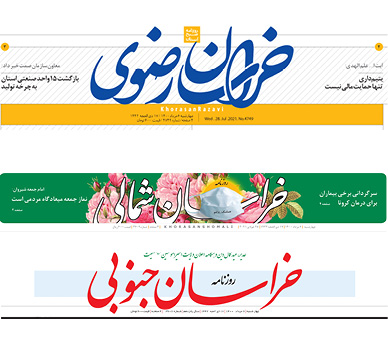
Figure 3. Mastheads of the online versions of the three provincial editions of Ḵorāsān newspaper, 6 Mordād 1400 Š./17 Ḏu’l-ḥejja 1442/28 July 2021 (Ḡadir Ḵomm [q.v.] holiday issues). After http://khorasannews.com.
From 1978 to 2020. During the early days of the Revolution of 1978-79, Ḵorāsān, the longest-surviving newspaper in Khorasan, followed many other Iranian newspapers and went on a solidarity strike for 24 days, from November to December 1979. It then resumed publication with almost the same reporters who had been on its staff before the revolution. In May 1980, the assets of the newspaper were sequestered, and the management of the paper was transferred to the Bonyād-e Mostażʿafān (Foundation for the Oppressed) in May 1980, and four years later, in 1984, to Bonyād-e Šahid (q.v.; Foundation for the Martyrs), and subsequently to the Imam Khomeini Relief Foundation. Finally, in 2001, it found a new home in the Moʾassasa-ye farhangi va honari-ye Ḵorāsān (The Art and Cultural Institute of Khorasan), under the auspices of the Office of the Supreme Leader and directed by a board of trustees.
Following the administrative division of Khorasan into three provinces in 2004, Ḵorāsān began to include supplementary pages to cover the news from the three new provinces (Figure 3). In more recent years, the supplements focusing on the different provinces (Ḵorāsān-e rażawi, Ḵorāsān-e šemāli, and Ḵorāsān-e janubi) were granted their own licenses and operated from offices in Birjand, Bojnurd, and Mashhad, although the printing was still carried out in Mashhad.
The Art and Cultural Institute of Khorasan also publishes other journals dealing with cultural issues and sports such as Ḵorāsān-e farhangi and Ḵorāsān-e varzeši.
A feature of current daily papers in Khorasan and elsewhere in Iran is the availability of their simultaneously published digital version. Most of the other newspapers published in the three current (2021) provinces have online versions and archives readily available online. These include: Qods-e Ḵorāsān, Hamšahri (of Khorasan), Šahr-ārā, Āvā-ye Ḵorāsān-e janubi, Zaʿfarān-e Ḵorāsān-e janubi, Ḵorāsān-e emruz, Āftāb-e šarq, Āzādi, and Atrak.
Bibliography
- Jalāl Āl-e Aḥmad, “Varšekastegi-ye maṭbuʿāt,” in Se maqāla-ye digar, rev. 2nd ed., Tehran, 1963, pp. 8-39.
- Hamid Algar, “Freemasonry ii. In the Qajar period,” EIr. X, 2001, pp. 208-12.
- Camron Michael Amin, “Selling and Saving ‘Mother Iran’: Gender and the Iranian Press in the 1940s,” IJMES 33, 2001, pp. 335-61.
- Idem, “The Press and Public Diplomacy in Iran, 1820-1940,” Iranian Studies 48, 2015, pp. 269-87.
- Manučehr Ārāsta, “Barresi-e vižagihā-ye kotob‑e čāp šoda da maṭbaʿ-ye Ṭus: qadimtarin maṭbaʿa-ye sorbi dar Mašhad,” Šamsa 6/22-23, 2014, pp. 1-30 (online at http://shamseh.aqr-libjournal.ir/article_60009.html).
- Masʿud Barzin, Šenās-nāma-ye maṭbuʿāt-e Irān az 1275 tā 1357 šamsi, Tehran, 1992.
- Moḥammad-Taqi Bahār, Tāriḵ-e moḵtaṣar-e aḥzāb-e siāsi I, Tehran, 1944.
- E. G. Browne, The Press and Poetry of Modern Persia, Cambridge, 1914.
- Ḥosayn Elāhi, Ruz-nāmahā va ruz-nāma-negāri dar Ḵorāsān, Mashhad, 1999.
- L.P. Elwell-Sutton, “The Iranian Press, 1941-1947,” Iran 6, 1968, pp. 65-104.
- Moḥammad Golbon, “Ḵorāsān, mohemmtarin ruz-nāma-ye Ḵorāsān dar enqelāb-e mašruṭa,” Boḵārā 65, 2008, pp. 588-97.
- Ahmad Karimi-Hakkak, “Censorship,” EIr. V, 1992, pp. 135-42.
- Firoozeh Kashani-Sabet, Conceiving Citizens: Women and the Politics of Motherhood in Iran, Oxford, 2011.
- Guʾel Kohan, Tāriḵ-e sānsur dar maṭbuʿāt-e Irān, 2 vols., Tehran, 1981-83. Majalla-ye jahān-e zanān 1-5, online at https://iiif.lib.harvard.edu/manifests/view/drs:424427931$5i (accessed 3 March 2020).
- Moḥammad Moḥiṭ Ṭabāṭabāʾi, Tāriḵ-e taḥlili-e maṭbuʿāt, Tehran, 1986.
- Afsaneh Najmabadi, The Story of the Daughters of Quchan, Syracuse, 1998.
- Morteza Nouraei, “Mashhad Between 1890 and 1914: A Socio-historical Study,” Ph.D. diss., University of Manchester, 2000. “Nouveaux journaux persans,” Revue du monde musulman 6, 1907, pp. 246-68.
- Nāṣer-al-Din Parvin, “Negāhi ba manābaʿ-ye tāriḵ-e ruz-nāma-negāri irāni va fārsi,” Irān-nāma 16, 1998, pp. 191-210.
- Sayyed Mahdi Sayyed Qoṭbi, “Neẓām-e tawżiʿ-e maṭbuʿāt-e Mašhad dar dawra-ye Qājār,” Šamsa 6/24-25, 2014 (online at http://shamseh.aqr-libjournal.ir/article_60125.html).
- H. L. Rabino, Ṣūrat-e jarāyed-e Īrān wa jarāyed-ī ke dar ḵārej az Īrān be zabān-e fārsī ṭabʿ šoda ast, Rašt, 1911, tr. M. L. Buvat as “La presse persane depuis ses origins jusqu’au à nos jours,” Revue du monde musulman 22, 1913, pp. 287-315.
- Moḥammad Ṣadr Hāšemī, Tāriḵ-e jarāʾed o majallāt-e Irān, 4 vols., Isfahan, 1948-53, I, pp. 82-88.
- Hossein Shahidi, Journalism in Iran: From Mission to Profession, London, 2007.
- Sattār Šahvāzi Baḵtiāri, Rāhnemā-ye maṭbuʿāt-e Ḵorāsān az āḡāz tā emruz (1279-1382), Mashhad, 2004a.
- Idem, Nāmhā va nāmahā: ruz-nāmahā va ruz-nāma-negārān-e Ḵorāsān dar dawra-ye Qājār, Mashhad, 2004b.
- Ursula Sims-Williams, Union Catalogue of Persian Serials and Newspapers in British Libraries, London, 1985.
- Turān Ṭulābi, “Simā-ye ejtemāʾi Ḵorāsān-e ʿaṣr-e mašruṭa dar āʾina-ye ruz-nāma-ye Ḵoršid,” Pažuhešhā-ye ʿOlum-Tāriḵi 11/1, 2019, pp. 113-32.