



Early life and education. Ruhollah Khomeini was born on 20 Jomādā II 1320/24 September 1902 in Ḵomeyn, a small town in the province of Lorestān (now Markazi), about 135 miles from Isfahan, that numbered Jews and Armenians among its population (PLATE I and PLATE II). The lineage of his father, Sayyed Moṣṭafā, extended back to a family of sayyeds from Nishapur that had settled in Kintur, a little town near Lucknow, India, in the early 18th century, establishing themselves there both as religious scholars and as cultivators of the land. An alternative version of the Indian connection has it that the migration was to Kashmir—no precise destination is suggested—and took place toward the end of the 18th century. This seems unlikely, although propounded by Khomeini’s elder brother, Sayyed Mortażā Pasandida (p. 8). On the other hand, a number of Shiʿi ʿolamāʾ did migrate from Kashmir to Lucknow in the 17th and 18th centuries (S. Rizvi, II, pp. 106, 158), so it may be possible to reconcile or combine the two narratives.
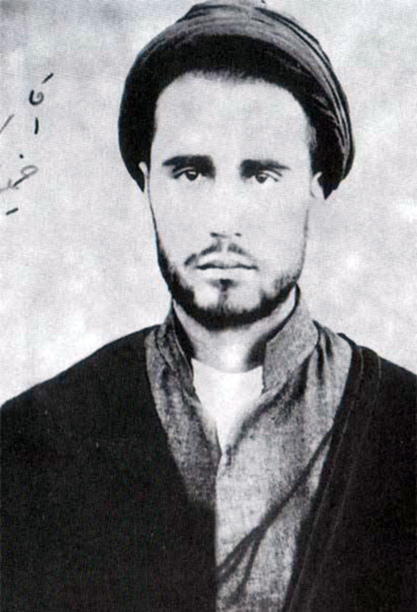

Whatever the case, in the mid-19th century, Sayyed Aḥmad, a descendant of the Nishapuri migrants, left India to go on a pilgrimage to Najaf; there he encountered Yusof Khan Kamarāʾi, a leading citizen of Ḵomeyn, who persuaded Sayyed Aḥmad to accompany him back to his native city in order to assume responsibility for the religious needs of its people. In addition, in 1841, he married Yusof Khan’s sister, Sakina Khanom. This was the third of his marriages; he had previously married two other women from the same district: Širin Khanom and Bibi Khanom. Only one child resulted from these first two marriages; by contrast, Sakina Khanom gave him three daughters and, in 1856, a son, Sayyed Moṣṭafā, the father of Khomeini (Pasandida, pp. 9-11).
Sayyed Moṣṭafā had, in turn, three sons: Mortażā, Nur-al-Din, and Ruhollah. When the surname law came into effect in 1925, the three brothers ended up, not with the same surname, as might have been expected, but with three different ones: Pasandida, Hendi, and Moṣṭafawi respectively (Pasandida, pp. 53-54). Ruhollah rarely, if ever, used the surname thus awarded him, becoming known early on as Khomeini. He did, however, use “Hendi” as maḵlaṣ (pen-name) in some of the poems he wrote, for reasons to be discussed below (ii. WORKS).
Sayyed Moṣṭafā embarked on his study of the religious sciences in Ḵomeyn before moving to Isfahan, then the major city of religious learning in Iran. From Isfahan, he continued on to the ʿatabāt (q.v.) for the culminating stages of his training under, among others, Mirzā Ḥasan Širāzi (q.v.; d. 1895), author of the fatwā (q.v.) that inaugurated the 1891 boycott of the Tobacco Régie (see CONCESSIONS ii). This corresponded to a pattern of preliminary religious studies in Iran followed by advanced study in the ʿatabāt, which for long remained normative; Ruhollah Khomeini was, in fact, the first religious leader of prominence whose formative studies took place entirely in Iran. On returning to Ḵomeyn, Sayyed Moṣṭafā acquired a sizable amount of land and attended to the basic religious needs of the population. These two attributes, landowner and religious scholar, earned him considerable standing in the community.
Sayyed Moṣṭafā was attacked and killed in Ḏu’l-ḥejjah 1320/March 1903, some five months after Khomeini’s birth, while he was traveling on the road from Ḵomeyn to Arāk (q.v.). The assassin was Jaʿfar-qoli Khan, cousin of Bahrām Khan, one of the richest landowners of the region. Jaʿfar-qoli had asked to join Sayyed Moṣṭafā on the trip to Arāk, claiming that he needed to present a request for employment to ʿAżod-al-Solṭān, governor of the provincet. Sayyed Moṣṭafā rebuffed his offer, but Jaʿfar-qoli nonetheless set out after him and killed Sayyed Moṣṭafā before his guards could intervene (Pasandida, pp. 18-19). The cause of the assassination is difficult to establish with certainty. According to an account that became standard after the Islamic Revolution, Sayyed Moṣṭafā had aroused the anger of the local landowners with his defense of the impoverished peasantry. He was himself, however, a farmer of considerable prosperity, and it is possible that he fell victim to one of the disputes over irrigation rights that were common at the time. A third explanation is that, in his capacity as shariʿa judge in Ḵomeyn, he had punished someone for a public violation of the fast of Ramażān, and the family of the victim then exacted a deadly revenge. This theory is implausible, for Islamic law does not provide so harsh a penalty for non-observance of the fast, but it is of interest because it was propounded by Aḥmad, the second son of Khomeini (interview of present writer with Aḥmad Ḵomeyni, Tehran, 12 September 1982). The attempts by Ṣāḥeba, Sayyed Moṣṭafā’s sister, to have the killer punished in Ḵomeyn proved fruitless, so his widow, Ḥājiya, went to Tehran to appeal for justice, according to one account carrying the infant Ruhollah in her arms. She was followed there by her two elder sons, Mortażā and Nur-al-Din, and finally, after meetings with ʿAbd-al-Majid ʿAyn-al-Dawla (q.v.; 1845-1926), prime minister of the day, and his deputy Mošir-al-Salṭana (1844-1918), Jaʿfar-qoli Khan was publicly executed in Tehran in Rabiʿ I 1323/May 1905 (on the events leading to the punishment of the killer, see Pasandida, pp. 20-29).
In 1918, Khomeini lost both his aunt, Ṣāḥeba, who had played a great role in his early upbringing, and his mother, Ḥājiya. Responsibility for the family then devolved on the eldest of the three brothers, Sayyed Mortażā (who later took the family name Pasandida; Pasandida, pp. 53-54).
The family’s material welfare seems to have been ensured by their father’s estate, but the insecurity and lawlessness that had cost Sayyed Moṣṭafā his life continued. In addition to incessant feuds among landowners, Ḵomeyn was plagued by raids mounted on the town by Baḵtiāri (q.v.) and Lor tribesmen whenever they had the chance. Once, when a Baḵtiāri chieftain by the name of Rajab-ʿAli came raiding, the young Khomeini was obliged to take up a rifle and along with his brothers defend the family home. When recounting these events many years later, he remarked, “since childhood I have been engaged in struggle” (Ṣaḥifa-ye Emām, X, p. 430). Among the scenes he witnessed and that remained in his memory to help shape his later political activity, mention may also be made of the arbitrary and oppressive deeds of landowners and provincial governors. Thus, he recalled how a newly arrived governor had arrested and bastinadoed the chief of the merchant’s guild of Golpāyagān (q.v.) for no other purpose than the intimidation of its citizens (Ṣaḥifa-ye Emām, XVI, p. 175).
Little is known of Nur-al-Din Hendi, the second of the three brothers. He seems not to have pursued a religious education, dying in Tehran in 1976; writing from Najaf to his wife Ḵadija, Khomeini expressed grief at this brother’s passing and his inability to be at his side during his final days (Ṣaḥifa-ye Emām, III, p. 156). It was exclusively under the guidance of Sayyed Mortażā Pasandida that Khomeini began his education in Ḵomeyn; the resources available there were apparently quite plentiful. By the age of seven, he had memorized the Qur’an at a maktab (see EDUCATION iii) operated near his home by a certain Mollā Abu’l-Qāsem. Next, he embarked on the study of Arabic with Shaykh Jaʿfar, one of his mother’s cousins, and took lessons on other subjects first from Mirzā Maḥmud Efteḵār-al-ʿOlamāʾ and then from his maternal uncle, Ḥājji Mirzā Moḥammad Mehdi. His first teacher in logic was Mirzā Moḥammad Najafi. As for Pasandida himself, he recalls having instructed Khomeini in logic; a book he simply calls Moṭawwal, perhaps intending the Moṭawwal of Saʿd-al-Din Masʿud Taftazāni (d. ca. 793/1391), an authoritative text on balāḡa (rhetoric); and a work by Abu’l-Fażl Soyuṭi (849-911/1445-1505) that he similarly leaves unnamed (Pasandida, p. 50). In addition, Khomeini relates that with his brother he also studied the Šarḥ-e bāb-e ḥādi ʿašar of ʿAllāma Ḥelli (q.v.; d. 726/1325), a basic text on kalām (Bonaud, pp. 40-41, citing Ṣaḥifa-ye nur, 2nd. ed., I, p, 121).
In 1920-21, Pasandida sent his brother to Arāk to benefit from that city’s more extensive educational resources. Arāk had become an important center of religious learning because of the presence of ʿAbd-al-Karim Ḥāʾeri (q.v.; d. 1937), one of the principal scholars of the day. Hāʾeri had arrived there in 1914 at the invitation of the townspeople, and some 300 students—a relatively large number—attended his lectures at the Mirzā Yusof Khan madrasa. It is probable that Khomeini was not yet advanced enough to study directly under Ḥāʾeri; instead he worked on logic with Moḥammad-Reżā Golpāyagāni (q.v.; 1899-1993); read the Šarḥ al-lomʿa of Zayn-al-Din ʿĀmeli (d. 1558), one of the principal texts of Jaʿfari jurisprudence, with Āqā ʿAbbās Arāki; and continued his study of al-Moṭawwal with Moḥammad Borujerdi.
Early years in Qom. Roughly a year after Khomeini’s arrival in Arāk, Ḥāʾeri accepted a summons from the ʿolamāʾ of Qom to join them and preside over their activity. Qom was well established as a major center of religious learning as well as a place of pilgrimage to the shrine of Ḥażrat-e Maʿṣuma, but it had been overshadowed for many decades by the shrine cities of Iraq with their superior resources of erudition (see IRAQ xi. SHIʿITE SEMINARIES). The arrival of Ḥāʾeri not only brought about a revival of its madrasas but also began a process whereby the city became in effect the spiritual capital of Iran, a process that was completed by the political struggle launched there by Khomeini some forty years later. Khomeini followed Ḥāʾeri to Qom after an interval of roughly four months. This move was the first important turning point in his life. It was in Qom that he received all his advanced spiritual and intellectual training and began writing an extensive and varied series of works, and he was to retain a deep sense of identification with the city throughout the rest of his life. It is possible, indeed, to describe him, although not in a reductive sense, as a product of Qom. In 1980, when addressing a group of visitors from Qom, he declared, “Wherever I may be, I am a citizen of Qom, and take pride in the fact. My heart is always with Qom and its people” (Ṣaḥifa-ye Emā m, XIII, p. 165).
After his arrival in Qom in 1922 or 1923, Khomeini took up residence in the Dār al-Šefā madrasa (see EDUCATION v. THE MADRASA IN SHIʿITE PERSIA) and devoted himself to completing the preliminary stage of madrasa education known as soṭuḥ, a goal he attained in 1926. He studied the pertinent texts with not only Ḥāʾeri but also Mirzā Sayyed ʿAli Yaṯrebi Kāšāni, Mirzā Moḥammad Taqi Kᵛānsāri, and Moḥammad Reżā Najafi Masjed-e Šāhi (Pasandida p. 51). His interests were not, however, restricted to jurisprudence, but included subjects usually absent from the madrasa curriculum and even an object of hostility: philosophy and, more particularly, mysticism (ʿerfān, q.v.). He began by studying the Tafsir al-ṣāfi, a commentary on the Qur’an by the Sufistically-inclined Molla Moḥsen Fayż Kāšāni (q.v.; d. 1091/1680); his companion in this endeavor was the late Ayatollah Moḥammad ʿAli Arāki (d. 1994), then a young student like himself. His formal instruction in ʿerfān and the related discipline of ethics (aḵlāq, q.v.) began with classes taught by Ḥājji Mirzā Javād Maleki Tabrizi, but this scholar died in 1925. He was similarly unable to benefit for long from his first teacher in philosophy, Mirzā ʿAli-Akbar Ḥakim Yazdi, a pupil of the great master Hādi Sabzavāri (q.v.; 1797-1873), for Yazdi passed away in 1926. Another of Khomeini’s early instructors was Sayyed Abu’l-Ḥasan Rafiʿi Qazvini (d. 1975), a scholar of both Peripatetic and Illuminationist philosophy (see ILLUMINATIONISM); Khomeini attended his circle until Qazvini’s departure from Qom in 1931.
The teacher who had the most profound influence on his development was, however, Mirzā Moḥammad ʿAli Šāhābādi (1875-1951; see Bonaud, pp. 82-94). Khomeini refers to him in a number of his works (see, for example, Serr al-ṣalāt, p. 12; Ādāb al-ṣalāt, pp. 52, 141, 153, 312) as “our shaykh” (sayḵonā) and “the perfect gnostic” (ʿā ref-e kāmel). When Šāhābādi first came to Qom in 1928, Khomeini asked him a question concerning the nature of revelation and was captivated by the answer he received. At his insistent request, Šāhābādi consented to teach him and a few other select students the Foṣuṣ al-ḥekam of Ebn al-ʿArabi (q.v.; d. 638/1240), using the commentary by Šarāf-al-Din Dāwud b. Maḥmud Qayṣari (d. 751/1350) as the basis of instruction. Among the other texts that Khomeini studied with Šāhābādi were the Manāzel al-sāʾerin of Ḵᵛāja ʿAbd-Allāh Anṣāri (q.v.; d. 481/1089), and the Meṣbāḥ al-ons of Moḥammad b. Ḥamza Fanāri (d. 834/1431), a commentary on the Mafātiḥ al-ḡayb of Ṣadr al-Din Moḥammad Qunawi (d. 673/1274).
It is conceivable that Khomeini derived from Šāhābādi, at least in part, whether consciously or not, the fusion of gnostic and political concerns that came to characterize his life. For this spiritual master was one of the relatively few ʿolamāʾ in the time of Reżā Shah to preach publicly against the Pahlavi regime, and in his Šaḏarāt al-maʿāref, a work primarily gnostic in character, he analyzed the causes of decline in Muslim society and concluded that although the establishment of perfect governance is a task reserved for the Ṣāḥeb al-Zamān, the political dimension of Islam, implicit in all its juridical ordinances, cannot be neglected, for “Islam is most certainly a political religion” (pp. 6-7).
Gnosis and ethics were also the subject of the first classes taught by Khomeini. The class on ethics taught by Javād Āqā Māleki Tabrizi (d. 1925) was resumed, three years after his death, by Šāhābādi, and when Šāhābādi left for Tehran in 1936, he assigned it to Khomeini. The class consisted in the first place of a careful reading of ʿAbd-Allāh Anṣāri’s Manāzel al-sāʾerin, but ranged beyond the text to touch on a wide variety of contemporary concerns. It proved popular to the extent that the townsfolk of Qom, as well as students of the religious sciences, attended, and people are reported to have come from as far afield as Tehran and Isfahan simply to listen to Khomeini’s lectures. This popularity ran contrary to the policies of the Pahlavi regime, which wished to limit the influence of the ʿolamāʾ outside the religious teaching institution. The government therefore secured the transfer of the lectures from the prestigious location of the Fayżiya to the Mollā Ṣādeq madrasa, which was unable to accommodate large crowds. After the deposition of Reżā Shah in 1941, the lectures returned to the Fayżiya and instantly regained their former popularity. Once more, however, the regime was able by means of intrigue to obtain first the suspension and then the cessation of the lectures (Martin, 2003, p. 42). It was in them that Khomeini displayed for the first time his ability to address broad swathes of the population, crucial in the events culminating in the Islamic Revolution.
It was not only the state, however, that viewed with disfavor these lectures going beyond the conventional preoccupation with feqh. In 1980, Khomeini recalled that some of the ʿolamāʾ in Qom entertained such deep suspicions of ʿerfān that when Mirzā ʿAli-Akbar Ḥakim Yazdi died (1926), a preacher found it necessary to testify from the menbar that he had seen him reading the Qur’an (Tafsir-e sura-ye ḥamd, pp. 187-88). Khomeini also related, ten years after Yazdi’s death, that because of his own cultivation of ʿerfān, the cup from which his son Aḥmad drank water was deemed unclean by many at the ḥawza and had to be thoroughly cleaned before anyone else could use it (Ṣaḥifa-ye Emām, XXI, p. 279). Undeterred by such suspicions, and displaying the independent and critical attitude to the religious institution that always modified his loyalty to it, Khomeini not only lectured to a broad public on aḵlāq, but also offered classes first in ḥekmat and then in ʿerfān, taking great care in admitting only those students whom he deemed mature enough to study metaphysics without endangering their faith. The texts studied were the Asfār al-arbaʿa of Mollā Ṣadrā Širāzi (q.v.; d. 1045/1636) and Šarḥ-e manẓuma by Hādi Sabzavāri.
These private sessions continued into the 1940’s, and it was in them, as well as his classes in feqh, that Khomeini trained and inspired some of his closest associates who played significant roles in the revolution and its aftermath. Foremost among them was Ayatollah Mortażā Moṭahhari (1920-79); he declared in later years that Khomeini’s lectures on aḵlāq and ʿerfān “aroused in me such ecstasy that their effect remained with me until the following Monday or Tuesday, and an important part of my intellectual and spiritual personality took shape under the influence of those lectures and the other classes I took over a period of twelve years with that inspired master” (Moṭahhari, introd. to ʿElal-e gerāyeš be māddigari, p. 9).
Ayatollah Moḥammad Ḥosayn Behešti (1928-81), a prominent member of the Revolutionary Council established soon after Khomeini’s return to Iran in 1979, first made Khomeini’s acquaintance in 1945 when he left Isfahan for Qom to pursue studies there. His earliest memory of Khomeini was connected to a visit to the house of Ayatollah Āqā Ḥosayn Ṭabātabāʾi Borujerdi (q.v.; 1875-1961), the dominant figure in Qom at the time, where Khomeini was also present; the room was crowded, but despite Behešti’s junior status, Khomeini invited him to sit next to him: “I never forgot the friendliness he showed me.” He began attending Khomeini’s classes on feqh, and his devotion to Khomeini constantly grew (interview by this author with Behešti at the headquarters of the Revolutionary Council, Tehran, 13 December 1979).
Ayatollah Ḥosayn-ʿAli Montaẓeri (1922-2009), for long regarded as the probable successor to Khomeini’s official role as leader (rahbar) of the Islamic Republic, came from a peasant family in Najafābād, a small town near Isfahan. He came to Qom, after preliminary studies in Isfahan, when he was thirty-six years of age. There he became acquainted with Moṭahhari, and, like him, was drawn by an interest in ʿerf ān and ethics to join the circle of Khomeini (Izadi, pp. 33-34). As for his classes in feqh, they were the most crowded in Qom, drawing 500 to 600 students. More importantly, “never in his life,” relates Montaẓeri, “did he experience fear; he was famed for his virtue and piety” (interview by this author with Montaẓeri at the headquarters of the Revolutionary Council, 14 December 1979).
As for Ayatollah Ali Khamenei (ʿAli Ḵāmenaʾi, b. 1939), who ultimately did become leader of the Islamic Republic, he owed his acquaintance with Khomeini in the first place to Khomeini’s eldest son, Sayyed Moṣṭafā. The latter would spend the summer in Mashhad, Khamenei’s place of residence at the time, and he described to Khamenei his father’s classes. Khamenei first met Khomeini in 1953 while passing through Qom on his way back from a pilgrimage to the ʿatabāt and moved there the following year. He was particularly impressed by Khomeini’s readiness to entertain questions from his students in the course of his lectures (Behbudi, pp. 94-98).
Ayatollah Moḥammad Mofatteḥ (1928-79) began his studies in Qom in 1945 and was soon drawn to Khomeini. Together with Moṭahhari, it was he who persuaded him to begin holding classes on oṣul; his teaching was marked by “innovative views,” and day by day the numbers of those attending increased. He shared with Khomeini a desire for rapprochement between those educated at universities and the students of the religious sciences. To this end, he obtained a position teaching at the Faculty of Theology at the University of Tehran, and it was there that he was assassinated (interview by this author with Mofatteḥ at the University of Tehran Faculty of Theology (Dāneškada-ye maʿqul va manqul), 16 December 1979, two days before his assassination).
ʿAli-Akbar Hashemi Rafsanjani (Hāšemi Rafsanjāni, 1934-2017), who held a succession of important posts after the revolution, went to Qom in 1948 at the age of fourteen, and some ten years later began taking his classes on feqh. Among the attributes of Khomeini that left a lasting impression on him were his independence of thought and modesty; once through with a class, he would avoid the crowds that followed him by taking a circuitous route home (interview by this author with Rafsanjāni at the Ministry of Interior, 12 December 1979).
The background of Ayatollah Ṣādeq Ḵalḵāli (1926-2003), first chief judge (ḥākem-e šarʿ) of the revolutionary period, was rural, and it was his pious father who sent him from his hometown near Ardabil to study in Qom. There he became friends with Moṣṭafā Khomeini and was a frequent visitor to the family home. He studied with Khomeini for thirteen years and took copious notes on his lectures (interview by this author with Ḵalḵāli, Qom, 19 December 1979).
Scholarly career. A highly disciplined polymath, Khomeini began his prodigious output of scholarly writing in the related fields of ʿerfān and ḥekmat. In 1929, he completed Šarḥ doʿā al-saḥar; two years later, Meṣbāḥ al-hedāya elā’l-ḵelāfa wa’l-welāya; and in 1937, Taʿliqāt ʿalā šarḥ Foṣuṣ al-ḥekam; all three being written in Arabic. In 1939, he completed the first of four works in Persian related to the same disciplines: Čehel ḥadiṯ and in the same year Serr al-ṣalāt, to be followed in 1942 by Ādāb al-ṣalāt. (For more on the content of these books, see ii. WORKS.)
At the same time, Khomeini was by no means unaware of or indifferent to political concerns. Although respectful of Hāʾeri and his generally quietistic attitude to the Pahlavi regime, Khomeini was in touch with personalities who were outspokenly critical of its policies. In 1927, three of the ʿolamāʾ of Isfahan, Ḥājj Āqā Nur-Allāh Eṣfahāni (d. 1927), Mollā Ḥosayn Fešāraki (d. 1935), and Mirzā ʿAbd-al-Ḥosayn Sayyed-al-ʿErāqayn, led an uprising protesting the introduction of conscription and attempts to regulate and tax opium production (Algar, 1991, p. 742; Davāni, II, pp. 157-58; see also Martin, 2008, pp. 171-72). Other grievances were also voiced, and Ḥājj Āqā Nur-Allāh Eṣfahāni led a march of peasants on Qom, with the intention of picking up additional support and advancing on Tehran. Khomeini joined the movement once it arrived in Qom, but there it stalled, and Nur-Allāh died under suspicious circumstances (Šahidi digar az ruḥāniyat, p. 41).
Four years later, an ʿolamāʾ-led movement against the introduction of compulsory military service took place in Tabriz. Its leaders, Ayatollah Abu’l-Ḥasan Angaji (q.v.; 1865-1939) and Mirzā Ṣādeq Āqā, were arrested and banished, first to Kurdistan and then to Qom, and it was there that Khomeini frequently visited the latter (Šahidi digar az ruḥāniyat, p. 42).
In March 1935, one of the chief ʿolamāʾ of Mashhad, Ḥājj Āqā Ḥosayn Ṭabāṭabāʾi Qomi (1865-1946) went to Tehran to present his grievances to Reżā Shah, principally concerning the compulsory wearing of European-style hats. He took up residence near the shrine of Šāh ʿAbd-al-ʿAẓim, where crowds of people flocked to see him until the police cordoned off the house where he was staying. Two other religious scholars from Mashhad, Mirzā Moḥammad Āqāzāda and Sayyed Yunos Ardabili, were arrested and brought to Tehran at a time when Khomeini happened to be there; in a speech delivered in November 1977, he recalled having seen Āqāzāda at the side of the road, humiliatingly shorn of his turban (Sahidi digar az ruḥāniyat, pp. 41-42). On 12 July, when news of Ḥājj Āqā Ḥosayn Ṭabātabāʾi Qomi’s confinement reached Mashhad, mass protests took place in the shrine of Imam Reżā, only to be dispersed by troops firing indiscriminately. Two days later, the celebrated preacher Moḥammad-Taqi Bohlul addressed a second mass protest, this time at the Gowhar-šād mosque (q.v.), which was assaulted even more violently than the first and dispersed (for a full account, see Vāḥed). When paratroopers stormed the Fayżiya in Qom in 1963 (see below), Khomeini repeatedly compared that outrage to the assault on the Gawharšād mosque (Ṣaḥifa-ye Emām, II, p. 342, III, pp. 300, 423).
The oppositional ʿālem of the time who had the greatest impact on Khomeini was Sayyed Ḥasan Modarres (1870-1938). Khomeini described him as “the leader of those who stood against oppression … against the bandit Reżā Khan.” When elected to the Majles, Modarres rented a modest house in Tehran, where Khomeini used to visit him. The feat of Modarres that most impressed him was his successful opposition to a Russian ultimatum, an example that he explicitly cited when resisting the granting of capitulatory rights to the United States in October 1964. The memory of Modarres stayed with him to the end; he even evoked him in his testament (Ṣaḥifa-ye Emām, XXI, p. 440).
In March 1932, Khomeini left Qom to go on the Hajj, first traveling via Najaf to Beirut. While waiting there for a ship to Jidda, he wrote an extremely affectionate letter to his wife, Ḵadija Ṯaqafi, proclaiming “your beautiful face is inscribed in the mirror of my heart.” He told her how much he was missing their son, Moṣṭafā, and looking forward to the birth of the child she was expecting at the time (Ṣaḥifa-ye Emām, I, p. 2). This child, ʿAli, died soon after he was born, before Khomeini had returned from the Hajj. The letter appears to be the second oldest piece of his correspondence extant.
Khomeini and politics to 1964. In 1945, Khomeini published a polemical work, Kašf al-asrār, the first of his books to appear in print, albeit anonymously. He is said to have completed the book in forty-eight days, driven by a sense of urgency that is palpable in the harshness of his tone. The title refers to a now forgotten book, Asrār-e hazār sāla, by ʿAli-Akbar Ḥakamizāda (d. 1988), the errant son of Ḥājj Shaykh Mehdi Qomi, an ʿālem in Qom. Ḥakamizāda denounced as infractions of tawḥid such defining beliefs of Shiʿism as the intercession of the Imams and the attribution to them of miracles as well as Shiʿite practices such as pilgrimage to the ʿatabāt, the recitation of supplications composed by the Imams, and ceremonial mourning on ʿĀšurā (q.v.). In the course of refuting these attacks on tradition, Khomeini also condemns the historian Aḥmad Kasravi (q.v.; d. 1946) and a clerical supporter of Reżā Shah, Šariʿat Sangalaji (d. 1944), whom he judged to have been influenced by the Wahhabis, “ghouls of the desert of Najd … a band of camel herders” (Kašf, pp. 4-5). The political context in which the deviant opinions had surfaced were the secularizing policies of Reżā Shah, contemptuously referred to as “that Māzandarāni” (Kašf, p. 9). Significantly foreshadowing much later developments, Khomeini adumbrates the theory of the vice-regency (welāyat) of the mojtahed, which, he concedes, has been a topic of controversy “from the first day.” An assembly of pious mojtaheds should be established in order to “choose a just ruler who will not violate God’s laws and will shun oppression and wrongdoing,” not to exercize rule themselves (Kašf, pp. 185-86).
After the death of ʿAbd-al-Karim Hāʾeri in 1937, the supervision of the religious institution in Qom had fallen to a triumvirate of quietist scholars, and the lack of effective leadership became still more acute after the death in November 1946 of Ayatollah Abu’l-Ḥasan Eṣfahāni (q.v.), chief marjaʿ-e taqlid of the day, in Najaf. It seemed to many, including Khomeini, that Ayatollah Borujerdi, who had moved to Qom two years earlier, could fill the void as an energetic administrator and not averse, moreover, to political engagement. These hopes were soon to be disappointed, for Borujerdi focused almost entirely on expanding the religious institution in Qom and its material base. In April 1949, Khomeini was a signatory to a letter asking Borujerdi to clarify rumors that he had given consent to government plans for convening a constituent assembly in order to modify the constitution. He responded that assurances had been conveyed to him from the shah that all constitutional provisions concerning religion would remain unchanged (Majmuʿa-i az maktubāt, soḵanrānihā, payāmhā, va fatāwā-ye Emām Ḵomayni, pp. 7-8). Six years later, while on a visit to Tehran, Khomeini learned from a news report that Borujerdi had announced support for an anti-Baha’i campaign launched by a well-known preacher, Moḥammad-Taqi Falsafi (1908-98). He did not welcome this development, for he feared that Borujerdi would fail to carry the matter through to the end, so he hastened back to Qom to urge him to remain steadfast. In this, he was unsuccessful, for Borujerdi ultimately withdrew from the campaign. Frustrated, Khomeini confided in Moḥammad Mofatteḥ: “I don’t know what hands are at work in the house of Borujerdi. I go to visit him and talk to him in such a way that he decides to pursue the struggle. But the next day I see he has completely changed his mind” (interview by this author with Mofatteḥ, Tehran, 16 December 1979). In August 1955, orders went forth to all provincial governors to restore Baha’i meeting places to the community, and by 1957, according to an official Bahai source, “the battle had been won” (The Baha’i World, 1954-1963, pp. 295-96). Also in 1949, Borujerdi gave additional proof of his pliancy vis-à-vis the Pahlavi regime when, at its request, he had Khomeini’s classes on feqh transferred, albeit temporarily, from the Fayżiya to a less prestigious venue (Hiro, 1985, p. 52, citing Pasandida). This mirrored what had befallen his classes on aḵlāq in the time of Reżā Shah.
Infinitely more engaged in the political sphere was Ayatollah Sayyed Abu’l-Qāsem Kāšāni (q.v.; 1877-1962), who is said to have facilitated Khomeini’s marriage, in either 1929 or 1930, to Ḵadija, the daughter of Ayatollah Moḥammad Ṯaqafi, a scholar resident in Tehran. According to another account, it was Moḥammad Lavāsāni who introduced Khomeini to the father of his future bride (Moin, pp. 37-38). Three sons were born of this union: Moṣtafā, in December 1930; ʿAli, who died soon after his birth in 1932; and Aḥmad, in 1946; as well as three daughters. Whatever the case, Khomeini is reported to have stayed frequently at Kāšāni’s house on his visits to Tehran and to have been there on the night of 31 July 1953, when it was attacked by pro-Moṣaddeq demonstrators (Richard, p. 301). Likewise, he was in contact with Nawwāb Ṣafavi (d. 1956), founder of the Fedāʾiān-e Eslām (q.v.), who would frequently visit Khomeini in his house in Qom under cover of darkness (interview with Ṣafavi’s widow, in Soruš, 16 January 1982, p. 35). Neither of these figures, however, owed fealty to the religious leadership in Qom; this set them apart from Khomeini, despite the objectives all three of them shared.
Khomeini’s only independent venture into the political sphere during the lifetime of Borujerdi came in May 1944, after the deposition of Reżā Shah and during the occupation of Iran by the Allied powers. Citing the Qur’an, 34:46, “Say: I enjoin upon you one thing only, that you rise up for God, singly and in pairs,” Khomeini laments how contemporary Muslims “rise up” only for the sake of their worldly interests, with the result that foreigners have come to rule over them. If the Muslims of Iran failed to awake, the plans that had emerged from “the desiccated brain … of that illiterate Māzandarāni” would continue to be implemented (Ṣaḥifa-ye Emām, I, pp. 21-23).
The high esteem Khomeini enjoyed even before his emergence as a marjaʿ-e taqlid is apparent from a brief entry in a biographical dictionary of the ʿolamāʾ of Qom published in 1954: There, he is described as “the one on whom the eyes of hope in the ḥawza [seminaries] and beyond, in Qom, Tehran, and the provinces, are focused” (Rāzi, II, p. 45). On the death of Borujerdi on 30 March 1961, several of Khomeini’s associates pressed him to declare his availability as marjʿa-e taqlid and successor to Borujerdi. Initially reluctant, he consented first to the publication of a selection of his fatwās as a supplement to the Wasilat al-najāt of Ayatollah Abu’l-Ḥasan Eṣfaḥāni (1860-1946); then his commentary on the ʿOrwat al-woṯqā by Sayyed Moḥammad Kāẓem Yazdi (1831-1919); and finally his own resāla-ye ʿamaliya (a qualifying text expected for the rank), entitled, like other works of this genre, Tawżiḥ al-masāʾel. He was not, however, the sole marjaʿ-e taqlid active in Qom after the death of Borujerdi; prominent too, although infinitely less active in the political sphere, were Ayatollah Moḥammad Kāẓem Šariʿatmadāri (d. 1986), with whom significant differences arose after the revolution; Ayatollah Moḥammad-Reżā Golpāyagāni; and Ayatollah Šehāb-al-Din Marʿaši Najafi (d. 1990).
Khomeini’s first open clash with the state came the very next year, when he launched a campaign calling for the repeal of new laws governing elections to local and provincial councils. They deleted the requirement that those elected be sworn into office on the Qur’an, viewed by Khomeini and others as an attempt to permit the infiltration of public life by Baha’is. Seven weeks later, the laws were rescinded (Ṣaḥifa-ye Emām, I, pp. 78, 112).
A more serious confrontation ensued in January 1963, when Moḥammad-Reżā Shah announced a six-point program of reform that he termed the “White Revolution,” a package of measures designed to give the regime a liberal façade. Among its provisions were land reform, the sale of government-owned factories to provide funds for buying out landlords, a new electoral law providing for the enfranchisement of women, and the creation of a Literacy Corps designed to extend state-sponsored education into the countryside. Numerous oppositional groups and personalities opposed it, but none with the same vigor and resonance as Khomeini (see Azimi). When the shah refused any form of compromise and planned a referendum to obtain the appearance of popular support for his “White Revolution,” Khomeini headed a group of his colleagues calling for a boycott of the referendum, and on 22 January, he issued a strongly worded declaration denouncing the shah and his plans (Ṣaḥifa-ye Emām, I, p. 133). Two days later, the shah came to Qom, only to be shunned by all the dignitaries of the city. The referendum was held on 26 January, predictably endorsing the shah’s plans. Soon after, Khomeini issued a manifesto bearing the signatures of eight other senior scholars in which he condemned the shah for violating the constitution, spreading moral corruption, and submissiveness to the United States and Israel: “I see the solution in this tyrannical government being removed, for the crime of violating the ordinances of Islam and trampling the constitution, and in a government taking its place that adheres to Islam and has concern for the Iranian nation”(Ṣaḥifa-ye Emām, I, pp. 145-50). He also decreed that Nowruz (q.v.) celebrations for the year 1342 (which fell on 21 March 1963) should be cancelled as a way of protesting government policies (Ṣaḥifa-ye Emā m, I, p. 155).
On 22 March, paratroopers were sent to the Fayżiya in Qom, the site where Khomeini delivered his public speeches. They killed a number of students, beat and arrested a number of others, and ransacked the building (for more on these events, see Moin, pp. 92-106). Unintimidated, Khomeini continued his attacks on the regime. He repeated his admonition that the first day of 1342 not be celebrated as a festival; it should rather be an occasion for mourning, as the year 1341 had been marked by conspiracies against Islam, inspired by the imperialists and designed to extinguish “the luminous ordinances of the Qur’an.” The religious institution had come under attack for steadfastly resisting these evil plans, and it was incumbent on the religious scholars and their students to continue the struggle. If the regime abolished the official recognition of Islam as state religion, what purpose would be served by the continued existence of the ḥawza? Khomeini was referring here to the proposed change in the laws governing local and regional elections and went on to make clear that a particularly objectionable provision was that which enables women to participate in voting: “equal rights for women and men (tasāwi-ye hoquq-e zan va mard) means trampling on the Qur’an.” (After the triumph of the revolution, his stance changed, or had done so by the time it took place; women were fully enfranchised and able to vote in all electoral procedures). Proclaiming his own determination to continue resistance, he presciently suggested that the shah’s regime might send him into exile (Ṣaḥifa-ye Emām, I, pp. 157-65). On 30 April, the fortieth day after the attack on the Fayżiya, Khomeini described the Iranian government as determined to eradicate Islam at the behest of America and Israel and himself as resolved to combat it. Confrontation turned to insurrection some two months later at the beginning of Moḥarram; demonstrators carrying pictures of Khomeini loudly denounced the shah in front of his palace in Tehran. On the afternoon of ʿĀšurāʾ, 3 June 1963, Khomeini delivered a speech at the Fayżiya in which he drew parallels between Yazid the Omayyad caliph and the shah, denounced the shah again for his close ties to Israel, and warned him that if he did not change his ways the day would come when the people would offer up thanks for his departure from the country (Ṣaḥifa-ye Emām, I, pp. 243-48). Two days later, Khomeini was arrested at 3 a.m, by a group of commandos, who hastily transferred him to the Qaṣr prison in Tehran.
When news of Khomeini’s arrest spread through Qom, Tehran, and other cities, masses of angry demonstrators were confronted by tanks and many slaughtered; not until six days later was order restored. This uprising, on 15 Ḵordād 1342 Š./5 June 1963, can reasonably be called a turning point in Iranian history: The repressive nature of the regime was continuously intensified, and the stature of Khomeini as the only prominent figure willing to challenge it, enhanced. Previously quietist figures among the ʿolamāʾ began to follow his lead. (PLATE III; On the 15 Ḵordād uprising, see JAMʿIYAT-MOʾTALEFA-YE ESLĀMI i.)
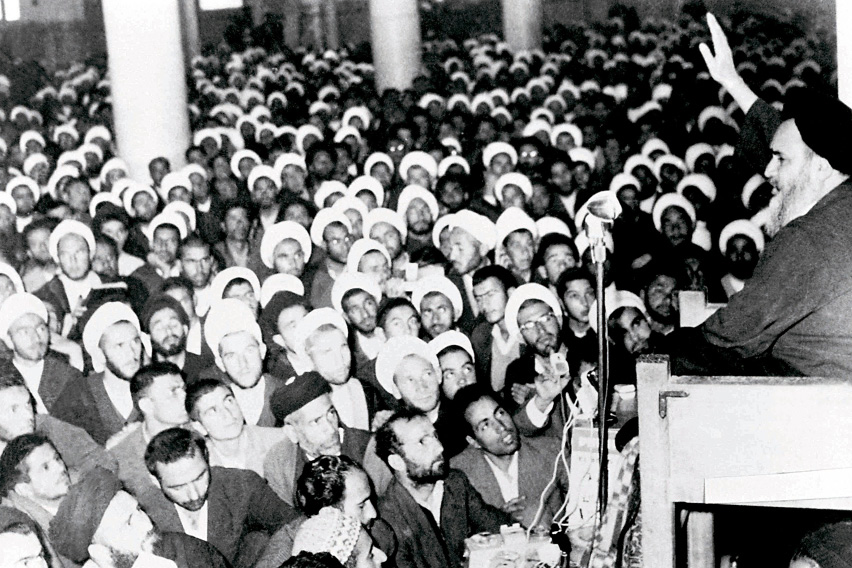
After nineteen days in the Qaṣr prison, Khomeini was moved first to the ʿEšratābād military base and then to a house in the Dāwudiya section of Tehran; it was there that he first learned of the bloodshed that had taken place on 15 Ḵordād. He was moved in succession to two houses in Qayṭariya, a location less accessible to would-be visitors, staying there for a total of roughly two months. Demonstrations continued calling for his release, and, on 7 April 1964, he was allowed to return to Qom, forthwith declaring that the movement begun on 15 Ḵordād would continue. Proof was not long in coming. In the autumn of 1964, the government concluded a status of forces of agreement with the United States that provided all American personnel in Iran and their dependents with immunity from prosecution. Khomeini reacted with one of the most vehement speeches he had ever delivered: He denounced the agreement as a surrender of Iranian independence and sovereignty and as traitors all those in the Majlis who had voted in favor of it; and he said that the government lacked all legitimacy (Kawṯar, I, pp. 169-78).
The years of exile: Turkey and Najaf. Shortly before dawn on 4 November 1964, a detachment of commandos surrounded Khomeini’s house in Qom and took him directly to Mehrābād airport for immediate deportation to Turkey, a choice of destination reflecting the security cooperation existing between Iran and Turkey. The United States was complicit in this decision, if not responsible for it; a letter from Stuart W. Rockwell, deputy head of the American mission in Tehran, to the State Department, dated 6 November, spelled it out with the imperial arrogance that continued to inform American policy for decades: “At last we have been able to get rid of the mischievous old man who has been putting a spoke into our wheels. The local bigwig [i.e., the shah] has ordered his expulsion. At present he’s living in a second-rate Turkish hotel” (fascimile of letter in Ruḥāni, Nahżat-e Emām Ḵomeini, II, p. 957). The hope of both the United States and the shah was no doubt that once exiled, Khomeini would fade from popular memory. Khomeini was first lodged in the Bulvar Palas Oteli in Ankara, under the joint supervision of Iranian and Turkish security officials, and then moved to a succession of apartment buildings. On 12 November, he was transferred to Bursa and lodged initially in the home of Ali Çetiner, a Persian-speaking official of the Turkish security apparatus. Despite initial friction with Çetiner’s family, an amiable relationship was established (Moin, pp. 131-34, and 139). Later, he was moved to a house in the Çekirge district of the city. On 3 January 1965, he was joined in exile by his son, Moṣṭafā, and other visitors from Iran also came occasionally (PLATE IV). Much of his time was spent in writing Taḥrir al-wasila, a two-volume compendium on questions of jurisprudence; among the rulings it contains are calls for resistance to foreign aggression and solidarity among Muslim states if an attack is anticipated (Taḥrir al-wasila, I, p. 486).
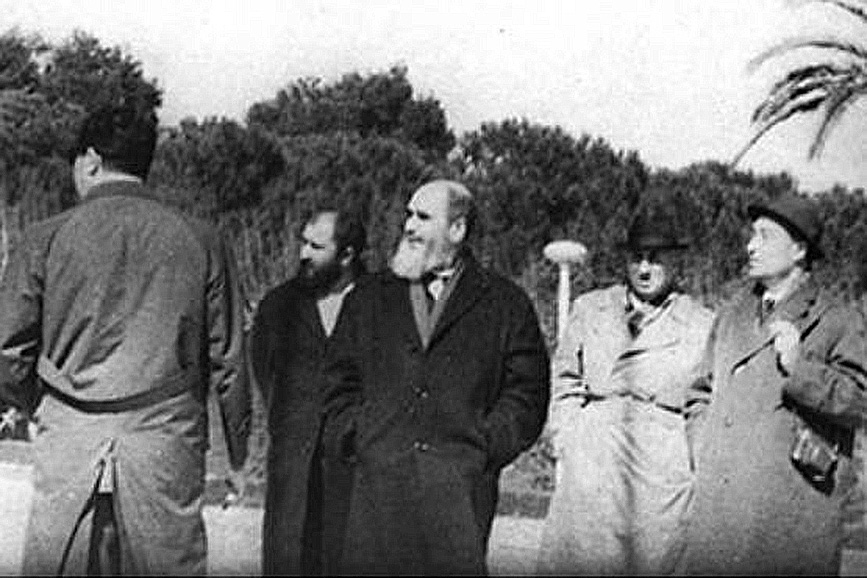
On 6 October 1965, Khomeini was able to leave Turkey for Najaf, a more congenial place of exile as a center of Shiʿi learning and pilgrimage. By acquiescing in this move, the Iranian government wished to quell or lessen the continuing disquiet among his followers in Iran at his banishment. But it was also hoped once there, he would either be overshadowed by the prestigious scholars resident there, or spend his energies on confronting them, a hope that was to be disappointed. En route to Najaf, Khomeini passed through Kāẓemayn, Sāmarrā, and finally Karbalā, where he was ceremonially greeted by crowds of Iranian religious students (ṭollāb) and stayed for one week. Once settled in his final destination, he began teaching feqh at the Shaykh Mortażā Anṣāri madrasa. His lectures were well attended, by students not only from Iran, but also India, Pakistan, Afghanistan, and the Persian Gulf states. In fact, a mass migration to Najaf from Qom and other centers of learning in Iran was proposed to Khomeini, but he advised against it as a measure bound to depopulate Qom and weaken it as a center of religious guidance.
Throughout his years in Najaf, Khomeini managed his relations adroitly with the senior ʿolamāʾ of Iraq (see IRAQ xi; PLATE V and PLATE VI). Soon after his arrival, he was visited by Ayatollah Abu’l-Qāsem Ḵoʾi (d. 1992), a marjaʿ averse to political involvement, and by Ayatollah Maḥmud Šāhrudi (d. 2018), who contrastingly did come to embrace activism and was imprisoned by the Iraqi regime in 1974. On 15 November 1965, Khomeini engaged in a brief and inconclusive discussion with another quietist scholar, Ayatollah Moḥsen Ḥakim (d. 1970), on the advisability of political action (Moin, pp. 141-43). Some four years later, the repression unleashed by the Ba’athists on the Iraqi ʿolamāʾ finally impelled Ḥakim to raise his voice in protest, but to no avail; he left Najaf for Baghdad, where he died not long after. Khomeini was also circumspect in his dealings with the Iraqi state. In 1969, when Iran unilaterally abrogated the 1937 treaty delineating the boundary between the two countries on the Shatt al-Arab (Šaṭṭ al-ʿArab), he refused requests to align himself with the Iraqi regime, remarking that “whatever the shah has done in Iran, you have done here in Iraq” (Ruḥāni, II. p. 559-60). By this, he was doubtless alluding to the repressive measures taken by the Ba’athists at around the same time.
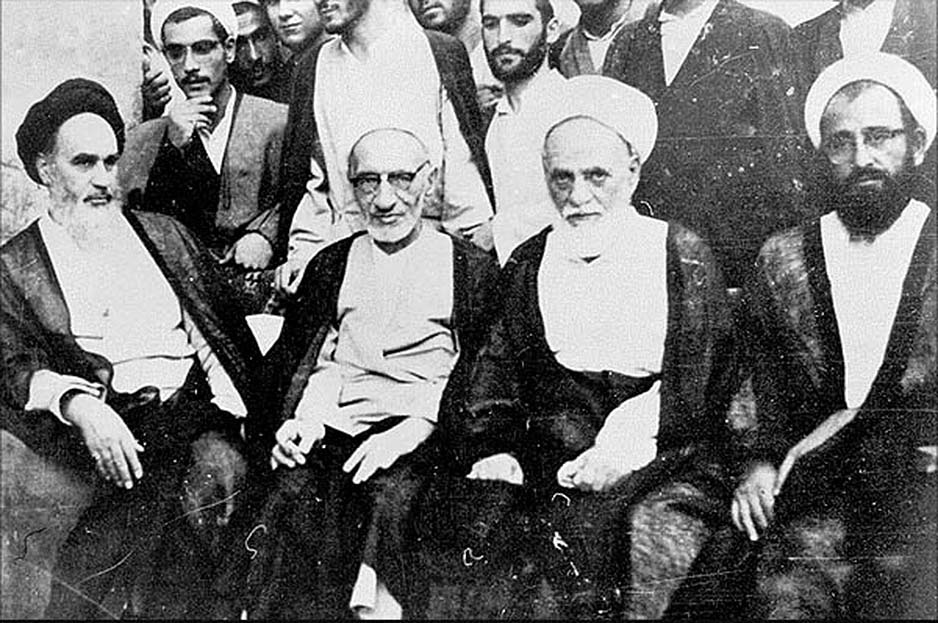
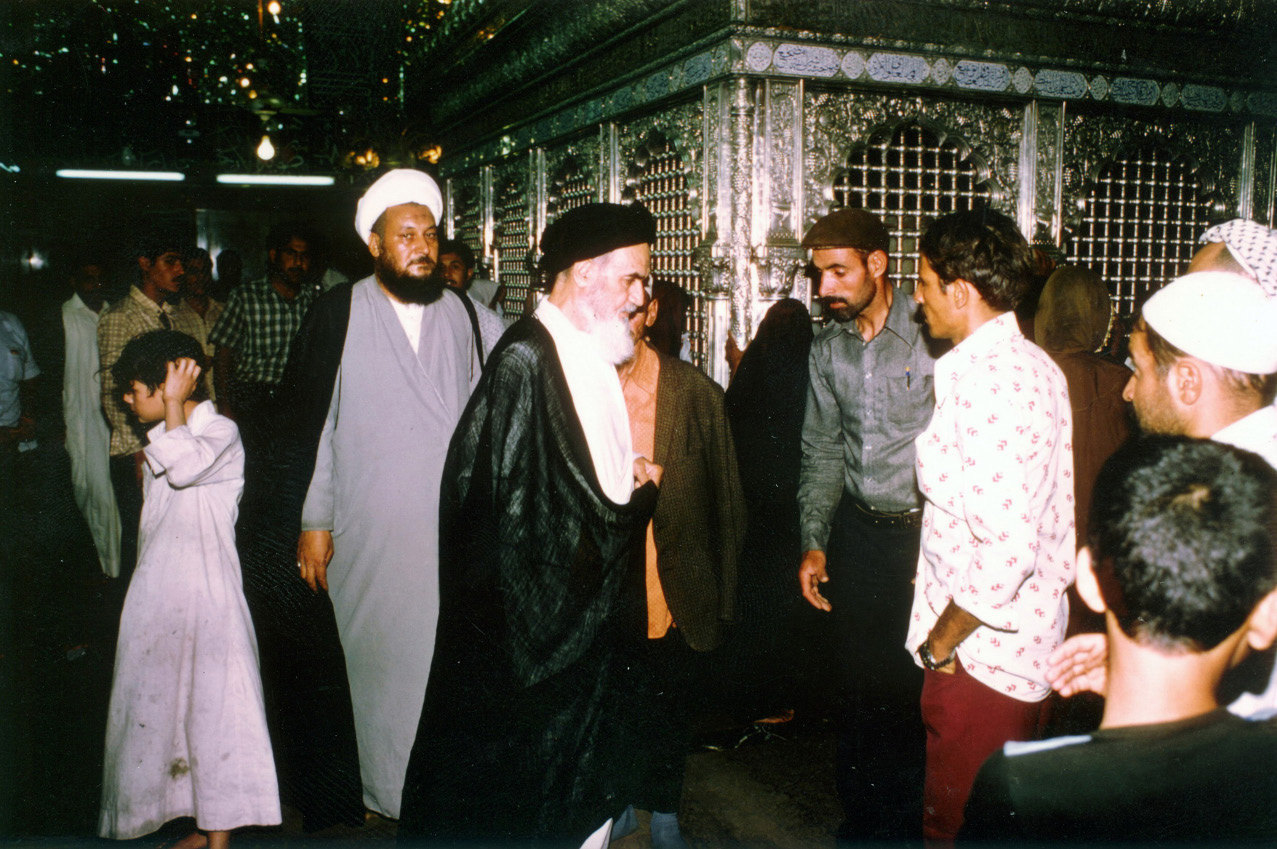
During his years in Najaf, Khomeini’s messages and declarations focused primarily on Iran, while not ignoring relevant developments elsewhere in the Islamic world. The first recorded message he sent from Najaf was a letter dated 16 April 1967, assuring the ʿolam āʾ of the ultimate downfall of the shah’s regime. On the same day, he wrote to Amir-ʿAbbās Hoveydā (q.v.; 1919-79), prime minister of the day, accusing him of running “a regime of terror and thievery” (Ṣaḥifa-ye Emām, II, pp. 123-27). On the occasion of the Six-Day War in June 1967, he issued a declaration forbidding any type of dealing with Israel as well as the consumption of Israeli goods (Ṣaḥifa-ye Emām, II, pp. 139). This declaration was widely publicized in Iran, and led to the ransacking of Khomeini’s house in Qom and the arrest of his son, Aḥmad, who had been living there. Manuscript copies of his unpublished works are said to have been destroyed in the course of this raid (introd., Divān-e Emām: Majmuʿa-ye šeʿr-e Emām Ḵomeyni, p. 310). Similarly inspired by support for the Palestinian cause was a fatwā authorizing the use of religious monies (wojuh-e šarʿi) to support the nascent activities of al-ʿĀṣefa, the armed wing of the Palestine Liberation Organization; this was confirmed by a similar and more detailed ruling issued after a meeting with the Baghdad representative of the PLO (Ṣaḥifa-ye Emām, II, pp. 194, 199). On 31 October 1971, he issued a lengthy and vehement declaration condemning the extravagant celebration of two-and-a-half millennia of monarchy in Iran. He began by identifying the Omayyads as the first dynasty to have polluted the Islamic world with monarchy, and he declared monarchy in all its forms to be utterly incompatible with Islam (Ṣaḥifa-ye Emām, II, pp. 358-73).
Of greater long-term significance than these declarations was the series of twelve lectures on Islamic government he delivered to an audience of religious students at the Shaykh Mortażā Anṣāri Mosque in Najaf, between 27 January and 8 February 1970. Recorded and transcribed by a student, they were published as a book with the title Ḥokumat-e eslāmi (n.p., 1971). Some editions are titled Ḥokumat-e eslāmi: Welāyat-e faqih, or the reverse, both arrangements signifying the synonymity of the “governance of the faqih” (see FEQH) with Islamic government during the occultation of the Twelfth Imam. The doctrine is accordingly expounded in terms far more categorical than those he had used in Kašf al-asrār twenty-five years earlier, where he described it as having been a topic of controversy “from the first day.”
Khomeini began his exposition with an account of the calamities that had befallen Iran, and the Muslim world in general, as the result of abandoning Islamic law and relinquishing the political realm to the enemies of Islam, the result of maleficent foreign influences. Also at fault were those scholars, whom he pejoratively called āḵunds (q.v.), who restricted themselves to such matters as ritual purity. The Iranian constitution of 1907 had no validity, for it recognized monarchy. Next he cited, with copious interpretation, a whole series of pertinent Qur’anic verses and Hadith; their legal force is permanent and binding, and during the absence of the Twelfth Imam, their implementation is the right and duty of qualified foqahāʾ. Most importantly, he called on his audience to work tirelessly for change and expressed hope that they would create a powerful movement resulting in the formation of an Islamic government: “I hope that by presenting the system of government and the political and social principles of Islam to broad segments of humanity, we will create a strong new current of thought and a powerful popular movement that will result in the establishment of an Islamic government” (For more detail on the content of these lectures, see below, ii. WORKS).
About two years later, Khomeini gave a series of lectures on jehād-e akbar, the struggle against the appetitive self that is the essential complement to combat in the political sphere. The transcript was printed the same year in Najaf. Khomeini gave proof of his own stoic fortitude in the face of personal loss when, on 23 October 1977, Moṣṭafā Khomeini died in Najaf under mysterious circumstances, allegedly while in police custody or in the presence of SAVAK agents. Khomeini declared the tragedy to be one of “the hidden favors” (alṭāf-e ḵafiya) of God (cited in Šahidi digar az ruḥāniyat, p. 27). Protest meetings took place on this occasion in Qom, Tehran, Yazd, Mashhad, Shiraz, and Tabriz.
Throughout Khomeini’s years in Najaf, the Iranian government attempted to block his channels of communication with the outside world, but in vain. Iranian pilgrims coming to Najaf took back with them copies of his letters, declarations, and transcripts of his lectures, for distribution across the country. From within Iran, oppositional figures such as Mehdi Bāzargān (d. 1995), head of the Freedom Movement (Nahżat-e āzādi), were able to correspond with him. Senior ʿolamā loyal to Khomeini, such as Mortażā Moṭahhari, Moḥammad Ḥosayn Behešti, and Ḥosayn ʿAli Montaẓeri, remained in contact with him, both directly and indirectly, and were known to speak on his behalf in important matters. Similarly supportive of his unrelenting struggle were the organizations of Iranian students in Europe and North America; they distributed copies of his proclamations and sent him letters of support. The documentary record testifies both to SAVAK’s awareness of these multifarious contacts and its attempts to disrupt them (see Sayr-e mobārezāt, IV-VII, passim).
Organizations supportive of Khomeini’s cause were also established within Iran. Not long after his being exiled to Iraq, a number of ʿolamāʾ, including Hāšemi-Rafsanjāni and Moḥammad Javād Bāhonar (d. 1981), established the Allied Islamic Organizations (Hayʾathā-ye moʾtalefa-ye eslāmi; see JAMʿIYAT-E MOʾTALEFA-YE ESLĀMI i), headquartered in Tehran but with branches throughout the country (Bādāmčiān and Benāʾi, Hayʾathā-ye moʾtalefa-ye eslāmi). In January 1965, four members of the organization assassinated Ḥasan-ʿAli Manṣur, the prime minister on whose watch Khomeini had been exiled. Recourse to direct, armed action was also had in the same year by the short-lived Islamic Nations Party (Ḥezb-e melal-e eslāmi), a group led by Moḥammad Kāẓem Bojnurdi, son of an ʿālem resident in Najaf. Late in 1976 or early in 1977, on the initiative of Ayatollah Behešti, the Society of Militant Clergy (Sāzmān-e ruḥāniyat-e mobārez) was established with the purpose of coordinating the activities of mosques throughout the country that not long after came to serve as the basic organizational units of the revolution.
Active throughout the 1960’s and 1970’s was the Freedom Movement (Nahżat-e āzādi), founded in 1961 by Mehdi Bāzargān, Yād-Allāh Saḥābi (d. 2002), and Ayatollāh Maḥmud Ṭālaqāni (1911-79). Nominally affiliated to the National Front (Jabha-ye melli), by this time a moribund and ineffective organization, the Freedom Movement was essentially a reformist group that attempted to harmonize Islamic and liberal-nationalist sentiment; the only prominent religious scholar to figure in its leadership was Ayatollah Maḥmud Ṭālaqāni. It nonetheless came to play an important role in the transition to the Islamic Republic in 1979.
In 1971, three members of the Freedom Movement once associated with Ṭālaqāni established the Organization of People’s Strugglers of Iran (Sāzmān-e mojāhedin-e ḵalq-e Irān; hereafter, Mojahedin-e Khalq [MKO or MEK]), a guerilla movement propounding a mixture of Islam and socialism (see COMMUNISM iii). Symptomatic of this syncretism was the slogan that introduced its main ideological text, Aḥmad Reżāʾi’s Nahżat-e Ḥosayni, and headed all the proclamations of the movement: “In the name of God and the heroic people of Iran” (be nām-e ḵodā va ḵalq-e qahramān-e Irān) as well as its emblem, incorporating a sickle but no hammer. In 1975, the movement split into two groups: one straightforwardly accepting Marxism, styling themselves Paykār, and the other, more numerous, group, the Mojahedin-e Khalq, headed by Masʿud Rajavi (1948-2003?), maintaining the syncretic mix (see Abrahamian, 1989, chap. 6). In a general, perhaps opportunistic sense, the movement expressed support for the struggle led by Khomeini, and it also enjoyed the sympathy of younger activists devoted to his cause, especially students in Europe and North America.
Educational rather than overtly political in orientation was the Ḥosayniya-ye eršād, an institute established in Tehran in 1965 with the aim of drawing the secularly educated to Islam. Its immediate forerunner had been the Monthly Religious Society (Anjoman-e māhāna-ye dini) organized in 1960 by Ayatollah Moṭahhari, who now served on the board of directors of the Ḥosayniya. At least equally prominent in its activities was ʿAli Šariʿati (1933-77), a French-educated intellectual whose view of matters differed sharply from that of Moṭahhari. Heavily influenced by thinkers such as Frantz Fanon, Šariʿati promoted the ideal of the “religious intellectual” (rowšan-fekr-e maḏhabi), advocated “an Islam minus āḵunds,” and a substitution of Islam as ideology for Islam as culture. Thanks to the discretion of Moṭahhari and a prudent silence on the part of Khomeini, the tensions created by the phenomenon of Šariʿati were largely held in check until after the revolution.
Revolutionary ferment continued in the early 1970’s. Khomeini’s name was invoked by students demonstrating at the University of Tehran in December 1970; in June 1973, in nationwide demonstrations on the tenth anniversary of the 15 Ḵordād uprising; and by protesters in Qom in 1975. Expressions of discontent were voiced repeatedly in mosques in all the principal cities of the country.
The Revolution of 1978-79 and the first years of the Islamic Republic. On 7 January 1978, the semi-official daily newspaper Eṭṭelāʿā t (q.v.) published an article accusing Khomeini of treachery and collusion with foreign enemies, and the next day, a crowd of protesters attacked and ransacked the offices of the newspaper in Tehran. Two days later, a crowd of some five thousand gathered at the shrine of Ḥażrat-e Maʿṣuma in Qom, protesting the insult to Khomeini and demanding fundamental changes in government policy. They were assaulted by the army as they left the shrine, and a large number were killed. Thus began a cycle of massacre and mourning. On 18 February, the fortieth day after this atrocity, mass demonstrations took place in Tabriz, leading to even more bloodshed. Then, on March 29, demonstrations took place in no fewer than fifty-five cities; casualties were heavy, especially in Yazd. Early May saw tanks on the streets of Tehran, and in August the government regained control of Isfahan only after killing hundreds of demonstrators. On 4 September, on the occasion of ʿId-e Feṭr, marches took place in all the major cities of Iran, and five days later martial law was proclaimed. A mass demonstration took place on 8 September (“Black Friday”) at the Meydān-e Žāla (renamed Meydān-e Šohadāʾ after the revolution); it was attacked by government forces, resulting in the reported slaughter of some 2,000 people; more were probably killed in other parts of the city. (On these demonstrations and varying reports of the casualties, see Širḵāni; Āhangarān; Ashraf and Banuazizi, table p. 22.)
Also in September, in a further misguided attempt to distance Khomeini from his homeland and people, the Iranian government, now on relatively good terms with its neighbor, had Iraq declare Khomeini persona non grata and expel him from its territory. Denied entry to Kuwait, Khomeini briefly considered Algeria, Lebanon, and Syria as places of refuge, but on 12 October 1978, he flew to Paris, accompanied by his son, Aḥmad, and Ebrāhim Yazdi of the Freedom Movement. He stayed first with Abu’l-Ḥasan Bani-Ṣadr, later the first president of the Islamic Republic, in Cachan, a suburb of Paris, before moving to the village of Neauphle-le-Château. There, he took up residence in a small house, and established a modest command center in another property immediately across the road, where he would lead congregational prayer and hold meetings (PLATE VII). A third house offered accommodation to visitors from Iran and the Iranian diaspora for a maximum of forty-eight hours. Sympathizers from other Muslim countries also came to pay their respects, including Khurshid Ahmad of the Pakistani Jamāʿat-i Islami, and Ṣādeq al-Mahdi, prime minister of Sudan. It was there, too, on the outskirts of Paris, that representatives of the world’s media would await their turn to interview him, something which had never been possible in either Turkey or Iraq.
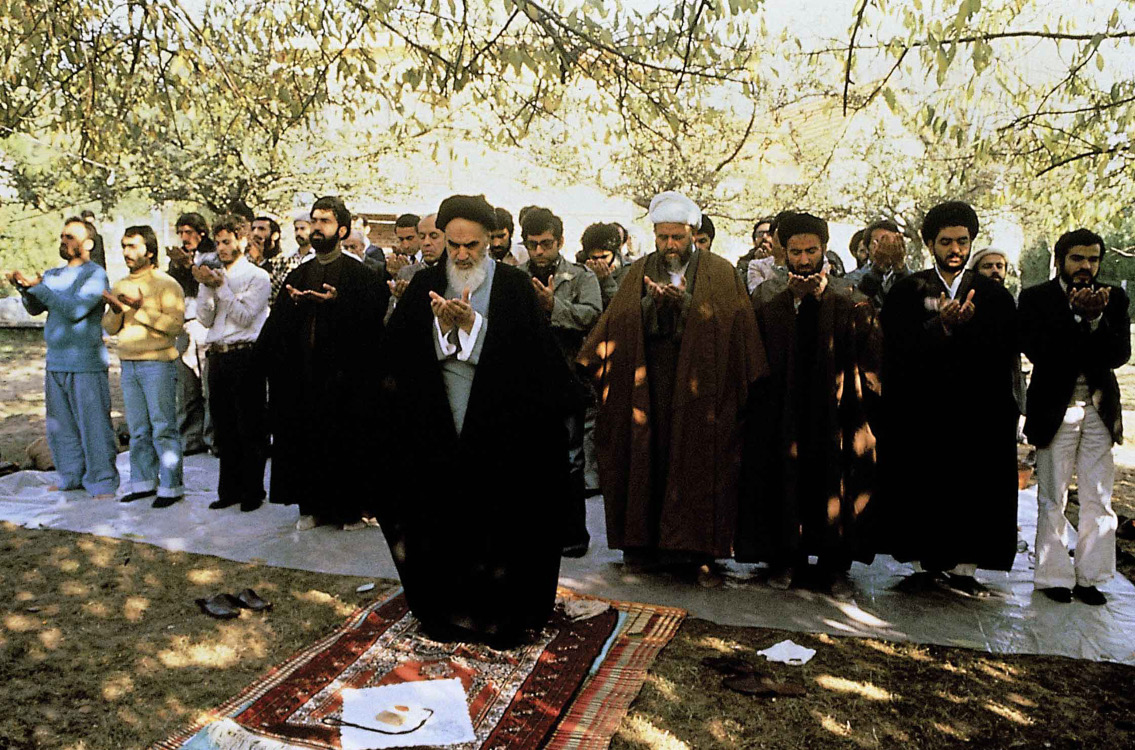
As the shah’s position became continually weaker—despite President Carter’s notorious laudation of him on New Year’s Eve, 1977 as “enjoying the respect, admiration and love of your people”—he appointed Jaʿfar Šarif-Emāmi as prime minister, a figure supposedly well-regarded by conservative elements among the ʿolamāʾ. On 6 November, a military government headed by Ḡolām-Reżā Azhāri was installed in his place. These maneuvers were unable to slow the momentum toward revolution. On 13 November, eight days before the beginning of Moḥarram 1400, Khomeini issued a declaration in which he likened the month to “a divine sword in the hands of the soldiers of Islam, our great religious leaders and respected preachers, and all the followers of Imam Ḥosayn, the lord of the martyrs.” They must, he continued, “make maximum use of it; trusting in the power of God, they must tear out the remaining roots of this tree of oppression and tyranny.” Opposition to the military government was a religious duty (Ṣaḥifa-ye Emām, V, pp. 75-78).
As soon as Moḥarram began, on 21 November 1978, vast demonstrations unfurled across Iran, with thousands of people donning white shrouds as a token of readiness for martyrdom. On the ninth day, a million people marched in the capital demanding the abolition of the monarchy, and the very next day, ʿĀšurāʾ, more than two million approved by acclamation a seventeen-point declaration in which the most important demand was the establishment of an Islamic government headed by Khomeini. On 18 December, a nationwide strike began, and, with his regime crumbling, the shah attempted to co-opt secular, liberal-minded nationalists in order to forestall the foundation of an Islamic government. On 3 January 1979, Šāpur Baḵtiār of the National Front was appointed prime minister to replace General Azhāri, and nine days later a nine-member regency council was formed to represent the shah in his absence abroad, now seen as inevitable. It was headed by Sayyed Jalāl-al-Din Ṭehrāni, another individual proclaimed to have religious credentials. The very next day, Khomeini proclaimed from Neauphle-le-Château the formation of the Council of the Islamic Revolution (Šurā-ye enqelāb-e eslāmi), a body entrusted with establishing a transitional government to replace the Baḵtiār adminstration. And on 16 January 1979, amid scenes of feverish popular rejoicing, the shah tearfully left Iran, never to return.
What now remained was to remove Baḵtiār and prevent a military coup enabling the shah to return. The first of these aims came closer to realization when Jalāl-al-Din Ṭehrāni came to Paris in order to seek a compromise with Khomeini. Khomeini refused to see him until he resigned from the regency council and pronounced it illegal. As for the military, the gap between senior generals, unconditionally loyal to the shah, and the growing number of officers and recruits sympathetic to the revolution, was constantly growing.
The conditions now seemed appropriate for Khomeini to return to Iran and preside over the final stages of the revolution. After a series of delays, including the military occupation of Mehrābād airport from 24-30 January, Khomeini, accompanied by Ebrāhim Yazdi, Ṣādeq Qoṭbzāda, and Bani-Ṣadr, embarked on a chartered Air France airliner on the evening of 31 January and arrived in Tehran the following morning. At the age of seventy-six, and after close to fifteen years in exile, Khomeini had returned to Iran to lead the revolution to triumph, to the manifest dismay and astonishment of the United States and other outside powers, not to mention most Western scholars claiming expertise on Iran. The historic event was concisely summarized in the slogan, “the shah has gone, the imam has come!” (šāh raft, emām āmad!; Kamāli, p. 273).
Before disembarking, Khomeini was joined by his elder brother, Ayatollah Pasandida, and Ayatollah Moṭahhari. He then delivered a brief speech in the airport building, thanking all who had made the event possible and calling for unity to remove the remnants of the shah’s regime. Amid unparalleled scenes of popular joy—millions of people had gathered in Tehran to welcome him—he proceeded, first by car and then by helicopter, to Behešt-e Zahrā (q.v.), the cemetery where martyrs of the revolution lay buried. There he decried the Baḵtiār administration as “the last feeble gasp of the Shah’s regime,” promised to “punch it in the mouth,” and warned the commanders of the army not to resist the popular will (Ṣaḥifa-ye Emām, VI, pp. 10-19). A temporary headquarters was established at the Rafāh school; Khomeini would appear regularly on the balcony to address the crowds flocking there (PLATE VIII). It was there, too, that Ayatollah Ḵalḵāli, appointed chief of the revolutionary court, promptly embarked on the summary trial of major figures of the Pahlavi regime, including Amir-ʿAbbās Hoveydā, prime minister from January 1965 to August 1977; after the trial, Hoveydā was taken to the Qaṣr prison and executed there on 7 April 1979.
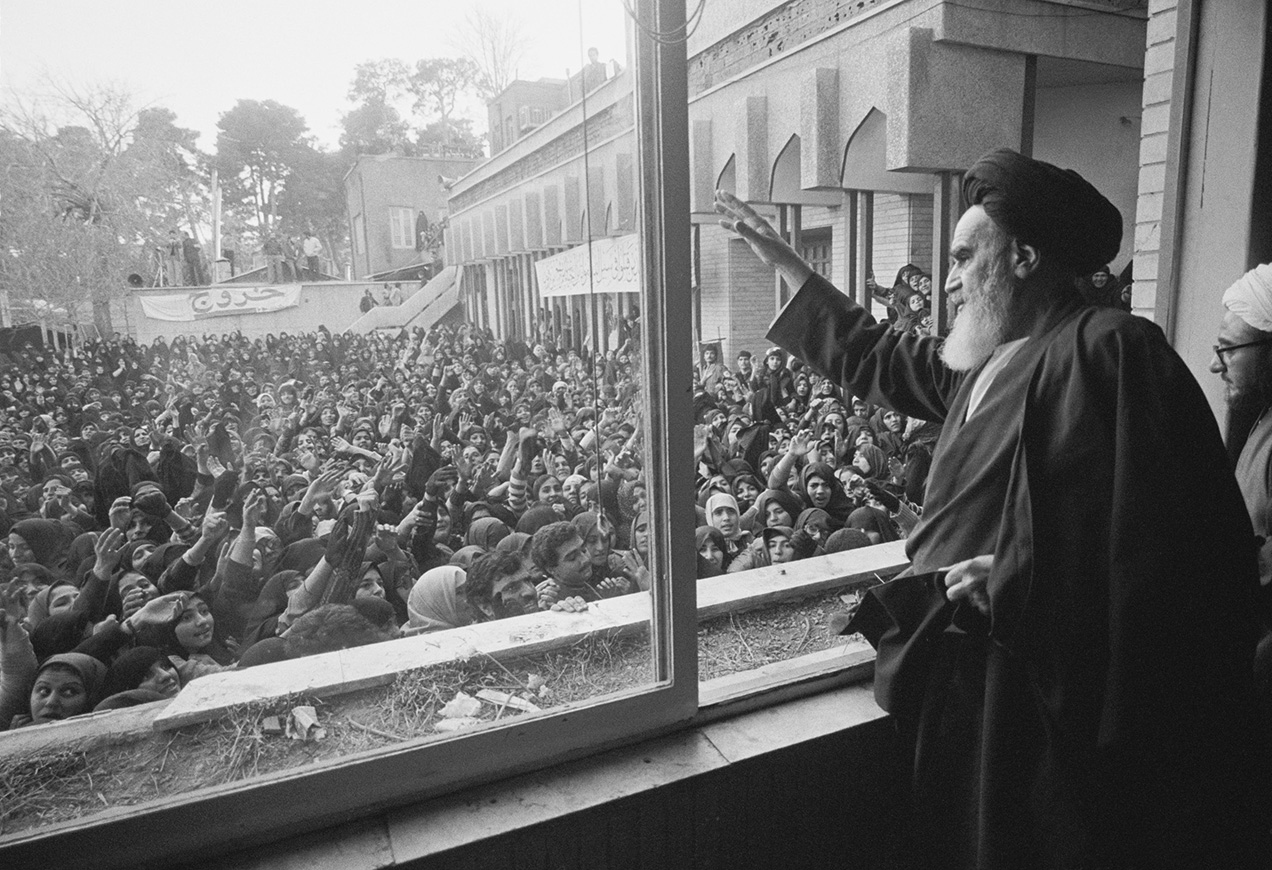
In January 1979, while Khomeini was still in Paris, the first step in establishing a revolutionary government had already been taken: the formation of the Council of the Revolution (Šurā-ye enqelāb) headed by Ayatollah Moṭahhari. Bāzargān had also accepted appointment as prime minister of a transitional government, although, it seems, with some reluctance. On 5 February, invoking the principle of welāyat, Khomeini publicly announced this appointment, charging Bāzargān and his cabinet with preparing a referendum on proclaiming Iran an Islamic Republic that, in turn, would pave the way to the election of a constituent assembly to elaborate a new constitution (Ṣaḥifa-ye Emām, VI, pp. 54-5). On 7 February, mass demonstrations took place in support of the provisional government.
The final collapse of the old order was not long in coming. The very next day, hundreds of air force technicians came to the Rafāh school to pledge their allegiance to Khomeini; the following day, remnants of the shah’s Imperial Guard attacked air bases around the city, provoking the final disintegration of the armed forces and the desertion of many officers and men, together with their weapons, to the Revolutionary Committees that were springing up everywhere. On 10 February, Baḵtiār decreed a curfew to take effect at 4 p.m., to which Khomeini’s response was that the curfew should be defied, and if elements in the army still loyal to the shah persisted in killing people, he would issue a formal fatw
ā for jihad (Ṣaḥifa-ye Emām, VI, pp. 74-6). The following day, the Supreme Military Council withdrew its support for Baḵtiār, and on 12 February, all organs of the regime, political, administrative, and military, finally collapsed. Baḵtiār, ridiculed in a popular rhyming slogan as “lackey without power” (nowkar-e bi eḵtiār; Kamāli, p. 283), fled to Paris, from where he tried to organize several coup attempts before being assassinated in August 1991.
One week after the end of the Baḵtiār regency, Yāser ʿArafāt, chairman of the Palestine Liberation Organization, flew unannounced into Tehran and was warmly embraced by Khomeini. He was the first foreign dignitary to visit Iran after the revolution; ties with Israel were immediately severed, and the building that had housed its mission was handed over to the PLO. Support for the Palestinian cause became a defining principle of Iranian foreign policy. On 9 August 1979, Khomeini recommended that the last Friday of Ramażān each year should be observed as Jerusalem Day (Ruz-e Qods), a day of protest against Israel and in particular its occupation of Jerusalem (Ṣaḥifa-ye Emām, IX, p. 267). Since then, it has been widely observed, not only in Iran but also in other Muslim countries and by Muslim communities in Europe and America.
On 29 February, Khomeini moved to Qom, making the city in effect the second capital of Iran, not, as Baḵtiār vainly hoped, “something like the Vatican,” a center simply of spiritual guidance. The institutionalization of the new order continued with a referendum on 30 and 31 March, an overwhelming majority voting in favor of founding an Islamic Republic. It was a simple “yes” or “no” vote, although a space was provided on the ballot paper for suggesting an alternative, such as Islamic Democratic Republic or even monarchy (by equating the former with the latter, Khomeini was clearly declaring it reprehensible and unacceptable; text of his message in Davāni, X, pp. 300-301). He proclaimed the following day to be “the first day of God’s government” (Ṣaḥifa-ye Emām,VI, pp. 457-63). The next step was to establish a constitution for the Islamic Republic. A draft constitution had been drawn up already in Paris by a committee headed by Yad-Allāh Saḥābi. Its text was published on June 18 (Matn-e kāmel-e pišnehādi-e pišnevis-e qānun-e esāsi, supplement to Šahed, no. 11) and on August 3, an Assembly of Experts (Majles-e ḵobragān) was elected for the purpose of reviewing it; fifty-five of the seventy-three persons chosen were religious scholars, but it also included Bani-Sadr and ʿEzzat-Allāh Saḥābi (d. 2011). They began their task on 12 August and completed it on 15 November, producing a constitution that differed greatly from the original draft, above all through the formal incorporation of the principle of welāyat-e faqih.
Chapter One of the draft constitution had spelt out the general principles of the Islamic Republic (articles 1 to 12), and Chapter Seven assigned control and management of the executive to the president and listed his duties and prerogatives (articles 75 to 112). It is only in Chapter Seven, on the Council of Guardians of the Constitution (Šaurā-ye nagahbān-e Qānun-e Asāsi) that authority is assigned to five mojtaheds “acquainted with the demands of the time,” and they are outnumbered by six experts in legal matters drawn from universities and judges of the supreme court.
The preamble to the revised constitution recounts the history of the revolution, with emphasis on the leadership of “Āyat-Allah al-ʿOẓmā Emām Ḵomeyni,” thereby anchoring the designation of Khomeini as “Imam” in official usage. Further, “in keeping with the principles of governance and the permanent necessity of leadership, the Constitution provides for the establishment of leadership by a faqih possessing the necessary qualifications and recognized as leader by the people.” His duties and prerogatives are spelled out in full in Article Five: “During the Occultation of the Lord of the Age (Ṣāḥeb al-Zamān) … the governance and leadership of the nation devolve upon the just and pious faqih who is acquainted with the circumstances of his age; courageous, resourceful, and possessed of administrative ability; recognized and accepted as leader (rahbar) by the majority of the people. In the event that no faqih should be so recognized by the majority, the leader, or leadership council, composed of foqahāʾ possessing the aforementioned qualities, will assume these responsibilities.” Article 109 specifies the qualifications and attributes of the leader as “suitability with respect to learning and piety, as required for the functions of mufti and marjaʿ,” and Article 110 lists his powers, which include supreme command of the armed forces, appointment of the head of the judiciary, signing the decree formalizing the election of the president of the republic, and—under certain conditions—dismissing him (Qānun-e as āsi-ye Jomhuri-e eslāmi-e Irān, pp. 3-4, 23-24, 53-58).
While the Council of Guardians was at work, on 22 October 1979, Moḥammad-Reżā Shah was admitted to the United States, his need for medical treatment being cited as justification. Mindful of the Anglo-American Coup d’État of 1332 Š./1953 (q.v.) that had restored the shah to power and overthrown the government of Moḥammad Moṣaddeq, inaugurating a quarter-century of royal dictatorship, many in Iran now feared a recurrence. The United States had continued to supply the shah with military aid and equipment as the final stages of the revolution unfolded, and, on 4 January 1979, General Robert Huyser of the U.S. Central Command had come to Tehran in order to assess the possibility of crushing the revolution militarily, a course of action favored by Zbigniew Brzezinski, National Security Adviser (Crist, pp. 1-2, 17, 21-3).
By way of reaction, on 4 November, a large group of students styling themselves “Students Following the Line of the Imam” (Dānešjuyān-e peyrow-e ḵaṭṭ-e Emām) scaled the walls of the embassy and took its personnel hostage, demanding that the shah be extradited to Iran. After a search of the documents archived in the embassy, it became popularly known as “the den of spies” (lāna-ye jāsusi); Khomeini himself adopted this term. An earlier invasion of the embassy had been short lived, and received no official backing. With the shah in the United States, circumstances were different this time, and Khomeini hailed the initiative of the students as “a second revolution, greater than the first.” America, he predicted, would be “unable to do a damned thing (Amrik ā hič ḡalaṭi namitavānd bokonad)” (Ṣaḥifa-ye Emām, X, pp. 489-96). This prediction seemed extravagant to many at the time, but a military expedition mounted by the United States on 24 April 1980 to rescue the hostages and attack sensitive sites in Tehran, with the collusion of royalist remnants in the military, came to an abrupt end after three American helicopters failed and another crashed into a supply plane on the ground near Ṭabas in south-eastern Iran in a sandstorm; eight Americans lost their lives. What became known as “the hostage crisis” was to last 444 days; it was not until 20 January 1981 that the hostages were released and sent back to America (see HOSTAGE CRISIS).
One result of the occupation of the embassy was a surge in popular enthusiasm, contributing to the 98.2 percent approval vote in the referendum on the constitution that took place in December. Another was the resignation of Bāzargān and his cabinet. He had been reluctant to accept the premiership in the first place, but, after a brief consultation with Khomeini on 4 February 1979, he had given his agreement. Already on 1 July, he had offered to resign, but was persuaded to stay on; four members of the Revolutionary Council (Rafsanjāni, Bāhonar, Mahdavi-Kani, and Khamenei) joined Bāzargān’s cabinet in an effort to improve coordination of the two bodies. Now, on 6 November, his resignation was unhesitatingly accepted. A few days earlier, he had been photographed shaking hands in Algiers with Zbigniew Brzezinski, the same American national security advisor who had pressed hard for a coup to overthrow the Islamic Republic; this was taken as a sign of willingness to accommodate American concerns. This final alienation of the Freedom Movement was perhaps inevitable for other, more fundamental reasons. In an interview with this author in December 1979, Bāzargān stressed that it was not the occupation of the embassy as such that prompted him to resign, but his accumulating dissatisfaction with the impotence of his cabinet. In the same interview, he confessed that he sensed a gap between himself and the youth fervently supportive of the revolution. Bound to be a transitional figure, he famously summarized his approach as “step by step” (gām be gām), something short of swift and radical revolution; he asserted, indeed, that the “second revolution,” i.e., developments following the overthrow of the shah, was a counter-revolution in that it contradicted the aims of the first (Bāzargān, p. 81). The fusion implied by the label “nationalist-religious” (melli-maḏhabi) was also at variance with the overwhelmingly religious fervor that had carried the revolution to victory, and it was repeatedly denounced by Khomeini.
Crucial, too, was the fact that Bāzargān had never endorsed the principle of welāyat-e faqih. In his contribution to a collective work published in 1962, Baḥṯi dar bāra-ye marjaʿiyat va ruḥāniyat: Enteẓārāt-e mardom az mar ājeʿ, Bāzargān called on the religious scholars to study “all the sciences and concerns of the day, or at least to acquaint themselves with them,” and to realize that the sciences of religion must undergo change and renewal, just like other branches of knowledge; the scholars “need to free themselves from the fetters and chains of the past” (pp. 112-13). The leadership they should provide is “practical and social” (p. 122); no mention is made of the political. Significantly and fatally erroneous was his belief, together with the rest of the Freedom Movement, that Khomeini himself no longer espoused welāyat-e faqih, and that the leadership he was to provide after the triumph of the revolution would be of a general and spiritual nature (conversation of this author with ʿEzzat-Allāh Saḥābi, Paris, 28 December 1978). A certain degree of intellectual snobbery could also be perceived in Bāzargān; he once described Montaẓeri, in the French that he was fond of deploying, as “un curé de village” (conversation of this author with Bāzargān, Tehran, December 1979). The matter has been well summarized as follows: “Bāzargān was out not to promote Khomeini’s agenda but to co-opt Khomeini’s standing to promote his own” (Leverett and Leverett, p. 161).
Largely unconnected to the immediate political concerns of the day and bearing witness to Khomeini’s unshakeable commitment to ʿerfān was the series of five lectures on the opening chapter of the Qurʾan (Surat al-fāteḥa) he delivered on Iranian television between 17 December 1979 and 11 January 1980. Khomeini did not proceed beyond the first two verses, expounding in great clarity and profundity key concepts of Qur’anic gnosis. At the end of the fifth lecture, he recalled the hostility to ʿerfān with which its exponents in Qom such as ʿAli-Akbar Ḥakim and Mirzā Šāhābādi had been confronted (pp. 187-88), and, aware that the same attitudes persisted, he appealed for a greater degree of open-mindedness: “The Qurʾan is like a banquet from which everyone can partake in accordance with his capacity” (Tafsir-e sura-ye ḥamd, p. 190). His appeal fell on deaf ears: A certain Javād Tehrāni organized a petition in Mashhad calling for the termination of the lectures (Bonaud, p. 64, n. 103).
On 23 January 1980, twelve days after the fifth and final lecture, Khomeini was brought from Qom to Tehran to receive treatment for a heart ailment. After thirty-nine days in hospital, he took up residence in the north Tehran suburb of Darband, and on 22 April, he moved into a modest house in Jamārān, another suburb to the north of the capital. A closely guarded compound grew up around the house, and it was there that he was destined to spend the rest of his life. His son, Aḥmad, was in constant attendance on him, and Rafsanjāni established residence in a villa in the same compound.
On the second day of Khomeini’s hospitalization, Bani-Ṣadr was elected first president of the Islamic Republic, and on 14 March, elections were held for the Majles. Almost immediately after his election, Bani-Ṣadr had difficulty forming a cabinet. The constitution provided for the president to nominate a prime minister, but his choice was subject to the approval of the Majles, dominated at the time by the Party of the Islamic Republic (Ḥezb-e Jomhuri-ye Eslāmi). This stipulation forced him to accept Moḥammad-ʿAli Rajāʾi, a person of thoroughly different orientation, and although Khomeini repeatedly called for consensus (waḥdat-e kalema) among the various political factions, differences were to remain intractable.
On 22 September 1980, Iraqi forces launched an invasion of Iran all along the border between the two countries and started bombing civilian and military airports. Thus began an eight-year-long conflict that came to be known in Iran as “the imposed war” (jang-e taḥmili; see Khomeini’s statement on 23 January 1981, in Ṣaḥifa-ye Emām, XIII, p. 530). This sudden crisis had the short-term effect of palliating the rivalry between Bani-Ṣadr, now appointed commander-in-chief of the armed forces, and his opponents, but in the spring of the following year, matters flared up anew. Bani-Ṣadr had aligned himself with the Mojahedin-e Khalq, and on 8 June 1981, he effectively called for an uprising against what he viewed as dictatorship. Two days later, Khomeini removed him from command of the armed forces; and on 21 June, he was impeached and removed from the presidency.
This outcome was perhaps inevitable. Although Bani-Ṣadr was the son of a religious scholar, Ayatollah Naṣr-Allāh Bani-Ṣadr, his education had been almost entirely secular, and insofar as he favored an Islamic government, it was, as he frankly stated after his dismissal and return to France, one “secular and democratic,” with no room for what he contemptuously called the mollariat (L’Espérance Trahie, pp. 111-12). He seemed to assume that the presidency entitled him to supremacy in all affairs, overlooking the principle of welāyat-e faqih enshrined in the constitution according to the provisions of which he had been elected president; indeed he was thoroughly opposed to it, as he made clear in the book he wrote after his impeachment, which may be characterized as a prolix apologia (Bani-Ṣadr, 1982, pp. 356, 367). Insofar as he accepted Khomeini as rahbar, it was in the vague sense of “guide,” rather than “leader,” and he is said to have thought himself the most popular person in the country (Moin, p. 238). In his memoirs, he repeatedly characterizes Khomeini as arbitrary and misguided in decision making, and he justifies his own involvement as a fruitless attempt to curb his errors and correct the orientation of the revolution (Bani-Ṣadr, 1982, pp. 365-68).
Like Bāzargān, Bani-Ṣadr thus turned out to be a transitional figure. After a period in hiding, he fled Tehran and returned to Paris, arriving there on 29 July. He was joined there by Rajavi. Enjoying the support of the president of France at the time, François Mitterand, Bani-Ṣadr and Rajavi established what they called the National Resistance Council (Šurā-ye melli-ye moqāwamat). The closeness between Bani-Sadr and Rajavi showed itself inter alia in the marriage of Bani-Ṣadr’s daughter, Firuza, to Rajavi. They divorced not long after, foreshadowing the split between their fathers in 1984, and two years later, the French encouraged Rajavi to leave for Iraq.
In addition to the organs of government, important, too, for the formation of the new order was the establishment of organizations designed to address socio-economic and cultural concerns. On 1 March 1979, Khomeini issued a decree confiscating the properties of the shah, his family, and close associates. Two days later, the Foundation for the Downtrodden (Bonyād-e mostażʿafān) was established to consolidate and manage the confiscated assets in the interests of the poor, especially in cities, where numerous housing units were built. The Foundation later extended its activities to industry and commercial development and various branches of the economy. May 1979 saw the formation of the Reconstruction Jihad (Jehād-e sāzandagi); it operated primarily in rural areas. Volunteers enlisted to help with the harvest that year, and their functions later extended to the construction of roads, bringing electricity to the countryside, and providing potable water and water for irrigation; schools and public baths were also constructed in a number of villages. When war with Iraq began, those with the relevant qualifications served as combat engineers in a number of campaigns. The Reconstruction Jihad also operated in a number of African countries and Lebanon. In February 1984, a separate ministry was created to manage the organization.
Another concern that for long had disturbed Khomeini was the cultural alienation he discerned to be underway in Iranian universities. In an address to university students on 18 April 1980, he lamented the infatuation of many professors and the students they teach with the West, and the failure of Iranian universities in their fifty years of existence to help the nation attain self-sufficiency in any of the subjects they teach. The call for a reform of higher education did not mean that only the religious sciences be taught in the universities, nor that sciences such as physics and mathematics have two sectors, Islamic and non-Islamic. The purpose was rather to foster Islamic morality in universities and make them independent of the West and the East. To this end, a purge would be required (Ṣaḥifa-ye Emām, XII, pp. 248-52) Accordingly, in a decree issued on 12 June, Khomeini established the Cultural Revolution Headquarters (Setād-e enqelāb-e farhangi) (Ṣaḥifa-ye Emām, XII, p. 432). It was renamed Council of the Cultural Revolution (Šurā-ye ʿāli-e enqelāb-e farhangi) on 9 December 1984. The term “cultural revolution” inevitably calls to mind the wave of persecutions that raged in China from 1966 to 1976, but the purpose of its Iranian namesake was narrower, as explained by Khomeini: To adapt the educational system to the priorities and worldview of the Islamic Revolution. It resulted in the closure of Iranian universities for approximately two years and the dismissal of many professors and instructors. At the same time, with a view to lessening the dichotomy between universities and the ḥawza, university personnel were dispatched to Qom to acquaint the religious scholars with subjects little known to them before.
The turbulent years of the immediate post-revolutionary period also saw a significant number of assassinations carried out by armed groups of primarily leftist orientation. Forqān, founded by a certain Akbar Gudarzi, proclaimed as its aim the establishment of an Islamic order that eliminated the foqahāʾ, citing ʿAli Šariʿati as its source of inspiration. The “elimination” was intended to be physical as well as ideological. Ayatollah Mofatteḥ was shot dead in his office at the Faculty of Theology at Tehran University by a member of the group on 18 December 1979. A still more prominent victim was Ayatollah Moṭahhari, chairman of the Revolutionary Council, killed on 1 May 1979. Khomeini wept at the loss of the one whom he described as “the very quintessence of my being” (Yādnāma-ye ostād-e šahid Mortażā Moṭahhari, pp. 3-5). By May 1989, Forqān had itself been eliminated (on the Forqān group, see Cohen).
Straightforwardly leftist in its orientation was the Sāzmān-e Fedāʾiān-e Ḵalq (see COMMUNISM iii); it was somewhat longer lived than Forqān. It first emerged as a guerilla movement in the early 1970s that soon divided into different factions over precise ideological and tactical choices. After the Islamic Revolution, it was active in Kurdistan, Torkamān Ṣaḥrā, and along the shores of the Caspian. Active in the same region was another leftist group, the Sarbedārān. It named itself after a movement that began in Mazandaran and, with the support of the peasantry, gained control of much of Khorasan in the period from 738-83/1337-81 (see EIr online, SARBEDĀRS). By contrast, although its would-be reincarnation briefly took over the city of Āmol (q.v.) in 1981, its followers were summarily defeated by government forces.
Destined for greater longevity, despite, or perhaps because of, its ideological and political tergiversations, was the Mojahedin-e Khalq organization. It initially supported the revolution as a step in the right direction, because of its struggle against American imperialism. Opposed to the constitution approved in the referendum of December 1979, it made common cause with Bani-Ṣadr. In June 1981 it organized demonstrations in his support, and on 21 June, the day of his impeachment, endorsed his call for a mass uprising against the government (on this and the subsequent events, see Abrahamian, 1989, chap. 9). The demonstrations that did take place were met with superior force by the counter-protesters known on this and similar occasions as the Anṣār-e Ḥezb-Allāh. Thereafter the Mojahedin-e Khalq turned to assassination as its modus operandi. On 28 June, a bomb was placed in the headquarters of the Islamic Republic Party, killing Ayatollah Behešti, the main antagonist of Bani-Ṣadr, together with some seventy other people. Other assassinations followed, including those of Ḥojjat-al-Eslām Šariʿatifard on the road between Āmol and Gorgān on 6 July; Ḥasan Āyat in Tehran on August 4; Moḥammad-ʿAli Rajāʾi, Bani Sadr’s replacement as president, and Moḥammad Javād Bāhonar, his prime minister, on 30 August; and Ayatollah Madani in Tabriz on 11 September. On 27 June, an attempt was made to assassinate Ali Khamenei, almost paralyzing his right arm. Throughout, Khomeini retained his equanimity, declaring that the loss of these persons, although painful, would not lead to the overthrow of the Islamic Republic (Ṣaḥifa-ye Emām, XV, p. 197-204). Early in 1982, the murderous potential of the Mojahedin-e Khalq inside Iran came to an end when their operational commander, Musā Ḵiābāni, was killed in his headquarters. Rajavi then left for France. It was not until the Mojahedin-e Khalq had aligned themselves with Saddam Hussein during the Iran-Iraq War that they were able to reenter the fray, to their own disadvantage, as they were ultimately to discover.
From within the ranks of the ʿolamāʾ, the principal opponent of the emerging Islamic Republic was Ayatollah Moḥammad Kāẓem Šariʿatmadāri, a marjʿa-e taqlid resident in Qom with a following concentrated in Azarbaijan. His support for the revolution had been sporadic and lukewarm at best. A party enjoying his patronage, the Muslim People’s Republican Party (Ḥezb-e jomhuri-e ḵalq-e mosalmān), was established in March 1979, and, later in the same year, clashes took place in Tabriz between its adherents and the partisans of Khomeini. Šariʿatmadari criticized crucial elements of the constitution including welāyat-e faqih and called for a boycott of the referendum held on 3 December. Worse was to follow three years later, in the spring of 1982.
The Imposed War (Jang-e taḥmili). The Iraqi invasion of Iran began on 22 September 1980, and hostilities finally came to an end on 20 July 1988 with both parties acceptance of UN Security Council Resolution 598 (see IRAQ vii. IRAN-IRAQ WAR). Iraq’s pretext for launching a war that was destined to drag on destructively for eight years was a demand for unrestricted sovereignty over the Shatt al-Arab. The calculation was no doubt that in the turmoil of the immediate post-revolutionary period, policy makers in Tehran would be unable to formulate a coherent response, and that the Iranian armed forces had become too weakened to mount an effective defense; expecting a swift Iranian surrender, Saddam initially assigned only a small part of the Iraqi army to the war. There was also the misplaced expectation that the predominantly Arabic-speaking population of Khuzestan (Ḵuzestān) would welcome the invaders. Most importantly, all the major Arab states, with the exception of Syria and Libya, lent Iraq their support, as did the United States, the European powers, and the Soviet Union, tacitly and covertly to begin with, and more brazenly as the war dragged on. What has been termed America’s “figleaf of neutrality” (Crist, pp. 84 ff.) was progressively discarded.
The only major success of the Iraqi invasion was the capture on 24 October 1980 of Khorramshahr (Ḵorramšahr), enabling the city and its environs to become a base for the shelling of nearby targets. An effective response was hampered by divisions, political and otherwise, within Iran. In the same month, Khomeini therefore merged the regular army with the Guardians of the Revolution (Pāsdārān-e enqelāb), a militia that had come into being during the revolution. He also appointed a seven-member Defense Council, headed by Bani-Ṣadr; not surprisingly, given the prevailing divisions, it proved dysfunctional. The first Iranian counteroffensive, codenamed Naṣr, was launched in January 1981, at the initiative of Bani-Ṣadr, a primary role being given to the regular army; hundreds of tanks attacked Iraqi forces positioned between Susangerd, Ahvāz (q.v.), and Dezful (q.v.), but they were beaten back with heavy losses. After the impeachment and dismissal of Bani-Ṣadr in June 1981, Khomeini appointed Khamenei as his representative on the Defense Council. More successful than Operation Naṣr was the offensive of September 1981 that broke the siege of Ābādān (q.v.).
On 22 March 1982, Iran launched an offensive called fatḥ-e mobin (“manifest victory”; cf. Qur’an, 98:1), and the siege of Dezful was soon broken. This and other successes were due in part to the “human wave attacks” that were launched by the young volunteers known as the basij (“mobilization”) in order to prepare the way for the regular army and the Revolutionary Guards to advance. On 30 March, Khomeini accordingly addressed a message of congratulation to all the various branches of the armed forces (Ṣaḥifa-ye Emām, XVI, pp. 142-43). A major victory was attained on 24 May with the liberation of Khorramshahr and the capture of thousands of Iraqi prisoners. In July, the decision was taken to advance into Iraqi territory, but Iranian forces were beaten back when Iraq deployed chemical weapons against them; a renewed attempt in October yielded a similar result. In 1983, a series of ten operations began that were codenamed Wa’l-fajr, by way of allusion to Qur’an, 89:1: “By the dawn, and the ten nights.” It was not until February 1986 that one of these operations, the eighth, yielded a substantial result, with the occupation of the Fao (Fāw) peninsula on the Iraqi bank of the Shatt al-Arab. This, however, did not signify a major breakthrough.
Throughout the war, Khomeini issued messages and delivered proclamations. On its first day, he addressed the Iranian people on radio and television, expressing confidence in victory; appealing to the Iraqi people and army to rise up against Saddam; and warning against dissent and attempts to sabotage the war effort. He noted that the people of Iraq bore no responsibility for the aggression, for they had already been suffering under the rule of Saddam, a madman. The people of Iran should not imagine that the armed forces were incapable of waging war successfully; Saddam had “thrown a stone and already been put back in his place.” Malicious rumors spread by the internal enemies of the Islamic Republic that the armed forces were deliberately sabotaging the war effort should be disregarded. The people of Iraq and its Iraqi army should rise up against Saddam and “return to Islam” (Ṣaḥifa-ye Emām, XIII, pp. 221-26). Khomeini repeated the same appeal on other occasions (see Ṣaḥifa-ye Emām, XIII, pp. 237, 291, 408), but without substantial effect. Iraqi soldiers certainly never showed the same devotion and fervor as their Iranian counterparts, and, at key points in the war, they were taken prisoner in the thousands, but only a negligible few heeded Khomeini’s call to turn on Saddam. A number of Iraqis did, however, seek refuge in Iran, and they were welcomed by Khomeini ( Ṣaḥifa-ye Emā m, XIII, p. 275).

PLATE IX Poster art by Kāẓem Čalipa depicting Khomeini watching over five Iranian soldiers of different ethnicities, emphasizing national unity against the background of the “imposed war” with Iraq. Source: Middle Eastern Posters Collection, Box 3, Poster 70, Special Collections Research Center, University of Chicago Library.
While predicting ultimate victory, Khomeini asserted that the war, in and of itself, brought blessings, for among other things it served the “export of the revolution,” and its triumphant outcome would open the way to the “liberation” of Jerusalem (Ṣaḥifa-ye Emām, XIII, pp. 331, 483, 513). Messages combining condolence with congratulation were regularly addressed to families whose sons had died in the war, sometimes collectively, sometimes individually (Ṣaḥifa-ye Emām, XIII, pp. 182, 513, 530). When victories were achieved, such as breaking the sieges of Ābādān in September 1981 (Ṣaḥifa-ye Emām, XV, p. 254) and of Dezful in March 1982 (Ṣaḥifa-ye Emām, XVI, pp. 155, 200), Khomeini issued congratulations to the armed forces and those who had supported them (Ṣaḥifa-ye Emām, XIII, 354). When Khorramshahr was liberated on 24 May 1982, he congratulated the armed forces on achieving this divinely enabled triumph: Regional states should now be aware that Iran was speaking from a position of strength and abandon their unquestioning obedience to America: Hosni Mubarak of Egypt, King Hussein of Jordan, and King Fahd of Saudi Arabia should remember what had become of the shah (Ṣaḥifa-ye Emām, XVI, pp. 257-59).
In these and many other messages, Khomeini warned against factions and personalities, generally left unnamed, who subversively nurtured pessimism concerning the outcome of the war and were opposed to continuing it. By way of response, the slogan “War, war until victory!” (jang, jang, tā piruzi) began to gain currency. It was, Khomeini declared, precisely those who had suffered most from the war who demanded that it be continued (see his address to the people of Gilān-e Ḡarb on 18 August 1983, Ṣaḥifa-ye Emā m, XVIII, pp. 47-49). The same insistence continued during the territorial stalemate and what became known as the “war of the cities,” the bombing raids on major cities exchanged between Iraq and Iran beginning in February 1984.
The home front was by no means tranquil during the war years. Some six months into the war, a conspiracy led by Ṣādeq Qoṭbzāda to take over the state and assassinate Khomeini was alleged to have been discovered (Moin, p. 252). Qoṭbzāda had left Iran in 1959 after a time in the shah’s jails, studied at Canadian and American universities, and resided in Algeria, Egypt, and Syria, in turn, before settling in Paris. It was there that he met Khomeini, whom he accompanied on the historic flight returning to Tehran. Linked earlier to the Freedom Movement, he was appointed to membership on the Revolutionary Council, and during his term as acting foreign minister from November 1979 to August 1980, he showed opposition to the occupation of the US embassy. Already on 7 November 1980, he had been arrested for plotting against the state, but was released days later. He was re-arrested on 8 April 1982, and in the course of the trial that began in August, leading to his execution on 15 September, he pleaded guilty and asserted that Ayatollah Šariʿatmadāri had been aware of his plans; this was confirmed by Šariʿatmadāri in a televised statement, as a result of which he remained under house arrest until his death in 1986, and the party that had operated under his auspices, chiefly in Azarbaijan, the Ḥezb-e jomhuri-e ḵalq-e mosalmān, was banned. This outcome was perhaps not surprising: Šariʿatmadāri’s support for the revolution had been tentative and ambiguous.
As the war continued, international assistance to Iraq intensified. France supplied Iraq with missiles and Mirage and other warplanes, and the Soviet Union provided MiG fighter aircraft. The American Airborne Early Warning and Control System (AWACS) conveyed the coordinates of Iranian targets to Iraq, enabling them to be struck with chemical weapons acquired from West Germany. American warships in the Gulf struck Iranian oil installations in the Persian Gulf and bombed an Iranian warship. What has been termed “the quasi-war” between Iran and America was reaching its climax in late 1987 (Crist, p. 329). The “war of the cities” that had begun in 1984 was intensified. More egregious than all the foregoing was what followed in the summer of the following year. On 3 July 1988, the USS Vincennes shot down an Iranian Airbus over the Persian Gulf, killing all 290 aboard. The plane had been in Iranian airspace and was not descending menacingly in the direction of the American ship, as was initially asserted, apart from which it was clearly a civilian, not a military, plane. Neither a convincing explanation nor an apology was forthcoming from the United States. This atrocity was inevitably seen in Tehran as confirmation of American resolve to prevent an Iranian victory in the war, at whatever cost.
On 20 July 1988, Khomeini announced with great reluctance Iran’s acceptance of UN Resolution 598 calling for a ceasefire between Iraq and Iran; it was for him like “draining a chalice full of poison.” It was also the anniversary of the slaughter of Iranian pilgrims making the Hajj in Mecca in 1987 (see below, p. 563), which had been motivated, he asserted, by the slavish desire of the Saudis to serve “the Great Satan,” i.e., the United States. He believed that neither that atrocity nor the pain inflicted on Iran by the war would extinguish the flame of resistance: It would not always be the case that the Americans could shoot down an Iranian passenger plane; it was possible that the sons of the revolution might someday send their warships plunging to the bottom of the Gulf. He exalted those who had fought or been martyred in the war. Khomeini said he was embarrassed before the Iranian people to accept the ceasefire, although the national interest (maṣlaḥat) required that he do so. If one test was now over, others awaited, and all should take care that the revolution not fall into the hands of the unworthy (nā-ahlān). Long-term developments could not be foreseen; and the Iranian people should be ready to fend off any new aggression (Ṣaḥifa-ye Emām, XXI, pp. 74-100).
While the war was still underway, structural problems had persisted; the resignation of Bāzargān and the dismissal of Bani-Ṣadr had not sufficed to eliminate disagreement among different organs of the state. The Majles had approved a number of measures relating to economic concerns, especially the limitation of legally acquired land holdings, only to have them vetoed by the Council of Guardians. In October 1981 and January 1983, Rafsanjāni, who had become chairman of the Majles, requested Khomeini to arbitrate decisively, drawing on the prerogatives inherent in welāyat-e faqih, in order to break the deadlock. He was reluctant to do so, preferring that a consensus should emerge, and it was not until 6 January 1988, in a letter addressed to Khamenei, that Khomeini put forward a far-reaching definition of welāyat-e faqih, now termed “absolute” (moṭlaqa), which made it theoretically possible for the leadership to override all conceivable objections to the policies it supported. Governance, he proclaimed, is the most important of all divine ordinances (aḥkām-e elāhi), and it takes precedence over secondary divine ordinances (aḥkām-e farʿiya-ye elāhiya). Not only does the Islamic government permissibly enforce a large number of laws not included in those ordinances, such as the prohibition of narcotics and the levying of customs dues, it can also suspend the performance of a fundamental religious duty, such as the Hajj, when this is necessitated by the higher interest of the Muslims (Ṣaḥifa-ye Emā m, XX, pp. 451-52). The specific mention of the Hajj was due, no doubt, to the killing of Iranian and other pilgrims by the Saudis in 1987. Use of the adjective “absolute” might appear to be a justification for unlimited individual rule by the leader, but it was more a clarification of the concept of welāyat-e faqih than an expansion of it. In any event, in February 1988, Khomeini delegated these broadly defined prerogatives to a body cumbersomely entitled the Assembly for the Determination of the Interest of the Islamic Order (Majmaʿ-e tašḵiṣ-e maṣlaḥat-e neẓām-e eslāmi) (Ṣaḥifa-ye Emām, XX, p. 463). It comprised six jurists from the Council of Guardians and seven other figures, including the then-president, Khamenei (Schirazi, p. 82, n. 19). It was empowered to rule decisively on bills passed by the Majles but rejected by the Council of Guardians. It issued no fewer than fifty-four rulings during the first ten years of its functioning (Majmuʿa-ye moṣawwabāt-e Majmaʿ-e tašḵiṣ-e maṣlaḥat-e neẓām-e eslāmi, pp. 47-209).
Even this measure did not suffice to bring sufficient order to the functioning of the government. Factional disputes were a perennial problem, in addition to which the delineation of executive power between president and prime minister had for long been a subject of dispute, and, as the war with Iraq was ending, it became particularly acute. To address this and other concerns, on 18 April 1989, members of the Majles requested Khomeini to order a revision of the constitution that had been approved in December 1979. A week later, he agreed, and assigned the task to a committee, the Council for the Revision of the Constitution (Majles-e bāznegāri-e qānun-e asāsi); it consisted of eighteen religious scholars and two others appointed by Khomeini, plus five others elected by the Majles. It first met on 29 April, electing Ayatollah ʿAli Meškini, president of the Council of Experts, as its chair. It was not until after the death of Khomeini that the process of revision was completed, on 9 July; the revised constitution was approved nineteen days later in a popular referendum. The most significant change was contained in Chapter Eight, articles 107 to 112, relating to the selection of a rahbar. Unlike the Constitution of 1979, it did not specify that he be a marjaʿ-e taqlid, only that he possess sufficient knowledge to issue fatwās, “a correct vision of political and social concerns” (bineš-e ṣaḥiḥ-e si āsi va ejtemāʿi), courage, and adequate strength for the task of rahbari. In the event that more than one person should be so qualified, the one whose credentials in the knowledge of feqh and political concerns are the strongest is to be preferred (Qānun-e asāsi-e Jomhuri-ye Eslāmi, pp. 54-55). The deletion of marjaʿiyat from the qualifications for the position of rahbar was in conformity with a statement from Khomeini on 9 May to the effect that recognition simply as a mojtahed-e ʿādel should suffice (Ṣaḥifa-ye Emām, XXI, p. 371). Relevant to this statement was no doubt the resignation of Ayatollah Montaẓeri from the succession, a few months earlier, on 27 March.
For several years, Khomeini had viewed the Hajj as having always had a political dimension; it was now an occasion to foster unity among the Muslim peoples and awaken them to the threats confronting them, primarily American imperialism and Israel. Thus on 7 August 1986, he had addressed a lengthy message to the pilgrims, Iranian and otherwise, who were about to depart on the Hajj. He prefaced it with Qur’an, 9:3: “A declaration from God and His Messenger to the people on the day of the supreme pilgrimage: That God and His Messenger abjure and renounce the mošrekin [polytheists].” The injunction contained in the verse is still valid, for the mošrekin have their modern counterparts, and it is incumbent on the pilgrims to abjure them. Khomeini also used the occasion to reject calls for the acceptance of what he called an “imposed peace” (ṣolḥ-e taḥmili) to end the “imposed war” (jang-e taḥmili) (Ṣaḥifa-ye Emām, XX, pp. 86-99).
Similar in content and extremely lengthy was the message he addressed to all pilgrims, Iranian and other, exactly one lunar year later, on 28 July 1987. It was in one sense celebratory, for Iran had been able to defend itself against the aggression from Iraq, and the hopes of the superpowers that the Islamic Republic would collapse in a matter of months or a year had come to naught. Again citing Qur’an, 9:3, Khomeini enjoined on the pilgrims renunciation of the contemporary counterparts of the mošrekin (polytheists), “the practitioners of global arrogance headed by criminal America.” This they were to do by engaging in demonstrations and marches in organized fashion under the supervision of Mehdi Karrubi. In error were those who claimed that political concerns should not be raised on the Hajj (Ṣaḥifa-ye Emām, XX, pp. 311-47). What followed three days later, on 31 July 1987, while the war with Iraq was still raging, was the slaughter of some 400 pilgrims, mostly Iranian, by armed Saudi police, as they demonstrated in the courtyard of the Kaʿba. The tragedy became known as “the Friday of blood” (jomʿa-ye ḵunin).
Khomeini reacted vigorously to the atrocity. It was, he declared, deliberate and pre-planned, the result of a conspiracy imposed on “the idiot Saudi dynasty,” resulting in their disgrace. With the exception of a few groups, the Hijazis themselves had not been involved. King Fahd, Khomeini continued, had sent him a message at the beginning of the Hajj season thanking him for enjoining peaceful conduct on the Iranian pilgrims, so that after the atrocity the Saudis could claim that they had been well-intentioned. The Saudis claimed that the Iranians were planning to set fire to the Kaʿba and make a new Kaʿba in Qom. It was rather they, the Saudis, who had violated the sanctity of the Kaʿba, a crime concerning which the Muslims would not remain silent. Far from being “the servant of the Ḥaramayn” (ḵādem al-Ḥaramayn), Fahd was a “traitor to the Ḥaramayn” (ḵāʾen al-Ḥaramayn). The day on which the atrocity occurred should never be forgotten, particularly during the month of Moḥarram; Imam Ḥosayn had, after all, left Mecca to confront his enemies elsewhere lest harm befall the Kaʿba (Ṣaḥifa-ye Emām, XX, pp. 368-71).
The following year, on 8 April 1988, he issued a similar although briefer declaration as 150,000 Iranian pilgrims were preparing to depart on the Hajj. It was not possible, Khomeini proclaimed, that our pilgrims should go on the Hajj and not demonstrate against “global arrogance” (estekbār-e jahāni). Failure to perform this political duty would invalidate the Hajj. If the Saudis tried to prevent it, they would find all the Muslims in the world arrayed against them; it would be to their benefit not to do so (Ṣaḥifa-ye Emām, XXI, p. 22). As it happened, the Saudis limited the number of pilgrims they were prepared to admit from Iran to 45,000, a restriction that was found unacceptable and resulted in a boycott of the Hajj that year.
Toward the end of the war with Iraq, the Mojāhedin-e Ḵalq reappeared on the scene in a murderous episode that had consequences for the succession to Khomeini. Persuaded to leave France, where the group had been in exile, for Iraq in 1986 as part of a deal for the liberation of French hostages held in Lebanon by Ḥezb-Allāh, the Mojāhedin placed themselves at the disposal of the Baathist regime. On 18 June 1988, Iraqi forces attacked the Iranian frontier town of Mehrān, flying no fewer than 530 sorties against it and launching attacks with nerve gas. When the town fell to the Iraqi forces, some 3,000 Mojāhedin accompanied the Iraqi troops, inflicting heavy casualties on the enemy. After three days, the Iraqi forces withdrew, leaving the Mojāhedin to fend for themselves. They were thoroughly defeated when the town was recaptured by Iran in an operation known as Merṣād (Hiro, 1989, p. 312). Despite this stunning defeat, on 26 July 1988, before the U.N. ceasefire came into effect, a detachment of Mojāhedin advanced suddenly across the border into Iran, taking and destroying the city of Eslāmābād-e Ḡarb. Their advance was swiftly repelled, with the loss of close to 4,500 lives. A significant consequence of their incursion was the execution of numerous members of the organization in Iranian jails, and others who had previously been released. The number of those executed is a matter of dispute, but it was certainly in the thousands. Prisoners who undertook to fight against their erstwhile comrades, designated “penitents” (tawwābun) by vague analogy with an early movement in Shiʿism, are said to have been spared this fate.
Ayatollah Montaẓeri criticized this response to the incursion by the Mojāhedin. Conventionally eulogized as “esteemed jurisprudent” (faqih-e ʿāliqadr), he had been selected in November 1985 by the Assembly of Experts (Majles-e ḵobragān), after deliberations lasting for more than two years, as successor to Khomeini as leader of the Islamic Republic. He was a firm believer in wel āyat-e faqih, a subject on which he wrote a multivolume study (Derāsāt fi Welāyat al-faqih), and had been appointed by Khomeini as the first emām-e jomʿa (q.v.) of Tehran soon after the revolution. Later, however, he distanced himself from various aspects of government policy, and, in the fall of 1986, he found himself obliquely and involuntarily involved in the turgid dealings of the Iran-Contra affairs (q.v.).
Mehdi Hāšemi, the brother of Montaẓeri’s son-in-law, Hādi Hāšemi, active in the “export of the revolution” and influential among certain groups in Lebanon, had come to learn about the Iran-Contra arms deal and publicized it, first by distributing pamphlets in Tehran and then by providing the information to the Lebanese monthly journal al-Šerāʿ, which published it on 3 November 1986. The news also reached Montaẓeri, and, in addition, Manučehr Qorbānifar, the principal arms dealer involved, had informed him via an intermediary of the clandestine visit to Tehran of Robert McFarlane, the US national security adviser (Montaẓeri, 2001, pp. 338-39). Mehdi Hāšemi was arrested on 12 October 1986 on charges of treason and executed on 28 September 1987 before the verdict was publicly announced; Hādi Hāšemi was also put on trial. Moḥammad Reyšahri, the minister of intelligence, affirmed in his memoirs that Mehdi Hašemi had been guilty of a whole range of nefarious activities unconnected to the Iran-Contra affair—smuggling, maintaining his own armed militia, and spreading corruption and immorality (Reyšahri, p. 136). Montaẓeri claimed to have suffered from guilt by association; he denied that either Mehdi or Hādi Hāšemi had operated out of his headquarters in Qom, and he believed the whole affair to have been concocted in order to sabotage his succession to Khomeini (Montaẓeri, 2001, p. 338).
More serious than all the preceding was Montaẓeri’s condemnation of the mass executions that followed the Mojāhedin incursion; he estimated their number to be between 2,800 and 3,000, men and women, including some who fasted and prayed. He promptly sent his representatives to the prisons where Mojāhedin were being held prior to execution, and even voiced objections to the long-standing designation of the Mojāhedin as “hypocrites” (monāfeqin) (Montaẓeri, p. 349). Despite attempts to discourage him, in early March 1989, Montaẓeri sent a letter to Khomeini, citing six reasons why he viewed the indiscriminate executions as unacceptable, and three days later recused himself from all šarʿi functions (Montaẓeri, pp. 352-55). This put paid to his succession to the leadership. On 26 March 1989, Khomeini dismissed him officially, writing that were he to succeed him, he would hand the country over to the “liberals,” meaning presumably Bāzargān and the Freedom Movement, and through them to the monāfeqin. The number of those executed was “very small,” and the concerns Montaẓeri had raised were not worth answering. He was a “simpleton” (sā da-lawḥ) whose appointment he had come to regret, just as he regretted the appointments of Bāzargān and Bani-Ṣadr; in all three cases, he had been persuaded by “friends,” whom he leaves unnamed (Ṣaḥifa-ye Emām, XXI, 330-32). Montaẓeri responded submissively and respectfully, stating that he had been reluctant in the first place to accept succession to the leadership (Montaẓeri, pp. 336-37).
However, Montaẓeri doubted the authenticity of the letters, for Khomeini was stricken with cancer at the time and inaccessible to visitors; Aḥmad Khomeini, he recalled, acted as his intermediary, and according to ʿAli Fallāḥiān, deputy minister of intelligence at the time, it was he who responded to questions posed by officials, but the answers he gave were presented as the words of Khomeini himself (Montaẓeri, p. 369). On 8 September 1988, Aḥmad had indeed requested Khomeini to entrust him with supervising all his written communications to ensure their accuracy, and his father had agreed (Ṣaḥifa-ye Emām, XXI, 125-27). A collection of eighty-four letters from Khomeini to Aḥmad, ranging in date from 1971 to 1989, relate to a wide array of matters, including the political (Waʿda-ye didār, Tehran, 1997). In his own memoirs, Aḥmad relates in considerable detail the ways in which he assisted his father, first in Iran, then in Iraq and in Paris, and finally back again in Iran, down to the time of his death (Aḥmad Ḵomeyni, Dalil-e āftāb, passim). That Aḥmad should have brazenly usurped his father’s authority on so important a matter as the succession is nonetheless extremely doubtful. Although it is true that, on 29 April 1989, Aḥmad sent Montaẓeri a lengthy screed with the title Ranj-nā ma, many of his complaints, especially those relating to Montaẓeri’s attitudes to the Mojāhedin, reflected the long-standing concerns of his father.
While these internal developments were unfolding, Khomeini came anew to global attention in two unrelated and contrasting ways. On 11 December 1988, as the Soviet Union was advancing toward implosion, Khomeini composed a lengthy message to Mikhail Gorbachev advising him to abandon communism and not be tempted by capitalism, another form of materialism. Instead, he should study Islam, paying particular attention to the works of Fārābi, Ebn Sinā, Sohravardi, Mollā Ṣadrā, and Ebn al-ʿArabi (Ṣaḥifa-ye Emām, XXI, pp. 220-26). In the first week of January 1989, the message was delivered in person to Gorbachev in Moscow by Ayatollah ʿAbd-Allāh Javādi Āmoli, accompanied by Javād Lārijāni and Marżiya Ḥadidči from the Foreign Ministry.
Of far greater impact was the fatwā Khomeini issued on 14 February 1989 calling for the execution of Salman Rushdie, author of The Satanic Verses, and all those who, aware of its contents, were involved in its publication (Ṣaḥifa-ye Emām, XXI, p. 263). The book had already enraged Muslims across the world, not only because of the alleged episode in the life of the Prophet that furnished its title, but also because of its depiction of a brothel staffed by women bearing the names of his wives as well as other offensive material hiding behind a veneer of fiction in the novel. Four days later, Rushdie issued a statement from London regretting the offence that he had caused to Muslims. Immediately, on the very same day, Khomeini emphasized that the fatwā still stood, and it could not be rescinded even if Rushdie repented and became the most pious man of the age (Ṣaḥifa-ye Emām, XXI, p. 268). The fatwā was acclaimed throughout the Muslim world and never rescinded.
On 22 February 1989, eight days after issuing the fatwā condemning Rushdie, Khomeini addressed a lengthy message to all the strata of the religious institution—the marājeʿ, the ṭalaba, the leaders of congregational and Friday prayer; it was entitled Manšur-e ruḥā niyat. Part of its content was, however, obliquely addressed to the public at large. It combines laudation with admonition, and retrospection with warning.
Khomeini began by praising those of the religious classes who fought in the war with Iraq; their efforts were not in vain, even if they were not martyred. It is the religious scholars who have always preserved Islam; they were at the forefront of the uprising of 15 Ḵordād. This should not be taken as a comprehensive defense of all religious scholars, including those of the present. “Pseudo-saintly idiots” are still combating “pure Muhammadi Islam” (Eslām-e nāb-e Moḥammadi) and propagating “American Islam.” This they do by claiming that religion should be separate from the state, and that entry into the political sphere is beneath their dignity. If you were to tell them “the shah is a traitor,” they would respond, “but the shah is a Shiʿi!” or “the shah is the shadow of God.” Another argument they would make is that just government is unattainable before the advent of the Twelfth Imam. Khomeini noted that he himself had suffered greatly at their hands during his years of study in Qom, additionally because his engagement with philosophy and ʿerfān was taken as a symptom of šerk, to the degree that the glass from which his son drank water was deemed polluted. Even after the revolution, the ḥawza is still subject to two conflicting approaches, and it is imperative that the younger generation not be contaminated by the “idiots” who continue to be opposed to political engagement—their file has not yet been closed. Although they claimed to distance themselves from politics, they supported attempted coups d’état such as those in Qom and Tabriz (an allusion to the violent demonstrations organized by the Ḥezb-e jomhuri-e ḵalq-e mosalmān in 1979 on the pretext of protecting Ayatollah Šariʿatmadāri) and that launched from the Nuža airbase on 10 July 1980. Some of the same class accused politically engaged ʿolamāʾ of being Wahhabi or inspired by communism. Also engaged in sabotaging the revolution were the Ḥojjatiya (q.v.), an organization founded in 1953 with the twin aims of refuting Baha’ism and hastening the advent of the Twelfth Imam, before which all attempts at establishing Islamic government are illicit, and the Welāyatis, who claim that the Islamic Republic has made the ḥalāl, ḥarām, and vice versa. To deal properly with all these “turban-wearers,” who act as channels of foreign influence, is not an easy task. The unity of the revolutionary ʿolamāʾ and the ṭalaba must be preserved, and whatever criticism arises within the religious institution should be measured (Ṣaḥifa-ye Emām, XXI, pp. 273-82).
Important, too, Khomeini continued, is to remember that ten years after the triumph of the revolution, most of its aims had been achieved. Even in the war, Iran was victorious in the sense that it repelled the Iraqi aggression. True, if it had had more resources at its disposal, it would have achieved higher aims, but the war aided Iran in exporting its revolution, in coming to know its friends and its enemies, and in proving to the people of the region that resistance to the superpowers was possible. The next step, Khomeini optimistically proclaimed, will be the liberation of Palestine. Accepting the UN resolution calling for a ceasefire was a matter of expediency (maṣlaḥat) needed to preserve the revolution (baqā-ye enqelāb); it did not signify a fundamental shift in policy (Ṣaḥifa-ye Emām, XXI, pp. 283-84).
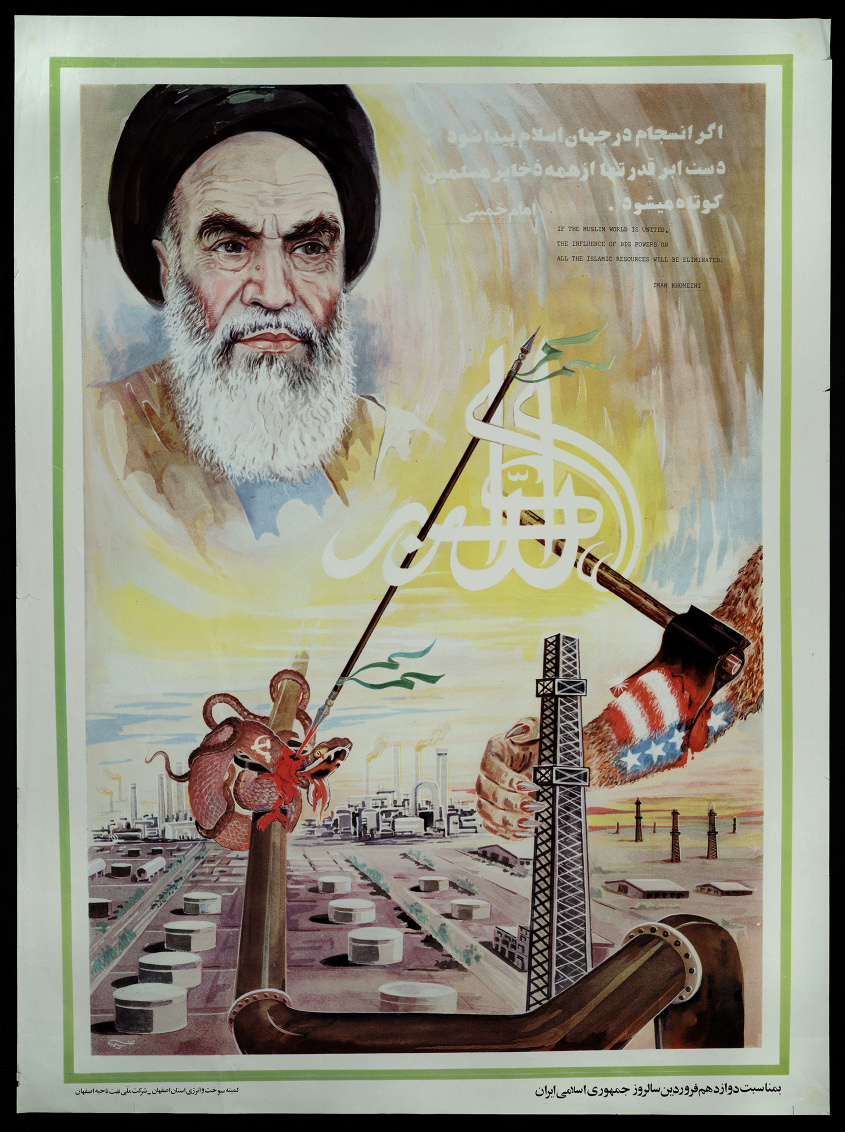
PLATE X Anti-imperialist poster, with a portrait of Khomeini and quoting his call to protect Iran’s resources from the control of the superpowers. Issued by the Petroleum Company for the Area of Isfahan (Komita-ye soḵt va enerži-ye ostān-e Eṣfahān, Šerkat-e naft-e nāḥiya-ye Eṣfahān) on the occasion of the 12 Farvardin anniversary of the Iranian Revolution. Source: Middle Eastern Posters Collection, Box 4, Poster 198, Special Collections Research Center, University of Chicago Library.
The ṭalaba should beware not only of the pseudo-saintly but also of “pseudo-revolutionaries,” by whom he presumably meant “liberals” such as Bāzargān and his associates. Immediately after the revolution, Khomeini confessed, he had appointed to important positions persons who did not believe in Eslām-e nāb-e Mohammadi; he did so reluctantly, on the advice of friends left unnamed. As for the present, some people ask why he implemented God’s command against the monāfeqin, an obvious reference to Montaẓeri’s objections to the mass executions that followed the Mojāhedin incursion of 26 July 1988. As long as he was alive, Khomeini affirmed, he would not allow the government to fall into the hands of the liberals and the monāfeqin and thereby destroy the Islam of the Iranian people (Ṣaḥifa-ye Emām, XXI, pp. 285-86).
Khomeini noted that another problem afflicting the ḥawza was the attempt to create a division between those who adhere to “traditional feqh” (feqh-e sonnati) and those who propagate what they call “exploratory feqh” (feqh-e puyā). Khomeini did not, at least on this occasion, make a clear distinction between the two. It seems, however, that the former takes as its point of departure the Qur’an and Sunna before engaging in ejtehād (q.v.), while the latter first engages in rational consideration and then attempts to reconcile the results with the Qur’an and Sunna. Khomeini claimed that the true motive of the proponents of feqh-e puyā was to sideline revolutionary modarresin and put the pseudo-saintly in control of the ḥawza. Among the numerous services of the “traditionalists” was denouncing a claimant to marjaʿiya who had distanced himself from the revolution (here again, it is Šariʿatmadāri who was intended). If debate is to take place between adherents of the two tendencies, it should be done with moderation. His own preference, Khomeini made clear, was for the exercise of ejtehād in accordance with feqh-e sonnati, a discipline which itself has claims to being puyā, for variations in time and place are always taken into consideration, and the mojtahed must be aware of the political, social, economic, and cultural complexities of the age. Properly understood, feqh is the means for regulating man’s life “from cradle to grave.” Important, therefore, is that feqh should not remain in the books of the scholars, but also be ʿamali, acted upon (Ṣaḥifa-ye Em ām, XXI, pp. 287-89, 292). It is precisely feqh-e sonnati, cultivated and implemented by the ruḥāniyat, that is seen by foreign enemies as a danger; it is this, rather than concern for the person of Rushdie, that explains their denunciation of the fatwā. Further, they propagate the notion that those scholars are responsible for the shortages and problems afflicting the masses, rather than the economic blockade of Iran and the war. By way of conclusion, Khomeini appealed to competent members of the ḥawza to accept executive and judiciary positions as a “sacred concern” (amr-e moqaddas) (Ṣaḥifa-ye Emām, XXI, pp. 286-89).
Testament and death. Khomeini’s will and testament (PLATE XI), entitled Ṣaḥifa-ye enqelāb:Waṣiyat-nāma-ye siāsi-elāhi, bears the date 15 February 1983, presumably the day on which he completed it, some six years before his demise. On 14 July 1983, it was sealed with his stamp and entrusted to the Assembly of Experts (Majles-e ḵobragān). In the following years, Khomeini made some changes and arranged for one copy to be archived at the Majles-e ḵobragān and the other to be sent to the Āstān-e Qods-e Rażawi (q.v.) in Mashhad; this took place on 10 December 1987. Although when writing his testament he had some six years left to live, Khomeini described himself in it as taking his “last breaths,” clearly not in a literal sense, but rather as anticipating his death, perhaps as the result of a diagnosis made during his hospitalization (Ṣaḥifa-ye enqelāb: Waṣiyat-nāma-ye siāsi-elāhi, in Ṣaḥifa-ye Emām, XXI, pp. 393-452). It consists primarily of prolix, often repetitive, exhortations and admonitions addressed to the various segments of Iranian society, and others to the Muslim world at large; it has much in common with the Manšur-e ruḥāniyat, delivered some two years after its composition. Throughout, Khomeini displays an acute awareness of actual and potential threats, of opposition and discontent; the Islamic Republic is portrayed as a work in progress. His testament also serves as a summary of the history of the Islamic Republic as he viewed it.
It begins on a gnostic note. In what may be called a preamble, Khomeini examines al-Ṯaqalayn, the hadith in which the Prophet proclaims the Book of God and his descendants, the Ahl al-Bayt (see AHL-E BAYT), to be the two entities of supreme value that constitute his legacy and shall remain interconnected until they enter al-ḥawż (“the pond”); this, Khomeini suggested, means “the station wherein the drops are absorbed into the sea,” or “the union of multiplicity with unity.” Next, in a lengthy invocation of blessings on the Prophet and the Ahl al-Bayt, he describes them as “the treasuries of Your Book, in which absolute unity is manifested with all of Your names, including even the reserved name (al-esm al-mostaʾ ṯ ar).” He had already discussed the concept of “the reserved name” in his Šarḥ doʿā al-saḥar. According to a tradition of Imam Jaʿfar al-Ṣādeq, this name, also known as “the supreme name” (al-esm al-aʿżam), consists of seventy-three letters; knowledge of varying quantities of these letters had been bestowed on the prophets, culminating in the Prophet Moḥammad, to whom knowledge of seventy-two letters was revealed—one short of the full total. It is in this sense that “the supreme name” is reserved (Šarḥ doʿā al-saḥar, pp. 85-86). On this occasion, Khomeini does not explain the meaning of the term, nor does he attempt to examine the gnostic implications of the hadith of al-Ṯaqalayn: his intention is rather to examine what has befallen the two, the Book of God and the Ahl al-Bayt, after the death of the Prophet. Important to what follows is that the hadith in question, although more commonly invoked by Shiʿis, is to be found in the six authoritative books of the Ahl al-Sunna, so that its sense is binding on all Muslims.
Beginning with the martyrdom of Imam ʿAli, the Qur’an was effectively laid aside, and the possibility of just government annulled. Distortions and deviations continually proliferated, thanks to the tyrants (ṭāḡutihā) and “vile akhunds” (āḵundhā-ye ḵabiṯ; see ĀḴUND). Recitation of the Qur’an was confined to funerals, and anyone who spoke of Islamic government was denounced as a sinner. Fine, ornate printings of the Qur’an were made by the shah, for which certain āḵunds praised him, and then by King Fahd of Saudi Arabia, to aid in propagating the superstitious creed of Wahhabism. However, the message of the Qur’an has now been saved from extinction thanks to the Iranian people’s devotion. Second only to the Qur’an is the Nahj al-balāḡa, adherence to which is a source of pride. Pride, too, is to be taken in the uprising of all ranks of the people for the sake of just government, and the direct participation of qualified and capable women in the defense of Islam—something opposed by “friends of ours unacquainted with the rules of Islam”—as well as the stoic endurance of mothers whose sons had been martyred. America, “the terrorist state” par excellence, has set the world on fire, together with its allies: Zionism; King Hussein of Jordan; Hosni Mubarak of Egypt, “who shares a trough with Israel”; and Saddam Hussein of Iraq.
The people should remain impervious to foreign propaganda and committed to the straight path, neither that of “the atheist East nor the oppressive West,” and they should be on watch at all times for “agents, foreign or domestic,” the latter being worse than the former. All Muslims should follow the teachings of the Imams and the feqh-e sonnati deriving therefrom, not listen to the “whisperers insinuating evil” (waswāsān-e ḵannāsān), an expression drawn from Qur’an, 114:4. Crucial in this respect are attending Friday prayer and congregational prayers; observing the ritual mourning on ʿĀšurāʾ (q.v.); cursing those who oppressed the Ahl al-Bayt, above all the Omayyads; resisting the United States and the Soviet Union and their dependents (PLATE X), above all the Saudis, who have betrayed the Ḥaramayn—they should be cursed loudly (Ṣaḥifa-ye Emā m, XXI, pp. 393-400).
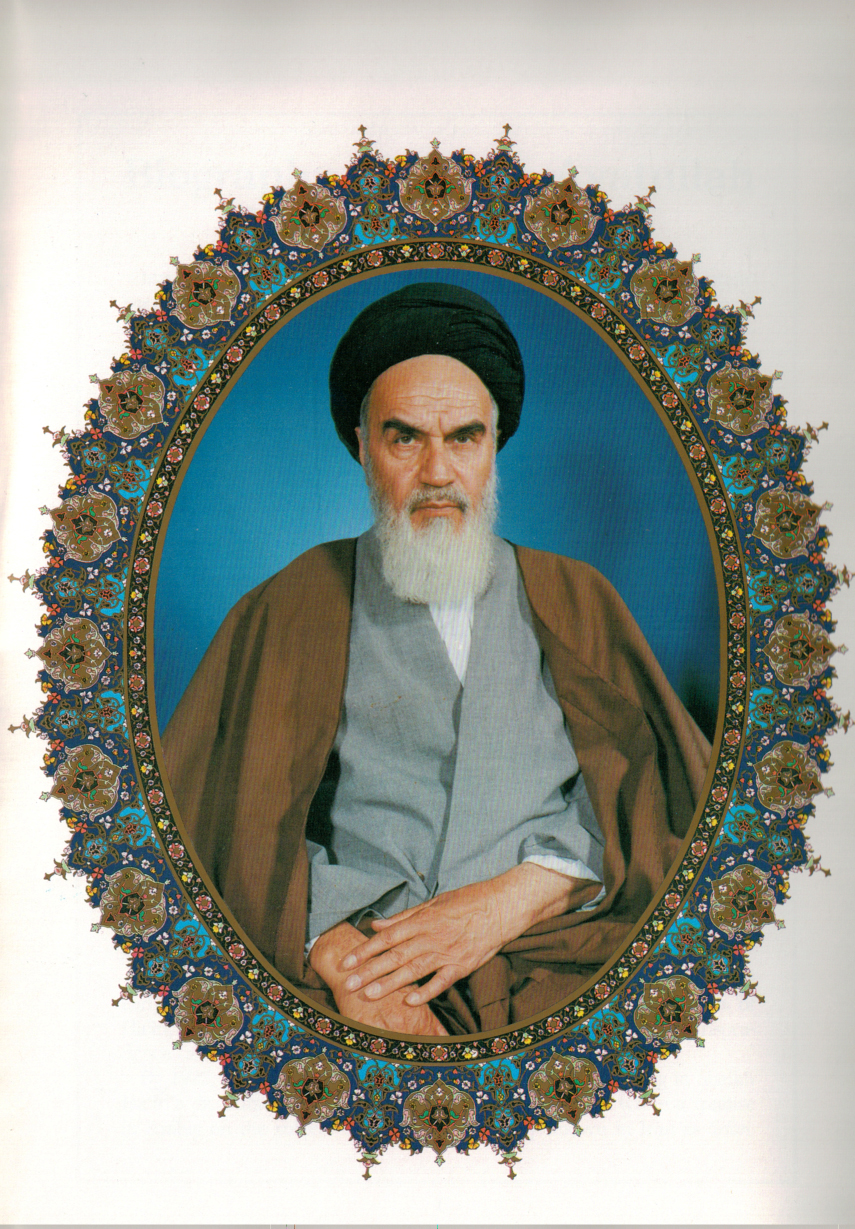
PLATE XI Cover and frontispiece for the English translation of Khomeini’s Waṣiyat-nāma, published and distributed by the Interests Section of the Islamic Republic of Iran, Embassy of the Democratic and Popular Republic of Algeria, Washington, D.C., n.d.
The testament proper begins with an enumeration of the obstacles which, with divine help, have been surmounted by the revolution. For a hundred years, a propaganda war had been waged against Islam, by writers sowing discord among the people in the mass media, meetings and gatherings held to subvert belief, the proliferation of debauchery and immorality, and the consumption of drugs and alcohol. Worse still was the situation in universities and high schools, where most instructors were enamored of either the West or the East. True, there was among them a small committed minority that proclaimed itself “nationalist” (melli-gerā), but it was unable to accomplish anything. Here, Khomeini is doubtless alluding to Bāzargān and like-minded persons. It was only with divine aid, he continues, that these multiple obstacles were surmounted, setting apart the Islamic Revolution of Iran from all other revolutions. Incumbent now on the people of Iran is safeguarding the Islamic order (Ṣaḥifa-ye Emām, XXI, p. 402).
Next, and throughout his testament, Khomeini warns of ongoing threats and challenges, both from abroad and within the country. The aim of the revolution must always be kept in mind to avoid division and disunity, an aim promoted by incessant propaganda. The leaders of some Muslim countries submissive to the United States, joined by pseudo-clerics (ruḥāni-namāhā
) within Iran, suggest that Islam as a fourteen-century-old religion cannot cope with the challenges of modern government. Then there are those who claim that the concern of Islam is only with the spiritual realm and that participation in government is sinful. The first of these groups is ignorant of the nature of government, and imagines that justice and the rules for its implementation are outdated. The second group is unaware that the Qur’an contains more rulings concerning government than any other subject; even those relating to worship have a political dimension (Ṣaḥifa-ye Emām, XXI, pp. 406-7).
More harmful than the foregoing, Khomeini noted, are the rumors, widespread throughout the country, but especially in the provinces, that the Islamic Republic has accomplished nothing for the people, that they are now in the thrall of a regime worse than the one they overthrew: The prisons are full of young men, and the torture they endure is worse than that practiced under the Shah! Executions take place every day in the name of Islam! The diffusion of these complaints is in itself proof of a conspiracy: A complaint is made somewhere in the country, and then it is repeated in taxis and buses. Certain clerics are also involved. Neither the problems that inevitably occur after revolutions nor the positive developments that have taken place should be ignored (Ṣaḥifa-ye Emām, XXI, p. 408). Islam is like a newborn infant, surrounded by enemies; it deserves mercy and sympathy.
There follows a clear acknowledgement of existing shortcomings: “I have never said, nor do I say now, that everything has been done in accordance with Islam or that no one, out of ignorance, has acted contrary to the regulations of Islam, but the three branches of government are striving to make this country fully Islamic, enjoying the support of tens of millions of its people. If the fault-finding minority were to join them, problems would be solved more swiftly and easily” (Ṣaḥifa-ye Emām, XXI, pp. 409-10). Those loyal millions are better than the people of the Hijaz in the time of the Prophet and those of Iraq in the time of Imam ʿAli; they would disobey them under some pretext or other. All branches of the Iranian armed forces manifest extreme devotion, and the families of the martyrs show fortitude. Listen to the tape recordings circulating in the country, Khomeini counsels the youth, those made by the hypocrites and the opportunist deviants who want the Islamic Republic to collapse, and then compare them with those made by the martyrs, and see which group truly supports the deprived and the oppressed (Ṣaḥifa-ye Emām, XXI, pp. 411-12)
Khomeini next addresses a frequently recurring concern: The often hostile dichotomy between universities and the religious institution that had been fostered by the Pahlavis. University professors were selected from the “Westoxicated” and the “Eastoxicated,” both categories presenting Islam as reactionary; committed believers were a small minority among them. Religious scholars for their part came to fear the universities and the government officials they produced as irreligious, and the religiously inclined masses were fully alienated from the state. The divide between dānešgāhi and ruḥāni resulted in a plundering of the country and its resources. Professors and university students should now establish ties of friendship with the religious scholars and their students, and expel from their midst those who act in contrary fashion (Ṣaḥifa-ye Emām, XXI, p. 414). Somewhat later, alluding to the cultural revolution (enqelāb-e farhangi) that was still underway at the time, Khomeini exhorts students and faculty alike to resist those who wish to alienate them from the ruḥāni (Ṣaḥifa-ye Emām, XXI, pp. 418-19).
Another persisting affliction had been a sense of inferiority and alienation from the country’s own culture, instilled in the people by the Pahlavis, as if they could never engage in useful innovation or attain self-sufficiency. The result was an imported culture of consumerism and immorality; the youth wasted its time in places of vice and entertainment. Now, however, despite the embargoes imposed on Iran, or perhaps even because of them, some progress to self-sufficiency has been made; Iranian factories, for example, can now manufacture aircraft parts. Useless consumer goods must no longer be imported, and competent technical experts should be encouraged (Ṣaḥifa-ye Emām, XXI, pp. 415-17).
After the Constitutional Revolution of 1907, particularly under the Pahlavis, the Majles had been controlled by a corrupt majority that did the bidding of Britain and America; the constitution was never properly observed. Now that the situation is different, people should elect representatives who are acquainted with the rulings of Islam, “not persons inclined to deviant schools of thought (maktabhā-ye enḥerāfi).” If deviant elements are nonetheless elected, their credentials should immediately be withdrawn. The religious scholars, particularly the marājeʿ, also have a duty in this respect. It was they who brought about the constitution of 1907 and then left the political scene. Indifference now to politics and the affairs of the Muslims would be an unpardonable sin. Everyone should participate in elections, whether for the president, the Majles, or the Council of Guardians (Ṣaḥifa-ye Emām, XXI, pp. 419-21).
Khomeini continued by stating that the judiciary stands in need of committed persons, well trained in feqh at one of the ḥawzas, especially Qom; those without such qualifications should be removed. The ḥawzas must guard against infiltration by deviant saboteurs, including “nationalists” (melligerāhā), fraudulent intellectuals, and sympathizers of the Mojāhedin-e ḵalq, the Fedāʾiyān-e ḵalq, and the Tudeh party. Feqh-e sonnati must be preserved as the basis for all research and investigation, but this does not preclude innovative methods of teaching and discussion. Necessary, too, is training in moral refinement (tahḏib-e nafs) and spiritual progress toward God (sayr o soluk), this being the supreme jihad (Ṣaḥifa-ye Emām, XXI, pp. 424-26).
The Foreign Ministry should exercise care in appointing ambassadors. Particularly sensitive are relations with other Muslim countries, most of which are hostile to the Islamic Republic; unity with their peoples should be promoted, by means of appropriate publications. The Ministry of Guidance ought similarly to improve its efforts to counter the propaganda waged against the Islamic Republic by the superpowers. If university students are to be sent abroad, it should be to industrially advanced countries, but not to the United States or the Soviet Union (Ṣaḥifa-ye Emām, XXI, p. 427).
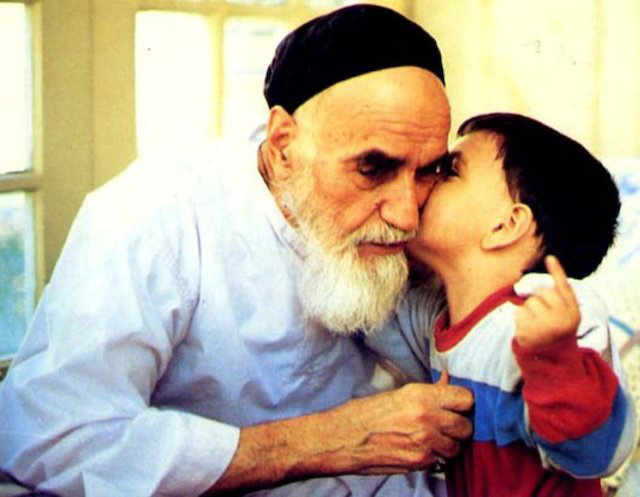
PLATE XII Khomeini with grandson in Jamārān, late 1980s. After http://english.khamenei.ir/d/2015/09/19/3/281.jpg (original source unknown).
Iranians abroad opposed to the revolution should come to their senses, and return to Iran unless they have committed a crime deserving punishment. Leftist groups should admit that communism has failed, and the only result of their efforts to gain autonomy for the Kurds and the Baluch has been to prevent economic aid from reaching them. There are those who oppose the government because of some of its errors, but they should realize that certain mistakes are inevitable in the aftermath of revolutions. The war imposed numerous hardships, and government institutions were infiltrated by people seeking to sabotage the Islamic Republic. Above all, the sacrifices made by those who fought and gave their lives at the front should not be forgotten (Ṣaḥifa-ye Emām, XXI, 436-49). In conclusion, Khomeini proclaims: “With a tranquil heart and joyful spirit, I take my leave of my sisters and brothers, and set out for the eternal resting-place,” asking God and the people to accept his apologies for his shortcomings (Ṣaḥifa-ye Emām, XXI, p. 450).
Appended to the testament were three admonitions; it is unclear whether they were added immediately after he had completed writing it or later, at some point before his death. Either way, they bear witness to developments that he found disturbing at the time. The first disowned statements or pronouncements attributed to him unless they had been written by him and bore his seal, were authenticated by experts (kāršenāsān), or had been broadcast on state media. Second, “certain persons” had been claiming to have arranged his move to Paris after he had been turned back at the frontier with Kuwait, whereas it was in consultation with his son, Aḥmad, and him alone, that he had chosen Paris as his destination. The “certain persons” may have been from the Freedom Movement, among them in particular Ebrāhim Yazdi; the general view was indeed that it was Yazdi who made this extremely important proposal (Chehabi, p. 242). Its attribution to Aḥmad may reflect the important role he played in his father’s last years. Finally, he confessed to having praised in the course of the revolution hypocrites whose deceitfulness he had later discovered; the criterion for assessing everyone should be their current posture (ḥāl-e feʿli). No names are given in this connection, perhaps Bāzargān, Bani-Ṣadr, and Montaẓeri are intended and people who might come to resemble them in the future. This last admonition clearly betrayed anxiety for the future welfare of the Islamic Republic (Ṣaḥifa-ye Emām, XXI, pp. 451-2). Significant, perhaps, was this warning, extracted from his declaration accepting the ceasefire, posted next to his mausoleum, that was seen by the present writer on his visit in June, 2009: “Do not permit the revolution after me to fall into the hands of the unworthy (nā-ahlān).”
Khomeini passed away shortly before midnight on 3 June 1989, after suffering a series of heart attacks. The next day, the seal on his testament was broken. He had stipulated that Aḥmad was to read it aloud, but, overcome by grief, he was unable to do so; it therefore fell to Khamenei to accomplish the task. Mass demonstrations of mourning filled the streets of Tehran, and when, on 5 June, Khomeini’s body was taken to the Moṣallā in the hills to the north of the city to be prepared for burial, crowds massed there as well. It was then placed in a helicopter to be conveyed to the Behešt-e Zahrā cemetery, but once there, the burial shroud was torn to pieces by mourners, and it became necessary to take the body back to the Moṣallā to be shrouded anew under the supervision of Ayatollah Golpāyagāni. The crowds had not diminished when it was returned to the cemetery for burial. The scenario was appropriately reminiscent of his arrival from Paris, when similarly accompanied by vast numbers of supporters, he had proceeded from the airport to Behešt-e Zahrā. Thus was he laid to rest, in proximity to those who had given their lives for the Islamic Republic he had led and inspired. The construction of a mausoleum, intended to be the center of a complex of buildings, was begun on 18 July 1989 (PLATE XIII). Buried in it are also Khomeini’s son, Aḥmad (d. 16 March 1995), and his widow, Ḵadija Ṯaqafi (d. 21 March 2009).
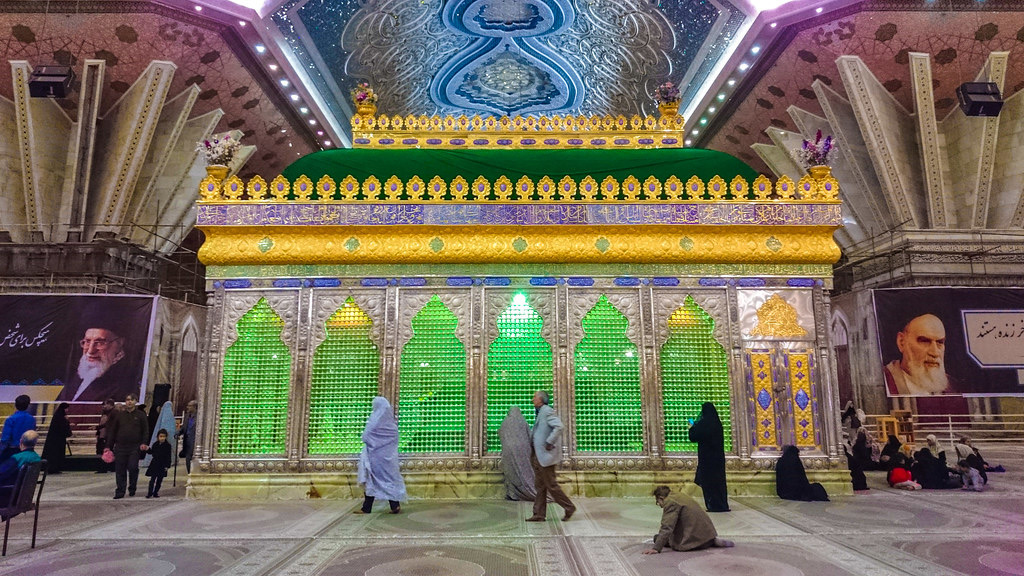
Bibliography
- Works of Khomeini cited in this entry:
- Ādāb al-ṣalāt: Ādāb-e namāz, Tehran, 1994.
- Divān-e Emām: Majmuʿa-ye ašʿār-e Emām Ḵomeyni, Tehran, 1994.
- Ḥokumat-e eslāmi, n.p., 1971 (English translation by Hamid Algar in Khomeini, Islam and Revolution, Berkeley, Calif., 1981, pp. 27-149).
- Kašf al-asrār, Tehran, n.d. Kawṯar, 2 vols., Tehran, 1984.
- Ṣaḥifa-ye Emām: Bayānāt, payāmhā, moṣaḥeba-hā, aḥkā m, ejāzāt-e šarʿi va nāma-hā, 21 vols., Tehran, 1999.
- Šarḥ doʿā al-saḥar, ed. Aḥmad Fehri, Tehran, 1983.
- Serr al-ṣalāt: Meʿrāj al-sālekin wa salāt al-ʿārefin, Tehran, 1996.
- Tafsir-e sura-ye ḥamd, Tehran, 1996. Taḥrir al-wasila, 2 vols., Qom, 1970.
- Tawżiḥ al-masāʾ el, n.p., n.d. Waʿda-ye didār, Tehran, 1997.
- Documentary sources.
- Majmuʿa-ye moṣawwabāt-e Majmaʿ-e tašḵiṣ-e maṣlaḥat-e neẓām-e eslāmi, Tehran, 1997.
- Qā nun-e asāsi-ye Jomhuri-ye Eslāmi-ye Irān hamrāh bā eṣlāḥāt-e Šurā-ye bāznegari-ye Qā nun-e asāsi, Tehran, 1991.
- Sayr-e mobārezāt-e Emām Ḵomayni ba rewāyat-e asnād-e SĀVĀK, 22 vols., 2nd. ed, Tehran, 1987.
- Primary sources.
- Javādi Āmoli, Bonyān-e marṣuṣ-e Emām Ḵomeyni, Qom, 1997.
- Ḥamid Anṣāri, Mohājer-e qabila-ye imān, Tehran, 1996.
- Āšnāʾi bā Majles-e šurā-ye eslāmi: Kār-nāma-ye 1361, Tehran, 1984.
- Asad-Allāh Bādāmčiān and ʿAli Benāʾi, Hayʾathā-ye moʾtalefa-ye eslāmi, Tehran, 1983.
- Baḥṯi dar bāra-ye marjaʿiat va ruḥāniat, Tehran, 1972.
- ʿAqiqi Baḵšāyeši, Yak-ṣad sāl mob āreza-ye ruḥāniat-e Šiʿa, 3 vols., Qom, 1982.
- Abol Hassan Bani-Sadr (Abu’l-Ḥasan Bani-Ṣadr), L’Espérance Trahie, Paris, 1982.
- Mehdi Bāzargān, Enqelāb-e Irān dar do ḥarakat, Tehran, 1984.
- Hedāyat-Allāh Behbudi, Šarḥ-e esm: Zendagi-nāma-ye Āyatollāh Sayyed ʿAli Ḵāmenaʾi, Tehran, 2012.
- Biografi-ye Pišvā, Tehran, n.d.
- Moḥammad Taqi Bušehri, “Ruh-Allāh Musawi Ḵomeyni: Ṭofuliat, ṣabāwat, va šabābat,” Češ mandāz no. 5, 1368 Š./1989, pp. 12-37.
- Idem, “Ruḥ-Allāh Musawi Ḵomeyni: Dawrān-e taḥṣil va taʿallom dar Dār al-amān-e Qom,” Češmandāz no. 10, 1371 Š./1992, pp. 38-41.
- Idem, “ Ruḥ-Allāh Musawi Ḵomeyni: Taʿallom dar ḥawza-ye ʿelmiya-ye Qom,” Češ mandāz no. 11, 1371 S./1992.
- Idem, “ Ruḥ-Allāh Musawi Ḵomeyni: Moʿallemān va ostādān,” Češmandāz no. 12, 1372 Š,/1993, pp. 44-57.
- Idem, “ʿĀref-e Kāmel Mirzā Moḥammad ʿAli Šāhābādi: Moʿallem va morād-e Ruḥ-Allāh Musawi Ḵomeyni,” Češmandāz no. 13, 1373 Š./1994, pp. 32-41.
- ʿAli Davāni, Nahżat-e ruḥāniān-e Irān, 10 vols., Tehran, n. d.
- M. Dehnavi, Qiām-e ḵunin-e 15 Ḵordād be rewāyat-e asnād, n.p., 1982.
- Moḥammad Moḥammadi Gilāni, Emām-e rāḥel wa feqh-e sonnati, Tehran, 1994.
- Ḥamāsa-āfarinān-e Qom va Tabriz, 3 vols., n.p., n.d.
- Ḥekāyat-e mehr, yādmān-e sālgard-e reḥlat-e yādgār-e gerāmi-e Emām Ḵomeyni, Tehran, 1996.
- ʿAli Reżā Ḥosayni, Āʾina-ye dānešvarān, Tehran, 1934.
- ʿAli Rabbāni Ḵalḵāli, Šohadā-ye ruḥāniyat dar yak-ṣad sāl-e aḵir, n.p. 1982.
- Ṣādeq Ḵalḵāli, Ḵāṭerāt az ayyām-e ṭalabagi tā dawrān-e ḥākem-e šarʿ-e dādgāhhā-ye enqelāb-e eslāmi, Tehran, 2001.
- Aḥmad Ḵomeyni, Ranj-nāma, Tehran, 1989.
- Idem, Pedar ʿalamdār-e maktab-e maẓlum, Tehran, 1993.
- Moʾassasa-ye tanẓim va našr-e āṯār-e Ḵomeyni, Maḥżar-e nur: Fehrest-e didārha-ye Emām Ḵomeyni, 2 vols., Tehran, 1995.
- Idem, Dalil-e āftāb: Kāṭerāt-e yādgār-e Emām, Tehran, 1996.
- Ḥosayn ʿAli Montaẓeri, Derās āt fi Welāyat al-faqih, 2 vols., Beirut, 1989.
- Idem, Ḵāṭerāt, Los Angeles, 2001.
- Moḥammad Morādiniā, Saṭr-e awwal: Ḵānd ān, rejāl, va ḥawādeṯ-e bist sāl-e naḵost-e zendagi-ye Emām Ḵomeyni, Tehran, 2006.
- Mortażā Moṭahhari, ʿElal-e gerāyeš ba māddigari, Tehran, 1978.
- Omid-e Eslām: Šahid Āyat-Allāh Ḥājj Sayyed Moṣṭafā Ḵomeyni be rewāyat-e asnād-e SĀVĀK, Tehran, 2009.
- Mortażā Pasandida, Ḵāṭerāt, ed. Moḥammad Morādiniā, Tehran, 1995.
- Qiām-e ḥamāsa-āfarin-e Qom va Tabriz, 3 vols., n.p., 1977-78.
- Moḥammad Ḥasan Rajabi, Zendagāni-ye siāsi-ye Emām Ḵomeyni az āḡāz tā tabʿid, Tehran, 1991.
- Moḥammad Reyšahri, Ḵāṭerahā, Tehran, n.d.
- Moḥammad Šarif Rāzi, Ā ṯār al-ḥojja, 2 vols., Qom, 1954.
- Ḥamid Ruḥāni, Nahżat-e Emām Ḵomeyni, 18th ed., 4 vols., Tehran, 2001.
- Ruḥāniun-e mobārez-e ḵārej az kešvar, Šahidi digar az ruḥā niyat, Najaf, n.d.
- Ayatollah Moḥammad ʿAli Šāhābādi, Šaḏarāt al-maʿāref, Tehran, 1982.
- ʿAbd al-Karim Soruš, ed., Yād-nāma-ye ostā d-e šahid Mortażā Moṭahhari, Tehran, 1981.
- Fāṭema Ṭabāṭabāʾi, Eqlim-e ḵāṭerāt, Tehran, 2011.
- Terurism-e żedd-e mardomi: baḥṯi pirāmun-e māhiat va ahdāf-e ḥarakat-e mosallaḥāna-ye monāfeqin, Tehran, 1982.
- U ba tanhāʾi yak ommati bud, Tehran, 1982 (a collection of speeches by Ayatollah Behešti with materials for his biography).
- Moṣṭafā Vejdāni, ed., Sargoḏašthā-ye viža az zendagi-e Hażrat-e Emām Ḵomeyni, Tehran, 1989.
- Viža-nāma-ye Ostād-e Šahid Mortażā Moṭahhari, n.p., n.d.
- Yādegār-e Emām: Ḥojjat-al-Eslām Ḥājj Sayyed Aḥmad Ḵomeyni be rewāyat-e asnād-e SĀVĀK, Tehran, 2009.
- Other sources.
- Pejman Abdolmohammadi, “Il Repubblicanesimo Islamico dell’Ayatollah Khomeini,” Oriente Moderno, n.s. 89, 2009, pp. 87-100.
- Ervand Abrahamian, Iran between Two Revolutions, Princeton, 1983.
- Idem, The Iranian Mojahedin, New Haven, 1989.
- Idem, Khomeinism: Essays on the Islamic Republic, London and New York, 1993.
- Arshin Adib-Moghaddam, ed., A Critical Introduction to Khomeini, Cambridge, 2014.
- Ṣādeq Āhangarān, ed., Lāla-hā-ye ḵunin-e enqelāb, Tehran, 1983.
- Moṣṭafā Alamuti, Irān dar ʿaṣr-e Pahlavi, 10 vols., London, 1988-91.
- Hamid Algar, “The Oppositional Role of the Ulama in Twentieth-Century Iran,” in N. Keddie, ed., Scholars, Saints and Sufis, Berkeley and Los Angeles, 1972, pp. 231-55.
- Idem, tr., Constitution of the Islamic Republic of Iran, Berkeley, 1980.
- Idem, tr. and annotated, Islam and Revolution: Writings and Declarations of Imam Khomeini, Berkeley, 1981.
- Idem, Roots of the Islamic Revolution in Iran, London, 1983.
- Idem, “Imam Khomeini, 1902-1962: The Pre-Revolutionary Years,” in Edmund Burke and Ira Lapidus, eds., Islam, Politics, and Social Movements, Berkeley and Los Angeles, 1988, pp. 263-88.
- Idem, “Religious Forces in Twentieth-Century Iran,” in Peter Avery, Gavin Hambly, and Charles Melville, The Cambridge History of Iran VII: From Nadir Shah to the Islamic Republic, Cambridge, 1991, pp. 732-64.
- Idem, “A Short Biography,” in Abdar Rahman Koya, ed., Imam Khomeini: Life, Thought and Legacy, Essays from an Islamic Movement Perspective, Kuala Lumpur, 2009, pp. 19-60.
- Ḥamid Anṣāri, Ḥadiṯ-e bidāri, Tehran, 1995.
- Said Amir Arjomand, The Shadow of God and the Hidden Imam, Chicago, 1984.
- Idem, Authority and Political Culture in Shi’ism, Albany, 1988a.
- Idem, The Turban for the Crown: The Islamic Revolution in Iran, New York and Oxford, 1988b.
- Ahmad Ashraf, “Charisma, Theocracy and New Men of Power in Postrevolutionary Iran,” in M. Weiner and A. Banuazizi, eds., The Politics of Social Transformation in Afghanistan, Iran, and Pakistan, Syracuse, 1994, pp. 101-55.
- Ahmad Ashraf and Ali Banuazizi, “The State, Classes, and Modes of Mobilization in the Iranian Revolution,” State, Culture, and Society 1/3, 1985, pp. 3-40.
- Fakhreddin Azimi, “Khomeini and the ‘White Revolution,’” in A. Adib-Moghaddam, ed., A Critical Introduction to Khomeini, Cambridge, 2014, pp. 19-42.
- Shaul Bakhash, The Reign of the Ayatollahs: Iran and the Islamic Revolution, New York, 1986.
- Maziar Behrooz, “Factionalism in Iran under Khomeini,” Middle Eastern Studies 27, 1991, pp. 597-614.
- Christian Bonaud, L’Imam Khomeyni, un gnostique méconnu du XXe siècle, Beirut, 1997.
- Daniel Brumberg, Reinventing Khomeini: The Struggle for Reform in Iran, Chicago, 2001.
- Norman Calder, “Accommodation and Revolution in Imāmi Shiʿi Jurisprudence: Khumayni and the Classical Tradition,” Middle Eastern Studies 18, 1982, pp. 3-20.
- Cengiz Çandar, Dünden yarına İran, Istanbul, 1981.
- Houchang Chehabi, Iranian Politics and Religious Modernism: The Liberation Movement of Iran under the Shah and Khomeini, Ithaca, N.Y., 1990.
- Ronen A. Cohen, Revolution under Attack: The Forqan Group of Iran, New York, 2016.
- Elvire Corboz, “Khomeini in Najaf: The Religious and Political Leadership of an Exiled Ayatollah,” Die Welt des Islams 55, 2015, pp. 221-48.
- David Crist, The Twilight War, New York, 2012.
- Stephanie Cronin, Reformers and Revolutionaries in Modern Iran: New Perspectives on the Iranian Left, London, 2004.
- Hamid Dabashi, “Ayatollah Khomeini: The Theologian of Discontent,” in idem, Theology of Discontent: The Ideological Foundation of the Islamic Revolution in Iran, New York, 1993, pp. 400-484.
- Joanna De Groot, Religion, Culture, and Politics in Iran: From the Qajars to Khomeini, London, 2007.
- E. A. Doroshenko, Shiitskoe Dukhovenstvo v Sovremennom Irane, Moscow, 1975.
- Diede Farhosh-van Loon, “The Fusion of Mysticism and Politics in Khomeini’s Quatrains,” International Journal of Persian Literature 1, 2016, pp. 59-88.
- Vali-Allāh Fawzi, Ḥamāsahā-ye eslāmi-e mellat be rahbari-e Emām Ḵomeyni, Qom, n.d.
- Moḥammad Ḥosayn Fażl-Allāh, Taʾammolāt fi’l-fekr al-ḥaraki wa’l-siāsi wa’l-manhaj al-ejtehādi ʿend al-Emām al-Ḵomeyni, Beirut, 2000.
- Michael M. J. Fischer, Iran: From Religious Dispute to Revolution, Cambridge, Mass., and London, 1980.
- Moḥammad Moḥammadi Gilāni, Esm-e mostaʾṯar dar waṣiyat-nāma-ye Emām wa zaʿim-e akbar, Tehran, 1991.
- Idem, Emām-e rāḥel va feqh-e sonnati, Tehran, 1995.
- Sayyed Sadegh Haghighat, ed., Six Theories about the Islamic Revolution’s Victory, Tehran, 2000.
- Moḥammad Reżā Ḥakimi, Tafsir-e Āftāb, Tehran, n.d.
- Dilip Hiro, Iran under the Ayatollahs, London, 1985.
- Idem, The Longest War: The Iran-Iraq Military Conflict, Ann Arbor, 1989.
- Idem, The Iranian Labyrinth, New York, 2005.
- Moḥammad-Ṣādeq Ḥosayni, al-Ḵomeyni fi rasāʾel al-eṣlāh wa’l-taḡyir, Beirut, n.d. [2009].
- Nura Hossainzadeh, “Ruhollah Khomeini’s Political Thought: Elements of Guardianship, Consent, and Representative Government,” Journal of Shi’a Islamic Studies, 7/2, 2014, pp. 26-44.
- Idem, “Democratic and Constitutional Elements in Khomeini’s Unveiling of Secrets and Islamic Government,” Journal of Political Ideologies, 21/1, 2016, pp. 26-44.
- Fahmi Howaydi, Irān men al-dāḵel, Cairo, 1988.
- Asaf Hussain, Islamic Iran: Revolution and Counter Revolution, New York, 1985.
- Moṣṭafā Izadi, Gozari bar zendagi-ye Āyat-Allāh Montaẓeri faqih-e ʿaliqadr, 2 vols., Tehran, 1987.
- ʿAli Kamāli, Enqelāb, Tehran, n.d. Nikki R. Keddie, Roots of Revolution: An Interpretive History of Modern Iran, New Haven and London, 1981.
- Idem, ed., Religion and Politics in Iran: Shi’ism from Quietism to Revolution, New Haven, 1983.
- Sayyed Hādi Ḵosrawšāhi, al-Ṯawra al-eslāmiya wa al-emberiāliya al-ʿālamiya, Rome, n.d.
- Abdar Rahman Koya, ed., Imam Khomeini: Life, Thought and Legacy, Essays from an Islamic Movement Perspective, Kuala Lumpur, 2009.
- Flynt Leverett and Hillary Mann Leverett, Going to Tehran: Why the United States Must Come to Terms with the Islamic Republic of Iran, New York, 2013.
- Vanessa Martin, Creating an Islamic State: Khomeini and the Making of a New Iran, London, 2003.
- Hamid Mavani, Religious Authority and Political Thought in Twelver Shi’ism, London and New York, 2013. Mohsen M. Milani, The Making of Iran’s Islamic Revolution, Boulder, San Francisco, and Oxford, 1994.
- Baqer Moin, Khomeini: Life of the Ayatollah, London, 1999.
- Sayyid Amjad Hussain Shah Naqavi, The Mystery of Prayer: The Ascension of the Wayfarers and the Prayer of the Gnostics, Leiden, 2015 (tr. with introd. and annotations of Khomeini’s Serr al-ṣalāt).
- Graeme Newman, “Khomeini and Criminal Justice: Notes on Crime and Culture,” Journal of Criminal Law and Criminology 73, 1982, pp. 561-81.
- ʿAli Qāderi, The Life of Imam Khomeini, Tehran, 2001.
- Farhang Rajaee, Islamic Values and World View: Khomeyni on Man, the State and International Politics, New York and London, 1983.
- R. K. Ramazani, ed., Iran’s Revolution: The Search for Consensus, Bloomington, Ind., 1990.
- Qahhār Rasuliān, Rasul-e bidāri-e šarq: Majmuʿa-ye maqālat-e dānešmandān-e tājik dar bāra-ye Emām Ḵomeyni, Tehran, 2008.
- Māšāʾ-Allah Razmi, Āḏarbāyjān va jonbeš-e ṭarafdārān-e Šariʿatmadāri dar sāl-e 1358, Stockholm, 2000. L. A. Reda, “Khatt-e Imam: The Followers of Khomeini’s Line,” in Adib-Moghaddam, ed., pp. 115-148.
- Yann Richard, “Ayatollah Kashani: ein Wegbereiter der islamischen Republik?,” Religion und Politik im Iran, Berlin, 1981, pp. 277-305.
- Lloyd Ridgeon, “Hidden Khomeini: Mysticism and Poetry,” in A. Adib-Moghaddam, ed., A Critical Introduction to Khomeini, Cambridge, 2014, pp. 193-210.
- Saiyid Athar Abbas Rizvi, A Socio-Intellectual History of the Isnā ʿAshari Shiʿis in India, 2 vols., Canberra, 1986.
- Kishwar Rizvi, “Religious Icon and National Symbol: The Tomb of Ayatollah Khomeini in Iran,” Muqarnas 20, 2003, pp. 209-24.
- Oliver Scharbrodt, “Khomeini and Muḥammad al-Shīrāzī: Revisiting the Origins of the ‘Guardianship of the Jurisconsult’,” Die Welt des Islams 60, forthcoming.
- Asghar Schirazi, The Constitution of Iran: Politics and the State in the Islamic Republic, London and New York, 1997.
- Sayyed Sebṭ-e Ḥasan, Enqelāb-e Irān, Karachi, 1988.
- Asghar Seyed-Gohrab, “Khomeini the Poet Mystic,” Die Welt des Islams 51, 2011, pp. 438-58.
- Gary Sick, October Surprise, New York, 1991.
- ʿAli Širḵāni, Ḥamasa-ye 29-e Bahman-e Tabriz, Tehran, 2000.
- Tā ṣobḥ-e ešrāq: Gozida-ye šeʿr dar manaqabat va sug-e Ḥażrat Emām Ḵomeyni, Tehran, 1997.
- ʿAli Tasḵiri, Derāsāt fi al-fekr al-siāsi le’l-Emām al-Ḵomeyni, Qom, 1995.
- Sinā Vāḥed, Qiām-e Gowhar-šād, Tehran, 1987.
- Waheed-uz-Zaman, Iranian Revolution: A Profile, Islamabad, 1985.
- Linda Walbridge, ed., The Most Learned of the Shi’a: The Institution of the Marjaʿ Taqlid, New York, 2001.
- Sepehr Zabih, The Left in Contemporary Iran, Stanford, 1986. Dmitrii Zhukov, Imam Khomeini: Ocherk Politicheskoi Biografii, Moscow, 1998.
- Sadegh Zibakalam, “To Rule, or Not to Rule? An Alternative Look at the Political Life of Ayatollah Khomeini between 1960 and 1980,” in A. Adib-Moghaddam, ed., A Critical Introduction to Khomeini, Cambridge, 2014, pp. 256-74.