



Cultivated flax has its ancestry in the wild flax (Linum angustifolium L.), which was widely distributed from Western Europe via the Middle East to Iran (Zohary and Hopf, p. 127; Durrant, p. 192). The cultivation of flax goes back thousands of years on the Iranian plateau, as evinced by “a pre-Sargonic text from Girsu (Tello) [that] refers to the cultivation of ‘Susian flax’ in the area of Lagash during the mid-third millennium BCE” (Potts, p. 51). Although Tepe Ali Kosh (ʿAlikoš, q.v.) was abandoned from 6750 BCE onwards, due to geographical conditions (Helbaek, p. 405; Harlan, p. 28, table 1), flax was found several kilometers farther away at Tepe Sabz in Dehlorān (q.v.; Figure 1), where irrigation cultivation had considerably improved the size of wild seeds from 2.4/2.7 to 4.67/4.8 mm (Helbaek, pp. 417-18, table 5). This fact led Hans Helbaek (1907-81) to hypothesize that flax was cultivated between 5500 and 5000 BCE in this region. Flax seeds were also found in Šahr-e Suḵta (Sistān) in an archeological site dated around 2500 BCE (Tosi, p. 186). Indeed, flax continued to be cultivated on the Iranian plateau all the way to the Sasanian (q.v.) epoch. This is confirmed, for example, in the inventory of radiocarbon samples from Dehlorān indicating the presence of cultivated flax at Tepe Sabz in 490 CE (Hole p. 336, table 77).
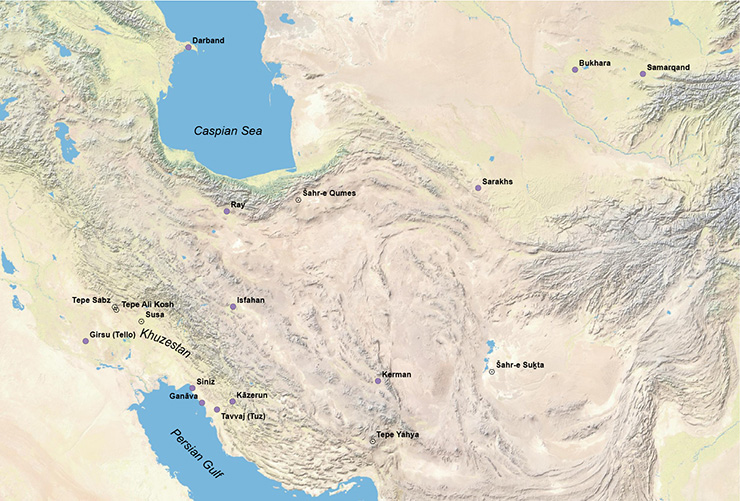
Figure 1. Areas of flax or linen production mentioned in the article. Map background from United States Geological Survey data.
Thomas W. Beale suggests that Susa or/and Mesopotamia (qq.v.) exported commodities like linseed oil and grain directly to Tepe Yahya (q.v.), south of Kerman (p. 143). In Tepe Yayha, Period II (Achaemenid and Hellenistic, 475-275 BCE), the presence of flax is attested without reference to its quantity (Lamberg-Karlovsky and Beale, p. 28, table 3.2). Its cultivation is also attested in the Sasanian (q.v.) and early Islamic periods (Rahimi-Larijani, pp. 140, 248-49; Reade and Potts, p. 103). In the Caspian Sea (q.v.) region, among some other localities, dual-purpose flax was cultivated (Durrant, pp. 190-92). In Khuzestan and the Caspian regions, flax and linen production continued into medieval and modern times.
With regards to linen in ancient Iran, the available archeological evidence is poor. Nonetheless, the earliest examples of textile art in Iran may be attested from the vestiges of two plain linen cloths wrapping two copper axes from the 3rd-4th millennium BCE. One of the pieces is coarse linen with a weft thinner (twisted thin thread) than the warp (coarse thread); the other textile is a skillfully made fine linen. The weft and warp are of the same size. The linens are fabricated on a loom, although it cannot be ascertained if the loom was horizontal or vertical. The manner that the weave of the wraps is spaced shows the usage of a rudimentary shuttle and the absence of combing (Lecaisne, p. 163, Ackerman, 1981a, p. 681).
The discovery of linen at Susa confirms the existence of “Susian flax” at about the 3rd millennium BCE. In spite of the absence of evidence for later periods, textile fragments (wool, silk, cotton and linen) from the 6th-7th century CE Sasanian period confirm the production of linen during that time (Annual Report, p. 11). Of these fragments, one is a plain weave embroidered with wool and cotton, and another is of a plain weave with warp-float pattern. A fragment of a white linen also was excavated at Šahr-e Qumes, ancient Hecatompylus (Crawford, p. 58).
Although there is little information about flax cultivation and weaving in Persian texts, there are, nevertheless, some textual references: Qāsem b. Yusof Abunaṣri Haravi in the Eršād al-zerāʿa (q.v.; compiled in 921/1515) described the method of flax cultivation (p. 102). Rašid-al-Din Fażl-Allāh Hamadāni (d. 718/1318) states that flax was cultivated in Persia either in the same season as cotton or in autumn: “It is cultivated in the sea regions (sawāḥel) lacking water and when the plant is dried its grain is gathered to be cultivated in its turn. Flax stalk is then scotched, that is, it is beaten to open the outer layer (pust bāz gozāštan). This scotched stalk is then passed through an iron-rippling comb (šāna) set tightly on a wooden frame in order to separate the fiber from the rest of the stem. Next the fiber is retted with lixivium (šaḵār) to become soft and white. Then the women spin the fiber with a spindle (dukča) and weave it like cotton cloth (karbās)” (Āṯār , p. 159; Lambton, p. 152).
Rašid-al-Din’s account is quite similar to that of Ebn al-Balḵi (q.v.) who wrote his book Fārs-nāma two centuries earlier (before 511/1117). For the latter, in Kazerun (q.v.), in the province of Fārs (q.v.), the tuzi linen is produced from the flax plant (čub-e kattān) as described by Rašid-al-Din (Ebn al-Balḵi, pp. 145-46; Serjeant, 1943, p. 83; Lombard, p. 55).
It is not known whether or not this particular tuzi linen was actually produced under the Sasanians. But Abu ʿAli Balʿami (see AMIRAK BALʿAMI) in his account on the gathering of the Persian army in Tavvaj (Tuz) against the Muslim army at the beginning of the year 23/643 mentioned that “Tavvaj is that city which in Persian is called Tuz, and tuzi cloth [Balʿami does not specifically use the word “linen”] comes from there” (Balʿami, I, p. 542). The city lies southwest of Shiraz between Kazerun and Ganāva on the Persian Gulf (qq.v.).
According to the 10th century Arabo-Persian geographers, the aforementioned two cities, along with Siniz, were well known for their linen production (Eṣṭaḵri, pp. 153, 184, tr. pp. 144, 190; Ḥodud al-ālam, 29:11-13). In fact, the tuzi, kāzeruni and sinizi linen were well known even in Egypt. “The Geniza letters show us that, from the beginning of the eleventh century, there lived in Egypt Jews bearing family names derived from three Persian towns, namely Kāziruni, Shinizi [Sinizi] and Tavvazi [Tuzi]. Whether the ancestors of these families actually came to Egypt from Persia (which is probable), or sold or produced in Cairo the fabrics called after these towns, we do not yet know. It is quite possible that these names suggest the three alternatives together, i.e., that the families concerned emigrated from Persia to Egypt and were among those who introduced there the manufacture of the fabrics for which their home towns had been famous” (Goitein, p. 265).
These cities correspond to what Rašid-al-Din calls sea regions (sawāḥel). The other sea region, according to the same 10th century geographers, was in the provinces of the Caspian Sea (q.v.). Eṣṭaḵri notes that Darband (q.v.) was the destination harbor of ships from Gorgān, Deylamān (qq.v.), and Ṭabarestān that produced linen, and there was no linen cloth in Azarbaijan and Arrān (qq.v.) except these (Eṣṭaḵri, p. 184, tr. p. 190; Ḥodud al-ālam, 36:40).
Tuzi and sinizi became generic names for special kinds of linen. Ebn al-Balḵi, as mentioned, notes the different steps in the fabrication of tuzi linen in Kazerun. The sinizi, like Egyptian dabiqi, was produced in Samarqand and Bukhara (Ackerman, 1981b, p. 1997). According to Ebn al-Balḵi, Tuz was a ruined city at his time in the first quarter of the 6th/12th century. The Buyid ʿAżod-al-Dawla (q.v.; d. 372/983) brought a group of Arabs from Syria and installed them in Tuz (Ebn al-Balḵi, p. 135). Perhaps they participated in renewing linen production there. In fact, a fabric with an inscription referring to ʿAżod-al-Dawla, excavated near Ray, is a Z-spun undyed linen (Glidden and Thompson, no. 17, pp. 99-100). Another “linen interwoven with silk and gilt thread” was probably produced in Fārs in the 4th-5th/10th-11th century (Ackerman, 1981b, pp. 2009-10, fig. 645). A silk fabric, excavated at Ray that belongs to the small group of Saljuqid textiles, is closely woven in simple linen binding, “the combination of blue warp and yellow weft gives an effect of changeant bluish green” (Weibel, p. 41, fig. 1). Another black silk fabric with combined linen binding is a reversible cloth with yellow drawing representing opposite falcons. Still one more Saljuq silk fabric found is a red with blue markings and combined linen binding. The circles here consist of a system of braids, grouped around a smaller circular medallion in the middle, reminiscent, in fact, of Sasanian seals (Schmidt, pp. 87-88, figs. 3-4).
From Rašid-al-Din’s praise of the fine interwoven linen-silk fabrics of foreign countries (Āṯār , p. 158), it can perhaps be inferred that the production of those high-quality linen or silk-linen fabrics of the 10th and 11th centuries had come to an end. Thus, efforts to fabricate finer linens in Tabriz either did not respond to internal demand or could not compete with foreign fabrics. In fact, it is known that Italian merchants were bringing European linens to Il-Khanid (q.v.) Persia.
A Latin-Persian-Turkish (Cumans) lexical manual for the use of Italian merchants, the Codex Cumanicus (q.v.), compiled probably between 1303 and about 1323 CE, provides a list of different kinds of European linen fabrics found in Il-Khanid Persia and among the Golden Horde: kätān āstēzān or tele astexane (linen of Asti), kätān bärganaskē or tele bergamasce (Bergamo), kätān bärgōnia or tele de nouo (Bergonia), kätān ẖām or tele crue (raw linen), kätān ālamānī or tele de alamagna (German), kätān-ī ǰonbān or telle de cap (Champagne), kätān-ī rūsī or tele de rens (Russian), kätān lōnbārdi or tele lobarde (Lombardy), kätān ōstūmē or tele ostume (Estonia), kätān soltāni or tele de orliens (Orleans) (Codex Cumanicus, pp. 107-8; Bodrogligeti, p. 156, Lopez and Raymond, p. 348).
In 1263, a Venetian merchant, Piero Veglione, asked in his will, redacted in Tabriz, to send back to Venice one bale of the unsold tele d’Alamagna (Stussi, p. 28). In his testament, it is stated that “j. balla de tele d’alemagna le quali sono pese .XXV. — chane .CCCCLX”; therefore, the linens in the bale would measure 1067 meters, for each chane or canna was equal to 2m 32cm (460 * 2.32). If the bale weighted 25 libbra, it was not so heavy and, thus, the linen was very fine (for Italian measures, cf. Edler). Beside the German linen, Veglione had in his baggage the white linen of Venice and Lombardy. Thereby, before going to Persia, Veglione had already known that there was demand for such linen fabrics in that country.
Persian merchants must have been familiar with these fabrics to accord them different names. However, the origin of one of the listed linens in the Codex Cumanicus is confusing. The Persian equivalent for tele de rens in the Codex is rendered as “Russian” (rusi) linen, instead of the more logical reading “Reims” (rens) in France. Yet, according to Rašid-al-Din, what is called “katan-i rusi” is problematic, since as he points out, “we must know that in Russia (rus) the flax (katān) is not planted and there is no flax/linen (katān).” On this point, he argued that the reason for this misunderstanding could be due to the resemblance of the physical features between European and Russian merchants, so that “Europeans” were regarded and taken to be Russians. He is adamant, however, and emphasized again that “certainly there is no flax in Russia.” On the contrary, “in Europe there is a very fine linen [certainly famous fine linen of Reims] which comes here rarely … European women cover their heads with it and their hairs are seen through it” (Āṯār , p. 158). We also learn from Abu Saʿid Gardizi (q.v.; p. 592), that the Russians’ and Slavs’ cloths were made of hemp (kanap) rather than flax/linen (see Sherman for linen in Medieval Russia).
Furthermore, in letters attributed to Rašid-al-Din, but most probably written at the beginning of the 15th century (Morton, p. 156 ff.), the author asked for 20,000 pieces of Crimean (qarmi) linen and 100 pieces (lat) of Russian (rusia) (Saw āneḥ , p. 170). Here, the use of the adjective rusia (without its noun katān) is indicative of a clear reference to Russian cloth. In another 15th-century text in a verse about garments written by Neżām Qāri, again rusi alone is used (pp. 15, 17). Although Qāri does not explain the use of this word, it is evident from one of his strophes that bayt, kattān, zuda, and biram, could be different kinds of linen in use and that all of them were of inferior quality compared to rusi (p. 26).
Moreover, other fine linens, such as šarb, were known from the Middle Ages and both Qāri (p.13) and Rašid-al-Din (Sawāneḥ, p. 170) mention this. In Qāri, šarb is compared to vālā (written vālād in Sawāneḥ, p. 171), which is applied to an extremely fine cloth. And in the Sawāneḥ, the author of the letter asked for 200 bales of colored šarb of the meṯqāli type, which was in its turn a lace-like fabric. Other fine linens such as qaṣab and šarāb(ia) were known to 10th-century geographers (Serjeant, 1943, p. 86; 1946, p. 104; also referred to by Qāri, pp. 152, 164). Rašid-al-Din also refers to 1000 pieces of kāzeruni linen woven in Kazerun (Sawāneḥ, p. 171).
Linen was an expensive fabric, and those who made woolen cloth could not fathom the value of kattān and rusi. Even though, notwithstanding its high price, linen wears out after six months, its high cost made it the garment of kings (Qāri, pp. 65, 71, 72) and elites.
Despite the above citations, there are rare references to linen from 10th/16th century onward. The books on Persian textiles are generally focused on Persian silks, which were mostly conserved in Europe. In Nancy Reath and Eleanor Sachs’ reference work, we find flax threads only in selvages of few silks (plates 26-30, fig. 9). In the mid-19th century, Keith Abbott (1814-73), the British consul general at Tabriz, did not mention any flax cultivation in southern Iran, and we find that cotton replaced flax and linen in nearly every city in that region. This is the case, for example, in Kazerun as well as the cities on the Persian Gulf coast (pp. 185-86), which were formerly the centers of flax cultivation and linen fabrication. In the 19th century, cotton was so widespread that even the word “katān” came to be a reference “to cotton fabrics … under the influence of European terminology” (Floor, p. 163). Also, in the northern Caspian coast provinces, apparently, hemp replaced flax. At the beginning of the 20th century, the factories for the production of hemp fibers, hemp cloth, and gunny (guni, see KANAF) were founded in Rašt, Šāhi and Maḥmudābād (Maḥbubi Ardakāni, pp. 168-72). However, Phyllis Ackerman (q.v.) documents “linen covers (?), embroidered predominantly in tent stitch with silk” dating from the 18th or 19th century (1981b, plate 1104).
Bibliography
- Keith Edward Abbott, Cities and Trade: Consul Abbott on the Economy and Society of Iran 1847-1866, ed. Abbas Amanat, London, 1983.
- Phyllis Ackerman, “Textiles through the Sāsānian Period,” in Arthur Upham Pope and Phyllis Ackerman, eds., A Survey of Persian Art from Prehistoric Times to the Present, Ashiya, Japan, 1981a, II (text), pp. 681-715.
- Idem, “Textiles of the Islamic Periods,” in Arthur Upham Pope and Phyllis Ackerman, eds., A Survey of Persian Art from Prehistoric Times to the Present, Ashiya, Japan, 1981b, V (text), pp. 1995-2163, XI (plates), plate 1104.
- Annual Report of Trustees of the Metropolitan Museum of Art, no. 131, New York, 2000-2001.
- Abu ʿAli Moḥammad Balʿami, Tāriḵ-nāma-ye Ṭabari gardānida-ye mansub ba Balʿami, ed. Moḥammad Rowšan, 3 vols., Tehran, 1999.
- András J. E. Bodrogligeti, The Persian Vocabulary of the Codex Cumanicus, Budapest, 1971.
- Codex Cumanicus Bibliothecae ad templum Divi Marci Venetiarum, ed. Comes Géza Kuun, Budapest, 1880.
- V. E. Crawford, “Reports of the Departments: Ancient Near Eastern Art,” The Metropolitan Museum of Art Bulletin 28/2, 1969.
- Ebn al-Balḵi, F ārs-nāma, ed. Guy Le Strange and Reynold A. Nicholson as The Fársnáma of Ibnu’l-Balkh í, Cambridge, 1921.
- Florence M. Edler, Glossary of Medieval Terms of Business: Italian Series 1200-1600, New York, 1970.
- Abu Esḥāq Eṣṭaḵri, Ketāb masālek al-mamālek, ed. M. J. de Goeje, 3rd. ed., Leiden, 1967; Pers. tr. as Mas ālek wa Mamālek, ed. Iraj Afšār, Tehran, 1994.
- Willem Floor, The Persian Textile Industry in Historical Perspective, 1500-1925, Paris, 1999.
- Abu Saʿid ʿAbd-al-Ḥayy b. Żaḥḥāk Gardizi, Zayn al-aḵbār (Tāriḵ-e Gardizi), ed. ʿAbd-al-Ḥayy Ḥabibi, Tehran, 1982.
- Harold W. Glidden and Deborah Thompson, “Ṭirāz in the Byzantine Collection, Dumbarton Oaks, Parts Two and Three: Ṭirāz from the Yemen, Iraq, Iran, and an Unknown Place,” Bulletin of the Asia Institute, New Series 3, 1989, pp. 89-105.
- Shlomo Dov Goitein, Studies in Islamic History and Institutions, Leiden, 1966; repr., 2009.
- Qāsem b. Yusof Abunaṣri Haravi, Eršād al-zerāʿa, ed. Moḥammad Moširi, Tehran, 1967.
- Ḥodud al-ʿālam, ed. M. Mir-Aḥmadi, and Ḡ. Varahrām, Tehran, 2005; tr. and comm. Vladimir Minorsky as The Regions of the World: A Persian Geography 372 A.H.-982 A.D., London, 1937; enlarged and corrected ed., London, 1970.
- Frank Hole, Kent V. Flannery, and James A. Neely, Prehistory and Human Ecology of the Deh Luran Plain: An Early Village Sequence from Khuzistan, Iran, Ann Arbor, 1969.
- Ann K. S. Lambton, “The Āthār wa a ḥyā of Rashīd al-Dīn Faḍl Allāh Hamadānī and His Contribution as an Agronomist, Arboriculturist and Horticulturalist,” in Reuven Amitai-Preiss and David O. Morgan, eds., The Mongol Empire and Its Legacy, Leiden, 1999, pp. 126-55.
- M. Z. Lecaisne, “Notes sur les tissus recouvrant des haches en cuivre,” Mémoire Recherches Archéologiques: Céramique Peintes de Suse XIII, Paris, 1912, pp. 163-64.
- Maurice Lombard, Les textiles dans le monde musulman VIIe au XIIe siècle, Paris, 1978.
- Robert S. Lopez and Irving W. Raymond, Medieval Trade in the Mediterranean World: Illustrative Documents, New York, 1967; repr. 2001.
- Ḥosayn Maḥbubi Ardakāni, Tāriḵ-e moʾassesāt-e tamaddoni-ye jadid dar Irān III, Tehran, 1987.
- A.H. Morton, “The Letters of Radhīd al-Dīn: ĪlKhānid Fact or Timurid Fiction?,” in Reuven Amitai-Preiss and David O. Morgan, eds., The Mongol Empire and its Legacy, Leiden, 1999, pp. 155-99.
- Daniel T. Potts, “The Elamites,” in Touraj Daryaee, ed., The Oxford Handbook of Iranian History, Oxford, 2012, pp. 37-56.
- Maḥmud b. Amir Aḥmad Neżām Qāri, Divān-e albesa, Istanbul, 1886; ed. Moḥammad Moširi, Tehran, 1980.
- Rašid-al-Din Fażl-Allāh Hamadāni, Āṯār wa aḥyāʾ, ed. Iraj Afšār and Manučehr Sotuda, Tehran, 1989.
- Idem, Sawāneḥ al-afkār-e rašidi, ed. Moḥammad Taqi Dānešpažuh, Tehran, 1979.
- Nancy Andrews Reath and Eleanor B. Sachs, Persian Textiles and Their Technique from the Sixth to Eighteenth Centuries, Including a System for General Textile Classification, New Haven, CT, 1937.
- J. Heinrich Schmidt, “Persische Seidenstoffe der Seldjūḳenzeit,” Ars Islamica 2/1, 1935, pp. 84-91.
- Robert B. Serjeant, “Material for a History of Islamic Textiles up to the Mongol Conquest: Ṭirāz Cities in Khuzistan,” Ars Islamica 10, 1943, pp. 71-104.
- Idem, “Material for a History of Islamic Textiles up to the Mongol Conquest: Ṭabaristan, Kūmis, Djurdjān,” Ars Islamica 11/12, 1946, pp. 98-145.
- Heidi M. Sherman, “From Flax to Linen in the Medieval Rus Lands,” in Robin Netherton and Gale R. Owen-Crocker, eds., Medieval Clothing and Textiles IV, Woodbridge, U.K, 2008, pp. 1-20.
- Idem, “The Flax and Linen of Medieval Novgorod,” in Angela Ling Huang and Carsten Jahnke, eds., Textiles and the Medieval Economy: Production, Trade and Consumption of Textiles 8th–16th Centuries, Oxford, 2015, pp. 104-113
- Alfredo Stussi, “Un testamento volgare scritto in Persia nel 1263,” L’Italia Dialettale 25, 1962, pp. 23-37.
- Adèle Coulin Weibel, “Seljuk Fabrics,” Bulletin of the Detroit Institute of Arts of the City of Detroit 15/3, 1935, pp. 41-43.