




Early life. Moḥammad was the second son of Mirzā Bozorg Khan, an official and farmer from the noted Ḡaffāri family of Kashan and Ḥājieh Maryam Beygom from the noted Šaybāni family of the town. Kamāl-al-Molk’s exact date of birth is a matter of controversy. Various estimates by his friends, students, and biographers range from 1848 to 1863. The date of 1848 is widely acknowledged by most biographers, and the date of 1863 implied in the newspaper Šaraf in an obituary of Kamāl-al-Molk’s brother, Abu Torāb Khan, in 1890, was convincingly rejected by Foruḡi (pp. 786-87). It appears that the date of 1848 was first publicized and widely disseminated in the mid-1940s by Ḥasan-ʿAli Vaziri, Kamāl-al-Molk’s loyal student and successor as the dean of his Academy of Fine Arts (Vaziri, 1946). This is largely due to Kamāl-al-Molk’s own imprecise answers to questions about his birth date, indicating that “he was born during the early years of Nāṣer-al-Din Shah’s reign” (r. 1848-96; Ḡani, V, pp. 11-12).
However, sufficient evidence exists to arrive at a more precise conclusion. First, Kamāl-al-Molk “frequently stated that he was born in a year when Nāṣer-al-Din Shah camped at Solṭāniya . . . which happened in 1853 and again in 1859” (Foruḡi, p. 787; also Kamāl-al-Molk, p. 29; for the two journeys of the Shah to Solṭāniya, see Eʿtemād-al-Salṭana, 1888, p. 133). Second, Ḡolām-Ḥosayn Ḡaffāri Ṣāḥeb Eḳtiār, a noted relative and peer of Kamāl-al-Molk, confirms the year 1859 as his birth date (Ḡolām-Ḥosayn Ḡaffāri, p. 807). Third, his maternal cousin, who appears to be a knowledgeable and judicious person, stated that Kamāl-al-Molk lived “no more than 82 years,” which supports a birth date of circa 1859 (Tābeš, p. 45). Fourth, the year 1880-81, which is likely the first year of Kamāl-al-Molk’s service at the royal court coincides with his “approximately 20th birthday” (Kamāl-al-Molk, p. 28), which lends further credence to the year 1859 as his birth date (Kamāl-al-Molk [p. 29] noted, “when I joined the court, it was the beginning of the rise of Mirzā Ebrāhim Amin-al-Solṭān,” which was circa 1880-81 [see Bāmdād, I, pp. 3-5]; furthermore, one of his first paintings in the court is dated 1881 [see Sohayli Ḵvānsāri, p. 247]). It would therefore seem very probable that Kamāl-al-Molk was born circa 1859.
Kamāl-al-Molk spent his early years at his father’s estate near Kashan. At the age of 12 he was sent to Tehran to stay with his maternal uncle, ʿAli-Moḥammad Mojir-al-Dawla Šaybāni (later Deputy Minister of Publications [Wezārat-e enṭebāʿāt]). He attended the Dār-al-fonun (q.v.) college for eight years and was taught painting and drawing by ʿAli-Akbar Naṭanẓi, Mozayyen-al-Dawla (1847-1923; q.v.). After his second year, he was granted an annual stipend of 20 tumāns (Kamāl-al-Molk, p. 28).
The artistic lineage. Kamāl-al-Molk descended from a family that had produced a number of artists since the Afsharid period, including his paternal great-grandfather, Mirzā Abu’l-Ḥasan Mostawfi, a court painter during the reign of Nāder Shah Afshar (r. 1736-47) and Karim Khan Zand (r. 1750-79). Mirzā Abu’l-Ḥasan Mostawfi’s grandson, Abu’l-Ḥasan Khan Ṣaniʿ-al-Molk, who became the chief court painter (naqqāšbāši) under Moḥammad Shah (r. 1837-48) and Nāṣer-al-Din Shah, was Kamāl-al-Molk’s uncle. Ṣaniʿ-al-Molk’s three sons were also painters of some importance. Kamāl-al-Molk’s father used to be an amateur painter, and Kamāl-al-Molk’s elder brother, Abu Torāb (d. 1890), was also an artist, primarily known for his lithographed portraits of Qajar notables (Kamāl-al-Molk, pp. 26-27; cf. Moṣṭafavi, pp. 30-44; Narāqi and Ḡaffāri).
Accounts of his first audience with Nāṣer-al-Din Shah vary. Kamāl-al-Molk himself relates, “at the school, I had made a portrait of Eʿteżād-al-Salṭana, modeled on his photograph. Having seen it at Mirzā Aḥmad Ṣaniʿ-al-Salṭana’s atelier of photography at Dār al-fonun, the Shah summoned me” (Kamāl-al-Molk, p. 28). Having formally joined Nāṣer-al-Din Shah’s court circa 1980-81, Kamāl-al-Molk received the honorary titles of Khan, pišḵedmat–e ḥożur-e homāyun (reflecting his honorary role as the monarch’s personal attendant), and naqqāšbāši in 1883 (Kamāl-al-Molk, p. 29; see also Bāmdād, III, pp. 263-67). In 1894, on the recommendation of the Grand Vizier, Mirzā ʿAli-Aṣḡar Khan Amin-al-Solṭān, the Shah bestowed on the painter the honorary title of Kamāl-al-Molk (Perfection of the Realm; the title was suggested by Moḥammad-Ḥosayn Khan Ḏakāʾ-al-Molk Foruḡi; see Foruḡi, p. 790; Sohayli-Ḵvānsāri, pp. 19-21).
Although he was the beneficiary of many favors from the Shah during this period, an unfortunate incident when he had been questioned about the theft of some precious gems from the royal throne located in the Hall of Mirrors (Ṭālār-e āʾina; see Figure 2), where Kamāl-al-Molk worked for almost five years to create his masterpiece, left a bitter taste. Even though the matter was finally resolved and the culprit found, Mirzā Moḥammad never forgot the incident (Kamāl-al-Molk, p. 28). The completion of a painting of the Hall of Mirrors, commissioned by Nāṣer-al-Din Shah, coincided with the Shah’s assassination in 1896 and the ascension of Moẓaffar-al-Din Mirzā (r. 1896-1907) to the throne.

Journey to Europe. Although neither his involvement in artistic matters nor his personal skill in painting matched that of his father, Moẓaffar-al-Din Shah nevertheless continued the tradition of courtly patronage. He commissioned Kamāl-al-Molk to produce a painting, depicting his father as crown prince at its center, surrounded by pictures of Moẓaffar-al-Din Mirzā at different stages of his life. When the painting was finished, the Shah left it to him to decide his reward. Kamāl-al-Molk, who may have been seeking some way out of the court, requested permission to go to Europe to improve his technical mastery of the craft, and his wish was granted (Moʿayyer-al-Mamālek, p. 276).
In 1898, one and a half years after Nāṣer-al-Din Shah’s demise, Kamāl-al-Molk set off for Europe through Russia by way of Qazvin and the port of Anzali, residing first at Vienna and later at Florence and Paris. In retrospect, he admitted that he had chosen to go to Europe because of his uneasy relations with the new sovereign. He stayed in Europe for three years, mostly in Florence and Paris (Kamāl-al-Molk, p. 31; for his studies in Europe, see ii and iii, below).
Return from Europe. In 1900, when Moẓaffar-al-Din Shah was in Paris, Kamāl-al-Molk showed the paintings he had copied from the works of Titian and Rembrandt to the sovereign. His work won the shah’s admiration, and the monarch gave him 500 tumāns as a reward. He was then commissioned to paint the scenic views around the hotel where the king was staying. Having completed these paintings, Kamāl-al-Molk returned to Iran in 1901 (Kamāl-al-Molk, p. 32).
In 1902, the newspaper Šarāfat published an enthusiastic biographical account of Kamāl-al-Molk (with his portrait drawn by Moṣawwer-al-Molk), announcing the return of the painter from Europe, his receiving the Lion and Sun decoration, first-class (see decorations), with the complementary green sash (ḥamāyel-e sabz), and being given his own special accommodation at the royal court (Šarāfat 60, 1902).
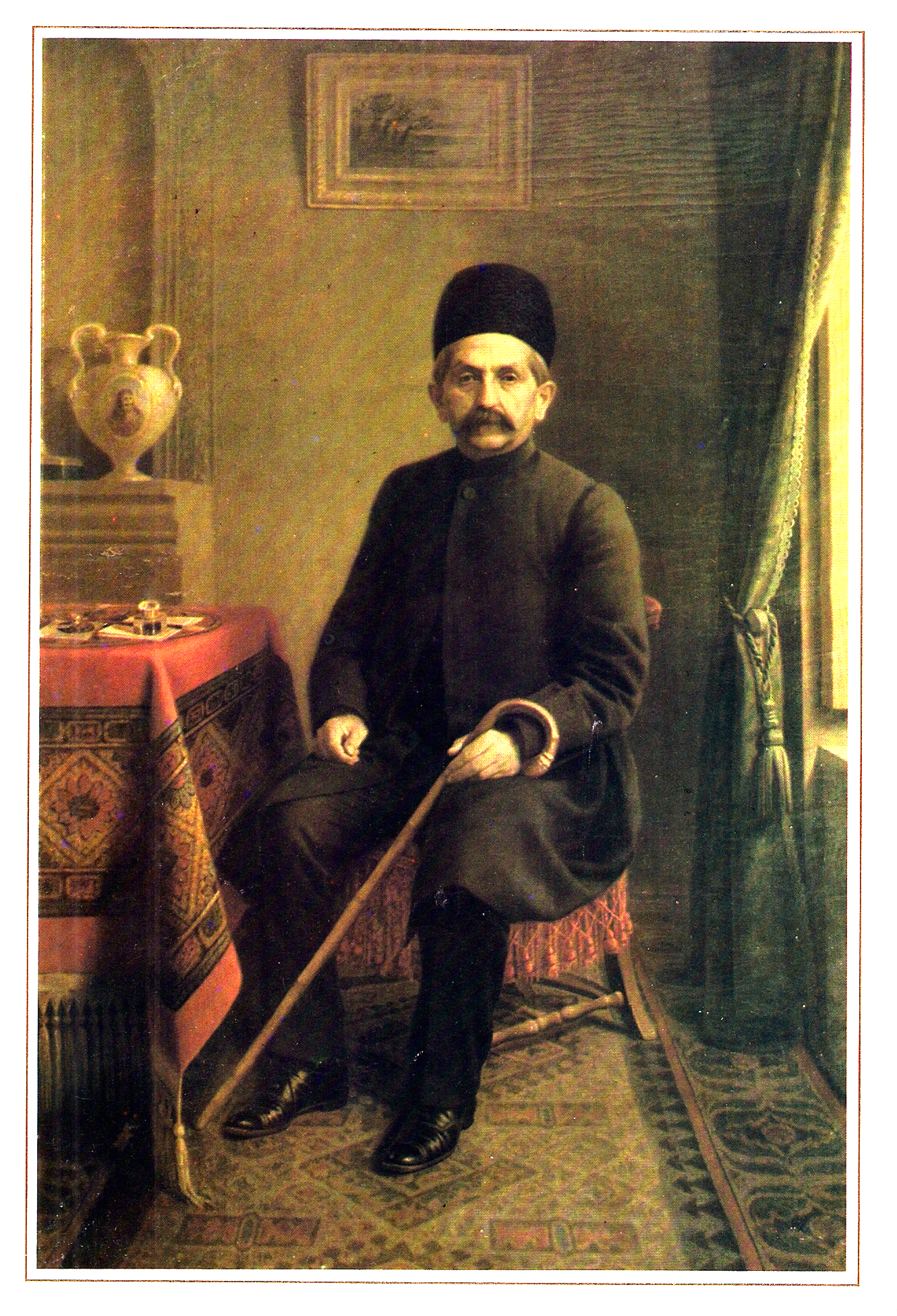
But soon difficulties emerged. Moẓaffar-al-Din Shah’s fondness for, and his commissioning of, erotic paintings were not acceptable to Kamāl-al-Molk. In contrast to Nāṣer-al-Din Shah’s time, when the painter received encouragement and praise in many ways, under the new Shah he was constantly pestered by unwelcome demands from the sovereign and his entourage, which he did his best to evade in various ways. In 1902, when his job dissatisfaction coincided with a tragic love affair, Kamāl-al-Molk left Tehran for Baghdad and Karbalā, where he stayed for about two years (Kamāl-al-Molk, pp. 32-33; for his love affair with Anna, see below). Finally, in Moẓaffar-al-Din Shah’s last years, Kamāl-al-Molk had to feign a debilitating stroke, which had supposedly paralyzed the right side of his body and necessitated the use of a walking stick (Foruḡi, pp. 793-94; Ḥakimi, p. 803).
The Constitutional Revolution. Kamāl-al-Molk was a freedom-loving artist and an ardent supporter of the Constitutional Revolution from the very start, often making sarcastic asides aimed at those opposed to constitutional reform (Foruḡi, p. 796). In spite of facing severe financial difficulties during this period, Kamāl-al-Molk refrained from painting the portrait of Moḥammad-ʿAli Shah, heedless of pressure from the courtiers and the monarch’s offer of a substantial sum for the work. (It is said that once he became so desperate that he went to the house of a friend to borrow five tumans; see ʿAṭāʾi, p. 813; see also Foruḡi, p. 796; Ḥakimi, pp. 803-4.)
In the midst of the Constitutional Revolution in November 1906, a number of active constitutionalists founded the Freemasonry Lodge Réveil de l’Iran (Lož-e bidāri-e Irāniān), affiliated with the Grand Orient de France, the first regularly affiliated lodge to operate in Iran (see freemasonry ii). A number of Kamāl-al-Molk’s friends were among the founding members of the Lodge, including Moḥammad-ʿAli Foruḡi Ḏakāʾ-al-Molk and Ebrāhim Ḥakimi Ḥakim-al-Molk. On their recommendation, Kamāl-al-Molk joined the Lodge as a member (for a list of 130 members of the Lodge, which includes Kamāl-al-Molk, see “Majmuʿa-ye asnād-e montašer našoda . . . ,” pp. 6-7; PLATE I shows a photograph of Kamāl-al-Molk with his friends and co-members of the Lodge Bidāri). An indication of his interest in the constitutional movement is his exquisite portrait of ʿAliqoli Khan Baḵtiāri Sarār Asʿad (d. 1918; see baḵtiāri; see Figure 4), one of the two revolutionary leaders who led the successful march on Tehran in 1909 during the Constitutional period (see constitutional revolution ii).

The Academy of Fine Arts. The founding of the Madrasa-ye ṣanāyeʿ-e mostaẓrafa (the Academy of Fine Arts; see faculties ii. faculty of fine arts) in Tehran was one of the achievements of the Constitutional movement. Ḥakim-al-Molk, the education minister and a friend of Kamāl-al-Molk, was aware of the painter’s aspiration to create a painting school and set about helping him in 1911 (see Ḥakimi, pp. 804-5). He had the site for the school and the necessary budget approved by the Majles, allocating a piece of the Negārestān Palace property (one of Fatḥ-ʿAli Shah’s palaces, to the north of the present Bahārestān Square) to the project (Sohayli-Ḵvānsāri, p. 43; Foruḡi, pp. 796-97).
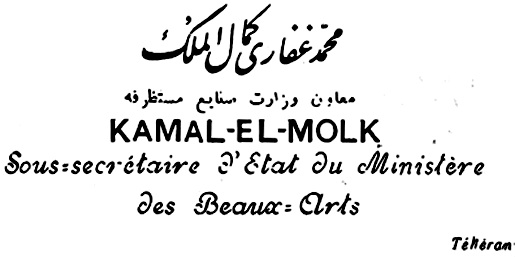
At first all went well, with the education ministers giving him a free hand in managing the school. Problems arose later when, in the 1920s, as part of the general process of modernizing the administration, the ministers of education began to implement new regulations in the school. Kamāl-al-Molk, regarded himself as above such regulations and was unable to adjust to the new situation. Having hitherto received orders solely from the sovereign himself, he thought it below his dignity to follow instructions from others. To solve the problem, Ḥakim-al-Molk promoted him to the position of deputy minister of education in charge of fine arts in 13 December 1920; he held the position until 1926 (Sohayli-Ḵvānsāri, pp. 50-51, 69; for his business card as deputy minister, see PLATE II). Yet, any word or action instigated by others would be deemed malicious and would infuriate him as a result. In time, his perennial hot temper and growing distrust of authorities spread from the officials of the ministry of education to his own circle of friends, and finally maltreatment of the school by Moḥammad Tadayyon, an infamous minister of education, led to Kamāl-al-Molk’s resignation in 1927 (Foruḡi, pp. 797-800).
This frustrating period for Kamāl-al-Molk coincided with the rise to power of Reza Khan Sardār Sepah (later Reza Shah) and led to a myth of Kamāl-al-Molk’s struggle against the dictatorial regime that even attributed the accidental injury of his eye to a possible plot by the regime (Dehbāši, 1989, pp. 9-11; see further below, under Romantic image). Nevertheless, it should be noted that Reza Khan himself showed deep admiration and deference toward Kamāl-al-Molk on a number of occasions, including the visits he paid to the art school (see Āštiāni, p. 14; Vaziri, pp. 22-28). In 1922, when Reza Khan was minister of war, he assured Kamāl-al-Molk, in a respectfully worded letter (beginning with the reverential expression, fedāyat šavam), of the continuation of the budget for the art school (for the text of the letter, see Sohayli-Ḵvānsāri, p. 59). When Reza Khan assumed the premiership, he expressed his full support for the school in another encouraging letter to him in 1925 (Sohayli-Ḵvānsāri, p. 62) and told Solaymān Mirzā Eskandari, the minister of education: “You should obey whatever Kamāl-al-Molk says” (Vaziri, pp. 22-24; Āštiāni, pp. 14-15). In 1933, when a forged petition attributed to Kamāl-al-Molk was received by Reza Shah’s chief-of-staff, the shah ordered the prime minister to comply with Kamāl-al-Molk’s demands immediately (Sohayli-Ḵvānsāri, pp. 105-9).
Family life. In 1884 Kamāl-al-Molk married Zahrā Khanom, the sister of Meftāḥ-al-Molk from the Malelek-al-Tojjār family of Tabriz. They had one daughter, Noṣrat, and three sons, Moʿezz-al-Din, Ḥosaynqoli, and Ḥaydarqoli. Following in the family tradition, the three sons all found employment at the ministry of finance (Wezārat-e Māliya; see Maḥmudi, pp. 722-24; Āštiāni, pp. 11-12).
As an artist skeptical of many traditional values, Kamāl-al-Molk often came into conflict with the more traditional views of the time; in particular, his relationship with the elders in his extended family was not without tension. Following a number of bitter disputes with senior members of his family, who were austerely religious, Kamāl-al-Molk severed all ties with them and even left his wife, albeit without formally divorcing her. Having immersed himself in his own world of art and intellect, living with his students in the school, and with his social interactions limited to a close circle of friends, Kamāl-al-Molk apparently was not a strong presence in his own sons’ lives (Tābeš, pp. 41-42).
During his stay in Vienna, where he made two portraits of Anna, the daughter of Narimān Khan Qawām-al-Salṭana, an Iranian-Armenian Minister Plenipotentiary of Iran to Vienna, a love affair developed between the two, which, despite Narimān Khan’s opposition, ended in their marriage in 1901. Anna joined her husband in Tehran and stayed at a summer house in Šemirān, north Tehran. The marriage, however, was short-lived. The contrast between life in Tehran and in Vienna—or, as Foruḡi has put it, the contrast between “the Šemirān and the paradise of Vienna”—led to disagreements and eventual separation. They both left Iran, Anna for Vienna and Kamāl-al-Molk for Baghdad and Karbalā (Foruḡi, pp. 794-95).
Character traits. Tall and handsome, with a cheerful countenance, Kamāl-al-Molk has been described as an imposing figure in appearance and manners. At the same time, he was said to have been compassionate and generous. He was a thoughtful and resourceful teacher in dealing with his students, much more so, possibly, than in his relations with his own family. He lived in a room by the gates of the Academy of Fine Arts (usually allocated to the doorman) and had his lunches with the students, paying for them as his guests. He even provided stipends from his own salary to needy students (Maḥmudi, pp. 708-9; PLATE III).

Kamāl-al-Molk’s friends have characterized him as very good company, pleasantly eloquent and witty, with a fount of anecdotes and stories with which he regaled his friends in their gatherings (Ḡani, V, pp. 15-16; Foruḡi, p. 788).
Kamāl-al-Molk was well acquainted with Italian and French literature and was an admirer of Dante, Rousseau, Victor Hugo, Racine, Montesquieu, and Chateaubriand. He had a thorough knowledge of Persian poetry and was a great admirer of Hafez. He knew many verses by Ferdowsi (q.v.), Hafez, and Saʿdi by heart and often recited Hafez’s ghazals in the presence of his friends. He was also a lover of Persian classical music and would sometimes sing in social gatherings with his close friends (Ḡani, X, p. 683; Foruḡi, p. 788; Ḥakimi, p. 805; Maḥmudi, p. 709).
Romantic image. The romantic perception of Kamāl-al-Molk as a heroic artist was bolstered by Čašmhāyaš, a much influential and debated novel by the noted Iranian writer Bozorg ʿAlavi (q.v.; Tehran, 1952; tr. John O’Kane as Her Eyes, London, 1989). Influenced by the vogue for socialist realism popular at the time, ʿAlavi creates a heroic image of “Mākān-e Naqqāš” as a celebrated artist and an activist leader of a clandestine revolutionary movement. Some critics maintain that ʿAlavi’s portrayal of Mākān may have been drawn from Kamāl-al-Molk (Mirʿābedini, I, p. 234; Hillmann, p. 298). Others see traces of Taqi Arāni (1903-40), the leading Marxist political activist of the 1930s, in Alavi’s depiction of Mākān (Golširi, p. 507). Still others have viewed Mākān as an amalgamation of Kamāl-al-Molk and Arāni: a character who represents Kamāl-al-Molk as an artist and Arāni as a political activist (Dastḡayb, p. 124).
The popular image of Kamāl-al-Molk as a great artist who stood up to and resisted the authorities, born out of Bozorg ʿAlavi’s depiction, appears to have originally been created and disseminated by Ḥasan-ʿAli Vaziri, in a partly fictional and emotional biography of Kamāl-al-Molk of about 100 pages, published and distributed during the turbulent years of the mid-1940s. Vaziri portrayed Kamāl-al-Molk as a man of dignity with a heedless attitude towards the powerful ministers of education, and more specifically in his dealings with Reżā Khan Sardār Sepah, the increasingly influential statesman of the time. It appears that Vaziri’s book, and his frequent narration of stories about Kamāl-al-Molk’s dignified and powerful character traits, became a source of inspiration for his close relative and friend, Āqā Bozorg ʿAlavi, in plotting a popular novel with a painter as its main protagonist (A. Ashraf, personal communication with Bozorg ʿAlavi, Tehran, Spring 1979, as well as information gathered from Rowšan Vaziri, a niece of both ʿAlavi and Vaziri, New York, April 2010).
ʿAlavi’s creation of a dual character for Mākān is probably drawn from his own direct relationship with Arāni as well as his indirect knowledge of Kamāl-al-Molk’s life and character traits constructed from numerous stories narrated to him by Vaziri.
Mākān is portrayed in the first part of novel (pp. 5-93), as “the greatest artist of the last 100 years . . . who was among a few people who had the courage to fight against the regime” (p. 6). When Sardār Sepah pays a visit to his school of painting, Mākān does not receive him warmly, which leads the government agencies to thereafter ignore his artistic center (pp. 16-17). While Mākān refuses to paint a portrait of Reza Shah (pp. 11, 20-21), he makes twenty-two portraits of his servant and doorman, Āqā Rajab, as well as paintings of landscapes showing work conditions and the destitution of the peasantry in villages (pp. 17-18). “He struggles with tyranny through his paintings, he is a socially conscious artist” (p. 32). This portrayal of Mākān may have been in part drawn from Kamāl-al-Molk.
The heroic image of Kamāl-al-Molk was again popularized in a film by ʿAli Ḥātami, Kamāl-al-Molk, released in 1984, which focused on his role in the Constitutional Revolution and in his encounter with Reżā Khan Sardār Sepah (for a critical review of the film, see Ḥesāmi, pp. 327-30; it should be noted in this context that although, as Ḥesāmi points out, Kamāl-al-Molk did not play an active part in the Constitutional Revolution, nevertheless, as described earlier in the entry, he deeply sympathized with the movement and remained detached from Moḥammad-ʿAli Shah’s regime).
The myth of Kamāl-al-Molk’s resistance vis-à-vis the rising and powerful government apparatus in the 1920s has even entered the realm of Persian conspiracy theories, where a belief has emerged that attributes the accidental injury to Kamāl-al-Molk’s eye to a possible plot by Reżā Khan’s regime (Dehbāši, 1989, pp. 9-11; Ḡani [V, pp. 17-21] convincingly demonstrated that his eye injury was caused by a personal accident).
Refuge at Ḥosaynābād. Kamāl-al-Molk had been entertaining the idea of finding a refuge far from Tehran for his final years. He had even entrusted his savings to Moḥammad-ʿAli Foruḡi, earmarked for the purchase of a rural estate later. According to existing documents, this money was used towards the purchase of Ḥosaynābād in 1924. This was a remote rural estate in Khorasan, which, with its hot dry climate and views of the desert, appealed to the painter’s eye (Foruḡi, pp. 800-801; for the title of the estate, see Sohayl-Ḵvānsāri, pp. 92-94).
Unfortunately, rural life from the beginning led indirectly to a personal accident. In a trip to Nišābur in the summer of 1926, in an accident at Taqiābād a piece of glass from his broken spectacles irreparably damaged his right eye. He was taken to Tehran for treatment in a few days (Ḡani, V, pp. 17-19; it should be noted that different dates are reported for his trips to Nišābur and the date of accident in Taqiābād; a more accurate date, however, would be the date of his letters form Tehran to Ḡani in the summer and fall of 1926, when he provided Ḡani with medical reports from the beginning of the treatment of his right eye in Tehran [see Ḡani, V, pp. 47-50]).
Kamāl-al-Molk died at the age of 81 in Nišābur on 18 August 1940 and was buried by the shrine of the celebrated 13th-century mystical poet, Farid-al-Din ʿAṭṭār.
Bibliography
Chahryar Adle and Yahya Zoka, “Notes et documents sur la photographie iranienne et son histoire,” Studia Iranica 12, 1983, pp. 249-80.
Āydin Āḡdāšlu, “Ḵāstgāh-e Kamāl-al-Molk,” in Yād-nāma, pp. 223-38.
Bozorg Alavi, Čašmhāyaš, Tehran, 1952; tr., J. O’Kane as Her Eyes, New York, 1989.
Esmāʿil Āštiāni, “Šarḥ-e ḥāl va tāriḵ-e ḥayāt-e Kamāl-al-Molk,” in Honar o mardom 1/7, 1963, pp. 8-19; repr. in Yād-nāma, pp. 177-98.
Ṣaniʿ ʿAṭāʾi, “Šarḥ-e ḥāl-e Kamal-al-Molk,” a letter to Dr. Qāsem Ḡani (31 August 1940), in Ḡani, IX, pp. 810-16.
Mehdi Bāmdād, Tāriḵ-e rejāl-e Irān dar qorun-e 12, 13, 14 Ḥejri, 6 vols., Tehran, 1968-72.
ʿAbd-al-ʿAli Dastḡayb, Naqd-e āṯār-e Bozorg-e ʿAlavi, Tehran, 1999.
ʿAli Dehbāši, ed., Nāmahā-ye Kamāl-al-Molk, Tehran, 1989.
Maryam Ekhtiar, “The Dār al-Funun: Educational Reform and Cultural Development in Qajar Iran,” Ph.D. diss., New York University, 1994.
Karim Emāmi, “Art xi. Post-Qajar (Painting),” in EIr. II, 1987, pp. 640-46.
Iraj Eskandari, “Kamāl-al-Molk va taḥavvolāt-e naqqāši-e moʿāṣer-e Irān,” in Qāmus 3, 1985; repr. in Yād-nāma, pp. 319-26.
Moḥammad-Ḥasan Khan Eʿtemād-al-Salṭana, al-Maʾāṯer wa’l-āṯār, Tehran, 1888.
Idem, Ruz-nāma-ye ḵāṭerāt-e Eʿtemād-al-Salṭana, ed. I. Afshar, Tehran, 1970.
Willem Floor, “Art (Naqqāshi) and Artists (Naqqāshān) in Qajar Persia,” Muqarnas 16, 1999, pp. 125-54.
M.-ʿA. Foruḡi, “Ḥālāt-e Kamāl-al-Molk,” in Ḡani, IX, pp. 783-802.
Ḡolām-Ḥosayn Ḡaffāri Ṣāḥeb Eḵtiār, “Nāma-ye Ṣāḥeb Eḵtiār be Doctor Ḡani,” in Ḡani, IX, pp. 807-9.
Qāsem Ḡani, Yāddāšthā-ye Doktor Qāsem-e Ḡani, 12 vols., London, 1980-84.
Idem, “Ḵāṭerāti az Kamāl-al-Molk,” in Ḡani V, 1981, pp. 10-25.
Idem, “Nāmahā-ye Kamāl-al-Molk,” in Ḡani, V. Nāmahā-ye Kamāl-al-Molk va Moḥammad Qazvini, London, 1981, pp. 26-162.
Idem, “Dar bāb-e Mirzā Moḥammad Khan Ḡaffāri Kamāl-al-Molk,” in Ḡani, X, London, 1983, pp. 677-85.
Moḥammad Golbon, “Sālšemār-e zendagi-e Kamāl-al-Molk,” in Āyanda 9/12, 1983; repr. in Yād-nāma, pp. 331-36.
Hušang Golširi, Bāḡ dar bāḡ (A garden within the garden), Tehran, 1999.
Ebrāhim Ḥakimi Ḥakim-al-Molk, “Ānčeh Ḥakim-al-Molk rājeʿ be Kamāl-al-Molk negāšteh ast,” in Ḡani, IX, pp. 803-6.
Moḥammad Ḥejāzi, “Kamāl-al-Molk,” in E. Ḵājenuri, Mardān-e ḵowd sāḵteh, Tehran, 1956, pp. 103-18; repr. in Yād-nāma, pp. 155-64.
Michael C. Hillmann, ed., “Major Voices in Contemporary Persian Literature,” Literature East and West 20, l976, pp. 85-98.
Sayyed Moḥammad-ʿAli Jamālzādeh, “Kamāl-al-Molk,” in Honar o mardom 3/35, 1965, pp. 6-19; repr. in Yād-nāma, pp. 81-92; and “Yād-e Kamāl-al-Molk,” in Yād-nāma, pp. 93-96. Kamāl-e honar: see Sohayli Ḵvānsāri.
Kamāl-al-Molk, “Šarḥ-e ḥāl-e Kamāl-al-Molk az zabān-e ḵodaš,” in Ḡani, V, pp. 26-37 (this autobiography is based on an interview of Kamāl-al-Molk by Dr. Ḡani in Nišabur); repr. in Yād-nāma, pp. 11-20.
M.-ʿA. Karimzādeh Tabrizi, Aḥvāl va āṯār-e naqqāšān-e qadim-e Iran va barḵi az mašāhir-e negārgar-e Hend va ʿOṯmāni, London, 1985, III, entry no. 1117, pp. 1031-59.
ʿAli Maḥmudi, two letters to Dr. Ḡani (Maḥmudi, a student and relative of Kamāl-al-Molk, wrote two letters to Dr. Qāsem Ḡani in 1940 and 1941, collecting his memories of Kamāl-al-Molk), in Ḡani X, pp. 707-31.
“Majmuʿa-ye asnād-e montašer našoda dar bāre-ye aʿżā-ye Lož-e Bidāri-e Irān,” Irān 1/48, 4 April, 1995, pp. 6-7.
Ḥassan Mirʿābedini, Sad sāl dāstān nevisi dar Iran (One hundred years of fiction writing in Iran) I, Tehran, 1999.
Maktab-e Kamāl-al-Molk: Majmuʿa-ye āṯār-e Kamāl-al-Molk, Āštiāni, Awliāʾ, Ḥaydariān, Šayḵ, Yāsami, va Šehābi, Tehran, 1986.
Ḥosayn-ʿAli Moʾayyad Pardāzi, “Čeguna bā Kamāl-al-Molk āšnā šodam,” in Ḡani, X, pp. 733-48.
Dust-ʿAli Khan Moʿayyer-al-Mamālek, “Mirzā Moḥammad Khan Ǧaffāri Kamāl-al-Molk,” in idem, Rejāl-e ʿaṣr-e Nāṣeri, Tehran, 1982, pp. 276-77.
M.-T. Moṣṭafavi, “Čand nasl-e honarmand dar yek ḵāndān-e čand ṣad sāla-ye Kāšān,” Naqš o negār 1/7, 1950, pp. 30-44; repr. in Yād-nāma, pp. 21-38.
Ḥ. Narāqī and F. Ḡaffāri, Ḵānadān-e Ḡaffāri-e Kāšān, Tehran, 1974.
ʿAbd-al-Ḥosayn Navāʾi, “Kamāl-al-Molk, āfarinande-ye zibāʾi,” in Eṭṭelāʿāt-e māhāna, 4 July 1949; repr. in Yād-nāma, pp. 97-138.
Ruʾin Pākbāz, “Kamāl-al-Molk: Sonnat-šekan-e bozorg,” in Tamāšā 4/186, 1974; repr. in Yād-nāma, pp. 239-46.
Idem, “Kamāl-al-Molk: Sonnat-šekan va sonnat-gozār,” Honar o mardom 13/150, 1975, pp. 63-67; 151, pp. 63-68; 152, pp. 62-67; 155, pp. 47-51; repr. in Yād-nāma, pp. 247-77.
Mārkār Qarābegiān, “Moḥammad Ḡaffāri Kamāl-al-Molk, honarmand va naqqāš-e bozorg,” Payām-e now 2/9-10, 1946, pp. 81-92; repr. in Yād-nāma, pp. 199-206.
B. W. Robinson, “Art in Iran x. Qajar 2. (Painting)” in EIr. II, 1987, pp. 637-40.
Šarāfat 60, Tehran, 1902; reprint, 1976. Ḥosayn Šayḵ, “Naqqāši yaʿni taqlid-e ṭabiʿat” (an interview by Kāveh Rastegār), Rudaki 4/37-38, 1974, pp. 32-33; repr. in Yād-nāma, pp. 213-16.
A. Sohayli-Ḵᵛānsāri, ed., Kamāl-e honar: Aḥvāl va āṯār-e Moḥammad Ḡaffāri Kamāl-al-Molk (Perfection of the art: life and works of Mohammad Ghaffari Kamal-al-Molk), Tehran, 1989.
Tābeš “Kamāl-al-Molk mardi az Kāšān” (attributed to Kamāl-al-Molk’s cousin, a certain Tābeš, by Ḡani’s son, Cyrus), in Ḡani, V, pp. 38-46.
Ḥasan-ʿAli Vaziri, Kamāl-al-Molk, Tehran, 1946; selection repr. in Yād-nāma, pp. 165-76.
Moḥsen Vaziri-Moqaddam, “Kamāl-al-Molk va peyrovan-e ou,” Rudaki 4/37-38, 1974, pp. 33-36; repr. in Yād-nāma, pp. 279-88.
Wezārat-e maʿāref va awqāf va ṣanāyeʿ-e mostaẓrafa, Sāl-nāma, 1918, “Qesmat-e šešom, Ṣanāyʿ-e mostaẓrefa,” pp. 41-43; repr. Ḡani, X, pp. 698-702.
[Yād-nāma] Yād-nāma-ye Kamāl-al-Molk, ed. D. B. Šabāhang and ʿAli Dehbāši, Tehran, 1985.
Ehsan Yarshater, “Contemporary Persian Painting,” in R. Ettinghausen and E. Yarshater eds., Highlights of Persian Art, Boulder, 1979, pp. 363-77.
ʿAli Yādgār Yusofi, “Kamāl-al-Molk gozašta-gerā-ye sonnat šekan,” in Rastāḵiz 702, 1977; repr. in Yād-nāma, pp. 303-10.
Yahya Zoka, “Mohammd Zaman, The First Iranian Painter to Visit Europe,” in Stuart Welsh and Y. Zoka, Persian and Mughal Miniatures. The Life and Times of Muhammad-Zaman, Tehran, 1994, pp. 18-22.
Idem, Tāriḵča-ye arg-e salṭanati va rāhnemā-ye kāḵ-e golestān, Tehran, 1970.
Idem, Tāriḵ-e ʿakkāsi va ʿakkāsān-e pišgām dar Iran (The history of photography and pioneer photographers in Iran), Tehran, 1997. (The author would like to acknowledge Dr. Layla Diba’s contribution in preparing the part on “Learning and practicing academic painting,” in section ii, above.)