
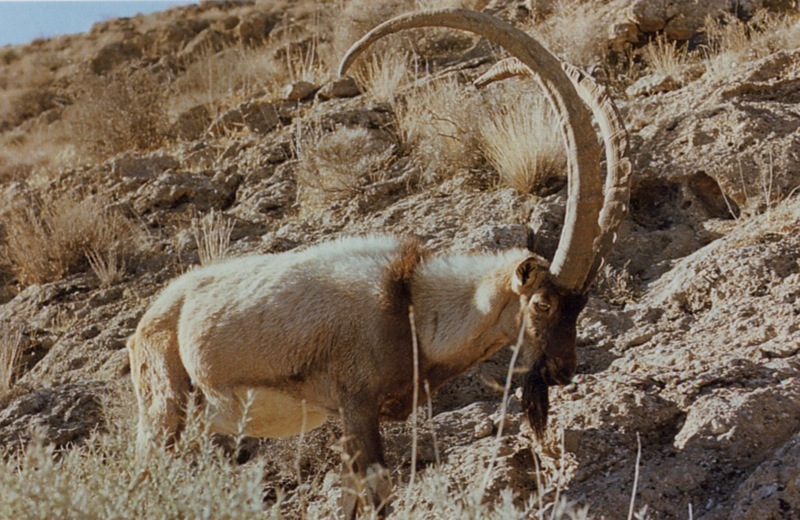



The Persian ibex is of stocky build with relatively short but strong and thick legs. In the adult male the color of the flanks and back in summer is a grayish-brown, becoming paler in winter; there is a dark-brown to black band along the spine and a similar band forming a collar in front of the shoulders. With increasing age, as the flanks and sides of old males become cream-colored, the color pattern becomes more and more distinctive and the contrast with the black bands more striking. The coloration of the female is similar, but the dorsal band is indistinct and the shoulder band absent.
The horns of the males are scimitar-shaped and greatly compressed laterally; the frontal edge is sharp and irregularly knobbed, while the back is rounded. The curvature is gentle at first but becomes more sharply rounded in the last third of its length, with the tips (in old males) turning down and either inward or outward. Except for the latter development, the curvature of the horns is in one plane. However, horn shapes tend to vary quite perceptibly among ibex from different localities. Horn lengths in excess of 140 cm have been recorded for the Persian ibex in Persia; and it is one of the coveted trophies among sportsmen. Males measure on average 90 cm in height at the shoulder, and weight may reach 80-100 kg in northern and western Persia, while those from desert ranges in the south and the east tend to be up to 30 percent smaller. The female ibex are much smaller and have short horns, rarely more than 20 cm long. Some authors recognize the form ranging in western and central Persia as Capra aegagrus aegagrus, while the eastern form is regarded as C. aegagrus blythi and called Pasang (pāsang) or Sind Wild Goat (Shackleton, 1997).
Steep, rocky slopes and sheer cliffs are the preferred habitat of the Persian ibex. They will, however, frequent gentle slopes, rolling hills, and adjacent plains in order to feed and obtain water, particularly when these include sections covered with shrubs and trees. However, they are always within safe distance of their refuge, rocky terrain and cliffs. The breeding season begins in mid- to late November in northern Persia and up to two months earlier in the south. This is the time when rival males engage in fights, some quite serious, over the possession of a harem. The kids are born from early to late May in the northern regions, and mid-February to early April in the more southern parts of their range. Twin kids are usually produced, but sometimes only one, and more rarely, three.
Until the revolution of 1979, the ibex was found in almost all of Persia’s mountainous areas with rugged cliffs—from forests to deserts, and within sight of the Caspian Sea and the Persian Gulf. They were very numerous, reaching range capacity in most of the highlands, and it is probable that they reached the highest densities ever seen in some of the national parks and refuges. At present qualified technical personnel of the Department of the Environment estimate that, countrywide, the decline in the population of the ibex since before the revolution is on the order of 85-90 percent. This is primarily due to the incursion of tens of thousands of domestic sheep and goats into their mountain habitats (including the various reserves), with no effort made to keep the numbers in some sort of rational balance with the range potential; but a near absence of effective control over indiscriminate hunting, particularly with automatic weapons and shotguns, has also been instrumental in wiping out large parts of their populations.
The historian and geographer Hamd-Allāh Mostawfi (q.v., 1281-1344) wrote of the ibex that “its flesh may be eaten in all religions and sects . . . It is an enemy of the snake and the crab” (Nozhat al-qolub, p. 12). In respect to its “properties,” he states: “A mithqal of the scrapings of its horns with syrup, taken fasting by an epileptic, will cure him . . . The smoke of its horns drives away snakes, scorpions and poisonous animals . . . Its liver, roasted and rubbed up, and used as an eye-salve, gives clearness of visioŋIts penis and testicles pounded up give sexual power” (ibid.).
Various preparations made from parts of the body of the ibex have been regarded as remedies against many diseases, such as epilepsy, corneal opacity, or leprosy; its bile was thought to be an antidote against poisons. From the Middle Ages on, the Persian ibex was known in Europe as the “bezoar goat” (e.g., mod. German Be-zoarziege); because the concretion occasionally found in the animal’s stomach or intestines, called bezoar stone (Pers. pādzahr), was believed by the Europeans too to be an effective antidote against poison.
See also: BOZ and ENVIRONMENTAL PROTECTION.
Bibliography
E. Firouz, Ḥayāt-e vaḥš-e Irān/A Guide to the Fauna of Iran,Tehran, 2000.
Hamd-Allāh Mostawfi, Nozhat al-qolub, ed. and tr. by J. Stephenson as Nuzhatu-L-Qulub. In English and Persian, Oriental Translation Fund, London, 1928.
F. A. Harrington, Jr., A Guide to the Mammals of Iran. Tehran, 1977.
V. G. Heptner, A. A. Nasimovich, and A. G. Bannikov, Mammals of the Soviet Union I, Washington, D.C., 1988.
D. M. Lay. A Study of the Mammals of Iran, Chicago, 1967.
D. M. Shackleton, ed., and the IUCN [World Conservation Union] Species Survival Commission, Caprinae Specialist Group, Wild Sheep and Goats and their Relatives, Gland, Switzerland and Cambridge, 1997.
Ḥ. Żiāʾi. Rāhnemā-ye ṣaḥrāʾi-e pestāndārān-e Irān, Tehran, 1996.