



i. Biography
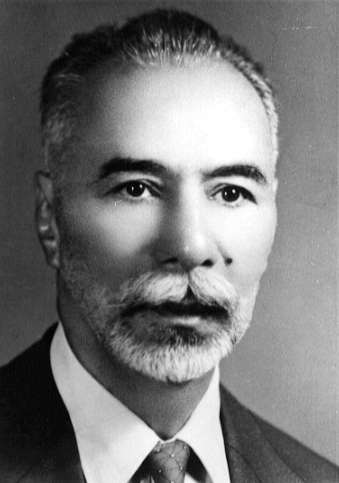
Nūr-ʿAlī Elāhī was born in the village of Jeyḥūnābād, some twelve kilometers to the west of the town of Ṣaḥna on the road between Hamadān and Kermānšāh, where both his father, Ḥājj Neʿmat-Allāh “Mojrem” (1871-1920) and his grandfather, Mīrzā Bahrām, had functioned as masters of the Šāh-Hayāsī branch of the Ahl-e Ḥaqq. His given name was Fatḥ-Allāh, but he was known in the family as Kūček-ʿAlī. He is said to have manifested a prodigious talent for music (see part iii), and to have mastered the art of the tanbūr while still a child. At the age of nine, he is related to have begun a period of intense ascetic training under his father that was to last for twelve years. Two years into this regimen, Elāhī accompanied his father on a pilgrimage to the tomb of Solṭān Esḥāq, the putative founder of the Ahl-e Ḥaqq, at Pardīvar, and there fell suddenly and unaccountably ill, dying three days later. However, according to the hagiographical account developed by Elāhī’s followers, just as the child was about to be buried, a Kurdish Qāderī shaikh by the name of Ḥosām-al-Dīn sent word that Elāhī was about to return from the dead, infused with a new soul. The prediction came true, and from then on Elāhī was known as Nūr-ʿAlī, in recognition of the new soul housed in his frame (anonymous preface to Unicity, p. ix). The period of ascetic retreat came to an end in 1917, and Elāhī married soon thereafter. When his father died in 1920, he left the confines of his native village, and began to reside for extended periods in Kermānšāh and Tehran. In 1929, in preparation for a more thorough entry into the wider world, he cut the hair that had been permitted to luxuriate since he was six, trimmed his beard, and put on a suit (for a depiction of his hirsute state, see the frontispiece to Elâhî, L’ésotérisme). Three years later, he began working for the registrar’s office in Kermānšāh. In 1933, after completing his legal studies in what is said to have been a preternaturally short time, he entered the service of the Ministry of Justice and remained in its employ until his retirement in 1957. This choice of an administrative career is related to have been inspired by the wish to avoid becoming a financial burden on the following he had inherited from his father (Mokri, intr. to Elâhî’s L’ésotérisme, p. 34). Among the cities where he worked as judge or prosecutor were Ḵorramābād, Kermān, Jahrom, Lār, Qom, and Shiraz.
Retirement enabled Elāhī to devote the remainder of his life to writing on Ahl-e Ḥaqq doctrine. This he did in part by composing commentaries and glosses on his father’s works: Kašf al-ḥaqāʾeq, a commentary on Ḥājj Neʿmat-Allāh’s Forqān al-aḵbār (Minorsky, 1964, p. 310; both the original work and its commentary appear to have remained unpublished) and a series of notes to Ḥājj Neʿmat-Allāh’s Šāh-nāma-ye ḥaqīqat (Ḥaqq al-ḥaqāʾeq), compiled, it would seem, at the request of Henry Corbin (Ḥāšiya bar Ḥaqq al-ḥaqāʾeq, printed as an appendix to Šāh-nāma-ye ḥaqīqat, new ed., Tehran, 1363 Š./1984, pp. 433-70). In these notes Elāhī undertook not only to clarify chronological problems in the mythohistory of the Ahl-e Ḥaqq but also to present aspects of the sect’s doctrine as compatible or even identical with the teachings of Twelver Shiʿism. Thus the Ahl-e Ḥaqq belief in reincarnation is depicted as synonymous with the Shiʿite doctrine of rajʿat (the return to this world of certain sacred personages in advance of the general resurrection; pp. 443-46), and the affirmation of the divinity of ʿAlī b. Abī Ṭāleb is explained to mean that he received “a manifestation of the light of the divine essence” (p. 442).
These attempts at a rapprochement with Shiʿism, inherited by Elāhī from his father, received fuller expression in his first published work in Persian, Borhān al-ḥaqq. The Ahl-e Ḥaqq are, Elāhī proclaimed, Twelver Shiʿites (p. 10), and they uniformly follow the injunctions of the šarīʿat. If there are among the Ahl-e Ḥaqq those who fail to observe the devotional duties of Islam, it is because they have fallen under the influence of other communities with which they are intermingled in Kurdistan, notably the ʿAlī-Allāhīs (p. 2). A further cause of deviation was, he maintained, the lack of an authoritative and comprehensive text detailing the beliefs and practices of the Ahl-e Ḥaqq, a deficiency Borhān al-ḥaqq was intended to remedy. The Ahl-e Ḥaqq are in essence simply “one of the mystical chains derived from the Mohammadan šarīʿat,” i.e. something akin to one of the Sufi orders (p. 6). This claim of initiatic descent is bolstered by an interpretation of the expression “holders of authority” (ūlu’l-amr) in the Qurʾān (4:59) to mean “the immaculate Imams and after them those who in every age, linked to that lineage in belief, attain the station of manifestation (maẓharīyat) and will (mašīyat); they become, that is, perfect humans and manifestations of the divine essence in such fashion that their will is identical to the divine will, beings who in the terminology of the Ahl-e Ḥaqq are called dīdavār and bāṭendār” (p. 15). A further linkage of the Ahl-e Ḥaqq to Shiʿite tradition is sought by attributing to Solṭān Esḥāq genealogical descent from Imam Mūsā al-Kāẓem (p. 42). It may have been these attempts at the “normalization” of Ahl-e Ḥaqq doctrine that caused another learned adherent of the sect, a certain Maʿbūdī, to write a refutation of Borhān al-ḥaqq (mentioned in Modarresī Čahārdehī, 1361 Š./1982, p. 109).
Borhān al-ḥaqq was followed in 1969 by Maʿrefat al-rūḥ, a work in which Elāhī attempted to distinguish between the Ahl-e Ḥaqq belief in the soul donning a series of “garments” (jāma or dūn) and the doctrine of transmigration of souls (tanāsoḵ) traditionally refuted by Muslim theologians. His published corpus in Persian was completed with the posthumous appearance in 1991 of Āṯār al-ḥaqq, a two-volume collection of his utterances thematically arranged. It may be significant that these statements, not originally made for purposes of publication, are not consistently marked by a concern for conformity with Shiʿite Islam. Thus, he remarks that the prayer and fasting prescribed by Islam are not intrinsically necessary, serving only the purpose of preserving the outer fabric of religion; “otherwise, tranquillity of the heart and prayer and supplications uttered in any language are quite sufficient” (I, p. 199). When asserting the simultaneous creation of Adam and Eve, as opposed to the fashioning of the latter out of the former, Elāhī goes so far as to observe, “I am not concerned with what is written in the Qurʾān or books of Hadith; this is what I believe” (I, p. 322).
The most complete and coherent presentation of Elāhī’s understanding of Ahl-e Ḥaqq doctrine is to be found not in his Persian books, destined for circulation among Twelver Shiʿites and written with at least sporadic concern for their sensitivities, but in his unpublished writings in Gūrānī, intended to be read only by Ahl-e Ḥaqq initiates. As Moḥammad Mokrī, translator into French of some of these writings, observes, in Borhān al-ḥaqq the teachings of the Ahl-e Ḥaqq are presented as “a pure Shiʿite mysticism” and certain unorthodox aspects are passed over in silence “for extrinsic reasons” (introduction to L’ésotérisme, pp. 36-37). The work translated under the title L’ésotérisme kurde consists of 114 chapters of unequal length in which essential aspects of Ahl-e Ḥaqq doctrine are expounded in question-and-answer form: the sacred history of humanity; the principal theophanies of the Ahl-e Ḥaqq; reincarnation understood as the “changing of garments”; the offerings and sacrifices of Ahl-e Ḥaqq practice; and rites of passage and acts of devotion. In the chapter on the rank of Solṭān Esḥāq, Elāhī remarks: “Given that Solṭān is the founder of our religion and that we are Ahl-e Ḥaqq and his disciples, we must consider him superior to all the prophets. To put it differently, in the particular sense that we intend, he is for us God, although not the Creator” (p. 217).
It may also be mentioned that according to Saeed Khan (p. 34), Elāhī wrote tristichs in which he identified Benyāmīn, the master of the Ahl-e Ḥaqq covenant (pīr-e šarṭ), with Christ and asserted that only through the law of Christ can the truth be known.
Elāhī died on 27 Mehr 1353 Š./18 October 1974 and was buried at Haštgerd, a small town 70 kilometers to the west of Tehran. The conical structure built over his tomb was destroyed in 1982, presumably by opponents of the Ahl-e Ḥaqq. Elāhī’s devotees claim that the tomb itself escaped desecration because his corpse had miraculously absconded (Unicity, p. xx). The structure was in any event rebuilt in 1984.
Elāhī was succeeded as leader of his particular branch of the Ahl-e Ḥaqq by Šayḵ Jānī, an elderly sister living as a recluse in Jeyḥūnābād. Infinitely more visible, however, has been his son, Bahrām Elāhī, a pediatric surgeon living in Paris, who has claimed on behalf of Elāhī that he elaborated an “exact science of spiritual advancement,” a “path of perfection” that summarizes the shared esoteric essence of all religions. Bahrām Elāhī’s two books embody simple ethical maxims and moral pronouncements, with only rare mention of specifically Ahl-e Ḥaqq themes such as “past lives.”
Bibliography
See also J. During, Musique et mystique, Paris and Tehran, 1989, pp. 293-519.
B. Elahi, The Path of Perfection. The Spiritual Teaching of Nur Ali Elahi, Shaftesbury, 1993.
Idem, The Way of Light. The Path of Nur Ali Elahi, Shaftesbury, 1993.
N.-ʿA. Elāhī, Borhān al-ḥaqq, Tehran, 1342 Š./1963.
Idem, L’ésotérisme kurde, tr. M. Mokri, Paris, 1966.
Maʿrefat al-rūḥ, Tehran, 1348 Š./1969. Idem, Āṯār al-ḥaqq, 2 vols., Tehran, 1370 Š./1991.
V. Minorsky, “Ahl-i Ḥaḳḳ” in EI2 I, pp. 260-63.
Idem, “The Sect of the Ahl-i Ḥaḳḳ,” Iranica. Twenty Articles, Tehran, 1964.
N. Modarresī Čahārdehī, Ḵāksār wa Ahl-e Ḥaqq, Tehran, n. d., pp. 158-59.
Idem, Sayr-ī dar taṣawwof. Dar šarḥ-e ḥāl-e mašāyeḵ wa aqṭāb, Tehran, 1361 Š./1982.
M. Moosa, Extremist Shiites: the Ghulat Sects, Syracuse, NY, 1988, pp. 233, 249.
M. Mokri, “Les songes et leur interprétation chez les Ahl-i Haqq du Kurdistan iranien,” Contribution scientifique aux études iraniennes, Paris, 1970, pp. 161-73.
Saeed Khan, “The Sect of Ahl-i Ḥaqq,” The Moslem World 17, 1927, pp. 31-42.
Unicity. A Collection of Photographs of Ostad Elahi, Paris, 1995
(HAMID ALGAR)