




i. IN PERSIA SINCE 1319 Š./1940
Since World War II Persia, formerly a rural and tribal country dominated by elderly notables and with low population growth, has come to have a majority of young urban dwellers, mostly literate and multiplying rapidly. In 1358 Š./1979, for the first time in history, the proportions of urban dwellers and individuals classified as literate both passed the threshold of 50 percent. Such social changes have, however, been accompanied by great stability in natural demographic components, particularly fertility, which has changed very little, thus raising questions about the depth of the changes themselves. Unless otherwise noted, the statistics presented here have been drawn directly from the censuses of the general population conducted by Markaz-e āmār-e Īrān (Statistical center of Persia) in November 1956, 1966, 1976, and 1986 (see CENSUS); a demographic survey was conducted in 1991.
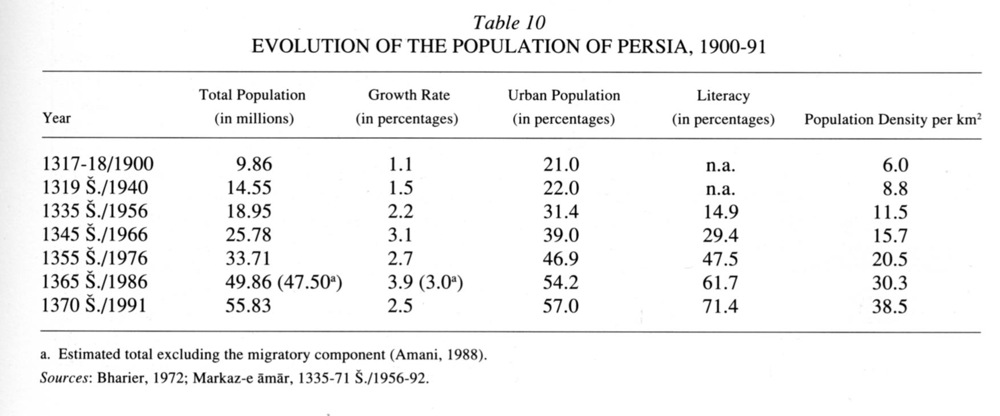
In 1995 Persia had about 63 million inhabitants, increasing at a rate of about 1.8 million a year. Population density (38.5 per km2) differs sharply from that prevailing at the beginning of the century, when the total population of this large country was fewer than 10 million, increasing by only 100,000 a year, with a density of 6.0 per km2. Since World War II the Persian population has nearly doubled every twenty years (2.9 percent a year), and migration to the cities has increased enormously (Table 10). Like most comparable countries Persia experienced a demographic “boom” beginning in the 1950s (with a 2.5 percent annual increase), entering a phase of “demographic transition,” characterized by a continued high birth rate and a rapid decline in the death rate. Despite the impression gathered from examining the raw data, however, the rate of population growth has not accelerated but has remained stable. For extraneous reasons (including factors like registration for military service and food coupons) the census of 1365 Š./1986 was more nearly complete, whereas those of 1335 Š./1956, 1345 Š./1966, and 1355 Š./1976 were underreported by 7.5, 5.0, and 2.5 percent respectively (Bharier, 1968); if only natural growth had been taken into account, the Persian population in 1365 Š./1986 would have been recorded at between 45 and 47 million, rather than the nearly 50 million reported in the census (Amani, 1988).
Distribution. The geographical distribution of the Persian population is very uneven. The heaviest concentration is in the western part of the country, northwest of an imaginary line drawn from Ābādān to Gorgān, where 64 percent of Persians live on 27 percent of the territory (72.4/km2). This high density reflects stability among the large rural population, rather than growth of the cities, with the exception of the region around Tehran (308/km2). In the province of Hamadān population density is 77/km2, in that of Māzandarān 73/km2, and in that of Gīlān 140/km2. The rest of the country, comprising 73 percent of the territory, is largely desert (q.v.; 14.9/km2), with a population concentrated around cities and on several irrigated plains. The southern regions (Fārs, Baluchistan, Kermān) have experienced higher population growth than those of the north and west (the central plateau, the Caspian provinces, Azarbaijan, and even Kurdistan), however. The census of 1365 Š./1986 provides evidence of the effects of regional wars, with heavy increases in Khorasan and Baluchistan, where Afghan refugees have settled, and, on the other hand, abandonment of the šahrestāns (subprovincial units) on the Iraqi frontier, especially those of Ābādān and Ḵorramšahr (Figure 12).

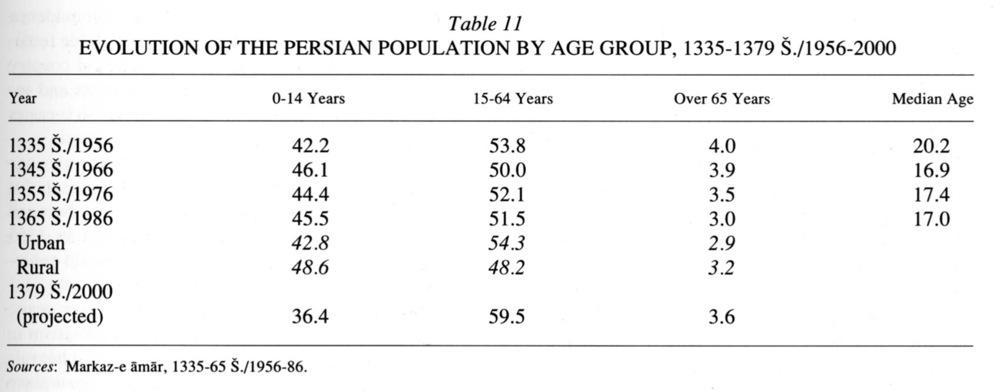
The continuous high rate of population increase since the 1950s has had the direct effect of lowering the age of the population, 50 percent of which is now under seventeen years old. The proportion below fifteen years old will drop below 40 percent before the end of the century, however, as the “postwar” generations age; a very gradual increase in life expectancy will not lead to a significant increase in the number of older people (Table 11; Figure 13).

Early census findings that men outnumbered women did not reflect genuine demographic facts; rather, they resulted from cultural features linked to the traditional status of women (underreporting of girls) and the higher value placed on boys (Table 12). The ratio was reversed in the age group between fifteen and thirty years, on the other hand, for men seek to avoid military service, and women, once married, are normally counted (Behnam and Amani, p. 17). In the census of 1365 Š./1986 the sex ratio corresponded more closely to biological reality.

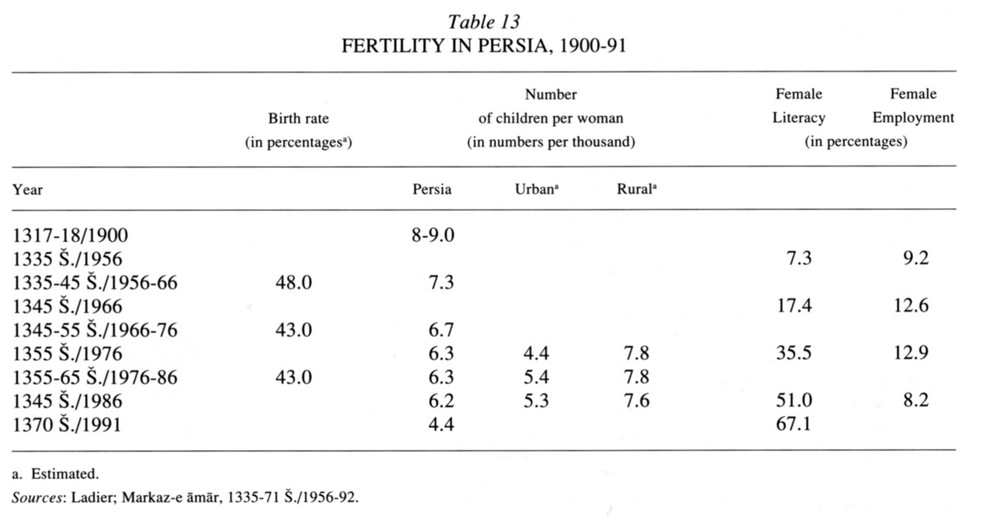
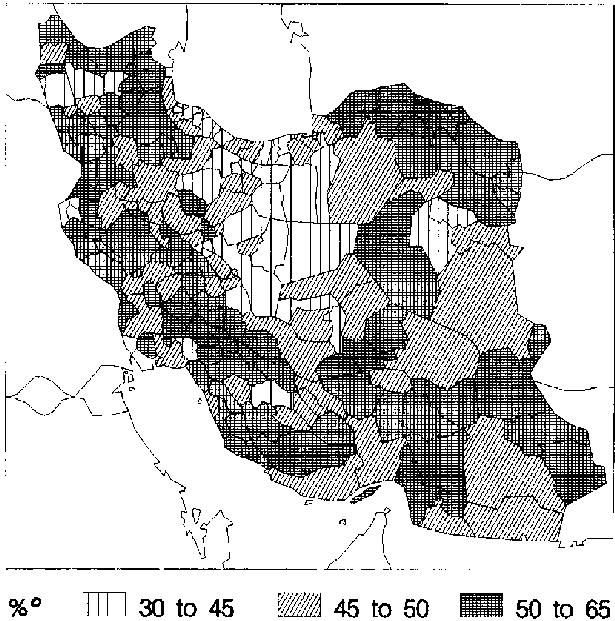
Fertility and mortality. The birth rate is about 43 percent, that is, between six and seven children born alive per woman, among the highest in the world, comparable to rates in several neighboring countries (e.g., Syria 7.5, Turkey 4.3, Jordan 6.5 infants per woman). It has not changed noticeably from that observed in the rural zone in 1344 Š./1965 (Chasteland et al.). In the absence of reliable government figures, the fertility of Persian women can only be estimated, but it is certain that for three decades the level remained stableuntil 1365 Š./1986, while the economic and social development of the country was supposed to have led to a lowering of the number of infants born per woman (Bauer). It is is also certain that the government’s family policies, both before and after the Revolution of 1357 Š./1978-79, have had very little direct impact and that, in this respect, the deeply rooted cultural and social characteristics of Persian women and families have, despite a few innovations, evolved little in forty years (Table 13). Since 1986 the fertility rate has been declining rapidly, the average number of children born to women was only 4.4 in 1991 (compared to 6.2 in 1986). The fertility rate varies noticeably with place of residence (urban or rural) and especially with educational level. Regional differences are equally noteworthy, distinguishing the central plateau and the Caspian provinces from peripheral regions, especially those in the south (Figure 14).
The government first adopted a policy of promoting birth control in maternal- and child-health centers in 1332 Š./1953, but consciousness raising began only in 1339 Š./1960, when importation of birth-control pills was authorized (Sardari and Keyhan, p. 780). In fact, it was not until 1345 Š./1966 that the government began to devote serious attention to this issue, establishing the High council of family planning (Wāḥed-e jamʿīyat wa tanẓīm-e ḵānavāda), creating a special ministerial post (moʿāwen-e vazīr; Sardari and Keyhan), and, on 15 Ḵordād 1346 Š./5 June 1967, adopting the Law for the protection of the family (Qānūn-e ḥemāyat-e ḵānavāda). The new policy received massive support from international organizations, but this support produced a greater impact in the media (e.g., the Isfahan communication program in 1349 Š./1970; Lieberman, p. 149) than on actual behavior. In the private sector 4.2 million sets of birth-control pills were sold in 1350 Š./1971, compared to 900,000 in the public centers (Moore et al., p. 403). In 1355 Š./1976 abortion, already widely practiced (11-17 percent of births in the years 1339-46 Š./1960-67; Jalali et al., p. 218), was legalized, but by 1357 Š./1978 only 11 percent of Persian women had accepted the principle of family planning (Aghajanian, 1992). In 1358 Š./1979 the government of the Islamic Republic abolished the laws for protection of the family and legal abortion; although contraception was not forbidden, the administration ceased all significant activity in this area until 1359 Š./1980, when a fatwā (legal opinion) from Ayatollah Rūḥ-Allāh Ḵomeynī (Khomeini) confirmed the lawfulness of contraception, permitting the Ministry of health (Wezārat-e behdārī) to resume its contraception programs. Between 1362 Š./1983 and 1366 Š./1987, 6-7 million people, 31 percent of the relevant population, received contraceptive devices each year, aside from sales in the private sector (according to data published in Markaz-e āmār, 1367 Š./1988). The new family-planning policy thus reached populations that had previously been hesitant or poorly informed, which naturally helped to lower the birth rate more rapidly than before, though it remained very high. After the war between Persia and Iraq the demographic policy of the Islamic government changed radically. Following a conference on population and development, held at Mašhad on 18 Mehr 1367 Š./10 September 1988, all propaganda encouraging large families was abandoned, and a new Malthusian policy has been very actively pursued, in order to bring about a reduction in the rate of population increase to 2.3 percent by 1377 Š./1998.
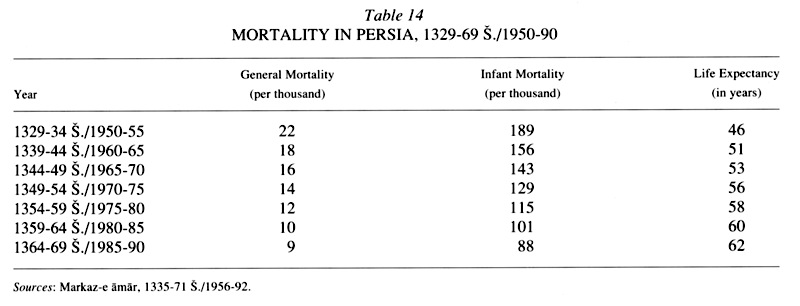
The general mortality rate (9 per thousand), and especially the mortality rate among children (88 per thousand), dropped markedly after 1329 Š./1950, but it, too, remained high (Table 14). The differences between city and country were particularly great because of the lack of medical equipment in rural areas: According to the Population Growth Survey (Markaz-e āmār, 1357 Š./1978), the infant mortality rate was 130 per thousand in the country for the years 1351-55 Š./1973-76, compared to 76 per thousand in the city (general mortality: 13.9 and 8.3 per thousand respectively). Life expectancy at birth rose from forty-six years in 1338 Š./1959 to sixty-two years in 1369 Š./1990; in contrast to the situation in most countries, in Persia men seem to live longer than women, but the hypothesis of a higher mortality rate among women has not been confirmed. The war between Persia and Iraq, in which almost 50,000 people died each year, did not alter the overall demography of Persia but did result in changes in numbers of female heads of household (7.1 percent of households) and the rates of remarriage.
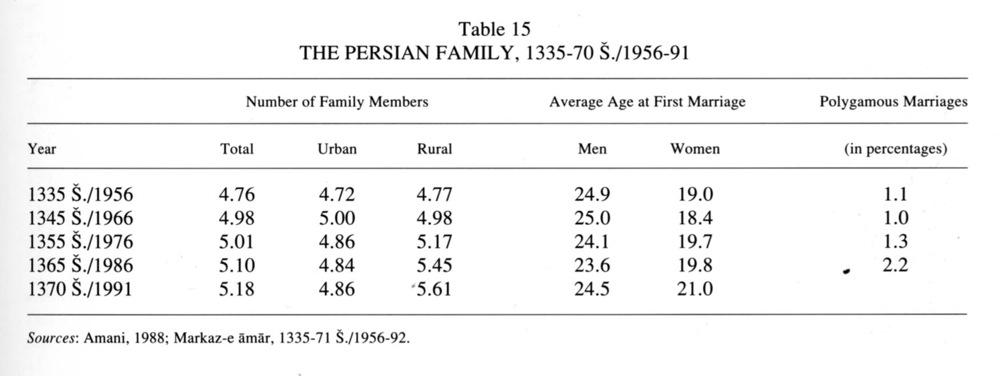
The main consequence of longer life expectancy has been the spread of permanent cohabitation of two and even three generations. This situation has consequences for behavior, both demographic (fertility, marriage) and social (aggravation of generational conflict), the effects of which are just beginning to appear. Average family size (five people) has remained stable or increased slightly, further evidence of both the decline in mortality and the stable fertility rate. The differences between city and country reflect both greater fertility in rural areas and increasing cohabitation of generations, which is easier and more traditional than in the urban zones.
Marriage. The average age for first marriage (nineteen years for women, twenty-three years for men) and the proportion of married women between ten and forty-nine years old (58 percent in 1355 Š./1976, 57 percent in 1365 Š./1986) remain generally quite stable, and celibates are still rare (1.1 percent in the age group fifty to fifty-four years; Table 15). These figures reveal a conservatism in behavior that is in sharp contrast to the upheavals that the country has experienced in other areas since World War II. The difference in ages of men and women at first marriage dropped from 5.9 years in 1335 Š./1956 to 3.5 years in 1370 Š./1991. In 1358 Š./1979 the legal marriage age was lowered from eighteen to thirteen years for girls and from twenty to fifteen years for boys. In 1344 Š./1965 an investigation of rural areas revealed that 19.7 percent of girls were married before the age of fourteen years (33.3 percent in the Kāzerūn region; Chasteland et al., p. 180), reflecting a deeply rooted social practice independent of the law.
The sociology of marriage was upset by the revolution in Persia in 1357 Š./1978-1979. There was an immediate boom in marriages, which increased from 1.8 million in 1357 Š./1978 to 3.0 million in 1358 Š./1979, reaching 4.1 million in 1362 Š./1983 before stabilizing at 3.4 million. This phenomenon was provoked not by Islamic legislation but by the arrival at marriageable age of larger generations and by the “revolutionary spirit,” which had caused ruptures in the traditional family structure and permitted meetings (e.g., at demonstrations and in political action) that led to marriage alliances contrary to familial traditions. The divorce rate remained stable (10 percent of marriages).
Polygamy accounts for 2-3 percent of all marriages and thus remains marginal demographically, except in certain rural regions of Fārs (Chasteland et al., p. 195) and Ḵūzestān, as well as in traditional lower-income social groups; the rate reached as high as 3.5-13.8 percent, depending upon age, among the skilled laborers of the Iranian Oil Refinery Company in 1335 Š./1956 (Miller and Windle, p. 309). Long-lasting “temporary” marriages (ṣīḡa) have never been counted but do not seem to have a notable effect on demography.
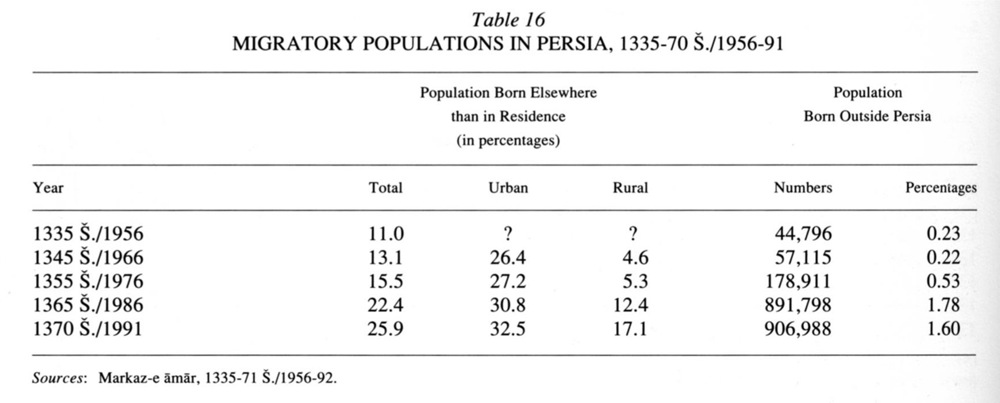
Migration. Migrations involve only a small, though growing part of the population; the proportion of people counted in the šahrestāns of their birth dropped from 89 percent in 1335 Š./1956 to 77.6 percent in 1365 Š./1986 (Table 16). International migrations were of little importance until the end of the 1970s, but, owing to the Revolution of 1357 Š./1978-79 and then to the war between Persia and Iraq, about 3 million people went into exile in the United States and Europe (Bozorgmehr and Sabbagh, p. 33), as well as in India and Turkey. Emigration on this scale is a new phenomenon but one with ancient roots; it has involved particularly the middle classes and the most highly educated and skilled groups. Large-scale foreign immigration is also new in Persia. In the 1970s more than 1 million Afghan and southeast Asian (Philippine) workers, as well as workers from industrialized nations, lived in Persia on a temporary basis and were rarely counted. In the census of 1365 Š./1986 the nationalities of the 865,307 foreigners counted were specified for the first time: 87.3 percent Afghans, 9.7 percent Iraqis, 1.5 percent Pakistanis, and so on. Refugees from Iraq, mainly Kurds and Iraqis of Persian origin, were not counted because they had been assimilated or lived provisionally in camps. These census data are underestimates, but they reflect a new situation; according to some estimates (Amani, 1988, p. 547), there were actually about 3.5 million foreigners (7 percent of the total population) in Persia in 1365 Š./1986.
Since 1335 Š./1956, 90 percent of internal migrations have been from the country to the cities, the population of which has multiplied 4.5 times (Clark, p. 105), whereas, in the period 1279-35 Š./1900-56, 61 percent of such migrations were between cities, especially toward Tehran, where 48 percent of the inhabitants were migrants; the proportion of migrants was 52 percent in Ābādān, 45 percent in Arāk, and only 25 percent in Mašhad (Bharier, 1972). This very rapid development of the cities reflects the departure of about 50 percent of the natural demographic surplus of the villages, the population of which has grown 71 percent in four decades (Table 17). This migration does not, however, fit the definition of a “rural exodus.” On the contrary, Persia is confronted simultaneously with the growth of new districts surrounding already heavily populated cities (Zandjani, 1992) and the persistence of a very large rural population.
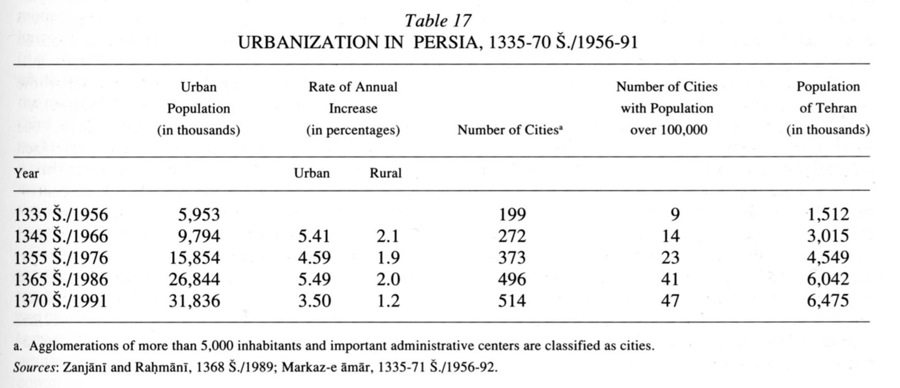
The proportion of migrants in Tehran is declining, even though the absolute numbers are growing. Julian Bharier (1972, p. 58) has calculated that, between 1279 Š./1900 and 1335 Š./1956, 42 percent of migrants settled in Tehran and 22 percent in the oil cities; from 1335 Š./1956 to 1345 Š./1966 this proportion rose to 50 percent for Tehran (with only 5 percent for Isfahan and Mašhad), but in 1355-65 Š./1976-86 only 33.3 percent of the 3,277,794 migrants from their native šahrestāns moved to the capital, 7 percent to the province of Isfahan, 6.7 percent to Khorasan, and 5.8 percent to Fārs. The position of Tehran as an urban center remained stable over four decades (26.2 percent of city dwellers in 1355 Š./1956, compared to 25.7 percent in 1365 Š./1986, including the suburbs), but in the same period the population living in cities of more than 100,000 inhabitants grew from 15.7 to 36.4 percent, of which 21 percent were concentrated in the five largest cities, each larger than 1 million inhabitants. The concentration of migrants in cities was accelerated by the war between Persia and Iraq and particularly affected the large provincial cities, which evolved from regional centers into urban metropolises (Zanjānī and Raḥmānī). With the arrival of the Afghans and the peasants of southern Khorasan Mašhad became the second city of Persia (1,463,000). Shiraz (850,000 in 1365 Š./1986) was disrupted by the influx of refugees coming from Ābādān, and Tabrīz (971,000) received a large number of Kurds. Tehran received populations from all over the country, mainly Azarbaijan and Kurdistan; like all the large metropolises of Persia, the capital has become surrounded by immense suburbs with a population of 900,000 people, swallowing up rural areas from Varāmīn to Haštjerd (Rahnemaʾi).
The nomadic population (see ʿAŠĀYER) was counted for the first time in the summer of 1987 (Tīr 1366 Š.) by the Statistical center of Persia (Markaz-e āmār, 1367 Š./1988). The total was 1,152,099 people, grouped in 96 tribes (īl) and 547 independent clans (ṭāyefa-ye mostaqell); the figures are not comparable with the estimates in the previous general censuses (337,176 nomads counted in 1355 Š./1976; Amirahmadi). Because of economic development and an authoritarian settlement policy, particularly under Reżā Shah (1304-20 Š./1925-41), the number of people practicing pastoral nomadism has been sharply declining since the beginning of the 20th century, when it was estimated at 2.5 million, 32 percent of the rural population, compared to 5 percent today (Bharier, 1972, p. 59). From the cultural and economic point of view this population is little favored; 83 percent are illiterate, and only 32 percent of children between six and eleven years old are in school, compared to 81.7 percent for Persia as a whole.
Social and economic characteristics. The literacy rate of the population (54.2 percent) has risen rapidly since 1335 Š./1956, especially in rural areas, which nevertheless remain far behind the cities (Table 18). These signs of progress go hand in hand with attendance at primary school (91.5 percent in the cities, 72.6 percent in the villages). Young adults are thus largely literate (75.2 percent of those between fifteen and twenty-four years old), especially in the cities, but 58.1 percent of the generation between twenty-five and sixty-four years old were still illiterate in 1365 Š./1986 (Markaz-e āmār, 1365 Š./1986).
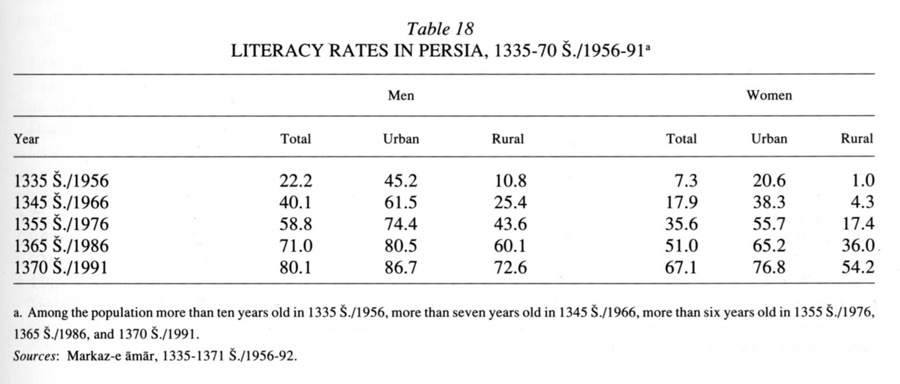
The census of 1365 Š./1986 for the first time furnished information on the knowledge of Persian among the population; 82.7 percent of Persians claimed to speak Persian (73.1 percent in rural areas), but the differences were very great between the central plateau, where nearly all inhabitants spoke it, and the peripheral regions, where people claiming inability to speak Persian were sometimes in the majority (Kurdistan 60 percent, Azarbaijan 59 percent, Īlām 47 percent, Zanjān 34 percent). It is not surprising that the level of literacy is lower where there are fewer Persian speakers (Hourcade and Taleghani, 1988, p. 22; Figure 15).

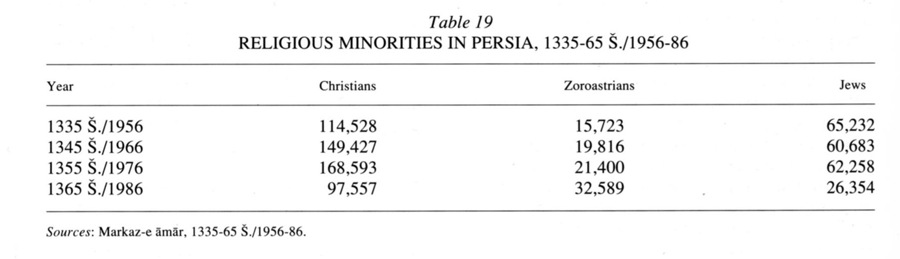
From the religious point of view the Persian population is quite homogeneous, as 99.3 percent are Muslims, either Shiʿite or Sunni (Table 19). Religious minorities, more and more concentrated in the cities (52.3 percent in Tabrīz in Tehran in 1365 Š./1986; cf. de Mauroy, 1973), are less numerous because of accelerating emigration (Jews, Armenians); only the Zoroastrians have increased. Many Assyro-Chaldean refugees from Iraq have passed through Persia but have not settled there.
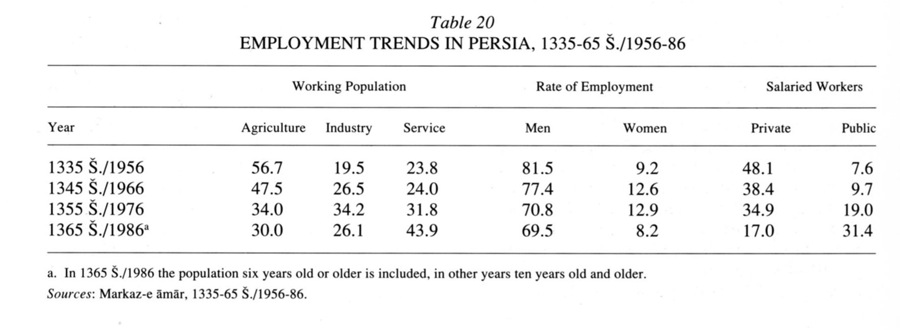
Economic activity among the population has profoundly altered in four decades, reflecting the decline of agriculture, the increase in the service sector, and the decline of industrial employment (Table 20). The political and economic crisis revealed by the census of 1365 Š./1986 is clear evidence that modernization of the economy and of Persian society has often been only superficial and easily reversed (e.g., female employment). The decline in private white-collar employment and the equivalent rise in the number of government bureaucrats (almost one third of the employed population) do not reflect the reality of the labor market, which is actually dominated by an informal economy. Reported unemployment remains low (5.5 percent), but it involves mainly the young (10.4 percent of the generation between twenty and twenty-four years old).
Despite urban development and its direct consequences, the population of Persia has preserved for more than forty years a large part of its basic cultural and economic character. This stability is particularly clear in the status of women and the demographic evolution of the country, reinforced by crisis conditions and the recent decrease in the rate of population growth.
Bibliography
C. Adle and B. Hourcade, eds., Téhéran. Capitale bicentenaire, Bibliothèque iranienne 37, Paris, 1992.
A. Aghajanian, “Status of Women in Iran,” in Women and Population Dynamics. Perspectives from Asian Countries, New Delhi and London, 1989, pp. 167-76.
Idem, “Status of Women and Fertility in Iran,” Journal of Comparative Family Studies 23/3, 1992, pp. 361-74.
I. Ajami, “Differential Fertility in Peasant Communities. A Study of Six Iranian Villages,” in C. A. O. van Nieuwenhuijze, ed., Commoners, Climbers and Notables. A Sampler of Studies on Social Ranking in the Middle East, Leiden, 1977, pp. 391-408.
M. Amani, “La population de l’Iran,” Population 27/3, 1972, pp. 411-18.
Idem, “Vue d’ensemble sur la situation démographique de l’Iran,” Revue de géographie de Lyon 48/2, 1973, pp. 141-63.
Idem, “Accroissement et évolution de la population en Iran,” in Les disparités démo-graphiques régionales. Ve colloque national de démographie du CNRS, Paris, 1978, pp. 577-82.
Idem, “Naissances et taux de natalité et de mortalité de l’Iran de 1877 à 1950,” Population 37/1, 1982, pp. 175-77.
Idem, “La population de l’Iran au recensement de 1986,” Population 43/3, 1988, pp. 537-54.
B. Amirahmadi, “The Socio-Econonomic Census of Nomadic Tribes in Iran in July 1987,” Journal of Official Statistics 9/3, 1993, pp. 691-703.
J. Bauer, “Demographic Change, Women and the Family in a Migrant Neighborhood of Tehran,” in A. Fathi, ed., Women and the Family in Iran, Leiden, 1985, pp. 158-86.
M. Bazin, “La population de l’Iran in 1976,” Monde iranien et l’Islam 4, 1976-77, pp. 237-42.
D. Behnam and M. Amani, La population de l’Iran, Paris, 1974.
Idem, “A Note on the Population of Iran 1900-1966,” Population Studies 22, 1968, pp. 273-79.
J. Bharier, “The Growth of the Towns and Villages in Iran, 1900-1966,” Middle Eastern Studies 8/1, 1972, pp. 51-61; repr. in J. A. Momeni, ed., The Population of Iran. A Selection of Readings, Honolulu and Shiraz, 1977, pp. 331-41.
M. Bozorgmehr and G. Sabbagh, “High Status Immigrants. A Statistical Profile of Iranians in the United States,” Iranian Studies 21/3-4, 1988, pp. 5-36.
J.-C. Chasteland et al., Étude sur la fécondité et quelques carac-téristiques démographiques des femmes mariées dans quatre zones rurales d’Iran, Tehran, 1968.
B. D. Clark, “Iran. Changing Population Patterns,” in J. L. Clarke and W. B. Fisher, eds., Populations of the Middle East and North Africa. A Geographical Approach, London, 1972, pp. 68-96.
E. Farahani, “Abridged Life Tables of Iran, 1965-1966,” Genus 34/1-2, 1978, pp. 215-25.
F. Firoozi, “Iranian Censuses 1956 and 1966.
A Comparative Analysis,” The Middle East Journal 24, 1970, pp. 220-28.
Idem, “Tehran. A Demographic and Economic Analysis,” Middle East Studies 10/1, 1974, pp. 60-76.
H. Firouzbakhch, “A Structural-Demographic Approach to Revolution. The Case of the Iranian Revolution of 1979,” Civilisations 38/2, 1988, pp. 85-164.
L. Henri, “Aspects démographiques d’une région rurale de l’Iran,” Population 3, 1953, pp. 590-92.
B. Hourcade, “La population iranienne d’après le recensement de 1976,” Population 4, 1981, pp. 1171-76.
Idem, “Migrations intérieures et changement social en Iran (1966-1976),” Médi-terranée 4, 1983, pp. 63-69.
Idem and M. Taleghani, “La population de l’Iran en 1986, entre les conflits irakien et afghan,” Mappemonde 1, 1988, pp. 18-22.
Idem, “La population iranienne d’après le recensement de 1986,” Stud. Ir. 18/2, 1989, pp. 247-54.
G. H. Jalali, H. Peyman, and A. Majd, “Study of Abortion at Farah Maternity Hospital, Tehran,” Iranian Journal of Public Health 2/4, 1974, pp. 212-18.
F. Kazemi, Poverty and Revolution in Iran, New York, 1980.
M. Ladier, “La fécondité des ethnies principales d’Iran,” Cahiers d’Études sur la Méditerranée Orientale et le Monde Turco-Iranien 16, 1993, pp. 314-34.
S. S. Lieberman, “Family Planning in Iran. Results of a Survey and a Mass Media Campaign,” Iranian Studies 5/4, 1972, pp. 149-79.
Markaz-e āmār-e Īrān, Sar-šomārī-e ʿomūmī-e nofūs o maskan, Tehran, 1335 Š./1956; 1345 Š./1966; 1355 Š./1976; 1365 Š./1986.
Idem, Population Growth Survey of Iran. Final Report 1973-1976, Tehran, 1357 Š./1978.
Idem, Sar-šomārī-e ejtemāʿī-eqteṣādī-e ʿašāyer-e kūčanda1366, Tehran, 1367 Š./1988.
H. de Mauroy, “Mouvements de population dans la communauté assyro-chaldéennes en Iran,” Revue de géographie de Lyon 43/3, 1968, pp. 333-65.
Idem, “Les minorités non musulmanes dans la population iranienne,” Revue de géographie de Lyon 48/2, 1973, pp. 165-206.
M. K. Miller and C. Windle, “Polygyny and Social Status in Iran,” Journal of Social Psychology 51, 1960, pp. 307-11.
ʿA.-A. Mohājerānī, “Tawzīʿ-e makānī-e jamʿīyat-e Īrān,” Taḥqīqāt-e joḡrāfīāʾī 4/2, 1368 Š./1989, pp. 35-59.
J. A. Momeni, “The Difficulties of Changing the Age at Marriage in Iran,” Journal of Marriage and Family 37, 1975a, pp. 545-51.
Idem, “Polygyny in Iran,” Journal of Marriage and the Family 37, 1975b, pp. 453-56.
Idem, ed., The Population of Iran. A Selection of Readings, Honolulu and Shiraz, 1977.
R. Moore, K. Asayesh, and J. Montague. “Population and Family Planning in Iran,” Middle East Journal 28/4, 1974, pp. 396-408.
H. Moṭīʿī Langarūdī, “Tarākom-e jamʿī-e Īrān,” Taḥqīqāt-e jōḡrāfīāʾī 2/1, 1366 Š./1987, pp. 95-112.
A. A. Nazari, Population Geography of Iran, Tehran, 1989.
A. Nizard, “La population de l’Iran au recensement de 1956,” Population 23/1, 1968, pp. 145-50.
N. Pakdaman, “Étude critique du recensement général de l’Iran,” Tiers-Monde 6/21, 1965, pp. 231-46.
A. A. Paydarfar, “Marital Fertility and Family Structure among the Urban Population of Iran,” Journal of Comparative Family Studies 18/3, 1987, pp. 389-402.
M. T. Rahnemaʾi, “L’extension de Téhéran et les mutations de l’environnement rural,” in C. Adle and B. Hourcade, eds., Téhéran. Capitale bicentenaire, Paris, 1992, pp. 321-48.
A. M. Sardari and R. Keyhan, “The Prospect of Family Planning in Iran,” Demography 5/2, 1968, pp. 780-84.
Sāl-nāma-ye āmārī-e kešvar 1370, Tehran, 1371 Š./1992, p. 48.
G. P. Smith, “A Note on Babi and Bahaʾi Numbers in Iran,” Iranian Studies 17/2-3, 1984, pp. 295-301.
United Nations, Population and Family Planning in Iran, New York, 1971.
H. Zandjani (Ḥ Zanjānī), “Évolution de la population iranienne d’après les recensements,” Population 6, 1977, pp. 1277-83.
Idem, “Téhéran et sa population. Deux siècles d’histoire,” in C. Adle and B. Hourcade, eds., Téhéran. Capitale bicentenaire, Paris, 1992, pp. 251-66.
Idem and F. Raḥmānī, Rāhnemā-ye jamʿīyat-e šahrhā-ye Īrān 1335-1370, Tehran, 1368 Š./1989.