



ii. PERSEPOLIS TREASURY ARCHIVE
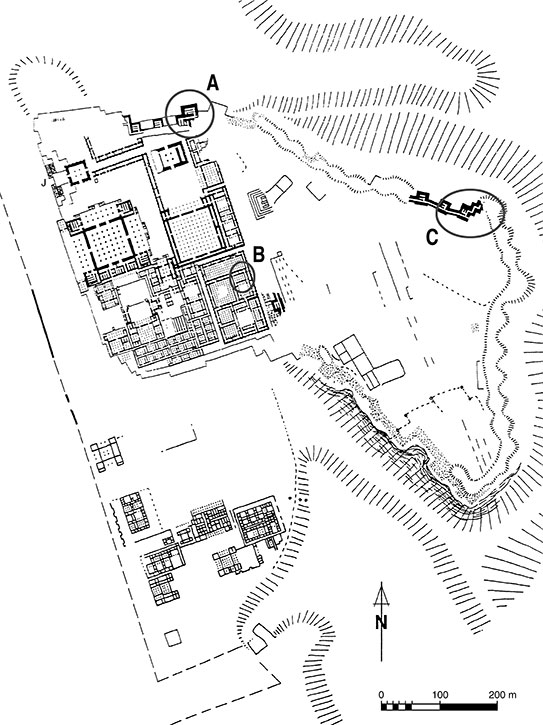
Excavations between 1934 and 1938 directed by Erich Schmidt for the Oriental Institute discovered 198 cuneiform tablets and substantial fragments of tablets, along with 548 smaller fragments, in the Treasury on the southeastern part of the Persepolis terrace, most of them concentrated in or around a single room. Herzfeld had found a fragment from this group in 1932 (Jones and Yie). The excavators also found 199 sealings, that is, clay objects of various shapes with impressions of stamp seals, cylinder seals and seal rings, many of them with marks of strings that secured bags or boxes and/or attached the sealings to containers; 72 of these sealings were found in the room where most of the tablets were concentrated (Schmidt, 1957, pp. 4-5).
All but one of the Treasury tablets are approximately tongue-shaped and formed around knotted strings, similar to the majority of Fortification tablets with Elamite memoranda or letters, but generally larger (ca. 7-10 cm wide; PLATE VII). All of these have texts in Achaemenid Elamite. One tablet is rectangular, unsealed, and stringless; it has a text in the Babylonian dialect of Akkadian. Some of the associated clay sealings resemble those used elsewhere with folded papyrus or parchment documents. Few if any of them resemble the uninscribed Fortification tablets.

Forty-six of the Elamite documents and the Akkadian document belong to collections of the Oriental Institute. The remaining Treasury tablets are in the National Museum of Iran, Tehran (Cameron, 1948, p. viii; Razmjou, p. 55). The single Akkadian text and 139 Elamite texts have been published (Cameron 1948, 1958, pp. 172-76; 1965, with collations and corrections by Hallock, 1960 and Arfaʿi, 2008c; Jones and Yie).
The Elamite Treasury texts are dated between year 30 of Darius I and year 7 of Artaxerxes I, 492-457 BCE. The largest numbers of dated texts are from years 19 and 20 of Xerxes.
Impressions of a few seals shared by the Elamite Treasury tablets and/or the Treasury sealings and/or the Elamite Fortification tablets confirm functional connections and administrative continuity among these groups of records.
All but a few of the Treasury texts deal with payments of silver from a treasury at Persepolis made in lieu of partial or full rations of sheep, wine, or grain, to workers and craftsmen active at or near Persepolis. The geographical range is more limited than that of the Fortification texts (Henkelman, forthcoming[d]) They include letters ordering payments to groups of workers and memoranda of such payments made. The letters are addressed to four men in succession over the thirteen-year interval, sometimes entitled “treasurer” (Elamite kapnuškir, corresponding to Iranian ganzabara). In the memoranda of payment, the same men are sometimes characterized with the Elamite word šaramanna, common in the Fortification texts to indicate officials in charge of work groups and their provisions. The earliest-named of these men also appears in this role in Fortification texts.
Senders of the Treasury letters were men of the same effective rank as the chief administrative officers in the Fortification archive (Hallock, 1985, p. 592; Henkelman, forthcoming[d].). One of them is sometimes termed “foremost” (Elamite pirratamma, transcribing Old Iranian *fratama), probably intended as a title, “chief,” “director” (Tuplin, 2005; Tavernier, 2007, p. 405). The recipients of Treasury payments included craftsmen working at Persepolis and, occasionally, at nearby district centers (woodworkers, goldsmiths, stonecutters, some described as Syrians, Ionians, Egyptians), and accountants working in the treasury.
The few Elamite Treasury documents that record other matters include details that link them to the Fortification Archive. Some tablets and fragments from the reign of Darius are marked with the seal of a high-ranking official (Elamite Irdumartiya, Aramaic ʾrtwrzy, representing Old Iranian *Artavard/ziya-) who is well-represented in the Fortification texts; they record outlays of silver according to royal orders, sometimes in very large amounts and sometimes at district centers also well-documented in the Fortification texts (PT 4-8, and fragments listed in Schmidt, 1957, p. 31, Seal No. 33 [PTS 33* = PFS 0071*]). Another text records a deposit of a large amount of gold, taken from the main settlement nearest Persepolis to one of the same district centers (PT 83).
The single Akkadian text from the Treasury records assays of silver payments made, perhaps at or near Persepolis, by three individuals in years 19 and 20 of Darius I (503-502 BC; PT 85, see Briant, 2002, p. 441). Its functional connection, if any, to the Elamite Treasury documents is not known (Tamerus, pp. 255-57, with references).
Bibliography
G. G. Aperghis, “Surplus, Exchange and Price in the Persepolis Fortification Tablets,” in J. Andreau, P. Briant, and R. Descat, eds., Économie antique: Prix et formation des prix dans les économies antiques. Entretiens d’archéologie et d’histoire 3, Saint-Bertrand-de-Comminges, 1997, pp. 277-90.
Idem, “Storehouses and Systems at Persepolis: Evidence from the Persepolis Fortification Tablets,” Journal of the Economic and Social History of the Orient 42, 1999, pp. 152-93.
A. Arfaee, “The Geographical Background of the Persepolis Tablets,” Ph.D. diss., Department of Near Eastern Languages and Civilizations, University of Chicago, 2008a.
Idem, Persepolis Fortification Tablets: Fort. and Teh. Texts, Ancient Iranian Studies Series 5, Tehran, 2008b.
Idem [A. Arfaʿi], “PT 10a, Collated and Completed,” Arta 2008.001 [2008c].
[http://www.achemenet.com/document/2008.001-Arfai.pdf]
A. Askari Chaverdi, A. Khosrowzadeh, B. McCall, C. A. Petrie, D. T. Potts, K. Roustaei, M. Seyedin, L. Weeks and M. Zaidi, “Archaeological Evidence for Achaemenid Settlement within the Mamasani Valleys, Western Fars, Iran,” in J. Curtis and St. J. Simpson eds., The World of Achaemenid Persia, London, 2010, pp. 287-97.
A. Askari Chaverdi, P. Callieri, and E. Matin, “Tol-e Ajori: a Monumental Gate of the Early Achaemenian Period in the Persepolis Area. The 2014 Excavation Season of the Iranian-Italian Project ‘From Palace to Town,’ ” Archäologische Mitteilungen aus Iran und Turan 46, 2014, pp. 223-54.
A. Azzoni, “The Bowman MS and the Aramaic Tablets,” in P. Briant et al. eds., 2008, pp. 253-74.
Idem, “The Empire as Visible in the Aramaic Documents from Persepolis,” in B. Jacobs, W. F. M. Henkelman, and M. W. Stolper, eds., Die Verwaltung im Achämenidenreich—Imperiale Muster und Strukturen/Administration in the Achaemenid Empire—Tracing the Imperial Signature, Classica et Orientalia 17, 2017, pp. 455-68.
A. Azzoni and E. R. M. Dusinberre, “Persepolis Fortification Aramaic Tablet Seal 0002 and the Keeping of Horses,” in M. Kozuh, W. F. M. Henkelman, C. E. Jones, and C. Woods, eds., Extraction and Control: Studies in Honor of Matthew W. Stolper, Studies in Ancient Oriental Civilization 68, Chicago, 2014, pp. 1-16.
A. Azzoni and M. W. Stolper, “From the Persepolis Fortification Archive Project, 5: The Aramaic Epigraph ns(y)ḥ on Elamite Persepolis Fortification Documents,” Arta 2015.004
[http://www.achemenet.com/pdf/arta/ARTA_2015.004-Azzoni-Stolper.pdf ]
R. Boucharlat, “The Persepolis Area in the Achaemenid Period, Some Reconsiderations,” in N. F. Miller and K. Abdi, eds., Yeki bud, yeki nabud: Essays on the Archaeology of Iran in Honor of William M. Sumner, Cotsen Institute of Archaeology at UCLA, Monograph 48, Los Angeles, 2003, pp. 260-65.
Idem, “Iran,” in P. Briant and R. Boucharlat eds., L’archéologie de l’empire achéménide: nouvelles recherches, Persika 6, Paris, 2005, pp. 221-92.
Idem, “Southwestern Iran in the Achaemenid Period,” in D. T. Potts, ed., The Oxford Handbook of Ancient Iran, Oxford, 2013, pp. 503-27.
Idem, “À propos de parayadām et paradis perse: perplexité de l’archéologue et persepectives,” in C. Redard, ed., Des Contrées avestiques à Mahabad, via Bisotun, Civilisations du Proche-Orient III/2, Paris, 2016, pp. 61-80.
R. Boucharlat and Ch. Benech, “Organisation et aménagement de l’espace à Pasargades. Reconnaissances archéologiques de surface 1999 et 2002,” Arta 2002.001 [http://www.achemenet.com/ressources/enligne/arta/pdf/2002.001-loc.pdf]
P. Briant, From Cyrus to Alexander: A History of the Persian Empire, Winona Lake, Ind., 2002.
Idem, “The Empire of Darius III in Perspective,” in W. Heckel and L. Trittle eds., Alexander the Great: a New History, Chichester, U.K., 2009, pp. 141-70.
Idem, “L’approvisionnement de l’armée macedonienne: Alexandre le Grand et l’organisation logistique de l’empire achéménide,” in S. Gondet and E. Haerinck eds., “L’Orient est son Jardin,” Hommages à Rémy Boucharlat, Studia Iranica, Leuven, forthcoming.
P. Briant, W. Henkelman, and M. Stolper, eds., L’archive des Fortifications de Persépolis: État des questions et perspectives de recherches, Persika 12, 2008, Paris.
C. Brixhe, “Corpus des inscriptions paléo-phrygiennes, Suppl. II,” Kadmos 43, 2004, pp. 1-130.
M. Brosius, Women in Ancient Persia 559-331 B.C., Oxford, 1996.
Idem, “Reconstructing an Archive: Account and Journal Texts from Persepolis,” in M. Brosius, ed., Ancient Archives and Archival Traditions: Concepts of Record-Keeping in the Ancient World, Oxford, 2003, pp. 264-83.
P. Callieri, “Evidence of Administration in the Archaeological Heritage of the Achaemenid Period in Iran,” in B. Jacobs, W. F. M. Henkelman, and M. W. Stolper, eds., Die Verwaltung im Achämenidenreich—Imperiale Muster und Strukturen/Administration in the Achaemenid Empire—Tracing the Imperial Signature, Classica et Orientalia 17, Wiesbaden, 2017, pp. 257-294.
G. G. Cameron, Persepolis Treasury Tablets, Oriental Institute Publications 65, Chicago, 1948.
Idem, “Persepolis Treasury Tablets Old and New,” Journal of Near Eastern Studies 17, 1958, pp. 161-76.
Idem, “New Tablets from the Persepolis Treasury,” Journal of Near Eastern Studies 24, 1965, pp. 167-92.
E. Carter and H. T. Wright, “Archaeological Survey on the Western Ram Hormuz Plain,” in Naomi F. Miller and Kamyar Abdi, eds., Yeki bud, yeki nabud: Essays on the Archaeology of Iran in Honor of William M. Sumner, Cotsen Institute of Archaeology at UCLA, Monograph 48, Los Angeles, 2003, pp. 60-82.
R. A. Carter, K. Challis, S. M. N. Priestman and H. Tofighian, “The Bushehr Hinterland: Results of the First Season of the Iranian-British Archaeological Survey of Bushehr Province, November-December 2004,” Iran 44, 2006, pp. 63-103.
E. R. M. Dusinberre, “Seal Impressions on the Persepolis Fortification Aramaic Tablets: Preliminary Observations,” in P. Briant et al., eds., 2008, pp. 239-52.
Michael T. Fisher and Matthew W. Stolper, “Achaemenid Elamite Administrative Tablets, 3: Fragments from Old Kandahar, Afghanistan,” Arta 2015.001.
[http://www.achemenet.com/pdf/arta/ARTA_2015.001-Fisher-Stolper.pdf]
M. B. Garrison, “A Persepolis Fortification Seal on the Tablet MDP 11, 308 (Louvre Sb 13078),” Journal of Near Eastern Studies 55, 1996, pp. 15-35.
Idem, “The Seals of Ašbazana (Aspathines),” in M. Brosius and A. Kuhrt, eds., Studies in Persian History: Essays in Memory of David M. Lewis, Achaemenid History 11, Leiden, 1998, pp. 115-31.
Idem, “Achaemenid Iconography as Evidenced by Glyptic Art, Subject Matter, Social Function, Audience and Diffusion,” in C. Uehlinger, ed., Images as Media, Sources for the Cultural History of the Near East and the Eastern Mediterranean (1st Millennium BCE), Orbis Biblicus et Orientalis 175, Fribourg and Göttingen, 2000, pp. 115-63.
Idem, “The ‘Late Neo-Elamite’ Glyptic Style: A Perspective from Fars,” Bulletin of the Asian Institute 16, 2002, pp. 65–102.
Idem, “The Uninscribed Tablets from the Fortification Archive: a Preliminary Analysis,” in P. Briant et al. eds., 2008, pp. 149-238.
Idem, “By the Favor of Auramazdā: Kingship and the Divine in the Early Achaemenid Period,” in P. P. Iossif, A. D Chankowski, and C. C. Lorber, eds., More than Men, Less than Gods: Studies in Royal Cult and Imperial Worship. Proceedings of the International Colloquium Organized by the Belgian School at Athens (1-2 November 2007), Studia Hellenistica 51, Leuven, Paris, and Walpole, Mass., 2011, pp. 15–104.
Idem, “The Royal-Name Seals of Darius I,” in W. F. M. Henkelman, C. E. Jones, M. Kozuh, and C. Woods, eds., Extraction and Control: Studies in Honor of Matthew W. Stolper, Studies in Ancient Oriental Civilization 68, Chicago, 2014a, pp. 67-104.
Idem, “Glyptic Studies as Art History,” in B. A. Brown and M. H. Feldman, eds., Critical Approaches to Ancient Near Eastern Art, Berlin, 2014b, pp. 481–513.
Idem, “Beyond Auramazdā and the Winged Symbol: Imagery of the Divine and Numinous at Persepolis,” in W. F. M. Henkelman and C. Redard, eds., Persian Religion in the Achaemenid Period/La religion perse à l’époque achéménide, Classica et Orientalia 16, Wiesbaden, 2017a, pp. 185–246.
Idem, “Sealing Practice in Achaemenid Times,” in B. Jacobs, W. F. M. Henkelman, and M. W. Stolper, eds., Die Verwaltung im Achämenidenreich—Imperiale Muster und Strukturen/Administration in the Achaemenid Empire—Tracing the Imperial Signature, Classica et Orientalia 17, Wiesbaden, 2017b, pp. 517-580.
Idem, The Ritual Landscape at Persepolis: Glyptic Imagery from the Persepolis Fortification and Treasury Archives. The Collège de France Lectures, Studies in Ancient Oriental Civilization 71, Chicago, 2017c.
Idem, “Visual Representation of the Divine and the Numinous in Achaemenid Iran: Old Problems, New Directions,” in C. Uehlinger and F. Graf, eds., Iconography of Ancient Near Eastern Religions I: Pre-Hellenistic Periods: Introductory Essays, Leiden, forthcoming.
M. B. Garrison and W. F. M. Henkelman, “Sigillophobe Suppliers and Idiosyncratic Scribes: Status, Administrative Profile and Glyptic Behaviour of Storage Managers in the Persepolis Fortification Archive,” in E. R. M. Dusinberre and M. B. Garrison eds., The Art of Empire in Achaemenid Persia: Festschrift in Honor of Margaret Cool Root, Achaemenid History 16, Leiden, forthcoming.
M. B. Garrison and M. C. Root, Persepolis Seal Studies: An Introduction with Provisional Concordance of Seal Numbers and Associated Documents on Fortification Tablets 1-2087, Achaemenid History 9, corrected edition, Leiden, 1998.
Idem, Seals on the Persepolis Fortification Tablets I: Images of Heroic Encounter, Oriental Institute Publications 117, Chicago, 2001.
Idem, Seals on the Persepolis Fortification Tablets II: Images of Human Activity, Oriental Institute Publications, Chicago, forthcoming(a).
Idem, Seals on the Persepolis Fortification Tablets III: Images of Animals, Geometric and Abstract Designs, Oriental Institute Publications, Chicago, forthcoming(b).
F. Grillot, “Une tablette achéménide inédite,” Archaeologische Mitteilungen aus Iran 19, 1986, pp. 149-50.
R. T. Hallock, “New Light from Persepolis,” Journal of Near Eastern Studies 9, 1950, pp. 237-52.
Idem, “A New Look at the Persepolis Treasury Tablets,” Journal of Near Eastern Studies 19, 1960, pp. 90-100.
Idem, Persepolis Fortification Tablets, Oriental Institute Publications 92, Chicago, 1969.
Idem, “Selected Fortification Texts,” Cahiers de la Délégation Archéologique Française en Iran 8, 1978, pp. 109-36.
Idem, “The Evidence of the Persepolis Tablets,” in Ilya Gershevitch, ed., The Cambridge History of Iran II: The Median and Achaemenian Periods, London, 1985, pp. 588-609 (preprinted in 1971 with a preface by I. Gershevitch).
S. W. Helms, “Excavations at ‘The City and the Famous Fortress of Kandahar, the Foremost Place in All of Asia,’ ” Afghan Studies 3-4, 1982, pp. 1-24.
Idem, Excavations at Old Kandahar in Afghanistan 1976-1978, Society for South Asian Studies Monograph 2, BAR International Series 686, Oxford, 1997.
W. F. M. Henkelman, “An Elamite Memorial: the šumar of Cambyses and Hystaspes,” in W. Henkelman and A. Kuhrt, eds., A Persian Perspective: Essays in Memory of Heleen Sancisi-Weerdenburg, Achaemenid History 13, Leiden, 2003, pp. 101-72.
Idem, “Animal Sacrifice and ‘External’ Exchange in the Persepolis Fortification Tablets,” in H.D. Baker and M. Jursa, eds., Approaching the Babylonian Economy,Studies in the Economic History of First Millennium Babylonia 2 = AOAT 330, Münster, 2005, pp. 137-65.
Idem, The Other Gods Who Are: Studies in Elamite-Iranian Acculturation Based on the Persepolis Fortification Texts, Achaemenid History 14, Leiden, 2008a.
Idem, “From Gabae to Taoce: the Geography of the Central Administrative Province,” in P. Briant et al., 2008b, pp. 303-16.
Idem, “‘Consumed before the King’: The Table of Darius, that of Irdabama and Irtaštuna, and that of his Satrap Karkiš,” in B. Jacobs and R. Rollinger, eds., Der Achämenidenhof/The Achaemenid Court, Classica et Orientalia 2, Wiesbaden, 2010, pp. 667-775.
Idem, “Parnakka’s Feast: šip in Parsa and Elam,” in J. Álvarez-Mon and M. B. Garrison, eds., Elam and Persia, Winona Lake, Ind., 2011a, pp. 89-166.
Idem, “Cyrus the Persian and Darius the Elamite, a Case of Mistaken Identity,” in R. Rollinger, B. Truschnegg, and R. Bichler, eds., Herodot und das Persische Weltreich/Herodotus and the Persian Empire, Classica et Orientalia 3, Wiesbaden, 2011b, pp. 577-634.
Idem, “Xerxes, Atossa and the Persepolis Fortification Archive, in Annual Report 2010: The Netherlands Institute on the Near East and The Netherlands Institute in Turkey, Leiden, 2011c, pp. 26-33.
Idem, “Of Tapyroi and Tablets, States and Tribes: The Historical Geography of Pastoralism in the Achaemenid Heartland in Greek and Elamite Sources, “ Bulletin of the Institute of Classical Studies 54/2, 2011d, pp. 1-16.
Idem, “Elam,” in H. Heinen, ed., Handwörterbuch der antiken Sklaverei (CD-ROM-Lieferung 3), Stuttgart, 2011e.
Idem, “Šimut,” Reallexikon der Assyriologie 12, 2011f, pp. 511-12.
Idem, “The Achaemenid Heartland: an Archaeological-Historical Perspective,” in D. T. Potts, ed., A Companion to the Archaeology of the Ancient Near East, London, 2012a, pp. 931-62.
Idem, “Tamukkan/Taḫ(u)makka,” Reallexikon der Assyriologie 13.5/6, 2012b, pp. 440-41.
Idem, “Administrative Realities: the Persepolis Archives and the Archaeology of the Achaemenid Heartland,” in D. T. Potts ,ed., The Oxford Handbook of Ancient Iran, Oxford, 2013, pp. 528-46.
Idem, “Tirazziš, “Reallexikon der Assyriologie 14.1/2, 2014a, pp. 59-60.
Idem, “Turmira,” Reallexikon der Assyriologie 14.3/4, 2014b, pp. 199-200.
Idem, “Anhang: Egyptians in the Persepolis Archives,” in M. Wasmuth, Ägypto-persische Herrscher- und Herrschaftspräsentation in der Achämenidenzeit, Oriens et Occidens 27, Stuttgart, 2017a, pp. 273-99.
Idem, “Humban and Auramazdā: Royal Gods in a Persian Landscape,” in W. F. M. Henkelman and C. Redard, eds., Persian Religion in the Achaemenid Period/La religion perse à l’époque achéménide, Classica et Orientalia 16, Wiesbaden, 2017b, pp. 273-346.
Idem, “Imperial Signature and Imperial Paradigm. Achaemenid Administrative Structure and System Across and Beyond the Iranian Plateau,” in B. Jacobs, W. F. M. Henkelman, and M. W. Stolper, eds., Die Verwaltung im Achämenidenreich—Imperiale Muster und Strukturen/Administration in the Achaemenid Empire—Tracing the Imperial Signature, Classica et Orientalia 17, Wiesbaden, 2017c, pp. 45-256.
Idem, “Bactrians in Persepolis—Persians in Bactria,” in J. Lhuillier and N. Boroffka eds., A Millenium of History: the Iron Age in Southern Central Asia (2nd and 1st Millennia B.C.), Archäologie in Iran und Turan, Berlin, forthcoming(a).
Idem, “The Heartland Pantheon,” in B. Jacobs and R. Rollinger, eds., A Companion to the Achaemenid Persian Empire, Oxford, forthcoming(b).
Idem, “Practice of Worship in the Achaemenid Heartland,” in B. Jacobs and R. Rollinger, eds., A Companion to the Achaemenid Persian Empire, Oxford, forthcoming(c).
Idem, “Local Administration: Persia,” in B. Jacobs & R. Rollinger, eds., A Companion to the Achaemenid Persian Empire, Oxford, forthcoming(d).
Idem, “The Elamite religious and administrative heritage of Persia,” in G. P. Basello, J. Álvarez-Mon, and Y. Wicks, eds., The Elamite World, forthcoming(e).
W. F. M. Henkelman and M. L. Folmer, “Your Tally is Full! On Wooden Credit Records in and After the Achaemenid Empire,“ in K. Kleber and R. Pirngruber, eds., Silver, Money and Credit: A Tribute to Robartus J. Van der Spek on the Occasion of his 65th Birthday, Uitgaven van het Nederlands Instituut voor het Nabije Oosten te Leiden 128, Leiden 2016, pp. 133-239.
W. F. M. Henkelman and B. Jacobs, “Roads and Communication,” in B. Jacobs and R. Rollinger, eds., A Companion to the Achaemenid Persian Empire, Oxford, forthcoming.
W. F. M. Henkelman, C. E. Jones, and M. W. Stolper, “Clay Tags with Achaemenid Seal Impressions in the Dutch Institute of the Near East (NINO) and Elsewhere,” Arta 2004.001.
[http://www.achemenet.com/ressources/enligne/arta/pdf/2004.001/2004.001.pdf]
W. F. M. Henkelman, C. E. Jones, and M. W. Stolper, “Achaemenid Elamite Administrative Tables, 2: the Qaṣr-i Abu Nasr Tablet,” Arta 2006.003
[http://www.achemenet.com/ressources/enligne/arta/pdf/2006.003-Stolper-Jones-Henkelman.pdf]
W. F. M. Henkelman and K. Kleber, “Babylonian Workers in the Persian Heartland: Palace Building at Matannan during the Reign of Cambyses,” in C. Tuplin, ed., Persian Responses: Political and Cultural Interaction with(in) the Achaemenid Empire, Swansea, 2007, pp. 163-176.
W. F. M. Henkelman and R. Rollinger, “New Observations on ‘Greeks’ in the Achaemenid Empire according to Cuneiform Texts from Babylonia and Persepolis,” in P. Briant and M. Chauveau, eds., Organisation des pouvoirs et contacts culturels dans les pays de l’empire achéménide, Persika 14, Paris, 2009, pp. 331-51.
W. F. M. Henkelman and M.W. Stolper, “Ethnic Identity and Ethnic Labeling at Persepolis: the Case of the Skudrians,” in P. Briant and M. Chauveau, eds., Organisation des pouvoirs et contacts culturels dans les pays de l’empire achéménide, Persika 14, Paris, 2009, pp. 271-329.
W. Hinz, “Die elamischen Buchungstäfelchen der Darius-Zeit,” Orientalia N.S. 39, 1970, pp. 421-40.
Idem, “Achämenidische Hofverwaltung,” Zeitschrift für Assyriologie und Vorderasiatische Archäologie 61, 1971, pp. 260-311.
C. E. Jones and M. W. Stolper, “Fortification Texts Sold at the Auction of the Erlenmeyer Collection,” Arta 2006.001 [http://www.achemenet.com/ressources/enligne/arta/pdf/2006.001.Jones-Stolper.pdf]
C. E. Jones and M. W. Stolper, “How Many Persepolis Fortification Tablets Are There?” in P. Briant et al., eds., 2008, pp. 27-50.
C. E. Jones and S. Yie, “From the Persepolis Fortification Archive Project, 3: The First Administrative Document Discovered at Persepolis, PT 1971-1,” Arta 2011.003.
[http://www.achemenet.com/document/2011.003-Jones&Yie.pdf]
T. Kawase, “Sheep and Goats in the Persepolis Royal Economy,” Acta Sumerologica 2, 1980, pp. 37-51.
Idem, “Female Workers ‘pašap’ in the Persepolis Royal Economy,” Acta Sumerologica 6, 1984, pp. 19-31.
Idem “Kapnuški in the Persepolis Fortification Texts,” in L. de Meyer, H. Gasche, and F. Vallat, eds., Fragmenta Historiae Elamicae: Mélanges offerts à M.-J. Steve, Paris, 1986, pp. 263-75.
R. Kent, Old Persian. Grammar, Lexicon, Texts, American Oriental Series 33, 2nd rev. ed., New Haven, 1953.
H. Koch, “Steuern in der achämenidischen Persis?,” Zeitschrift für Assyriologie und Vorderasiatische Archäologie 70, 1980, pp. 105-37.
Idem, “Zu den Lohnverhältnissen der Dareioszeit in Persien,” in Heidemarie Koch and D. N. Mackenzie, eds., Kunst, Kultur und Geschichte der Achämenidenzeit und ihr Fortleben, Archaeologische Mitteilungen aus Iran Ergänzungsband 10, Berlin, 1983, pp. 19-50.
Idem, Verwaltung und Wirtschaft im persischen Kernland zur Zeit der Achämeniden, Beihefte zum Tübinger Atlas des Vorderen Orients, B 89, Wiesbaden, 1990.
A. Kuhrt, The Persian Empire: A Corpus of Sources from the Achaemenid Period, London and New York, 2007.
D. M. Lewis, “Postscript,” in A. R. Burn, Persia and the Greeks: The Defence of the West, c. 546-478 BC., 2nd ed. London, 1984, pp. 587-609.
Idem, “Persians in Herodotus,” in The Greek Historians, Literature and History: Papers Presented to A. E. Raubitschek, Saratoga, Calif., 1985, pp. 101-17.
Idem, “The King’s Dinner (Polyaenus IV 3,32),” in H. Sancisi-Weerdenburg and A. Kuhrt, eds., The Greek Sources, Achaemenid History 2, Leiden, 1987, pp. 79-87.
J. Naveh and S. Shaked, Aramaic Documents from Ancient Bactria (Fourth Century B.C.E.) from the Khalili Collections, London, 2012.
F. Pompeo, “I Greci a Persepoli, Alcune riflessioni sociolinguistiche sulle iscrizione greche nel mondo iranico,” in C. Consani, ed., Contatto interlinguistico fra presente e passato, Milan, 2015, pp. 149-72.
Idem, “Towards a Redefinition of ‘Context’—Some Remarks on Methodology Regarding Historical Sociolinguistics and Texts of Antiquity,” Athens Journal of Philology 4, 2017, pp. 9-16.
D. T. Potts, “The Persepolis Fortification Texts and the Royal Road: Another Look at the Fahliyan Area,” in P. Briant et al., eds., 2008, pp. 275-301.
D. T. Potts, A. Askari Chaverdi, C.A. Petrie, et al., “The Mamasani Archaeological Project, Stage Two: Excavations at Qaleh Kali (Tappeh Servan/Jinjun [MS 46]),” Iran 45, 2007, pp. 287-300.
D. T. Potts and K. Roustaei eds., The Mamasani Archaeological Project, Stage One, Tehran, 2006 [1385]. [BAR International Series 2044, Oxford, 2009]
M. Rahimifar, “Moʿarafi-ye barḵi az barčasb-hā-ye geli-ye Taḵt-e Jamšid,” Bāstān-šenāsi 1, 2005, pp. 72-76.
Sh. Razmjou, “Find Spots and Find Circumstances of Documents Excavated at Persepolis,” in P. Briant et al., eds., 2008, pp. 51-58.
“Recent Discoveries at Persepolis,” Journal of the Royal Asiatic Society, 1934, pp. 226-32.
M. C. Root, “Evidence from Persepolis for the Dating of Persian and Archaic Greek Coinage,” The Numismatic Chronicle 148, 1988, pp.1-12.
Idem, “The Persian Archer at Persepolis: Aspects of Chronology, Style and Symbolism,” in R. Descat, ed., L’or perse et l’histoire grecque. Table ronde CNRS, Bordeaux, 20–22 mars 1989, Revue des Études Anciennes 91, Paris, 1989, pp. 33–50.
Idem, “The Persepolis Fortification Tablets: Archival Issues and the Problem of Stamps versus Cylinder Seals,” in M.-F. Boussac and A. Invernizzi, eds., Archives et sceaux du monde hellénistique. Archivi e sigilli nel mondo ellenistico, Torino, Villa Gualino 13–16 Gennaio 1993, Bulletin de Correspondance Hellénique Supplément 29, Athens, 1996, pp. 3-27.
Idem, “Cultural Pluralisms on the Persepolis Fortification Tablets,” in M.-F. Boussac, ed., Recherches récentes sur l’Empire achéménide, Topoi 7, Suppl. 1, Lyon, 1997, pp. 229-52.
Idem, “The Legible Image: How Did Seals and Sealing Matter in Persepolis?,” in P. Briant et al., eds., 2008, pp. 87-148.
E. F. Schmidt, The Treasury of Persepolis and Other Discoveries in the Homeland of the Achaemenians, Oriental Institute Communications 21, Chicago, 1939.
Idem, Persepolis, II: Contents of the Treasury and Other Discoveries, Oriental Institute Publications 69, Chicago, 1957.
J. Seibert, “Unterwegs auf den Straßen Persiens zur Zeit der Achämeniden,” Iranistik 1, 2002, pp. 7-40.
Sh. Shaked, Le satrape de Bactriane et son gouverneur: Documents araméens du IVe s. avant notre ère provenant de Bactriane, Persika 4, Paris, 2004.
C. Starr, “A Sixth-Century Athenian Tetradrachm Used to Seal a Clay Tablet from Persepolis,” The Numismatic Chronicle 16, 1976, 219-22.
M. W. Stolper, “The Neo-Babylonian Text from the Persepolis Fortification,” Journal of Near Eastern Studies 43, 1984, 299-310.
Idem, “From the Persepolis Fortification Archive Project, 4: ‘His Own Death’ in Bisotun and Persepolis,” Arta 2015.002.
[http://www.achemenet.com/pdf/arta/ARTA_2015.002-Stolper.pdf]
Idem, “The Oriental Institute and the Persepolis Fortification Archive,” in B. Jacobs, W. F. M. Henkelman, and M. W. Stolper, eds., Die Verwaltung im Achämenidenreich—Imperiale Muster und Strukturen/Administration in the Achaemenid Empire—Tracing the Imperial Signature, Classica et Orientalia 17, Wiesbaden, 2017a, pp. vii-xxix.
Idem, “Investigating Irregularities at Persepolis,” in B. Jacobs, W. F. M. Henkelman, and M. W. Stolper eds., Die Verwaltung im Achämenidenreich—Imperiale Muster und Strukturen/Administration in the Achaemenid Empire—Tracing the Imperial Signature, Classica et Orientalia 17, Wiesbaden, 2017b, pp. 719-804.
Idem, “From the Persepolis Fortification Archive Project, 6: The Dossier of Šarbaladda, Treasury Secretary at Persepolis,“ Arta 2017c.001.
Idem, “Intercalary Months in Achaemenid Elamite Administrative Documents from Persepolis,” in C. J. Crisostomo, E. A. Escobar, T. Tanaka, and N. Veldhuis, eds., “The Scaffolding of Our Thoughts”: Essays in Assyriology and the History of Science in Honor of Francesca Rochberg, Ancient Magic and Divination, Leiden, forthcoming(a).
Idem, “Atossa Re-Enters: Cyrus’s Other Daughter in Persepolis Fortification Texts,” in S. Gondet and E. Haerinck, eds., “L’Orient est son Jardin,” Hommages à Rémy Boucharlat, Studia Iranica, Leuven, forthcoming(b).
M. W. Stolper and J. Tavernier, “From the Persepolis Fortification Archive Project, 1: An Old Persian Administrative Tablet from the Persepolis Fortification,” Arta 2007.001.
[http://www.achemenet.com/document/2007.001-Stolper-Tavernier.pdf]
W. M. Sumner, “Achaemenid Settlements in the Persepolis Plain,” American Journal of Archaeology 90/1, 1986, pp. 3-31.
A. Tadjvidi, “Persepolis,” Iran 8, 1970, pp. 186-87.
Idem, Dānestānihā-ye nuvin dar barā-ye honār va bāstānšenāsi-ye ʿaṣr-e Haḵāmaneši bar bonyād-e kāvushā-ye panj sāla-ye Taḵt-e Jamšid, Tehran, 1976.
N. Tallis, “Transport and Warfare,” in J. Curtis and N. Tallis, eds., Forgotten Empire: the World of Ancient Persia, London, 2005, pp. 210-35.
M. Tamerus, “Elusive Silver in the Achaemenid Heartland: Thoughts on the Presence and Use of Silver according to the Persepolis Fortification and Treasury Archives,” in K. Kleber and R. Pirngruber, eds., Silver, Money and Credit: A Tribute to Robartus J. Van der Spek on the Occasion of his 65th Birthday, Uitgaven van het Nederlands Instituut voor het Nabije Oosten te Leiden 128, Leiden, 2016, pp. 241-93.
J. Tavernier, Iranica in the Achaemenid Period (ca. 550-330 B.C.), Lexicon of Old Iranian Proper Names and Loanwords, Attested in Non-Iranian Texts, Orientalia Lovaniensia Analecta 158, Leuven, Paris, and Dudley, Mass., 2007.
Idem. “Multilingualism in the Fortification and Treasury Archives,” in P. Briant et al., eds., Paris, 2008, pp. 59-86.
Idem, “The Use of Languages on the Various Levels of Administration in the Achaemenid Empire,” in B. Jacobs, W. F. M. Henkelman, and M. W. Stolper, eds., Die Verwaltung im Achämenidenreich—Imperiale Muster und Strukturen/Administration in the Achaemenid Empire—Tracing the Imperial Signature, Classica et Orientalia 17, Wiesbaden, 2017, pp. 337-412.
C. Tuplin, “The Parks and Gardens of the Achaemenid Empire,” in Christopher Tuplin, Achaemenid Studies, Historia Einzelschriften 99, Stuttgart, 1996, pp. 80-131, 178-82.
Idem, “The Seasonal Migration of Achaemenid Kings: a Report on Old and New Evidence,” in M. Brosius and A. Kuhrt, eds., Studies in Persian History: Essays in Memory of David M. Lewis, Achaemenid History 11, Leiden, 1998, pp. 63-114.
Idem, “Fratama,” Arta 2005.004. [http://www.achemenet.com/ressources/enligne/arta/pdf/2005.004-Tuplin.pdf]
F. Vallat, Les noms géographiques des sources suso-élamites, Répertoire Géographique des Textes Cunéiformes, 11, Beihefte zum Tübinger Atlas des Vorderen Orients B 7/11, Wiesbaden, 1993.
Idem, “Deux tablettes élamites de l’Université de Fribourg,” Journal of Near Eastern Studies 53, 1994, pp. 263-74.