


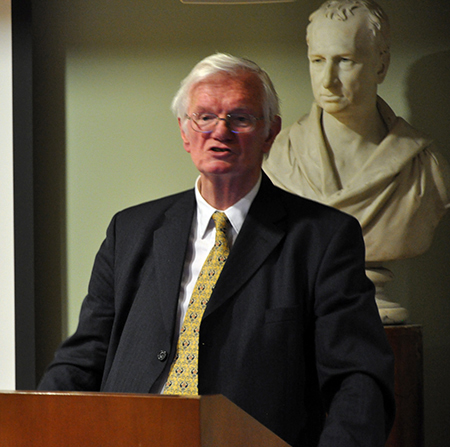
MORGAN, DAVID ORRIN (b. Wales, April 29, 1945; d. Middlesex, October 23, 2019; Figure 1), a British historian of medieval Iran and the Mongol Empire.
David Orrin Morgan was educated first at Rugby and then at Worcester College, Oxford, where he read Modern History. After graduating in 1966, he gained a postgraduate certificate in Education and taught History for three years at Watford Grammar School. In 1970 he enrolled for a PhD at the School of Oriental and African Studies (SOAS) in London under the supervision of Ann K.S. Lambton (q.v.), who taught him Persian and became a close friend and mentor. He spent a year in Iran (1973–74) as a Fellow of the British Institute of Persian Studies (see GREAT BRITAIN xiv.). He graduated in 1977 with a thesis on “Aspects of Mongol Rule in Persia.”
Morgan had joined SOAS as a research fellow in 1975 and subsequently taught there for twenty years, first as a Lecturer (1978-89), and later as Reader in the History of the Middle East at the University of London (1989-99). In 1999, he moved to the United States upon being appointed Professor of History and Religious Studies at the University of Wisconsin-Madison. After retiring in 2010, he returned to England, but continued to teach at Madison for one semester a year until 2013. He died in Middlesex, England on 23 October 2019.
Morgan was a prolific writer, authoring dozens of articles and more than a hundred reviews, but he is mostly remembered for his two monographs, which became the standard in their fields: The Mongols (1986), a sound and well written introduction to Mongol history, and Medieval Persia: 1040-1797 (1988), “the only single-authored work in any language to cover the entire period of Persian history from the advent of the Seljuqs to the beginning of the Qājār dynasty —and the first to make sense of it” (Jackson, p. 1). Morgan’s clear and accessible style, spiced with penetrating insights and dry humor, made the books popular not only among scholars and students but also among the general public. Morgan’s research focused on Il-Khanid Iran (q.v.; 1260-1335), but he always saw the Mongols – and hence Iranian history –in their full context both spatially, from China to western Europe, and temporally, from their debt to their predecessors in the Eurasian Steppe and in Baghdad and their appeal for the pre-Islamic Iranian past, to their impact on future polities and their image in the modern world. He studied central issues such as various aspects of Il-Khanid government and society (the ethnic composition of the administration; the postal system; the army; the status of the Yāsā [q.v.], the law code ascribed to Čengīz Khan [q.v.]; foreign relations, etc.); the Mongol impact on Iranian and world history, and Mongol historiography, both medieval and modern, with a special emphasis on Rašid-al-Din Fażl-Allāh Hamadāni (1247-1318, see JĀMEʿ AL-TAWĀRIḴ). He was famous for his willingness to reconsider his views in the light of new information and easily declared himself wrong when he saw fit. His posthumous work, the chapter on the Il-Khanids that he wrote with Stefan Kamola for the forthcoming The Cambridge History of the Mongol Empire, will be an enduring monument to his abilities.
Morgan was also an outstanding editor and teacher. He not only edited or co-edited quite a few important volumes including Medieval Historical Writing in the Christian and Islamic Worlds (1982), The Mission of Friar William of Rubruck (1990), The Mongol Empire and Its Legacy (1999), Late Classical Persian Sufism 1501-1750 (1999), The New Cambridge History of Islam III: The Eastern Islamic World, Eleventh to Eighteenth Centuries (2010) and, most recently, volume seven of the series The Idea of Iran, The Coming of the Mongols (2018).
In addition, he also served in the editorial board of Bulletin of the School of Oriental and African Studies and was the chief editor of J
ournal of the Royal Asiatic Society (1987-1999), making this journal a venue for many Mongol-related and cross-Asian studies. He was also the chief editor of the prestigious series Cambridge Studies in Islamic Civilization (1991-2013), where during his long tenure he had accepted for publication several Mongol-and Iran-related titles, many of which are now classics in their fields. In both capacities, Morgan openhandedly helped many emerging scholars to take their first steps in the publication world and was always generous with his time and knowledge. In 2016, the Royal Asiatic Society celebrated Morgan’s academic achievements with the publication of a Festschrift entitled, The Mongols and Post-Mongol Asia: Studies in Honour of David O. Morgan.
Morgan was also an engaging and dedicated teacher. He taught over a broad chronological and geographical range, including the history of Afghanistan from Alexander to the Taliban, and both at SOAS and at the University of Wisconsin-Madison he trained research students, notably George Lane and Timothy May, both noted scholars of the Mongol Empire. Morgan was also a member of the Governing Council of the British Institute of Persian Studies, and in the last years also its Honorary Vice President (Jackson, p. 2).
By the combination of his superb monographs; his own research published in his numerous articles; his long, dedicated and diverse service to the profession; his engaging teaching; and his warm and unassuming personality, Morgan played a crucial role in laying the foundations for the burgeoning study of the Mongol Empire and Il-Khanid Iran during the last quarter of the 20th century and well into the 21st, in the U.K., the rest of Europe, North America, and Asia, not the least in Israel.
Bibliography
Selected studies by David O. Morgan in chronological order.
“Aspects of Mongol Rule in Persia,” Ph.D., University of London, England, 1977.
Medieval Historical Writing in the Christian and Islamic Worlds, London, 1982.
The Mongols, Oxford, UK, 1986; 2nd ed., Malden, Mass., 2007.
Medieval Persia: 1040-1797, London, 1988; 2nd ed., New York, 2016.
The Mission of Friar William of Rubruck: His Journey to the Court of the Great Khan Möngke 1253-1255, London, 1990 (co-edited with Peter Jackson).
The Mongol Empire and Its Legacy, Leiden, 1999 (co-edited with Reuven Amitai-Preiss).
The Heritage of Sufism. Volume III: Late Classical Persianate Sufism (1501-1750): The Safavid & Mughal Period, Oxford, 1999 (co-edited with Leonard Lewisohn).
The New Cambridge History of Islam. Volume III: The Eastern Islamic World, Eleventh to Eighteenth Centuries, Cambridge, UK, 2010 (co-edited with Anthony Reid).
The Coming of the Mongols, The Idea of Iran Book 7, London, 2018 (co-edited with Sarah Stewart).
Entries by David O. Morgan in the Encyclopædia Iranica.
“Aḵtājī”; “Alāfrank”; “Ālčī”; “Āmoli”; “Āqā”; “Bokāvol”; “Čengīz Khan”; “Dastjerdānī, Jamāl-al-Din”; “Dastūr al-Kāteb fī Taʿyīn al-Marāteb”; and “Elčī”.
Other works cited.
Peter Jackson, “David Orrin Morgan (1945-2019),” Journal of the Royal Asiatic Society 30/1, 2020, pp. 1-3.
Timothy May and Peter Jackson, eds., The Mongols and Post-Mongol Asia: Studies in Honour of David O. Morgan, Special Issue Journal of the Royal Asiatic Society 26/1-2, 2016.