



KLAPROTH, HEINRICH JULIUS [von] (b. Berlin, 11 October 1783; d. Paris, 28 August 1835; Figure 1), German scholar of Oriental studies, traveler, ethnographer, and linguist.
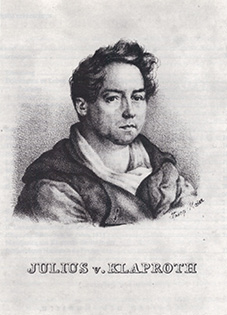
At the age of 14, Klaproth taught himself various Oriental languages, mainly Chinese, as he was already passionately interested in philology. This was done against the will of his father, the chemist Martin Heinrich Klaproth (1743-1817), the discoverer of several chemical elements (e.g., uranium). Heinrich Klaproth founded his first scholarly journal (Asiatisches Magazin, 2 vols., Weimar, 1802), when he was only 19, to which he himself contributed the bulk of the articles. In view of Klaproth’s varied works and his encyclopaedic interests, Jan Potocki (1761-1815), the famous Polish traveler and historiographer, recommended him to the Russian Academy of Sciences in St. Petersburg, where from 1805 to 1812 he held an adjunct position in Oriental languages and literatures.
On behalf of the Academy and because of his excellent knowledge of various languages, Klaproth took part in two great expeditions. In 1805-6, the diplomatic mission headed by Yuriĭ Golovkin (1762-1846) led him straight through Siberia and to the Chinese frontier, from where, after the mission’s failure, he traveled back alone in order to become acquainted with the languages spoken in Central Asia. Up to his return in early 1807, he compiled extensive lexical lists of all those languages, pursued ethnographic studies, and collected masses of books. Owing to his outstanding merits, in the same year he was made a member of the Academy and granted a title of nobility. Moreover, he was entrusted to lead another expedition to the Caucasus region and to Georgia for the geographic, ethnographic, and linguistic exploration of that territory in the years 1807-9 (cf. Klaproth, 1812–14; idem, 1814b). Once more, he collected valuable materials in spite of the political tensions between the Russian tsardom and its southern neighbors, but an impending war had prevented him from reaching his original destination, namely, Persia, for initially it was intended to do research mainly in Iranian studies.
In 1812, Klaproth applied to be dischargedl from the Academy, left St. Petersburg, and moved to Berlin, before settling in 1815 in Paris, where he remained for the rest of his life. At the suggestion of Wilhelm von Humboldt (1767-1835), the Prussian philosopher, linguist, and government functionary, Friedrich Wilhelm III (1770-1840) conferred upon Klaproth in 1816 the title of Professor of Asian Languages and Literature at Bonn University, allocating him, in addition to a considerable salary, a sum of eighty thousand francs for the publication of his works, and granting him permission to remain in Paris until its completion (Landresse, p. 266). Only in 1817 was he discharged by the Russian Academy and deprived of the title of nobility with which he had formerly been decorated for his great merits.
Klaproth was a versatile scholar, whose studies encompass the whole of Asia, from the Caucasus region via Central Asia, Siberia, and Mongolia up to the Far East, even though they center on the Caucasus and China, particularly since he had a good command of the Chinese language. He worked on a field of immense vastness, equally on all imaginable aspects from language and literature to history and ethnography, geography, and even cartography, and in each field in a very stimulating manner. He did pioneering work on a number of languages by collecting rich material, often for the first time. His linguistic studies and in particular those of a comparative approach, however, have often been criticized as not being at the cutting edge of the scholarship of the time. Indeed, the methodologically decisive weak point of his comparative studies is the fact that they are based on the lexical material of the languages he compared, on homonymous or similar word forms with similar meaning, and not on their grammatical structure, as was the prevailing usage of the time. But it should not be forgotten that he rendered outstanding services by the very fact that he opened new fields for future research.
Owing to his enthusiasm, his countless publications, books as well as minor studies, are devoted to a wide range of subjects. His most important work is without doubt, and in spite of all criticism, Asia Polyglotta of 1823 (cf. Klaproth, 1823). There, Klaproth tried to classify all the languages of Asia according to their family relationship and to present them in a linguistic atlas, for it was the aim of all his linguistic studies to get information on the history and prehistory of the people(s) in question. The book is based on linguistic material of various origins (Klaproth’s own collections of words and manuscripts as well as printed books) and presents the knowledge at the time, and it clearly was a remarkable achievement for that period. Klaproth subdivided the languages into 23 branches (with a number of considerable gaps, though) and gives short descriptions of about 150 idioms and word lists as samples of them.
Among the numerous languages with which Klaproth dealt in the course of time and for which he collected an enormous amount of lexicographical material (from Georgian and the other Caucasian languages via Uighur, Kirghiz, Manchu, and many others to Chinese and Japanese) are also several Iranian languages (called “Median” by him). During the Caucasus expedition in 1808, he established the Iranian character of the Ossetic language (q.v.), with the notice (attested in a letter) that this language has a great similarity with Avestan (q.v.) and the Iranian elements of New Persian. Likewise he saw that the Alans (q.v.) and their language belong to the Ossetes, too.
In 1810, the examination of the Afghan linguistic material known from former travelers’ books (esp. Johann Anton Güldenstädt [Russ. Gil’denshtedt, 1745–81]) made it possible to recognize that this language also belongs to the same family (cf. Klaproth, 1810). Incidentally, he dealt also with Kurdish (cf. Klaproth, 1814c), for which in 1808 he had found an informant in Tbilisi, and Baluchi.
Finally, a reference seems appropriate to the maps Klaproth prepared, the most famous of which is the posthumously published Carte de l’Asie centrale in four pages (Paris, 1836). More as a curiosity may be mentioned that he was involved (among many others) in a controversy with Jean-François Champollion (1790–1832), whose decipherment of the Egyptian hieroglyphs he rejected, without meeting with any approval, however.
Bibliography
Major works.
Über die Sprache und den Ursprung der Aghuan oder Afghanen, St. Petersburg, 1810. Abhandlung über die Sprache und Schrift der Uiguren, Berlin, 1812.
Reise in den Kaukasus und nach Georgien unternommen in den Jahren 1807 und 1808, …, enthaltend eine vollständige Beschreibung der Kaukasischen Länder und ihrer Bewohner, 2 vols., Halle and Berlin, 1812-14 (Engl. tr., London, 1814; French tr., Paris 1823, 2nd ed., 1836).
Kaukasische Sprachen: Anhang zur Reise in den Kaukasus und nach Georgien, Halle and Berlin, 1814a.
Geographisch-historische Beschreibung des östlichen Kaukasus, zwischen den Flüssen Terek, Aragwi, Kur und dem Kaspischen Meere, Weimar, 1814b.
“Kurdisches Wörterverzeichniss, mit dem Persischen und anderen verwandten Sprachen verglichen,” Fundgruben des Orients 4, 1814c, pp. 312-21.
Asia Polyglotta, Paris, 1823 (with “Sprachatlas” in large folio format; 2nd ed., 1831).
Tableaux historiques de l’Asie, depuis la monarchie de Cyrus jusqu’à nos jours, accompagnés de recherches historiques et ethnographiques sur cette partie du monde, 4 vols., Paris, 1826.
Mémoires relatifs à l’Asie, contenant des recherches historiques, géographiques et philologiques sur les peuples de l’Orient, 3 vols., Paris, 1826-28 (“Sur la langue des Afghans,” in III, pp. 418-70).
Obituaries and biographies.
C. Landresse, “Notice historique et littéraire sur M. Klaproth,” Nouveau Journal Asiatique 16, 1835, pp. 243-73.
Joh. Klatt, “Klaproth, Julius Heinrich,” in Allgemeine Deutsche Biographie XVI, Leipzig, 1882, pp. 51-60.
Gert Naundorf, “Klaproth, Heinrich Julius,” in Neue Deutsche Biographie XI, Berlin, 1977, pp. 706-7.
Frank Kammerzell, “Klaproth, Julius Heinrich,” in Harro Stammerjohann, ed., Lexicon Grammaticorum: Who’s Who in the History of World Linguistics, Tübingen, 1996, pp. 516-18.
Hartmut Walravens, Julius Klaproth (1783-1835): Leben und Werk, Wiesbaden, 1999a (pp. 65-166 full bibliography of Klaproth‘s writings and pp. 191-96 literature on Klaproth).
Idem, Julius Klaproth (1783-1835): Briefe und Dokumente, Wiesbaden, 1999b.
Idem, Julius Klaproth (1783-1835): Briefwechsel mit Gelehrten, großenteils aus dem Akademiearchiv in St. Petersburg, Wiesbaden, 2002 (pp. 193-97 supplement to the bibliography in Walravens, 1999a).