



In the Taherid and Samanid periods, Khorasan became virtually synonymous with the Mašreq or “Islamic East,” stretching from Ray far into Central Asia. It enjoyed a bourgeoning economy built on agriculture and trade, and it participated in a brilliant efflorescence of Islamic scholarship while simultaneously constructing a distinct Perso-Islamic, and laying the foundations for a subsequent Turko-Persian, culture throughout the region. As the author of the 4th/10th-century geographical treatise Ḥodud al-ʿālam put it (tr., p. 102), Khorasan was “a vast country with much wealth and abundant amenities,” as well as a salubrious climate, healthy people, its own king (padšāy), and a frontier protected by march lords (moluk-e aṭrāf). The anonymous Persian author’s near contemporary, the Arab geographer Moḥammad b. Aḥmad Moqaddasi, who visited the region, likewise praised Khorasan in this period for its climate and its natural resources as well as the strength, piety, virtue, wisdom, and industry of its people (p. 294).
THE TAHERIDS
The Taherids, based initially in Pušang/Bušanj (see FUŠANJ), came to prominence during the period of the daʿwa in Khorasan and faithfully served the ʿAbbasid cause there for some fifty years, before founding their own autonomous and hereditary provincial dynasty. An ancestor of the family, likely of Iranian ethnicity, had reputedly accompanied one of the Arab armies invading Khorasan, converted to Islam, and become a client (mawlā) of the tribe of Ḵozāʿa (on the conflicting traditions about this, see Kaabi, 1983, I, pp. 62-64). Abu Manṣur Ṭalḥa b. Zorayq (or Rozayq) b. Asad is well-attested as a naqib ‘chief’ of the daʿwa organization; living at that time in a village near Marv, he later held an administrative or military office in Herat (sources given in Agha, pp. 372-73, no. 351). His brother, Moṣʿab, was a lower-ranking member of the organization and was later an official in nearby Bušanj, where he was succeeded by his son Ḥosayn b. Moṣʿab (a notable in the time of Hārun al-Rašid and enemy of ʿAli b. ʿIsā b. Māhān).
Ṭāher b. Ḥosayn, later known by the honorific title Ḏu’l-Yaminayn (“The Ambidextrous”) because of his military prowess, rose to prominence during the wars with Rafiʿ b. Layṯ and the civil wars between al-Amin and al-Maʾmun (q.v.), defeating ʿAli b. ʿIsā b. Māhān, participating in the siege of Baghdad, and engineering the death of the defeated al-Amin (on these events, see KHORASAN v.). He shrewdly bided his time during the administration of Ḥasan b. Sahl, building up a power base and a fortune in Iraq. When al-Maʿmun was returning to Baghdad in Ṣafar 204/August 819, he was accompanied by Ṭāher from Nahrawān to Roṣāfa, and Ṭāher was given authority over the Jazira, all of Baghdad, and the Sawād and made commander of the security force (ṣāḥeb al-šorṭa), a position members of the family would hold for almost a century, acquiring further fame and riches in the capital. By this time, Ṭāher had turned sharply against Ḥasan b. Sahl and his policies, and it was Ṭāher who was said to have persuaded al-Maʾmun to abandon the wearing of green garments and return to the traditional ʿAbbasid black (Ṭabari, III, pp. 1037-38).
Al-Maʾmun appointed Tāher governor of Khorasan, “from the City of Peace to the most distant districts of the East,” in late Ḏu’l-Qaʿda 205/May 821 (Ṭabari, III, p. 1043). Ṭāher had barely had time to make some administrative appointments (Ebn Abi Ṭāher Ṭayfur, pp. 58-60; Tāriḵ-e Sistān, p. 177) before he died unexpectedly in his sleep at the age of 48 in 208/822. There are wildly different explanations for why Ṭāher was made governor of Khorasan, as well as conspiracy theories about his untimely demise. In both cases, the issue hinges on whether Ṭāher and al-Maʾmun were still on good terms or whether there had been a rift between them. The official rationale for the appointment seems to have been that there were disturbances in Khorasan that the acting governor, Ḡassān b. ʿAbbād, could not handle; moreover, Ḡassān was a paternal cousin of Fażl b. Sahl and an appointee of Ḥasan b. Sahl, so his removal was needed as part of the post-Sahlid house-cleaning (Ṭabari, III, 1043). However, there are also claims that Ṭāher tricked al-Maʾmun into making the appointment with the help of his friend, the vizier Aḥmad b. Abi Ḵāled Aḥwal, since he had learned that the caliph resented him because of his involvement in killing al-Amin and was being encouraged by al-Amin’s mother to seek revenge (Ṭabari, III, p. 1042; Masʿudi, VI, pp. 485-87). It is also possible that al-Maʾmun was anxious to get an overly powerful general away from Baghdad, and Ṭāher was reluctant to go: He was certainly in no hurry to leave for Khorasan, taking about a year to prepare, but that may have been to make the arrangements for his son ʿAbd-Allāh b. Ṭāher (q.v.) to take over his interests in Baghdad and the Jazira. As for his death, his son and uncles indicated it was after a high fever, and Ṭāher had a premonition of it as his last words were dar marg niz mardi wāyaḏ ‘one must be manly even in the face of death’ (Ṭabari, III, p. 1063). However, it was also noted that he died shortly after failing or “forgetting” to mention the caliph’s name in his Friday sermon, which was an indication of independence from the caliphate in Baghdad. Aḥmad b. Abi Ḵāled had vouched to al-Maʾmun for Ṭāher’s behavior and had made arrangements to eliminate him should he act otherwise (Ṭabari, III, p. 1064; Ebn al-Aṯir, VI, pp. 381-83). It is also a fact that Ṭāher had begun to omit al-Maʾmun’s name from coins struck at his mints (Bosworth, 1975, p. 95).
Yet no such suspicions perturbed relations of the caliph with other members of the family either in Iraq or Khorasan. Both al-Maʾmun and Aḥmad b. Abi Ḵāled agreed that the obvious choice as Ṭāher’s successor should be his son Ṭalḥa, just as Ṭāher is said to have wanted (Gardizi, p. 135). This may have been in the expectation that Ṭalḥa’s older brother in Iraq, ʿAbd-Allāh, would keep him in line. It is equally likely that it was a considered decision that the goal of stability in Khorasan while al-Maʾmun dealt with manifold problems developing in the West would be in the interest of all and best met by keeping a Taherid as governor. Any threat the young Talḥa might have posed was further diminished by returning Aḥmad b. Abi Ḵāled to Khorasan to assist in another offensive into Ošrusana (Ṭabari, III, pp. 1065-66; Ebn al-Aṯir, VI, p. 382). Talḥa’s tenure was mostly occupied in dealing with the continuing threat from the Kharijites and Ḥamza b. Āḏarak (q.v.). Both Talḥa and Ḥamza died in 213/828.
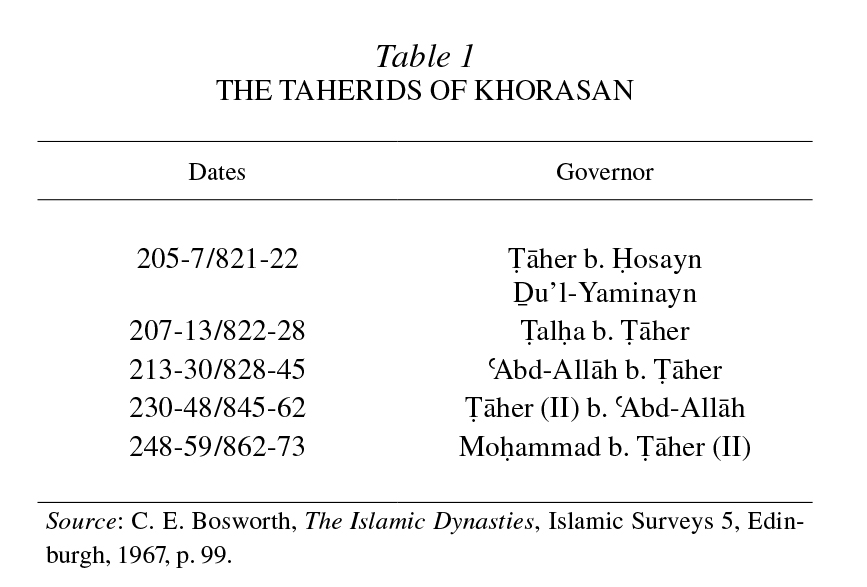
Table 1 THE TAHERIDS OF KHORASAN
The third Taherid governor, ʿAbd-Allāh b. Ṭāher, ruled for seventeen years (213-30/828-45). Marv ceased to be the administrative capital of Khorasan, and the Taherids established themselves at Nishapur, which experienced a period of prosperity and florescence under them and their successors, the Samanids (Barthold, 1984, pp. 96-98). ʿAbd-Allāh was himself highly cultured and a lover of literature and of music and singing, and he gathered around himself a distinguished circle of Arabic poets and litterateurs, with such visiting luminaries as the poet Abu Tammām and the genealogist and historian Zobayr b. Bakkār (see Bosworth, 1969, pp. 58-67). He assembled a team of experts who compiled a Ketāb al-qoni as an authoritative guide to the law and practice of irrigation and water rights; the Ghaznavid historian ʿAbd-al-Ḥayy Gardizi (q.v) states that this was still in use in Khorasan during his own time, that is, two centuries later (Gardizi, p. 137; cf. Barthold, p. 213). Whereas Khorasan had been a distant province of the caliphate in earlier times, its importance being primarily military and strategic (Herzfeld, pp. 119-20), its agricultural prosperity now increased. According to Yaʿqubi (Boldān, p. 308), the land-tax (ḵarāj) of Khorasan amounted to 40 million dirhams a year under the Taherids. It benefited from the commercial transit traffic bringing the products of Transoxiana and the Inner Asian steppes to the caliphal heartlands. Leather products, weapons, honey, furs, and various luxury items were imported, and a spécialité
du pays is mentioned for the Nishapur district, namely noql or edible earth, praised by the great physician Moḥammad b. Zakariyā Rāzi (d. ca. 313/925) and so prized that it was exported as far as Egypt and the Maghrib (Ṯaʿālebi, pp. 131-32). Above all, there was the transit trade across Khorasan in Turkish slaves from the steppes from the early 3rd/9th century, increasingly becoming a component of the caliphal and other armies in the central and eastern Islamic lands. Slaves normally formed a substantial part of the annual tribute forwarded to Samarra and Baghdad by the Taherids and then as presents by their successors the Samanids (see Barthold, pp. 235-38, on all this traffic in imports in Samanid times, this information being substantially valid for the preceding Taherid period; see also Bosworth, 1975; la Vaissière, 2005, pp. 291-302).
As governors in Khorasan, the Taherids were strong upholders of Sunni orthodoxy against various heterodox and sectarian movements and outbreaks of religio-social protest, which were racking Khorasan and Transoxiana at this time. They campaigned against the veteran Kharijite Ḥamza b. Āḏarak in Khorasan and against Māzyār b. Qāren in the Caspian provinces and the Zaydi Shiʿite Hasanids there. It is not therefore surprising that the sources regard with great favor the orthodox and obedient Taherids as servants of the caliphs when they were at the height of their power (Bosworth, 1975, pp. 105-6). They also preserved a certain independence of action but always regarded themselves as faithful servants of the caliphs, acknowledging the ʿAbbasids in the sermons and on coins. All in all, the ʿAbbasid-Taherid relationship was a symbiotic partnership and “the most successful solution the Abbasids ever found to the problem of governing the province” (Kennedy, p. 166).
Taherid power in Khorasan seems to have loosened with later governors of the line. There may have been a certain feeling in Sunni orthodox circles that the later Taherids were failing to cope with threats from the Kharijites and the ʿAlids of the Caspian provinces, a feeling that facilitated the overthrowing of the Taherids in Khorasan by the Saffarid Yaʿqub b. Layṯ (q.v.), who in 259/873 captured Nishapur from Moḥammad b. Ṭāher II (Tāriḵ-e Sistān, pp. 219-23; Ebn al-Aṯir, VII, pp. 261-64; Bosworth, 1994, pp. 109-21; Tor, pp. 118-22, 134-53). Yaʿqub then became embroiled in ventures in the Caspian provinces and then in western Persia and Iraq, and speedily lost control of Khorasan (Tāriḵ-e Sistān, pp. 223 ff.; Ebn al-Aṯir, VII, pp. 268-69, 276-77, 290-92; Bosworth, 1994, pp. 123-26). For some two decades, the province was a battleground for contending military leaders, some, such as Aḥmad Ḵojestāni (q.v.), claiming to represent the former Taherid interest there (Ebn al-Aṯir, VII, pp. 296-97); others merely seeking their own aggrandizement, until in 283/896 Yaʿqub’s brother and successor ʿAmr established his control over the province. This restored Saffarid power in Khorasan was, however, short-lived. In 287/900, the Samanid Amir Esmāʿil b. Aḥmad (q.v.) defeated ʿAmr in battle, so that the province then entered upon a century of Samanid domination, as an integral part of their empire centered on the Transoxianan cities of Bukhara and Samarqand (Tāriḵ-e Sistān, p. 234-35, 254-56; Naršaḵi, pp. 119-25; Ṭabari, III, pp. 2194-95; Ebn al-Aṯir, VII, pp. 500-503; Bosworth, 1994, pp. 217-35).
THE SAMANIDS
The eponym of the Samanids was Sāmān-ḵodā, usually understood as meaning the landlord (dehqān, q.v.) of the town of Sāmān. Sāmān has been claimed to have been located near Samarqand, Termeḏ, or Balḵ. Naršaḵi, for example, indicates that Sāmān-ḵoda hailed from Balḵ and built the village or estate of Sāmān there (Naršaḵi, tr., p. 59), but Menhāj-e Serāj Juzjāni (I, p. 201) identifies him as the chief (raʾis) of the district of Sāmān near Samarqand. The question is of some interest in terms of the ethnic origins of the Samanids. The later Samanids claimed, and probably believed, they were descended from Bahrām Čōbin (q.v.) and the Parthian Mihranid family (an idea accepted even by the usually sceptical Biruni, p. 39, tr., p. 48; see also Bosworth, 1973, pp. 58-59). Samarqand and the Zarafšān basin suggest a Sogdian background or even Turkish ancestry, while Balḵ and Ṭoḵarestān raise the possibility of Iranian, Hephthalite or other connections (Kamoliddin, pp. 79-114, has argued for a Buddhist-Manichean background and descent from the yabḡu Jabbā Khan; Togan, p. 283; see also Treadwell, 1991, pp. 64-71).
Another factor that speaks strongly in favor of a connection to Balḵ, is the widely reported account of Sāmān-ḵodā’s friendship with the Omayyad governor Asad b. ʿAbd-Allāh Qaṣri (d. 120/737-38). According to Naršaḵi (tr., p. 59), Sāmān-ḵodā fled, for unspecified reasons, from Balḵ to Marv, where Asad treated him honorably and returned him to Balḵ. Sāmān converted to Islam at the hands of Asad and named his son after him. Naršaḵi’s account is certainly plausible, since Asad is known to have held the governorship of Khorasan on two occasions (106-9/724-28 and 117-20/735-37), and, in both cases, he campaigned extensively in areas around Balḵ; Asad also died in Balḵ (Daniel, 2009).
The grandsons of Sāmān-ḵodā—Nuḥ, Aḥmad, Yaḥyā, and Elyās—joined the forces of Harṯama b. Aʿyan after he was sent by Hārun al-Rašid to put down the rebellion of Rafiʿ b. Layṯ. They were subsequently instrumental in arranging a negotiated end to the conflict. Their assistance had been specially requested by al-Maʾmun, and he was so pleased with the results that, as caliph, he instructed his governor in Khorasan, Ḡassān b. ʿAbbād, in 202/817 or 204/819, to reward them with districts to govern. Nuḥ was given Samarqand; Elyās, Herat; Yaḥyā, Šāš (Čāč); and Aḥmad, Farḡāna (Ebn al-Aṯir, VII, p. 279; Gardizi, p. 146; Juzjāni, I, p. 203; Mirḵᵛānd, pp. 1-2). Ṭāher b. Ḥosayn confirmed the appointments when he became governor of Khorasan, and sent a robe of honor to Nuḥ (Manini, I, p. 348) and the offices continued to be held during the governorships of Ṭalḥa and ʿAbd-Allāh b. Ṭāher. Ṭalḥa even visited Samarqand in 212/827-28 (Treadwell, p. 78).
The family of Abu’l-Fażl Elyās b. Asad appears to have acted more often as Taherid officers than as administrators of Herat. Ṭalḥa b. Ṭāher sent Elyās to Sistān in Ṣafar 208/July 823 to fight the Kharijites, but he was there only until Jomādā I 208/October 823. He is named, somewhat surprisingly, as a governor of Alexandria under ʿAbd-Allāh b. Ṭāher in 212/827 (Kendi, p. 184). During the governorship of ʿAbd-Allāh b. Ṭāher in Khorasan, Elyās and some cadet members of the Samanid family were again sent to Sistān, ca. 216/831 and then again between 222/837 and 225/840 (Tāriḵ-e Sistān, pp. 177-78, 182-83, 187-89). Elyās died in Herat in 241/855 (Samʿāni, VII, p. 26). His son Ebrāhim was the commander (sepahsālār) of the Taherid army fighting the Saffarid Yaʿqub b. Layṯ. He was defeated and pushed out of Herat and Bušanj in 253/867; he advised Moḥammad b. Ṭāher that Yaʿqub could not be defeated and recommended a policy of appeasement; and, after the fall of Nishapur in 259/873, he went with other army officers to seek clemency from the victorious Yaʿqub. He was given a robe of honor and sent to Sistān, so with that the Herat branch of the Samanids came to an end (Tāriḵ-e Sistān, pp. 208, 225).
It was in Transoxiana that the Samanids flourished greatly, helped latterly by the confused state of post-Taherid Khorasan under a succession of ambitious military leaders culminating in ʿAmr b. Layṯ (q.v.).
In 225/840, Nuḥ b. Asad assisted ʿAbd-Allāh in arresting the son of Afšin (q.v.; a former ruler of Ošrusana, q.v., in the service of the caliph al-Moʿtaṣem, then out of favor and on trial for treason; see Ṭabari, III, p. 1307). Nuḥ also sent an expedition against the town of Asfijāb (q.v.) in the middle Syr Darya valley and built defenses there against marauders from the Turkish steppes (Balāḏori, p. 422; Samʿāni, VII, p. 26; Ebn al-Aṯir, VI, p. 509). Asfijāb remained as a separate, dependent province of what became the Samanid empire, with its local Turkish ruler still enjoying a freedom, unique in the Samanid lands, from tax liabilities (Ebn Ḥawqal, II, p. 510; tr. Kramers, II, p. 488). After the death of Nuḥ b. Asad in 227/841-42, the governor of Khorasan ʿAbd-Allāh b. Ṭāher (q.v.) appointed the remaining two brothers in Transoxiana, Yaḥyā and Aḥmad, over Samarqand and Sogdiana; on the death of the former in 241/855, Šāš reverted to Aḥmad also. Aḥmad thus emerged as the commanding figure in the family, and all subsequent rulers of the dynasty descended from him. Yaḥyā had not apparently struck even a local copper coinage at Samarqand, whereas folus of Aḥmad begin there in 244/858-59. Aḥmad’s son Naṣr (I) (r. 250-79/864-92) extended his power from his capital Samarqand westwards to Bukhara, which was later, under Naṣr’s brother Esmāʿil b. Aḥmad (q.v.), to become the permanent capital of the Samanids. The ʿAbbasid caliph al-Moʿtamed (r. 256-79/870-92) formally invested Naṣr with the governorship of Transoxiana in 261/875 (Ṭabari, III, p. 1889), in opposition to the claims of the Saffarid Yaʿqub b. Layṯ who was at that point striking at the heartland of the caliphate in central Iraq. It was only around this time that direct caliphal interest in Transoxiana could no longer be sustained. The caliph al-Moʿtaṣem (r. 218-27/833-42) had, with some reluctance, contributed two million dirhams toward the digging of an irrigation canal in the province of Šāš (Ṭabari, III, p. 1326), and, up to the time of Naṣr b. Aḥmad, the ʿAbbasids still drew revenue from their crown demesnes in Transoxiana (see Barthold, pp. 95, 99, 212). Naṣr had begun to mint dirhams of a mixed ʿAbbasid-Samanid type from the 240s/860s onwards, and then at the formal accession of Esmāʿil b. Aḥmad (279/892), the regular minting of Samanid dirhams and dinars began, with acknowledgement of the ʿAbbasids as suzerains (Miles, p. 374).
Naṣr sent his brother Esmāʿil to take over Bukhara from a certain Ḥosayn b. Moḥammad Ḵawāreji (or Ḵᵛārazmi?), apparently an adherent of the Saffarids, and in summer 260/874 Esmāʿil entered the city and delivered the Friday sermon (ḵoṭba) for Naṣr instead of for Yaʿqub b. Layṯ. The brothers quarreled, however, leading to a military conflict that ended in the capture of Naṣr by Esmāʿil (autumn 275/888); Esmāʿil wisely retained his brother as the official ruler in Samarqand until Naṣr’s death in 279/892, while himself remaining at Bukhara and eventually making it his capital (Naršaḵi, pp. 94-101; tr. pp. 79-86; Barthold, pp. 222-23).
Naṣr had appointed Esmāʿil as his heir, so that the latter succeeded unchallenged as amir of Transoxiana and Farḡāna. Esmāʿil (I)’s reign (279-95/892-907) marks the formal constituting of the Samanid state as a powerful force in the Islamic east, especially as his victory over the Saffarid ʿAmr b. Layṯ in 287/900, though technically an act of rebellion against the caliph’s appointee over Khorasan and Transoxiana, in practice brought him recognition by al-Moʿtażed (r. 279-89/892-902) and what must have been approbation as governor of both those provinces (Ṭabari, III, p. 2195). This was essentially a confirmation of the fact that the ʿAbbasids, their direct authority now confined to Iraq and western Persia, could no longer exert any power over the east. Even so, right to the end, the Samanids usually paid due respect to the caliphs, placing their names in the koṭba and on the coinage (sekka), and claiming for themselves no higher title than that of amir; presents were sent to Baghdad, although there is no evidence that any taxation or tribute was ever forwarded. Hence, Amir Esmāʿil may be regarded as the real founder of the Samanid state and certainly as the ablest of his dynasty. The historical and literary sources praise him as such, and speak of his wisdom and just rule, awarding him the honorific titles of amir-e ʿādel ‘The Just Amir’ and amir-e mā
ż
i ‘The Late Amir’. He may also now consciously have endeavoured to raise himself, as amir now of a united principality, to a level above the families of nobles and landowners, from which class his own family had earlier risen. They probably still regarded the Samanids as socially not much more than primi inter pares. According to Naršaḵi (p. 96; tr. Frye, p. 82), when Esmāʿil was still the theoretical subordinate of his brother Naṣr, he had already taken steps to reduce the power of the Bukharan leaders (mehtarān) because they had not sufficiently shown him the respect (haybat) due to a ruler.
The amirate was at this time young and vigorous, and under Esmāʿil its borders expanded in all directions and the northern frontier defended against the pressure of the nomads. In 280/893, Esmāʿil led a major expedition that captured Talas (Ṭarāz) from the Qarluq Turks (possibly led by Oḡulčak Kadïr Khan, son of the Ilak-khan Bilge Kül Kadïr Khan; Golden, p. 352-57), capturing a great booty of slaves and beasts. He extended Samanid suzerainty over the Afšin, local rulers of Ošrusana, south of the middle Syr Darya; over the Khwarazmshahs (see CHORASMIA ii); and, as coins seem to indicate, over petty princes of the upper Oxus lands such as the Abu Dāwudids or Banijurids (on them, see Bosworth, 1996, p. 174) of Ḵottal and Toḵārestān, and the Farigunids of Guzgān (see ĀL-E FARIḠUN). Expansion westwards into the Caspian provinces and northern Persia was a special concern of Esmāʿil, who in 288/901 personally led armies into Gorgān (q.v.) and Ṭabarestān against the ʿAlid Moḥammad b. Zayd, restored the supremacy of the Sunna there, and compensated those who had suffered losses under the Zaydis (Madelung, 1975, p. 208). Samanid authority was likewise extended over Ray, with the caliph al-Moktafi (r. 289-95/902-8) at the beginning of 290/902 investing Esmāʿil as governor of Ray and Qazvin (Ṭabari, III, pp. 2220-21; Miles, 1938, pp. 132-33), the westernmost outposts of Samanid power, although these regions soon slipped away from Samanid hands. Esmāʿil died in 295/907 (see also ESMĀʿIL B. AḤMAD B. ASAD SĀMĀNI).
Esmāʿil was succeeded by his son Aḥmad (II) (r. 295-301/907-14). Despite the brevity of his reign, he nevertheless managed to bring Sistān temporarily under Samanid rule. After the defeat of ʿAmr, various short-reigned Saffarid princes held power in Sistān and southern Persia, but Aḥmad then intervened there, dispatching two expeditions in 298/911 and 300/912-13 under the amir’s cousin, Abu Ṣāleḥ Manṣur b. Esḥāq b. Aḥmad (q.v.), who functioned ineffectively as governor in Sistān for a while (see SAFFARIDS). More pressing for Ahmad were measures to retrieve the position in the west. In Ray, a Samanid governor, Moḥammad b. ʿAli Ṣoʿluk, was probably in place by 298/910-11, and he remained there into the succeeding reign of Naṣr b. Aḥmad (Miles, 1938, pp. 135-36). In the Caspian provinces, however, the Zaydi Ḥasan b. ʿAli Oṭruš made firm his authority in Deylam (see Deylamites) and Gilān (q.v.) and then extended eastwards into Ṭabarestān, which was under his control by Amir Aḥmad’s death (Madelung, 1975, pp. 208-9); measures against him could only be undertaken in the next reign. Aḥmad’s reign was cut short when his military slaves (ḡolāms) assassinated him at Farabr near Bukhara in 301/914, allegedly because he was showing excessive favor to the ulema and other religious dignitaries and because he attempted to restore Arabic as the language of the divans; obviously, Persian had by then established itself as the working language of these government departments (see Naršaḵi, pp. 110-11; tr. pp. 94-95; Gardizi, pp. 148-50; Barthold, p. 240). Aḥmad’s murder earned him the posthumous title of amir-ešahid ‘The Martyred Amir.’ As noted above, his father had already become known as “The Just, or, the Late Amir,” and this practice of giving honorifics (laqabs) after death was to become general amongst the Samanids, though some of the amirs also acquired regnal titles in their own lifetimes and used them on coinage, such as Nuḥ (I) b. Naṣr’s one of al-malek al-moʾayyad ‘The [Divinely] Supported King’, and Nuḥ (II) b. Manṣur (I)’s one of al-malek al-manṣur ‘The Victorious King’ (see Bosworth, 1962, pp. 214-15).
The long reign which followed, that of Naṣr (II) b. Aḥmad (II), called amir-e saʿid ‘The Fortunate Amir’ (301-31/914-43), in many ways marks the zenith of Samanid power and glory, although the amir himself was no charismatic war leader or outstanding administrator. But he was fortunate to be served by highly competent officials, often from families with long traditions of service in the bureaucracy, who were appointed at least in part because of the medieval Islamic belief that such competence was a hereditary trait of such families. Hence, Naṣr was fortunate in having capable viziers such as Abu ʿAbd-Allāh Jayhāni and his son Abu ʿAli Moḥammad, and Abu’l-Fażl Balʿami (q.v.), all famed as much for their own scholarship and patronage of learned and literary men as for their administrative skills. Thus, the first Jayhāni was vizier ca. 302-10/914-22 but was also the author of a geography, a Ketāb al-masālek wa’l-mamālek, which Moqaddasi (pp. 3-4) praises for its topographical and astronomical information, amongst much else; he saw a manuscript of it, in seven volumes, in the library of the Buyid Amir ʿAżod-al-Dawla (q.v., r. 338-72/949-83), but it is now known only from citations. Jayhāni apparently incorporated information personally gathered on his travels plus that gained from merchants and travelers to the land of the Turks and to India (Barthold, pp. 12-13).
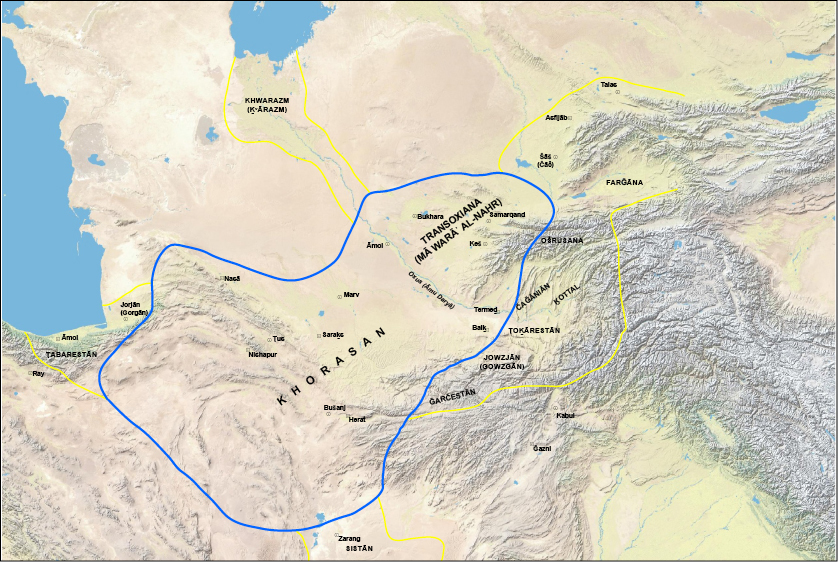
Figure 1. The Samanid Realm: Core territories (blue border); areas under local rulers, contested, or tributary (yellow border). After R. N. Frye, ed., Cambridge History of Iran IV, Cambridge, 1975, p. 139. (Map background data from US National Park Service World Physical Map.)
The young amir faced a series of revolts on his accession, which only the skills of his vizier Jayhāni and military commanders such as Ḥamuya b. ʿAli enabled him to survive. These revolts were raised by discontented members of the Samanid family who felt that their adulthood gave them a greater claim to the throne than that of the eight-year-old boy. Thus, Naṣr’s great-uncle Esḥāq b. Aḥmad came out immediately at Samarqand, aided by his two sons Elyās and Manṣur. The latter, the ex-governor of Sistān, raised his standard at Nishapur, and after his death there, the revolt was carried on by one of his military commanders; Elyās fled to Farḡāna after the suppression of the Samarqand outbreak and thence to Šāš and the Turks. Several years passed during which Naṣr’s authority was unchallenged, but ca. 317/929 there was a further serious rebellion, this time in the capital Bukhara, involving three of Naṣr’s own brothers (Gardizi, pp. 152-53); the suppression of this marks the opening of the ascendancy in Khorasan during the middle decades of the 4th/10th century of the Moḥtāj or Čaḡāni family, to whose head, Abu ʿAli Aḥmad, the amir entrusted the governorship of western Khorasan (see ĀL-E MOḤTAJ).
Through all these vicissitudes, a vigorous external Samanid policy was carried on. This involved, amongst other things, attempting to extend Samanid power into the rich and strategically important region of northern Persia with its main city, Ray. Moḥammad b. ʿAli Ṣoʿluk held Ray as a Samanid vassal intermittently till his death in 316/928, but thereafter the Samanid hold was increasingly challenged by various Deylami and Jili soldiers of fortune such as Asfār b. Širuya, Mākān b. Kāki and the Ziarid brothers Mardāvij and Vošmgir, all of whom at times held the city of Ray until 329/940, when Abu ʿAli Čāḡāni was sent with a strong force that defeated the allied forces of Mākān and Vošmgir. Samanid coins were then once again issued from the Ray/Moḥammadiya mint, but not for long. The strongest and most lasting of the Deylami adventurers, the three Buyid brothers, were now consolidating their power in western and central Persia (see BUYIDS). Rokn-al-Dawla Ḥasan b. Buya (r. 335-66/947-77) had definitively taken over Ray, making it the center of what became the northern Buyid amirate of Ray and Jebāl. Only sporadically thereafter did the Samanids control Ray.
Thus, the rise of the Buyids meant that the Samanids were in the long run unable to retain Ray and northern Persia. Their successes in the Caspian provinces were also intermittent, for the region became a battleground for various Deylami contenders, including the Buyids, the Zaydi Shiʿite Imams, and the Samanids themselves. Abu ʿAli Čāḡāni secured those provinces for Amir Naṣr, forcing Vošmgir to become the Samanids’ vassal. The latter in fact gave military aid to Vošmgir against the Buyids, and control over the region oscillated between the various parties involved, punctuated by a general peace in 344/955 between Rokn-al-Dawla and the Samanid ʿAbd-al-Malek (I) b. Nuḥ (I), which did not however last. Vošmgir was once more driven out by the Buyids, and, after his death in 356/967, there was a division in the Ziarid family between his sons, with the Samanids at the outset favoring Qābus and the Buyids favouring Abu Manṣur Bisotun b. Vošmgir (q.v.; r. 356-67/967-78), who married ʿAżod-al-Dawla’s daughter. Qābus eventually succeeded as ruler in the Caspian provinces on his brother’s death, but offended the powerful ʿAżod-al-Dawla two years later, in 369/980, and fled to a seventeen-year exile in Samanid Khorasan. Samanid forces under the generals Tāš and Fā’eq (q.v.) were sent with the aim of restoring Qābus to his domains but were defeated. The Samanid amirate was by now in increasing internal difficulties, and henceforth the amirs could not exert any influence beyond western Khorasan (Madelung, pp. 211-15; Busse, p. 290).
The closing years of the reign of Naṣr b. Aḥmad saw efforts by Ismaʿili agents (who apparently worked independently of the Fatimid movement in the lands further west) to spread their daʿwa (see DĀʿI). Evidence for this radical Shiʿite movement rests on sources that are non-historical (Ebn al-Nadim’s Fehrest [q.v.], Ṯaʿālebi’s Ādāb al-moluk, and Neẓām-al-Molk’s Siyāsat-nāma), but everything points to the historicity of Ismaʿilism as a significant current of thought, philosophical rather than messianic in nature, in Samanid Khorasan and Transoxiana. The Ismaʿili d āʿ is or propagandists made converts at the highest levels of Samanid court society, culminating in their securing the adhesion of the amir himself, and recruited adherents amongst others of the elite such as army commanders, dehqāns, divan secretaries, and urban headmen. This provoked a reaction among the Sunni ulema and their allies, the Turkish commanders of the army. The details are confused, but there was certainly a general massacre of the Ismailis and their adherents in Khorasan and Transoxiana. If the amir was not forced to abdicate in favour of his son Nuḥ (I), he did apparently live out the rest of his life as a secluded ascetic and invalid, dying in 331/943, possibly still as an Ismaʿili sympathizer. It is clear that much of the achievement of his reign can be laid at the door of Naṣr’s viziers and military commanders rather than at that of the amir himself (Naršaḵi, pp. 111-12; tr. 95-96; Gardizi, pp. 150-54; Barthold, pp. 240-44; Stern, pp. 77-80; Frye, 1975, pp. 141-42; 1997, pp. 52-56; Daftary, pp. 120-23; Crone and Treadwell, pp. 37-48, 52-56, 61-67; see also for more details, NAṢR [I] B. AHMAD [I] B. ESMĀʿIL).
Naṣr’s reign in many ways marks the apogee of Samanid power and splendor. As already noted, Naṣr and other Samanid rulers enjoyed over a long period the services of notable viziers, several of them from families with traditions of vizieral service such as the Jayhānis, Balʿamis and ʿOtbis; many of these made their mark as much in the academic and literary world as in the realm of administration and military leadership. Under their direction, what must have been a corps of skilled secretaries (Ar. kottāb, Per. dabirān; see Dabir ii.) and officials raised the bureaucracy in Bukhara to a high level of specialized functioning and complex administrative techniques. Naršaḵi, the historian of Bukhara, enumerates ten divans (see DIVĀN ii.) of the Samanid central administration housed in what he calls the sarāy-e ʿommāl, “officials’ building,” near the portal of the ruler’s palace and the government headquarters complex built by the Amir in the Rigestān of Bukhara. All this could not have evolved ex nihilo but must have been based on the ʿAbbasid divans in Baghdad, mediated through the example of the Taherid ones in Nishapur. The Samanid official Abu ʿAbd-Allāh Ḵᵛārazmi has a chapter on ketāba, or chancery practice, in his encyclopaedia of the sciences, Mafātiḥ al-ʿolum (ca. 977), that deals with administrative and financial techniques, documents, registers, methods of correspondence, etc., that clearly stemmed largely from ʿAbbasid models, but it also includes specific references to practices specific to the eastern Iranian lands, such as that of the divān al-māʾ, or office concerned with the maintenance of the irrigation systems and the division of waters in the Marv oasis in Khorasan and the valley of the Zarafšān river in Sogd (see IRRIGATION); and the section on weights and measures used by government surveyors and taxation assessors refers in part to practice in the Samanid provinces of Khorasan and Toḵārestān on the upper Oxus and to the adjacent province, theoretically subject to the Samanids, of Khwarazm (see Bosworth 1969a, pp. 115, 147-54).
It was this bureaucracy, and its subordinate organs in the provinces, that collected taxes from the rich agricultural oases of Sogdiana, Farḡāna, and Khorasan, together with customs duties and transit duties (mokus) levied on trade entering the Islamic lands from Inner Asia and beyond, a trade that had been in existence since pre-Islamic times and in which the Sogdians of Transoxiana had played a leading role. These last comprised luxury goods, such as furs, Chinese silks, and even Chinese porcelain, but above all, Turkish slaves, Transoxiana being one of the principal entry points for this traffic. The geographers describe how dues were levied on slave imports at the Oxus crossings. Authors such as Ebn Ḥawqal (q.v.) and Moqaddasi, who travelled within the Samanid lands in the third quarter of the 10th century CE, lavish praise on the amirs as just and enlightened rulers, in whose lands taxation was light, with provisions and everything for ease of life plentiful and at hand (see Barthold, pp. 234-40; Bosworth, 1963, pp. 27-33; Negmatov, pp. 84-85). This direct taxation was supplemented by the tribute and presents that the amirs, in their heyday, were able to require as overlords from local rulers in such regions as the upper Oxus lands and northern parts of modern Afghanistan such as the princes of Čāḡāniān, Ḵottal, Gowzgān (Jowzjān, q.v.), and Garčestān (q.v.); the regions such as the middle Syr Darya basin, including from the dehqāns of Ošrusana (q.v.) and Ilāq; and the ancient kingdom of Khwarazm (see Chorasmia). In all these cases, the Samanid amirs preferred to leave these local structures of power in place rather than to incorporate them within what would have become an extended, and hence unwieldy, empire.
The power and authority of the amirs rested, of course, on the armed forces at their disposal, needed both to maintain the ruler in power against other members of the Samanid family who coveted the throne and to guard the northern frontiers against pressure from the Turks in the outer steppe and to carry out the amirs’ “forward policy” in the Caspian coastlands region and northern Persia. The first troops of the Samanids stemmed from the free Iranian population of Transoxiana, the
dehqān
(q.v.) class. At the time when the Samanids, themselves probably dehqāns, were first emerging as governors in Transoxiana and the upper Oxus region, this class of landowners was also providing high-level commanders for the ʿAbbasid armies in the central lands of the caliphate, seen in the careers of the Afšin (q.v.) Ḵayḏar from the ruling family in Ošrusana and of various members of the Sajid family from this same period. The dehqāns of the Samanid lands functioned as commanders for the amirs’ armies and brought with them levies of their local tenantry and peasantry to swell the rank-and-file.
There was an ever-present need to maintain forces along the lengthy frontiers of the amirate against the Turks, not only from the obvious motive of state security but also because waging war (jehād or ḡazā) against non-Muslims was a religious duty for Muslims in such regions. Hence, there was a stimulus for the formation of bands of ghazis or volunteer fighters for the faith who manned the rebāṭs or frontier posts in provinces such as Asfijāb and other districts along the Syr Darya valley. The rebāṭs of Asfijāb, numbered, according to Moqaddasi (p. 273), 1,700; they were manned substantially by volunteers from Naḵšab, Bukhara, and Samarqand (Barthold, pp. 175-76; Bosworth, 1963, pp. 31-32). The degree of state control of such enthusiasts probably varied; contingents of volunteers from Bukhara, under their own commander and with their own banners, are mentioned as parading alongside regular troops (Bosworth, 1969b, pp. 20-21). Such warriors must have been usually self-financed and have borne their own weapons and equipment unless helped by funds from such pious endowments as the rebāṭs; and a similar lack of central control must have been the case with the bands of ʿayyār s (q.v.) mentioned as elements in the urban societies of Bukhara and Samarqand (Bosworth, 1969b, p. 21; Paul, pp. 14-20).
Neither of these two elements, the troops raised and led by local landowners, the dehqāns, and the religiously-motivated volunteers, owed any direct, unbreakable loyalty to the Samanid state as such, and the latter were in any case only of use against pagans outside the Abode of Islam, and their usefulness and their activities seem to have decreased as the Turks of the steppes gradually accepted Islam (Paul, pp. 23-24). Troops from these sources were, however, supplemented by Turkish slave soldiers (ḡelmān, mamālek) from an early date, certainly from the time of Esmāʿil b. Aḥmad onwards, since the Turk Simjur Davāti, founder of a line destined to play a leading role in later Samanid military and public affairs (see SIMJURIDS), is described as his mawlā (here in the sense of slave; see Tāriḵ-e Sistān, p. 293; tr. Gold, p. 237). These could be purchased from slave markets on the fringes of the outer steppes or captured in raids, such as that of Esmāʿil to Talas (see above). We know that Sebüktegin, subsequently the founder of the Ghaznavid dynasty, purchased in the first place by the Samanid general Alptigin (q.v.) for his personal following, came from Barsḵān on the shores of the Issiq Köl, in the region of Semirečye, now within the Kyrgyz Republic. Over the course of time, the amirs came to depend increasingly on these Turkish troops. From the higher ranks of these were recruited important offices of state and court such as the amir-e ḥaras, commander of the police and internal security guard (see Barthold, pp. 227-28 [who, however, attached too much importance to the romanticized and embroidered account of the training of Turkish ḡolāms in Neẓām-al-Molk’s Siyāsat-nāma]; Bosworth, 1969b, pp. 9-11; Frye, 1975, pp. 149-51; BARDA AND BARDA-DĀRI iii.).
However, at the side of those soldiers who were undoubtedly of servile origin, the amirs were from an early date served also by personal retainers who are variously called in the sources mawāli or čākarān (see ČĀKAR) and who were apparently free vassals. The exact significance of the terminology here is uncertain, but it may be that the status of čākar had its roots in pre-Islamic Iranian and Turkish Central Asia (as maintained by Beckwith, pp. 32-40). Esmāʿil b. Aḥmad seems to have been especially concerned to build up around himself a body of reliable guards and retainers, as part of the policy of elevating himself above the landowning classes of Transoxiana from which his family had sprung and of reducing dependence on the provincial magnates (see Paul, pp. 27-30; la Vaissère, 2005b).
It was the leading army commanders who filled some of the most important offices in the Samanid state after that of the amir himself and his vizier, such as the command-in-chief (sepahsālāri) of the army and the governorship of the rich province of Khorasan. In the halcyon years of the amirate, the army of Khorasan was used for expansion westward into northern Persia and southward into Sistān. In the later decades of the 10th century CE, holders of this governorship, whether from native Iranian local potentates and landowners like the Čāḡānis and Abu Manṣur b. ʿAbd-al-Razzāq (q.v.), or from the Turkish slave soldiery such as the Simjuris, Tāš, Alptigin, and Fāʾeq, increasingly used their power and resources to further their own ambitions, to interfere in the workings of the central administration, and to make and unmake amirs. A precedent for this last had been set as early as 301/914 when Aḥmad (II) b. Esmāʿil had been murdered by his own ḡolāms; by the later part of the 10th century CE, a governor of Khorasan such as Abu ʿAli Moḥammad Simjuri arrogated to himself the style, titulature, and powers of an independent sovereign.
Whereas volunteers tended to live off the land and were lured on by the prospects of plunder, and locally raised Iranian troops could disperse after a campaign back to their estates and villages, the cost of maintaining a standing, professional army, whether of free retainers or of Turkish ḡolāms, was formidable. These last had to be paid with cash allowances every quarter (bistgāni , q.v.), and were liable to become mutinous or to refuse to go out on campaign if these payments fell into arrears. The commitment of paying the army had to be a first charge on the revenues collected from the Samanid lands, but in the course of the 4th/10th century, the state became increasingly unable to find enough money for this. External conquests no longer brought in fresh revenue so that the amirs resorted to the expedients of levying new and unusual taxes (Barthold, pp. 339, 246-47), whilst the leading army commanders quarreled over the allocation of provincial governorships, from which they could raise taxation to pay their troops; the result was almost continuous crisis in the Samanid state from the mid-10th century onwards (Paul, pp. 30-32).
Barthold noted that, with the reign of Nuḥ (I) b. Naṣr (II), posthumously called amir-e ḥamid ‘The Praiseworthy Amir’ (r. 331-43/943-54), there were distinct signs of the weakening of the dynasty. With the anti-Ismaʿili reaction and exaltation of the orthodox Sunni ulema, the vizierate passed to a religious scholar (faqih), Abu’l-Fażl Moḥammad Solami, more noted for his piety than his administrative talents. The army had to be used to quell a revolt against Samanid overlordship in Khwarazm and against the Turks on the northern borders, but when the people of Nishapur complained of the governor Abu ʿAli Čāḡāni’s oppression in Khorasan, and Nuḥ tried to replace him with the Turkish general Ebrāhim b. Simjur, there was a financial crisis when the army refused to move until it received its pay arrears, compelling the administration to increase taxation. Even so, the army would not march, and Abu ʿAli was able temporarily to place on the throne in Bukhara a Samanid prince and uncle of Amir Nuḥ, Ebrāhim b. Aḥmad (II). Although Nuḥ retrieved his position, Abu ʿAli was still powerful and had the backing of the local princes of his native upper Oxus region, so that peace had to be made, with Abu ʿAli recovering his governorship, only to lose it when the amir felt strong enough to revoke his appointment (Naršaḵi, pp. 113-15; tr. pp. 97-98; Gardizi, pp. 154-59; Barthold, pp. 246-49; Frye, 1975, p. 151).
On Nuḥ’s death, his eldest son ʿAbd-al-Malek (I), called amir-e rašid “The Rightly-Guided Amir” (r. 343-50/954-61), succeeded. He confirmed the deposition of Abu ʿAli and appointed Moḥammad b. ʿOzayr as his vizier. Despite securing help from the Buyids, Abu ʿAli was unable to maintain himself in Khorasan, and died of plague in 344/955. A succession of governors in Khorasan ensued, until the commander Alptigin achieved this post in 350/961, placing his own nominee, Abu ʿAli Moḥammad b. Moḥammad Balʿami (see AMIRAK BALʿAMI), in the vizierate. The great military leaders were clearly now getting the upper hand in the state, and this was to be the pattern for the remaining four decades or so of Samanid rule (Naršaḵi, p. 115; tr. p. 98; Gardizi, pp. 159-60; Barthold, pp. 249-50). It also seems that, on the evidence of Neẓām-al-Molk, toward the end of ʿAbd-al-Malek’s reign, there was a recrudescence of Ismaʿili activity, or possibly Ḵorrami (q.v.) disturbances, in such provincial regions of the Samanid empire as the upper Oxus lands and Farḡāna (Crone and Treadwell, pp. 48-50).
The country fell into chaos when ʿAbd-al-Malek died in 961 in an accident. Naršaḵi (p. 115, tr. p. 98) says that “the army became turbulent and rebelled; everyone coveted the kingdom, and civil strife appeared.” Alptigin and Balʿami tried to place ʿAbd-al-Malek’s young son Naṣr on the throne, doubtless seeing in him a willing tool for their own interests, but their putsch failed, and the late amir’s next brother was placed on the throne as Manṣur (I) b. Nuḥ (I) (r. 350-65/961-76), called amir-e sadid ‘The Upright Amir.’ Alptigin was in disgrace and forced to withdraw to Ghazna, but his son and successor, Abu Esḥāq Ebrāhim, could only retain his position there against the returning, dispossessed, former local ruler by seeking help from Bukhara in 354/965, after which the line of Turkish commanders in Ghazna continued to acknowledge the Samanid amirs as their suzerain and to place their names on the coinage almost till the final demise of the Samanid dynasty. From his base in Khorasan, the Samanid governor Moḥammad b. Ebrāhim b. Simjur was able to support the Ziarid ruler Vošmgir against threats from Rokn-al-Dawla in 356/967, and when Vošmgir died, his son Bisotun was compelled to pay tribute to Bukhara. The effective policies of the Samanid governors in Nishapur led to a peace agreement with the Buyids in 361/971-72 by the terms of which, Rokn-al-Dawla agreed to pay an annual tribute to the Samanid amirs, but four years later, Manṣur died, and it is unclear how long the Buyids had continued to pay these substantial sums (Naršaḵi, pp. 115-16; tr. pp. 98-99; Gardizi, pp. 161-64; Barthold, pp. 250-52; see for a more detailed consideration of this reign, MANSUR [I] B. NUḤ [I]).
The reign of Nuḥ (II) b. Manṣur (I), who was called amir-e rażi ‘The Well-Pleasing Amir’, was the last substantial one for a Samanid amir (365-87/976-97). It witnessed the disintegration of the amirate under the double pressure of the Samanids’ own ambitious commanders internally, and the advent of the Turkish Qara-khanids (see ILAK-KHANIDS) from outside the empire. With, yet again, only a youth on the throne, executive power was at the outset in the hands of a vizier, Abu’l-Ḥosayn ʿAbd-Allāh ʿOtbi (see ʿOTBI), whose authority was, however, contested by the amir’s Turkish military commanders. ʿOtbi was successful in removing Moḥammad b. Ebrāhim Simjuri from the governorship of Khorasan in favor of his own nominee, Tāš. The peace treaty with Rokn-al-Dawla lapsed at some unspecified point, hence war was resumed against the Buyids, now headed by the formidable ʿAżod-al-Dawla; but it went badly for the Samanids, with ʿOtbi being murdered shortly afterwards with the connivance of Moḥammad b. Ebrāhim b. Simjuri and Fāʾeq Ḵāṣṣa (q.v.). The ensuing years witnessed a power struggle between the Simjuris, Fāʾeq, Begtuzun (q.v.) and other ambitious generals. The territory controlled by Nuḥ shrank, and, inevitably, the tax basis with which he hoped to pay his troops.
Thus, at least in the territories across the Oxus, there was a growing power vacuum, and within this there appeared in 382/992 a new factor, that of the Qara-khanids, a Turkish steppe confederation nomadizing beyond the Syr Darya whose nucleus was probably made up of the Qarluq tribe. Abu ʿAli Moḥammad b. Moḥammad Simjuri intrigued with Buḡrā Khan Hārun to partition the Samanid dominions, the Khan to have Transoxiana and Abu ʿAli to have Khorasan. Nuḥ was driven from his capital Bukhara by the Turks, but given a respite by the khan’s illness and death. Now faced with a coalition of Abu ʿAli and Fāʾeq, Nuḥ could only call upon Sebüktegin and his son Maḥmud, who defeated the rebel commanders. When a fresh Qara-khanid incursion took place in 386/996, the amir’s impotence was such that Sebüktegin and Maḥmud ended by making an agreement with the new Qara-khanid leader, Arslan Ilig Naṣr, that would have left Nuḥ with the Zarafšān valley only, with all the Syr Darya basin ceded to the Qara-khanids; shortly after this, in 387/997, Nuḥ died (Naršaḵi, p. 117, tr. pp. 99-100; Manini, I, pp. 163-255; Gardizi, pp. 167-69; Barthold, pp. 252-54, 257-64; Frye, 1975, pp. 156-58; see also NUḤ (II) B. MANṢUR (I)).
The remaining, short-reigned amirs could only struggle hopelessly against the approaching demise of their dynasty. Nuḥ’s son Manṣur (II) (r. 387-89/997-99) followed his father. Much of the power in his shrunken realm was exercised by Fāʾeq, and it was Fāʾeq and Begtuzun who deposed Manṣur after two years, raising to the throne his younger brother ʿAbd-al-Malek (II) (r. 389-90/999-1000). Maḥmud b. Sebüktegin was now ruling Khorasan as its independent ruler, and when Fāʾeq died, the Arslan Ilig Naṣr occupied Bukhara unopposed, carried off ʿAbd-al-Malek and other Samanid princes, and thus ended the Samanid dynasty. The later amirs had failed to retain the support of their subjects, and an appeal to the state-salaried ḵaṭibs or preachers in Bukhara to rouse the populace for resistance, when the Qara-khanids appeared for a second time, fell on deaf ears (see Bosworth, 1963, p. 34). The former amir’s brother Esmāʿil, called al-montaṣer ‘The Victorious’, succeeded in escaping from Qara-khanid captivity and over the five years 390-95/1000-1005 attempted a revanche and the restoration of his house, procuring the help of the Oghuz Turks, achieving some victories and even reoccupying Bukhara at one point; but in the end he was overwhelmed by Arslan Ilig Naṣr’s superior forces, and amid what seems to have been a general apathy of the subject population, the rule of the Samanids came to its definitive end (Gardizi, pp. 171-73; Manini, I, pp. 268-347; Barthold, pp. 264-70; Nazim, pp. 42-47; Frye, 1975, pp. 157-60; see also MANṢUR (II) B. NUḤ (II)).
Throughout the Samanid period, Khorasan enjoyed a great cultural and intellectual efflorescence, building on foundations laid in the Taherid period. It continued to be a great center for orthodox Sunni legal and Quranic studies; four of the six compilers of the canonical collections of Hadith, either stemmed from or had connections with the eastern Islamic lands (Mottahedeh, pp. 66-70). The theological pietistic Sunni movement, the Karrāmiya (q.v.) was initiated in Khorasan with its intellectual center at Nishapur; several towns, such as Nishapur and Bayhaq, had within them Shiʿite communities, with important families of Sayyeds; and Khorasanian ascetics and mystics (e.g., Abu Saʿid Abi’l-Ḵayr, Bāyazid Besṭāmi, qq.v.) played significant roles in the development of Sufism (Madelung, 1988, pp. 39-46; Chabbi). The desire to perpetuate the fame and learning of notable scholars and theologians was a strong factor in the genre of local histories, which flourished in Khorasan from this time onwards, seen in those known to have been composed in centers such as Nishapur, Bayhaq, Herat, and Balḵ, several of which are extant or whose material is contained in later works (Barthold, pp. 13 ff.; Browne, I, pp. 416 ff; Ṣafā, passim; Pourshariati; and the special issue of Iranian Studies, 32/1-2, 2000, devoted to local historiography of the mediaeval period). Virtually all this scholarship was written in Arabic; several local histories were later translated into Persian. There is a large representation of Khorasanian poets and stylists writing in Arabic from the Samanid and early Ghaznavid periods in Yatimat al-dahr, the literary-biographical anthology by the Nishapuri author Abu Manṣur Ṯaʿālebi (d. 426/1038), and in its continuations by ʿAli b. Ḥasan Bāḵarzi (q.v.; likewise from the Nishapur region, d. 467/1074) and ʿEmād-al-Din Moḥammad Kāteb Eṣfahāni (q.v.; d. 597/1201).
Samanid Khorasan also played a significant role in the rise of New Persian language and literature, a reflection of the Samanids’ patronage of the pioneer poets in New Persian, Daqiqi (q.v.) and Rudaki, at their court and that court’s part in the commissioning of epitomized translations of Ṭabari’s Taʾriḵ and Tafsir (Lazard; Daniel, 2008; Peacock). Above all, the origins of Ferdowsi’s version of the national epic, the Šāh-nāma, lie in Khorasan, where in 346/947 the local governor of Ṭus, the dehqān
Abu Manṣur Moḥammad b. ʿAbd-al-Razzāq (q.v.; d. 350/961), commissioned translations of the Pahlavi text of the royal epic, Xwadāy-nāmag, into New Persian (Browne, I, pp. 445 ff.; Minorsky, pp. 159-79; Rypka, pp. 133 ff.; Ṣafā, I, pp. 206-7, 163-76, 610-20).
Descendants of the Samanid house continued to reside in the Zarafšān basin and to enjoy respect for their ancient name, but a decisive break in the history of Central Asia had been made. Henceforth, regions north of the Oxus which had for millennia been bastions of Indo-Iranian population and language, and ruled by monarchs from this ethnic and linguistic background, were to pass under the control of an alien power from the steppes, that of the Inner Asian Turks. The process of Turkification may have begun on the fringes of Transoxiana and of Khwarazm with the influx during Samanid times of Turkish auxiliaries along the frontiers, but it then speeded up so that (whilst New Persian has remained a language of culture in Central Asia almost up to the present day, and in the cities at least is still used by many speakers as a second or third language after Turkish and Russian) only reduced areas of monoglot Iranian speakers now survive, most notably in the modern Republic of Tajikistan and in pockets of the upper Zarafšān valley in Uzbekistan.
See also SAMANIDS, TAHERIDS.
Bibliography
- Abu’l-ʿAbbās Aḥmad b. Yaḥyā b. Jāber Balāḏori, Ketāb fotuḥ al-boldān, ed. M. J. de Goeje, Leiden, 1866.
- Abu’l-Fażl Moḥammad Bayhaqi, Tāriḵ-e Bayhaqi, ed. ʿAli-Akbar Fayyāż, Mashhad, 1971; tr. C. E. Bosworth with full revision by Mohsen Ashtiany, as The History of Beyhaqi: The History of Sultan Masʿud of Ghazna, 1030-1041, 3 vols., Boston, 2011.
- Abu Rayḥān Biruni, Ketāb al-āṯār al-bāqia ʿan al-qorun al-ḵālia, ed. Eduard Sachau, Leipzig, 1878, tr. idem, as The Chronology of Ancient Nations, London, 1879.
- Ebn Abi Ṭāher Ṭayfur, Ketāb Baḡdād, Beirut, 1968.
- Ebn al-Aṯir, Ketāb al-kāmel fi’l-taʾriḵ, ed. C. J. Tornberg, 13 vols., Beirut, 1965.
- Abu’l-Qāsem b. Ḥawqal Naṣibi, Ketāb ṣurat al-arż, ed. J. H. Kramers, Leiden, 1938; tr. J. H. Kramers and Gaston Wiet, as La configuration de la terre, 2 vols., Paris and Beirut, 1964.
- Abu Saʿid ʿAbd-al-Ḥayy Gardizi, Zayn al-aḵbār, ed. ʿAbd-al-Ḥayy Ḥabibi, Tehran, 1968.
- Ḥodud al-ʿālam men al-mašreq ela’l-maḡreb, ed. Manučehr Sotuda, Tehran, 1962; tr. with commentary Vladimir Minorsky, as Hudūd al-ʿĀlam: The Regions of the World, 2nd ed., London, 1970.
- Moḥammad b. ʿAbdus Jahšiāri, Ketāb al-wozarāʾ, ed. M. Saqqa, Cairo, 1938.
- Menhāj-e Serāj Juzjāni, Ṭabaqāt-e nāṣeri, ed. ʿAbd-al-Ḥayy Ḥabibi, 2nd ed., 2 vols., Kabul, 1963-64.
- Shaikh Aḥmad b. ʿAli Manini, Šarḥ al-Yamini al-mosammā be’l-Fatḥ al-wahbi ʿalā Taʾriḵ Abi Naṣr al-ʿOtbi, 2 vols. in one, Cairo, 1869.
- Abu’l-Ḥasan ʿAli Masʿudi, Moruj al-ḏahab wa maʿāden al-jawhar, ed. and tr. Charles Barbier de Meynard and Abel Pavet de Courteille, as Les prairies d’or, 9 vols., Paris, 1861-1917.
- Mir Moḥammad b. Sayyed Borhān-al-Din Ḵᵛāvandšāh Mirḵᵛānd, Rawżat al-ṣafā, part ed. and tr. M. Defrémery, as Histoire des Samanides, Paris, 1845.
- Abu ʿAbd-Allāh Moḥammad Moqaddasi, Aḥsan al-taqāsim fi maʿrefat al-aqālim, ed. M. J. de Goeje, Leiden, 1877.
- Ḥamd-Allāh Mostawfi, Tāriḵ-e gozida, ed. ʿAbd-al-Ḥosayn Navāʾi, Tehran, 1960.
- Abu Bakr Jaʿfar Naršaḵi, Tārik-e Boḵārā, ed. M.-T. Modarres Rażawi, 2nd ed., Tehran, 1972; tr. R. N. Frye, as The History of Bukhara, Cambridge, Mass., 1954.
- Abu Saʿd ʿAbd-al-Karim b. Moḥammad Tamimi Samʿāni, Ketāb-al-ansāb, ed. ʿAbd-al-Raḥmān Yamāni, 13 vols., Hyderabad, 1962-82.
- ʿAbd-al-Malek b. Moḥammad Ṯaʿālebi, Laṭāʾef al-maʿāref, tr. C. E. Bosworth, as The Book of Curious and Entertaining Information, Edinburgh, 1968.
- Moḥammad b. Jarir Ṭabari, Ketāb taʾriḵ al-rosol wa’l-moluk, eds. M. J. de Goeje et al., 3 vols. in 15, Leiden, 1879-1901.
- Tāriḵ-e Sistān, ed. M.-T. Bahār, Tehran, 1935; tr. Milton Gold, as The Tārikh-e Sistān, Rome, 1976.
- Aḥmad b. Abi Yaʿqub Yaʿqubi, Ketāb al-boldān, ed. M. J. De Goeje, Leiden, 1892.
- Idem, Taʾriḵ al-Yaʿqubi, ed. M. Th. Houtsma, as Historiae, 2 vols., Leiden, 1883.
- Studies.
- Saleh Said Agha, The Revolution which Toppled the Umayyads: Neither Arab nor ʿAbbāsid, Leiden, 2003.
- V. V. Barthold, Turkestan Down to the Mongol Invasion, 3rd ed., London, 1969, pp. 209-70.
- C. I. Beckwith, “Aspects of the Early History of the Central-Asian Guard Corps in Islam,” Archivum Eurasiae Medii Ævi 4, 1984, pp. 29-43.
- C. E. Bosworth, “The Rise of the Karramiyya in Khorasan,” Muslim World 50, 1960, pp. 6-14.
- Idem, “The Titulature of the Early Ghaznavids,” Oriens 15, 1962, pp. 21-33.
- Idem, The Ghaznavids: Their Empire in Afghanistan and Eastern Iran 994-1040, Edinburgh, 1963.
- Idem, “Abū ʿAbdallāh al-Khwārazmī on the Technical Terms of the Secretary’s Art: A Contribution to the Administrative History of Mediaeval Islam,” JESHO 12, 1969a, pp. 113-64.
- Idem, “An Alleged Embassy from the Emperor of China to the Amir Nasr b. Ahmad: A Contribution to Samanid Military History,” in Yād-nāma-ye irāni-ye Minorsky, ed. M. Minovi and I. Afšār, Tehran, 1969b, pp. 1-13.
- Idem, “An Early Arabic Mirror for Princes: Ṭāhir Dhū l-Yamīnain’s Epistle to his Son ʿAbdallāh,” JNES 29, 1970, pp. 25-41.
- Idem, “The Heritage of Rulership in Early Islamic Iran and the Search for Dynastic Connections with the Past,” Iran, 11, 1973, pp. 58-59.
- Idem, “The Ṭāhirids and Ṣaffārids,” in R. N. Frye, ed., The Cambridge History of Iran IV: From the Arab Invasion to the Saljuqs, Cambridge, 1975, pp. 90-135.
- Idem, The History of the Saffarids of Sistan and the Maliks of Nimruz, Columbia Lectures on Iranian Studies 8, Costa Mesa, Calif. and New York, 1994.
- Idem, The New Islamic Dynasties, Edinburgh, 1996, pp. 170-71.
- E. G. Browne, A Literary History of Persia, 4 vols., London, 1902-24.
- H. Busse, “Iran under the Būyids,” in R. N. Frye, ed., The Cambridge History of Iran IV, Cambridge, 1975, pp. 250-304.
- Jacqueline Chabbi, “Remarques sur le dévoloppement historique des mouvements ascétiques et mystiques au Khurasan: IIIe/IXe siècle-IVe/Xe siècle,” Studia Islamica 46, 1977, pp. 5-72.
- Patricia Crone and Luke Treadwell, “A New Text on Ismailism at the Samanid Court,” in Chase F. Robinson, ed., Texts, Documents and Artefacts: Islamic Studies in Honour of D. S. Richards, Leiden and Boston, 2002, pp. 37-67.
- Farhad Daftary, The Ismāʿīlīs: Their History and Doctrines, Cambridge, 1990, pp. 120-23.
- Elton L. Daniel, “The Sāmānid ‘Translations’ of al-Ṭabari,” in Hugh Kennedy, ed., Al-Ṭabarī: A Medieval Muslim Historian and His Work, Princeton, 2008, pp. 263-98.
- Idem, “Asad b. ʿAbdallāh,” in Kate Fleet, et al., eds., Encyclopaedia of Islam Three, Leiden, 2009, s.v.
- R. N. Frye, “The Sāmānids,” in R. N. Frye, ed., The Cambridge History of Iran IV: From the Arab Invasion to the Saljuqs, Cambridge, 1975, pp. 136-61.
- Idem, Bukhara, the Medieval Achievement, repr. Costa Mesa, Calif., 1997.
- P. B. Golden, “The Karakhanids and Early Islam,” in Denis Sinor, ed., The Cambridge History of Early Inner Asia, Cambridge, 1990, pp. 343-70.
- Idem, An Introduction to the History of the Turkic Peoples, Wiesbaden, 1992.
- Ernst Herzfeld, “Khorasan: Denkmalsgeographische Studien zur Kulturgeschichte des Islam in Iran,” Der Islam 11, 1921, pp. 107-74.
- Robert Hillenbrand, “Content versus Context in Samanid Epigraphic Pottery,” in A. C. S. Peacock and D. G. Tor, eds., Medieval Central Asia and the Persianate World: Iranian Tradition and Islamic Civilisation, London, 2015, pp. 56-107.
- Mongi Kaabi, “Les origins ṭāhirides dans le daʿwa ʿabbāside,” Arabica 19, 1972, pp. 145-64.
- Idem, Les Ṭāhirides, 2 vols., Paris, 1983.
- Shamsiddin Kamoliddin, The Samanids: The First Islamic Local Dynasty in Central Asia, Saarbrücken, 2011.
- Moḥammad b. Yusof Kendi, Wolāt Meṣr, ed. Rhuvon Guest as, The Governors and Judges of Egypt, Gibb Memorial Series 19, Leiden and London, 1912.
- Hugh Kennedy, The Early ʿAbbasid Caliphate: A Political History, London, 1981.
- Étienne de la Vaissière, Sogdian Traders: A History, Leiden, 2005a.
- Idem, “Châkars d’Asie centrale,” Stud. Ir. 34, 2005b, pp. 139-49.
- Gilbert Lazard, La langue des plus anciens monuments de la prose persane, Paris, 1963.
- T. Levicki, “Le commerce des sâmânides avec l’Europe orientale et centrale à la lumière des trésors de monnaies coufigues,” in D. K. Kouymjan, ed., Near Eastern Numismatics, Iconography, Epigraphy and History: Studies in Honor of George C. Miles, Beirut, 1974, pp. 219-33.
- Wilferd Madelung, “Minor Dynasties of Northern Iran,” in R. N. Frye, ed., The Cambridge History of Iran IV, Cambridge, 1975, pp. 198-249.
- Idem, “Sufism and the Karramiyya,” in idem, Religious Trends in Early Islamic Iran, New York, 1988, pp. 39-53.
- G. C. Miles, Numismatic History of Rayy, New York, 1938, pp. 135-54.
- Idem, “Numismatics,” in R. N. Frye, ed., The Cambridge History of Iran IV, Cambridge, 1975, pp. 364-77.
- V. Minorsky, “The Older Preface to the Shāh-nāmeh,” in Studi Orientalistici in Onore de Giorgio Levi Della Vida II, Rome 1956, pp. 159-79.
- Roy Mottahedeh, “The Transmission of Learning: The Role of the Islamic Northeast,” in Nicole Grandin and Marc Gaborieau, eds., Madrasa: La transmission du savoir dans le monde musulman, Paris, 1997, pp. 63-72.
- Saʿid Nafisi, Tāriḵ-e ḵāndān-e ṭāheri, Tehran, 1335 Š./1956.
- M. Nazim, The Life and Times of Sultan Maḥmud of Ghazna, Cambridge, 1931, pp. 28-32, 42-47, 180-83.
- N. N. Negmatov, “The Samanid State,” in M. S. Asimov and C. E. Bosworth, eds., History of Civilizations of Central Asia. IV. The Age of Achievement: A.D. 750 to the End of the Fifteenth Century. Part 1: The Historical, Social and Economic Setting, Paris, 1998, pp. 77-94.
- E. E. Oliver, “The Decline of the Sámánís and the Rise of the Ghaznavís in Máwará-un-Nahr and Part of Khurasan (With Some Unpublished Coins),” J(R)ASB 55, 1886, pp. 91-106, 120.
- Jürgen Paul, The State and the Military: The Samanid Case, Papers on Inner Asia 26, Bloomington, Ind., 1994.
- A. C. S. Peacock, Mediaeval Islamic Historiography and Political Legitimacy: Balʿamī’s Tārīkhnāma, New York, 2007.
- Parvaneh Pourshariati, “Local Histories of Khurāsān and the Pattern of Arab Settlement,” Studia Iranica 27, 1998, pp. 41-82.
- Jan Rypka et al., History of Iranian Literature, ed. Karl Jahn, Dordrecht, 1968.
- Ḏabiḥ-Allāh Ṣafā (Zabihollah Safa), Tāriḵ-e adabiyāt dar Irān I, rev. ed., Tehran, 1956.
- Dominique Sourdel, “Les circonstances de la mort de Ṭāher Ier au Ḫurāsān en 207/822,” Arabica 5, 1958, pp. 66-69.
- S. M. Stern, “The Early Ismāʿīlī Missionaries in North-West Persia and in Khurāsān and Transoxania,” BSOAS 23, 1960, pp. 77-81, 82-83.
- Z. V. Togan, “The Topography of Balkh down to the Middle of the Seventeenth Century,” Central Asiatic Journal 14, 1970, pp. 277-88.
- W. L. Treadwell, “The Political History of the Sāmānid State,” Ph.D. diss., Oxford University, 1991.
- Idem, “A Unique Portrait Medallion from Bukhara Dated 969 AD,” The Ashmolean 36, 1999, p. 9-10.
- Idem, “Ibn Zafir al-Azdi’s Account of the Murder of Ahmad ibn Ismaʿil al-Samani and the Succession of his Son Nasr,” in Carole Hillenbrand, ed., Studies in Honour of Clifford Edmund Bosworth II: The Sultan’s Turret, Leiden, 2000, pp. 397-419.
- Idem, “Shāhānshāh and al-Malik al-Muʾayyad: The Legitimation of Power in Sāmāni and Būyid Iran,” in F. Daftary and J. W. Meri, eds., Culture and Memory in Medieval Islam: Essays in Honor of Wilferd Madelung, London, 2003, pp. 318-37.
- Idem, “The Account of the Samanid Dynasty in Ibn Zāfir al-Azdi’s Akhbār al-duwal al-munqaṭiʿa,” Iran 43, 2005, pp. 135-73.