



INTRODUCTION
After the Arabs conquered and colonized Iraq in the early Islamic era, the two garrison towns of Basra and Kufa were established there and soon became cities that experienced massive Arab immigrations. They served as the main bases from which campaigns to the east were launched. Under the caliph ʿOmar (r. 13-23/634-44), raids into Persia commenced. Persian resistance against the Arabs continued through the caliphate of ‘Oṯmān (r. 23-35/644-56). The Arabs established garrisons and appointed governors in the major cities and relative calm prevailed. The Arab governors of Iraq administered the eastern lands from Basra and reported to the caliph in Damascus. They were largely responsible for appointing governors in the east. The furthest frontier on the eastern border of the newly emerged Arab Empire was called Khorasan. This region comprised the former Sasanian province of Khorasan as well as Ṭoḵārestān and lands beyond the Oxus (see MA WARĀʾ AL-NAHR).
The Arabs quickly subdued Sasanian Khorasan and Sistān and raided as far east as Kabul and the Sind (See ʿARAB ii. ARAB CONQUEST OF IRAN). Treaties were negotiated with the individual rulers of the major towns and cities of Khorasan and annual tributes were agreed upon. The local rulers (moluk al-ṭaw āʾ ef) were responsible for the collection and payment of tribute. The Arabs did not maintain a large physical presence there during this period (see ʿARAB iii. ARAB SETTLEMENTS IN IRAN; la Vaissière, 2007, 2017, 2018; and Agha, 1999, 2003). Initially, after campaigning, they typically returned to Basra. Due to this and internal Arab upheavals, such as the assassinations of the caliphs ‘Omar, ʿOṯmān, and ʿAli, the Khorasanis frequently used these periods of Arab unrest to rebel. The early raids and garrisons of the Rashidun period (21-40/641-60) were ephemeral. Treaties were concluded, but the Khorasanis rebelled and withheld tribute in locale after locale. The first fetna or civil war (36-40/656-60) marked a hiatus for further Muslim advances.
The appointees of the caliph ʿAli (35-40/656-61) experienced multiple problems from both the Khorasanis and the Arab Muslims. Jaʿda b. Hobayra Maḵzumi, sent to govern Abras̆ahr (Nishapur) in 37/657 was turned back at the gates. ʿAliʾs first appointee to Sistān was murdered by bandits, while the second appointee was killed by Ḥasaka b. ʿAttāb, the leader of a renegade Muslim beggar army that occupied Zaranj for two years (36-38/656-58; Balāḏori, Fotuh ̣, pp. 394-95, tr., pp. 144-45; Ḵalifa b. Ḵayyaṭ, Taʾriḵ, pp. 120-21). Only during the reign of Moʿāwia (41-60/661-80) were attempts made to regain and centralize authority in Khorasan (Ṭabari, I, p. 2706, tr. XIV, p. 76; Balāḏori, Fotuḥ ̣, p. 396, tr. p. 146-47).
The history of Khorasan in the early Islamic period can be divided into three distinct stages.
First stage. The first stage began with the initial raids under the first three caliphs and ended with the death of Ziād b. Abi Sofyān (d. 53/673), Moʿāwia’s governor of Iraq and the East. During the later portion of this stage (54-63/673-82) the Muslims established a presence in former Sasanian Khorasan, Sistān, and Ṭoḵārestān. The first raids and campaigns into Sogdia began during this phase, which ended with the so-called second fetna, namely Ebn Zobayr’s rebellion (64-74/683-92). During this period, ‘Abd-Allāh b. Ḵāzem ruled Khorasan and was aligned with the counter-caliph Ebn Zobayr (d. 73/692).
Second stage. Factionalism and expansion characterized the second stage (64-96/683-714). Serious Arab tribal conflicts and territorial clashes fostered Muslim disunity and partisanship. The strong neutral authority and intervention of Mohallab b. Abi Ṣofra (gov. 78-82/697-701) and his sons (Yazid, gov. 82-85/701-4; Mofażżal, gov. 85-86/704-5) helped restore Omayyad authority over Khorasan and extended raids into Sogdia. Territorial expansion began and ended with the governorship of Qotayba b. Moslem (gov. 86-96/705-15), who carried out the policies of Ḥajjāj b. Yusof (governor of Iraq and the East, d. 95/714) for activities on the Khorasani frontier. He reclaimed Sistān from the Ratbil (see above), conquered vast areas of Sogdia, and raided beyond the Jaxartes River.
Third stage. The third and final stage of development (97-128/715-45) experienced a period of mis-governance from outsider Syrians and Kufans, who had little understanding of Khorasan and its frontier. Asad b. ʿAbd-Allāh Qaṣri (gov. 106-9/725-27 and 117-20/734-37) initiated reforms and tried to reestablish even-handedness to reduce increasing Khorasani factionalism. Fiscal and administrative reforms implemented by Naṣr b. Sayyār (gov. 120-31/738-49) were followed by social and economic reforms that came too late and culminated with an internal Khorasani uprising led by Abu Moslem Ḵorāsāni (q.v.) that toppled the Omayyads and established the ‘Abbasid dynasty.
Conquest and Settlement (21-64/641-83)
After the imperial Persian army had been defeated in Iraq (see QĀDESIYA) and at Nehāvand (q.v.), the last Sasanian king, Yazdegerd III, fled eastwards to Khorasan and made his last stand at Marv before his betrayal by the local marzbān Māhōē and his murder in 31/652 (Ṭabari, I, pp. 2872-84, tr. XV, pp. 78-90; Balāḏori, Fotuḥ, pp. 315-16). According to traditional accounts, Arab troops, mainly those based on Basra, had, however, already been raiding toward Khorasan via the Ṭabasayn (Ṭabas al-Tamr and Ṭabas al-ʿOnnāb) in the Great Desert. The first expeditionary forces to Khorasan were reportedly composed of ten thousand men from Baṣra and ten thousand from Kufa. Aḥnaf b. Qays entered Khorasan in 22/642 via Ṭabasayn, the desert route, taking the city of Harāt (Ṭabari, I, p. 2682, tr. XIV, p. 53; Ebn Aṯir, III, p. 16). A brief note in Ṭabari states that in Quhestān a governor and a Muslim judge were appointed and that Quhestān was used as a base for staging attacks into Kermān (Ṭabari, I, p. 2705, tr. XIV, p. 74). The cities of Nis̆āpur, Ṭus, Marv, Abivard, Nasā, Saraḵs, and Balḵ all came under Muslim control. The chronology for these conquests varies but Ṭabari dates the above conquests to 31/651 (Ṭabari, I, pp. 2884-88, tr. XV, pp. 90-93).
Other reports indicate that when ʿAbd-Allāh b. ʿĀmer b. Korayẓ (29-35/649-55 and 41-44/661-64) was governor of Basra and the East, a two-fold attack was launched on Khorasan, with a Kufan army under Saʿid b. ʿĀṣi pushing on the northern route, along the southern rim of the Alborz via Ray, and a Basran army under ʿAbd-Allāh b. ʿĀmer and Aḥnaf b. Qays traveling by the southern route from Fārs through Kerman and the Ṭabasayn. As a result, in 31/651-52 Basran forces under Aḥnaf b. Qays captured Nishapur, and in the next year, the last great fortress of the region, Marw al-Rud, fell. All this took place against the background of resistance by the Sasanian army and by local magnates, such as the marzbān of Marw al-Rud, Bāḏām. Bāḏām submitted to the Arabs and received back his lands in exchange for tribute of 60,000 dirhams (Ṭabari, I, pp. 2884-88, 2897-906, tr., XV, pp. 90-93, 102-10; Balāḏori, Fotuḥ, p. 406; Markwart, pp. 67-68). Over the following years, however, turmoil in the central lands of the caliphate, with the murder of the caliph ʿOṯmān and the ensuing struggles for power, especially the civil war (35-40/656-61) between ʿAli b. Abi Ṭāleb and Moʿāwia, the tentative Arab control over Khorasan became relaxed. The Iranian landowners and magnates sought the aid of outside powers, such as the Hephthalites of northern Afghanistan, the Western Turks of Türgesh, and even from the Chinese, since the T’ang emperors claimed a distant sovereignty over Tibet and Central Asia to the west of the Tien-shan and Kunlun mountains. But the distances involved meant that practical Chinese aid to the Iranian princes was at best intermittent, and although the Sasanian prince Pērōz, son of Yazdegerd III, was recognized around 661 as vassal prince of Tsi-ling, he was speedily driven out by the Arabs and died in China in 672 (Markwart, p. 68). (For a more detailed account of the conquest period, see ʿARAB ii. ARAB CONQUEST OF IRAN).
The continual unrest in Khorasan during this period has muddled the facts and obscured the chronology and the historical records of events there. It appears the Khorasanis rebelled by withholding tribute and expelling Muslims in locale after locale. The small sizes of the Muslim armies and their inability to garrison all towns and cities precipitated a repeated pattern of “capture-rebellion-recapture” (Hill, pp. 135-37). Sistān had a more settled Muslim presence than Sasanian Khorasan and provided Iraq and Syria with 40,000 slaves (Balāḏori, tr., p. 143; Bosworth, 1968, p. 20.) The pacification of the Ratbil in Sistān and the enlargement of the Arab garrison in Marv shifted Muslim priorities to the edges of their new frontier in Ṭoḵārestān and into Sogdia in Transoxiana (Mā warāʾ al-nahr).
Moʿāwia (r. 41-60/661-80), the founder of the Omayyad dynasty, attempted to centralize authority in Khorasan. Under him, Omayyad Khorasan encompassed Sasanian Khorasan, Sistān, and Zābolestān (the lands of the Ratbil, stretching to Kabul). He re-subdued all of these regions, but much of western (lower) Ṭoḵārestān resisted Muslim authority (Ṭabari, I, p. 2706, tr., XIV, p. 76; Balāḏori, Fotuḥ, tr., p. 137).
TREATIES, TRIBUTE, AND GARRISONS
During this phase, the Muslim armies negotiated treaties with the local elites. The conditions of these treaties varied depending on whether the town or city had been taken by force (ʿanwatan) or peacefully (solḥan). Those cities taken by force lost everything. In those taken peacefully, all moveable booty was collected and the town and outlying dependencies were put under tribute.
The local rulers (moluk al-ṭawāʾef) typically remained in power and collected the tribute for the Muslims, maintaining the existing tax structure. These treaties (ʿohud) varied in content but were adhered to by both the Muslims and the Khorasanis. (see Qāḍi, pp. 47-113.) Tribute was paid in cash and in kind. The local rulers during this early period submitted to the Muslims but kept their social hierarchies intact and maintained their privileges. The establishment of Muslim settlements in Khorasan injected a new dynamic that transformed the Muslim presence there from a military force that only extracted resources, to one that shared in its social and economic integration. The principal Muslim garrisons established throughout Khorasan included Abaršahr (Nishapur), Herat, Marv al-Ruḏ, and Marv.
Permanent Settlements (53-64/672-683). The caliph ʿOmar instructed his armies to settle in cities, as urban garrison towns (meṣr, pl. amṣār). This assured the development of an Islamic zone of control and structured leadership. The amṣār provided a safe environment for religious education, adherence to Islamic traditions and beliefs, and concentrated all tribes in a common space that forced them to interact with each other, allowing them to have a sense of community.
A Muslim force of 4,000 under Omayr b. Aḥmar Yaškori remained garrisoned in Marv, the main city in Khorasan, until 32/652 and represented the beginning of a permanent Muslim physical presence in Khorasan (Gardizi, pp. 229-30; Balāḏori, Fotuḥ, tr. p. 170). At Marv, the Muslim garrisons rotated in and out until 51/671 when, according to a report by Balāḏori (Fotuḥ, p. 410, tr. p. 171), 50,000 families settled around the Marv oasis (for interpretations of this report, see Agha, 1999; la Vassière, 2017). They established themselves in a network of villages along the lines of the five tribal divisions (aḵmās) present in Baṣra (Jabali, p. 121; see Figure 1). We know that in addition to Marv, there were garrisons in Nasā, Abivard, Saraḵs, Nishapur, Ṭus, Marv al-Ruḏ, Bušanj, Herat, Ṭālaqān, Fāryāb, and Jowzjān (Ṭabari, I, 2884-904, tr., XV, pp. 90-107). Baruqān, near Balḵ (Yaqut, Mo ʿjam, I, p. 405) and Ḵolm (Samʿani, V, p. 164) are mentioned as being garrisoned much later.
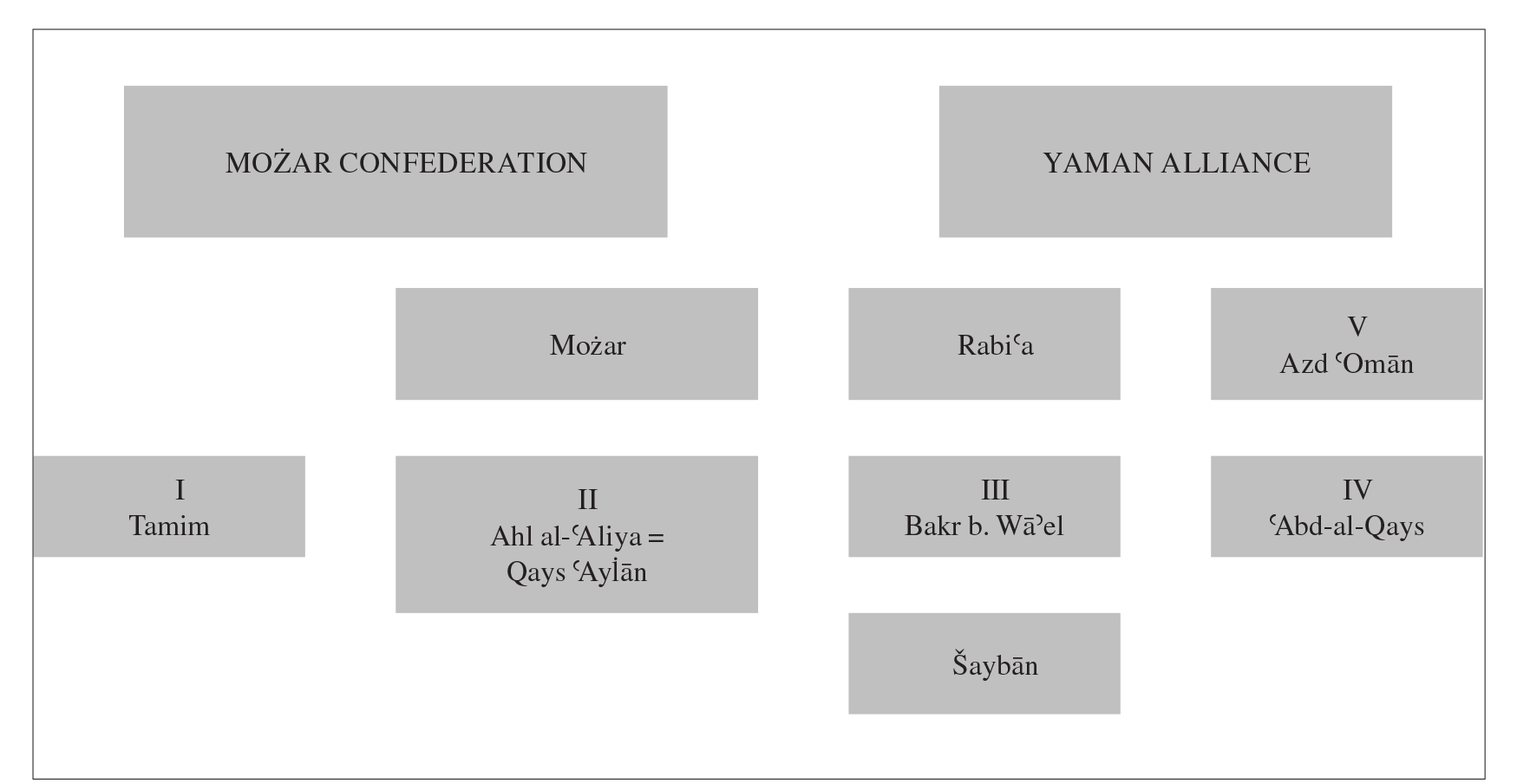
Figure 1. The Arab tribal divisions of Khorasan in the Omayyad Period, with the aḵmas marked by roman numerals.
EARLY FRONTIER GOVERNANCE
Under ʿOṯmān, there were five districts (ko
war) of Khorasan: Marv al-Šāhejān (with Marv al-Ruḏ as a dependency), Balḵ, Herat (with Bušanj and Bādḡis), Ṭus, and Nishapur (see ʿAṭwān, pp. 49-50, and ʿAli). This division mirrors divisions along early (pre-7th century) Sasanian lines. After restructuring, Marv (al-Šāhejān) was administered separately, while Marv al-Ruḏ, on the edge of the former Sasanian-Hephthalite frontier, became the main Muslim administrative center for western (lower) Ṭoḵārestān, which included Ṭālaqān and Fāryāb in Jowzjān to the east, but excluded Balḵ. The district of Herat continued to include both Bādḡis and Bušanj (Balāḏori, Fotuḥ, tr. p. 163). The administrative center of Ṭus district was switched to Nishapur, when Oṯ̣mān appointed Qays b. Hayṯām Solami over it and Khorasan (Ṭabari, I, p. 2831, tr., XV, 36; Balāḏori, Fotuḥ, p. 404, tr. p. 161).
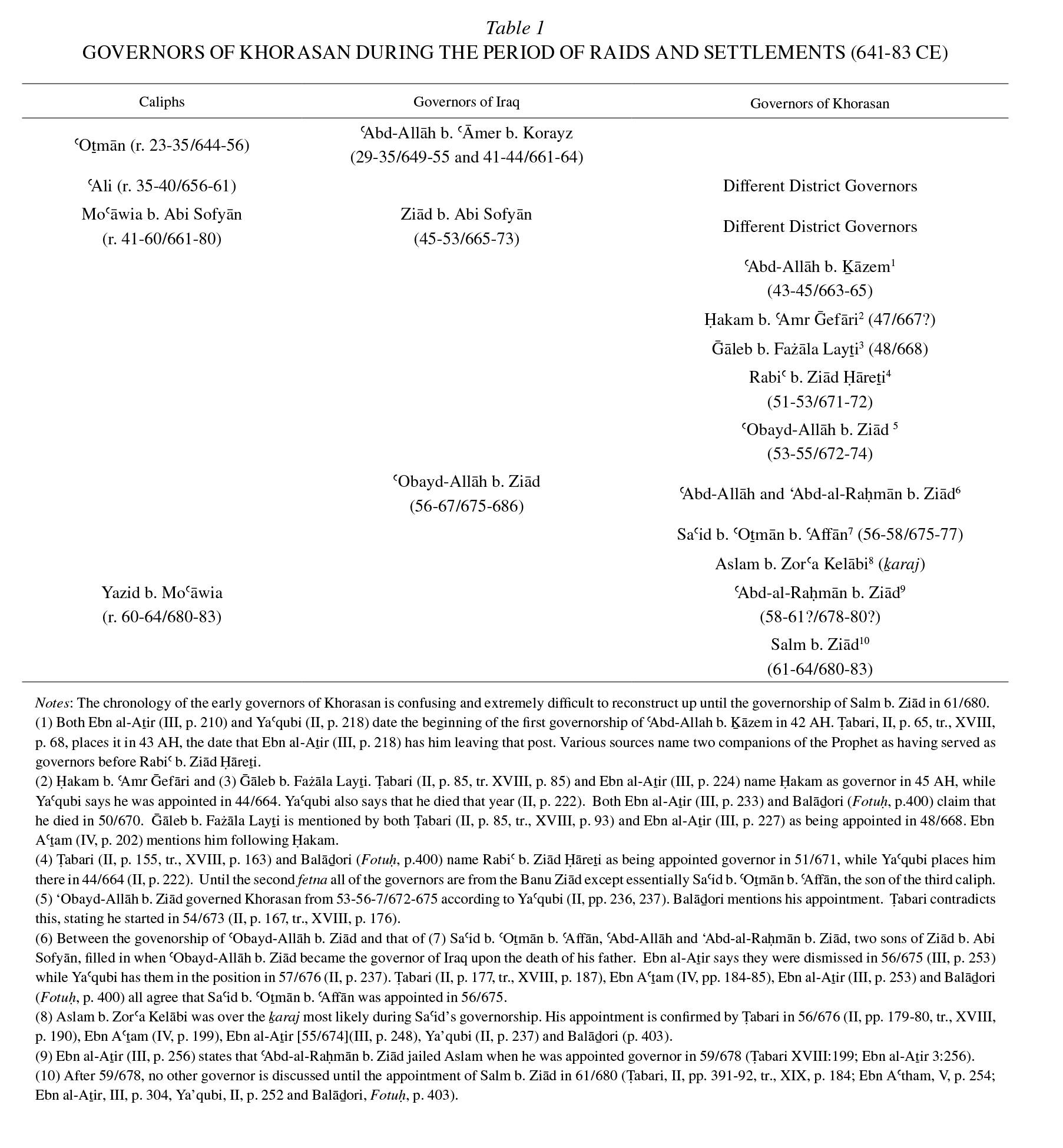
Table 1 Governors of Khorasan during the Period of Raids and Settlements (641-83 CE)
The caliph ʿOmar had established š araf (nobility) on the basis of Islamic precedence, that is, honoring and granting special privileges to the earliest Muslims. As a consequence, ṣaḥābis (Companions of the Prophet) dominated in leadership positions (Ebn al-Aṯir, Osd al-ḡāba, I, pp. 68-69; Ḵalifa, al-Ṭabaqāt, pp. 95-96; Ebn Ḵallekān, I, pp. 425-28.) All of these Companions of the Prophet represented a segment of the Muslim elite (a š rāf al-Eslām), who obtained a high status in society because of their service to Islam and their relationship to the ruling Islamic authorities rather than tribal status or ethnic purity. ʿOṯmān continued this policy while at the same time favoring his relatives. The caliph Moʿāwia (r. 41-60/661–80) ordered Ziād b. Abi Sofyān (gov. of Iraq 42-53/662-73) to select Ḥakam b. ʿAmr Ḡefāri, a ṣaḥābi (first-generation Muslim) to be governor of Khorasan in 44/664-65 (Yaʿqubi, II, p. 222). Ḥakam died in office in Marv 50/670-71, and then, after a succession of deputies, Rabeʿ b. Ziād Ḥāriṯi (gov. 51-53/671-72), another ṣaḥābi, was appointed governor. Under Moʿāwia, a second generation of administrators emerged who were better equipped to deal with matters of state in Khorasan than the aging first generation ṣaḥāba (Companions of the Prophet). For a period of ten years, the east was almost exclusively ruled by Ziād’s sons (ʿAbd-al-Raḥmān, ʿObayd-Allāh, ʿAbbād). Yazid b. Moʿāwia (60-64/680-83) continued his father’s policy by appointing his “cousins,” (Salm b. Ziād [61-64/680-83] and Yazid b. Ziād [killed 61/680]). This Sofyānid corporate dynasty thus ruled, and the only exception was the two-year appointment of the third caliph ʿOṯmān’s son, Saʿid b. ʿOṯmān b. ʿAffān to the governorship of Khorasan (56-58/675-77). This near family monopoly on governing positions in Khorasan was accepted by the Muslims.
FACTIONALIZATION AND ASSIMILATION (64-96/683-714)
The second fetna (64-73/683-92), as the rebellion of ʿAbd-Allāh Ebn Zobayr has been called, marked the end of Sofyānid Omayyad political rule. It intensified major religious unrest in Iraq. The Kharijites grew stronger and repeatedly attacked Baṣra. Iraq became embroiled in political as well as sectarian wars. As a result, distant Khorasan became a place of political and religious refuge for many Muslims.
When the caliph Moʿāwia II b. Yazid died in 64/683, Omayyad authority throughout Khorasan broke down and individual tribes seized control of the different districts. Tribal warfare ensued with the Qays and Tamim against the Rabiʿa and the Azd. Inter-tribal feuds became common between the Tamim and the Bakr b. Wa’il. Omayyad authority in Khorasan was in tatters.
The Marwanid Omayyad restoration. Ḥajjāj b. Yusof became governor for Iraq in 75/694 and gained authority over Khorasan in 697. Ḥajjāj appointed Mohallab b. Abi Ṣofra over Khorasan. In 699, Mohallab crossed the Oxus and campaigned against Keš, which he made his base of operations for two years. His strategy was to pacify eastern (upper) Ṭoḵārestān (Keš, Ḵottal and Čaḡāniān) as well as western (lower) Ṭoḵārestān, which had never been completely subdued.
Qotayba b. Moslem and the conquest of Sogdia. Qotayba b. Moslem (d. 96/715) became governor over both Khorasan and Sistān in 86/705. Qotayba was forced to subdue rebellion in Sogdia and Ṭoḵārestān instigated by the Arab rebel Musa b. ‘Abd-Allah, who had established an enclave in Termeḏ (72-85/691-704). His father, ‘Abd-Allah b. Ḵāzem, was governor of Khorasan (64-72/683-91) and had the support of the non-Arab rulers of Sogdia.
With the help of the Hepthalite ruler, the Nēzak (see NĒZAK and HEPTHALITES) Qotayba succeeded in concluding agreements in Sogdia and pacifying Ṭoḵārestān. When the Nēzak rebelled and enlisted all of the rulers of Ṭoḵārestān from Bādḡis to Kabul to join him, Qotayba was hard pressed but eventually executed the Nēzak and many of the moluk al-tawāʾef of Ṭoḵārestān (Ḵalifa, Taʾrik
̱, p. 190; Ebn al-Aṯir, IV, p. 114; Ṭabari, II, pp. 1207-8, 1221-23, tr. XXIII, pp. 154-55, 168-70). Qotayba subsequently pacified the Ratbil in Sistān, subdued Ḵᵛārazm, and captured Samarqand (on his campaigns, see Stark, 2018). He successfully employed a policy of making peace and then impressing local militias into service.
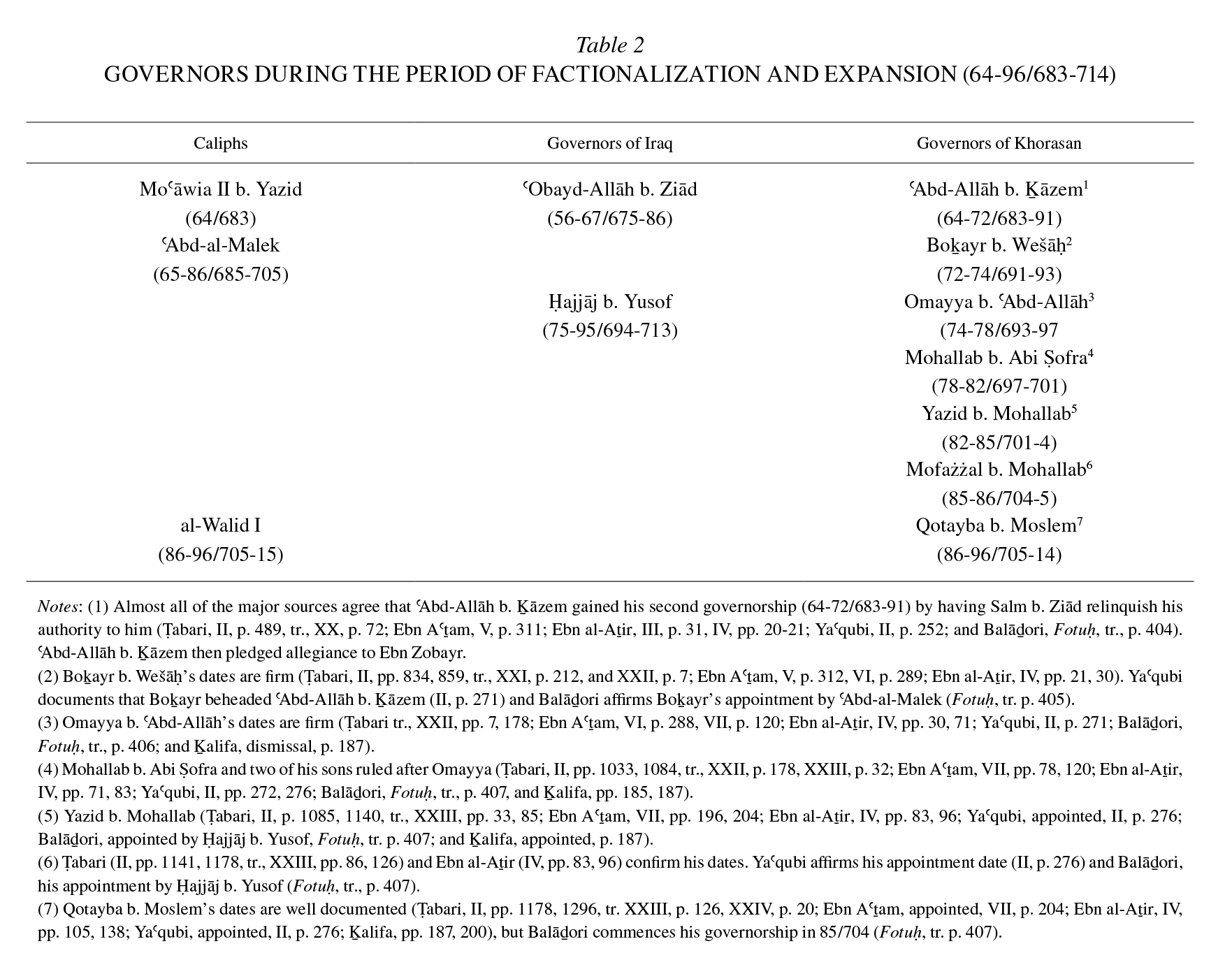
Table 2. Governors During the Period of Factionalization and Expansion (64-96/683-714)
The death of Hajjāj in 95/713, followed a year later by the death of the caliph al-Walid b. ʿAbd-al-Malek caused Qotayba to fear an end of his ten-year posting (Ṭabari, II, p. 1267, tr. XXIII, p. 216; Ebn Aʿṯam, VII, p. 249; Ebn al-Aṯir, IV, p. 132). In 96/714-15, Qotayba incited his army to rebel, but they refused and killed him (ca. August 715). The tribal leaders of Khorasan deferred to Moḍar pre-eminence, but Qotayba’s downfall was accomplished by consensus among the Moḍar, the Rabiʿa-Yaman, and the mawāli (clients; see ʿARAB iii; CONVERSION ii; IRAN ii[2]). The passing of these three men marked a turning point in Omayyad governance.
ESTRANGEMENT, DIVISION, AND ARBITRATION (97-128/715-45)
Under Qotayba’s leadership, the maw ā li found status, power, and prestige. Men such as Ḥayyān Nabaṭi and his son Moqātel rose to prominence. Ḥayyān’s status as the commander of the mawāli forces gave him the same status as a chief in the qabā ʾ el-system; but within Muslim society, owing to his non-Arab origin, his advancement could only truly be achieved under the auspices and umbrella of the a š rāf al-Eslām. The presence and service of the maw āli as part of Muslim authority eclipsed the authority of the non-Muslim moluk al-ṭawāʾef and affected the eventual transfer of all local power to Muslim officials (see Ṭabari, II, pp. 1290-91, 1299, 1328-31, tr., XXIV, pp. 13-15, 23, 53-55; Balāḏori, Fotuḥ, p. 337, tr. p. 42).
During the caliphate of ʿOmar b. ʿAbd-al-ʿAziz (ʿOmar II; r. 99-101/717-20), there was a focus on reforms and recognizing equality among Muslims regardless of their ethnic origins. A delegation from Khorasan informed him that the mawāli participating in campaigns in Khorasan did not receive ʿ aṭ āʾ or rezq (salary and maintenance pay) and that converts to Islam still paid the jezya (q.v.). ʿOmar II abolished the jezya for new converts and triggered a wave of new converts (Ṭabari, II, p. 1354, tr., XXIV, p. 83; Ebn al-Aṯir, IV, p. 158). These mass conversions broke the pattern of controlled conversion, and many administrators believed that these new Muslims had only converted in order to escape the jezya. The reforms were short-lived and the jezya was re-imposed on many of the “new converts,” causing many of them to renounce Islam (see Ṭabari, II, p. 1510, tr., XXV, p. 48).
Samarqand, conversion, and the Murjiʾites. Throughout the Omayyad period governorship was a source of private enrichment. Both the Muslim tax collectors (ʿommāl) and the non-Muslim rulers in Sogdia were often corrupt. While lining their own pockets, they were pressured to maintain or increase tax revenues. Exemption from paying the jezya for converts to Islam reduced revenues, so these officials continually contended that new conversions were a contrived means to escape taxes. As a result, converts to Islam were forced to pay the jezya.
Mass conversions to Islam prompted Jarrāḥ b. ʿAbd-Allāh Ḥakami (gov. 99-100/717-18) to impose a circumcision test as proof of conversion. ʿOmar II stopped this (Ṭabari, II, p. 1354, tr. XIV, p. 83; Madelung, p. 16). Most probably, many converted for economic reasons. However, Ašras b. ʿAbd-Allāh Solami (gov. 109-11/727-30) sponsored a conversion campaign initiated by a mawlā, Abu’l-Ṣaydāʿ Ṣāleḥ b. Ṭarif, who converted many by promising them that they would pay no jezya, only ḵarāj (Ṭabari, II, 1507-10, tr. XXV, pp. 46-48; Ṭabari, II, 1507-10, tr. XXV, pp. 46-48). But, again, when revenues dropped drastically, circumcision tests were re-imposed, and converts were required to recite a sura from the Qurʾan (see Ṭabari, II, p. 1508, tr. XXV, p. 47).
Pressure to produce revenues no doubt triggered conversion tests in an effort to detect fraud, but additionally non-Muslim rulers did not wish to see their subjects convert, since that diminished their standing in the community. Another factor that is impossible to gauge is the brand of Islam that was being preached by Abu’l-Ṣaydāʾ. Was his message one approved by the authorities or was it a type of Murjiʾism, where all one needed was to have faith in one’s heart with no need for actions or outward displays of religious practice? This question is raised because of the large concentration of Murjiʾite believers in Balḵ and Sogdia. We know that the famous poet-warrior Ṯābit Qoṭnah was a Murjiʾite. He and Abu’l-Ṣaydāʾ actively supported some seven thousand new converts who refused to pay the jezya again when it was re-imposed on them. Abu’l-Ṣaydāʾ and Ṯābit withdrew with this group, but they were both imprisoned for a while and Persian elites were humiliated in the streets and forced to pay the ḵarāj, while common converts were forced to pay the jezya (Ṭabari, II, p. 1508, tr., XXV, p. 47).
Five years later, in 734, Ḥāreṯ b. Sorayj Tamimi rebelled against ʿĀṣem b. ʿAbd-Allāh Helāli (gov. 116-17/734-36). His men consisted of converts and both Yamanis and Tamimis. He advocated for the end of illegal taxes on Muslims, insisted on providing proper pensions for them and called for fairness and justice. He was charismatic and championed the mawāli and converts of Sogdia, along with his religious spokesman, Jahm b. Ṣafwān (q.v.; d. 128/746), who founded the Jahmiya. Ḥāreṯ found refuge with the Ḵāqān in Ṭoḵārestān, the Eḵšid of Sogdia, the Yabḡu, the Sabal of Ḵottal, the Eḵšid of Šāš, and the Türgesh. Ḥāreṯ’s Murjiʾite version of Islam, like that of the Kharijites, accepted all Muslims as equals. Independent of Omayyad authority, he spread his form of Islam in Khorasan (on Ḥāreṯ and the Murjiʾites, see Wellhausen, pp. 464-72, 485-88; Gibb, pp. 76-85; Madelung, 1982, 1988; Blankinship, pp. 176-84; Agha, 1997).
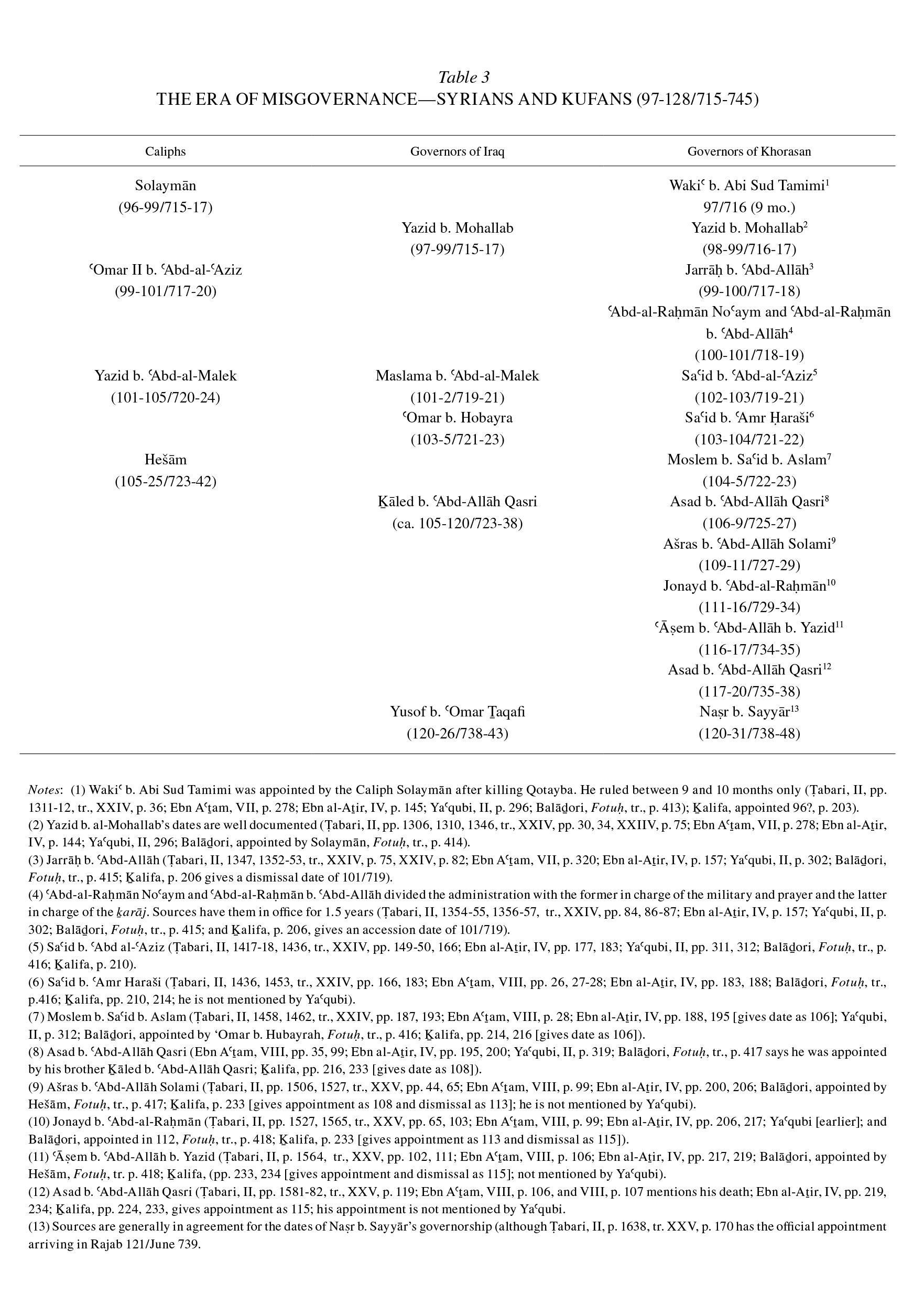
Table 3 The Era of Misgovernance—Syrians and Kufans (97-128/715-745)
The Muslim presence in Sogdia completely disrupted the economy and stripped the population of its wealth. Until the governorship of Naṣr b. Sayyār (gov. 120-131/738-48), Omayyad governance had only extracted wealth. It had been corrupted and inconsistent in its policies of tax collection and conversion. Only when peace and commerce were restored could Sogdia begin to accept a new order. Naṣr b. Sayyār, as mentioned before, implemented reforms and was able to win back Sogdian trust. During his governorship, he launched diplomatic missions to China, which successfully established cordial Omayyad-Chinese relations (Beckwith, pp. 124-25). His missions to China became so regular that, in 741, when Inäl Tudun Külüg, the viceroy of Šāš, requested Chinese assistance against the Muslims, the emperor refused it.
An anti-Omayyad movement had begun around 720. Its propaganda concentrated on the population of Khorasan, and finally, in 746, the Abbasid Revolution under the leadership of Abu Moslem Khorāsāni began there. It quickly gained success in Khorasan, toppled Omayyad authority there, and spread westward into Persia and Iraq. Continued victories propelled the movement into Syria and in 750, the Omayyads were defeated and the Abbasid dynasty was established. Abu Moslem Khorāsāni retained control of Khorasan and reestablished Muslim control over Transoxiana. However, in 755, he was assassinated, and the Abbasid caliph appointed his own governor of Khorasan.
Bibliography
- Saleh Said Agha, “A Viewpoint of the Murjiʾi in the Umayyad Period: Evolution through Application,” Journal of Islamic Studies 8/1, 1997, pp. 1-42.
- Idem, “The Arab Population in Ḫurāsān during the Umayyad Period: Some Demographic Computations,” Arabica 46/2, 1999, pp. 211-29.
- Idem, The Revolution which Toppled the Umayyads: Neither Arab nor ʿAbbāsid, Leiden and Boston, 2003.
- Ṣāleḥ Aḥmad ʿAli, Estiṭān al- ʿarab fi Ḵorāsān, n.p., n.d.
- Khalil Athamina, “Tax Reforms in Early Islamic Khurāsān: A Reassessment,” Der Islam 65, 1988, pp. 272-281.
- Idem, “Aʿrāb and Muhājirūn in the Environment of Amṣār,” Studia Islamica 66, 1987, pp. 5-25.
- Ḥosayn ʿAṭwān, al- Š e ʿr fi Ḵorāsān: M en al-fatḥ el ā nehāyat al- ʿaṣr al-Omawi, Beirut, 1989.
- Aḥmad b. Yaḥyā Balāḏori, Ansāb al-a š rāf, ed. Sohayl Zakkār and Riyāż Zerekli, 13 vols., Beirut, 1996.
- Idem, Ket āb fotuḥ al-boldān, ed. M. J. de Goeje, Leiden, 1866; tr. Francis Clark Murgotten as, The Origins of the Islamic State II, New York, 1924.
- Larissa S. Baratova, “Turkic Khaghanate in Middle Asia (VI-VIII Centuries A.D.),” in Hasan Güzel, ed., The Turks I: Early Ages, Ankara, 2014, pp. 357-63.
- W. Barthold, An Historical Geography of Iran, tr. Svat Soucek and ed. C. E. Bosworth, Princeton, 1984.
- Idem, Turkestan Down to the Mongol Invasion, 3rd ed., London, 1968.
- Christopher I. Beckwith, The Tibetan Empire in Central Asia : A History of the Struggle for Great Power among Tibetans, Turks, Arabs, and Chinese during the Early Middle Ages, Princeton, 1987.
- Khalid Yahya Blankinship, The End of the Jihâd State: The Reign of Hishām Ibn ʿAbd Al-Malik and the Collapse of the Umayyads, Albany, 1994.
- Clifford Edmund Bosworth, Sīstān Under the Arabs: From the Islamic Conquest to the Rise of the Ṣaffārids (30-250/651-864), Rome, 1968.
- Audrey Burton, “Itineraires commerciaux et militaires entre Boukhara et l’Inde,” Cahier d’Asie Centrale 1-2, 1996, pp. 13-32.
- Edouard Chavannes, Documents sur les Tou-Kiue (Turcs) occidentaux, recueillis et commentés, suivi de notes additionnelles, Paris, 1942.
- Arthur Christensen, L’Iran sous les Sassanides, Copenhagen, 1944, repr. Osnabrück, 1971.
- M. Cook, “Activism and Quietism in Islam: The Case of the Early Murjiʾa,” in Alexander S. Cudsi and E. Hillal Dessouki, eds., Islam and Power, London, 1981, pp. 15-23.
- Patricia Crone, “A Note on Muqātil b. Ḥayyān and Muqātil b. Sulaymān,” Der Islam 74, 1997, pp. 238-49.
- Idem, “Al-Muhallab b. Abī Ṣufra,” in Encyclopaedia of Islam: New Edition VII, Leiden, 1993, p. 357.
- Elton L. Daniel, The Political and Social History of Khurasan Under Abbasid Rule, 747-820, Minneapolis, 1979.
- Touraj Daryaee, Sasanian Iran (224-651 CE) : Portrait of a Late Antique Empire, Costa Mesa, Calif., 2008.
- Daniel Clement Dennett, Conversion and the Poll Tax in Early Islam, Cambridge, Mass., 1950.
- ʿAbd al-ʿAziz Duri, “Notes on Taxation in Early Islam,” Journal of the Economic and Social History of the Orient 17/2, 1974, pp. 136-44.
- Aḥmad Ebn Aʿṯam Kufi, Ketāb al-fotuḥ, 8 vols., Ḥaydarābād (Deccan), 1968-75.
- ʿEzz-al-Din Ebn al-Aṯir, al-Kāmil fi’l-taʾriḵ, 9 vols., Beirut, 1997.
- Idem, Osd al-ḡāba fi maʿrefat al-ṣaḥāba, Cairo, 1964.
- ʿAli b. Aḥmad Ebn Ḥazm, Jamharat ansāb al- ʿ arab, ed. ʿAbd-al-Salām Moḥammad Hārun, Cairo, 1962.
- Abu’l-ʿAbbās Aḥmad b. Moḥammad Ebn Ḵallekān, Wafayāt al-aʿyān wa-anbaʾ abnāʾ al-zamān, ed. Yusof ʿAli Ṭawil et al., 6 vols., Beirut, 1998.
- Emil Esin, “Tarkhan Nīzak or Tarkhan Tirek?,” Journal of the American Oriental Society 98, 1977, pp. 323-32.
- Richard Nelson Frye, “The Turks in Khurasan and Transoxiana at the Time of the Arab Conquest,” The Moslem World 35, 1945, pp. 308-15.
- Idem, “Bukhārā,” in Encyclopaedia of Islam: New Edition I, Leiden, 1986, pp. 1293-96.
- ʿAbd-al-Ḥayy b. Zaḥḥāk Gardizi, Zayn al-aḵbār, ed. ʿAbd-al-Ḥayy Ḥabibi, Tehran, 1968.
- H. A. R. Gibb, The Arab Conquests in Central Asia, London, 1923, repr. New York 1970.
- Idem, “The Fiscal Rescript of ʿUmar II,” Arabica 2, 1955, pp. 1-16.
- Frantz Grenet, “Regional Interaction in Central Asia and Northwestern India in the Kidarite and Hephthalite Periods,” in Nicholas Sims-Williams, ed., Indo-Iranian Languages and Peoples, Proceedings of the British Academy 116, Oxford, 2002, pp. 203-24.
- Idem, “Nēzak,” in Encyclopædia Iranica, online version, 2002.
- Franz Grenet and Étienne de la Vaissière, “The Last Days of Panjikent,” Silk Road Art and Archaeology, 2002, pp. 155-96.
- Moḥammad b. ʿAbd-Allāh Ḥākem Nišāburi, Tārik ̱-e Nis̆ābur, ed. Moḥammad-Reżā Šafiʾi Kadkani, Tehrān, 1996.
- J. Harmatta and B. A. Litvinsky, “Tokharistan and Gandhara Under Western Turk Rule (650-750),” in B. A. Litvinsky et al., eds., History of Civilizations in Central Asia III, Paris, 1996, pp. 358-93.
- Robert Haug, The Eastern Frontier: Limits of Empire in Late Antique and Early Medieval Central Asia, London and New York, 2019.
- Donald Routledge Hill, The Termination of Hostilities in the Early Arab Conquests, A.D. 634-656, London, 1971.
- A. H. Jalilov, “The Arab Conquest of Transoxania,” in B. A. Litvinsky et al., eds., History of Civilizations in Central Asia III, Paris, 1996, pp. 456-65.
- Ḵalifa b. Ḵayyāṭ, Ketāb al- ṭabaqāt, ed. Sohayl Zakkār, Damascus, 1966.
- Idem, Ta ʾ riḵ, ed. Moṣṭafā Najib Fawwāz and Ḥekmat Kešli Fawwāz, Beirut, 1995.
- Étienne de la Vaissière, Sogdian Traders: A History, Leiden and Boston, 2005.
- Idem, ed., Islamisation de l’Asie centrale: Processus locaux d’acculturation du VIIe au XIe siècle, Cahiers de Studia Iranica 39, Paris, 2008.
- Idem, “Early Medieval Central Asian Population Estimates,” Journal of the Economic and Social History of the Orient 60, 2017, pp. 788-817.
- Idem, “The ʿAbbāsid Revolution in Marw: New Data,” Der Islam 95/1, 2018, pp. 110–46.
- Wilferd Madelung, “The Early Murjiʾa in Khurāsān and Transoxania and the Spread of Hanafism,” Der Islam 59, 1982, pp. 332-39.
- Idem, “The Murji’a and Sunnite Traditionalism,” in idem, Religious Trends in Early Islamic Iran, Albany, 1988, pp. 13-25.
- Roy Andrew Miller, tr. and annot., Accounts of Western Nations in the History of the Northern Chou Dynasty [Chou Shu 50. 10b-17b], Chinese Dynastic Histories Translations 6, Berkeley, 1959.
- Michael G. Morony, Iraq After the Muslim Conquest, Princeton, N. J., 1984.
- Idem, “Mulūk al-Ṭawāʾif (A.) 1. In Pre-Islamic Persia,” in Encyclopaedia of Islam: New Edition VII, Leiden, 1993, pp. 551-52.
- Saʿid Nafisi, Tāriḵ-e ejtemāʿi -e Irān az enqerā ż -e Sāsāniān tā enqerā ż -e Omawi ān, Tehran, 1964.
- Parvaneh Pourshariati, Decline and Fall of the Sasanian Empire: The Sasanian-Parthian Confederacy and the Arab Conquest of Iran, London and New York, 2008.
- Wadād Qadi, “Madḵal elā derāsat ʿohud al-ṣolh zamān al-fotuḥ,” al-Ejteh ād 1/1, 1988, pp. 43-113.
- M. Rekaya, “Ḳārinids,” in Encyclopaedia of Islam: New Edition IV, Leiden, 1978, pp. 644-47.
- Khodadad Rezakhani, ReOrienting the Sasanians: East Iran in Late Antiquity, Edinburgh, 2017.
- Abu Saʿd ʿAbd-al-Karim b. Moḥammad Tamimi Samʿāni, Ketāb-al-ansāb, ed. ʿAbd-al-Raḥmān Yamāni, 13 vols., Hyderabad, 1962-82.
- Muḥammad Shaban, Islamic History: A New Interpretation, Cambridge, 1971.
- Søren Stark, “Mercenaries and City Rulers: Early Turks in Pre-Muslim Mawarannahr,” in L. M. Popova, C. W. Hartley, and A. T. Smith, eds., Social Orders and Social Landscapes, Newcastle, 2007, pp. 307-33.
- Idem, “The Arab Conquest of Bukhārā: Reconsidering Qutayba b. Muslim’s Campaigns 87-90 H/706-709 CE,” Der Islam 95, 2018, pp. 367-400.
- Boris Y. Stavisky, “Once More about the Peculiarities of the Sogdian Civilization of the 4th-10th Centuries,” in Matteo Compareti et al., eds, Ērān ud Anērān: Webfestschrift Marshak, Transoxiana Webfestschrift Series 1, 2003, available at www.transoxiana.org/Eran/Articles/Stavisky.html (accessed 10 October 2019).
- Moḥammad b. Jarir Ṭabari, Tāriḵ al-rosol wa’l-moluk, eds. M. J. de Goeje et al., 15 vols., Leiden, 1879-1901, tr. as The History of al-Ṭabari, gen. ed. Ehsan Yarshater, 40 vols., Albany, N.Y., 1985-2007 (translators vary).
- Tāriḵ-e Sist ā n, ed. Moḥammad-Taqi Bahār, Tehran, 1935.
- Tsʾen Chung-Mien, tr. Penelope A. Herbert in “The Tʾang System of Bureaucratic Titles and Grades,” Tʾang Studies 5, 1987, pp. 25-31.
- Julius Wellhausen, The Arab Kingdom and Its Fall, tr. Margaret Weir, Calcutta, 1927, repr. Beirut, 1963.
- Aḥmad b. Abi Yaʿqub Yaʿqubi, Tārikh, 2 vols., Beirut; tr. and ed. Matthew S. Gordon et al. as, The Works of Ibn W āḍ iḥ al-Ya ʿ qubi: An English translation, 3 vols., Leiden, 2017.
- Šehāb-al-Din Abu ʿAbd-Allāh Yāqut b. ʿAbd-Allāh Ḥamawi, Moʿjam al-boldān, 5 vols., Beirut, 1955-57.