



GENERAL INTRODUCTION
Khorasan in the Sasanid and early Islamic period included areas that are part of modern-day eastern Iran, Afghanistan, Pakistan, Uzbekistan, Tajikistan, and the eastern portion of Turkmenistan (see KHORASAN i. THE CONCEPT OF KHORASAN). At the time of the Islamic conquests, beginning in the third decade of the 7th century, Khorasan was fragmented geographically, politically, socially, culturally, and ethnically. The population was composed of Persians (Sasanians), Hephthalites (q.v.), Sogdians, and Turks. Regional political elites (the moluk al-ṭaw āʾ ef) of this period retained much authority over their localities. When the Arabs arrived in the second half of the 1st/7th century to claim these lands, there were multiple frontiers and mini-states. This complex shatter zone comprised a unique set of geographic features, ecological niches, and different populations. Indigenous populations resisted conquest and rebelled, while significant numbers of localized Muslims established roots in these regions.
In ancient times, these lands were claimed as part of the (Achaemenid) Persian Empire (558–330 BCE). Before 558 BCE, pre-Achaemenid Balḵ (q.v.) was a major power center. It retained its importance during Achaemenid times and served as the royal capital in the east. It remained the political capital of Bactria under the Greeks (305–125 BCE). Under the Arsacids (Parthians, 250 BCE– 228 CE), Khorasan again rose to preeminence from its regional capital city, Nisa (q.v.; see also CAPITAL CITIES i. PRE-ISLAMIC TIMES; Wiesehöfer, p. 1).
During the latter part of Sasanian rule (590-630), the ongoing wars with Byzantium (309-79, 540, and 590-628) generated a major shift of focus to its western borders. On its Khorasani borders, the Sasanians were defeated by the Hephthalites (465/484) and briefly became tributaries. After 579, major battles with the Western Turks for control of Hephthalite lands resulted in Sasanian defeats and the loss of territorial control of Ṭoḵārestān/Tocharia (Wiesehöfer, pp. 314-15)
In 39/659 and 41/661 the Chinese (Tʾang dynasty) took nominal control of all of the Khorasani lands formerly under the Turks, and bestowed Tʾang titles and hereditary offices on their rulers. In 41/661 the Tʾang created the Bo-si (Po-ssu, Persia) area command in Sistān and appointed Pērōz (Firuz), the son of Yazdegerd III, as the area commander (Chavannes, p. 172, see CHINESE-IRANIAN RELATIONS i. IN PRE-ISLAMIC TIMES). In 42/662 they gave him the title king of Persia. There are no accounts of this Pērōz in the Arabic chronicles of Ṭabari or Ebn al-Aṯir (qq.v.), but both include short passages referring to al- šāh that only make some sense when they are applied to Pērōz (Ṭabari, tr., XIII, p. 175; Ebn al-Aṯir, III, p. 23). Pērōz died in China sometime between 57/676 and 60/679.
SASANIAN KHORASAN
Geographic d ivisions. Sasanian Khorasan occupied all of the present-day Iranian province of Khorasan, the northern adjoining non-desert areas of present-day Turkmenistan, including the current capital Ashgabat (Nisa; Ar. Nasā or Nesā), and the northwestern border areas of Afghanistan. The eastern frontier areas had remained under direct Sasanian rule, while neighboring areas were autonomous. There were four distinct geographical areas: the northern piedmont (the Kopet Dāḡ basin or corridor), the Kašaf Rud basin, the Herat valley (the Herat basin), and Qohestān. Ṭabas al-Tamr and Ṭabas al-ʿOnnāb together roughly marked the southern boundary between Qohestān and Kermān. Travel times were long. Marv (Marw al-Šāhejān), in the extreme northeastern corner of the northern piedmont was a twelve-day journey to Ṭus, to the southeast. The travel time from Abaršahr (q.v.; Nishapur) or Ṭus to Herat in the Herat valley was nine days (see Figure 1).
The northern piedmont/Kopet Dāḡ basin. Mountains divided Sasanian Khorasan from the northwest to the southeast. The northern piedmont formed a corridor 375 miles long and 50 miles wide between the mountain slopes and the Qara Qum desert. Nasā and Abivard (q.v.) were the best known and most important settlements during Sasanian and Omayyad times. Beyond this belt lay the Qara Qum desert. Toward the southeastern limits of this rim was the town of Saraḵs.
Marv in the northeast was situated on a delta formed by the Morḡāb river. Southeast of Marv and also on the Morḡāb river was Marw al-Ruḏ, which bordered Bādḡis and Ḡarčestān (q.v.; Ar. Ḡarj al-Šar or Ḡarjestān). Marw al-Ruḏ was on the Sasanian frontier.
Kašaf Rud basin. The Binālud (q.v.) ranges comprised the mountain recesses of Ṭabārestān and Jorjān (Gorgān, q.v.) and meet the Khorasan plateau. Only a narrow, thirty-mile wide strip of land, which began at Qumes, separated this barrier range from the Dašt-e Kavir (see DESERT). This was the only non-desert route into Khorasan. The inner circle of mountains protected the inner region on the north and the east, but it was internally isolated, by salt wastes on the west and southwest.
Qohestān (Quhest ān). The Dašt-e Kavir and Dašt-e Luṭ deserts and the mountains of Qohestān formed an additional physical barrier from Persia proper. To the south, deserts met the mountains of Kermān. The isolated Kermāni frontier sheltered the Kharijites (see KHARIJITES IN PERSIA), who utilized Sistān as a refuge of last resort. Qohestān’s north/south mountains (Qāʾen to Birjand) met the deserts on the west and their eastern slopes formed the western boundary to Sistān (Sejestān) and faced the Kuh-e Bābā range. A fertile north-to-south corridor between these two ranges drains southwardly from Herat to Zarang in Sistān.
The Herat basin. The Harirud river watered the Herat valley, flowing from the east to the west out of Ḡur (q.v.). Bušanj (Pušang) was west of Herat where the river flowed north, reaching the Hazār Masjed range. It converged with the Kašaf Rud, flowing out of the southern slopes of the Ālā Dāḡ (q.v.). From there the Harirud flowed past Saraḵs into the Qara Qum desert.
The Barkut (Šāhjahān) mountains connect the Kopet Dāḡ with the Safid Kuh. The Harirud cut through them. Between the Harirud and the Morḡāb rivers lay the pasturelands of Bāḏḡis and further to the east was Ḡarčestān. The Ālā Dāḡ (q.v.) range in the north and the Afghan Safid Kuh range east of Herat divided Sasanian Khorasan in two, and separated the Iranian plateau from the steppes of Central Asia, and Herat from Bāḏḡis and Ḡarčestān.
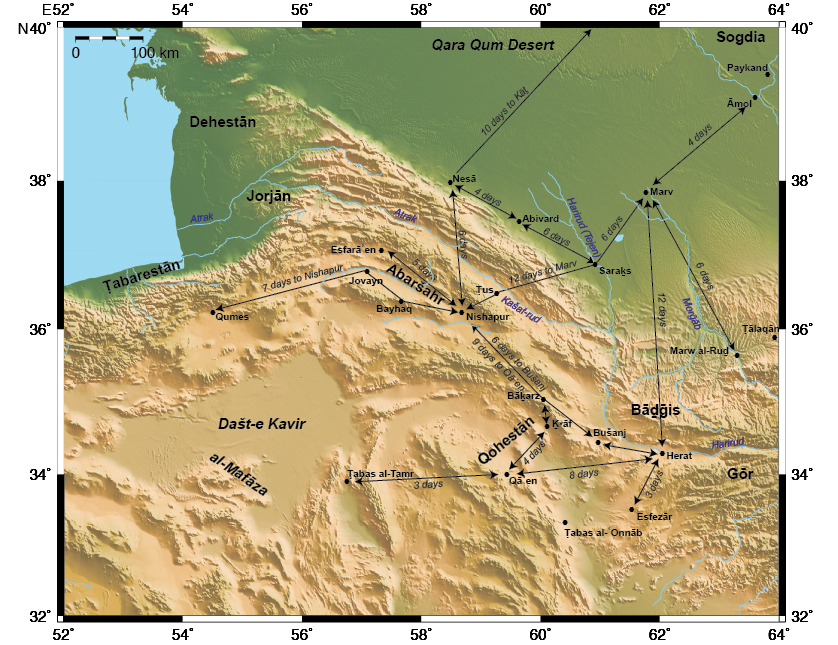
Figure 1. “Sasanian Khorasan” or “Marv and Inner Khorasan.” (Map created with Generic Mapping Tools and NOAA topographic data.)
Marv and “Inner Khorasan.” Nasā, Abivard, Saraḵs, Marw al-Šāhejān (Marv) and Marw al-Ruḏ comprised the major population centers on the northern piedmont of Sasanian Khorasan. Ṭus and Abaršahr (Nishapur) were the main population centers of the Kašaf Rud basin during the 2nd/7th century. At this time, the irrigation systems most likely limited the populations of these towns to no more than ten thousand (Pourshariati, 1995, p. 9; Christensen, p. 194). Ṭus was the oldest, and Abaršahr was rebuilt during the Sasanian campaigns and wars against the Hephthalites. Smaller settlements in the region of Abaršahr such as Jovayn, Esfarāyen, and Bayhaq (qq.v) rested near the mountains and were stretched out to the western limits of Sasanian Khorasan as far as Qumes. Qāʾen in Qohestān was a small but important place for transiting into and out of Sasanian Khorasan via the desert route to Kermān.
Trade flowed from Ṭoḵārestān, Sogdia, and beyond, either to Sistān or to the Persian Gulf and Kermān through Herat. Northern traders often chose a route through Herat because it was the less difficult one to India. Trade from India also skirted the Hindu Kush through Farāh (q.v.) to Herat and then on to the north or west to Sasanian Khorasan. During the early Islamic conquests, Herat, Bušanj, and the region of Bādḡis negotiated a joint peace treaty with the Arabs. The de facto border of Sasanian Khorasan at the time of the Arab invasions was the Morḡāb river.
ṬOḴĀRESTĀN
Ṭoḵārestān (formerly Bactria, q.v.) was the nexus of the trade routes connecting India with Sogdia and China. The Hephthalites dominated Ṭoḵārestān and Sogdia in the 5th and 6th centuries CE, until they were destroyed politically and militarily by the Western Turks and the Sasanians in 563-66 (Grenet, p. 116; Belenitsky, pp. 110-11). After the Hephthalites were defeated, their lands were divided. The Turks took the territories to the north of the Oxus river (see ĀMU DARYĀ), while the Sasanians took the territories to the south.
Arab geographers delineated the region in a number of ways. (For a detailed explanation of the views of Balāḏori, Ebn Ḵordādbeh, Ebn Rosta, Eṣtaḵri, Yāqut, and Yaʿqubi concerning Ṭoḵārestān and its divisions, see W. Barthold and C. E. Bosworth, “Ṭukhāristān,” in EI 2 X, pp. 600-601.) Here, Ṭoḵārestān is defined in its broadest sense to include Ḡarčestān and Jowzjān (q.v.) and includes the river valleys on both sides of the upper Oxus river.
Geographic divisions. Traditionally, Ṭoḵārestān has been divided into an upper region and a lower one, but it is less confusing to rename these two divisions as western and eastern Ṭoḵārestān. The geographical divide between western (lower) Ṭoḵārestān and eastern (upper) Ṭoḵārestān is the Ḵolm river (Kuwayama, pp. 89-134).
Western Ṭoḵārestān was primarily an area of vast plains bounded on the south by the sharp cliffs of the mountains of northern Afghanistan. In the north, the Oxus constituted the boundary. Jowzjān (Gowzgān or Gowzgānān; Ar. Juzjān) was the area between Ḡarčestān and Balḵ. Throughout the Omayyad period, the rulers of Ṭālaqān in Ḡarčestān and Fāryāb and Šoburqān (Šebarḡān) in Jowzjān were important politically. An Omayyad Arab governor lived in Anbār (q.v.), which was a day’s journey south of Šoburḡān.
The Arabs called Balḵ the “mother of cities” (Barthold, 1984, p. 33). It was the political and commercial capital of Ṭoḵārestān and a place of religious pilgrimage for both Zoroastrians and Buddhists even in early Islamic times (Barthold, 1968, p. 68). During the governorship of Asad b. ʿAbd-Allāh, in 107/725, Balḵ became the administrative capital of Khorasan (Barthold, 1968, p. 77).
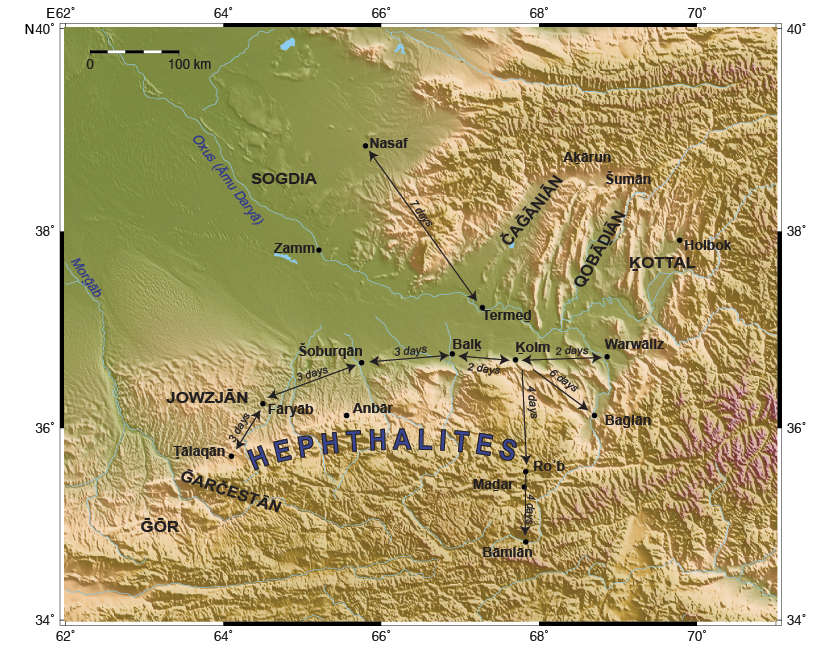
Figure 2. Ṭoḵārestān. (Map created with Generic Mapping Tools and NOAA topographic data.)
As for eastern Ṭoḵārestān, Ḵolm was two-days journey east of Balḵ. Warwāliz (Kunduz) was two days to the east from Ḵolm. From Warwāliz, it was another two days to Ṭālaqān and beyond Ṭālaqān another seven-day journey to Badaḵšān. North of Badaḵšān was the kingdom of Šoḡnān (Šeḡnān). The Ḵāwak and Aq-rabāṭ passes allowed passage through the mountains to the south. The route through Bāmiān was well traveled.
Across the upper Oxus was Ḵottal (q.v.) between the Panj and Waḵš rivers, ruled from Holbok. Ṣaḡāniān (see ČAḠĀNIĀN) in the Sorḵān valley was a four-day journey to the north from Termeḏ, a strong citadel on the Oxus. The small kingdoms of Āḵarun (Ḵarun) and Šumān were situated in the plains of the Sorḵān and Kāfernehān (Qobāḏiān) valleys.
In western Ṭoḵārestān, many of the inhabitants were semi-nomadic and depended on herding. In eastern Ṭoḵārestān, agriculture and trade were dominant. Two major trade routes ran south to India. Ṭālaqān, Fāryāb, Šoburqān, and Anbār in Jowzjān were all connected along the route from Herat to Balḵ or from Marv to Balḵ. Balḵ, Ḵolm and Termeḏ (Termez) had Arab garrisons during Omayyad times.
SOGDIA
Sogdia (see SOGDIANA) lay in Transoxiana (the land beyond the Oxus river up to the Jaxartes (Syr Daryā); see MĀ WARĀʾ AL-NAHR). Culturally, Sogdia was the most potent power in the region, and Sogdian was the lingua franca of traders throughout Central Asia.
Geographic divisions. Sogdia was situated between the Oxus and the Jaxartes. It was bound on the west by Margiana (the region of Marv) and on the north by Ḵᵛārazm (see CHORASMIA), the Qizil Qum desert and Šāš (modern Tashkent; see ČĀČ). Osrušana and Farḡāna (qq.v.) lay to the east, while Ṭoḵārestān lay to the south.
The three major urban centers were Bukhara (q.v.), Samarqand, and Keš (q.v.). The Zarafšān river valley represented the heartland of Sogdia. The Zarafšān river ran 400 miles from east to west, disappearing into the desert forty miles from the Oxus. The valley was extensively irrigated. To the south of the Zarafšān Valley lay the Kaška Daryā river.
The dominant cities on the lower Zarafšān were Paykand and Bukhara, and on the middle course were Samarqand and Panjikant (q.v.). Keš in the Kaška Daryā valley was fifty miles northwest of the Iron Gate, which was the main route into Sogdia from Ṭoḵārestān via Termeḏ.
Ḵᵛārazm, on the lower course of the Oxus river and its delta area, was separated from Sasanian Khorasan by the Qara Qum desert and from Sogdia by the Qizil Qum Desert. The two main towns were Kaṯ on the northern bank of the Oxus and Jorjāniya (Urganj) to the northwest of it.
The eastern frontier. To the east and the northeast lay the lands of Osrušana, Farḡāna, and Šāš (Čāč). Osrušana skirted the Alai mountains. Its capital was Panjikant (Ar. Bonjekaṯ). Farḡāna was situated in a rich river valley and was surrounded on the south, east and north by high mountains (the Tien-shan and Pamirs). Ḵojand (q.v.) was its major city, lying on the Jaxartes (Syr Daryā) bordering Šāš. Both Šāš and Ilāq were bounded by the Jaxartes and the mountains. Benkaṯ, the capital of Šāš, was in the Chirchik (Nahr Tork) river valley, while Ilāq lay in the Āhangarān river valley.
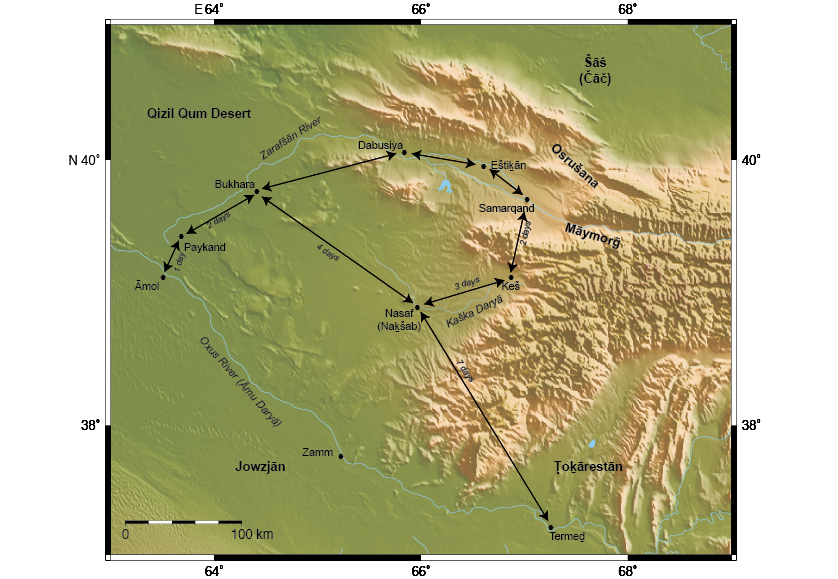
Figure 3. Sogdia. (Map created with Generic Mapping Tools and NOAA topographic data.)
Bukhara was the dominant population center. Paykand (Ar. Baykand) and Wardana were traditional rivals. In 87 or 88/705-6, Qotayba b. Moslem completely destroyed Paykand and held its population for ransom (Ṭabari, tr. XXIII, p. 137; Ebn Aʿṯam, VII, pp. 221-23; Ebn al-Aṯir, IV, pp. 107-9; Naršaḵi, pp. 61-62, tr., pp. 44-45; la Vassière, pp. 268-69). Bukhara emerged as the major city and trade center, but Bukhara’s rulers deferred to the ruler of Samarqand. Samarqand, on the middle course of the Zarafšān river, was a major trading emporium linked with the west, with India (via Ṭoḵārestān), and the many routes to China. The city hosted a wide variety of religious communities: Zoroastrians, Christians, Buddhists, Manichaeans and numerous cults. Keš held the dominant position in southern Sogdia. It was situated on the Samarqand to Termeḏ road, a two-day journey from Samarqand and a four-day journey from the Iron Gate. On the lower reaches of the Kaška Daryā lay Nasaf (Naḵšab, Qarši).
Bonjekaṯ, Benkaṯ and Aḵsikaṯ were, respectively, the capital towns of Osrušana, Šāš and Farḡāna in Omayyad times, and constituted the eastern frontier of Omayyad authority. From 86/705 until 96/714, Qotayba b. Moslem waged a campaign of conquest in Sogdia, and these eastern regions became a safe haven from conflict with the Arabs. While Šāš and Farḡāna nominally remained under Arab rule, Omayyad control and authority in reality ended between Samarqand and Osrušana (la Vaissière, p. 266).
THE REGIONAL RULERS (MOLUK AL-ṬAWĀʾEF)
The Persian histories and geographies often refer to the local rulers in the East of the pre-Islamic period as the moluk-e aṭrāf, which is equivalent to the Arabic moluk al-ṭaw āʾ ef. Both the Arabic and Persian expressions are similar in meaning to the middle Persian Sasanian title marzb ān (warden of the march). Here, the term moluk al-ṭaw āʾ ef is used to describe the main local rulers of principalities and mini-states in Ṭoḵārestān, Sogdia, and Sasanian Khorasan (A. Christensen, p. 19; M. Morony, “Moluk al-ṭawāʾif,” in EI 2 VII, p. 551; Frye, 1975, p. 9).
The terminology for the titles of these rulers is confusing. Some sources use generic terms such as de hqān (q.v.) and malek. Other sources use Sasanian terms such as marzbān or sp āhbed (q.v.; Ar. eṣbahbaḏ), which denoted administrative or military ranks and titles, respectively. Additionally, most of the regional rulers possessed local regnal names (Ebn Ḵordāḏbeh, pp. 39-41 [list of titles]; Balāḏori, Fotuḥ, tr., pp. 163, 169, Ansāb, V, p. 230; Ḵalifa, Taʾriḵ p. 109; Yaʿqubi, Taʾriḵ, II, p. 184; Gardizi, p. 103; Ebn al-Aṯir, III, p. 62; Ebn Aʿṯam, II, p. 104; Ṭabari, I, p. 2888, tr., XV, p. 93; Gyselen, pp. 55-56; Rekaya, “Ḳārinids” in EI2 IV, pp. 644-47l; Table 1).
The regional rulers under the Omayyads retained their positions in exchange for tribute, taxes, and additional obligations. As the leaders of their communities, they maintained the economy and upheld the local beliefs and values. In time, Muslim administrators and governors gradually took over many of the duties as these elites themselves became Muslims. In Ṭoḵārestān and Sogdia, however, the regional rulers resisted Omayyad authority, which represented a period of exploitation and resource extraction.
Peace in Ṭoḵārestān and Zābolestān was never constant because of the shifting loyalties of the three main Hephthalite rulers of these regions: the Nēzak Ṭarḵān in western (lower) Ṭoḵārestān; the Yabḡu (Jabḡuya) in eastern (upper) Ṭoḵārestān; and the Ratbil (or Zunbil) in Zābolestān, one of the most determined opponents of Omayyad authority in Khorasan (Bosworth, 1968, p. 34, following Josef Markwart and others, accepted the form Zunbil as a theophoric title; Bombaci, pp. 58-59, and more recently Sims-Williams, p. 235, have argued for Ratbil or Rotbil, often found in the Arabic sources, as derived from the Turkish title ilt äbir with metathesis of l and r, but cf. Afridi, pp. 31-32).
SASANID KHORASAN: STRUCTURES OF THE EMPIRE AND LOCAL NETWORKS
The ruling Parthian families of Sasanian Khorasan controlled vast estates; however, Sasanian dynasts had also acquired large royal estates and appointed elites from other ruling families and transplanted peoples. A blending of centralized and local authority was most visible in the major Sasanian power centers of Marv/Marw al-Ruḏ and Nishapur/Ṭus.
Marv and its dependencies. Abrāz Māhōē (Ar. Māhuya or Māhawayh; see ABRĀZ), the marzbān of Marv, is variously described in the sources as the dehqān of Marv or as its marzbān or its malek. His designation dehqān by Ṭabari (Ṭabari, I, pp. 2876; tr. XV, p. 83) indicates his standing as a local landed nobleman, while the Sasanian title/rank marzbān indicates an administrative and/or military function. He ruled over Marv and Marw al-Ruḏ, its dependency. Additionally, Ebn Aʿṯam (II, p. 104) names him as the malek (king) of Saraḵs. His local regnal name of Abrāz indicates that he was a leader of the regional elite, and his official designation as the marzbān most probably gave him responsibility for the northern piedmont region. Māhōē also was said to have had authority over Ṭālaqān, Jowzjānān and other places. All of these facts, coupled with the information that Māhōē was married to the daughter of the Nēzak Ṭarkān, the Hephthalite ruler of Bādḡis, demonstrates that the Sasanian bureaucracy had successfully stabilized the Sasanian-Hephthalite border.
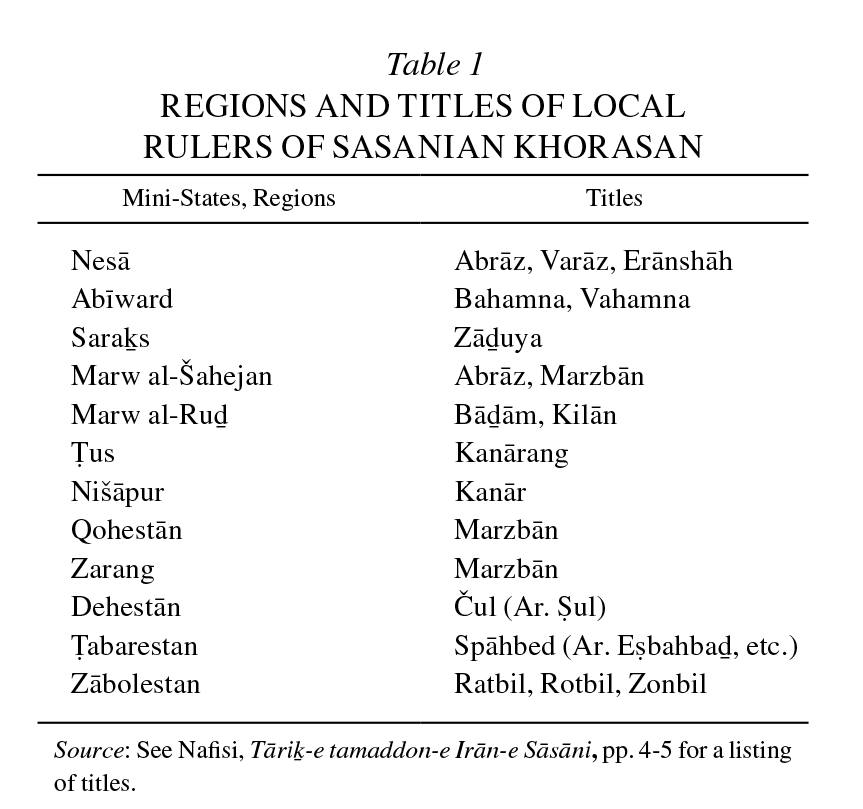
Table 1. Regions and Titles of Local Rulers of Sasanian Khorasan
Māhōē remained the ruler in Marv, subordinate to the Muslim authorities for at least fifteen years. Balāḏori (Ansāb V, p. 230) asserts that Māhōē visited the caliph ʿAli in Kufa and that later the Khorasani governor Rabiʿ b. Ziād Ḥāreṯi escorted Māhōē to meet the governor of Iraq and the East, Ziād b. Abi Sufyān. Yaʿqubi (II, p. 214) acknowledges a correspondence between the caliph ʿAli and Māhōē, ordering Māhōē to recognize ʿAli’s appointees and to deliver the ḵarāj to them.
There are no records of later marzbāns of Marv beyond Māhōē and his son Barāz (Abrāz) until 105/723 under the governorship of Moslem b. Saʿid, who appointed Bahrām Sis, a Zoroastrian, as marzbān. Bahrām Sis evidently remained in this position for at least sixteen years, until the governorship of Naṣr b. Sayyār (120-131/738-48), the last Omayyad governor of Khorasan (Ṭabari, II, pp. 1462, 1688, tr. XXIV, p. 193; XXVI, p. 24).
Bāḏām (Bāḏān; see Justi, p. 56) is named in the sources as the marzbān of Marw al-Ruḏ. He was a relative of the former Persian ruler of Yemen. He negotiated a peace treaty with Aḥnaf b. Qays in 31/651. As part of the treaty, Bāḏām negotiated the exemption of his family from taxes, but he was required to provide asāwera (q.v.) as requested.
Aba ršahr (Nišāpur)/Ṭus and Qohestān. The marzbān of Nishapur is named Aswār by Ebn Aʿṯam (II, p. 103), but this is most likely a designation meaning the head of the asāwera. Nišāburi (paragraph 2,726, p. 204) names him Barzān Jāh, the marzbān of the territory (Abaršahr). This could be a corruption of the regnal name Abrāz Šāh (Pourshariati, p. 273, suggests this is a corruption of Borzin Šāh). The marzbān of Nishapur fiercely resisted the Muslim siege of the city, but the kanārang of Ṭus assisted them and delivered half of the city to the Muslims (Ṭabari, I, p. 2886, tr. XV, pp. 91-92). Balāḏori represented the kanārang of Ṭus as the governor of Khorasan. The narratives concerning the kanārang (see kanārang in Justi, p. 155, and Frye, 1975, p. 9) are contradictory, but all the reports indicate that he assisted the Muslims in conquering Nishapur and paid tribute to them. Other puzzling reports state that he retained control of half of Nishapur and half of Ṭus and Nasā (see Ṭabari, I, p. 2886, tr., XV, pp. 91-92; Balāḏori, Fotuḥ, tr., pp. 39, 162; Nišāburi, pp. 202-3; Yaʿqubi, Taʾriḵ, II, p. 167). In 77/696-7, ʿOmar b. Abi’l-Ṣalt b. Kanārā, a grandson of the kanārang, claimed to be the one who killed the Azraqite caliph Qaṭari b. Fojaʾa (Ṭabari, II, p. 1019, tr. XXII, p. 163; see KHARIJITES IN PERSIA). He later fought on the side of Ebn al-Ašʿaṯ during the latter’s rebellion (Ṭabari, II, p. 1118, tr. XXIII, p. 63).
Qāren (see KĀRIN) rebelled in Qohestān in 33/653 and marshalled a force of forty thousand from Qohestān, Bādḡis and Herat (Ḵalifa, Taʾriḵ, p. 107; Ebn al-Aṯir, III, p. 68; Ṭabari, I, p. 2905-6, tr., XV, pp. 108-9). He was killed by forces led by ʿAbd-Allāh b. Ḵāzem. The inclusion of troops from Bādḡis and Herat again highlights a joint Sasanian-Hephthalite military effort against the Muslims. Until the colonization of Khorasan in 51/671, there were sporadic rebellions, but the local armies of Sasanian Khorasan were destroyed at this early stage and never re-emerged.
LOCAL RULERS AND THE T’ANG PROTECTORATES
The rulers of Ṭoḵārestān and Sogdia (Tables 2, 3) included the Yabḡu of Ṭoḵārestān (see JABḠUYA), the Šaḏ (the ruler of Ṣaḡāniān), the Nēzak Ṭarḵān of Bādḡis, and the Sabal, the ruler of Ḵottal. The Ratbil of Zābolestān could also be included as Zābolestān was considered subordinate to the Yabḡu, and the Ratbils also later incorporated Kapisa-Kābol into their territories. The terms Yabḡu (Jabḡu) and Šaḏ are pre-Turkish titles of ranks introduced to the region by the Western Turks.
The Chinese jimi fuzhou system of frontier regions created the Protectorate of Ṭoḵārestān and the Protectorate of Sogdia autonomously governed by their own rulers (Twitchett and Wechsler, p. 280; Yihong, pp. 201-2). Throughout the Omayyad period, regional ties remained strong with China, and these states remained loyal to China and requested Chinese military assistance. This quasi-system (jimi fuzhou) made no specific tributary demands on the Sogdians and Tocharians. Tʾang military support only manifested itself in the form of the Türgesh (see KHAGAN), whose interests were not altogether altruistic. Chinese military detachments were stationed as far as the Ili valley and Farḡāna (Twitchett, p. 362).
The Nēzak Ṭarḵān (see NĒZAK) dominated in western Ṭoḵārestān while the Yabḡu (Jabḡuya, q.v.) dominated in eastern Ṭoḵārestān. These two men exerted the most influence in the region and served as the main leaders of the many other rulers of small principalities.
The Yabḡu and eastern (upper) Ṭoḵārestān. Ṭabari (II, p. 1206, tr. XXIII, p. 154) called the Yabḡu the king of Ṭoḵārestān because all of the local moluk (regional rulers) had pledged full allegiance to him and the emperor of China. The major principalities of the Yabḡu comprised Čaḡānīān (Ṣaḡānīān, which included Tirmiḏ), Ḵottal (the Waḵš valley and other valleys to the east), Šomān and Āḵarun, Rob, Bamiān, Badaḵšān, Kapisa, Kābol and Zābolestān. The Yabḡu resided in Warwāliz (Kunduz).
In 118/736, the Yabḡu gave sanctuary to the Murjiʾite rebel, Ḥāreṯ b. Sorayj, in Badaḵšān. Anticipating the gravity of the threat posed by the joint Türgesh-Sogdian-Tocharian-Murjiʾite alliance, Asad b. ʿAbd-Allāh, the Omayyad governor, moved the capital of Khorasan from Marv to Balḵ (Ṭabari, II, p. 1591, tr. XXV, p. 128). In 119/737, Ḥāreṯ b. Sorayj, with the Ḵāqān and the Yabḡu, attacked Ḵolm with 30,000 men and moved across Jowzjān toward Marv. Asad b. ʿAbdullāh defeated them at the battle of Ḵarestān (Ṭabari, II, p. 1604, tr. XXVI, pp. 140-41). After this battle, the Yabḡu ceased to pose a serious threat.
The Šaḏ, Čaḡān (Ṣaḡān) Ḵodā, king of Čaḡānīān. Čaḡānīān served as a Hephthalite buffer principality on the frontier with Sogdia. It lay on a major trade route along the Oxus River. Termeḏ, to the south of Čaḡānīān, was overrun and settled by a rebel Muslim, Musā b. ʿAbd-Allāh, in 72/691. In 85/704, the Čaḡān Ḵodā fought alongside Mofażżal b. Mohallab’s forces when Termeḏ was stormed and Musā b. ʿAbd-Allāh was killed. In 86/705, the Čaḡān Ḵodā, Tiš al-Aʿwar, was allied with Qotayba b. Moslem and in 90/708 refused to rebel with the Nēzak Ṭarḵān against Qotayba b. Moslem (Bosworth, 1981, p. 1).
The Sabal, the king of Ḵottal. The Sabal of Ḵottal ruled the Waḵš valley and other valleys to the east and resisted Omayyad authority. However, in an earlier act of solidarity, the Sabal joined the Nēzak, Bukharans, Čaḡānīāns and Modrek b. Mohallab in the assault against Musā b. ʿAbd-Allāh at Termeḏ in 85/704. In 107/725, the Sabal aligned himself with the Murjiʾite rebel Ḥāreṯ b. Sorayj but later left him. The Sabal was defeated along with the Ḵāqān (Türgesh) in the previously mentioned battle of Ḵarestān in 119/737. About this time, an Omayyad governor was appointed to Ḵottal (Ṭabari, II, pp. 1151-53, 1162, 1492-94, 1583-84, tr., XXIII, pp. 96-97, 106, XXV, pp. 30-32, 120-21).
The Nēzak Ṭarḵān and western Ṭoḵārestān. The Nēzak Ṭarḵān figured prominently in the Omayyad period from the earliest times through the governorship of Qotayba b. Moslem (86-96/705-15). He is associated with Bādḡis, a region of high plateau pasturelands with no cities.
In 64/683, the Nēzak Ṭarḵān attacked and defeated the Azdi garrison at Qaṣr Asfād. Not until 84/703 was Yazid b. Mohallab able to force him to pay the jezya (q.v.). In 87/705, Nēzak joined forces with Qotayba b. Moslem and the Moslem army in the campaigns into Sogdia. They campaigned together from 88/706 through 90/708. Ṭabari (II, 1204-5, tr., XXIII, p. 153) reports that the Nēzak left the service of Qotayba in 90/709, fearing that he would be killed.
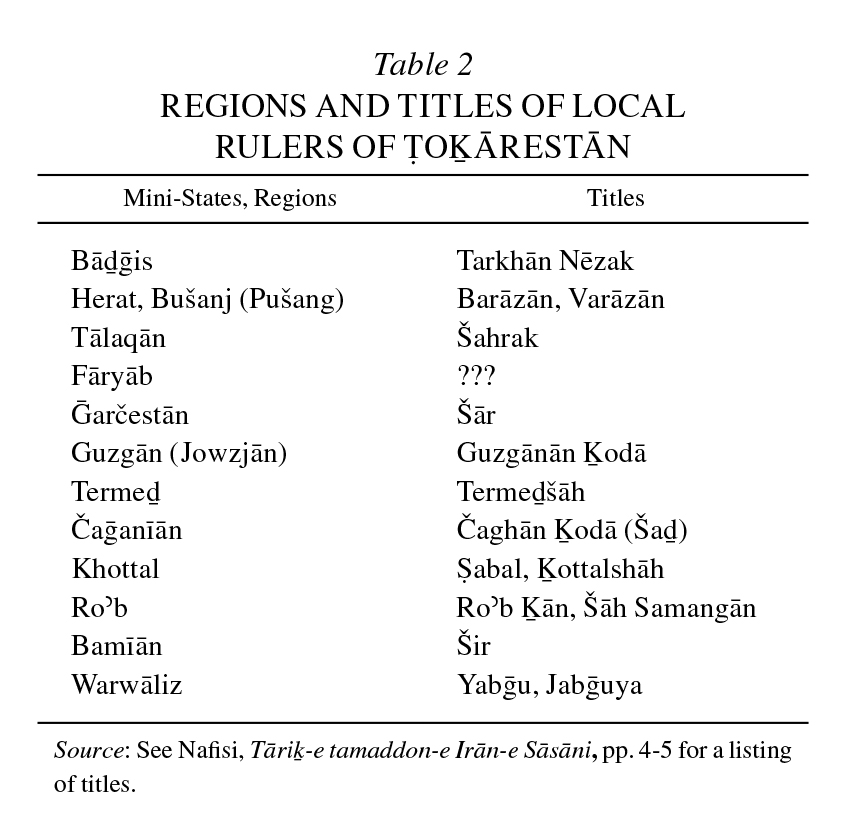
Table 2 Regions and Titles of Local Rulers of Ṭoḵārestān
Nēzak rebelled with the support of all of the rulers of western Ṭoḵārestān. Tabari (II, pp. 1206, 1218, tr. XXIII, pp. 154-55, 165) lists them as the Eṣbahbaḏ of Balḵ; Bāḏām, the king of Marw al-Ruḏ; Sohrak, the king of Ṭālaqān; Tusek, the king of Fāryāb; and Jowzjāni, the king of Jowzjān. After arranging for possible asylum with the Kābolšāh, Nēzak fled to eastern Ṭoḵārestān, abducted the Yabḡu, and then fortified himself in a fortress in Baḡlān.
Qotayba gathered an army from Abrašahr, Abiward, Saraḵs, and Herat and marched to Marv. From there, he marched east through Tālaqān, Fāryāb and Juzjan to Balḵ subduing the population along the way. The Roʾb Ḵān, the king of Roʾb, helped Qotayba find a way behind Ḵolm pass, which allowed Qotayba to dislodge Nēzak from his secure fortress. Nēzak took refuge in a place called Korz and was besieged for two months until he was enticed to surrender. Nēzak was imprisoned until Qotayba received permission from the governor Ḥajjāj b. Yusof to kill him. During this time, Qotayba allowed the Šaḏ and the Sabal to pledge their fealty to the Yabḡu and depart. Qotayba executed Nēzak and crucified him. Reportedly, an additional 12,000 men were killed (Ṭabari, II, 1218-27, tr., XXIII, pp. 164-74).
This rebellion in 91/710 caused Qotayba to lose a major portion of his local militias and resulted in the extermination of the ruling elites of the area. ʿAmr b. Moslem was posted to Ṭālaqān to maintain order. A member of the tribe of Bāhela was appointed over Fāryāb and ʿĀmer b. Mālek Ḥemmāni over Jowzjān (Ṭabari, II, p. 1218, tr., XXIII, p. 165).
The protectorate of Sogdia. Sogdia was the richest of all the regions of Khorasan. Its established colonies along the trade routes to China allowed it to maintain strong social and economic ties that made the Sogdians natural allies of the Turks and Chinese. Muslim campaigns into Sogdia began in the 50s/670s, but a Muslim presence started only from 90/708 in Bukhara and from 93/711 in Samarqand. This presence was always precarious and never constant.
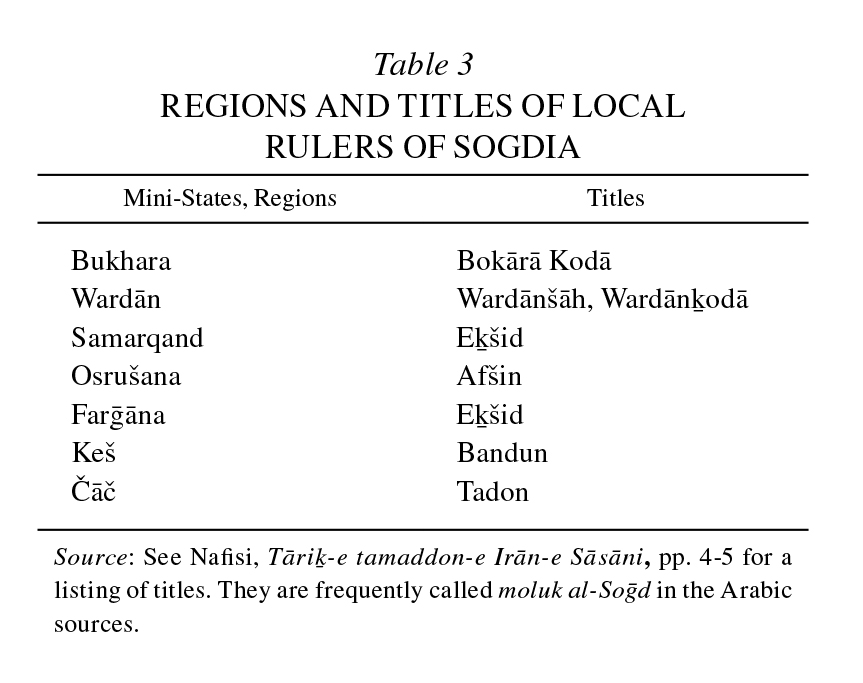
Table 3 REGIONS AND TITLES OF LOCAL RULERS OF SOGDIA
The Eḵšid (q.v.) or Ṭār of Farḡāna ruled on the upper reaches of the Jaxartes (Syr Daryā) river, and in 38/658, the Chinese emperor Kao-tsung established Farḡāna as the Hsiu-hsün area command and appointed the Eḵšid as the military governor. In 121/738, the emperor Hsüan-tsung gave him a princess from the imperial house in marriage (Marshak and Negmatov, p. 274; Bielenstein, pp. 323-24; Ebn al-Aṯir, IV, p. 126).
The Eḵšid of Farḡāna along with the king of Šāš (Č̌āč̌) and the Ḵāqān all sent forces to fight the Muslims. Farḡāna and Šāš, both with mixed populations of Sogdians and Turks, supported the Türgesh coalition. The Eḵšid was forced to shift his capital from Aksikaṯ to Kāšān, and Qotayba b. Moslem captured its chief cities: Ḵojand and Kāšān (Frye, p. 82; Gibb, pp. 467-74).
The Eḵšid of Sogdia (Samarqand [Kʾang-chü]). The Eḵšid of Samarqand was made a military governor over the Kʾang-chü area command created by the Tʾang emperor Kao-tsung in 38/658. In 77/696 the empress Wu recognized the king of Sogdia (Tukaspadak) and appointed him “General-in-Chief of the Resolute Guards on the Left.”
The Eḵšid of Sogdia traditionally led a very loose Sogdian confederation of principalities. The four Ekhšids of Samarqand during the Omayyad period were elected and not of royal stock. The Eḵšid, Ṭarḵun (r. 79-92/698-710), assisted his neighbors when they needed troops and helped Musā b. ʿAbd-Allāh expel all Omayyad tax collectors from Sogdia in 85/704 (Ṭabari, II, 1147-48, 1152-54, tr., XXIII, pp. 91-92, 96-97; Naršaḵi, pp. 63-65, tr., pp. 45-47). Later, he surrendered to Qotayba and agreed to pay an annual tribute; the Samarqandis were outraged, and Ṭarḵun either committed suicide or was assassinated (Ebn al-Aṯir, IV, p. 262). Ḡurak (r. 92-121/710-738), Ṭarḵun’s younger brother, was then elected (Naymark, p. 253).
The Boḵār Ḵodā and Bukhara. Both Āmol and Paykand were dependencies of Bukhara. Bukhara was made a Chinese commandery in 39/659. The first Muslim campaigns at Bukhara encountered Qabaj Ḵātun. She acted as the regent for her infant son, Ṭoḡšāda, for fifteen years, until Qotayba b. Moslem installed him as the Boḵār Ḵodā in 91/709. He reigned for thirty years until he was assassinated in 121/738. Ṭoḡšāda appeared to be Muslim and loyal to Omayyad authority. However, once Omayyad authority in Sogdia began to slip away, Ṭoḡšāda, along with the other regional moluk al-ṭaw āʾ ef, wrote to the Tʾang court pleading for assistance against the Muslims (Frye, “Bukhārā”; Frye, 1975, p. 81; Chavannes, p. 138 n. 2).
Bibliography
- Gulman S. Afridi, “Etymology of Zhunbil and Identity of the Rulers of Kabul and Zabul in Seventh-Ninth Centuries C.E.,” Journal of Asian Civilizations 39, 2018, pp. 25-47.
- Aḥmad b. Yaḥyā Balāḏori, Ansāb al-a š rāf, ed. Sohayl Zakkār and Riāż Zerkali, 13 vols. Beirut, 1996.
- Idem, Ket āb fotuḥ al-boldān, ed. M. J. de Goeje, Leiden, 1866, tr. Francis Clark Murgotten, as The Origins of the Islamic State, Part II, New York, 1924.
- W. Barthold, Turkestan down to the Mongol Invasion, 3rd ed., London, 1968.
- Idem, An Historical Geography of Iran, tr. Svat Soucek and ed. C. E. Bosworth, Princeton, 1984.
- A. M. Belenitskiǐ, Central Asia, London, 1969.
- Hans Bielenstein, Diplomacy and Trade in the Chinese World, 589-1276 Leiden and Boston, 2005.
- Alessio Bombaci, “On the Ancient Turkic Title Eltäbär,” in Proceedings of the IXth Meeting of the Permanent International Altaistic Conference, Naples, 1970, pp. 1-66.
- C. E. Bosworth, Sīstān Under the Arabs, from the Islamic Conquest to the Rise of the Ṣaffārids (30-250/651-864), Rome, 1968. Idem, “The Rulers of Chaghāniyān in Early Islamic Times,” Iran 19, 1981, pp. 1-20.
- Edouard Chavannes, Documents sur les Tou-Kiue (Turcs) Occidentaux. Recueillis et commentés, suivi de notes additionnelles, Paris, 1942.
- Arthur Christensen, L’Iran sous les Sassanides, repr. Osnabrück, 1971.
- Peter Christensen, The Decline of Iranshahr: Irrigation and Environments in the History of the Middle East, 500 B.C. to A.D. 1500, Copenhagen, 1993.
- Aḥmad Ebn Aʿṯam Kufi, Ketāb al-fo tūḥ, ed. M. ʿA. Khan et al., 8 vols., Ḥaydarābād (Deccan), 1968-75.
- ʿEzz-al-Din Ebn al-Aṯir, al-Kāmel fi’l-ta ʾ riḵ, 9 vols., Beirūt, 1997.
- Abu’l-Qāsem Ebn Ḥawqal, Ket āb ṣurat-al-arż, ed. J. H. Kramers, 2nd ed., Leiden, 1938-39; repr. as Ibn Ḥawqal’ s Kit ā b Ṣūrat al-arḍ: Opus geographicum, Leiden, 2014.
- Ebn Ḵordāḏbeh, Ket āb al-masālek wa’l-mam ā lek, ed. M. J. de Goeje, Bibliotheca Geographorum Arabicorum 6, Leiden, 1889.
- Ebn Rosta, Ketāb al-a ʿ lāq al-nafisa, ed. M. J. de Goeje, Bibliotheca Geographorum Arabicorum 7, Leiden 1892; tr. G. Wiet, as Les Atours précieux, Cairo, 1955.
- Richard N. Frye, “Bukhārā,” in EI 2 I, [1960], pp. 1293-96.
- Idem, The Golden Age of Persia: The Arabs in the East, London, 1975.
- ʿAbd-al-Ḥayy Gardizi, Zayn al-akhbār, ed. ʻAbd-al-Ḥayy Ḥabībī, Tehran, 1968.
- H. A. R. Gibb, “The Arab Invasion of Kashgar in A.D 715,” BSOS 2/3, 1922, pp. 467-74.
- Frantz Grenet, “Regional Interaction in Central Asia and Northwestern India in the Kidarite and Hephthalite Period,” in Nicholas Sims-Williams, ed., Indo-Iranian Languages and Peoples, Oxford, 2002, pp. 203-24.
- ika Gyselen, The Four Generals of the Sasanian Empire: Some Sigillographic Evidence, Rome, 2001.
- Abu Ishaq al-Istakhri, Kitab Masalik al-mamalik, ed. M. J. de Goeje, Bibliotheca Geographorum Arabicorum 1, repr. Leiden, 1967.
- Ferdinand Justi, Iranisches Namenbuch, repr. Hildesheim, 1963.
- Ḵalifa b. Ḵayyāṭ, T aʾriḵ Ḵalifa b. Ḵayyāṭ, ed. Moṣṭafā Najib Fawwāz and Ḥekmat Kešli Fawwāz, Beirut, 1995.
- Deborah E. Klimburg-Salter, The Kingdom of Bāmiyān: Buddhist Art and Culture of the Hindu Kush, Naples, 1989.
- Shoshin Kuwayama, “The Hephthalites in Tokharistan and Northwest India,” Zinbun: Annals of the Institute for Research in Humanities, Kyoto University 24, 1989, pp. 89-134.
- Étienne de la Vaissière, Sogdian Traders: A History, Leiden and Boston, 2005.
- Guy Le Strange, The Lands of the Eastern Caliphate: Mesopotamia, Persia, and Central Asia from the Moslem Conquest to the Time of Timur, repr. New York, 1976.
- B. I. Marshak and N. N. Negmatov, “Sogdiana,” in History of Civilizations of Central Asia III: The Crossroads of Civilizations, A.D. 250-750, Paris, 1996, pp. 237-81.
- Michael G. Morony, “Mulūk al-ṭawāʾif (a),” in EI2 VII, [1993], pp. 551-52.
- Saʿid Nafisi, T āriḵ-e tamaddon-e Irān-e Sāsāni, 2 vols., Tehran, 1953-65.
- Idem, T ā riḵ-e ejtem āʿ i-e Ir ā n az enq er āż -e S ā s ā ni ā n t ā enqer āż -e Omaw i ā n, Tehran, 1964.
- Moḥammad b. Jaʿfar Naršaḵi, Tāriḵ-e Boḵārā, ed. M.-T. Modarres Rażavi, 2nd. ed., Tehran, 1984; tr. R. N. Frye, as The History of Bukhara, Cambridge, Mass., 1954.
- Alexsandr Naymark, “Sogdiana, its Christians, and Byzantium: A Study of Artistic and Cultural Connections in Late Antiquity and Early Middle Ages,” Ph.D. diss., Indiana University, Bloomington, 2001.
- Moḥammad b. ʿAbd-Allāh Ḥākem Nišāburi, T ā riḵ-e Ni š ā bur, tr. Ahmad b. Moḥammad b. Ḥosayn Ḵalifa Nišāburi, ed. Moḥammad-Reżā S̆afiʾi Kadkani, Tehran, 1996.
- Parvaneh Pourshariati, “Iranian Tradition in Ṭūs and the Arab Presence in Khurāsān,” Ph.D. diss., Columbia University, 1995.
- Idem, Decline and Fall of the Sasanian Empire: The Sasanian-Parthian Confederacy and the Arab Conquest of Iran, London, 2008.
- M. Rekaya, “Ḳārinids,” in EI2 IV, [1978], pp. 644-47.
- Nicholas Sims-Williams, “Ancient Afghanistan and its Invaders: Linguistic Evidence from the Bactrian Documents and Inscriptions,” in idem, ed., Indo-Iranian Languages and Peoples, Oxford, 2002, pp. 225-42.
- Moḥammad b. Jarir Ṭabari, T aʾriḵ al-rosol wa’l-molūk, eds. M. J. de Goeje et al, 15 vols. in 3 series, Leiden, 1879-1901; tr. as E. Yarshater, ed., The History of al- Ṭabari, 40 vols., Albany, N.Y., 1985-2007 (translators vary).
- Tāriḵ-e Sistān, ed. M.-T. Bahār, Tehran, 1935.
- Denis Twitchett, “Hsüan-tsung (Reign 712-56),” in idem, ed., Cambridge History of China III: Sui and T’ang China, 589-906 AD, Cambridge, 1979, pp. 333-463.
- Denis Twitchett and Howard J. Wechsler, “Kao-Tsung (Reign 649-83) and the Empress Wu: The Inheritor and the Usurper,” in Denis C. Twitchett, ed., Cambridge History of China III: Sui and T’ang China, 589-906 AD, Cambridge, 1979, pp. 242-89.
- Josef Wiesehöfer, Ancient Persia from 550 BC to 650 AD, London and New York, 2004. Aḥmad b. Abi Yaʿqub Yaʿqubi, Taʾri ḵ al-Yaʿqubi, Beirut, n.d.; ed. and tr. in Matthew S. Gordon et al., as The Works of Ibn W āḍ iḥ al-Ya ʿ q ū b ī: An English Translation, 3 vols., Leiden, 2017.
- Yāqūt ibn ʿAbd-Allāh Ḥamawī, Moʿjam al-boldān, Beirut, [1955-57].
- Pan Yihong, Son of Heaven and Heavenly Qaghan: Sui-Tang China and Its Neighbors, Bellingham, Wash., 1997.