



Movsēs Xorenacʿi (q.v.) in his Geography divides Khorasan into 26 districts stretching from Gorgān (q.v.) and Qumes in the southeastern Caspian region to Badaḵšān (q.v.) and Ṭoḵārestān on the upper Oxus and Bāmiān in the Hindu Kush (Marquart, 1901, pp. 16-17, 47ff.).
In the past, Khorasan could often be associated with a territorial entity more than an administrative one. According to recent archaeological and historical discoveries (Rante and Collinet, 2013; Rante, 2015, pp. 9-25), Khorasan should be considered concretely as a large quarter of the Sasanian empire (q.v.) from the mid-6th century CE.
It was, in fact, considered by the Sasanians as one of the four quarters of the empire, that of the east, and traditionally divided into four administrative provinces: Nishapur, Herat, Marv, and Balḵ (Figure 1; Gyselen, 1989, p. 85; and 2003; see also Daryaee, pp. 13-18).
Regarding the frontiers of Khorasan, Ernst Herzfeld (q.v.) described the limits of Khorasan during the last part of the Sasanian period (Figure 2): “Eastern Tehran, at the ‘Caspian Gates,’ beginning the eastern parts of the Alborz Mountains, to the southeastern corner of the Caspian Sea, today’s Russian-Persian border at Atrek, along the Trans-Caspian railway to about Loṭfābād; [then] after a line through the desert, including the oases of Marv and Tejen, up to the Āmu Daryā at Karki, the Āmu Daryā itself to about Ḥażrat Emām, then west of Badaḵšān to the south into the Hindu Kush mountains, thence west to the high ridge of the Hindu Kush and continuing along its western extensions, south past Herat, [by] a salt lake on the Afghan-Persian border, continuing through Kuhestān south of Ḵᵛāf and Toršiz and along the northern edge of the great Dašt-e Kavir desert back to the starting point at the Caspian Gates” (Herzfeld, p. 109).
While the “concept” of Khorasan in the early and Middle-Sasanian period could have been popularly intended to start from Ray, or from Hamadān (Herzfeld, p. 108), eastwards to the “place where the sun rises,” it would seem more probable that the limits of western Khorasan would have corresponded to the “whole Abaršahr” (Gyselen, 1989, p. 85). It is therefore probable that in the Sasanian epoch Khorasan excluded Ray and some other provinces mentioned in later historical sources. Qumes, often associated with the Gorgān region (Gyselen, 1989, p. 84), was likely the western frontier of the Abaršahr. The problem is that the “whole Abaršahr” remains hard to circumscribe today. The Sasanian extension of this region could correspond, as attested by Josef Markwart (q.v.), to the area where the Aparni originally settled, corresponding to the area of Tajan (1901, p. 74; Lecoq, p. 151).
The Sasanian occupation of eastern Iran was de facto ephemeral (Gyselen, 2003, p. 166), thus rendering it difficult today to have a precise and conclusive idea of the eastern boundaries. Nonetheless, if an administrative Khorasanian entity had existed before the 6th century, its eastern boundaries probably would have corresponded to the Morḡāb River (q.v.; Rante, 2015, p. 10, n. 3). Concerning the south, the large Iranian deserts and Sistān (q.v.) could have been the limits of Khorasan.
During the Arab Islamic invasion, Khorasan seems to correspond to an abstract geographical entity. The Arab armies did not limit their conquest to the boundaries of Sasanian Khorasan, but rapidly passed the Oxus River (q.v.) through the Kara Kum desert and advanced through Sogdiana (q.v.) toward the northeast, to stop later on the Talas River around 750 CE. This could certainly also explain the chaotic administration of the first years of Arab occupation (Daniel, p. 19). At that time, the administrative framework pointed out by a Middle Persian source, Šahrestānīhā ī Ērānšahr (q.v.), dated to the ʿAbbasid time, saw Khorasan divided into twelve capitals (Marquart, 1931, pp. 8-13; Daryaee, p.18): Samarkand, Navarak, an unnamed city of Ḵvārazm (Chorasmia, q.v.), Marv-rud, Marv, Herat, Bušanj (Fušanj, q.v.), Ṭus, Nishapur, Qāʾen, Gorgān and Qumes. The province west of Qumes seems to have been attached to Iraq. This area, between Mesopotamia and Khorasan, was the military outpost to subdue the eastern lands.
Despite the former geographical limitation, which looks furthermore to be an indication of the conquered countries, it seems in any case that at the time of the Arab invasion, between the second half of the 7th century and the beginning of the 8th century, the real northeastern and the western boundaries of Khorasan were respectively the Oxus River and Qumes. The southern ones were Sistān and Kerman (q.v.) provinces, obviously not included in Khorasan. Regarding the eastern frontier, at the time of the conquest its limits would still have been ephemeral. In fact, even if its reign was destroyed and its people dispersed between southeastern Iran and Afghanistan, the territory of the Hayṭāl (Hephthalites, q.v.) is still mentioned at the time of the Arab Muslim conquest and after. Maqdesi describes the Oxus River as being the frontier between the Hayṭāl and Khorasan (see Miquel, p. 286, n. 8). Therefore, in the period corresponding to the Islamic conquest and the Umayyad dynasty (end of the 7th and 8th centuries), the frontiers proposed by Herzfeld would be a good geographical framework of Khorasan, although with strong doubts concerning Badaḵšān.
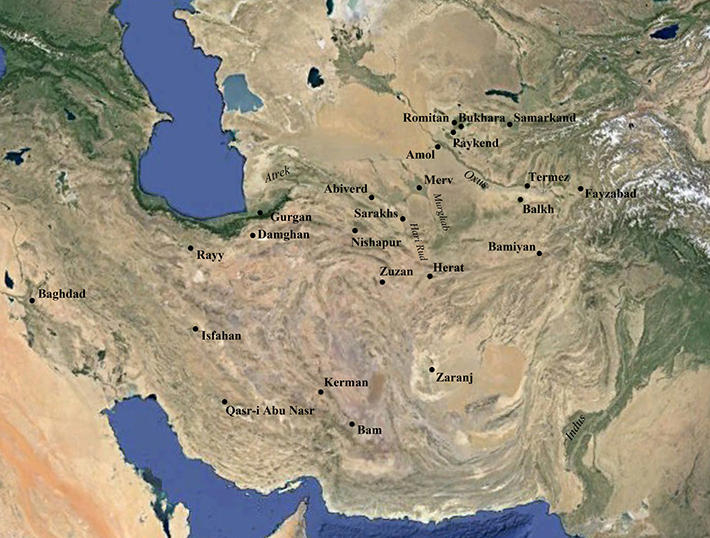
Figure 1: Geographical map showing cities of Khorasan and adjacent areas in an anachronistic way, in order to provide different points of reference through the epochs. (Map courtesy of the authors.)
In the Islamic period, one of the first descriptions of the territory of Khorasan is that of the geographer Yaʿqubi, in the 9th century. In his Historiae (I, p. 201), Yaʿqubi lists the districts governed by the spāhbed (q.v.) of Khorasan: (1) Nishapur, (2) Herat, (3) Marv, (4) Marv al-Ruḏ, (5) Fāryāb, (6) Ṭālaqān, (7) Balḵ, (8) Bukhara, (9) Bāḏḡis, (10) Bāvard (Abivard, q.v.), (11) Ḡaršestān, (12) Ṭus, (13) Saraḵs, and (14) Gorgān. The same author, in Ketāb al-boldān, discussing Balḵ, moreover defines the region as extending from Ray to Farḡāna (q.v.), and identifies its center in Balḵ: between Ray and Balḵ there was a distance of thirty days, the same as between Balḵ and Farḡāna (Yaʿqubi, tr. Wiet, 1937, p. 101). Toward the east there was Turkestan, which surrounds Khorasan and Sistān. The western boundary was Qumes: “of which Dāmḡān was the first city of Khorasan” (Yaʿqubi, tr. Wiet, 1937, p. 80). Yaʿqubi seems also to include Ṭabarestān in Khorasan; the sovereign called himself the “Eṣbahbaḏ [spāhbed] of Khorasan” in his correspondence with the caliphs al-Maʾmun and al-Moʿtasem (Yaʿqubi, tr. Wiet, 1937, p. 81).
During the latter part of the 9th century, Abu Ḥanifa Dinavari (q.v.), relating the political and geographical situation of late antiquity and early medieval eastern territories in his Aḵbār al-ṭewāl (q.v.), located the city of Āmuya, or Āmul (Āmol), in Khorasan, on the western side of the Oxus (Dinavari, p. 367). He thus also included in this region the area between the Marv oasis and the Oxus. It seems, additionally, that Dinavari excludes Bukhara from the boundaries of Khorasan (Dinavari, pp. 66, 55, 86, 78). Concerning the western frontiers, Dinavari (p. 90) appears to include Qumes and Gorgān in Khorasan. This affirmation seems to be contradictory with the following one describing Besṭām (Besṭām o Bendōy, q.v.) as governor of Khorasan, Qumes, Gorgān, and Ṭabarestān, listed separately (Dinavari, p. 93).
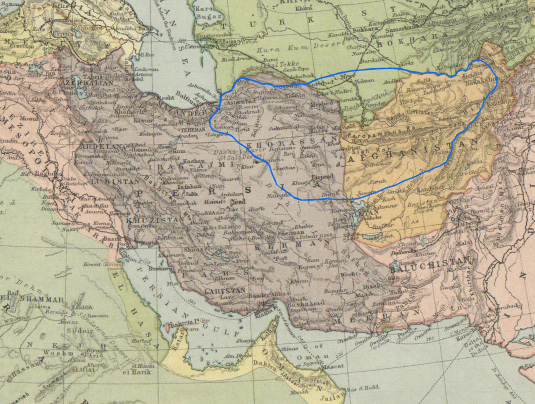
Figure 2: Herzfeld’s boundaries of Khorasan as proposed in his 1921 article, imposed on an original map from that same period by the London Geographical Institute (1920).
In the same century, Balāḏori (q.v.) proposed a geographical framework of Khorasan that is totally different from those mentioned above. He also included Ḵvārazm, Ṭoḵārestān, Sistān, and Transoxiana within the frontiers of Khorasan. According to Yāqut’s commentary (Barbier de Meynard, 1861, p. 199), all these countries were mentioned because they were under the authority of the governor of Khorasan, while remaining outside the regional limits of Khorasan. However, Balāḏori did not draw up any official geographical list of the countries included within Khorasan (see also Herzfeld, pp. 108-9).
In the 9th century, it is difficult to understand and delimit the eastern and the northeastern limits of Khorasan, unlike its western and southern ones. The historical sources report different geographical borders of Khorasan, sometimes expanding it up to the frontiers with China and the Turkic people. Nonetheless, Khorasan at that epoch constituted a well-established political entity due to the advent of the Taherid (q.v.) dynasty in 821 CE. Without diminishing the importance of the unification of Khorasan and the Mā warāʾ al-nahr (q.v.) under the Samanid dynasty, already established in Transoxiana, the Taherids had the merit of having extended their sovereignty to a part of Transoxiana that was still not completely Islamized (Bosworth, 1975, pp. 90-135). If the numismatic evidence reflects a political presence in that area, then it can be assumed that the Taherid sphere extended from Iranian Khorasan to the north and the east covering the oasis of Ḵvārazm, Čāč (q.v.), as well as to the west of Ray (Rante, 2015, pp. 13-14). The largest extension of Taherid power, and thus the largest expansive phase of the culture of Khorasan, was established in the 9th century, perhaps more precisely during the short reign of Ṭalḥa b. Ṭāher, governor of Khorasan (822-28). Qodāma b. Jaʿfar (ca. 873-932/948) in his book, Ketāb al-ḵarāj, compiled about 879 CE, listed the cities of Khorasan as including Bost, Roḵḵaj, Kābol, Zābolestān, Ṭabas, Qohestān, Herat, Ṭālaqān, Bāḏḡis, Bušanj, Ṭoḵārestān, Ṭārqān, Balḵ, Ḵolm, Marv al-Rud, Ṣaḡāniān, Vāšjerd, Bukhara, Ṭus, Fāryāb, Abaršahr, Kār, Samarkand, Šāš [Čāč], Farḡāna, Ošrusana, Ṣoḡd, Ḵojand, Ḵvārazm, Esbijāb, Termeḏ, Nasā, Abivard, Marv, Kass, Nušjān, Bottam, Aḵrun, and Nasaf. Qodama estimated the tax of Khorasan as eight million dirhams, which is one of the most important tax revenues sent from an Islamic province (Qodāma, p. 141).
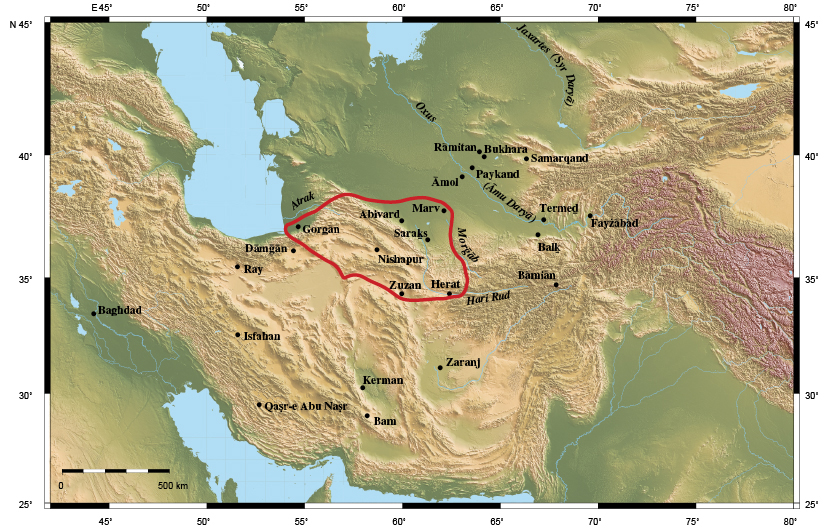
Figure 3: Map proposing the possible frontiers of Khorasan in the 5th-6th centuries CE. (Map created with Generic Mapping Tools and NOAA topographic data.)
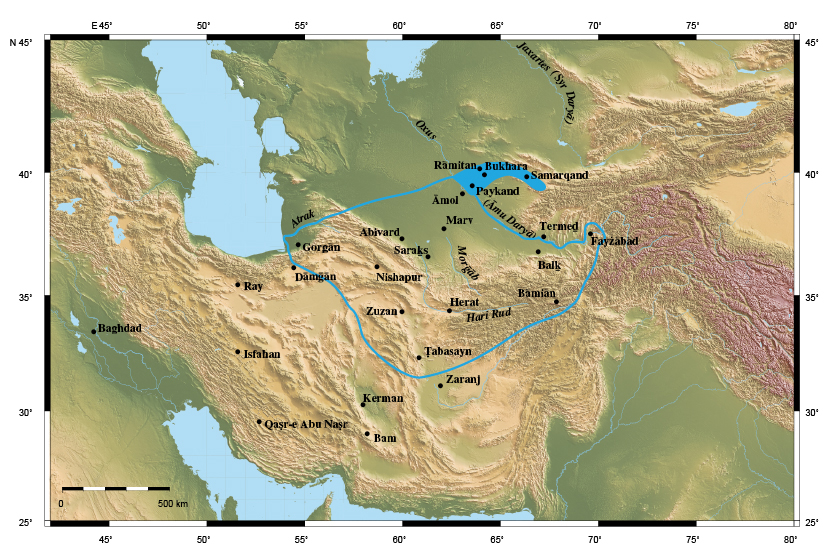
Figure 4: Map proposing the possible frontiers of Greater Khorasan in the 10th century CE. (Map created with Generic Mapping Tools and NOAA topographic data.)
Later, in the 10th century, the Samanid dynasty carried out the “official” unification of Khorasan and Transoxiana. It created, from the new capital Bukhara, an area of interaction between the Far East (China and the Turkic people) of the Islamic lands and the boundaries of western Khorasan, which at that period corresponded to the Buyid (q.v.) territories. Within that period, the frontiers of Khorasan appear clearer. In the middle of the 10th century, Ebn Ḥawqal (q.v.) located the boundaries of northeastern Khorasan at the Oxus River, the eastern ones in Badaḵšān, of which the city of Jarm should have been the eastern limit (p. 102; Barthold, p. 66) and the western ones, as before, in Dāmḡān (Ebn Ḥawqal, II, pp. 413-16). The southern limit was the Sistān province. Masʿudi (par. 312, p. 119) fixes the Kušān region, which would at least correspond to Ṭoḵārestān, between Khorasan and China, later identifying the mine of Pangšir in Khorasan (par. 455, p. 164).
Later, Yāqut located Khorasan within the boundaries of Iraq, Ṭoḵārestān, Ghazna, Sejestān and Kerman (Barbier de Meynard, pp. 197-98). He definitely excluded Transoxiana and Ḵvārazm.
From the Sasanian epoch, Khorasan had been a vast territory joining the Iranian cultures with the Far East and India as well as Mesopotamia and the Near East. From the very outset a territory issued by different ancient regions and provinces, its frontiers have always been hard to understand because the historical reports were often contradictory. The limits proposed by Herzfeld (Figure 2) corresponding to the end part of the Sasanian period seem to be likely, although in the light of the recent researches, it would be preferable to situate the eastern boundaries along the Morḡāb River. During the Arab-Muslim conquest and the Omayyad dynasty, this territory would be constituted of all conquered regions eastwards from the province of Ray.
Guy Le Strange (1966, map 1), who produced a map of the eastern provinces of the ʿAbbasid caliphate that still remains useful, left the eastern part of Khorasan without frontiers. Moreover, concerning the western and the northwestern boundaries, he left Qumes, Ṭabarestān, Gorgān, and Qohestān outside Khorasan (for these provinces see Gyselen, 1989, p. 53; Schwarz, pp. 809 ff.). Although Ṭabarestān, Qumes, and Gorgān could be situated outside the western frontiers of Khorasan, at least in the second half of the 8th century, from the 9th century a part of Qumes and Gorgān could be integrated into the boundaries of Khorasan (Bosworth, 1986, p. 378), making Dāmḡān the gate of Khorasan. The eastern boundaries could be situated in the province of Badaḵšān, around the city of Fayżābād (q.v.), where a solid mountain range rises up as natural border and goes down to reach the main ranges of the Hindu Kush.
During the 10th century (Frye, 1975, map 3, p. 139), when Khorasan and Transoxiana were under the control of the Samanids, the western boundaries of Khorasan, according to Ebn Ḥawqal, remained at Qumes, near or in Dāmḡān. The eastern ones excluded Ḡur (q.v.) from the 9th century limits, even if Bāmiān seems to be within the frontiers of Khorasan (Ebn Ḥawqal, p. 416). The south was bordered by Sistān; Qohestān was inside the perimeter of Khorasan. Concerning the northeastern boundaries, even if at that time Samanids ruled over Khorasan and Transoxiana thus making it almost a unique territory, the limit of Khorasan proper continued to be the Oxus, again separating two historically independent regions, which however were from the advent of Islam culturally, and in part politically, united.
There is little doubt that the designation of “Greater Khorasan” is traceable in the Islamic period, during the ʿAbbasid period, more precisely beginning with the Taherid’s several decades of government, in the 9th century, even if some would date it to the time of Abu Moslem Ḵorāsāni (q.v.). The following century and the Samanid control contributed to increase and reinforce it.
From the 6th century, Khorasan seems to have been constituted of an original nucleus, or “Khorasan Proper,” which has been tentatively located within the Marv oasis, Herat, and Zuzan, following the eastern border of the Iranian Deserts to the south-eastern corner of the Caspian Sea, excluding thus a large part of Qumes, but including the province of Gorgān following the shape of the Great Wall, which in the light of recent research is dated to the 5th-6th centuries (Figure 3). From this nucleus the limits expanded during the Islamic period, firstly including Balḵ and its province, the whole of Qohestān, a part of ancient Hyrcania as far as the Atrek River, and the desert zones between the Marv oasis and the Oxus, which has been a natural frontier over the centuries. A large part of the Zarafšān valley, in Transoxiana, including the Bukhara and Samarkand oases, has been an area of major influences on Khorasan (Figure 4). The standing of this first nucleus of Khorasan, which became “Greater Khorasan,” is certainly to be sought in its geographical position at the center of such different lands as Central Asia, China, India, Western Iran and Mesopotamia. This geographical situation formed out of this territory a crossroads through which travelled peoples, cultures, ideas and influences.
Bibliography
Abu’l-ʿAbbās Aḥmad b. Yaḥyā b. Jāber Balāḏori, Ketāb fotuḥ al-boldān, tr. by P. K. Hitti as The Origins of the Islamic State, part 1, New York, 1916.
- Charles Barbier de Meynard, Dictionnaire Géographique, Historique et Littéraire de la Perse et des Contrées Adjacentes, extrait … du Mo’djem El-Bouldan … de … Yaqout, Paris, 1861.
- Vaslilii Vladimirovich Barthold, Turkestan down to the Mongol Invasion, 3rd ed., London, 1969.
- C. E. Bosworth, “The Tahirids and Saffarids,” The Cambridge History of Iran IV, Cambridge, 1975, pp. 90-135.
- Idem, “Ḳumis,” The Encyclopaedia of Islam V, Leiden, 1986, pp. 376-78.
- Elton Daniel, The Political and Social History of Khurasan under Abbasid Rule, 747-820, Minneapolis and Chicago, 1979.
- Touraj Daryaee, Šahrestānīhā Ī Ērānšahr : A Middle Persian Text on Late Antique Geography, Epic, and History, Costa Mesa, Calif., 2002.
- Abu Ḥanifa Dinavari, al-Aḵbār al-ṭewāl, ed. Amir ʿAbd-al-Munʿim, Beirut, 1990.
- Abu’l-Qāsem Ebn Ḥawqal, Configuration de la Terre, tr. by J. H. Kramers and G. Wiet, 2 vols., Paris and Beirut, 1964.
- Richard Frye, “Kushans and Other Iranians in Central Asia,” in Reşid Rahmeti Arat Için, Türk Kültürünü Araştırma Enstitüsü Yayınlari 19, Ankara, 1966, pp. 244-47.
- Idem, ed., The Cambridge History of Iran IV: The Period from the Arab Invasion to the Saljuqs, Cambridge, 1975. Rika Gyselen, La Géographie Administrative de l’Empire Sassanide, Paris, 1989.
- Idem, “La reconquête de l’est iranien par l’empire sassanide au Vie siècle, d’après les sources ‘iraniennes’” Arts Asiatiques 58, 2003, pp. 162-67.
- Ernst Herzfeld, “Khorasan: Denkmalsgeographische Studien zur Kulturgeschichte des Islam in Iran,” in Der Islam 11, 1921, pp. 107-74.
- Meysam Labbāf-Ḵāniki, “Ḵorāsān dar ʿasr-e Sāsāni,” in Meysam Labbāf-Ḵāniki, ed., Gozari bar bāstānšenāsi-ye, Tehran, 2015, pp. 61-67.
- Pierre Lecoq, “Aparna,” Encyclopædia Iranica II, London and New York, 1987, p. 151.
- Guy Le Strange, The Lands of the Eastern Caliphate; Mesopotamia, Persia, and Central Asia, from the Moslem Conquest to the Time of Timur, Cambridge, 1930; 3rd ed., London, 1966.
- Joseph Markwart, “Ērānšahr’ nach der Geographie des ps. Moses Xorenacci, Abhandlungen der Königlichen Gesellschaft der Wissenschaften zu Göttingen, phil.-hist. KL. N.F. 3/2, Berlin, 1901.
- Idem, A Catalogue of the Provincial Capitals of “Ērānšahr”: Pahlavi Text, Version and Commentary, ed. Giuseppe Messina, Rome, 1931.
- Abu’l-Ḥasan ʿAli Masʿudi, Moruj al-ḏahab, tr. as Les prairies d’or by C. Barbier de Meynard and A. Pavet de Courteille, rev. by Charles Pellat, vol. I, Paris 1962.
- André Miquel, La Géographie humaine du monde musulman jusqu’au milieu du 11e siècle, 4 vols., Paris, 1967-88.
- Qodāma b. Jaʿfar, Ketāb al-ḵarāj, tr. A. Ben Shemesh, Leiden, 1965. Rocco Rante and A. Collinet, Nishapur Revisited: Stratigraphy and Ceramics of the Qohandez, Oxford, 2013.
- Rocco Rante, “‘Khorasan Proper’ and ‘Greater Khorasan’ within a Politico-Cultural Framework,” in idem, ed., Greater Khorasan: History, Geography, Archaeology and Material Culture, Boston, 2015, pp. 9-25.
- P. Schwarz, Iran im Mittelalter nach den arabischen Geographen, Leipzig, 1896-1921, repr. Hildesheim and New York, 1969.
- Aḥmad b. Abi Yaʿqub Yaʿqubi, Ketāb al-boldān, tr. by Gaston Wiet as Les pays, Cairo, 1937.
- Idem, Taʾri ḵ, ed. M. Th. Houtsma as Ibn-W ādhih qui dicitur al-Jaʿqubī Historiae, 2 vols., Leiden, 1883; repr. 1969.