



Gonbad-e Qābus is a tall tower that marks the grave of the Ziyarid ruler Qābus b. Vošmgir (r. 978-1012). It is the major monument (Iranian National Monument no. 86) of the town of Gonbad-e Qābus after which the town itself is named.
Figure 1. Plan of the Gonbad-e Qābus.

Plate I. View of the tomb.
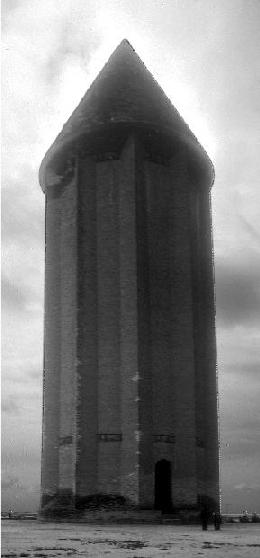
In plan, the building is a flanged circle, with an interior diameter of 9.67 meters at the base and three-meter walls articulated with ten right-angled buttresses spaced regularly around the exterior. The single entrance doorway, set between two buttresses on the southeast, is surmounted by trilobed niches, some of the earliest evidence for the development of the moqarnas, or stalactite vaulting, in Persia. Formally, the building is therefore a simple and logical variant of the type of cylindrical tomb tower found along the Caspian littoral at sites such as Rādkān and Lājim.
What sets the Gonbad-e Qābus apart from its contemporaries is its extraordinary height: including the conical roof, it measures 52 meters, some three times its diameter. The verticality is enhanced by its position on a 10-meter artificial hillock. Like a skyscraper, the tower thus dominates the surrounding plain and can be seen as far away as 30 kilometers.
The tomb is entirely constructed of fine-quality baked brick whose pale yellow color has been turned golden by the sun. The technical quality of the construction is clear from its almost perfect survival despite the ravages of time, climate, and even reported shelling by the Russians. The only decoration comprises two inscription bands which ring the building above the doorway and below the roof. Each band is divided into ten panels, one set between each pair of buttresses. The text, which is repeated in the two bands, states that the amir Qābus b. Vošmgir ordered the building during his lifetime in the lunar year 397 (27 September 1006-16 September 1007) and the solar year 375 (15 March 1006-14 March 1007). The two dates allow us to bracket the date of commissioning between late September 1006 and mid-March 1007.
The patron was the fourth ruler of the local Ziyarid line which controlled Tabarestān and Gorgān during the so-called “Daylamite interlude” in the 10th and 11th centuries. Qābus, though reportedly a bloodthirsty tyrant, was also a noted patron of the arts. The philosopher and physician Ebn Sina (q.v. Avicenna) took refuge at his court; so did the scholar and polymath Biruni (q.v.), who wrote his first and best-known work, the calendrical treatise entitled Aṯar al-bāqīa (q.v.) there. Qābus himself was a poet and proponent of the new type of rhymed prose. His interests and talents are clear from the foundation inscription, which is composed in rhymed prose and uses two calendars, the Muslim lunar and Iranian solar. The sober style of the script—tall angular letters formed of cut bricks once covered with a plaster slip—contrasts with the decorative style found on many contemporary buildings and shows that the inscription, like the building itself, was designed to stand out from afar. The carefully planned text combines with the tower’s formal purity and soaring verticality to make it one of the most famous and memorable monuments in all of Iranian architecture.
Bibliography
Sheila S. Blair, The Monumental Inscriptions from Early Islamic Iran and Transoxiana, Leiden, 1992, no. 19, pp. 63-65.
C. Edmund Bosworth, “Kabus b. Wushmagir b. Ziyar,” EI2 III, pp. 357-58.
Ernst Diez, Churasanische Baudenkmäler, Berlin, 1918, pp. 39-43; 100-106.
André Godard, “Gunbad-i-Qabus,”in Survey of Persian Art, pp. 970-74.