
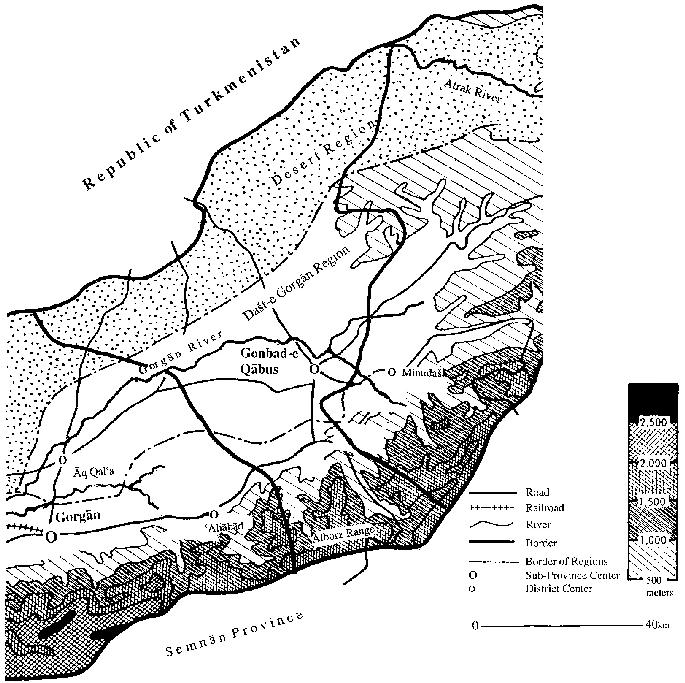



Because of changes to the boundaries of the sub-province (šahrestān) of Gonbad-e Qābus (Kāvus) and its constituent rural districts, which culminated in the separation of the district of Minu-Dašt, the sub-province’s population data for the census years are not comparable. Comparable data are, however, available for the city of Gonbad-e Kāvus (Table 1).
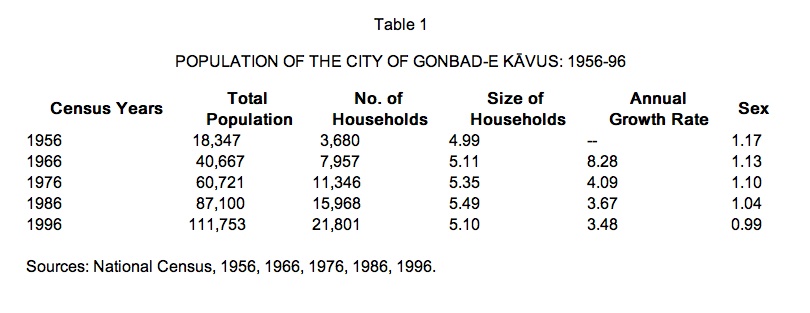
The high rate of growth in the period 1956-1966 is partly explained by an influx of immigrants from the province of Sistān. This was brought about by the push factor of drought in Sistān and the need for manpower in the rapid expansion of cotton cultivation, a highly labor-intensive crop, in the region. As a result, a plantation-like organization of agricultural production emerged in the region with a fairly large number of immigrant cultivators who lived on the cultivation site. Furthermore, the development of related industries such as cotton seed oil processing in the city attracted more immigrant workers to the region. Large scale immigration to Gonbad-e Qābus from other provinces continued, and between 1986 and 1996 over one-third of the immigrants of this sub-province, as well as the immigrants to its urban areas, were born in other provinces. Of the immigrants to the urban areas in this period, women accounted for only 22 percent. The population of other cities of the sub-province in 1996 were as follows: Āzādšahr, 33,000; Rāmiān, 11,000; Ḵānbeben, 10,000; Daland, 7,000.
Economic and social characteristics. In 1996, over 85 percent (90 percent for men and 80 percent for women) of the 6-years-old and over population in the city of Gonbad-e Qābus were literate; 45 percent of this figure was composed of students, of which 3 percent (1,173 persons) pursued higher education. In that year, 65 percent of men in the age group of 15 years old and over and 51 percent of the women in the age group of 10 years old and over were married; 95 percent of women 10 years old and over were married before the age of 35, which shows the high incidence of marriage among them.
In 1996, 34 percent of the city population in the age group of 10 years old and over were active, of which 89 percent were employed and 11 percent unemployed. Of the employed, 65 percent were engaged in services, 27 percent in industry, just over 7 percent in agriculture, and the rest in unclassified activities. Of the 11 percent unemployed, 15 percent were women and 85 percent men.
The distribution of household amenities and utilities in 1966 were as follows: 98 percent of the households had electricity and were supplied with pipelined water, and 75 percent were supplied with pipelined gas. Over one-third of the households had telephones. Over 69 percent of the households were owner-occupiers, 19 percent were tenants, and 13 percent occupied their dwellings under other conditions.
Bibliography
Mohandesin-e mošāwer-e ṭarḥ o meʿmāri, Ṭarḥ-e jāmeʿ-e šahrestān-e Gonbad-e Kāvus II, Tehran, 1996.
National Census, 1956, 1966, 1976, 1986, 1996.
Ḥabib-Allāh Zanjāni, Rāhnemā-ye jamʿiyat-e šahrhā-ye Irān, 1956-1370, Tehran, 1378 Š./1999.