




Modern Zoroastrian calendars. The vague Zoroastrian year (see i, above) was subject to varying corrections by the Zoroastrian communities in Iran and India. In Iran the Jalālī calendar (see ii, above) was adopted by several Zoroastrian communities; the 5 or 6 epagomenal days follow the month of Esfandārmoḏ or, in some villages in the district of Naṭanz, the month of Bahman (Taqizadeh, p. 610; A. K. S. Lambton apud Hartner, 1971, p. 784). Indian and Iranian Zoroastrians (cf. Vitalone) were already aware from a.d. 1635 of the mutual differences in their calendars but showed no interest in resolving them until in 1720 a man from Kermān named Jāmāsb Welāyatī arrived in Surat and noted that the calendar of the Parsi community was a month behind that of Iran (Darmesteter, p. xii). On 17 June 1745 (Darmesteter, loc. cit.) or 1746 according to Boyce (1979, p. 189) and Hinnells (1981, p. 51) one segment of the Parsi community therefore adopted the Persian calendar, calling it qadīm “old.” The majority of Parsis, however, rejected this innovation and adopted the name rasmī “traditional” for their calendar, in opposition to the qadīmīs (cf. Darmesteter, p. xcv; Boyce, 1977, pp. 164-66; 1979, pp. 189-90). The rasmīs (also known as “Sharshais” or “Shenshais,” Boyce, 1979, p. 190) claimed in fact that it was the Iranian community that was a month behind because it had not intercalated one month after each cycle of 120 years. In 1906 an attempt was made to resolve the controversy with the adoption of a new calendar similar to the Gregorian. This provoked the formation of a new group, the faṣlīs (separatists), who are particularly concentrated in western India (Boyce, pp. 212-13, 221). The qadīmīs and the rasmīs have preserved their own respective calendars. The latter community is the more numerous. Today, however, the three sects do not differ in other important ways, and the hostility and polemics of the last century are only a memory. The qadīmī and “Shenshai” (royalist: Boyce, 1979, p. 190; cf. Sogd. šʾnšʾy “king of kings”; Sundermann) calendars are dated from the coronation of the last Sasanian king, Yazdegerd III, in a.d. 631 (e.g., 1358 Yazdegerdī = 1989).
Bibliography
M. Boyce, A Persian Stronghold of Zoroastrianism, Oxford, 1977.
Idem, Zoroastrians. Their Religious Beliefs and Practices, London, etc., 1979.
J. Darmesteter, Le Zend-Avesta I, Annales du Musée Guimet 21, Paris, 1892, pp. xii, xciv-xcvi.
J. R. Hinnells, Zoroastrianism and the Parsis, London, 1981, pp. 51-53.
F. M. Kotwal and J. W. Boyd, ed. and tr., A Guide to the Zoroastrian Religion. A Nineteenth Century Catechism with Modern Commentary, Chico, Calif., pp. 10, 65, 158, 162, 176-81.
K. P. Mistree, Zoroastrianism. An Ethnic Perspective, Bombay, 1982, pp. 110-15.
Sundermann, “Sogdische šʾnšʾy,” AoF 10, 1983, pp. 193-95.
S. H. Taqizadeh, “The Old Iranian Calendars Again,” in Studies Presented to Vladimir Minorsky, BSOS 14, 1952, pp. 603-11.
M. Vitalone, “Note su due Revāyat persiane inedite,” in Proceedings of the First European Conference of Iranian Studies, Turin, 1987 (forthcoming).
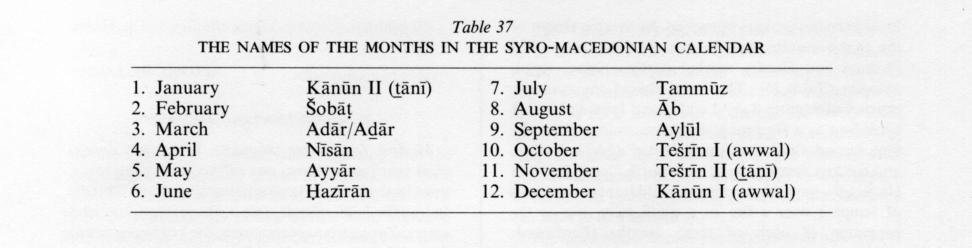
The Syro-Macedonian calendar. The Syro-Macedonian calendar (Table 41), which has been adopted by the eastern Christian communities in Iran, is regulated according to the Julian calendar but with Arabic (derived from Phoenician) names for the months. This calendar is old, probably pre-Islamic, according to Bīrūnī (Āṯār, pp. 59-60, tr. Sachau, pp. 69-70).
G. D’Erme, Grammatica del Neopersiano, Naples, 1979, p. 210. M. O. S. Hodgson, The Venture of Islam. Conscience and History in a World Civilization I: The Classical Age of Islam, Chicago, 1974, p. 22.
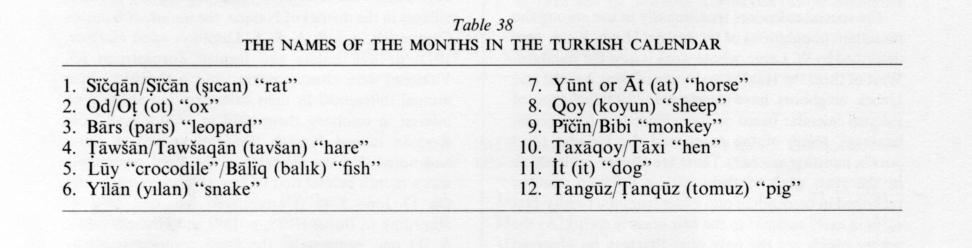
The Turkish duodecennial calendar. The Turkish calendar was inspired by the same duodecennial system as, for instance, the ancient Khotanese calendar (see i, above), but its origin is clearly Turkish. Each twelve-year cycle is called a mucal. The year (ïl) is solar, divided into twelve “mansions” according to the signs of the zodiac; it begins with the vernal equinox (see Table 42; modern Tk. forms in parenthesis). See further ii, below.
L. Bazin, Les calendriers turcs anciens et mediévaux, thesis, Paris University, 1972; publ. Lille University, 1974.
G. D’Erme, Grammatica del Neopersiano, Naples, 1979, p. 210-11.
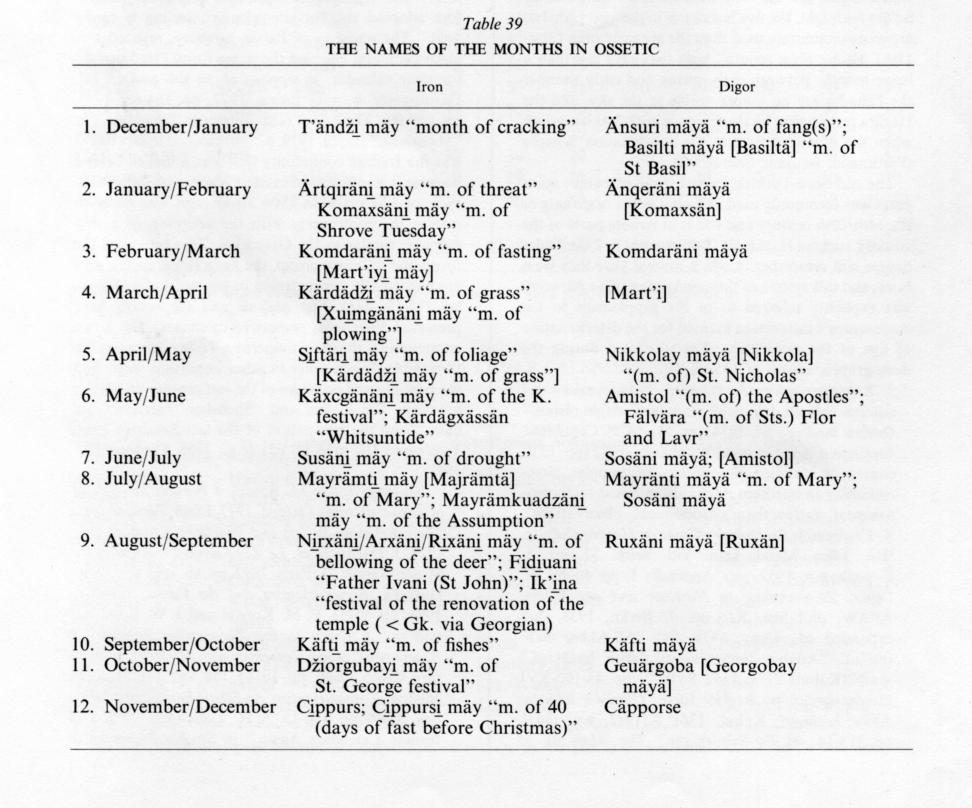
The Ossetic calendar. Although the names of the months in the Ossetic calendar have been adopted from the Latin tradition in the corresponding Russian forms, in the Iron and Digoron dialects other names are also preserved; at least some of them seem to have been adopted after the conversion of the Alans to Christianity (a.d. 10th century). Still another group of month names is linked to observations of recurring natural phenomena clearly traceable to pagan traditions of the Alans, though these names have also been Christianized. In Table 43 the names of the months are given after Abaev, 1970, with variants from Magometov in brackets.
V. I. Abayev, “The Names of the Months in Ossetic,” in W. B. Henning Memorial Volume, ed. M. Boyce and I. Gershevitch, London, 1970, pp. 1-7.
Idem, Istoriko-ètimologicheskiĭ slovar’ osetinskogo yazyka, Moscow and Leningrad, 1958- (s.vv.).
J. F. Baddeley, The Rugged Flanks of the Caucasus, Oxford and London, 1940, I, p. 187.
A. Christensen, Textes ossètes, Copenhagen, 1921, p. 64.
G. Gappo Baiew, Iron k’pelindper, Berlin, 1925.
J. von Klaproth, Reise in den Kaukasus und nach Georgien, 2 vols., Halle and Berlin, 1814, II/1, p. 599.
A. Kh. Magometov, Kul’tura i byt osetinskogo naroda, Ordzhonikidze, 1968, pp. 504-05.
V. Miller, Osetinskie ètyudy, Uchenyya zapiski Imperatorskago Moskovskago Universiteta, otd. ist.-filol., 2, Moscow, 1882, pp. 262-88 (on festivals and the calendar).
B. Munkácsi, Blüten der ossetischen Volksdichtung, Budapest, 1932, pp. 208-22.
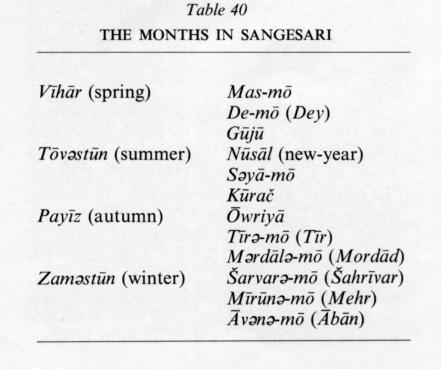
The Sangesari calendar. The Sangesaris, a semitribal people living north of Semnān and south of the Alborz mountains, has a special calendar of 12 months with 30 days each and an epact (pētak) added after the last month of the year. Of the old names of the days only two have been retained: Varmaz (Hormoz), Anirān (Anīrān</em>); the 13th day of Tīrə-mō is called Tīrə-mō-yi sizdə. (See Table 44.)
Č.-ʿA. Aʿẓamī, “The Sangesari Calendar,” Journal of the K R. Cama Oriental Institute 55, 1988, pp. 155-99.
Table 20. Month names in Old Persian, Elamite, and Babylonian

a. Avestan Zaremaya; Dadīstān ī dēnīg, chap. 16; tr. West, SBE 17, p. xxiv.
Table 21. Parthian month names
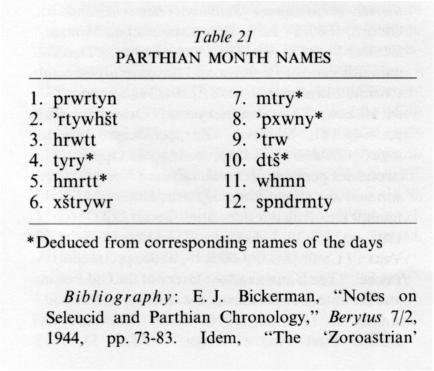
Table 22. The months of the Zoroastrian calendar
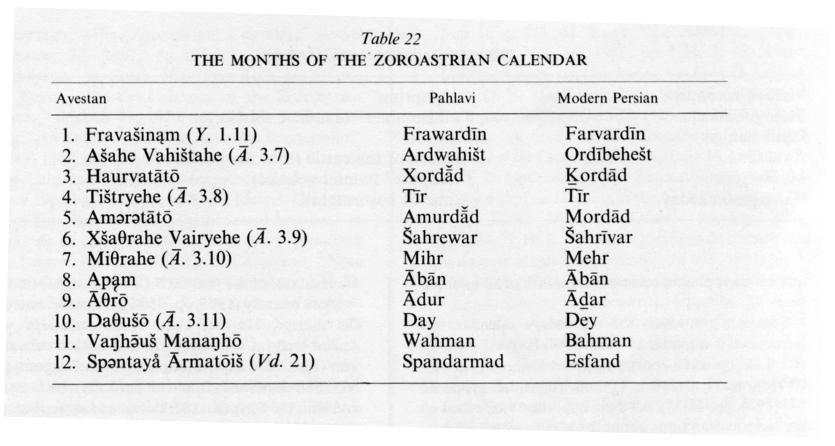
Table 23. The days of the Zoroastrian calendar

Table 24. The Zoroastrian Gāhānbār

Table 25. The names of the months in the Cappadocian calendar
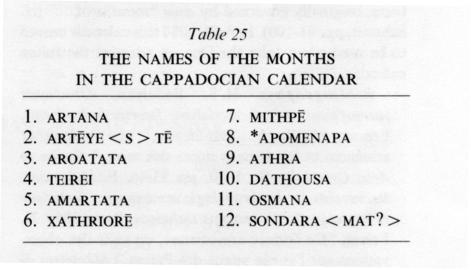
Table 26. The names of the months in the Armenian calendar
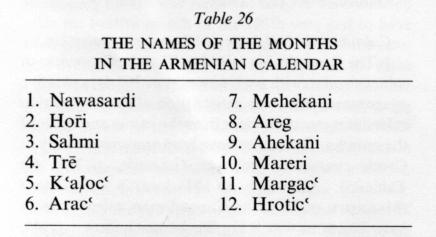
Table 27. The days of the Sogdian calendar

Table 28. The names of the months in the Sogdian calendar
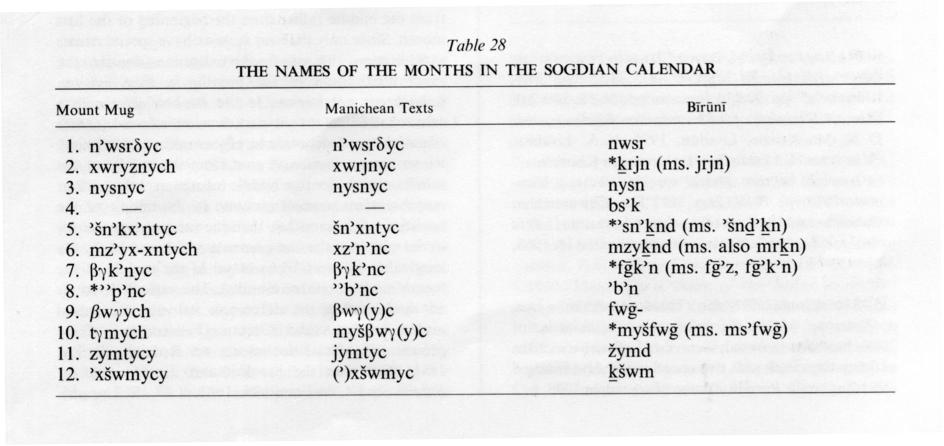
Table 29. The seven weekdays in Sogdian
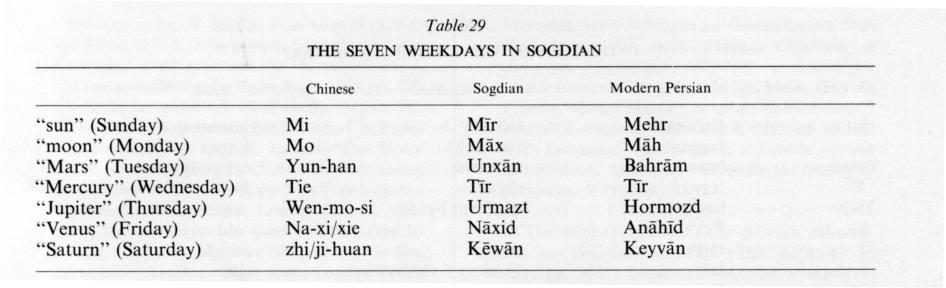
Table 30. The names of the months in the Choresmian calendar
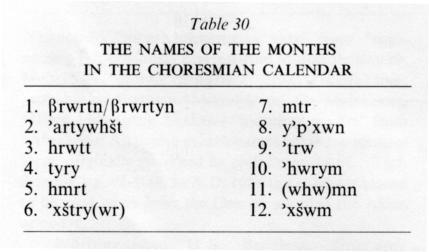
Table 31. The names of the months in the calendar of Sīstān
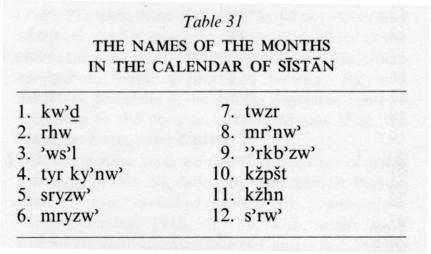
Table 32. Names of the six-fold Khotanese calendar divisions
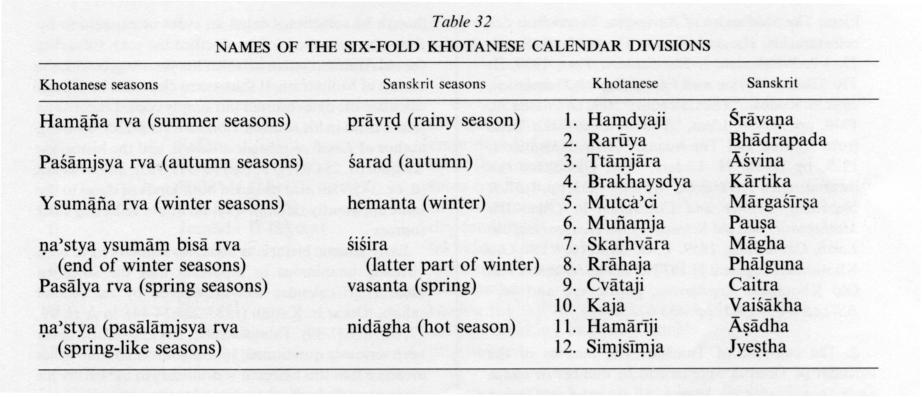
Table 33. Names of the years in the Central Asian animal cycle
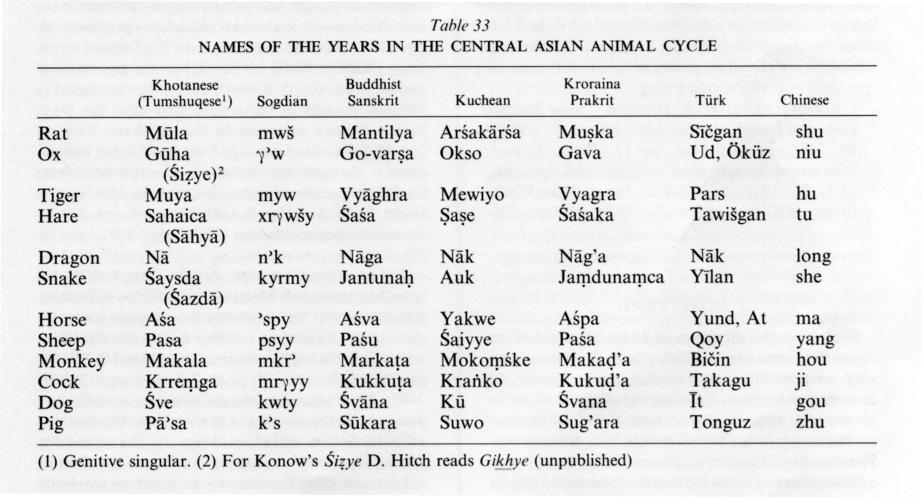
(1) Genitive singular. (2) For Konow’s Śiẓye D. Hitch reads Gikhye (unpublished)
Table 34. Lunar hejrī months
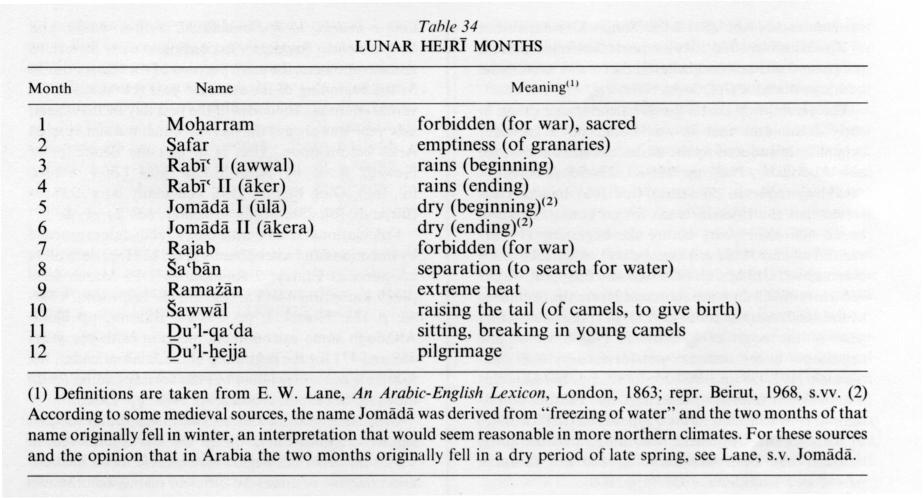
(1) Definitions are taken from E. W. Lane, An Arabic-English Lexicon, London, 1863; repr. Beirut, 1968, s.vv. (2) According to some medieval sources, the name Jomādā was derived from “freezing of water” and the two months of that name originally fell in winter, an interpretation that would seem reasonable in more northern climates. For these sources and the opinion that in Arabia the two months originally fell in a dry period of late spring, see Lane, s.v. Jomādā.
Table 35. Jalālī month names

(1) Garmāfazāy in Sanjar Kamālī, fol. 4a. (2) Sarmāfazāy in Sanjar Kamālī, fol. 4a. (3) Ṭūsī gives the name of this month as Māh-e Rūzafzūn (1330/1912, faṣl b), a repetition of the name of the fourth month. The name Māh-e Sālafzūn is given by Sanjar Kamālī, and its correctness is confirmed by its literal meaning “the month of increasing year(s),” i.e., the month after which a new year is added: Māh-e Rūzafzūn, lit. “month of increasing days,” may be interpreted as the month in which the day becomes longer than the night.
Table 36. Jalālī day names
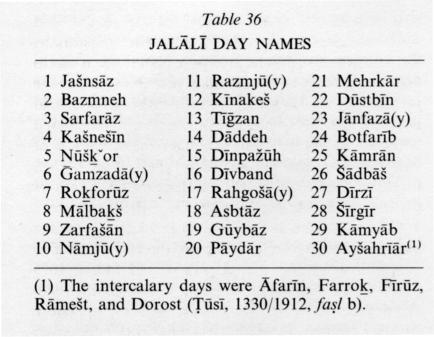
Table 37. Names of the months in the Persian civil calendar
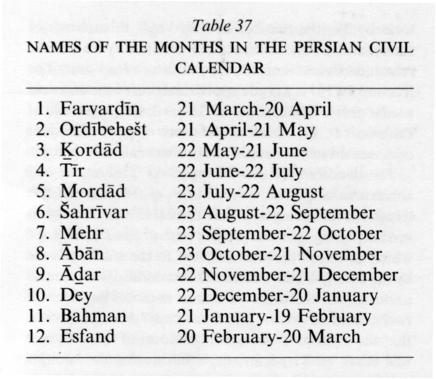
Table 38. Aggregate totals of months and days
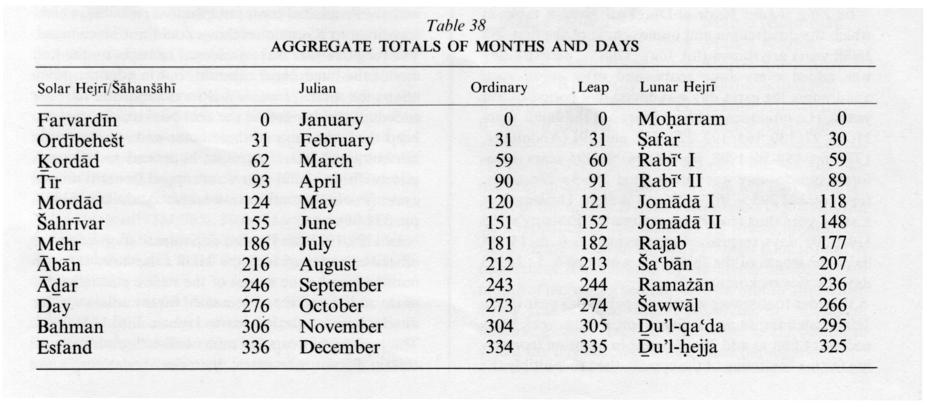
Table 39. The Afghan solar calendar
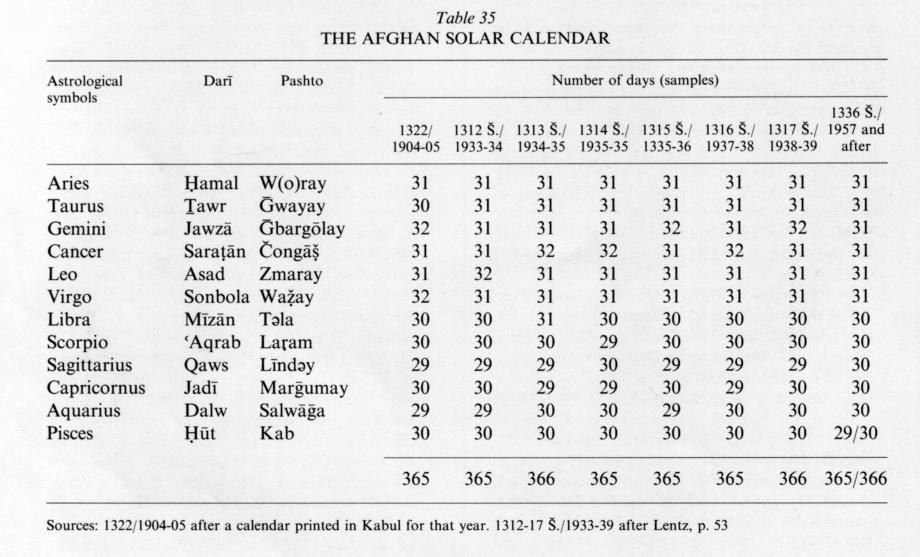
Sources: 1322/1904-05 after a calendar printed in Kabul for that year. 1312-17 Š./1933-39 after Lentz, p. 53
Table 40. The Afghan lunar calendar
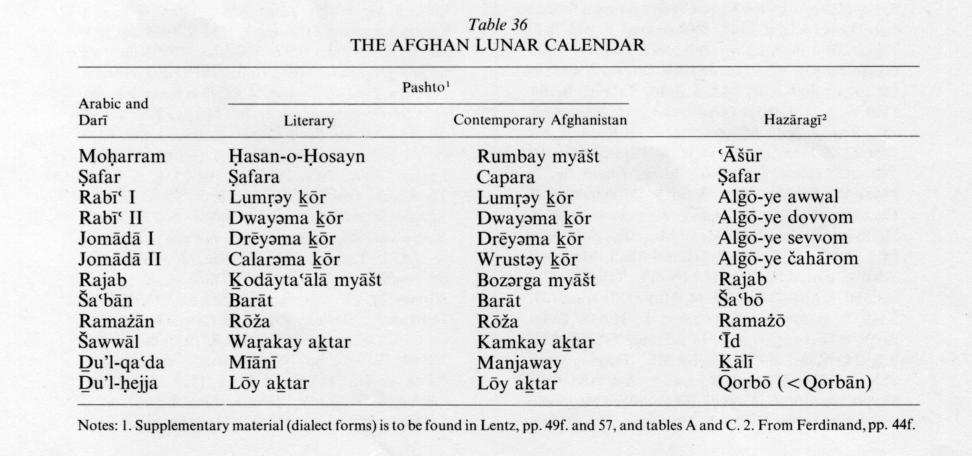
Notes: 1. Supplementary material (dialect forms) is to be found in Lentz, pp. 49f. and 57, and tables A and C. 2. From Ferdinand, pp. 44f.
Table 41. The names of the months in the Syro-Macedonian calendar
Table 42. The names of the months in the Turkish calendar
Table 43. The names of the months in Ossetic
Table 44. The months in Sangesari