




The solar (šamsī) hejrī calendar, beginning with the vernal equinox, has been official in Afghanistan since 1301 Š./1922 (See afghanistan x. political history). Prior to this time all official events were recorded according to the lunar hejrī calendar, although the solar one was already in common use.
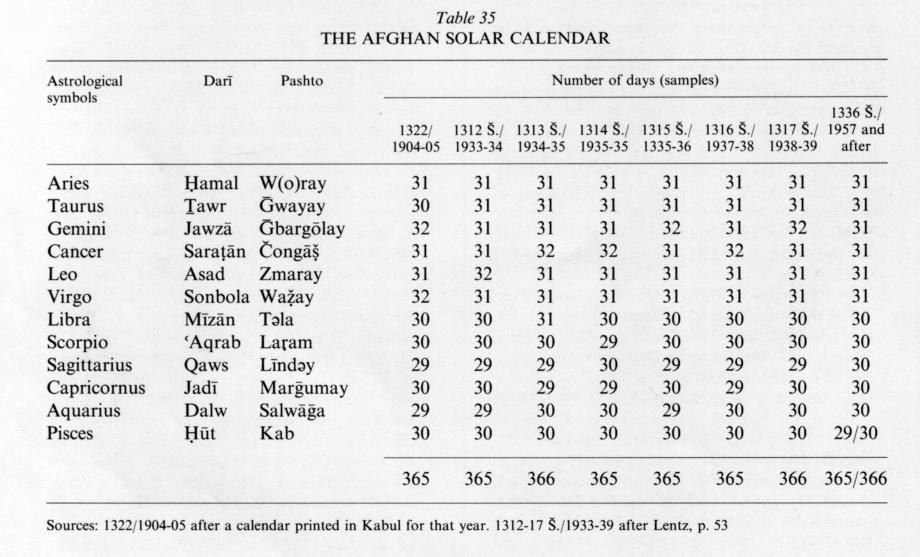
The Afghan solar calendar (Table 39) is basically the same as the Persian one. In Persian of Afghanistan (darī) the names of the twelve months are the same as the Arabic terms for the zodiacal signs. Pashto translations of these names also exist but are rarely used. Before 1336 Š./1957 the number of days in most months ranged from 29 to 32 according to the year. In 1336 Š./1957 the number of days was fixed at 31 days in each of the first six months, 30 each in the next five, and 29 in the last (30 in leap years).
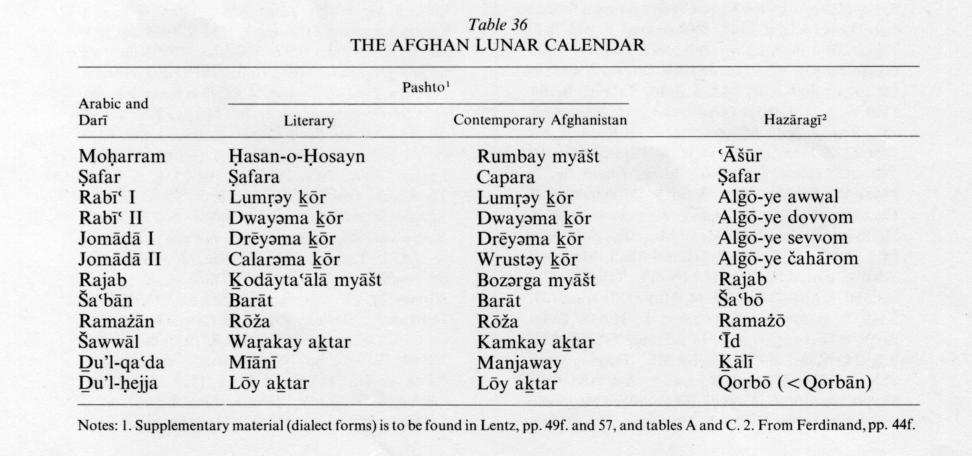
The lunar calendar in use in Afghanistan before 1301 Š./1922 was the common Arabic one (Table 40). While local Persian speakers borrowed the Arabic names of the twelve months, non-Persian speakers such as the Pashtun and Hazāra created partly original terminologies (Table 40). The latter shared the common practice of naming Rabīʿ I and II and Jomādā I and II according to a four-number system, calling them the first, second, third, and fourth “sister” (ḵōr) in Pashto, and the first, second, third, and fourth “leap” (alḡō) in Hazāragī—possibly a remnant of old Iranian traditions of jumping over a fire as a purification rite at the beginning of each of these months (Ferdinand, p. 45).
The special calendars traditionally in use among the mountain populations of the eastern Hindu Kush were described by W. Lentz, whose work is now the standard. West of them the Hazāra and some of their Aymāq and Uzbek neighbors have developed a peculiar type of sidereal calendar based on the conjunction (Darī qerān; Hazāragī, tōḡal) of the moon and the Pleiades (Darī parvīn; Hazāragī mēčīd/t). There are eleven visible tōḡals in the year, each of them with a different number reckoned in descending odd order from the twenty-first tōḡal in early summer to the first in early spring. As the winter tōḡals are the only ones that can be observed before midnight, the five last tōḡals in the year (9th-1st) are more commonly used than the six early ones (21st-11th). Each “tōḡal month” lasts two days less than a lunar month. Between early spring and early summer the Pleiades are no longer visible in the sky, and the Hazāra reckon time by the few days in each solar month when the moon appears in the constellation Scorpio (Ferdinand; Bausani; Šahrestānī).
The old Sino-Turkish animal cycle of twelve solar years was commonly used in Kabul at the beginning of the 14th/20th century and still is in remote parts of the country such as Hazārajāt (Schurmann, p. 292). Older people still remember in which animal year they were born, and this system of time-reckoning (sāl-e ḥaywānī) was explicitly referred to in the supplement to the enumerator’s instruction manual for the determination of age of the population that was used during the demographic census of 1358 Š./1979.
Bibliography
A. Bausani, “Osservazioni sul sistema calendariale degli Hazara di Afghanistan,” Oriente moderno 54, 1974, pp. 341-54.
P. Centlivres, Un bazar d’Asie Centrale, Wiesbaden, 1972 (pp. 123f. contain a detailed description of popular time-reckoning in northern Afghanistan based on meteorological, rather than astronomical, observations).
K. Ferdinand, Preliminary Notes on Hazāra Culture, Hist. Filos. Medd. Dan. Vid. Selsk. 37, no. 5, Copenhagen, 1959, esp. Appendix I, pp. 40-46.
W. Lentz, Zeitrechnung in Nuristan und am Pamir, APAW, phil-hist. Kl., no. 7, Berlin, 1938, 2nd expanded ed., Graz, 1978.
Šāh ʿAlī-Akbar Šahrestānī, “Adab-e ʿāmmīāna-ye darī-e hazāragī,” Adab (Kabul) 21/3, 1352 Š./1973, pp. 43-106-XVI (Setāra-šenāsī, pp. 91-95).
Idem, Qāmūs-e lahja-ye darī-e hazāragī, Kabul, 1361 Š./1983, s.v. tōḡal, pp. 313-14.
H. F. Schurmann, The Mongols of Afghanistan, Central Asiatic Studies 4, The Hague, 1962.