



ii. In the Parthian and Sasanian Periods
Investigation of representations of belts in Iran between the fall of the Achaemenid dynasty in the 4th century b.c. and the coming of Islam in a.d. the 7th century reveals that they were almost exclusively male accessories. Depictions of females wearing belts are rare, and most are heavily influenced by Hellenistic and Roman styles, with simple, draped garments or robes girt below the breast (Ghirshman, 1956, pl. VII; 1962, pp. 92-93 figs. 103-04, p. 147 fig. 186, p. 193 fig. 235; Peck, pls. IXb-XI).
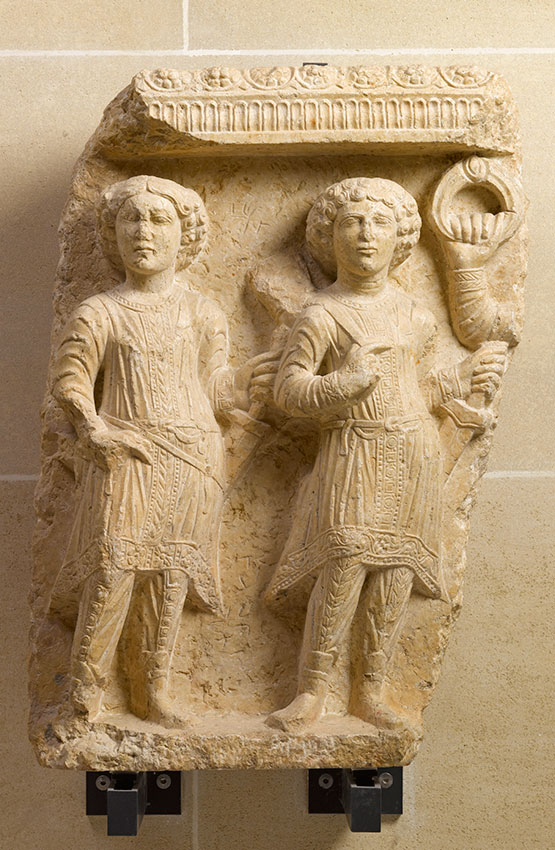
In the Parthian period two basic types are found: a tied sash and an elaborate wide belt. At Tang-e Sarvak (Tang-i Sarwak) in Elymais a late a.d. 2nd-century rock relief portrays a Parthian ruler and his retinue clad in tunics tied with tasseled sashes, which recalls the Achaemenid fashion for tied belts of cloth or leather (Ghirshman, 1962, p. 55 fig. 68; 1964, p. 84 fig. 109, pp. 157-58 fig. 209, p. 188 fig. 235; Survey of Persian Art IV, pls. 108 A, B; also see i above). At Dura Europos and Hatra, as well as at Palmyra just west of Parthia, 1st- and 2nd-century images of deities are shown in Roman armor bound with the cingulum, or belt of honor, worn by the Roman emperor and his troops (Ghirshman, 1962, p. 71 fig. 84; Colledge, fig. 10a; Downey, p. 203 pl. L/1; Pauly-Wissowa, III/2, p. 2561; Brilliant, figs. 2.63, 4.50, 4.89). The most common belt represented at Palmyra, however, is a sash derived from the cingulum, worn round the hips and tied with a square “herakles” knot, the long ends tucked up over the belt (PLATE II): In 2nd- and 3rd-century funerary sculpture it is worn by figures clad in Parthian dress (Ghirshman, 1962, pp. 78-79 figs. 90-91; Ingholt, 1954, pl. 11; Schlumberger, p. 90). Almost identical sashes, of similar derivation, appear on the stelae of Antiochus I of Commagene (69-34 b.c.) at Nimrud Dağ (Ghirshman, 1962, p. 67 fig. 80; Rosenfield, fig. 154; Houston, figs. 168, 169).
As for the wide belts, bronze buckles with movable tongues securing the girdles were excavated at Palmyra (MacKay, pl. LXIII/3); to the east, a gold-inlaid buckle from the so-called “treasure of Nihavand” (1st-3rd centuries) attests to a taste for elaborate wide belts in Iran (Ghirshman, 1962, p. 100 fig. 112). From approximately the same period in Iran are bronze belt plaques in openwork with representations of human and animal figures and bronze buckles in the shape of confronted animal heads formerly in the Foroughi collection (Ghirshman, 1979, p. 171, pls. I-IV). Geo Widengren distinguishes between the Parthian kamar, a sword or tunic belt, and the hemyān, or sacred girdle worn by priests (Widengren, p. 254). Funerary monuments at Palmyra, on which only members of the priestly caste wear wide, rolled belts, seem to support this differentiation (Ingholt, 1928, pl. IV). The fashion for decorated belts, probably of jointed metal on a leather backing, is known from the bronze statue of a Parthian ruler found at Shami; a similar belt, tied with ribbons, appears at Bīsotūn on a rock relief depicting a Parthian prince (Widengren, p. 252; Fukai, 1960, p. 172; Ghirshman, 1962, p. 53 fig. 66, p. 88 fig. 99). Also dated to a.d. the 2nd century are the elaborate belts girding the hips of ruler statues found at Hatra. The belts seem to be of metal, in openwork (Ghirshman, 1962, p. 94, fig. 105) or ornamented with reliefs of hippocamps and portrait busts of Greco-Roman design (PLATE III; Ghirshman, 1962, p. 89 fig. 100; Rosenfield, fig. 136). The distinctive semicircular clasps, tied with strips of material or leather thongs with dangling ends, suggest that these belts are very closely related to those found on 2nd-century Kushan monuments in India and Afghanistan (Ghirshman, 1962, p. 89 fig. 100; Rosenfield, fig. 136; Kushan belts: Rosenfield, figs. 2, 3, 8, 12, 20, 62a, 67). A precursor of these sumptuous girdles is a gold belt adorned with plaques depicting goddesses riding lions, found at the site of Tillya Tepe in northwestern Afghanistan (1st century b.c. to a.d. 1st century; Sarianidi, pp. 38-40, 37 ill.). Rosenfield called attention to classical imagery in the decorations of a Kushan ruler’s belt, suggesting that it symbolizes the well-being of the kingdom (Rosenfield, p. 183 figs. 3, 3a); perhaps the classical motifs on the Hatra belts have comparable symbolic meanings. This similarity between belts depicted at Hatra and in the distant Kushan empire may be explained either by contact through trade or by a common derivation from a now lost Parthian site (Rosenfield, pp. 170-71).

The most characteristic Sasanian girdle consists of ribbons tied in a bow in front, the ends often pleated horizontally. It is worn by queens and goddesses, as well as by kings and gods, and appears fully developed, without apparent prototypes, as early as the reign of Ardašīr I (a.d. 224-41) on the rock relief at Naqš-e Rostam (Naqsh-i Rustam; Schmidt, pl. 90). The fashion was followed by Šāpūr I (241-72) at Bīšāpūr and Naqš-e Rajab (Naqsh-i Rajab; Ghirshman, 1962, p. 165 fig. 209; Schmidt, pl. 90), by Hormozd I (272-73) at Tang-e Qandīl (Hinz, 1973, pls. 46-48), and by Bahrām II (27693) at Sar Mašhad, Barm-e Delak, and Naqš-e Rostam (Hinz, 1969, pls. 135, 137, 117). Such a ribbon belt also encircles the waist of the goddess Anāhīd in the investiture relief of Narseh (293-302) at Naqš-e Rostam (PLATE IV: Schmidt, pl. 90). The latest representation of the type is on the image of Ohrmazd in the large niche at Ṭāq-e Bostān, which should probably be dated to the reign of Ḵosrow II (591-628). Prudence Oliver Harper has noted that this late appearance of the belt demonstrates the conservative nature of sacred representations (p. 65 n. 126).
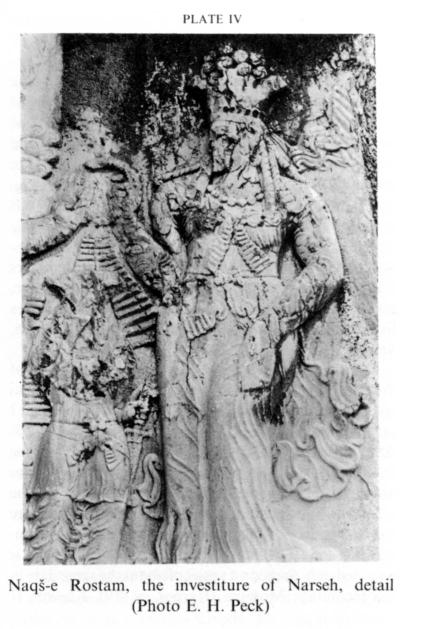
The popularity of the ribbon belt was rivaled by that of the girdle tied with a ribbon in such a way that two loops were pulled up through circular clasps (described by Grenet as two cabochon jewels regulating the ribbon length, p. 197 pl. 1) and the ends were left dangling (PLATE IV). This belt can be seen on the reliefs of Hormozd I at Tang-e Qandīl, the investiture relief of Narseh, and the rock carvings of Ardašīr II (379-83) and Šāpūr II (309-79) and III (383-88) at Ṭāq-e Bostān (Hinz, 1973, pls. 47, 48; Ghirshman, 1962, p. 176 fig. 218, p. 190 fig. 223; Fukai, 1972, pls. LXVI, LXVIII). It was on silver “hunting plates,” however, that this ribboned belt with double clasp was most fully delineated, as Harper has shown (pp. 54-87). It appears first on vessels of the late 3rd and 4th centuries (Harper, pls. 10, 12, 15, 16, 23, 28) and continues on examples from the mid-5th to 7th centuries (Harper, pls. 25, 26, 31).
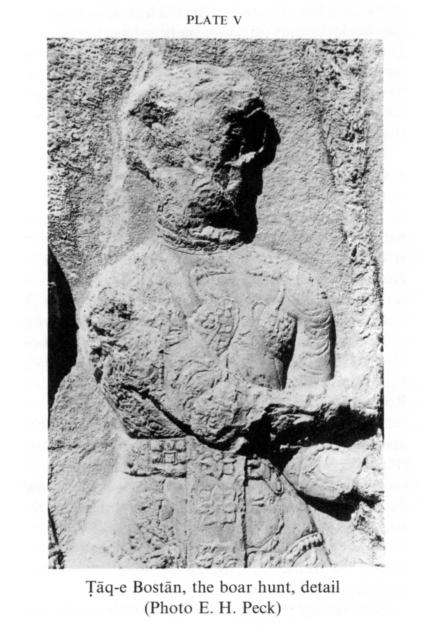
The taste for jeweled belts, already apparent at Parthian Hatra, persisted at the early Sasanian royal court, as is clear from the reliefs of Ardašīr I and Šāpūr I at Dārāb and Naqš-e Rajab (Hinz, 1969, pls. 57, 58; Schmidt, pls. 97A, 101B). On “hunting vessels” of the 5th century and later jeweled belts with square buckles are illustrated (Harper, p. 87 pls. 18, 20, 21), but in the reliefs of the boar hunt at Ṭāq-e Bostān the buckles are hidden under vertical panels of patterned or embroidered cloth (PLATE V; Peck, pl. XV). This style is repeated only once, on a vessel of about the same date in the Hermitage Museum (Harper, pl. 19). Ḵosrow II wears a most elaborate belt in the depiction of his investiture at Ṭāq-e Bostān. Studded with rows of pearls and huge, square gems, it is the perfect visual reflection of the kamar, which Widengren describes as a jewel-encrusted warrior’s belt worn in the Sasanian period. The high priest Kartīr received a kamar together with a kōlāf “hat” from Hormozd I, son of Šāpūr I, as a symbol of his high rank (inscription on the Kaʿba-ye Zardošt at Naqš-e Rostam, line 4, Back, p. 394; cf. Widengren, p. 260).
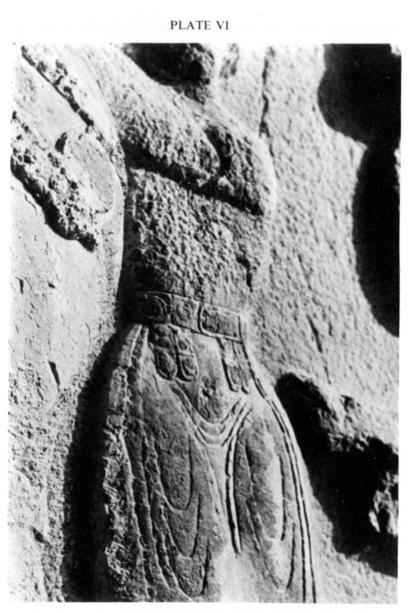
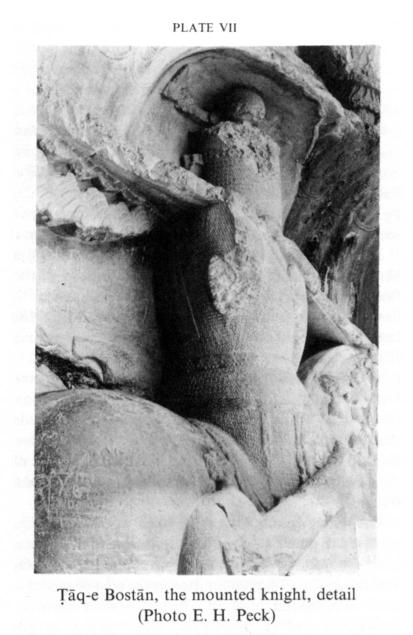
A new style of belt with lyriform buckle and movable tongue appears first on a “hunting vessel” dated to the reign of Pērōz (457-84) or Kavād I (488-96 and 498-531) in The Metropolitan Museum of Art (Harper, p. 87 pl. 17) and later, at the end of the Sasanian dynasty, on plates in the Bibliothèque Nationale and the Hermitage Museum (Harper, pls. 22, 27). Harper has pointed out that, though the buckle with movable tongue does not appear on Sasanian reliefs before those at Ṭāq-e Bostān, Marshak has traced it to 5th-century Kucha in Central Asia (Harper, p. 65 n. 126). Ghirshman published a gilded iron buckle with movable tongue that he had excavated in level IV at Susa; he dated it to the mid-4th century (1979, pp. 183, 184 fig. 2). This type of buckle is depicted in the reliefs of boar and stag hunts at Ṭāq-e Bostān on belts worn by the king and his male entourage. As Widengren was the first to note, this kind of jeweled leather belt with pendant thongs tipped and adorned with metal plaques and gems is of Central Asian origin (Widengren, pp. 270-72; PLATE VI; Peck, pls. III, IV, VI, IXa, XIII, XVI-XIX). Although often portrayed on Central Asian wall paintings of the 6th-8th centuries as merely an ornamental fashion (von Le Coq, pls. 14, 16, Bäzäklyk; Grünwedel, fig. 56, Ming-Oï, fig. 654, Bäzäklyk, fig, 666, Idyqutšahri), this belt was essentially a nomadic accessory, weapons being suspended front the thongs during battle and the hunt (Bussagli, p. 59, Dandan Öiliq; Belenitsky, pls. 9, 11, 12, Pyandzhikent). Ghirshman observed that the earliest known examples came from 5th- and 6th-century burials of the nomadic Avars in Mongolia and southern Siberia (1953, p. 69; 1963, pp. 305-06, fig. 13); among these tribes two belts were worn, the upper one as a symbol of station, the lower one for attachment of weapons (1963, p. 305). In the sculpture of the royal mounted knight carved in high relief below the investiture scene at Ṭāq-e Bostān, there is a lower belt with long lappets (PLATE VII; Ghirshman, 1962, p. 192 fig. 234). On the other hand, the thonged girdles worn by Ḵosrow II in the hunting scenes seem to denote his high station; they are more elaborate and highly decorated than those of the courtiers. In addition, only the royal belt is used to suspend objects: a piece of cloth attached to a ring and a flint or whetstone (Gropp, p. 276; Fukai, pl. XLVII). Two other belts are depicted in the large ayvān at Ṭāq-e Bostān: a simple ribbon sash, most typical of the Sasanian period, and the nomadic girdle of eastern derivation (Peck, pp. 118, 120, pls. IXa, CIII, XIX).
Bibliography
M. Back, Die sassanidischen Staatsinschriften, Acta Iranica 18, Tehran and Liège, 1978.
A.M. Belenitsky, Monumental’noe iskusstvo Pyandzhikenta, Moscow, 1973.
M. Bieber, Entwicklungsgeschichte der griechischen Tracht, Berlin, 1934.
R. Brilliant, Gesture and Rank in Roman Art. The Use of Gestures to Denote Status in Roman Sculpture and Coinage, Memoirs of the Connecticut Academy of Arts and Sciences 14, New Haven, 1963.
M. Bussagli, Painting of Central Asia, Geneva, 1964.
M. A. R. Colledge, Parthian Art, London, 1977.
S. B. Downey, The Excavations at Dura-Europas. The Stone and Plaster Sculpture, Monumenta Archaeologica V, 1977.
S. Fukai, “The Artifacts of Hatran and Parthian Art,” East and West 11, 1960, pp. 135-81.
Idem and K. Horiuchi, Taq-i-Bustan I-II, Tokyo, 1969, 1972.
R. Ghirshman, “Notes iraniennes V. Scènes de banquet sur l’argenterie sassanide,” Artibus Asiae 16, 1953, pp. 51-71.
Idem, Fouilles de Châpour. Bîchâpour II. Les mosaïques sassanides, Paris, 1956.
Idem, Persian Art. The Parthian and Sassanian Dynasties, New York, 1962.
Idem, “Notes iraniennes XIII. Trois épées sassanides,” Artibus Asiae 26, 1963, pp. 293-311.
Idem, The Arts of Ancient Iran. From Its Origins to the Time of Alexander the Great, New York, 1964.
Idem, “La ceinture en Iran,” Iranica Antiqua 14, 1979, pp. 167-95.
F. Grenet, “Un plat sassanide d’Ardašir II (379-383) au bazar de Kabul,” Studia Iranica 12, 1983, pp. 195-205.
G. Gropp, “Der Gürtel mit Riemenzungen auf den sasanidischen Reliefs in der grossen Grotte des Taq-e Bostan,” AMI, N.S. 3, 1970, pp. 273-88.
A. Grünwedel, Altbuddhistische Kultstätten in Chinesisch-Turkistan, Berlin, 1912.
P. O. Harper, Silver Vessels of the Sassanian Period I: Royal Imagery, New York, 1981.
W. Hinz, Altiranische Funde und Forschungen, Berlin, 1969.
Idem, “Das Sasanidische Felsrelief von Tang-e Qandil,” AMI, N.S. 6, 1973, pp. 201-12.
D. Homès-Fredericq, Hatra et ses sculptures parthes. Etude stylistique et iconographique, Istanbul, 1963.
M. G. Houston, Ancient Egyptian, Mesopotamian and Persian Costume and Decoration, London, 1920.
H. Ingholt, Studier over palmyrensk skulptur, Copenhagen, 1928.
Idem, “Parthian Sculptures from Hatra,” Memoirs of the Connecticut Academy of Arts and Sciences 12, 1954, pp. 5-46.
Idem, Gandharan Art in Pakistan, New York, 1957.
A. von Le Coq, Die buddhistische Spätantike in Mittelasien. Die Wandmalereien, Berlin, 1924.
D. MacKay, “The Jewellery of Palmyra and Its Significance,” Iraq 11, 1949, pp. 160-87.
E. H. Peck, “The Representations of Costumes in the Reliefs of Taq-i-Bustan,” Artibus Asiae 31, 1969, pp. 101-23.
J. M. Rosenfield, The Dynastic Arts of the Kushans, Los Angeles, 1967.
V. Sarianidi, “The Treasure of the Golden Mound,” Archaeology 33/3, 1980, pp. 31-41.
D. Schlumberger, L’Orient hellénisé, Paris, 1969.
F. F. Schmidt, Persepolis III: The Royal Tombs and Other Monuments, Oriental Institute Publications 70, Chicago, 1970.
G. Widengren, “Some Remarks on Riding Costume and Articles of Dress among Iranian People in Antiquity,” Studia Ethnographica Upsaliensia 11, 1956, pp. 228-76.