



i. In Iran
The history and evolution of production.The almost exclusive use of wood and charcoal as energy sources hampered Iran’s economic development in the pre-20th century period. Government and private investors’ efforts to create an industrial base had to face this issue, which often led to high investment cost, followed by energy-supply, operational, and financial problems. The new 19th-century industries in general used wood or coal boilers and later oil. It was only in 1297/1880 that (coal-based) gasworks were installed in Tehran at a cost of 30,000 pounds sterling at the instigation of Ḥosayn Khan Sepahsālār. Because of the lack of suitable coal, operations stopped a few years later. The machinery was bought by an Iranian who resold it in 1309/1891 to the “Compagnie générale belge pour éclairage et chauffage en Perse.” This company bought more machinery, but no progress was made and the works were closed down (Issawi, pp. 306, 308).
The electrification of individual government buildings appears to have begun during the reign of Nāṣer-al-Dīn Shah (ca. 1304/1887) with the state armory (Eʿtemād-al-Salṭana, p. 93) and the shah’s residence in Tehran (Tāj-al-Salṭana, p. 53).
It was only in 1318/1900 that the first electrical plant (of 6,6 kw) was built in Iran, in the city of Mašhad. Two years later a second one (of 19 kw) was built in the same city. This plant was financed by Moẓaffar-al-Dīn Shah at a cost of 8,000 tomans; the plant was imported from Russia by Ḥāji Bāqer Mīlānī, known as Rezayof. Both plants were used to illuminate the shrine of Emām Reżā and part of the street which is known as Bālā Ḵīābān and which lies between the plant and the shrine (Issawi, p. 310; Bank Melli Iran, p. 536). In 1321/1903, an electrical plant was erected in Rašt, which functioned irregularly and was closed down after a while. In 1323/1905, an electrical plant of 93 kw was erected in Tabrīz (ibid.).
Tehran.It was only in 1326/1908 that Ḥājj Ḥosayn Amīn-al-Żarb erected an electrical plant (of 300 kw) in Tehran for his brick factory. It was bought in Germany and was also used to light government buildings. The plant was located on Ḵīābān-e Barq, the present-day Ḵīābān-e Amīr Kabīr. Another smaller plant of 2 kw was erected shortly thereafter on Ark Street; this was also used for lighting government buildings (mainly the area around the Meydān-e Sepah, formerly Tūpḵāna). All these plants used coal as fuel (Baladīya, p. 123).
Sale of electricity by Amīn-al-Żarb in Tehran was per lamp; the cost of the previous night’s consumption was collected the next day from the consumers. Rates differed per type of customer and the duration of power consumption. The municipality of Tehran paid 50 percent less than private consumers. Moreover, for both categories of consumers the rates were reduced as their number of connected lamps increased (Baladīya, p. 123). In 1308 Š./1929, there were 7 electrical plants in Tehran, with a capacity of 630 kw, that supplied street lighting. The number of street lamps in use rose from 1,408 in 1924 to 3,082 in 1929. In addition there were small plants to supply private homes and industries. Their installed capacity was estimated to be about 400 kw, thus a total of 1,000 kw in Tehran (Baladīya, p. 123), which by 1313 Š./1934 had risen to 1,500 kw. In 1934, the municipality (šahrdārī)took over electricity production in Tehran in view of large unmet demand. Prior to early 1934, electricity had been available only until midnight; shortly thereafter it became available until 2:00 a.m. When new equipment arrived in that same year, electricity became available 24 hours a day (US Legation no. 864.14 [23 Sept 1934, vol. 238]).
National situation.Between 1908 and 1925 no additional electrical plants were erected in Iran, but after that period considerable investment took place, so that by 1309 Š./1930 there were electrical plants in 29 towns. By 1315 Š./1936 there were about 100 electrical plants, private and government-owned, throughout Iran, ranging from small to big plants (Sāl-nāma-ye Pārs,1315 Š./1936-37, p. 220). The majority (138 in 1939) of these plants ran on diesel oil, five steam plants used coal, and the two steam plants in Zābol used wood and regularly lay idle due to fuel shortages (Bank Melli Iran, p. 542; FO 371/23263, f. 152). Total installed capacity (thermal and hydroelectric) was 20 mw in 1939 (excluding Anglo-Iranian Oil Company production), which was produced by a total of 149 plants in 61 towns (Bank Melli Iran, p. 542). The first hydroelectric plants were built in the 1920s, the first at Marāḡa; the last of this group, built near Asadābād (Hamadān) in the early 1930s, had an installed capacity of 375 kw and was designed to supply power to a cotton spinning and weaving factory, the plans for which were never realized (FO 371/21900, ff. 100-01). Total installed hydroelectric capacity was 902 kw in 1939.
Parallel to the first generation of semipublic electric plants was the Anglo-Persian Oil Company’s own electrification policy. APOC began to wire its workshops, offices, and lodgings in 1908 and continued to do so as oil fields were discovered. By 1920, all the industrial petroleum sites in Ḵūzestān were electrified; this province was thus given a lead in electrification that it has never relinquished. It is claimed that, in this pioneer phase of the electrification of Iran, industry preceded or accompanied electrical wiring and not the reverse.
Although new investments in the power sector after 1943 had increased Iran’s installed capacity to 90 mw by 1948 (exclusive of 100mw of AIOC), use of electricity in Iran was still very low compared to neighboring countries. In 1948 per capita kwh production was 12, compared with 32 kwh in Turkey and 64 kwh in Lebanon. Of the 90 mw installed capacity only some 23 percent was used by the domestic and public sector. The remainder was used by the industrial sector. In 1948 per capita kwh production was 12, percent by a coal steam plant (in Tehran), and 8 percent hydroelectrically.
In most cases, power was generated by more than one plant in a city, which resulted in high operating costs. Except for Tehran and a few larger cities, electricity was not supplied on a 24-hour basis. In the smaller cities four to six hours in the evening was the usual practice, in larger cities 12 to 15 hours, with all-night service but no service during most of the daylight hours. This was due to the fact that industrial establishments usually had their own generating plants that only supplied other customers after factory hours. Outside the industrial sector, electricity was almost exclusively used for lighting; therefore it was uneconomical to invest in new capacity for other purposes. Finally, because the reliability of the systems was low, plant owners did not want to become too reliant on the system. As a consequence, service suffered both in quantity and quality (Seven Year Development Plan IV,pp. 189-92). In 1954 one third of the commercial production of electricity was in private hands; at Tehran there were twenty-seven private generators and only two belonging to the state and the municipality. This decentralized low-voltage system experienced losses as high as 50 percent of production, which was a handicap to manufacturers who had to have their factories wired themselves at very high cost.
After 1947 the state took the initiative in a new policy of financing large-scale projects such as the great hydroelectric dams, the first of which was the Karaj dam in 1948, and large steam plants, which were connected by high-tension lines. An effort was made to develop installations outside the Tehran region, in which 61 percent of national production was concentrated in 1956. It was not until the Third Development Plan, however, that this policy became truly coordinated and systematic: In 1963 the Iranian Power Authority (IPA/Sāzmān-e Barq) was created as an autonomous organization responsible for electricity. However, the need was felt for an organization with wider authority and broader functions. Thus, in 1964 the Ministry of Water and Power (Wezārat-e Āb o Barq) was created to replace IPA. It was reorganized in 1974 and renamed the Ministry of Energy (Wezārat-e Nīrū; Markaz-e Āmār, p. 1).
In 1965 the power industry was nationalized to permit its consolidation and to allow the large-scale expansion of generating and transmission facilities. During the Third Plan period (1963-68), a start was made with the development of a nationwide grid system through the construction of transmission facilities in Ḵūzestān and Tehran provinces (Wezārat-e Nīrū, p. 10). By 1967, all generating capacity was in the public sector except for those in industrial plants, and since 1973 there has been little private investment in power generation, because in the beginning of that year the ministry required all industries to use public power. As a result, the private sector controlled an installed capacity of only 1,600 mw, supplying 7 percent of national production in 1984 (ibid.). In 1969 the TAVANIR (Šerkat-e Sahāmī-e Tawlīd o Enteqāl-e Nīrū) was created, which is responsible for planning, generation, transmission, and distribution of power in the public sector. It controls the nine regional power companies (Šerkat-e Barq-e Manṭaqa) and the Ḵūzestān Water and Power Authority, but it is not involved in hydro-generation (Markaz-e Āmār, s.v.). The construction, maintenance, and operation of hydroelectric power stations are the responsibility of the regional water authorities under the Ministry of Energy. The Atomic Energy Organization of Iran (Sāzmān-e Nīrū-ye Ātomī, established in 1973, is responsible for the purchase, installation, and operation of all nuclear power plants. It is an independent agency responsible to the prime minister.
Production thus doubled every five years until 1978 (Table 38): 0.2 billion kwh in 1948, 4.1 in 1967, 18.9 in 1977. High-tension lines were built to link the great hydraulic plants to urban industrial centers: The 400-kw grid begun in 1973 exceeded 4,300 km in 1984; the 230-, 132-, and 63-kw grids, which totaled 1,800 km in 1967, reached 24,600 km in 1984.
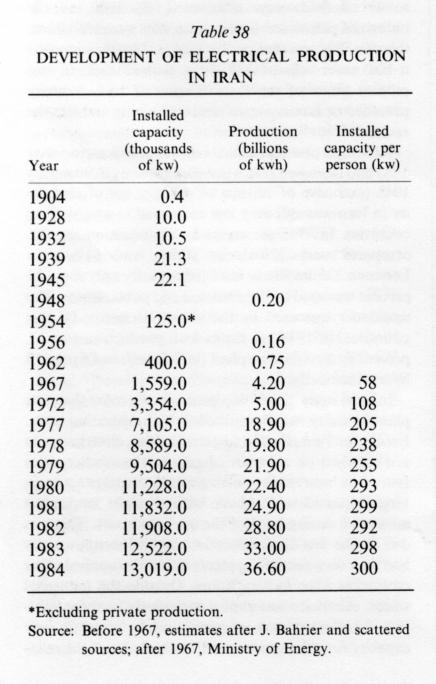
Since 1980 the increase in production has continued at a sustained rate, but that of installed capacity has leveled off because of the slowdown in a number of projects (Tabrīz, Ṭūs, Nekā, the Lār dam) and lack of investment. In 1979 the nuclear plants at Būšehr and Ahvāz were abandoned, although it had been predicted that nuclear energy would furnish more than 20 percent of the country’s electricity by 1983. Installed capacity per person dropped for the first time in 1982 (Wezārat-e Nīrū, p. 10); the drop led to a lowering of tension and cuts in current that mainly affect urban industries and populations, which had been favored since 1970. The new policy, on the contrary, is aimed at favoring the rural areas, which previously had been deliberately neglected; in 1966 only 4 percent of rural families had electric service. Since 1979, numerous villages have been connected to the grid or supplied from small plants; 16,800 villages had been electrified by 1984, versus 4,400 in 1978 (ibid., p. 44).
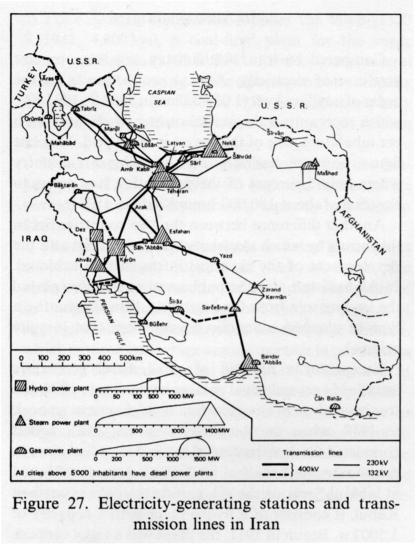
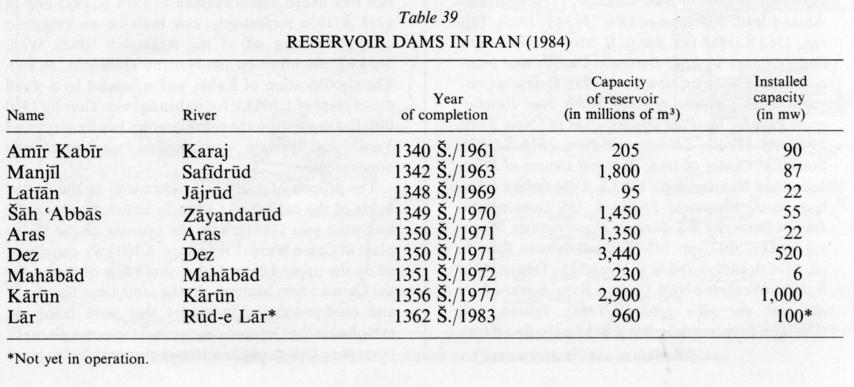
Present production (Figure 27). In 1984, total production in Iran reached 36.6 billion kwh (of which 2.5 billion were produced by the private sector) for an installed capacity of 13,000 mw. The chief generating method was steam produced by fuel-burning plants. The fifteen steam plants scattered throughout the whole country furnished 50 percent of production in 1984, versus 35 percent in 1979. Large-scale urban plants produced 200 to 600 mw; the largest one in Iran, at Nekā in Māzandarān, produced 1,740 mw. The thirty-eight plants operating with gas turbines have been built for the most part in the last ten years on twenty-four urban or industrial sites, notably in Fārs and along the large gas pipelines; they are generally of medium size (from 50 to 100 mw as a rule) and produce 24.2 percent of the electricity. Hydroelectric production (15.7 percent) is stagnant because of the lack of new equipment. In this last category, however, Iran possesses a remarkable array of eight large dams intended for both irrigation and the production of electricity (Table 39). These remarkable and prestigious monuments (the Kārūn and Dez dams in particular) have been very controversial because of their cost, their questionable usefulness for irrigation, and the rapidity with which they become clogged with alluvial deposits.
Production by diesel engines (3.2 percent of the total) is under the regional power authorities, not TAVANIR; it is small in quantity but plays a considerable role in rural areas and small towns. At present all the towns of Iran with more than 5,000 inhabitants have diesel generators, and in many villages groups of residents have banded together to buy small generators that operate only in the evenings.
The geographical distribution of electric power production corresponds to that of the population and of industry (Figure 27). The entire country is served by an interconnected grid that is especially well developed in the western provinces, except for Kurdistan, which is far behind in this sphere. Between the Tehran region and Ḵūzestān, which consume 60 percent of the country’s electricity, a dense grid of high- and medium-tension lines has been constructed to serve the main industrial centers of Iran. Toward the east two secondary grids have recently been connected to the principal grid: the northern Khorasan grid around Mašhad and the Kermān-Yazd-Bandar-e ʿAbbās grid, centered on the coal mines of Zarand and the copper mines of Sarčašma. The undersupplied areas of eastern and southern Afghanistan extend across the border into Baluchistan and southern Khorasan in Iran. The thin population density and the dispersal of urban centers cause considerable energy losses (about 33 percent), despite the development of 400-kilowatt lines linking the large towns.
Iranian households consumed more than 35 percent of production in 1984; their total consumption had doubled since 1979, while that of industry (31 percent of the total), of commerce (22 percent), and of agriculture (6 percent) remained steady. Average production per person reached 785 kwh, with an average consumption per subscriber of 4,220kw. Despite recent policy, the imbalance between the supply for towns, where more than 90 percent of the houses had been electrified by 1976, and for the country, 14 percent of which is electrified, remains very large (National Census).
The future of electrical production does not seem to lie in large dams, for reasons of general policy, cost, and lack of suitable sites; by contrast, it is possible to develop the construction of small irrigation dams that generate electricity as a by-product. Nuclear energy does not seem to be a viable solution to the country’s future needs, despite revival of the nuclear program in 1982. The main future source of primary energy is without question natural gas, which is already widely distributed in northern Khorasan and Fārs for direct use or to power small electrical plants.
Activities connected with electricity represent an important segment of the economy in Iran; the different public services overseeing electrical production and distribution employ 53,000 people. Manufacturers of small electrical goods (electrical appliances, bulbs, wire, small engines, etc.) employ more than 25,000 people, primarily in the Tehran region but also at Rašt and Shiraz, and produce 50 percent of the nation’s needs. For heavy equipment, Iran depends entirely on foreign technology and goods (Markaz-e Āmār, s.v.).
Bibliography
Baladīya-ye Ṭehrān, Dovvomīn sāl-nāma-ye eḥṣāʾīya-ye šahr-e Ṭehrān,Tehran, 1310 Š./1931.
J. Bharier, Economic Development in Iran 1900-1970, London, 1971.
Bank Melli Iran, “L’Eclairage en Iran,” Bulletin de la Banque Mellie Iran 41, 1939, pp. 535-49.
M.-Ḥ. Eʿtemād-al-Salṭana, al-Maʾāṯer wa’l-āṯār,Tehran, 1307/1889-90.
W. M. Floor, Industrialization in Iran, 1900-1941,Durham, 1984.
M.-ʿA. Golrīz, Mīnū-dar ya Bāb al-Janna-ye Qazvīn,Tehran, 1337 Š./1958, pp. 712-13 (on the electrification of Qazvīn).
M. Ḥejāzī, Mīhan-e mā,Tehran, 1338 Š./1959-60, pp. 617-18.
Ch. Issawi, The Economic History of Iran,Chicago, 1972.
Markaz-e Āmār-e Īrān, Sāl-nāma-ye sāl-e 1362 [Š./1983],Tehran, 1363 Š./1984 (s.v. barq).
B. Mosavar-Rahmani, Energy Policy in Iran, Domestic Choices and International Implications,New York, 1981. Overseas Consultants Inc., Report on [the] Seven Year Development Plan for the Plan Organization IV, New York, 1949, pp. 189-93.
Sāl-nāma-ye Pārs, 1315 Š./1936.
Statistical Center of Iran, National Census of Population and Housing,n.p., 1353 Š./1974 (entire country).
Idem, Statistical Yearbook. US Government, Iran, A Survey of US Business Opportunities,Washington, D.C., 1977, pp. 105-17.
Tāj-al-Salṭana, Ḵāṭerāt, ed. M. Etteḥādīya and S. Saʿdvandīān, Tehran, 1361 Š./1982.
Wezārat-e Nīrū, Omūr-e Barq, Ṣaṇʿat-e barq dar Īrān dar sāl-e1363 [Š./1984],Tehran, n.d. (Daftar-e Barnāmarīzī-e Barq, Baḵš-e Omūr-e Barq).