



i. In Iran
The cultivation of barley in Iran, like that of wheat, goes back to the origin of agriculture itself. Both botanical and archeological data locate the beginning of the “Neolithic revolution” in the Fertile Crescent, i.e., a semiarid area stretching from Palestine to the Zagros through the Taurus foothills, where both wild barley, Hordeum spontaneum, and a wide-grain kind of wild wheat, Triticum dicoccoides can still be found (H. Helbaek, “Domestication of Food Plants in the Old World,” Science 130, 1959, pp. 365-72). Most of the paleobotanical surveys made on several prehistoric sites on the Iranian plateau up to the fifth millennium b.c. show the existence of cultivated barley (O. Meder, Klimaökologie und Siedlungsgang auf dem Hochland von Iran in vor- und frühgeschichtlicher Zeit, Marburger Geographische Schriften 80, Marburg am Lahn, 1979, pp. 109-13). Barley cultivation is believed to have spread from there to the irrigated plains of Mesopotamia and Egypt, and then to Europe and other places (R. Ghirshman, Iran, London, 1954, p. 35).
Since those times, barley has been throughout history one of the two staple crops in the Iranian world, as a constant staple but subordinate to wheat, and is still mainly grown as a subsistence crop (H. Bowen-Jones, “Agriculture,” in Camb. Hist. Iran I, p. 568; the map 33 of G. Stöber, Die Afshār. Nomadismus im Raum Kermān (Zentralirān), Marburger Geographische Schriften 76, Marburg am Lahn, 1978, clearly shows the geographical coincidence of barley and wheat cultivation).
Barley is grown throughout Iran and Afghanistan, either as a rainfed (deym) or irrigated (ābī) crop, and can be winter barley (pāyīza, “autumnal,” often jow-e torš “sour barley”) sown in November and harvested between May and July, or spring barley (bahāra, generally jow-e šīrīn “sweet barley”) sown between February and April and harvested in summer. Cultivation techniques (see for instance P. H. T. Beckett, “Agriculture in Central Persia,” Tropical Agriculture 34, 1957, pp. 9-28, and H. E. Wulff, The Traditional Crafts of Persia, Cambridge, Mass., and London, 1966, pp. 262-77) are quite similar for barley and wheat. The fields are plowed and sown with various types of traditional plows (ḵīš, gāv-āhan), or more and more with a tractor. Mature barley is harvested with a sickle (dās); green barley can be uprooted as fodder. Threshing is done in three traditional ways: by driving teams of draft animals over the threshing ground, with a wain (čarḵ-e ḵarman-kūbī) or threshing board (vāl), and also with a tractor pulling a disk plow or threshing machine.
The greater part of barley acreage is devoted to non-irrigated cultivation, using the dry-farming technique of plowed fallow, in regions where the mean amount of annual precipitation generally exceeds 300 mm (see the discussion of the limits of rainfed cultivation in Iran in H. Bobek, “Die Verbreitung des Regenfeldbaus in Iran,” in Festschrift L. Sölch, Vienna, 1951, pp. 9-30). Most of the barley fields are in highlands, i.e., Azerbaijan, the northwestern and central Zagros, Alborz, and the chains of northern Khorasan, and all the central Afghan mountains, together with their northern loess-covered piedmont (Ch. Jentsch, “Die landwirtschaftlichen Produktionsflächen in Afghanistan und naturräumliche Möglichkeiten ihrer Erweiterung,” in W. Kraus, ed., Steigerung der landwirtschaftlichen Produktion und ihre Weiterverarbeitung in Afghanistan, Afghanische Studien 6, Meisenheim am Glan, 1972, pp. 80-82 and inset map). Though winter barley can be found up to 2,000 m in the central Alborz (E. Ehlers, “Anbausysteme in den Höhenregionen des mittleren Elburz/Iran,” in C. Rathjens, C. Troll, and H. Uhlig, eds., Vergleichende Kulturgeographie der Hochgebirge des südlichen Asien/Comparative Cultural Geography of the High-Mountain Regions of Southern Asia, Erdwissenschaftliche Forschung 5, Wiesbaden, 1973, pp. 66-67), spring barley grows in the highest permanent villages, for instance, above 1,900 m in eastern Azarbaijan (M. Bazin, Le Tâlech: Une région ethnique au nord de l’Iran, Paris, 1980, II, p. 97), as well as in summer temporary settlements such as the yeylāq of the Ṭāleš seminomads in the northwestern Alborz (ibid., II, p. 23) or the cold region (sarḥadd) of more or less sedentarized Afšār nomads in southeastern Iran (G. Stöber, op. cit., pp. 94-95). Such rainfed fields are regularly left fallow.
Irrigated cultivation of barley occurs in limited spots in the above-mentioned mountainous regions but is prevalent in central and eastern Iran and in the peripheral oases of Afghanistan. The fields are watered once or twice before the winter rains and three or four times in spring. Water needs have been estimated between 4,000 cubic meters per hectare around Borūjerd and 7,500 in the Zāyandarūd area (M. Atai, “Economic Report on Cultivation in the Region of the Sixth Province,” Taḥqīqāt-e eqteṣādī 11-12, 1967, Eng. ed., p. 97), where barley is integrated into quite varied schemes of crop rotation (M. Bazin, La vie rurale dans la région de Qom, Paris, n.d. [ 1974], fig. 26 pp. 47-48).
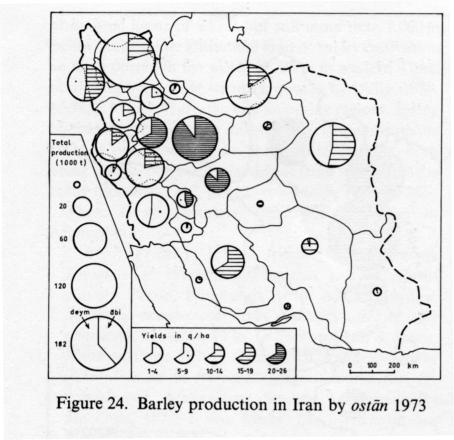
Yields of barley are slightly lower than those of wheat, and there is of course a sharp contrast between irrigated and non-irrigated lands. The latter give very low and irregular yields. Data from the years 1926 to 1933 compiled by M. Atai (“Economics of Cereals in Kuzistan,” Taḥqīqāt-e eqteṣādī 3-4, 1962, pp. 56-91; idem, “Economic Report on Agriculture in the Isfahan and Yazd Areas,” ibid., 9-10, 1965, pp. 144ff.; art. cit., 1967, pp. 81ff.) for several provinces of Iran range from 350 to 400 kg per hectare. The mean yield in Iran increased only to 502 kg per hectare in 1973, and the best yields obtained in the northwestern provinces never exceed 1,000 kg per hectare (Figure 24). Irrigated fields give much higher yields, with 1,400 to 1,817 kg per hectare in 1926-33 for the same provinces, and an average of 1,445 kg per hectare in 1973; the highest yields are reached in central Iran with 2,663 kg per hectare in Isfahan.
Barley is mostly a subsistence crop given to livestock, especially to sheep and horses, and provides little surplus for marketing. Before land reform in Iran, the crop was divided on the threshing ground between the tenant and the landlord. According to the factors of production supplied by each, the farmer’s share could go from 1/4 to 4/5 (see detailed data for Isfahan in M. Atai, 1965, table 20, p. 128). After land reform, some of the former sharecroppers could bring barley to the market; a part of it was sold to the country’s small brewing industry, and the bulk to specialized cereal traders (ʿallāf), who supply herders with supplementary grain for their fodder resources. As a whole, the barley production of Iran and Afghanistan is only marginally sufficient for domestic needs. In the late 1970s, the scarcity of available barley led to a sharp increase of its price in Iran, in such a way that many herders (for instance in northern Khorasan, cf. M.-H. Pâpoli-Yazdi, Le nomadisme et le semi-nomadisme dans le Nord du Khorâssân: Etude de géographie humaine, thèse lettres, Paris, 1983) were compelled to sell part of their flocks and horses. Efforts made after the 1979 revolution to raise the production in Iran seem to have been successful, with a conspicuous increase in Fārs and Khorasan (Figure 25), but it is difficult to see in these figures a long-term trend, since barley, because of its subordinate position vis-à-vis wheat, suffers from greater instability in acreage and production.
