



ii. History and Monuments
Bāmīān is celebrated for the beauty of its landscape and for the presence of two colossal statues of the Buddha. In the past it was a caravan halt and a renowned artistic center, as well as a center for the propagation of Buddhism.
Early History. Situated 2,500 meters above sea level and enclosed between the high mountains of Ḵᵛājaḡar (an extension of the western Hindu Kush) on the north and Kūh-e Bābā on the south, the valley of Bāmīan provided the necessary sheltered corridor permitting passage of one of the main ancient routes linking India and China.
The name Bāmīān, according to P. Pelliot, is from Middle Persian Bāmīkān (Bundahišn, TD2, p. 88.2; Bāmīkān in the Geography of (Pseudo-)Moses of Khorene; Marquart, Ērānšahr, p. 92). From the fifth century onward it appears in the Chinese texts in different forms: Fan-yang, Fan-yan, Fang-yan, and Fan-yen-na (see Marquart, p. 215). These texts are of two kinds; on one hand, there are texts dealing with Bāmīān when it was included in the great Chinese administrative reorganization connected with the western countries, and, on the other, travelers’ reports. The celebrated Chinese pilgrim Xuanzang, who visited Bāmīān between 629 and 645, left a very important description of its monuments and of the social and religious life of its inhabitants (tr. Beal, I, pp. 49-53). Nearly a century later, the Korean monk Huichao, who passed through Bāmīān in 727, described it as an independent and powerful kingdom, despite the presence of the Arab armies to the north and south of the region.
The Islamization of the population of the valley took place gradually. Instead of being brutally suppressed, most of the princes of Bāmīān, who bore the title šēr (“king,” translated incorrectly as “lion” by Yaʿqūbī in Boldān, p. 289), were named to important posts at the court in Baghdad or elsewhere. Ṭabarī (III, p. 1335) reported that a šēr of Bāmīan had been named governor of Yemen in 229/844. Yaʿqūb the Saffarid destroyed a great temple and sent the idols to Baghdad (Ṭabarī, III, p. 1851), but this did not signal the end of the pre-Islamic life of Bāmīān.
Not until the Ghaznavids did the non-Muslim indigenous dynasty of Bāmīān succumb. Under the Ghurids Bāmīān was for almost a century (550-609/1155-1212) the capital of a great kingdom extending to the north of the Oxus (Amu Darya). The valley was part of the kingdom of the Ḵᵛārazmšāhs in 618/1221, when Jengiz (Čengīz) Khan, in order to avenge the death of his grandson, totally razed the city and massacred its inhabitants.
Under the Mughals the name of Bāmīān is mentioned again, especially in connection with Awrangzēb, whose depredations there included using the large Buddha of 55 meters as a target for his cannons.
In the nineteenth century several European travelers visited the Bāmīān valley (Godard et al.), but not until the Délégation Archéologique Française en Afghanistan (DAFA) has studied the archeological remains, between 1922 and 1930, did the site become accessible to tourists.
Monuments. As an important center of Buddhism, Bāmīān received numerous bequests and donations, which allowed erection of important cult monuments. On the northern slope of the Bāmīān valley there is a cliff which contains two statues of standing Buddhas, the one to the east 38 meters high, the other, to the west, 55 meters high (Plate IV). Both are sheltered under trilobed arches decorated with wall paintings and are surrounded by dozens of artificial caves in different forms, varying in plan from circular to polygonal and from square to rectangular. These caves are ornamented with wall paintings and architectural elements executed in relief. It is believed that the smaller standing Buddha and the surrounding caves (the group A-G) are the oldest works at Bāmīān. Traces of later restorations and alterations have also been discovered.
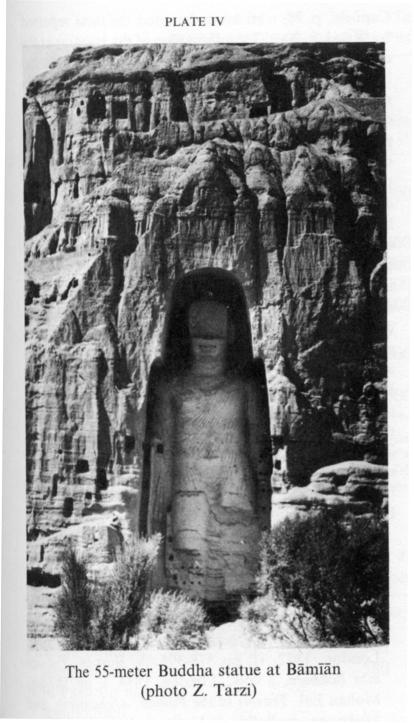
The 55-meter statue and the adjacent caves (numbered from I to XV) form a more coherent complex, influenced by the art of Gandhara and that of the Guptas of India; this influence can be seen in the graceful proportions of the statue itself and also in the wall paintings in its niche, all executed between the fifth and sixth centuries a.d.
Situated in the central part of the cliff, between the two Buddhas, are other cave groups (e.g., E, H, I, J, and K). They consist either of trilobed niches that at one time sheltered seated Buddhas (E, H, and I) or of grottos (J and K), the wall paintings of which are the artistic apogee of Bāmīān. Here various influences commingled gradually, giving birth to a unique art, one of the principal characteristics of which is the use of primary colors like the lapis blue of the bodhisattva in group E or the red ocher of the bodhisattva in group K. The wall paintings of Folādī and the fragments at Kakrak should be linked to this phase of the school of Bāmīān (sixth-eighth centuries).
A large reclining Buddha in parinirvāṇa 1,000 feet (ca. 300 meters) long has not yet been excavated (Pelliot in Godard et al.).
We have only fragmentary information on the royal city and on two large Buddhist monasteries built not far from the cliff. On the other hand, two important ruins of the Islamic period are still standing: The first, to the southeast of the cliff, is called Šahr-e Ḡolḡola; the second, Šahr-e Żoḥāk, or the Red City, is situated farther east of Bāmīān on a rocky spur at the intersection of the roads leading to Kabul.
The “Irano-Buddhist” art of Bāmīān, thanks to the valley’s geographical position, thus functioned as a link in the long chain running from India and Gandhara to Bactria and Sogdia, eventually reaching Chinese Central Asia and finally Tun-huang.
Bibliography
L. Bachhofer, review of B. Rowland, The Wall-Paintings . . . , in Art Bulletin 20, 1938, pp. 230ff.
A. Foucher, “Rapport A. Foucher” (a letter addressed to E. Senart about the antiquities of Bāmīān), JA, April-June, 1923, pp. 354-68.
Idem, La vieille route de l’Inde de Bactres à Taxila, MDAFA 1, 2 vols., Paris, 1942-47.
J. Godard, Y. Godard and J. Hackin, Les antiquités bouddhiques de Bāmiyān, MDAFA 2, Paris and Brussels, 1928.
J. Hackin and J. Carl, Nouvelles recherches archéologiques à Bāmiyān, MDAFA 3, Paris, 1933.
J. Hackin, J. Carl, and J. Meunié, Diverses recherehes archéologiques en Afghanistan (1933-1940), MDAFA 8, Paris, 1959.
T. Higuchi, Bāmiyān: Art and Archaeological Research on the Buddhist Cave Temple in Afghanistan 1970-1978, 4 vols., Kyoto, 1983 (in Japanese).
Huichao (Huei-chʾao), tr. W. Fuchs, Huei-chʾaos Pilgerreise durch Nordwest-Indien und Zentralasien um 726, APAW, Phil-hist. Kl., Berlin, 1928.
T. Kodera, M. Maeda, and A. Miyaji, Bāmiyān, Nagoya, 1971 (in Japanese).
B. Rowland, The Wall-Paintings of India, Central Asia and Ceylon, Boston, 1938.
Z. Tarzi, L’architecture et le décor rupestre des grottes de Bāmiyān, 2 vols., Paris, 1977.
Idem, “La grotte K3 de Bamiyan,” Arts asiatiques 38, 1983, pp. 20ff.
Xuanzang (Hsüan-tsang, tr. S. Beal, Si-yu-ki. Buddhist Records of the Western World, 2 vols. in one, London, n.d.