



ḴORFA (Portulaca oleracea L.), English “common purslane,” of the Portulacaceae family (purslane family), a pharmaceutical plant (PLATE I). The genus name is Portulaca, from portula, diminutive of L. porta ‘little gate’, referring to the small opening of the fruit, or from porto ‘to carry’ and lac ‘milk’, ‘milk-carrier’ (Gledhill, p. 31). The species name oleracea, also from the Latin, means “pot herb.”
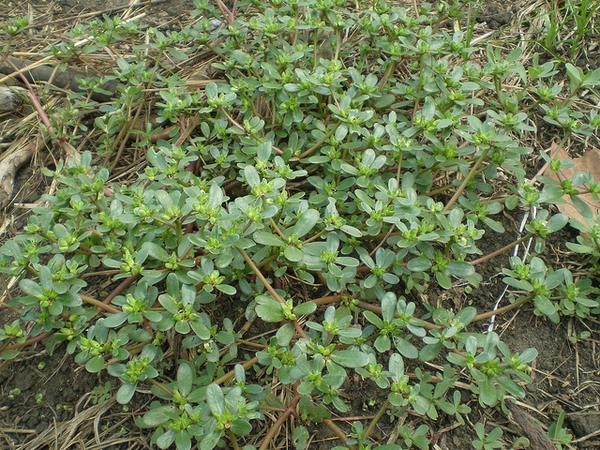
PLATE I. Common purslane (ḵorfa). Photograph from North Carolina State University (plants.ces.ncsu.edu/plants/portulaca-oleracea/). Licensed under CC BY-NC 2.0.
Purslane has an extensive distribution worldwide and is regarded as a common weed affecting field crops in many countries (Holm et al; Miyanishi and Cavers). Abu Rayḥān Biruni (q.v.; d. ca. 422/1050) in the Ṣaydana (tr. Kāsāni, pp. 137, 781) refers to two types of ḵorfa, wild and cultivated. He also mentions the Arabic name, al-baqla al-ḥamqāʾ, and its medicinal properties. Today, purslane is sold at local markets in Iran and other Middle Eastern countries and under the name verdolaga in Mexico and South America.
This annual plant has a thick taproot; smooth, reddish, prostrate stems; and succulent, toothless, spatulate to obovate leaves clustered at the stem ends. The prostrate growth of purslane, in contrast to the erect growth of cypress, is a metaphor for an incompetent person versus a capable person in a verse by Ebn Yamin (q.v.; d. 769/1368): bar kanda-and sarv-e sahi-r
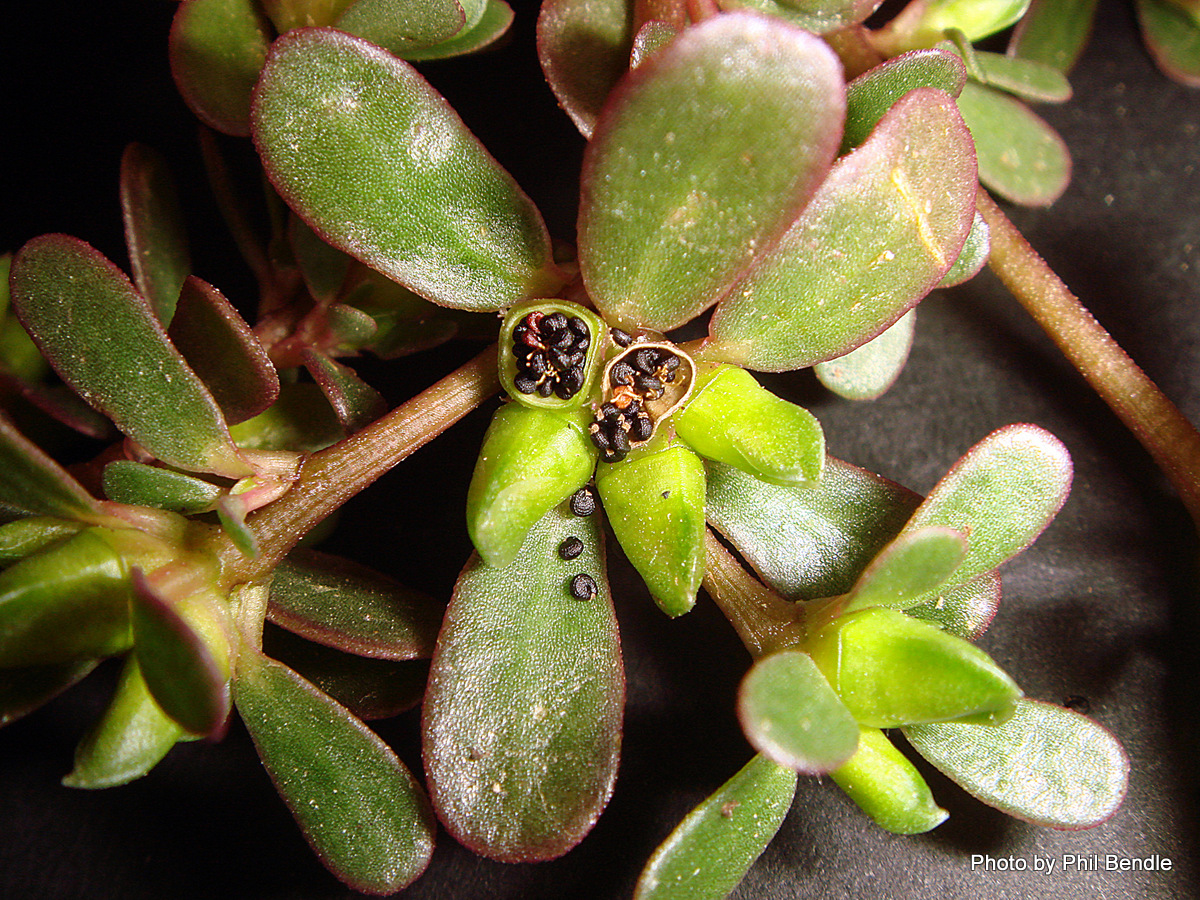
ā z juybār / bar jāy-e sarv baqla ḥamqā nešānda-and ‘They have uprooted the tall cypress from the riverbank; they have planted purslane in place of the cypress’ (p. 367, l. 7615). Purslane has the ability to reproduce vegetatively by developing adventitious roots from the cut end of the stem (Proctor, p. 4). Small yellow-petaled flowers occur singly or in terminal clusters. Each flower turns into a spherical seedpod that opens with a circular lid to release numerous tiny black seeds (Miyanishi and Cavers; PLATE II).
The entire purslane plant, including leaves, stem, flowers, and seeds, is edible as a leaf vegetable. It has a sour and salty taste, and a bite into its smooth, fat leaves gives a burst of tangy, sour juice, and thus makes an interesting addition to the palate. The plant juice is cooling and refreshing and causes polyuria. In southern Iran, purslane seed is used for decorating pastries.
In contrast to about 97 percent of all plants species that perform the C3 carbon fixation photosynthetic process, purslane is among the remaining 3 percent that perform the C4 metabolism. Such C4 plants, under droughty conditions, switch to a third process known as the CAM pathway. Through this pathway, malic acid is synthesized and stored in leaves during the night and converted into glucose during the day. This explains why the purslane leaves harvested in the early morning contain several times more malic acid and are thus significantly more sour and tangier than the sweetish tasting leaves harvested in late afternoon (Proctor, pp. 56-59).
Purslane contains more omega-3 fatty acids, alpha-linolenic acid in particular, than any other leafy vegetable, a characteristic that makes it highly desirable for nutrition (Simopoulos et al., 1992). It is rich in the antioxidants alpha-tocopherol and beta-carotene, and it is a good source of dietary minerals such as magnesium, calcium, potassium and iron (Simopoulos et al., 2005). The nutritional value and beneficial properties of purslane make it a prospective source of nutrition (Ḥosayni et al.). Some people have listed purslane as one of the world economic plants and named it “Global Panacea” (Sultana and Rahman). With this rediscovery of its properties, purslane is now sold extensively at local markets in Iran and other Middle Eastern countries.
The medicinal properties of ḵ orfa have been mentioned in Persian poetry: kasi rā ku to bini dard sorfa / befarmāyaš to āb-e duḡ o ḵorfa ‘When you see someone coughing / offer him diluted yogurt and ḵ orfa’ (Ṭayyān Marḡazi [early 11th century CE] in Modabberi, ed., p. 319). Ḵorfa is also called parpahan in Persian, often in poetry. The white mucilage from the black parpahan seed is a metaphor for rain drops and tears, respectively, in the two following verses: ze miḡhā ke sia h-tar ze toḵm-e parpahanand / čo toḵm-e parpahan ārad borun sepid laʿāb ‘From clouds darker than parpahan seed / a white mucilage comes out as if from parpahan seed’ (Ḵāqāni, in Sajjādi, p. 216), and laʿāb-e parpahan yārab čerā az čašm-e man ḵizad / gar ān ḵāl-e siah nesbat be toḵm-e parpahan dārad ‘If that black mole has a kinship with the parpahan seed / then why do my tears look like parpahan mucilage?’ (Qāʾāni, p. 144). In another verse, Qāʾāni (p. 488) refers to the tiny seed of purslane: āḵar na in ze toḵma-ye šāhi ke Buqobays / gardad ze zaḵm-e gorzaš čon toḵm-e parpahan ‘This is the sign of a king’s lineage that the rocky mountain [Abu Qobays] / is smashed into parpahan seeds by its mace.’
Bibliography
F. Agha-Hosseini, K. Borhan-Mojabi, H. R. Monsef-Esfahani, I. Mirzaii-Dizgah, S. Etemad-Moghadam and A. Karagah, “Efficacy of Purslane in the Treatment of Oral Lichen Planus,” Phytotherapy Research 24/2, 2010, pp. 240-44.
Abu Rayḥān Biruni, al- Ṣaydana fi’l- ṭebb , Pers. tr. by Abu Bakr ʿAli b. ʿOṯmān Kāsāni as Ṣaydana, Manučehr Sotuda and Iraj Afšār, eds., Tehran, 1979.
Ebn Yamin Faryumadi, Div ān-e ašʿār, ed. Ḥ.-ʿA. Bāstāni Rād, Tehran, 1965.
David Gledhill, The Names of Plants, 2nd ed., Cambridge, U.K., 1985.
LeRoy G. Holm et al., The World’s Worst Weeds: Distribution and Biology, Honolulu, 1977.
Sayyeda Zahrā Ḥosayni, Bayt-Allāh ʿAlipur, and Zahrā Moḥebbi, “Ḵorfa: ḡazā-ye bartar-e āyanda,” Majalla-ye ṭ ebb-e sonnati-ye Esl ā m va Ir ā n 6/3, 2015, pp. 257-65.
Kiyoko Miyanishi and Paul B. Cavers, “The Biology of Canadian Weeds 40: Portulaca oleracea L.,” Canadian Journal of Plant Science 60/3, 1980, pp. 953-63.
Maḥmud Modabberi, ed., Šarḥ-e ḥāl va ašʿār-e šāʿerān-e bi divān dar qarn-hā-ye 3, 4, 5 hejri qamari, Tehran, 1991.
Christopher A. Proctor, “Biology and Control of Common Purslane (Portulaca oleracea L.),” Ph.D. diss., University of Nebraska, 2013.
Mirzā Ḥabib-Allāh Qāʾāni Širāzi, Divān, ed. Nāṣer Hiri, Tehran, 1984.
Sayyed Żiyāʾ-al-Din Sajjādi, Farhang-e loḡāt va taʿbirāt-e divan-e Ḵāqāni Šervāni I, Tehran, 1995.
A. P. Simopoulos, H. A. Norman, J. E. Gillaspy, and J. A. Duke, “Common Purslane: A Source of Omega-3 Fatty Acids and Antioxidants,” Journal of the American College of Nutrition 11/4, 1992, pp. 374-82.
A. P. Simopoulos, Du-Xian Tan, L. C. Manchester, and R. J. Reiter, “Purslane: A Plant Source of Omega-3 Fatty Acids and Melatonin,” Journal of Pineal Research 39/3, 2005, pp. 331-32.
Arshiya Sultana and Khaleequr Rahman, “Portulaca Oleracea Linn: A Global Panacea with Ethnomedicinal and Pharmacological Potential,” International Journal of Pharmacy and Pharmaceutical Sciences 5, suppl. 2, 2013, pp. 33-39.
Catherine Parr Traill, Studies of Plant Life in Canada, or, Gleanings from Forest, Lake and Plain, Ottawa, Ontario, 1885.