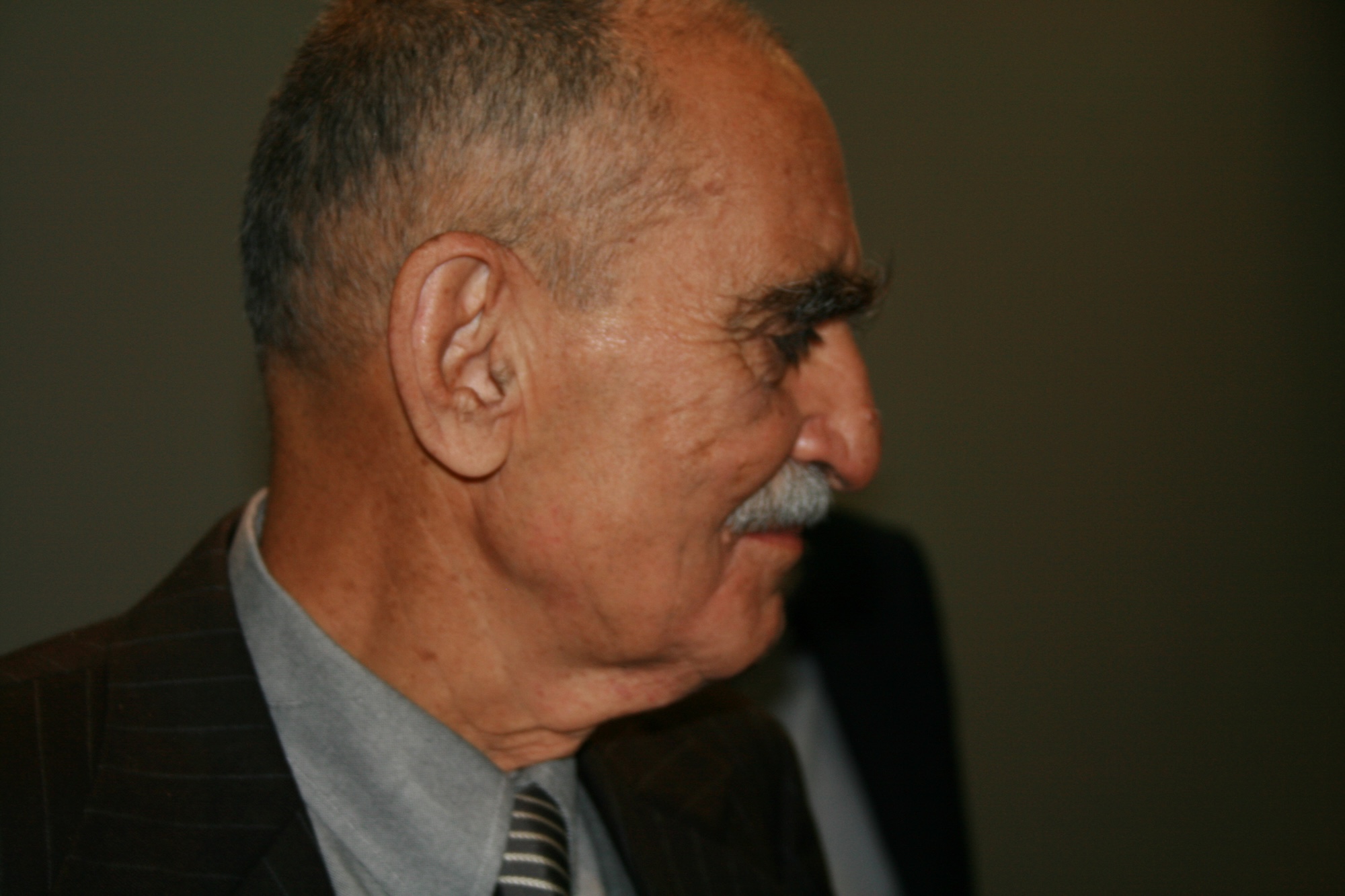
In Memoriam of Bahram Beyzaie (26 December 1938- 26 December 2025)
by Saeed Talajooy
The void that Bahram Beyzaie’s passing has left in the hearts of the Iranian intelligentsia is beyond any other in the recent decades. Beyzaie passed away in Stanford on his 87th birthday on a day that due to his birthday and Akbar Radi’s passing on the same day in 2007 was already called the Iranian Playwrights’ Day. Beyzaie was a unique individual, a leading playwright, theatre director, screenwriter, and filmmaker, who was also highly influential as a scholar and teacher of world theatre and cinema, Persian literature and Iranian folklore, history, myths, and indigenous performing traditions. His quest for knowledge and his relentless creativity changed the course of Iranian cultural production with an oeuvre that introduced many new ways of seeing, doing and understanding into Iranian culture. The range, depth and timeliness of his works were so impressive that one can only compare him with the most influential figures of Iranian cultural production such as Ferdowsi, Nezami, Saʿadi, Rumi, Hafez or Hedayat.
Bahram Beyzaie was born in Tehran in 1938 into an art and literature loving family. His father, Ne’matallah Beyzaie was a poet and scholar and his mother, Nayereh Movafegh and maternal grandmother were strong, intelligent, witty women with a passion for literature and folktales that prompted Beyzaie’s early love for folklore and myths. His forefathers were leading directors and writers of taʿziyeh plays in Aran and Bidgol County of Kashan, and his cousin, Hossein Parto Beyzaie was the author of the first monograph on the History of Zurkhaneh (1958). This already rich cultural origin, which carried the markers of several significant folk and elite traditions, was further heightened in his teenage years by his exposure to the types of marginalization that dominant religious and political discourses imposed on society to promote their reductive narratives of collective identity. It also evolved into a secular epistemic authority as his exposure to religious debates on Bahaism, his parents’ religion, and his acquired knowledge about Shiism and ancient Iranian religions enabled him to identify the mythical origins of all religions and the fallacy of the fanatics’ claims to truth.
In the 1950s, Beyzaie, who found the oppressive post-coup ambiance and the bigotry of some of his teachers and classmates intolerable, began to skip school to frequent Tehran’s cinemas. Yet, having already developed a passion for in-depth understanding of culture and cultural production, rather than being fascinated with superficial aspects of cinema, he found his way into such cultural centres as the Cine Club where he watched arthouse films and the National Arts Group where he watched Ali Nassirian’s and Abbas Javanmard’s attempts to create plays that echoed aspects of Iranian performing traditions. Originally, he tried to fulfil this desire for understanding the issues of his culture by studying whatever he could find on Iranian myths, history and folk culture and then doing a degree in Persian literature at Tehran University. However, upon realizing that his professors do not deem Iranian performing traditions worthy of study, he dropped out in 1960, found employment in Damavand’s notary public, fell in love with taʿziyeh technical qualities when watching a local performance and began to publish articles on indigenous performing traditions. These articles led to Beyzaie’s transfer to the newly established Office of Theatre (1957-) where he produced several research monographs through which he expanded the West-obsessed horizons of Iranian theatre by introducing Japanese, Chinese and South Asian performing traditions and publishing the first complete study of indigenous performing traditions with his Namāyesh dar Iran (1965). Published in a period in which most theatre practitioners did not even see Asian performing traditions as theatre, this approach created a creative momentum spearheaded by Beyzaie himself in which the purpose was no longer copying the Western or old forms of Iranian performance but reformulating the latter for a modern era. Simultaneously, Beyzaie, who was concerned with how cultural narratives victimized non-complying people by pushing them into extreme roles of heroes and demons focused on reformulating naqqāli dramatic recounting, Kheimah-shab-bāzi puppet plays and taʿziyeh passion plays in plays that subverted the demon-hero binaries in myths (Ārash and Azdāhāk 1960-61), folktales (Puppet Trilogy, Four Boxes, Sinbad’s Eighth Voyage and The Snake King 1962-66) and Javānmardi chivalry cult (So Dies Pahlevān Akbar 1963). These plays were characterised by an emancipatory gaze that deconstructed the exclusionist disocurses that perpetuated the vicious circles of inherited violence for totalitarian power. Yet, they also depicted heroes and demons as victims, and introduced women, marginalised and working-class people and intellectuals as new characters whose entrance into the public arena promoted new forms of egalitarian cultural agency. This approach shaped Beyzaie’s life-long vision in which he revitalised neglected Iranian forms in works whose narratives and aesthetic arrangements brought neglected and marginalised characters and events and into the centre of culture. These works worked at realistic, archetypal, historical, psychosocial, existential and political levels to undermine the reductionist attitudes that reduced Iranian culture to the givens of dominant religious, cultural or political discourses.
In 1965, Beyzaie married Monir Azam Raminfar with whom he had three children: Niloofar (1967-), a noted theatre director and playwright, Arzhang, who sadly passed away a few months after he was born in 1968, and Negar (1972-) who lives in Sweden. In 1968, Beyzaie, who was ever conscious of the negative impacts of censor on cultural production, became one of the founding members of Iran’s Writers Association. However, facing another form of censor and threats by extremist leftists when performing The Snake King in Mashhad, in 1969 he reduced his theatrical activities and accepted the offer to join the Department of Performing Arts at Tehran University as a visiting professor from 1969 and then a full-time professor from 1973. In his role as a leading educator until he was fired by Islamists in 1981, Beyzaie raised the standards of theatre education in Iran and turned the Department into a leading hub of training, creativity and experimentation for acting, designing, playwriting and directing.
Soon after entering this new career path, from 1970, Beyzaie brought his writing and directing experience into screenwriting and filmmaking and became a leading figure of Iranian New Wave Cinema. In this decade, he made two short films, Uncle Moustache (1970) and Journey (1972) and four feature-length films, Downpour (1972), The Stranger and the Fog (1974), The Crow (1977) and Ballad of Tara (1978-80). What set these films apart from mainstream cinema and even alternative and New Wave films is their emancipatory aesthetics which, as in his plays, constructed new visions for cinema by building on and reflecting its links with rituals, myths, literature, history, philosophy and politics, while offering inclusive visions of heroism, leadership, and citizenship and introducing new ways of seeing and understanding the positions of women, men and children in society. This approach raised the standards of Iranian cinema and turned it into a vehicle of aesthetic psychosocial, existential, and political contemplation.
During the same period, whenever he could not make films or stage plays, Beyzaie wrote plays and screenplays, whose later publications turned them into inspiring contributions to Iranian cultural production and Persian prose. This aspect of Beyzaie’s productivity became more important after the revolution when his filmmaking and theatre activities faced new forms of censor. Having already produced works of great literary significance such as So Dies Pahlevān Akbar (1963) or Court of Bactria (1969), this trend became central in his oeuvre from Death of Yazdgerd (1979) which Beyzaie turned into a film in 1981, and culminated in masterpieces like Kalat Claimed (1982), Parchment of Master Sharzin (1986), New Preface to the Shahnameh (1986), The Reed Panel (1986), Reciting Siavush (1993), Account of Bondar the Premier (1996), Afra or the Day Is Passing (1997), The One Thousand and First Night (2003), and Dash Akol According to Marjan (2011) whose poetic prose, narrative complexity and thematic visions of humanity have turned them into celebrated literary texts. Beyzaie’s mastery of the Persian language is particularly impressive due to the range of historical and social class registers he has used for his characters, the performability of his multilayered dialogues and the hypnotic power of his monologues.
Despite the screening ban on all his pre-revolutionary film as well as his Death of Yazdgerd, in 1984, Beyzaie finally managed to receive a permit for Bashu, the Little Stranger, which is often regarded as one of the greatest films ever made in Iran. However, having completed the film in December 1985, he faced a new ban which postponed the film’s screening until February 1989. Like The Stranger and the Fog and Ballad of Tara, the other two films in his Village Trilogy, Bashu, the Little Stranger has a woman at its centre and celebrates the primacy of life, love, fertility and creativity over obsession with afterlife, history, religion, stilted traditions, wars, warrior heroism and ethnocentrism. Like most of his works, it also demythologises the past by showing the divine qualities of humans and the humanity of what is assumed to be divine. Yet it also redefines the meaning of nationhood and the borders of belonging to promote a more inclusive collective identity.
With the unexpected ban on Bashu, Beyzaie switched to a seemingly less problematic project, Maybe Some Other Time (1988) which like The Crow uses noir and self-reflexive motifs to reflect the conditions of Iranian middle-class intelligentsia in an era in which imitative pseudo-modernity and equally imitative and stilted understanding of tradition destroy the prospect of grassroots sociopolitical and cultural development. In both films as in all his other creative and scholarly works, rather than accepting the crude dichotomy between tradition and modernity, Beyzaie promotes the idea of obtaining in-depth awareness of the multilayered nature of Iranian culture and regrowing its roots and narratives for a modern, inclusive idea of collective identity.
After the completion of Maybe Some Other Time, with the ban on Soosan Taslimi’s appearance in films, Beyzaie followed his family to Sweden. Soon, however, he realised that his life can only find its sense if he can follow his creative vision in his homeland, and thus, separated from his first wife and returned to Iran with literally no money in 1989. Thus, he began another period of intense writing and producing which lasted until his departure for Stanford in 2009. During this period, apart from a yearlong sojourn in Germany, which took place with the support of the International Writers’ Association in 1996 as the Chain Murders of Iranian intellectuals were reaching a record high, Beyzaie actively contributed to the intellectual debates of Iran’s rapidly changing public space, made four films, wrote numerous plays and screenplays, staged several of his plays and republished most of his plays and screenplays with the support of Shahla Lahiji’s publication house Roshangaran va Motāleʿāt-e Zanān.
His first film in this period, Travellers (1992) was an existential contemplation on the meaning of death in a ritualistic form that marked the origins of funerary rituals in purgation fertility rites and yoked a funeral to a sacred marriage to suggest the birth of a new Mithraic heroine and undermine the death-centred, religious fanaticism that distorted life in 1980s Iran. Beyzaie’s works had always featured women whose life-centred acumen, native wit or creative intellectuality highlighted the roles that women played in Iran’s cultural continuity. He had also often used archetypal suggestiveness to link these women to Anahita, Spandārmaz and Ishtar in works that introduced new ways of being that reshaped men’s and women’s agencies for social progress and predicted the rise of the men and women who initiated the ‘Women, life, Freedom’ movement. What was changing in the 1990s, however, was that his vision was being discovered by more people as Women’s movement in Iran was finding its proper place and was breaking the patriarchal shackles that the Islamists had tried to reinforce after the revolution.
While he continued his depiction of women in inspiring ways, his encounter with the 1980s reign of terror, and the Chain Murders of the 1990s and the rise of the new economic oligarchs urged Beyzaie to also revitalise his ever-present motif of creative intellectuals as sacrificial heroes and heroines in this period. While such motifs were already central to Downpour, Parchment of Master Sharzin and New Preface to the Shahnameh, their frequent use in the 1990s and 2000s in Reciting Siavush (1993), Account of Bondar the Premier (1997), Afra or the Day Is Passing (1997), Congregation for Senemar’s Sacrifice (1998), The One Thousand and First Night (2003) and Congregation for Commemoration of the Travails of Professor Navid Mākān and His Wife, Engineer Rukhshid Farzin (2005) created a new momentum for cultural resistance against tyranny and suffocating censor. In these works, Beyzaie who identified the roots of taʿziyeh in ancient fertility rites about dying fertility gods, used the form’s motifs and techniques to depict creative intellectuals and artists as sacrificial heroes victimised by dogmatic religious and political opportunists in plays that subverted the Islamists’ use of Shiʿi rituals to promote their suppressive ideology. In Day of Incidence and Striking Ali (1999), Beyzaie went so far as depicting the Shiʿi saints Imam Ali and Imam Hossein as open-minded intellectuals who faced dogmatic fanatics like the extremists of the Islamic Republic.
In 1992, Beyzaie married his lead actress in Travellers Mozhdeh Shamsaie with whom he had his son Niasan in 1995. Shamsaie, who continued to support Beyzaie as his wife, colleague and lead actress, has an impressive stage presence that facilitated the embodying of Beyzaie’s powerful women. In this period, he also wrote a monograph on Alfred Hitchock and made two short films and two feature length films. The first short, Dialogue with the Wind (1998), is a mythopoetic tragedy about the Kish Island’s loss of productive authenticity in face of trading consumerism. The second is a poetic documentary, The Speaking Rug (2006) that links the Shahnameh legend of the speaking tree to the motif of the speaking tree in Iranian rugs. His two feature-length films, Killing Mad Dogs (2000) and When We Are All Sleeping (2009) however, form a noir tetralogy with The Crow and Maybe Some Other Time. Like most of his projects in the 2000s, these films are focused on how culture is derailed by the anomy that the united force of extremism, philistinism and economic opportunism create. While the archetypal coding of these works reflects the dire impacts of such attitudes on human life in general, their direct sociopolitical referencing indicated the conditions of Iran in the 1990s and 2000s.
The sense of internal exile and the constant threats that Beyzaie suffered in Iran finally led to his emigration when the support of Dr Abbas Milani, the Head of Hamid and Christina Moghadam Program in Iranian Studies at Stanford University made it possible for him to resume his life-long passion for teaching. In Stanford, besides researching and teaching cinema and drama, Beyzaie completed a significant monograph, Hezār Afsān Kojāst? (Where is ‘A Thousand Tales’, 2013) on the Iranian roots of One Thousand and One Nights. Functioning like a sequel to his earlier monograph Rishah-yābi-ye Derakht-e Kohan (Finding the Roots of the Old Tree, 2004) and his play, The One Thousand and First Night, this book is an impressive piece of scholarship that analyses numerous mythical, historical, and literary narratives to reveal many hidden aspects of Iranian creativity while demonstrating the shared roots of the Cycle of Zahhak and Jamshid’s Daughters and the Framing Story of One Thousand and One Nights. In addition to these, Beyzaie also published several of his earlier projects, set up acting workshops, delivered public lecturers on Iranian myths, literature and performing traditions, staged several plays and helped restore some of his films. Four of the plays that Beyzaie staged in Stanford, Ārash (incantatory recitation 2013), Jānā and Balādour (shadow play 2012), Ardāvirāf’s Report (journey to the underworld 2015) and Tarabnāmeh (musical taqlid 2016) were focused on revitalizing Iranian performing traditions. The other two plays, Crossroads (2018) and Dāshākol According to Marjān (2025), are also similar in their reformulation of indigenous forms and introducing new ways of seeing and understanding for cultural rebirth, but they also introduce new tragic templates that are more concerned with the way rivalling dominant discourses become similar in their exclusionism.
Beyzaie was one of those rare individuals who fulfil the promise of their humanity in their unrelenting compassion and creative impulse for constructing a better world for posterity. Among his works which come to about one hundred plays, screenplays and monographs, he has more than thirty masterpieces which are bound to remain central to the canons of modern Iranian drama and cinema, but even his average works have aesthetic or thematic innovations that can inspire future authors and artists. In 2017 when I hosted him for receiving his honorary doctorate at the University of St Andrews, I had already initiated my publication plans for analysing his works, but his warm character, love for Iran, intellectual and moral integrity, in-depth knowledge and relentless desire for teaching and learning made me more determined than ever. Last year when I visited him in Stanford and saw one of the rehearsals of Dash Akol According to Marjan what astonished me again was his stamina, his outstanding memory and his insatiable desire for creating despite the limitations that old age impose on all of us. In my works on Beyzaie, which include two monographs, two edited volumes, several articles, two translations of his plays and an extended entry for Cinema Iranica,[1] I have tried to analyse and extract the multilayered significance of his dialogue with Iranian culture. For these studies I have seen and read more than a hundred creative and scholarly works of different lengths by Beyzaie and have in all cases been so impressed by his versatility, acumen, creativity and humanity that I am positive that his works will continue to be watched and read like such sources of inspiration as Ferdowsi’s Shahnameh, Nezami’s Panj Ganj, Saʿadi’s prose and poetry and Rumi’s and Hafez’s timeless ghazals.
[1]Talajooy, S. (2024). ‘Bahram Beyzaie’s Dramatic and Cinematic Oeuvre’. In Cinema Iranica. Encyclopaedia Iranica Foundation https://cinema.iranicaonline.org/article/bahram-bayzais-dramatic-and-cinematic-oeuvre/
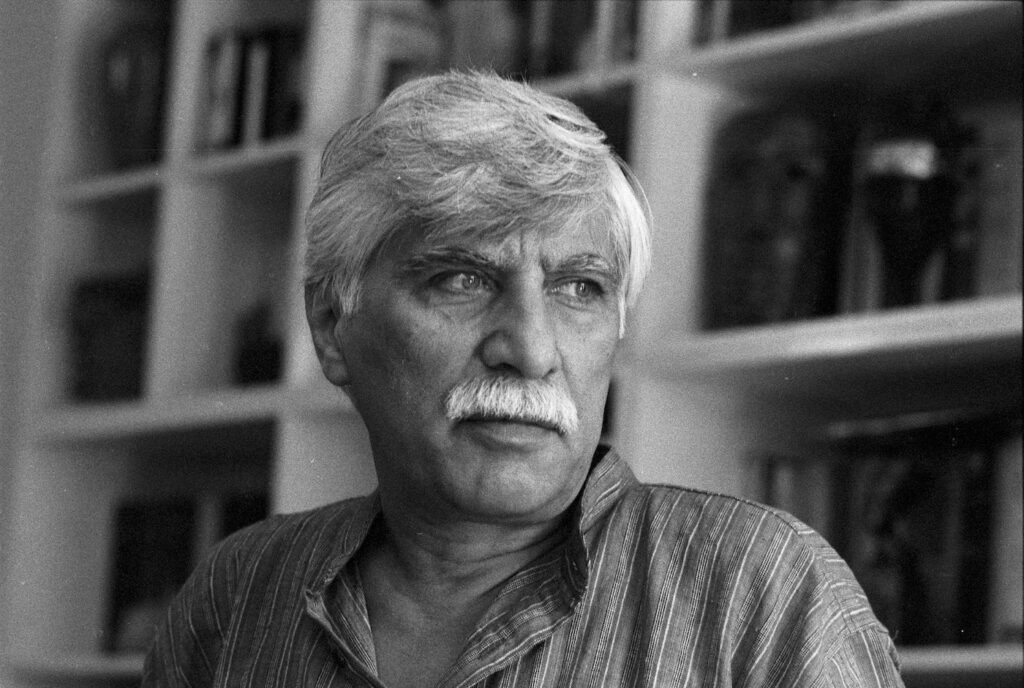
Photo by Mehrdad Oskouei, Tehran 1998.