



PLANHOL, XAVIER DE (b. Paris, 3 February 1926, d. Paris, 17 May 2016; Figure 1), prominent cultural geographer and leading authority on the relationship between the human and the natural environment, with a lifelong interest in the political geography of the Middle East and particularly Iran and Turkey.
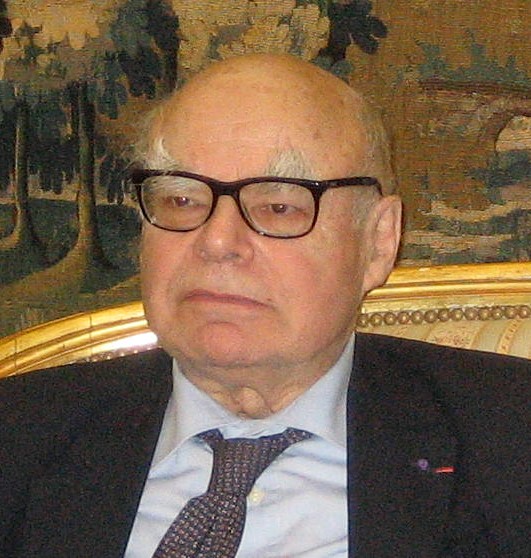
Xavier Genestet de Planhol was born in Paris on 3 February 1926. His parents left Paris in 1930 for Clamecy in the Nivernais, to an old family house, where the young Xavier grew up among books and in a traditional, but secular, monarchist family. His father, René Genestet de Planhol (1889-1940), a hussard during the First World War, had been wounded in action. On his return, he devoted himself to journalism as the editor of a small literary journal, La nouvelle lanterne, and to the education at ¯home of his only son. Xavier de Planhol did not go to school until 1939, when he joined the final year of the high school (lycée) in Moulins to prepare for the baccalauréat that he obtained at the age of fifteen (Pitte, p.99).
Back in Paris, he studied geography at the Sorbonne, where he was a pupil of Roger Dion (1896-1981) and obtained his bachelor’s degree (licence) in history and geography in 1943. Faithful to his nationalist education, he interrupted his studies in 1944 and joined a maquis of the French resistance movement against the German occupation and was wounded in battle. After the war, he resumed his studies with a master’s degree on the geomorphology of the Nivernais area, under the supervision of André Cholley (1886-1968), and successfully passed the competitive examination of agrégation in history and geography in 1946.
After teaching a year at the Prytanée military school at La Flèche, he left for Turkey as a research fellow at the French Institute of Archaeology in Istanbul (1947-50), headed then by Albert Gabriel (1883-1972). Xavier de Planhol became interested in the Ottoman world thanks to an uncle who had married the daughter of a Kurdish Ottoman military officer, Nemrut Mustafa Paşa (1886-1936). For three years, he spent each winter in intensive study of the Turkish language so he could carry out his field studies without an interpreter during the summer. Alone, in difficult conditions, he rode through villages and mountains on the horse he had bought, an exemplary testimony to the first-hand experience of geographical field studies (private discussions between the authors and de Planhol; Débarre and Pérouse). His doctoral thesis, under the direction of Jean Despois (1901-1978), entitled “De la plaine Pamphylienne aux lacs Pisidiens: nomadisme et vie paysanne,” was presented in 1956 at the Sorbonne.
After a research mission in Iranian provinces of Azarbaijan (q.v.) in 1957, the following year he took part in a major expedition of French geographers to Tehran and the central Alborz (qq.v.), initiating a strong and lasting relationship with Iranian geographers. In 1959, he took advantage of his recall to the army to carry out controversial research about colonization in Algeria. Later, he accompanied his doctoral students in Tāleš (q.v.), in the central Alborz, or in the Hindu Kush (q.v.). These fieldworks, combined with an exceptional bibliographic scholarship, enabled de Planhol throughout his career to provide a highly original analysis of the geography of the Muslim world.
On his return from Turkey, Xavier de Planhol was recruited as a lecturer in geography at the Sorbonne (1951-54), and then at the University of Nancy II (1956), where he remained for fifteen years, becoming full professor in 1960. It was also in Nancy that he, along with André Blanc, founded the Revue géographique de l’Est in 1961 and edited several special issues on the Turco-Iranian world. His annual chronicle, “Nomades et pasteurs,” was for twenty years a standard reference in international studies about nomadism for anthropologists, geographers, and historians.
Appointed professor at the Sorbonne in 1969, he succeeded his master, Jean Despois, as the chair for geography of North Africa and the Middle East (Afrique Blanche et Moyen Orient; 1969-94). He also taught at the National Institute for Oriental Languages and Civilizations (INALCO). For a quarter of a century, he directed 48 theses on the historical and cultural geography of France and of the Muslim world. Fifteen dissertations he supervised dealt with the Iranian world, including the only doctorat d’État (Habilitation) presented by an Iranian geographer, M.- H. Pāpoli-Yazdi (Le nomadisme et le semi-nomadisme dans le nord du Khorassan
, 1983).
De Planhol’s research and teaching also focused on cultural and historical geography, giving — in the tradition of Fernand Braudel (1902-85) — a wider interest to cultural heritages anchored in space and to the longue durée rather than to contemporary changes. The monumental works he published on France (Géographie historique de la France), on beverages (L’eau de neige: Le tiède et le frais, histoire et géographie des boissons fraîches), or about the animal landscape (Le paysage animal: L’homme et la grande faune, une zoogéographie historique), testify the immense erudition and the wide intellectual curiosity of this atypical geographer, who was an heir of Paul Vidal de la Blache (1845-1918), the founder of modern French geography.
However, it was the geographical study of the Muslim world that was at the heart of de Planhol’s academic works. The main theoretical analyses proposed in his major work, Les fondements géographiques de l’histoire de l’islam, published in 1968 and translated into many languages, were developed in Les nations du Prophète: Manuel géographique de politique musulmane (1993), unfortunately, not translated into English. This “handbook of political geography” is still a major reference for scholars working on the social history of the Islamic world. One can admire his extraordinary scholarship on the Muslim world and on the comparative history of civilizations in Les minorités en Islam: géographie politique et sociale (1997). The unconventional ideas of Xavier de Planhol are obvious in L’islam et la mer: la mosquée et le matelot, VIIe-XXe siècle (2000), where he wonders if phobia of the sea may explain why the Muslim peoples, who mastered the art of navigation long before the Christian West, were not the first to discover America.
The Iranian world was central in the work of de Planhol. He emphasized its originality and its specific identity linked to an early Islamization without Arabization, and also to the strong impact of the invasions of Turkish and Mongolian nomads on a territory of peasants attached to their land irrigated by the network of qanāts (see KĀRIZ) and able to protect their culture in the mountains, in strongholds of resistance to the expansion of the great nomadism. In his last lecture given at the Centre National de la Recherche Scientifique (CNRS) in Paris, “Le kârez et la luzerne: une première révolution agricole en Iran,” he pointed out the strong relations between the ecology of the Iranian plateau, the settlement of the Iranians, agricultural techniques, and the roots of the power of the Achaemenid empire. He showed how, by nature, Iran is nationalist but not imperialist, how the Iranian nation has always remained centered on the same territory protected by buffer zones.
De Planhol had a specific interest in the study of rural societies, but following the tradition of Orientalists, he had also a very deep knowledge of the whole human geography and the anthropology of the Muslim world, as testified by his more than sixty contributions to the Encyclopædia Iranica in entries dealing with historical geography, bazaars, cities, provinces, agricultural techniques of Iran and Afghanistan, and other subjects.
Even though he organized few conferences or research programs, de Planhol was very active in university institutions (director of the Department of Geography and vice-president of the University of Paris-Sorbonne) and in academic associations and societies (Chairman of the Commission of Cultural Geography of the French National Council of Geography, 1977-84), a member of the Académie des sciences d’Outre-mer (1979), of the Academia Europaea (1989), and a member of the Advisory Committee of the Encyclopædia Iranica from the very beginning (1985).
As his pupils, colleagues, and the authors of this article can attest, de Planhol was a good chess player, a connoisseur of fine wines, a great reader of detective novels, an avid bibliophile, and a collector of rare books who sought to possess all the publications he needed for his research and teaching. His impressive, yet eclectic, academic library added to the large collection of books of his parents, filling the whole apartment where he lived in Chaville near Paris as well as his mansion in Normandy.
Despite his exceptional work, de Planhol’s ideas did not have in France the resonance that one might have expected given his strong international influence, particularly in Germany (the Association of German Geographers awarded him its Grand Prize in 2015). His desire to shun the limelight might have been linked to the erudite and modest nature of his academic work, which did not explicitly fit into the schools of thought and philosophical debates that animated the social sciences. It could also be explained by his occasional unsociability and his strong character. He was confronted with the rivalry of some colleagues in the academic but also political field, in particular about the war in Algeria. Although he was honored with numerous academic awards (see Pitte, p. 102), Xavier de Planhol was not elected professor at the Collège de France, nor a member of the Académie des sciences morales et politiques, and he was only belatedly made a Chevalier of the Légion d’Honneur (2007). However, the diversity of contributions to the volumes of tributes that were offered to him on the geography of France and on the Muslim world assert the influence of this outstanding scientific personality on the many students and colleagues who admired his scholarship and were stimulated by his analyses of the Muslim world and Iran.
Bibliography
Selected works of Xavier de Planhol.
Le Monde islamique: essai de géographie religieuse, Paris, 1957; tr. as The World of Islam, Ithaca, N.Y., 1959.
De la plaine Pamphylienne aux lacs Pisidiens: nomadisme et vie paysanne, Paris, 1958.
Nouveaux villages algérois: Atlas Blidéen, Chénoua, Mitidja Occidentale, Paris, 1961.
Recherches sur la géographie humaine de l’Iran septentrional, Paris, 1964.
Les fondements géographiques de l’histoire de l’islam, Paris, 1968; tr. Heinz Halm, as Kulturgeographische Grundlagen der islamischen Geschichte, Zurich, 1975; tr. M. Saʿiduni, as Kazāfiya dawblā nohul taʾriḵ arż al-Eslām al-osos al-joḡrāfiya le-taʾriḵ al-Eslām, Tunis, 2008.
“Turquie, Iran, Afghanistan,” Revue géographique de l’Est 9/3-4, 1969 (special issue, ed. X. de Planhol).
Les zones tropicales arides et subtropicales (with Pierre Rognon), Paris, 1970.
“Turquie, Iran, Afghanistan,” Revue géographique de l’Est, 13/1-2, 1973 (special issue, ed. X. de Planhol).
Quelques paysages arborés et complantés, eds. Pierre Flatrès and X.de Planhol, Paris, 1980.
“Monde turco-iranien,” Revue géographique de l’Est, 22/1-2, 1982 (special issue, ed. X. de Planhol).
Études sur l’habitat perché (eds. Pierre Flatrès and X. de Planhol), Paris, 1983.
Géographie historique de la France, Paris, 1988 (with Paul Claval); tr. Janet Lloyd, as An Historical Geography of France, Cambridge, 1994.
Les nations du Prophète: manuel de géographique de politique musulmane, Paris, 1993; tr. Juan Vivanco as Las naciones del profeta: manual de geografía política musulmana, Barcelona, 1998.
L’eau de neige: le tiède et le frais, histoire de géographie des boissons fraîches, Paris, 1995.
Les minorités en islam: géographie politique et sociale, Paris, 1997.
L’islam et la mer: la mosquée et le matelot, VIIe-XXe siècle, Paris, 2000.
Le paysage animal: l’homme et la grande faune, une zoogéographie historique, Paris, 2004.
“Le kârez et la luzerne: une première révolution agricole en Iran,” Studia Iranica 39/1, 2010, pp. 11-26
Selected festschrifts and obituaries.
For a full bibliography of Xavier de Planhol’s publications between 1946 and 1995, see Daniel Balland in Jean-Robert Pitte, ed., Géographie historique et culturelle de l’Europe: Hommage au Professeur Xavier de Planhol, Paris, 1995, pp. 7-29; and up to 2000, Daniel Balland, ed., Hommes et terres d’islam: Mélanges offerts à Xavier de Planhol, Bibliothèque iranienne 53, 2 vols., Tehran, 2000, I, pp. 1-15.
Marcel Bazin, “In Memoriam: Xavier de Planhol (1926-2016) Ancien directeur de la Revue-géographique de l’Est de 1965 à 1972,” Revue géographique de l’Est 56/3-4, 2016. (available online at http://journals.openedition.org/rge/5957; DOI: https://doi.org/10.4000/rge.5957)
Ségolène Débarre and Jean-François Pérouse, “In Memoriam Xavier de Planhol, ancien membre de L’IFAI/IFEA (1947-1950),” Dipnot, IFEA, 2016 (https://dipnot.hypotheses.org/1928).
Jean-Robert Pitte, “Obituary: Xavier de Planhol, 1926–2016,” Journal of Historical Geography
54, 2016, pp. 99-102.