



NEGĀRESTĀN MUSEUM, a museum founded in Tehran in 1975, specializing in Iranian art of the 18th and 19th centuries.
Introduction. The Negārestān Museum was established as part of a wider museum building program initiated in the 1970s by Empress Faraḥ Pahlavi. The program was intended to preserve the country’s rich cultural heritage and to showcase Iran’s emergence as a cultural power. Other museums included the Museum of Contemporary Art, the Carpet Museum, the Ābgina Museum of Ceramics and Glass in Tehran, and regional museums in Kerman, Shiraz, and Lorestān (Stein, pp. 76, 79-81).
The museum was created with a three-fold purpose: to contribute to the general cultural advancement of Iran; to promote the appreciation and further development of the arts; and to preserve and exhibit the permanent collection of the museum, as well as temporary artistic and cultural programs (Negarestan Museum Brochure, 1975, unpaginated).
The museum derived its name from the Negārestān palace in Tehran, built ca. 1812 during the reign of Fatḥ-ʿAli Shāh Qājār (q.v.; r. 1797-1834), which later became the site of the Madrasa-ye ṣanāyeʿ-e mostaẓrafa (Fine Arts Academy) that was founded by Moḥammad Ḡaffāri Kamāl-al-Molk (q.v.) in 1911 and remained operational under that name until 1928. The original structure, the namesake of the Negārestān Museum, was decorated with large-scale mural paintings of the ruler and the court. The term negārestān also denotes a gallery of paintings in Persian. In 2017, the palace, now known as the Museum of the Negarestan Garden (Baḡ-e Muza-ye Negārestān), became the site of the Monir Museum, dedicated to the art of Monir Shahroudy Farmanfarmaian (Monir Šāhrudi Farmānfarmāʾiān, 1922-2019).
Inauguration. The Negārestān Museum was inaugurated on 24 Farvardin 1354 Š./23 April 1975 by Empress Faraḥ and Moḥammad-Reżā Shāh Pahlavi. The opening, as well as subsequent temporary exhibitions and art education programming, were extensively covered in the press and media, including Eṭṭelāʿāt, Kayhan International, The Tehran Journal, and Homa magazine (see, e.g., Pirnia; Jaferi; Graham; “Negarestan Museum …,” pp. 2-8; Lane).
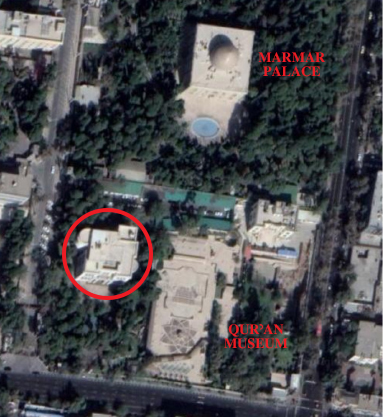
Planning, construction, and interior design. The Negārestān Museum was situated in downtown Tehran, in a park of fine pine trees adjoining the Marble Palace (Kāḵ-e Marmar) at the corner of present-day South Falasṭin street and Emām Ḵomeyni avenue (formerly Kāḵ and Sepāh avenues). The building itself was constructed at the time of Reżā Shāh Pahlavi (1925-41) in High Modernist style and may be attributed to one of the leading architects of the pre-war period. The synthesis of Bauhaus and Beaux-Arts elements found here presents similarities with the work of Moḥsen Foruḡi (q.v.) in particular (Figure 1; Grigor).

The two-story residence, foregrounded by a pool surrounded by classical-style statuary and a circular driveway, was entered through a short flight of stairs and columned portico, and was modest in materials and elegant in conception. A notable feature were the floor-to-roof triple windows of the southern façade. Although the building followed the style of modernist urban residential architecture of the era, it lacked, except for some minor architectural details, the Sasanian and Achaemenid revival elements of the official government structures of the period.
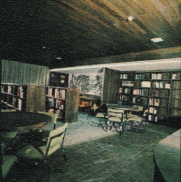
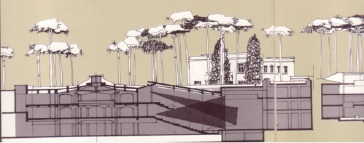
The building, previously used as the palace of the Queen Mother, Tāj-al-Moluk (1896-1982), served as the residence of Empress Faraḥ during the period of her engagement in 1959. The palace was renovated in 1974-75: the interior was converted by the consulting design firm, Art Centrum of Czechoslovakia (Jaroslav Friç, Director), and transformed into a modern museum (Figure 2) in collaboration with Her Imperial Majesty’s Private Secretariat, headed by Karim-Pāshā Bahādori, Manučehr Irānpur (architect), Firuz Shirvānlu (q.v.), and Leylā Dibā (Layla Diba) (Art and Culture section). The renovation budget was 96 million rials (Pirniā). In order to provide the services of a modern museum, the building was climate controlled, and a security system, bookstore, storage area, library (Figure 3), snack bar, and education spaces were added to the original structure by Manučehr Irānpur. An underground extensiom, intended to widen the scope of the Negārestān’s cultural activities, was planned but not completed until after 1978 (Figure 4). The site was then converted into a Qurʾan museum by Irānpur’s successor, the architect Behruz Aḥmadi in 1998 (Figure 5; “Negārestān Cultural Center”).
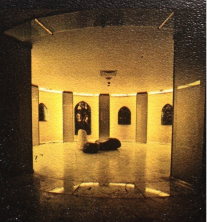
The newly renovated painting galleries were situated on the first floor. Sixty-three paintings, previously belonging to the Amery Collection (Falk, 1972, p. 57), were displayed in purpose-built alcoves separated by opaque gilt glass panels. A short multimedia presentation on Qajar art was shown in one of the galleries and a glass sculpture presenting an emblem of the empress’ crown was displayed inside the museum entrance. The second floor featured a long gallery with cases housing decorative arts such as Bohemian glass for the Persian market alternating with hanging silk carpets; a treasury with forty-nine enamel works and precious inlaid objects behind opaque glass cases; and a monumental painting of The Sons of Fatḥ-ʿAli Shah in three rows (acc. no. not available; Lane; Sotheby’s, 1975, pp. 34-35, lot 183; Taqvim-e muza-ye Negārestān, 1978, n.p.). A gallery devoted to the display of manuscripts and lacquerwork and two galleries for temporary exhibitions were also created, as well as administrative offices. The lower level housed modern spaces for museum services and storage mentioned above.
Permanent collection: Acquisition, provenance, and display, 1969-1975. After its opening, the Negārestān became the permanent home of the largest and finest public collection of 18th and 19th century Iranian art in the world. Previously, important collections of Qajar painting and decorative arts were held by the Hermitage Museum in St. Petersburg (Adamova, pp. 83-90), State Art Museum of Georgia in Tbilisi (Amiranashvili; Košoriże and Friedman, n.p.), the Victoria and Albert Museum in London, the Louvre Museum in Paris, and the State Museum of Oriental Art in Moscow (Sazonova, pp. 36-39; Maslenitsyna, pp. 14, 61-70, 82-88, 94-101, 110-117, 120, 148-163), where the works were rarely displayed. Sixty-three Qajar paintings were acquired by Empress Faraḥ through private sale in 1969 (Morton, p. 71) from Sotheby’s auction house and returned to Iran.
The paintings of the permanent collection had earlier formed part of the collection of Julian Amery (1919-96), Member of Parliament for Preston North and Brighton Pavilion from 1950 to 1992, and holder of various ministerial posts. The collection had been acquired by his father, Major Harold Amery, and his uncle, Leopold Amery, and was located in England. Harold Amery served as director of the Intelligence Services in Egypt and Sudan from 1900-1914 and acquired the majority of the collection in Cairo, Damascus, and Istanbul. Leopold Amery was a scholar who represented Spark Brook (Birmingham) in Parliament 1911-45 and served as secretary of state in India during World War II. He added to the collection during his travels abroad (Falk, 1972, p. 57; Behzādi, pp. 147-70). Unfortunately no acquisition records or correspondence have survived.
In the modern era, when traditional Persian art such as manuscript illustration and carpet production were universally admired and extensively studied and exhibited, 18th and 19th century art was generally dismissed by art historians and collectors. The appreciation of Qajar art suffered from a general disinterest in the art of the Victorian era and more specifically from the negative evaluations of Orientalist and Colonialist literature and the modern distaste for hybridity, a defining characteristic of Qajar art (Flood, pp. 33-38; Graves, pp. 4-6). The creation of the Negārestān Museum, whose sole mission was to preserve and display the art of this era, undoubtedly elevated its status and presaged the re-evaluation of the field in the 1990s (Diba, 1998, p. 8).
Some scholars have also argued that the period was neglected during the Pahlavi era: However, historical research by such figures as Fereydun Ādamiyyat and Yaḥyā Ḏokāʾ in Iran and B. W. Robinson in the United Kingdom, as well as the interest in Qajar photography and the creation of the Negārestān Museum itself, contradict this perception.
The Negārestān project may be viewed in the context of the debate on “Westoxication” (ḡarbzadegi) and the consensus by both government and opposition forces on the importance of validating and preserving “authentic” Iranian art and culture (Tabibi, pp. 106-8; Nabavi, pp. 92-104). Contrary to the more controversial Shiraz Arts Festival (q.v.), the Negārestān Museum does not appear to have been the subject of specific criticism (Stein, p. 81; Ašuri)
This collection was housed in a single dedicated space open to the public and comprised an impressive number of exceptional, historically documented, paintings of the Qajar era. Its chief value was to convincingly illustrate that Qajar art – originating in the late Safavid period and evolving though the Afsharid and Zand dynasties – actually represented the last flowering of later Persian painting before the modern era. Although masterpieces of later Qajar art such as the manuscript of the 1001 Nights, illustrated by Abu’l-Ḥasan Ḡaffāri Saniʿ-al-Molk (q.v.) and his atelier, and the paintings of Moḥammad Ḡaffāri Kamāl-al-Molk were housed in the Golestān Palace, the Museum and Library rarely made the works accessible to the general public.
The selection of paintings in the Negārestān Museum covered a wide range and was fully documented by the 1972 illustrated catalog raisonné of the collection by S. J. Falk and by the subsequent publications of B. W. Robinson (Falk, 1972a; Falk, 1972b; Falk, 2014; Robinson, 1987; Behzādi; Yaki az naqqāši-šenāsān, 2017a, 2017b). The majority of the collection belonged to the finest and most clearly defined period of the 19th century, that is, the reign of Fatḥ-ʿAli Shāh, but comprised some outstanding works of the earlier period of art produced under the patronage of Karim Khan Zand (q.v.; 1760-75) in Shiraz. It also featured examples of late 19th century painting and provincial styles. Leading artists of the period were represented by some of their most iconic works and all of the major themes of that period were included: court portraits, religious and legendary themes, idealized portraits of typical Iranian beauties, and a few landscapes. However, the works of Saniʿ-al-Molk and his followers were represented by only one work and the school of Kamāl-al-Molk not at all (Falk, 1972a, no. 63). The tradition of monumental paintings of the ruler and his court exemplified by the mural paintings of the original Negārestān Palace was also not represented in the Amery collection, leading to the additional acquisition of the large-scale painting of The Sons of Fatḥ-ʿAli Shah.
Also on permanent exhibit were examples of the arts of the book, lacquerwork, and decorative arts of the period, where it could be seen that the great tradition of Iranian craftsmanship and decoration continued to flourish. The collection was acquired in part through the Private Secretariat and its advisors, Moḥsen Foruḡi and Yaḥyā Ḏokāʾ, and in part through the generosity of private collectors. The fine selection of the 18th and 19th century jewelry and enamelwork, include an enameled writing set (Figure 6), rare necklaces of the first half of the 19th century, bejeweled and enameled weapons, and a wide range of enameled water pipe heads (see ENAMEL, ḠALYĀN).
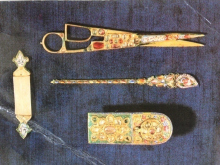
The bulk of the collection of enamelwork and jewelry was originally acquired at auction (Hotel Drouot, n.p.) by ʿAli Reżāʾi, and presented to Empress Faraḥ. The collection of lacquerwork, manuscripts, carpets, and watercolors was presented by Ḡolām-ʿAli Sayf Nāṣeri. Empress Faraḥ subsequently donated these objects to the museum. In recognition of their generosity, a gallery bearing his name was provided for Nāṣeri’s objects, and Reżāʾi’s donations were displayed with appropriate labeling in the Treasury.
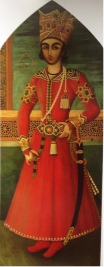
Acquisitions: 1975-78. By 1978, the collection grew from a few hundred works in 1975 to approximately 3,000 works. The bulk of the new acquisitions of 17th-19th century art was drawn from the Mahboubian Collection, which had been acquired by the Private Secretariat in 1977 (see Treasures of Persian Art after Islam for Qajar art component of the Mahboubian collection). Another significant acquisition was the purchase from Sotheby’s London in October 1978 (Sotheby’s, 1978, pp. 26-27, lot 68) of an important portrait of Crown Prince ʿAbbās Mirzā (q.v.), fourth son of Fatḥ-ʿAli Shāh Qājār (Figure 7; acc. no. not available); other notable additions included a group of five Safavid oil paintings from the late 17th century (Persian and Mughal Art, pp. 223-48 ; Keykāvusi, pls. 2-5); a Shāh-nāma dated ca. 1279/1862, with calligraphy by Mirzā Moḥammad Dāvari Širāzi (q.v.) and illustrated by Dāvari and Loṭf-ʿAli Ṣuratgar; and a Divān-e Ḵāqān, a collection of Fatḥ-ʿAli Shah’s compositions, copied in 1232/1816. While the former Amery collection itself was well-documented, the remainder of the collection although accessioned and catalogued remains unpublished, except for a few brochures and print-outs, such as the “Recent Acquisitions Brochure” of 1977.
Administration. The museum was originally administered through the Private Secretariat. After 1977, the museum became an independent entity with a Board of Directors and was incorporated into the Shahbanou Farah Foundation. A nominal entrance fee of two rials was charged and membership was available as of 1977.
The Board of Directors established in 1978 included Irān ʿAlā Firuz, ʿAli-Reżā Mehrān, Saʿid Kuroš, ʿAli Ṣādeq, and Ḵānbābā Bayāni. The chief curator and the director of the museum was Leylā Sudavar Dibā (Layla Soudavar Diba) and the museum staff included Ḥuri Eʿteṣām (Houri Etesam; Curator, 1975-77), Aṣḡar Julāʾi (Vice Director for Finances), Lily Alavi Moqaddam (Public Relations), Hādi Hazāvaʾi (Art Education), Juni Farmānfarmāʾiān (Ardalān) (Assistant Curator), Āsiya Żiāʾi (Gharagozlou) (Curator, April 1978-May 1979), and Mary Anderson (McWilliams) (Curatorial Assistant, June 1976-July 1977).
Art education. Art education programming at the Negārestān was spearheaded by Hādi Hazāvaʾi from 1977 to 1978 (the following account is based on Hādi Hazāvaʾi, “Diary: 1977-1980,” unpublished manuscript.) Hazāvaʾi was initially employed to design and implement educational activities at the museum for its staff, the public, and school-aged children. Educational material geared towards student engagement was created for teachers, including information pamphlets for gallery talks. Educational programming for children was executed in collaboration with the Ministry of Education. Classes started in February 1977 for school children, children of museum staff, and children of employees of Her Imperial Majesty’s Private Secretariat. Art classes were split between two age groups, one for children between 7-12 years of age and another for ages 12-17. Classes took place in a large basement hall, which had a seating capacity of 40 students. Each student was provided with a set of art-making supplies. Students from different schools took part in art classes at the museum three days a week. On 19 June 1977, a selection of art made by students was exhibited in the second floor main hall. Art appreciation classes made use of 100 large prints of art from around the world.
The Mini Museum, a concept developed by Hazāvaʾi in February 1977 to nurture understanding of art through study of museum art objects, opened on 4 October 1977. In the basement of the Negārestān, ceramics, woodwork, metalwork, inlaid objects, lacquerwork, and textiles depicted in Qajar painting were displayed alongside original paintings or prints of the works. The space was equipped with audio devices, procured by Hazāvaʾi and installed next to display cases, which recorded and played bilingual (English and Persian) recordings.
In addition to overseeing art education programming, Hazāvaʾi also played an instrumental role in planning the 1978 Religious Inspiration in Iranian Art exhibition and its related programming. As an advisor, he worked in conjunction with Juni Farmānfarmāʾiān and Lāla Baḵtiār (Laleh Bakhtiar) to prepare the catalogue, borrow objects for the exhibition, and coordinate press. Hazāvaʾi arranged for two naqqāl (see NAQQĀLI) to perform storytelling as part of the museum’s public programming.
Temporary exhibitions and catalogues. The Negārestān’s permanent installation was supplemented by the programming of the second floor galleries. Temporary exhibitions were planned on a regular basis and, in keeping with the goals of the Negārestān, covered a wide range of themes and materials obtained from private and public collections. In all, nine exhibitions were presented from 1975-78. The exhibitions were accompanied by bilingual catalogues (in Persian and English) and printed posters. Whenever possible, these exhibitions were supplemented by other events such as concerts, lectures, films, etc. A particularly popular event was the naqqāli storytelling that accompanied the exhibition of Religious Inspiration in Iranian Art.
History post-1979: Closing and afterlife. The building was occupied by Revolutionary Guards in 1979, and the museum was transformed into an official government site. The museum collection, which had been catalogued, sealed, and secured in the underground storage, was handed over to officials at that time. As far as is known, the collection was transferred elsewhere but has not been sold. However, a watercolor of two young ladies in European costume dated 1274/1857 by Loṭf-ʿAli Ṣuratgar (acc. no. 77.3.65) appeared on the London art market in 2006 but was removed from the sale by the intervention of the author (Christie’s, p. 112, lot 139; Taqvim-e muza, 1978, n. p.). A few of the paintings were on view at the Saadabad (Saʿdābād) Museum in 1992 (Keykāvusi, pls. 1-3, 5-11, 14-17).
According to newspaper reports, many of the pines in the Garden were destroyed in 2015 to make room for a new municipal structure, and the Qurʾān Museum has been sparsely attended and received little government support (as cited in Hazāvaʾi’s unpublished diary).
Since 2014, continued interest in the museum and its activities led to a new translation into Persian of Falk’s 1972 monograph (Falk, 2014), a reprinting of the 1941 Ruzgār-e now articles (“Amery Collection”) in 2015 (Yaki az naqqāši-šenāsān, 2017a; idem, 2017b), and a critical review in Persian of the Falk publication (Behzādi). On 26 July 2018, a conference on the Amery Collection was held at the Saadabad Museum.
| EXHIBITIONS HELD AT THE NEGĀRESTĀN MUSEUM, 1975-78(Persian and English Titles) | ||
| Date of Exhibition | Subject of Exhibition | |
| 1975 | April 23-May 24 | Namāyešgāhi az āṯār-e ḵošnevesān-e Irān/Iranian Calligraphy: A Selection of Works from 15th to 20th Century: The Āydin Ā̄ḡdāshlu Collection |
| 1975 | October 19 | Namāyešgāh-e ʿaks az sarzaminhā-ye Irān va Kānādā/An Exhibition of Photographs on Iran and Canada |
| 1976 | June – July | Grāfikhā-ye montaḵab az majmuʿa-ye ḵoṣuṣi-ye ʿoliāḥażrat Faraḥ Pahlavi Šahbānu-ye Irān/Selected Graphics from the Private Collection of Faraḥ Pahlavi, Her Imperial Majesty the Shahbanou of Iran: Curated by Donna Stein |
| 1976 | Namāyešgāhi az qabālahā ezdevāj: Sadeh-ye sizdahom va charhārdom-e hejri-ye qamari/Iranian Wedding Contracts of the 19th and 20th Centuries | |
| 1977 | February – May | Afzudahā-ye tāza ba majmuʿa-ye Negārestān: Namāyešgāhi az āṯār-e honarhā-ye sadahā-ye yāzdahom, davāzdahom va sizdahom/Recent Acquisitions: An Exhibition on the Arts of 11th, 12th, and 13th Century A.H. Iran (17th, 18th, and 19th Centuries CE) |
| 1977 | June 19 | Panj ḥess/Five Senses exhibition opening |
| 1977 | June 19 | Student-made art exhibition opening |
| 1977 | October 6 – November 16 | Ganjina-ye ṭalā va noqre-ye Landan/Golden Treasures of London (this exhibition was a part of the British Cultural Festival, Iran 1977) |
| 1978 | January 29 | Honar-e Irāni ba Elhām az‘Aqāyed-e Dini va Maḏhabi/Religious Inspiration in Iranian Art |
| POSTERS PRINTED BY THE NEGĀRESTĀN MUSEUM, 1975-79 | |
| Year | Poster |
| 1975 | Inauguration poster featuring Portrait of a Young Zand Prince Holding a Book, dated 1208/1793-94, from the Amery Collection (Falk, 1972, cat. 1) |
| 1975 | Inauguration poster featuring A Mother and Child with a Parrot, period of Fatḥ-ʿAli Shah, probably by Moḥammad Ḥasan, from the Amery Collection (Falk, 1972, cat. 31) |
| 1975 | Inauguration poster featuring Portrait of Fatḥ-ʿAli Shah Qajar in Court Costume, by Mehr-ʿAli, dated 1228/1813, from the Amery Collection (Falk, 1972, cat. 15) |
| 1975 | Inauguration poster featuring a graphic montage and detail of Lovers at a Window Drinking Wine by Moḥammad Ṣādeq, late 18th century, from the Amery Collection (Falk, 1972, cat. 5) |
| 1975 | Inauguration poster featuring a graphic montage and detail of A Court Lady Holding Roses, period of Fatḥ-ʿAli Shah, from the Amery Collection (Falk, 1972, cat. 24) |
| 1975 | Inauguration poster featuring A Girl Acrobat Balancing on a Knife, ca. 1840, by the Shirin painter, from the Amery Collection (Falk, 1972, cat. 43) |
| 1975 | Namāyešgāh-e ʿaks az sarzaminhā-ye Irān va Kānādā/An Exhibition of Photographs on Iran and Canada (photographs of Iran by Roloff Beny used in the book Persia: Bridge of Turquoise; organized in collaboration with the National Film Board and the Department of External Affairs of Canada, October) |
| 1975 | Namāyešgāhi az āṯār ḵošnevisān-e Irān/Iranian Calligraphy: A Selection of Works from the 15th to 20th Century: The Aydin Aghdashloo Collection (April 23-May 24) |
| 1976 | Namāyešgāhi az qabālahā-ye ezdevāj: Sadeh-ye sizdahom va chahārdahom-e hejri-ye qamari/Iranian Wedding Contracts of the 19th and 20th Centuries (the poster featured detail of a wedding contract dated 1316/1898 in the reqāʿ script, lent by Parviz Owsiā, acc. no. 75.3.44, in error of loan number) |
| 1977 | Afzudahā-ye tāza ba majmuʿa-ye Negārestān: Namāyešgāhi az āṯ̱ār-e honarhā-ye sadahā-ye yāzdahom, davāzdahom va sizdahom/Recent Acquisitions: An Exhibition on the Arts of the 11th, 12th and 13th Century A.H. Iran (February –May). |
| 1978 | Honar-e Irāni ba elhām az ʿaqāyed-e dini va maḏhabi/Religious Inspiration in Iranian Art |
| 1978-79 | Ṣurat va sonnat dar Torkaman Ṣaḥrā/Tradition and Transformation in the Turkmen Steppes (a collection of photographs by Maryam Zandi in the Exhibition of Turkmen Art at the Negārestān Museum, November -February). |
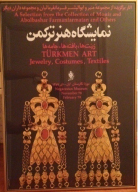
| 1979 | Namāyešgāh-e honar-e Torkaman/Turkmen Art: Jewelry, Costumes, Textiles (a selection from the collection of Monir and Abu’l-Bašar Farmānfarmāʾian and others, November-February). |
| Source: Based on Layla Diba’s personal archives, including six posters printed for the inauguration of the museum on 23 April 1975 and two posters printed in 1978 for the Turkmen art exhibition, which was scheduled for November 1978 but cancelled (Figure 8). | |
Bibliography
Exhibition Catalogs.
Nomunahāʾi az āṯā r-e ḵ o š nevis ā n-e I r ā n: Majmuʿaʾi-e Āqā-ye Āydin Āḡdāšlu dar Negārestan…/Iranian Calligraphy: A Selection of Works from the 15th to 20th Centuries, ed. Leilā S. Dibā, Tehran, 1975.
K ā t ā log-e gr ā fikh ā -ye montak ̱ ab az majmu ʿ a-ye ḵoṣuṣi-e ʿoli āḥ aż rat Fara ḥ Pahlavi šahb ā nu-ye Ir ā n/Selected Graphics from the Private Collection of Farah Pahlavi, Her Imperial Majesty the Shahbanou of Iran, introduction by Donna Stein, Tehran, 1976.
Qab ā lah ā ezdev ā j: Sada-ye sizdahom va č ah ā rdahom-e hejri-ye qamari/Iranian Wedding Contracts of the Nineteenth and Twentieth Centuries, ed. Leylā S. Dibā, essays by Āydin Āḡdāshlu and Jamšid Behnām, Tehran, 1976.
Ganjina-ye ṭ al ā va noqre-ye Landan/Golden Treasures of London, Tehran, 1977.
Honar-e Ir ā ni ba elh ā m az ʿaq ā yed-e dini va ma ḏ habi/Religious Inspiration in Iranian Art, ed. Leilā S. Dibā, with essays by Lalā Baḵtiār and Āydin Āḡdāshlu, Tehran, 1978.
Other Museum Publications.
Panj ḥ ess (Five Senses), Tehran, 1977.
Neg ā rest ā n Museum of Eighteenth and Nineteenth Century Iranian Art: Guide to the Galleries and Services, Tehran, 1975.
Neg ā h-i ba neg ā rgari-ye Ir ā n, ed. Firuz Širvānlu, Tehran, 1975 (edited volume of Persian essays and translations from English into Persian of essays on Safavid to Qajar art).
Taqvim-e muza-ye Neg ā rest ā n, 2567/Calendar of Negarestan Museum, 1978, Tehran, 1978.
1979 Appointment Calendar with Selected Works from the Collection of Neg ā rest ā n Museum of Eighteenth and Nineteenth Century Iranian Art, Tehran, 1979.
References.
Adel T. Adamova, Persian Painting and Drawing of the 15th-19th Centuries from the Hermitage Museum, St. Petersburg, 1996 (exhibition catalog).
“Amery Collection Part I,” Ruzg ā r-e now, no. 3, Winter 1941, pp. 8-20.
“Amery Collection Part II,” Ruzg ā r-e now, no. 4, Spring 1942, pp. 26-37.
“Art Education Activities in the Negārestān Museum,” in Eṭṭ el āʿā t, 8 July 1977.
Daryuš Ašuri, “Irānšenāsi čist?” R ā hnem ā -ye ket ā b 14, nos. 9-12 (Āḏar-Dey 1350 Š./ November 1971-January 1972), pp. 742-47.
Moḥammad-Reżā Behzādi, “Negārestān-e Gomšoda: Naqż-e ketāb-e Š am ā yel-neg ā r ā n-e Q ā j ā r,” Fas ̣ l-n ā ma-ye naq ż -e ket ā b 2/8, Zemestān 1394 Š./Winter 2015, pp. 147-70 (review of Falk, 2014).
Christie’s London, Art of the Islamic and Indian Worlds Tuesday 10 October 2006, London: 2006 (auction catalog).
Yahuda Dawud, “The Amery Collection of Persian Paintings,” Indian Art and Letters 16/2, 1942, pp. 90-92.
Layla S. Diba, Royal Persian Paintings: The Qajar Epoch, 1785-1925, London, 1999.
Layla S. Diba, Maryam Ekhtiar, and Basil William Robinson, Royal Persian Paintings: The Qajar Epoch, 1785-1925, London, 1998 (exhibition catalog).
S. J. Falk [Es Jey Fālk], Majmuʿa-i az naqq āšihā-ye Irān dar sada’ye davāzdahom va sizdahom-e ḥejri-e qamari, Tehran 1972a.
Idem, Qajar Paintings: Persian Oil Paintings of the 18th and 19th Centuries, London, 1972b; tr. ʿAli-Reżā Bāhārlu, as Šamāyel-negārān-e Qājār: Naqqāšihā-ye rang va rowḡan-e Irān dar sadahā-ye 12 va 13 ḥejri qamari/18 va 19 milādi, Tehran, 2014..
Tanya Farmanfarmaian, interview with Layla Diba, New York, 7 and 13 August 1984, Oral History Project,Foundation for Iranian Studies, Bethesda, Md., available at https://fis-iran.org/en/content/diba-leyla.
Finbarr Barry Flood, “From the Prophet to Postmodernism? New World Orders and the End of Islamic Art,” in Elizabeth Mansfield, ed., Making Art History: A Changing Discipline and its Institutions, London and New York, 2007, pp. 31-53.
T. Graham, “Shiʿite Themes Come in Focus at Negārestān,” Kayhan International, 30 January 1978.
Talinn Grigor, email to Layla Diba, 17 and 19 July 2018.
Margaret S. Graves, “Feeling Uncomfortable in the Nineteenth Century,” Journal of Art Historiography 6, 2012, pp. 1-27 (arthistoriography.files.wordpress.com/2012/05/graves.pdf).
Hādi Hazāvaʾi, “Diary: 1977-1980” (unpublished manuscript).
Hotel Drouot Paris, Objets en or Emaille de la Perse, Paris, 1964 (auction catalog).
M. Jaferi, “96m-rial Negārestān Museum Inaugurated,” The Tehran Journal 22, no. 6264, 23 April 1975.
N. K. Karpova, Stankovaya zhivopis Irana XVIII-XIX vekov (Oil painting of Iran: 18th-19th centuries), Moscow, 1973 (exhibition catalogue).
N. Keykāvusi, Golga š t dar Neg ā rest ā n, Tehran, 1992.
Irina Košoriże, Marina Friedman, Layla S. Diba, and B. W. Robinson, Qajar Portraits, Tbilisi, 2004 (Shalva Amiranashvili State Art Museum of Georgia Exhibition catalog).
George Lane, “At the Negārestān Museum: ‘Unique Experience of Aesthetic Tradition’,” Kayhan International, 10 May 1975.
Svetlana Petrovna Maslenitsyna, Persian Art in the Collection of the Museum of Oriental Art, Leningrad, 1975.
A. H. Morton, review of Falk, Qajar Painting, in Journal of the Royal Asiatic Society 106/1, 1974, pp. 71-72.
Negin Nabavi, Intellectual Trends in Twentieth-Century Iran: A Critical Survey, Gainesville, Florida, 2003.
“Negārestān,” Eṭṭ el āʿā t 27, no. 9648, 4 Ordibehešt 1354 Š./24 April 1975, pp. 1-4.
“Negarestan Cultural Center,” Contemporary Architecture of Iran, www.caoi.ir/en/projects/item/232-negarestan-cultural-center.html (accessed 22 June 2017).
Persian and Mughal Art: Catalogue to the Exhibition Held at Colnaghi ’ s, London, from 7 April to 20 May 1976, London, 1976.
“Negarestan Museum of Eighteenth and Nineteenth Century Iranian Art,” Homa: Iran Air In-Flight Magazine, August 1978, pp. 2-8.
Mansureh Pirnia, “Monarch, Empress Open ‘Most Precious Museum’,” Kayhan International, 23 April 1975.
B. W. Robinson, “Qajar Painted Enamels,” in R. Pinder-Wilson, ed., Paintings from Islamic Lands, Oxford, 1969, pp. 187-204.
Idem, “Art in Iran x.2 Qajar Paintings,” in Encyclop æ dia Iranica II, pp. 637-40 (available online at dx.doi.org/10.1163/2330-4804_EIRO_COM_9956).
N. V. Sazonova, “Iranian Paintings of XVIII-XIXth Centuries,” Art & the Islamic World 33, 1998, pp. 36-39.
Sotheby’s London, Oriental Miniature and Manuscripts and An Important Qajar Painting, April 8, 1975, London, 1975 (auction catalog).
Idem. Fine Oriental Miniatures, Manuscripts, Qajar Paintings and Lacquer, October 9, 1978, London, 1978 (auction catalog).
Jean Soustiel, “Retour en Iran,” Connaissance des Arts 227, 1971, pp. 32-39.
Donna Stein, “For the Love of Her People: An Interview with Farah Diba about the Pahlavi Programs for the Arts in Iran,” in Staci Gem Scheiwiller, ed., Performing the Iranian State: Visual Culture and Representations of Iranian Identity, London, 2013, pp. 75-82.
Baharak Tabibi, “Propagating ‘Modernities’: Art and Architecture Patronage of Shahbanu Farah Pahlavi,” Ph.D. diss., Middle East Technical University (Ankara), 2014.
Taqvim-e muza-ye Neg ā rest ā n 2567 (Calendar of Negarestan Museum, 1978), Tehran, 1978.
Treasures of Persian Art after Islam: The Mahboubian Collection, New York, 1970 (exhibition catalogue).
James Underwood, “Qajar Paintings Back in the Limelight,” Kayhan International, 13 April 1975.
Yaki az naqqāši-šenāsān [“A Painting Connoisseur], Conn, (Koleksion-e Eymeri (1),” Faṣl -n ā ma-ye naq ż -e ket ā b 4/16, Zemestān 1396 Š./Winter 2017a, pp. 227-38
Idem, “Koleksion-e Eymeri (2),” Faṣ l-n ā ma-ye naqż-e ket ā b 4/16, Zemestān 1396 Š./Winter 2017b, pp. 239-50.
“Zibātarin muza-ye Irān gošāyeš yāft,” Eṭṭ el āʿā t 27, no. 9647, 3 Ordibehešt 1354 Š./23 April 1975, pp 1-2.