



MYERS, GEORGE HEWITT, (b. 10 September 1875, Cleveland, Ohio; d. 23 December 1957, Washington, D.C.), American businessman and philanthropist; collector of textiles, including Persian carpets, as objects of art, and founder of The Textile Museum.
George Hewitt Myers was born in Cleveland, Ohio on 10 September 1875, the son of John J. Myers and Mary Butterfield Ware Hewitt; the only son of his father’s second marriage (Figure 1). His father died in an accident when Myers was eight, and he was raised by his mother. He earned his master’s degree from the Yale University’s Forestry School and was a member of the school’s first graduating class in 1902. While at Yale, Myer’s half-brother John Ripley Myers (1864-99), one of the founders of the Bristol-Myers pharmaceutical company, suddenly died, and Myers unexpectedly inherited an interest in Bristol-Myers. This gave him a financial cushion as he set out into the world. Carpets entered his life at Yale. Myers is said to have become interested in collecting carpets after he purchased a few carpets to decorate his dorm room at Yale and later learned that the carpets he had acquired were not as old or special as he hoped, and his curiosity was awakened to explore and figure out the reasons (Collins, 1985, p. 5). Despite his degree and lifelong interest and passion in forest management and nature conservancy, his real obsession was collecting textiles and inspiring others to appreciate textiles as art. After graduation, he spent the next few years traveling extensively for the U.S. Forestry Service to western Europe, India, the Philippines, and Japan. He began to invest in forest land, particularly in New England and Georgia.
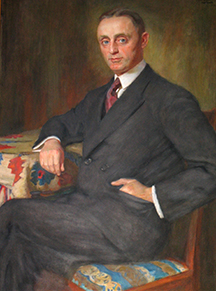
In 1908, Myers married Louise Stoddard Chase (1879–1960), the daughter of a wealthy cotton textile manufacturer in Fall River, Massachusetts. The couple first settled in Rhode Island, and then, after the birth of their first daughter, in Washington, D.C., in 1912. Myers hired the classical architect John Russell Pope to design a house for the family in the Kalorama neighborhood of Washington, to which they moved in 1913. In 1919, Myers purchased the house next door, a spacious private home designed by Washington architect Waddy Wood. It was both a house for his mother and a place for the display, study, and care of Myers’ burgeoning textile collection (Bier, pp. 58-59).
By 1915, Myers was a serious collector who was acquiring textiles from dealers in the United States and Europe. Myers also became a presence in Washington, D.C. arts circles, frequently hosting gatherings and after-theater or post-concert dinners, but his greatest contribution to the arts was the establishment on 1 June 1925 of a museum that he named The Textile Museum.
PRIVATE COLLECTING
Myers considered collecting to be a selfish activity, and he cautioned that “A thing constantly to be guarded against is the desire to get something that nobody else has and preferably, that they can’t get” (Myers, 1927), His advice to new collectors was to rely on their common sense as an aid to proper perspective.
In one of many speeches he delivered, he also shared his thoughts on art museums and their mission as such: “[The] Province of Museums of Art is certainly to preserve free from harm the best examples of artistic creations that they can obtain by gift or afford of purchase. But it is more certainly their duty, and on them most of all falls the responsibility to show these things to the public so as best to educate the public taste and set constantly higher standards in art. To give pleasure to the initiated is of less importance, …” (Myers, n.d.).
Myers, like any other collector, learned through his early mistakes. He later wrote that this came into focus when “… the first sight of a tattered old Ghiordes threw the spot-light of authenticity upon two or three of [my] earliest purchases which proved to be modern examples of this weave which had received an effective application of pumice-stone and ‘elbow grease’!” (Myers, 1931a, p. 335). His curiosity was aroused. He was intrigued by design and technique, and by how these were adapted by different weaving traditions or practiced independently of each other.
Myers was adamant that textiles had to be considered an independent branch of fine arts, and he whole-heartedly supported the investigation of their scholarly potential. Myers achieved his overriding interest of fostering and developing the textiles as fine arts by establishing a museum in 1925, as was the customary undertaking of civic leaders in the late 19th and early 20th century. What set Myers apart from others of his generation of benefactors was his singular focus on one type of art which was, and to a certain extent still is, considered a minor art: textiles. Above and beyond this singular focus, the type of textiles he chose was unusual: textile arts from non-western cultures.
THE TEXTILE MUSEUM AND INSTITUTIONAL COLLECTING
The mission of The Textile Museum has always been educational and scientific. Myers’s blueprint for the new institution was articulated clearly in the Museum’s incorporation document dated 1 June 1925: “To establish, maintain, and add to a collection of rugs, tapestries and other works of art; to foster and develop the fine arts by establishing in connection with such collection a library for use by students of the fine arts; by arranging for and giving exhibitions of rugs, tapestries, and other works of art; by arranging for and giving musical concerts and lectures on the fine arts … to encourage and to promote the knowledge, appreciation, and study of the fine arts …” (quoted in Bier, p. 62). As the president of the Board of Museum Trustees, director of the Museum, and the main benefactor for its collections during the Museum’s first 32 years, Myers set the course for the institution based on four principles: acquire, preserve, research, and disseminate.
In the early 1920s, Myers began to collect more methodically. His aim was to assemble a collection that was as diverse as possible, in order to build a comprehensive picture of non-western textiles. He had a discerning eye, he educated himself, he knew a lot about the material he collected, and he always relied on knowledgeable people to help him. These qualities allowed him to be experimental in new areas of collecting and to spend less while purchasing more.
The majority of Myers’ textiles were acquired through dealers based among others in New York; Washington, D.C.; Boston; Paris’ London; Vienna; Berlin; Munich; and Cairo. Myers was known as a well-informed and highly intelligent buyer. He believed that “one must be firmly grounded in art and unusually independent and tenacious of opinions honestly formed, not to be utterly confused by what he sees” (Myers, 1927). He sought advice from a large network of respected scholars including curators of The Textile Museum and scholars associated with other institutions building a comprehensive collection. They advised him on the technical and historical aspects of textiles as well as on new areas of interest. In 1928, Germaine Merlange (1897-1973), who was possibly the first in-house scholar in the early days of The Textile Museum, encouraged Myers to consider archaeological textiles from Peru as worthy objects for collecting. He consulted Islamic art historians, including Rudolf Meyer Riefstahl (1880-1936), Ernst Kühnel (1882-1964), Arthur Upham Pope (q.v.; 1881-1969), Mehmet Ağaoğlu (1896––1949), and Richard Ettinghausen (q.v.; 1906-79), along with scholars of Peruvian textiles, first Morris De Camp Crawford (1882-1949), and later Junius Bird (1907-82). Nonetheless, Myers always reserved for himself the right to make final decisions. His relationship with Pope was especially influential to the development of the Persian textile collection (Krody).
It is very clear from the actions and projects that were pursued by Myers and the Museum staff after the establishment of the Museum that establishing a public institution had a major effect on Myers’s collecting philosophy and habits. His early collecting, besides the mistakes, focused more on the aesthetics of a given textile under his consideration; this stayed the same with added considerations after the establishment of the Museum. He also bought some less than pristine objects, because of their historical importance as valuable material for research which would then lead to the reconstruction of traditions and the understanding of cultures that produced these textiles.
Once Myers had orchestrated the transformation of his private collection into a public one, his focus in collecting increasingly shifted towards textiles that were historically important or technically unusual, regardless of their condition. He stated “Since our last meeting we have made acquisitions, some of which are important and others which add to the completeness of our collection more from a technical and study viewpoint. I may lay the foundation for work in the future which will make the Textile Museum of some permanent value in the history and study of textiles” (director’s report presented by Myers to The Textile Museum Board of Trustees on 17 October 1948).
At the time Myers established The Textile Museum in 1925, his collection included 46 Persian rugs. His first significant Persian textile purchases are dated to 1926. Over the next 32 years as the director of the Museum, he continued to acquire Persian textiles for the collection from early Sassanian to Seljuk periods and to the later Safavid and Qajar periods (Myers, 1931a, pp. 338-342 for rugs, p. 334 for other textiles in the collection). When he died in December 1957, The Textile Museum collection included 445 Persian textiles, 93 of which were rugs. Currently the Museum collection includes 704 Persian textiles and 345 rugs. Myers wrote “The textiles of Persia….In sheer beauty of design and color and delicacy and complexity of weave this whole group, extending over a period of a thousand years, is almost without rival among stuffs now in existence” (Myers, 1931a , pp. 344). Among the Persian textiles, Myers was especially found of 16th century Persian carpets saying “There is no doubt that the Persian rugs of the 16th century, and before that time if they exist, are generally admitted to be the best of the pile carpets” (director’s report presented by Myers at The Textile Museum Board of Trustees meeting on 17 October 1948). On the other hand, he was frustrated not to be able to find complete examples at reasonable prices: “Likewise, we frankly admit that we are weakest in the Persians for the simple reason that their prices are and always were beyond our reach” (director’s report presented by Myers to The Textile Museum Board of Trustees on 17 October 1948).
Myers purchased most of his 93 Persian rugs in a period spanning from the 1910s through the 1930s, and his sources were auctions, such as the Lamm collection auction, and dealers, among whom were Hekimian, Indjoudjian, Benguit, Nasib, and Hintlian. He only added 16 new Persian carpets to the collections between 1940 and 1957, from the Kelekian collection auction, as well as through dealers such as Beshir, Demotte, Heeramaneck, Indjoudjian, Hintlian, and Madjar.
An exhibition of Early Oriental Carpets from Persia, Asia Minor, the Caucasus, Egypt and Spain, organized for the Arts Club of Chicago from 3 January to 10 February 1926, had a long-lasting impact on Myers and The Textile Museum’s Persian carpet collection. Arthur Upham Pope was the major contact between George Hewitt Myers and the Arts Club of Chicago during the negotiations for several rugs which eventually ended up in The Textile Museum’s collections and are considered a very important part of the collection today (Myers, letter to Pope, 7 January 1926, George Hewitt Myers Archives, The Textile Museum, Washington, D.C.). Eventually, Myers bought 12 rugs that were in the exhibition, and five of these were Persian rugs: Three came from Bernheimer Brothers (The Textile Museum R33.1.2 [Pope 1926, cat. no. 2]; The Textile Museum R33.6.11 [Pope, cat. no. 17]; The Textile Museum R33.28.1 [Pope, cat. no. 27]). Right after the exhibition closed, The Textile Museum R33.4.11 was purchased from DeMotte in June 1926 (Pope, cat. no. 12), and The Textile Museum R33.4.6 from the estate of Dikran Kelekian in 1951 (Pope, cat. no. 10). One of the rugs he purchased was the 17th-century Safavid kilim (The Textile Museum R33.28.1), from the central and border designs of which Myers created his book plate (Figures 2 and Figure 3). Considered a masterpiece of Safavid kilim weaving and purchased from Bernheimer Brothers, Myers was very particular about the kilim and requested special handling of it, asking that “it gets dirty as little as possible before it can be shipped” (Myers, letter to Pope, dated 7 January 1926, George Hewitt Myers Archives, The Textile Museum, Washington, D.C.).
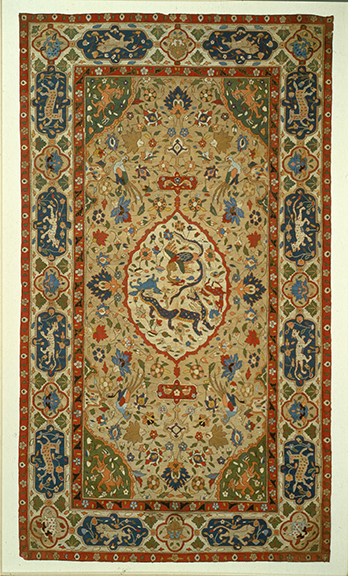
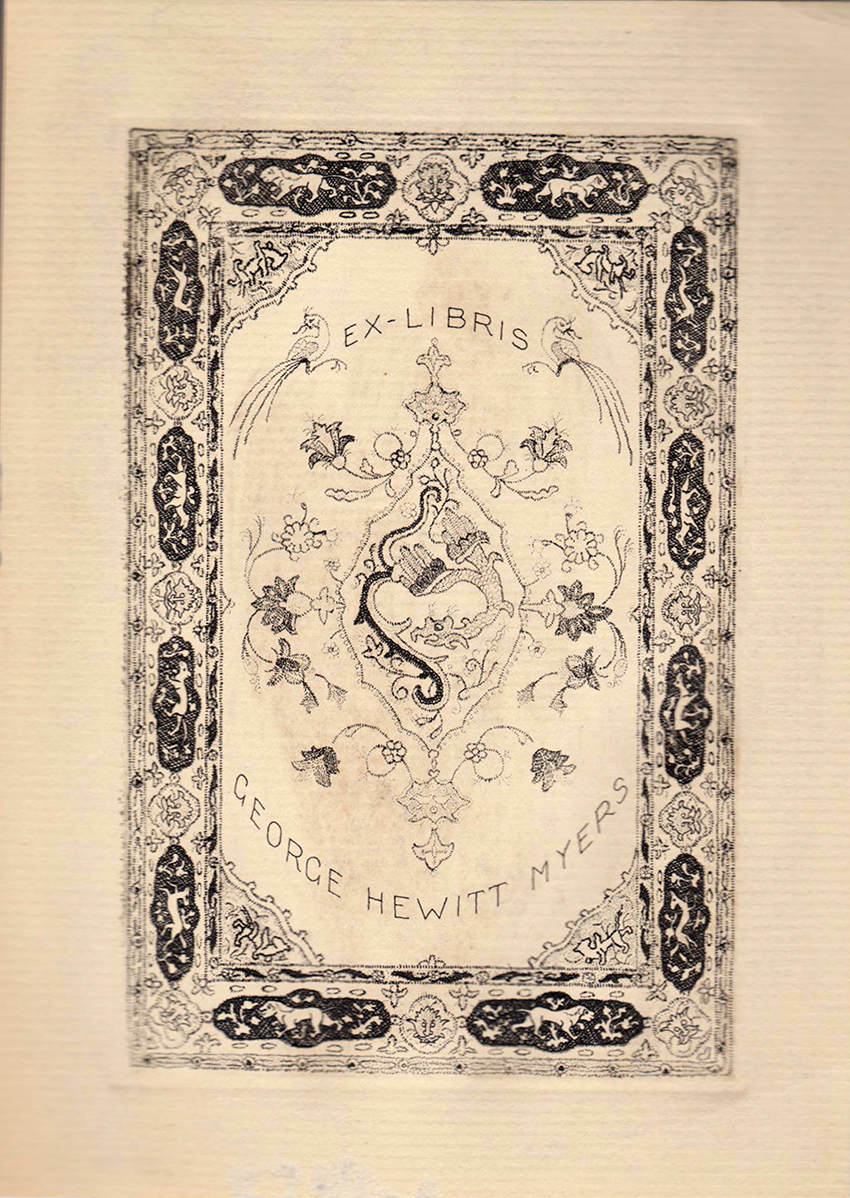
Myers acquired most of his Persian textile collection during the 1920s and 30s from various dealers including Filipo, Sasson, Indjoudjian, Nazare Aga, Loewi, Rabenou, Minasian, Guerson, Kevorkian, Kelekian, Mallon Hintlian, Beijan, and Beshir among others. He focused his collecting on Safavid and Qajar period textiles (Figure 4). Pope was one of the scholars Myers consulted when considering adding Islamic, especially Persian, art to his expanding collection. Myers relied not only on Pope’s knowledge of Persian art, but also may have trusted Pope’s aesthetics choices when selecting objects for the growing collection of The Textile Museum, particularly considering Pope’s expertise in studies of aesthetics (see Krody on the Pope and Myers relationship).
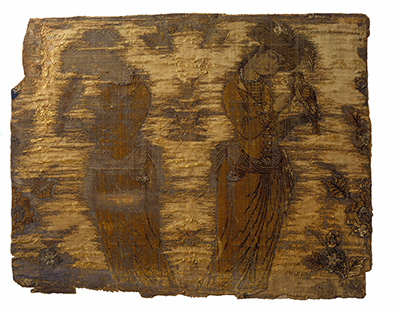
Myers’ collection of Safavid and Qajar period textiles was extremely important for scholarship and was the focus for The Textile Museum’s catalogue and exhibition Woven from the Soul, Spun from the Heart (Bier, ed.). The book still is considered one of the first, if not the first, integrated study showing the role textiles played in the development of the Persian nation, in addition to being an in-depth study of Safavid and Qajar period textiles and their impact in international trade and economics as well as to the cultural environment. After Myers’ death, the collecting focus of the museum slightly shifted to textiles produced by nomads, and in the villages and cities reflecting the collecting trends and availability of these textiles in private collections since the 1960s.
Myers understood the critical difference between a private collection and a museum collection; a private collection is an evolving personal entity and the other is a series of concepts embodied in an institution operating for public benefit. He defined the institutional collecting with a broad educational intent. He was a collector who sought to maximize the utilization of his collection for the purposes of research, interpretation, and presentation; he also recognized the accompanying responsibilities for collections management, records management, and institutional management and encouraged scientific research on the care and conservation of textiles.
In the early 1940s, Myers asked the Board of Trustees of the Museum to establish a committee to develop recommendations for the future activities at the Museum to make the museum authoritative resource in textile studies. The report presented in October 1944 is very interesting in the sense that it crystallized what had been developing since the establishment of the Museum and helped to focus the research methodology museum staff were using and help paved the way for scholarly research on textile history. The report encouraged Myers, and through Myers the Museum staff, to focus on analyzing physical characteristic of textiles in detail for weight, weave, thread count, yarn size, yarn construction, yarn twist, thickness, and for detailed analysis of the fiber content with respect to the particular variety and dimensions of each kind of fiber present, besides the normal practice of focusing on the color, pattern, and the structure of the textiles from the standpoint of the artistic or aesthetic evaluation. One outcome of this approach was the identification of fakes in the collection. In early 1930s, Myers and other museums in the United States and the United Kingdom bought a considerable number of early Iranian textiles, some of which were provenanced to the Bibi Shahr Banu complex near Tehran. Authenticity concerns about some of these early Iranian silks came to surface in the 1940s. The Textile Museum curators Florence Day and Louisa Bellinger raised concerns about structures they encountered in these textiles based on their analysis that they felt did not correspond with the available weaving technology at the time of production as suggested by scholars such as Phyllis Ackerman. Many other scholars and museum curators also raised similar authenticity concerns based on their research interests. The concerns about the dating of the individual textiles and their provenance in the museum collections are still debated in the scholarly community (see Mackie; Méthé and Krody; Blair, Bloom, and Wardwell for the history of this debate).
Myers decided on separating the roles of conservator and curator in early 1940s. To achieve his goal of “reconstructing the story of textiles from their earliest beginnings,” Myers hired an art historian and an “analyst” with specific area expertise. The work of the newly hired curator and analyst, Florence Day and Louisa Bellinger, especially the latter’s analysis and notation of technical aspects of textile structures, was pioneering in the study of textiles. Bellinger’s work came to full view with the publication of the first of The Textile Museum’s catalogues raisonné (Kühnel and Bellinger, 1952).
Irene Emery had joined the staff in 1955 as Associate Curator of Research. Myers believed that Emery’s work of compiling a glossary for technical terms was badly needed and essential for study of textiles. He was contemplating the publication of the exhaustive studies made by Emery on the analysis and classification of the structures of ancient and primitive fabrics. Myers believed that her research focus was consistent with the analytical work carried on by the Museum staff. Emery’s ground-breaking book The Primary Structures of Fabrics was published in 1966, eight years after Myers passed away in December 1957.
Research in textile conservation, analysis, and history conducted by the staff made the Museum a magnet for researchers and museum professionals. Initially Myers’s idea of sharing the Museum’s collections was more attuned to scholarly pursuits. While Myers was hesitant to open his house to visitation by the general public, he had no hesitation about sharing his collection with other institutions and museums. When Myers was on the helm, The Textile Museum organized many traveling exhibitions. These exhibitions tended to have more educational underpinnings and were organized to appeal to a public uninitiated in the textile arts. Myers and his staff also spent considerable time advising educational institutions on courses related to textiles and textile history, such as Goucher College in Baltimore.
Besides exhibitions and educational programs, Myers focused his and the Museum staff’s efforts on sharing knowledge gained through primary research and enthusiasm about textiles through scholarly publications. He spent significant time and financial resources on developing catalogues raisonné covering different areas in the collections. The Museum published a total of four catalogues raisonné. They are still the primary references for those parts of the Textile Museum’s Collections.
A second type of publication, titled Workshop Notes, was printed in pamphlet format. Although this publication required fewer financial resources, it held as much scholarly importance as the catalogue raisonné. Starting in 1949, Workshop Notes were published on several technical subjects, ranging from cleaning and mounting procedures for wool textiles to spinning and fibers in warp yarns. These publications were offshoots of the workshop-format programs conducted at the Museum, such as proceedings of a conference. Although they were not focused in one geographic area or culture, their technical content was relevant to many aspects of textile strudies.
Myers’s extensive contributions to the arts, apart from The Textile Museum, included serving on the board of the American Federation of the Arts and as a member of the Smithsonian Fine Arts Commission (Bier, p. 59). Myers was a passionate, meticulous, and prolific collector who amassed an internationally renowned and respected collection of textiles. His vision for institutional collecting developed out of his personal interest, and he implemented this vision by virtue of his active involvement with The Textile Museum until his death in 1957. Myers’s love of the textile arts was matched only by his enthusiasm to educate the public as well as scholars on the merit and importance of this ancient art form. Myers’ son-in-law, Alexander G. Stone, summoned up what Myers did best to achieve his goal: “Myers seemed to prefer the role of catalyst, one who provided the setting in which others could shine” (Notes, p. 46)
Bibliography
Carol Bier, “Legacy of Collector George Hewitt Myers,” Arts of Asia 26/1, 1996, pp. 58-65.
Carol Bier, ed., Woven from the Soul, Spun from the Heart, Washington, D.C., 1987.
Junius Bouton Bird and Louisa Bellinger, Paracas Fabrics and Nazca Needlework: 3rd Century B.C.-3rd Century A.D., Washington, D. C., 1954.
Sheila S. Blair, Jonathan M. Bloom, and Anne E. Wardwell, “Reevaluating the Date of the “Buyid” Silks by Epigraphic and Radiocarbon Analysis,” Ars Orientalis 22, 1992, pp. 1-4.
Sheridan Pressey Collins, “George Hewitt Myers 1875-1957,” HALI 27/7/3, 1985, pp. 5-7.
Sumru Belger Krody, “Equivocal Position as Expert or Dealer! The Long and Contentious Relationship of George Hewitt Myers and Arthur Upham Pope,” in Yuka Kadoi, ed., Arthur Upham Pope and A New Survey of Persian Art, Leiden, 2016, chap. 11, pp. 288-305.
Ernst Kühnel and Louisa Bellinger, Catalogue of Dated Tiraz Fabrics: Umayyad, Abbasid, Fatimid, Washington, D.C., 1952.
Ernst Kühnel and Louisa Bellinger, Cairene Rugs and Others Technically Related: 15th Century-17th Century, Washington, D.C., 1957.
Louise W. Mackie, “The Buyid Silk Controversy,” in idem, Symbols of Power: Luxury Textiles from Islamic Lands, 7th-21st Century, Cleveland, 2015, pp. 154-55.
Esther Méthé and Sumru Belger Krody: “Buyid Silk at the Textile Museum,” Textile Specialty Group Postprints 17, 2007, pp. 1-11,
George Hewitt Myers, untitled lecture transcript presented to the Colonial Dames of America for the benefit of Wythe House on 28 March 1927, George Hewitt Myers Archives, George Washington University Museum and The Textile Museum, Washington, D.C., 1927.
Idem, “The Washington Textile Museum,” The American Magazine of Art 22/5, 1931a, pp. 334-345.
Idem, “A Layman at the Persian Exhibition,” The American Magazine of Art 22/6, 1931b, pp. 457-60.
Idem, untitled lecture draft, George Hewitt Myers Archives, George Washington University Museum and The Textile Museum, Washington, D.C., n.d.
Notes about the Textile Museum, compiled by Petronel Lukens, The Textile Museum, Washington, D.C., 1973, unpublished manuscript.
Arthur Upham Pope, Loan Exhibition of Early Oriental Carpets from Persia, Asia Minor, the Caucasus, Egypt and Spain, Chicago, 1926.
The Textile Museum Board of Trustees Meeting Minutes 1925-1957, George Washington University Museum and The Textile Museum, Washington, D.C.