


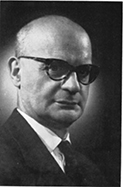
KURYŁOWICZ, JERZY (WŁADYSŁAW) (b. Stanislau [Galicia, Austria-Hungary, now Ivano-Frankivsk, Ukraine], 26 August 1895; d. Kraków, 28 January 1978; Figure 1), Polish linguist and scholar of Indo-European studies.
Jerzy Kuryłowicz, the son of a merchant, received his primary education in Lemberg (later Lwów; now Lviv, Ukraine). After finishing school in 1913, he took up studies in Vienna at the then University of World Trade and at the Consular Academy. After World War I, in which he fought as an officer of the Austrian army and was taken prisoner by the Russians, he began to study Romance and Germanic languages at the University of Lwów in 1920 and received his doctoral degree in 1923. Receiving a scholarship from the French government, he continued his studies in the years 1923–25 in Paris, in particular with Antoine Meillet (q.v.; 1866-1936), the noted Indo-Europeanist.
After his return to Poland, Kuryłowicz took his qualification as a university lecturer in Lwów in 1926, and, in 1928, he was appointed professor (in 1934, he obtained a full professorship) of Indo-European linguistics at the University of Lwów. He taught there until 1946 (except for the years of a Rockefeller scholarship [1931/32] and, during World War II, the years of the Soviet and then the German occupations). After a short intermezzo (1946–48) as a professor in Wrocław (formerly Breslau), in 1948 he moved to Kraków, where he became professor of General Linguistics at Jagiellonian University, a position he occupied until his retirement in 1965.
Kuryłowicz was a member since 1938 of the former Polish Academy of Learning in Kraków, and since 1952 of the later Polish Academy of Sciences, and also of a number of foreign academies. Moreover, he held several honorary degrees from European and American universities and was the recipient of several medals and decorations.
Jerzy Kuryłowicz was one of the leading European linguists of the 20th century. He became known first as an Indo-Europeanist through a number of studies (esp. 1927a; 1927b; also 1935, pp. 27–76), in which by taking into account also the Hittite evidence he irrefutably established that Hittite initial ḫ– reflected the Proto-Indo-European (PIE) laryngeal h2
-. This was the definite proof that the consonantal elements (“coefficients”) postulated by Ferdinand de Saussure (1857-1913) for the phonological system of the protolanguage only by theoretical reflections (in this case “A”) had really existed. By this discovery and other findings concerning, for example, compositional lengthening, contractions of short vowel plus laryngeal or the so-called Attic reduplication in the Greek perfect tense, Kuryłowicz had found material proof for de Saussure’s original hypothesis, which was based only on certain ablaut conditions, and the laryngeal theory had received its classical form.
A typical characteristic of Kuryłowicz’s oeuvre is that he started from some single (or even isolated) phenomenon and elaborated from this a more general statement; to a greater extent, this is true also for his “Inflectional Categories” (Kuryłowicz, 1964a), which expound general tendencies in the development of the categories playing their part in nominal and verbal morphology.
To Kuryłowicz’s disappointment, the publication of the Indogermanische Grammatik, the editorship of which had been entrusted to him by the publisher, came to a halt around 1970. Therefore, he published in his last book (1977) a couple of reflections related to “the method of comparative and historical research based on the principles of structuralism,” which, in his view, still merited discussion.
Kuryłowicz’s studies in the field of Indo-European comparative grammar dealt with all the historical languages from Celtic and Germanic to Hittite and Indo-Iranian as well as with the proto-language. He was the author of some very important works on accentuation and ablaut (1952; 1956; 1968) as well as on aspect and tense, the basic concepts of which he saw in perfectivity versus imperfectivity and simultaneity versus anteriority. Throughout most of his life, he dealt intensively with the documentation in the various individual languages and was able to establish the evidence and assess it with methodical stringency. In this connection, it should be emphasized that Kuryłowicz also made use of the methods customary in Indo-European studies for comparative studies on the Semitic languages (see Kuryłowicz, 1961; 1972a).
Even when dealing with particular problems, Kuryłowicz was always looking at the general aspects of each problem and not least at methodology. Therefore, he was more interested in identifying the overall context and the linguistic structure than in understanding all the evidence, and for this he employed the methods of structuralism elaborated by various European and American schools. Kuryłowicz’s method in historical comparative linguistics was taking notice more of the function than of the outer form of the linguistic elements in order to detect their role in the entire system of phonology, morphology, word-formation, etc.; this led him to comparing their relation or opposition to the other parts of the system regarding form and/or meaning. Accordingly, he turned increasingly to problems of linguistic theory. For example, he studied intensively the role of analogy in the development of languages, and, in an influential article from 1949 (reprinted in Kuryłowicz, 1960, pp. 66–86), he established six “laws of analogy” that contributed significantly to the understanding of the regularities of grammatical changes triggered by analogical processes both between single words and within a given paradigm or other grammatical (sub)system.
Another topic of Kuryłowicz’s studies on general linguistics is case theory (see Kuryłowicz, 1960, pp. 131–50, first published in 1949). Here he distinguished two categories: on the one hand, the grammatical cases, which chiefly have syntactic functions and are conditioned by the given context (esp. marking of subject and direct object), and, on the other, concrete or semantic cases like locative, ablative, etc., with a primarily adverbial function. His approach to illuminating historical changes at least in a relative chronology by synchronically diagnosing the attested data led to the method that today is called “internal reconstruction” (Kuryłowicz, 1975a, pp. 93–115; cf. also 1973). This method, the essential principles of which were developed by Kuryłowicz, is of some significance for reconstructing prior stages of any language (including reconstructed ones like Proto-Indo-European) by explaining irregular and exceptional forms.
In Kuryłowicz’s publications on Indo-European studies, the Indo-Iranian protolanguage (cf. esp. Kuryłowicz, 1927b) and even the Iranian (esp. Old Iranian) languages were always considered adequately. Only a few studies, however, treated Iranological questions in particular (see Reczek). The very first among them was a small booklet (Kuryłowicz, 1925a), in which by examining some vocalic alternations (-ōi/-ē, – ə̄/-ō, etc.) in Old Avestan, he uncovered traces of the inherited accentuation, because their distribution to a large extent shows agreement with the position of the Vedic accent. From the observation of that difference between stressed and unstressed syllables, he concluded that the accentuation must have been of a certain intensity; and the fact that final syllables were particularly affected by this detracted from the continuation of the inherited quantitative meter. In later years, Kuryłowicz continued those studies still more thoroughly (cf. Kuryłowicz, 1972b [= 1975a, pp. 268-88]; 1975b, pp. 102–38). His analysis of the Old Avestan Gathas (q.v.) showed that the meter of Y. 28–34 with the varying number of syllables in the second hemistich (7 plus 8, 9 or 10 syllables) is good evidence of a fixed number of 3 plus 3 ictus, whereas in the other hymns (Y. 43ff.) every line of the particular poem has the same number of syllables. In close relation with those studies on Avestan accentuation were two other papers dealing with word accent in Old Iranian, that is, of course, chiefly in Old Persian (cf. Kuryłowicz, 1964b; 1975c). Whereas the evidence of Old Persian writing (and of the Middle Persian continuants) suggests that the place of the accent was on the penultimate, Kuryłowicz assumed that short and long vowels coincided in absolute final position.
The remaining Iranological articles take a more marginal place in Kuryłowicz’s oeuvre. This is true also of his study on the Old Persian cuneiform script (Kuryłowicz, 1964c, first published in Kuryłowicz, 1960, pp. 274–80). The ambivalent use of the Ca
signs and the only partial creating of characters with inherent i or u vowels are interpreted as the result of Semitic (Aramaic) influence, and because he saw a certain continuing impact from that Semitic influence, he concluded (in contrast with today’s common opinion) that an invention of that writing system in the time of Darius I (q.v.) must be excluded. At the time of Kuryłowicz’s first studies of the Gathas, he wrote also an article on injunctive and conjunctive, which nowadays has only historical interest owing to the most thorough examination of the Vedic injunctive in the meantime.
The history of the Persian language (which he had learned during his first student days in Vienna) was also a focus of his work. He dealt with tense and aspect in Persian, too, when he undertook his relevant studies in a multitude of languages (see Kuryłowicz, 1960, pp. 109–18, first published in 1950). His study of the motaqāreb meter (1975b, pp. 97–101), the quantitative-syllabic character of which he explained by peculiarities of the Persian language, must also be seen in connection with his other works concerning metrics. One of his last published papers that somewhat stands out from the rest of his oeuvre is a rather general survey of Persian loanwords in various European languages, chiefly borrowed during Islamic times (cf. Kuryłowicz, 1974)—a final sign of the almost unlimited versatility of Kuryłowicz’s erudition.
Bibliography
The following publications by Kuryłowicz (in chronological order) are mentioned in this entry:
Traces de la place du ton en gathique, Paris, 1925a.
“Injonctif et subjonctif dans les Gāthās de l’Avesta,” Rocznik Orientalistyczny 3, 1925b, pp. 164–79.
“ə indo-européen et ḫ hittite,” in Witold Taszycki and Witold Doroszewski, eds., Symbolae grammaticae in honorem Ioannis Rozwadowski I, Kraków, 1927a, pp. 95-104.
“Les effets du ə en indoiranien,” Prace Filologiczne 11, 1927b, pp. 201–43.
Études indoeuropéennes. I, Kraków, 1935.
L’accentuation des langues indo-européennes, Kraków, 1952; 2nd ed., Wrocław and Kraków, 1958.
L’apophonie en indo-européen, Wrocław, 1956.
Esquisses linguistiques [I], Wrocław and Kraków, 1960.
L’apophonie en sémitique, Wrocław and Kraków, 1961.
The Inflectional Categories of Indo-European, Heidelberg, 1964a.
“L’accentuation en vieil iranien,” in Georges Redard, ed., Indo-Iranica: Mélanges présentés à Georg Morgenstierne à l’occasion de son soixante-dixième anniversaire, Wiesbaden, 1964b, pp. 103–7.
“Zur altpersischen Keilschrift,” Zeitschrift für Phonetik, Sprachwissenschaft und Kommunikationsforschung 17/6, 1964c, pp. 563–69.
Indogermanische Grammatik II: Akzent, Ablaut, Heidelberg, 1968.
Studies in Semitic Grammar and Metrics, Wrocław, 1972a.
“Le mètre des Gāthās de l’Avesta (Y. 28-34),” BSL 67, 1972b, pp. 47–67.
“Internal Reconstruction,” in Thomas A. Sebeok, ed., Current Trends in Linguistics XI: Diachronic, Areal and Typological Linguistics, The Hague and Paris, 1973, pp. 63–92.
“Les éléments persans dans le fonds lexical européen,” in Commémoration Cyrus: Hommage universel II, Acta Iranica 2, Leiden, 1974, pp. 391–97.
Esquisses linguistiques II, Munich, 1975a.
Metrik und Sprachgeschichte, Wrocław, 1975b.
“L’accent du mot en v. iranien,” in Monumentum H. S. Nyberg I, Acta Iranica 4, Leiden, 1975c, pp. 499–507.
Problèmes de linguistique indo-européenne, Wrocław, 1977.
Bio-bibliographical literature (in chronological order):
Symbolae linguisticae in honorem Georgii Kuryłowicz, Wrocław, 1965 (with bibliography 1925–1965).
Bio-bibliographies de 134 savants, Acta Iranica 20 (Répertoires I), Leiden, 1979, pp. 311–27 (biographical sketch and full bibliography).
Oswald Szemerényi, Richtungen der modernen Sprachwissenschaft II: Die fünfziger Jahre (1950–1960), Heidelberg, 1982, pp. 127–37.
Józef Reczek, “Prace iranistyczne Jerzego Kuryłowicza [Iranistic works of J. K.],” in Zeszyty Naukowe Uniwersytetu Jagiellońskiego 607 (= Prace Językoznawcze 73), 1983, pp. 135–41.
Wojciech Smoczyński, “On the Hundredth Anniversary of His Birth. Jerzy Kuryłowicz (1895-1978),” in W. Smoczyński, ed., Kuryłowicz Memorial Volume: Part One, Kraków, 1995, pp. xi-xxvi (with portraits, selected bibliography, obituaries, and other literature).
R. D. Greenberg, “Kuryłowicz, Jerzy (1895-1978),” in Keith Brown, ed., Encyclopedia of Language & Linguistics VI, 2nd ed., Amsterdam, 2006, pp. 270–72.
Andrzej M. Lewicki, “Kuryłowicz, Jerzy,” in Harro Stammerjohann, ed., Lexicon Grammaticorum: A Bio-Bibliographical Companion to the History of Linguistics I, Tübingen, 2009, pp. 853–55.