



KURĀNGUN, site of an Elamite rock relief located on the north face of the lowest spur of the Kuh-e Pātāva, a mountain ridge rising about 80 m above the Fahliān river, near the village of Seh Talān, in central-western Fārs (Plate 1). According to Moḥammad-Taqi Moṣṭafawi (p. 137; tr., p. 89), the relief at Kurāngun was first mentioned by Forṣat-al-Dawla (q.v.; 1854-1920), who made a vague reference to it without providing any details (Forṣat-al-Dawla, II, pp. 498-99). The site is less than 2 km west of Tall-e Espid, where a Middle Elamite brick from a temple to Kilahšupir, built by Šilhak-Inšušinak (ca. 1140 BCE), was found sometime before 1924 (Herzfeld, 1926, p. 258; idem, 1935, pp. 4-6, pls. II-III), and approximately the same distance north of the Achaemenid way-station at Jenjān (q.v.)/Sarvān (Atarashi and Horiuchi).
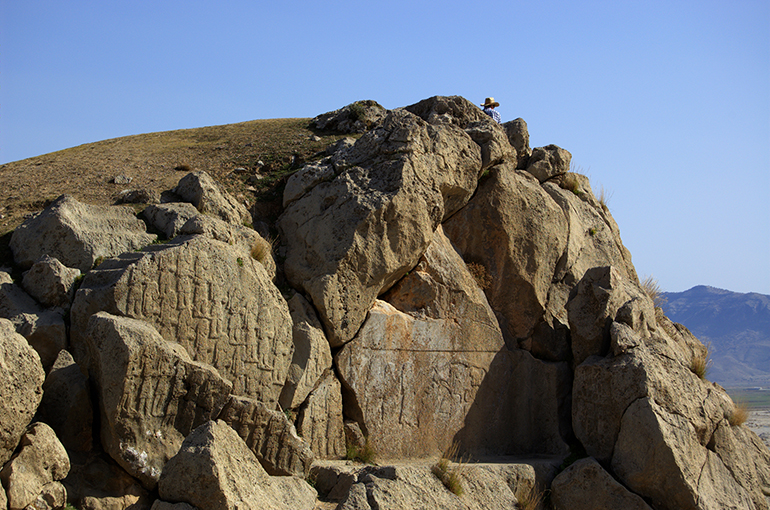
From the summit of the hill, three flights of steps descend to a 5-m long, 2-m wide area oriented northwest/southeast that was cut into the vertical rock face overhanging the river. The main scene is carved in low relief into a roughly 1.60-m high, 3.64-m wide rectangle situated at the back of the resultant ledge (Figure 1; Álvarez-Mon, 2014, p. 748; idem, 2019, p. 16). A fragmentary frieze of swimming fish, located below this central panel, was probably carved at the same time, but staggered sets of kilted male supplicants shown approaching the main scene from the left, as if descending a hill (sloping from the upper left to the lower right), are thought by most scholars to represent Neo-Elamite additions. Close parallels with the Kul-e Farah IV (9th/8th cents. BCE), III (8th/7th cents. BCE) and II (7th/6th cents BCE) suggest that efforts to add these rows of supplicants was an ongoing process carried out over several centuries (Álvarez-Mon, 2019, p. 19).
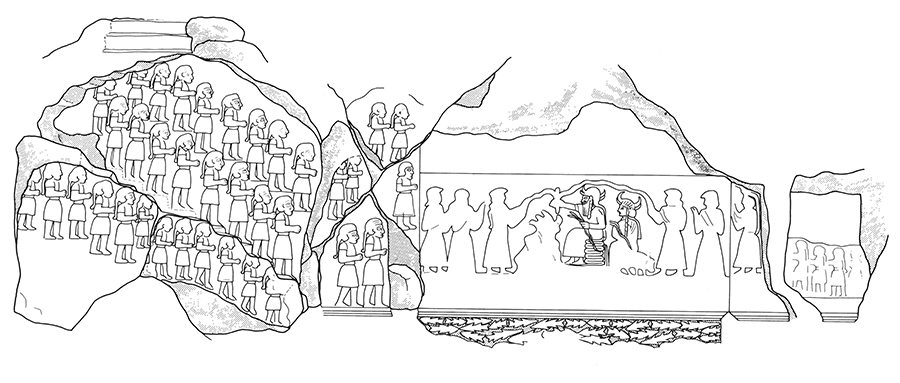
The focus of the main scene is an 82-cm high, seated god, facing left, with an 81-cm high, seated goddess, also facing left, to his right. Both wear horned crowns with two pair of horns on each. The god is bearded and has a long, single plait between his beard and headgear. He wears a long, robe-like garment and is seated on a snake throne, made up of the body of a snake wound back and forth. The neck of the snake rises up from the body of the throne and is grasped by the god in his left hand. His extended right hand clasps the rod and ring, symbols of authority (Spycket; Herzfeld, 1935, pl. II), which hover above a brazier or fire altar, from which flames rise. The goddess, who also wears a single, long plait, appears to be seated on an animal, which is too badly preserved to permit identification. She seems to be grasping the necks of two snakes, the heads of which are clear, in her left hand. Her garment is long, and there are indications of folds around her left shoulder.
On either side of the deities stand a pair of bearded attendants (each 0.95-1 m high), into or from whose hands water flows, in streams, joined to the rod and ring. The right-hand stream frames the figures of the two seated deities. These male figures, dressed in long robes, wear hornless, peaked headgear identical to that worn by the Neo-Elamite figure at Naqš-e Rostam (q.v.). Behind each is another pair of worshippers with raised hands but without the headgear. They appear to be female. Finally, behind these, is a third set of males, one on each side, wearing peaked headgear and long robes. The figure on the left appears to be clasping his hands in reverence, his elbows thrust outward, while the figure on the far right holds up his right hand in devotion.
The snake throne, horned headgear, and long robes of the principal deities appear in Elamite glyptic of the sukkalmah period, more precisely that of Kuk-Našur II (ca. 1620 BCE) and Tan-Uli (late 17th/early 16th cent. BCE; Binder, 2013; Álvarez-Mon, 2019, p. 18; see ELAM i. The History of Elam). The male and female deities have been variously identified as Humban (see ELAM vi. Elamite Religion) and Kiririša or Parti (Hinz, tr., p. 52); Napiriša and Kiririša (Amiet, p. 17; Vanden Berghe, p. 159); or Inšušinak and an unidentified goddess (de Miroschedji, 1980, p. 139; idem, 1981, p. 15). Interestingly, François Vallat has shown that “Ea” was sometimes used at Susa as an epithet of Inšušinak (Vallat). Further, in the Mesopotamian incantation Šurpu II, line 163, Napiriša (Naprušu) is called “Ea of Elam” (Reiner). Since Kiririša was Napiriša’s consort, and both were considered the most important divine couple in Anshan (q.v.), Kurāngun probably represents Napiriša (= Ea = Inšušinak) and his consort Kiririša (Potts, p. 153). The water imagery evokes the flowing waters of the Fahliān river below it, with overtones of the divine Apsû, a subterranean, cosmic body of water in Sumero-Babylonian mythology (Lambert, p. 75).
Bibliography
Javier Álvarez-Mon, “Aesthetics of the Natural Environment in the Arts of the Ancient Near East: The Elamite Rock-Cut Sanctuary of Kurangun,” in Brian A. Brown and Marian H. Feldman, eds., Critical Approaches to Ancient Near Eastern Art, Boston, 2014, pp. 741-71.
Idem, The Monumental Reliefs of the Elamite Highlands. A Complete Inventory and Analysis (From the Seventeenth to the Sixth Century BC), University Park, Penn., 2019.
Pierre Amiet, “Glyptique élamite, à propos de documents nouveaux,” Arts Asiatiques 26, 1973, pp. 3-64.
Kikuo Atarashi and Kiyoharu Horiuchi, Fahlian I: The Excavation at Tape Suruvan 1959, Tokyo, 1963 (in Japanese).
Anne-Birte Binder, “Von Susa nach Anšan — zu Datierung und Ursprung des Felsreliefs von Kūrāngūn,” Elamica 3, 2013, pp. 35-88.
Moḥammad-Naṣir Forṣat (Forṣat-al-Dawla), Āṯār-e ʿAjam, ed. Manṣur Rastgār Fasāʾi, 2 vols., Tehran, 1998.
Ernst E. Herzfeld, “Reisebericht,” Zeitschrift der Deutschen Morgenl
ändischen Gesellschaft 80, 1926, pp. 225-84.
Idem, Archaeological History of Iran, London, 1935.
Walther Hinz, Das Reich Elam, Stuttgart, 1964; tr. Jennifer Barnes, as The Lost World of Elam: Re-creation of a Vanished Civilization, London, 1972.
Wolfram Kleiss, “Kurangun, die Burganlage am elamischen Felsrelief in Südwest-Iran,” in Machteld J. Mellink, Edith Porada, and Tahsin Özgüç, eds., Aspects of Art and Iconography: Anatolia and Its Neighbors. Studies in Honor of Nimet Özgüç, Ankara, 1993, pp. 357-60.
Wilfred G. Lambert, “The Apsû,” in Lucio Milano et al., eds., Landscapes: Territories, Frontiers and Horizons in the Ancient Near East, Part III: Landscape in Ideology, Religion, Literature and Art, Padua, 2000, pp. 75-77.
Pierre de Miroschedji, “Le dieu élamite Napirisha,” Revue d’Assyriologie et d’Archéologie Orientale 74/2, 1980, pp. 129-43.
Idem, “Le dieu élamite au serpent et aux eaux jaillissantes,” Iranica Antiqua 16, 1981, pp. 1-25.
Sayyed Moḥammad-Taqi Moṣṭafawi, Eqlim-e Pārs: āṯār-e tāriḵi wa amāken-e bāstāni-e Fārs, Tehran, 1964; tr. Ralph Norman Sharp, as The Land of Párs, Chippenham, 1978.
Edith Porada, The Art of Ancient Iran: Pre-Islamic Cultures, New York, Toronto, and London, 1969, pp. 73-74.
Daniel T. Potts, “The Numinous and the Immanent: Some Thoughts on Kurangun and the Rudkhaneh-e Fahliyan,” in Kjeld von Folsach, Henrik Thrane, and Ingolf Thuesen, eds., From Handaxe to Khan: Essays Presented to Peder Mortensen on the Occasion of His 70th Birthday, Aarhus, 2004, pp. 143-56.
Erica Reiner, Šurpu: A Collection of Sumerian and Akkadian Incantations, Graz, 1958.
Ursula Seidl, Die Elamischen Felsreliefs von Kūrānḡun und Naqš-e Rustam, Berlin, 1986.
Agnès Spycket, “La baguette et l’anneau: Un symbole d’Iran et de Mésopotamie,” in Reinhart Dittmann et al., eds., Variatio Delectat, Iran und der Westen: Gedenkschrift für Peter Calmeyer, Munster, 2000, pp. 651-66.
Aurel Stein, Old Routes of Western Iran: Narratives of an Archaeological Journey Carried Out and Recorded, London, 1940, pp. 36-37.
François Vallat, “Inšušinak, Ea et Enzag,” Nouvelles Assyriologiques Brèves et Utilitaires 3, 1997, pp. 103-4.
Louis Vanden Berghe, “Données nouvelles concernant le relief rupestre élamite de Kurangun,” in Leon de Meyer, Hermann Gasche, and François Vallat, eds., Fragmenta Historiae Elamicae: Mélanges offerts à M. J. Steve, Paris, 1986, pp. 157-73.