



K’OSTA, XETÄGKATỊ (Rus. Konstantin Levanovich Khetagurov; b. Nar, 15 October 1859; d. Laba, 1 April 1906; Figure 1), prominent Ossetian public figure, poet, artist, playwright, ethnographer, and journalist.
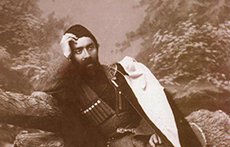
Xetägkatị K’osta, known mainly by his first name K’osta (Constantine), was born in the village of Narịqäu, not far from the present-day Uälladžịr. His father, Xetägkatị Leuan (1810-92), was a military man who served in the Russian army for over thirty years. His mother passed away when he was just two months old. He was raised by one of his distant relatives (Bigulaeva, pp. 19, 21). When he turned seven, his father enrolled him in the local elementary school; a year later he took him to Vladikavkaz, where he entered the preparatory class of a gymnasium. From 1873 to 1881, he studied at Stavropol gymnasium, where he received a classical education, studying the Latin language.
K’osta started drawing and painting at a young age. In 1877, his paintings were shown at an All-Russia Exhibition, where they were highly appreciated. On the recommendation of V. I. Smirnov, his drawing teacher and a close friend, he entered St. Petersburg Academy of Arts in 1881 and joined the class of Pavel P. Chistyakov (1832-1919). There, his classmates were artists like Mikhail A. Vrubel (1856-1910) and Valentin A. Serov (1865-1911). However, he did not graduate because of financial difficulties.
From 1885 to 1891, K’osta lived in Vladikavkaz and worked as an artist at the local city-theatre, where he created his first paintings (“Mountain Woman Going to Bring Water,” “Natural Bridge,” “Table Mountain”), which received critical acclaim. In addition to his secular paintings, Kosta is known to have completed the unfinished murals of the walls and ceiling of the Church of the Holy Ascension in Alagir. He left a number of religious paintings, such as “Grieving Angel,” including a depiction of Jesus Christ. He also took an active part in social life and participated in the charitable actions of the “Society for the Spread of Education and Technical Information among the Highlanders of the Terek region.” However, in June of 1891, he was exiled from the Terek province for five years because of his revolutionary poetry. In 1893, K’osta became a contributor to the newspaper Severnyi Kavkaz, published in Stavropol.
In 1903, K’osta was engaged to Lejla Xurịmtị, the daughter of a priest, but he became seriously ill and was unable to fulfill his desire to create a family, as he had no means to support one. It was his stepsister Olga who took care of him until his death in the village of Laba, founded by his father in the Kuban region. His body was taken to Ossetia and buried at the graveyard of the so-called Ossetian Church in Vladikavkaz.
Philosophy. Xetägkatị K’osta was not only an outstanding artist and poet, but also an influential philosopher. He played a key role for Ossetian society at the stage of transitioning from a traditional culture to a modern one and from an ethnic to a national stage of development. He described Ossetian traditional culture in all its aspects in his ethnographic essay called “Ósoba” (Ossetian lore). The ideology of a modern society, standing above ethnic differences, was formulated, as he believed, in the Christian tradition. He wrote numerous religious verses in Russian devoted, for example, to Easter, and he also composed a poem, describing an episode of the Last Supper based on the New Testament, called “Se chelovek” (Ecce homo).
The central idea of his philosophy was embodied in self-sacrifice as a symbol of love to the whole of humankind. In K’osta’s poems, his father embodies the role of a purely traditional man and a warrior ready to sacrifice his life in a battle. In one of his poems, called “Nịfs” (Fortitude), K’osta talks to him, explaining that to his mind the heroic behavior of a military man was similar to his own inner spiritual attitude as a civilian. This formula of spiritual self-sacrifice is expressed most vividly and completely in a short poem, called “Quịbadị.” The central figure, whose name it bears, is his alter-ego, as he is an old lyre player sitting in a place where the village inhabitants would gather to discuss and solve their problems of everyday life. Quịbadị, the old sage, who lived a hard and long life, clearly formulates and puts his main idea of self-sacrifice in a straightforward and convincing manner: “Fälä nä amond, / Änä särnịvond, / Nä xässị birä! – / Änä axxosäj / Fijjauị fosäj, / Nä xässị biräğ (Yet our happiness, / Without a self-sacrifice, / Won’t last long. / Without a guilt, / From the shepherd’s sheep, / None will ever be taken away by the wolf)” (Xetägkatị, p. 38). The key word here is sär-nịvond, which consists of two parts and literally means “sacrifice of one’s head.”
Another trait of his religious philosophy that manifests itself by esthetic means, and which he uses for his poetic language and structure, is “Dialogism.” The concept of dialogism was introduced by Mikhail M. Bakhtin (1895-1975), the Russian literary theorist known for his work on the prose of Fyodor M. Dostoevsky (1821-81) whose novels are endless dialogues between the author and heroes. The idea of such dialogues means that the word used by the writer, belongs simultaneously to both participants involved in communication (Salbiev, pp. 77-80).
K’osta Xetägkatị’s literary heritage is studied in schools and universities; his poems are translated into European languages, adapted in movies (“Fatima”), and an opera is devoted to his life. Several monuments are dedicated to him both in North and South Ossetia. His birthday is widely celebrated, as he remains one of Ossetia’s national symbols, connecting generations, past present, and future.
K’osta’s collection of Ossetic poetry, written in the Iron dialect (East Ossetian; see OSSETIC LANGUAGE), published in 1899 under the title of Iron fändịr (Ossetic lyre), made him the true founder of the Ossetian national literature and creator of the modern Ossetian literary language, which had a significant impact on all of its subsequent development. The most important achievement of this poetry collection was that it awakened and clarified the self-consciousness of the Ossetian people.
Kosta’s multifaceted social activities can be treated as a passionate impulse for freedom, social justice, and a better future for all. As Vasily I. Abaev (q.v.; 1900-2001) put it: “His name is infinitely dear to every Ossetian, because he sees in him the best part of himself, and therefore the poet’s personality became a true national symbol, embodying everything high and noble that its nature contains” (Abaev, p. 551). Although his own life was not easy or long, he made an enduring contribution to the cultural development of the Ossetian people and the preservation of their national identity.
Bibliography
For a list of Xetägkatị’s publications, see G. Z. Kaloev, Kh. N. Ardasenov, and Devlet Azamatovich Gireev, Pisateli Severnoĭ, Osetii: Bibliographicheskĭĭ spravoch’nik (Writers of Ossetia: Bibliographic Handbook), Vladikavkaz, 1992.
Sources:
Xetägkatị K’osta [Kosta Khetagurov], Iron fändịr (Ossetic lyre), Dzäudžịqäu (Vladikavkaz), 2009 (archival handwritten records).
Idem, Sobraniye sochiniy va trekh tomakh (Collected works in three volumes), Moscow, 1974.
Studies:
Vasily I. Abaev, “Osetinskiĭ narodniĭ poet Kosta Khetagurov” (Ossetian folk poet Kosta Khetagurov), in Izbrannye Trudy, Religia, Fol’klor, Literatura (Selected works: religion, folklore, literature), vol. I, Vladikavkaz, 1991, pp. 542-51.
I. S. Bigulaeva, Kosta Levanovich Khetagurov: nauchnaya biografiya (Kosta Levanovich Khetagurov: Scientific biography), Vladikavkaz, 2015.
Tamerlan K. Salbiev, “O tipe religioznosti Kosta Khetagurova: Nịstuan (‘Zapoved’)” (Types of religiosity of Kosta Khetagurov: Nịstuan [The testament]), Izvestiya SOIGSI (52), 2014, pp. 73-83.