



KOLANGI, Mir Ḥosayn Ḥosayni, also known as Nasafi, a calligrapher and poet of the 16th century active in Bukhara (q.v.). The 23 known manuscripts copied by him and several of his dated calligraphic specimens indicate that he was active between 942/1535-36 and 993/1585.
The scant information on his life and career is derived mainly from a short entry on him in Qāṭeʿi Heravi’s (d. 1024/1615) Majmaʿ al-šoʿarā-ye Jahāngiršāhi and supplemented by the different ways Mir Ḥosayn Ḥosayni signed his work at various stages in his career. According to Qāṭeʿi Heravi (p. 54), Mir Ḥosayn came from a sayyed family of Herat (q.v.) and grew up in Bukhara and became a student of Mir ʿAli Heravi (q.v.). Later he left Bukhara for the court of the emperor Akbar (q.v.; r. 1556-1605) and joined the group of calligraphers employed in the production of Akbar’s famous Ḥamza-nāma (q.v.; Qāṭeʿi, p. 54). Besides being famous as a calligrapher, he also composed poetry.
The account that he was originally from Herat is open to question (Bayāni, p. 164; Qāṭeʿi Heravi, p. 54; Akimushkin, p. 339) as he never called himself Heravi, but twice used the nesba Nasafi which makes him a native of Nasaf (Naḵšab), the present day Qarshi or Karshi, a city in southern Uzbekistan. Mir Ḥosayn Kolangi’s apprenticeship with Mir ʿAli Heravi is highly plausible. His writing emulates that of the older master (Bayāni, I, p. 164).
Kolangi worked for the ketāb-ḵāna of the Šaybānid ʿAbd-al-ʿAziz Bahādor Khan, the appanage ruler of Bukhara on behalf of his father ʿObayd-Allāh Khan (r. 940-46/1533-40) from 1533 and in his own right 946-57/1540-50. Together with other calligraphers of the younger generation, Kolangi participated, for instance, in the copying of an anthology in 954/1547-48 (Topkapı Sarayı Müzesi, Istanbul, Revan Köşkü 958) and a collection of four of Jāmi’s (q.v.) works (Chester Beatty Library, Dublin, Per 213) in 955/1548-49. In the latter case, he wrote under supervision of Solṭān Mirak ketābdār and, for the first time, referred to himself as a royal calligrapher (kāteb al-ḵāqānī.) After ʿAbd al-ʿAziz Khan’s death, he was firmly established in the royal atelier and continued working as kāteb al-ḵāqānī or al-solṭānī. Manuscripts by his hand were usually illustrated by the foremost painters of the Bukhara atelier.
Among the four dated and several more copies he produced in the 1550s is a copy of Jāmi’s Toḥfat al-aḥrār dated 962/1554-55 (Gulbenkian Foundation, Lisbon, LA 184; see PLATE I) and a Bustān (q.v.) dated 963-64/1555-57 (Bibliothèque nationale de France, Paris, suppl. pers. 1187). The latter is dedicated to Nowruz Aḥmad Khan, the ruler of Tashkent, who had succeeded annexing Bukhara to his realm before the future khan ʿAbd-Allāh II took the city in 964/1557, a ruler less interested in arts of the book.
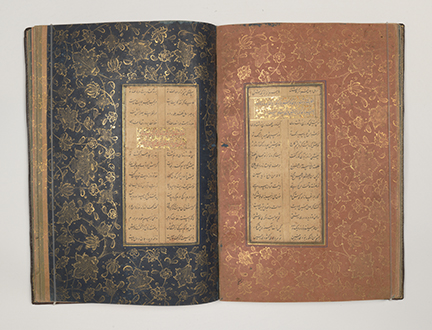
Thereafter, Mir Ḥosayn never again referred to himself as a royal calligrapher but instead always added Mir Kolangi to his signature. Moreover, there is a gap of about a decade between the two manuscripts explicitly stated to have been copied in Bukhara. This gap coincides roughly with the heyday of the young Akbar’s Ḥamza-nāma project (1556-73). One may assume, therefore, that sometime after 966/1558-59 Mir Ḥosayn went from Bukhara to India, as a qeṭʿa written in Mecca and dated 970/1562-63 (Arthur M. Sackler Gallery, Washington, S.86.0345) indicates. He eventually ended up in Delhi where he was employed in the production of the Ḥamza-nāma.
He probably returned to Bukhara in 978/1570-71, at the latest. The extant manuscripts signed by him in the following fifteen years indicate that he remained a highly esteemed calligrapher. As examples of his later output, a copy of Jāmi’s Toḥfat al-aḥrār, dated 980/1572-73 (Chester Beatty Library, Dublin, Per 239) and excerpts of Saʿdi’s Bustān, dated 983/1575-76 (National Library of Russia, St. Petersburg, PNS 269), both provided with illustrations, are mentioned here. The dominance of texts by Jāmi and Saʿdi in his work reflects the general preference for these authors in 16th-century Central Asia.
Bibliography
Oleg F. Akimushkin, “Biblioteka Shibanidov v Bukhare XVI veka,” (Šaybānid library in Bukhara XVI century), in Ingeborg Baldauf and Michael Friederich, eds., Bamberger Zentralasienstudien: Konferenzakten ESCAS IV, Bamberg 8.-12. Oktober 1991, Berlin, 1994, pp. 325-41.
Mehdi Bayāni, Aḥwāl o āṯār-e ḵošnevisān: nastaʽliqnevisān, 3 vols., repr. Tehran, 1984-85, I, pp. 164-66.
Filiz Çağman and Zeren Tanındı, Topkapı Sarayı Müzesi Islâm minyatürleri (Islamic Miniature Painting), Istanbul, 1979, p. 55.
The Chester Beatty Library: A Catalogue of the Persian Manuscripts and Miniatures, ed., Arthur J. Arberry et al., 3 vols., Dublin, 1959-62, II, pp. 78-79 and III, pp. 18-19.
Glenn D. Lowry and Milo C. Beach, An Annotated and Illustrated Checklist of the Vever Collection, Washington, DC, 1988, no. 441.
Molla Qāṭeʿi Herāvi, Taḏkera-ye Majmaʿ al-šoʿarā-ye Jahāngir-shāhi, ed. Muhammad Saleem Akhtar, Karachi, 1979.
Francis Richard, Splendeurs persanes: Manuscrits du XIIe au XVIIe siècle, Paris, 1997, pp. 147-48.
John William Seyller, “The Organization and Use of the Hamzanama,” in J.W. Seyller, ed., The Adventures of Hamza: Painting and Storytelling in Mughal India, Washington, DC, 2002, pp. 32-43.