



Introduction. An analysis of the representation of kingship in the Sasanian period in the multifaceted cultural ensemble broadly known as Eastern Iran must take into consideration both the political structures that succeeded the Greco-Bactrian and Indo-Greek (see INDO-GREEK DYNASTY) domains as well as the powers that came after the demise of direct Sasanian control. In this perspective, it will be possible to discern how strategies and models for the depiction of rulership among the Sakas, the Indo-Parthians, the Kushans, the Sasanian Kushanshahs, the Chionites, the Kidarites, the Hephthalites (qq.v.), and the Western Turks, were transmitted and developed through the centuries. For this reason, the chronological limits of this inquiry are set roughly between the 2nd century BCE and the 7th century CE. The geographical area under consideration is heterogeneous (Figure 1), and comprises the territories of historical regions such as Sogdiana (Lyonnet), Bactria (Martinez-Sève; Stančo; Lindström), Chorasmia (q.v.), Margiana (Puschnigg), Areia (see HERAT ii. HISTORY, PRE-ISLAMIC; Ball, 2021), Paropamisadae (see ARIA), including Sattagydia and Gandhara (Olivieri), Drangiana (Ball, 2021), Arachosia (Ball, 2021), Carmania (q.v.), Gedrosia (q.v.), and Paricania. Consequently, an analysis of archaeological finds and epigraphic materials from these areas will try to draw a comprehensive picture of the strategies employed by such culturally and politically different entities to assert and disseminate their concepts of power and, specifically, of rulership and kingship.
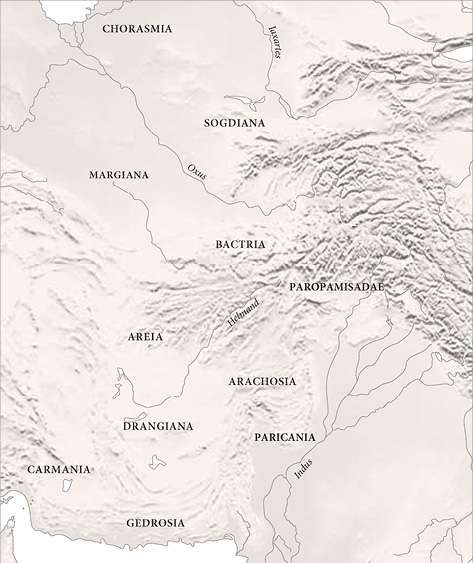
Figure 1. The eastern Iranian lands considered in the text (2nd century BCE-7th century CE). © Carlo Marchetti, courtesy of the author.
Display of rulership and strategies of power among Saka, Yuezhi, and Indo-Parthian elites (2nd century BCE to 1st century CE). Confronting the different systems devoted to the assertion of power in sedentary and in nomadic cultures in this period has numerous implications (for general references, see Golden, 1992, pp. 50-54; Benjamin; for archaeological remarks, see Rapin). On the one hand, there is a common strategy of representation, which involves the burial objects used in funerary practices; on the other, there are features characteristic of urban societies, such as coins and patronage of buildings, often involving written statements.
For the first aspect, iconographies of luxury objects in princely burials testify to a continuous connectivity with the West (in a broad sense, from the Iranian plateau to the Mediterranean) and the East (Boardman, pp. 14-19; Sinisi, 2020, pp. 365-67). Examples of these interactions can be found in the objects of the mounds of Pazyryk (Rudenko) and Tillya Tepe (Sarianidi, 1979; 1985; Boardman, pp. 12-14; Francfort; Olbrycht); symbols and iconographies commonly used during the Greco-Bactrian and Indo-Greek periods either continue to convey the same aspects, or are employed together with local elements for a more eclectic message. In this way, Hellenistic representations of gods and goddesses come alongside Greek armored figures flanked and surrounded by specific elements of rulership, tangible, such as the diadem, or symbolic, such as winged figures and birds (Grenet, 2012, pp. 4-6). Other means to display command and royal power, instead, involve more stable and direct control of urban centers; this is the case with numismatic evidence and architectural remains.
Regarding coinage, on the one hand, its continuity is generally related to the need to achieve and maintain a stable payment system over time (e.g., see ARAB-SASANIAN COINS). On the other hand, the appropriation and continuation of previous monetary issues may reflect a strategy devoted to the strengthening of the ruler’s domain through the confirmation of the continuity of power, even after the transition between two different dynasties or political entities (Sarkosh Curtis; Coloru, pp. 173-74). In time, new elements may surface in the “coinage tradition” (Cribb, 2007, pp. 334-35) to denote different conceptions of kingship, such as the adoption of different clothing or headdresses, or the use of nomadic clan-marks, conventionally known as tamghas (Cribb, 2007, pp. 362-64, 372-73, for Indo-Parthian, Sogdian, and Chorasmian coins). Linguistically, the Greek language remained in use in administrative practices, especially in coin legends, even if with increasing mistakes and signs of dwindling understanding, until the Bactrian language (q.v.), which adopted Greek script, eventually supplanted it under the Kushans. The titles referring to the kings employed in coins of this period retained a Greek formulaic (examples in Coloru, pp. 174-80), such as ΒΑΣΙΛΕΩΣ ‘of the king’ followed by the name of the ruler, but adaptation to a more Iranian style of citing royal prerogatives emerged in the 1st century CE, probably following Parthian models (Coloru, pp. 181-85). This is the case with expressions such as ΒΑΣΙΛΕΩΣ ΒΑΣΙΛΕΩΝ ‘of the king of the kings’ on Saka coins (Cribb, 2021, p. 655; Coloru, pp. 185-89). In time, this mixture of Greek language and script with Iranian names and formulaic phrases became somewhat of a hallmark of Saka and Indo-Parthian coinage. Various Saka rulers were addressed with titles such as ΜΕΓΑΛΟΥ ‘of the great’ and ΣΩΤΕΡΟΣ ‘of the savior, protector’ along with Iranian loanwords such as ΣΑΤΡΑΠΟΥ ‘of the satrap’ and Indian transpositions in Greek script as ΠΟΤΡΟΣ, rendering the concept otherwise expressed with the canonical Greek ΥΙΟΥ ‘of the son’, referring to the ruler’s genealogy. Indo-Parthian coins show also innovative use of genitive Greek forms such as ΑΥΤΟΚΡΑΤΟΡΟΣ ‘independent ruler’ or ΒΑΣΙΛΕΥΟΝΤΟΣ ‘ruling as a king’ (Cribb, 2021, pp. 656-60). Later, Kushan coins also adopted this last feature (see below). Other objects preserve a fair amount of names and titles adopted by Saka and Indo-Parthian elites, also in this case showing signs of continuity and adaptation of previous expressions to the realities of the new government. Frequent examples, often transposed also in Kharoṣṭhī script, are μεριδάρχης ‘local governor’, στρατηγός ‘general’, and ἐπίσκοπος ‘administrator’, all occurring in sealings (see SEALS AND SEALINGS) and dedications, sometimes on precious items such as silver vessels and reliquaries (Konow, pp. 1-5; Falk, p. 73; Cribb, 2021, pp. 662-65).
Royal support can also be postulated in the construction of monumental buildings and in the patronage of religious cults, as well as in epigraphic materials. Numerous attestations of royal titles, such as mahārāja ‘great king’ and rājātirāja ‘king of kings’, as well as other expressions denoting high rank, such as mahākṣatrapa ‘great satrap’, are attested in sealings, bullae (q.v.), ring gems, and stucco fragments (Falk, pp. 74-76). All these epithets would be employed also in Kushan times. Some samples of decorated stuccos found at the Apsidal Temple of Taxila, the largest of Sirkap’s sanctuaries, have been taken as a possible connection of the structure with a place of royal devotion. This temple would have been dedicated either to the local Indo-Scythian dynasty (q.v.; see AZILISES; AZES II) or Indo-Parthian dynasty, or to a cult tied to xwarrah, the royal glory (see FARR[AH]; Colliva, 95-99). The name of the Indo-Parthian king Gondophares (q.v.) is preserved in a dedicatory Kharoṣṭhī inscription of the temple complex at Takht-i Bahi, dated to the first half of the 1st century CE (Konow, pp. 57-62). While the king is not actually linked to the dedication of the building itself, his name is associated with a fixed time-reckoning system, therefore highlighting another praxis of royal legitimization originating in Seleucid times, that is, the founding of calendrical eras (Kosmin). Another remarkable example of persistence in the royal patronage of religious buildings may be inferred by the continuous functioning of the so-called Temple of the Oxus at Takht-i Sangin (q.v.) during a span of almost six centuries (ca. 3rd BCE-3rd CE), despite evidence of lootings in the 2nd century BCE. Here Iranian people could dedicate votive objects with Greek iconographies, such as the Silenus bronze statuette inscribed with the name Atrosokes (Ἀτροσώκες), and even statues that can be interpreted as representations of Greco-Bactrian kings (Lindström, pp. 291-95). Such elements testify to the open nature and the religious eclecticism, even regarding royal imagery, that were evidently a common feature of this period and which had parallels in Greek-era practices (for examples on this process, see Ghosh, 2021).
Kushan aspects of kingship (1st-3rd centuries CE). After Kujula Kadphises (q.v.; r. ca. 30-80) unified the territories of the five Yuezhi yabghus (see JABḠUYA; Falk, pp. 76-78; Cribb, 2018b) in the new Kushan Empire (Golden, 1992, pp. 55-56; Rezakhani, 2017a, pp. 52-57; 2022, pp. 307-11), the strategies adopted by the ruling elite to assert royal power changed in some aspects (see KUSHAN DYNASTY ix. ART OF THE KUSHANS). On the one hand, elements of the previous nomadic period were retained, marking a cultural continuity, but, on the other, the characteristics typical of a more articulated political structure were also adopted, refined, and adapted to the new context (Rezakhani, 2017b, pp. 200-3; Sinisi, 2018; 2020, pp. 378-88). Among the traits brought forward from the Saka and Yuezhi cultural milieu, there are figurative depictions of horse-mounted combat and representations of royal hunts. Examples of equestrian confrontations are attested in the Khalchayan (q.v.) clay reliefs (Grenet, 2012, pp. 12-14; Colliva, pp. 99-102; Sinisi, 2020, pp. 368-75) and in the Sogdian battle-plaque from Orlat (first or second century; Grenet, 2012, p. 14; Sinisi, 2020, p. 376, note 51; earlier dating in Abdullayev; later chronology in Mode). Royal hunting, also on horseback, is evidenced by an ivory plaque found in the Temple of the Oxus at Takht-i Sangin (Grenet, 2012, pp. 15-16). A scene of investiture of a crown prince is probably depicted on a cloth painting dated to the time of king Huviška (q.v.; r. 154-86), in which the sovereign seems to hand down bow and quiver to the royal heir, who, in his turn, receives a garland offered by a flying figure (Grenet, 2012, pp. 16-17).
This last iconography is attested also on currency from the earliest phases of the Kushan period, in conjunction with the mounted royal figure; well-known examples are the so-called Heraus (q.v.) coins, which may be attributed to Kujula Kadphises (Jongeward et al., pp. 21-23; contra Falk, p. 77; see also Sinisi, 2017). On the reverse of these coins, the sovereign is mounted on a horse facing right, with a quiver hanging down from the saddle, while either a small winged Nike (Victory) or a fravaši (q.v.) brings him a circular diadem or garland. Indo-Parthian coins of king Gondophares show similar designs, which, in their turn, go back to Parthian models dating to the 1st century BCE (Cribb, 1993, pp. 120-25; Coloru, pp. 190-91; see KINGSHIP iii. IN THE PARTHIAN PERIOD). The legend found on these coins is also peculiar in the use of the Greek participle ΤΥΡΑΝΝΟΥΝΤΟΣ ‘of the one who is sovereign ruler’, a title that replaces the otherwise more common term ΒΑΣΙΛΕΩΣ ‘of the king’ (Cribb, 1993, pp. 129-30; 2007, p. 352, fig. 79; Falk, p. 73). This feature shows an important persistence in the correct use of Greek grammar in this period (Cribb, 2021, pp. 654-55) that endured at least for about another century, until the epoch of Kanishka I (ca. 127-50; Cribb, 2018a, pp. 7-17; regarding the era of Kanishka and numismatic evidences see also the questions pointed out in Schindel, 2009; 2014). By the end of his reign, Kujula Kadphises had switched to loftier titles on his coins, such as ΒΑΣΙΛΕΥΣ ΒΑΣΙΛΕΩΝ ‘king of kings’, ΣΩΤΗΡ ‘savior, protector’, and ΜΕΓΑΣ ‘great’, following Parthian models in the use of the Greek nominative instead of genitive (Cribb, 2021, pp. 660-62). This tendency continued also under Kadphises’ successors, using also Kharoṣṭhī script whenever needed; later coins, instead, adopted Bactrian language, but the royal designations did not change their substance, still referring to the sovereign as the “king of kings” (Cribb, 2018b, pp. 12-18; Rezakhani, 2022, pp. 309-23). Greek and Roman influence in general, as exemplified by the Begrām (q.v.) hoard (Morris), and on coins in particular (Cribb, 2007, pp. 364-66), alternated during the Kushan period with elements pertaining to the nomadic ancestry of the sovereigns. Such is probably the case with the different attires on the coins of Vima Kadphises (ca. 100-127) and Kanishka I, with specific royal attributes such as helmets and crowns; on the reverse, there are also Iranian, Hindu, and Buddhist divine figures instead of Greek divinities (Rosenfield, pp. 66-69; Cribb, 2007, pp. 364-67; Coloru, pp. 191-92; Grenet, 2015; Sinisi, 2019). The broad Kushan pantheon can be considered, indeed, as part of a global strategy of legitimization of kingship in the culturally very different regions of the newly unified domains (Grenet, 2006; Cribb, 2008; Sinisi, 2019, pp. 136-40). Another interesting aspect of external influences on the royal depiction of Kushan power is a peculiar title adopted by Kanishka III (ca. 265-70), a variation of the Roman epithet of Caesar, both on coins (Jongeward et al., p. 169; Rezakhani, 2017a, p. 69; 2022, p. 322) and in an inscription found at Ārā, near Attock (Pakistan). This last attestation displays a full set of imperial designations such as mahārāja ‘great king’, rājātirāja ‘king of kings’, devaputra ‘son of the gods’, and kaïsara ‘emperor’ (Konow, pp. 162-65; Falk, p. 76); it is to be noted that the king is not the dedicatee of the inscription, but his titles are used in a chronological formula.
The monumental Rabatak inscription (see KUSHAN DYNASTY ii. INSCRIPTIONS OF THE KUSHANS) is a very explicit statement concerning how the Kushan king Kanishka I expressed his royal status and the legitimacy of his dynasty (Sims-Williams, 2004; 2012, pp. 77-78). The text allows us to recognize the importance of establishing a new era, starting with the first year of the reign; the uninterrupted line of descendants from the founder of the dynasty; the political significance of the Bactrian language; and that of displaying a vast array of divinities, possibly connected to the apotheosis of the king himself (Gnoli; Panaino, 2009). Some of these aspects, such as the use of particular royal titles, were already present in the inscriptions of Dašt-e Nāwor (q.v.), created during the time of Vima Taktu (r. ca. 80-100), grandfather of Kanishka I (Sims-Williams, 2012, pp. 76-77). The importance of the royal patronage to the construction of sacred buildings (Ghosh, 2011) is also stressed by the inscriptions (Sims-Williams, 2012, pp. 78-79) in the dynastic shrine at Surkh Kotal (Sorḵ Kotal), the modern site of Baḡlān (q.v.; Rosenfield, pp. 154-62; Schlumberger et al.; Fussman and Guillaume). This trend of royal support to monumental edifices is evident also at Mathurā (Srinivasan), specifically regarding the sanctuary at Māṭ, which displays numerous inscriptions of king Huviška (Fussman; Colliva, pp. 102-3). Other examples of titles linked to high-ranking nobles and office holders are attested in other minor inscriptions, often in Kharoṣṭhī script (Falk, pp. 78-79).
The strategies of legitimization employed by the Kushan emperors, therefore, seem to have been differentiated but complementary: use of Greek and then of Bactrian in royal inscriptions, divinization of the ancestors and of the sovereign, specific coins devoted to different gods, and patronage of monumental buildings. In this way, aspects belonging to the nomadic ancestors of the dynasty were successfully reconciled with characteristics received by the political structures that the Kushans supplanted and integrated, merging them with newly conceived instruments of royal sanction in an eclectic and effective system (Rezakhani, 2022, pp. 323-27).
Eastern Sasanian and Kushanshahs conceptions of power (3rd-4th centuries CE). After the overthrow of the last Arsacids (q.v.), Ardašīr I (q.v.; r. ca. 224-42) undertook a military campaign in the eastern Iranian plateau directed toward those local potentates who had not yet declared their loyalty to the new ruler. Among these polities, there were the so-called Late Kushans (Rezakhani, 2017a, pp. 68, 72-73; Ball, 2017; for a survey of the sources see KINGSHIP iv. IN SASANIAN IRAN).
It is still unclear which means were adopted by the Sasanians to gain control over the lands across the Hindu Kush (q.v.), whether military or diplomatic or both, but by the end of the third century these regions were incorporated as a semiautonomous structure known as Kušānšahr ‘Land of the Kushans’ (Payne, pp. 6-7; Rezakhani 2017b, pp. 203-5). This designation is attested in the Šāpur I (q.v.; r. ca. 239-70) inscription at the Kaʿba-ye Zardošt (q.v.; ŠKZ, par. 3: Huyse, 1999, pp. 23-24). The denomination has also a parallel in the title kušān šāh (kwšn MLKA) ‘Kushan king’ found in the inscription of Narseh (q.v.; r. 293-303) at Paikuli (q.v.; NPi, par. 92: Humbach and Skjærvø, 3.1, par. 91-95, pp. 70-71; for a different interpretation of the passage see Göbl, 1993). In this last testimony, the kušān šāh is in the first place in the list of the so-called greater rulers and kings who, according to king Narseh, “abode by Our advice and counsel,” that is, presented homage to him after his ascent to power (Humbach and Skjærvø, 3.1, par. 92-93, pp. 70-71; 3.2, pp. 120-26). This statement seems to imply that a certain degree of autonomy was intended in the administration of the Kušānšahr.
However, that the Sasanians may have exerted some sort of direct control, rather than just letting a cadet branch of the dynasty take care of the area, is probably confirmed by the rock relief of Rag-i Bibi (Grenet, 2005; Grenet et al.; Levine and Plekhov). In this monumental work (4.90 m in height and 6.50 m wide), carved on a mountain pass along the road going from Balḵ (q.v.) to Kabul, a Sasanian king, very likely Šāpur I, is portrayed on horseback hunting a rhinoceros under a mango grove. The depiction exploits the symbolism associated with the theme of the royal hunt of the sovereign, who is accompanied by at least one figure in Kushan attire, probably the Kushanshah of the time, Pērōz I (r. ca. 245-70/75) or Hormozd I (r. ca. 275-300; see HORMOZD KUŠĀNŠĀH). Other possible identifications involve, instead, one of the later Kushan rulers, Vasishka, Kanishka III, or Vasudeva II (chronological questions addressed in Cribb, 1990 and Grenet et al., pp. 257-61; see also Jongeward et al., p. 4, and KUSHANSHAHS i. HISTORY).
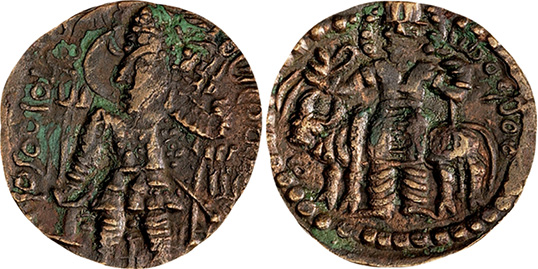
Figure 2. Pērōz I Kušānš¯āh bronze coin (2.8 g, 18.5 mm). Balkh mint. Recto legend (in Bactrian): ΠIPΩZO OOZOPKO KOÞANO ÞOYO (Pērōz Great Kushan Shah). Verso legend: OOPZAOANΔO IAZAΔO (Exalted god). American Numismatic Society 1987.46.19 (public domain).
The interchange between the Sasanian, Kushan, and Kushano-Sasanian ways of displaying power and kingly authority is evident in various ways, not necessarily all received from the West (Rezakhani, 2017b, p. 204; Canepa, 2018). The Kushanshahs adopted Sasanian imperial onomastics, but employed them to convey different images of power, as in the case of Pērōz, “victorious,” which was used as an epithet for the Sasanian Šāpur II (q.v., r. 309-79), as recorded by Ammianus Marcellinus (q.v.; 19.2.11; Rezakhani, 2017a, pp. 78-79; see also Rezakhani, 2017c for a Chionite attribution). Pērōz I Kušānšāh, in fact, preceded his homonymous Sasanian counterpart (see FIRUZ, r. 459-84) by about 200 years in the adoption of this qualification as personal name (Cribb, 1990, p. 171). Moreover, thanks to his coins, it is possible to ascertain how influences from the Sasanian coinage as well as from the later Kushan production in the east had an impact on royal depiction (see KUSHANSHAHS ii. KUSHANO-SASANIAN COINAGE; see also Göbl, 1984; 1993; and more recent research in Alram, 2014, pp. 263-70; Coloru, pp. 192-94; Schindel, 2012; 2015a; 2015b). Pērōz I Kušānšāh is styled as “Lord Pērōz, great Kušān šāh” (bago pirōzo oazarko košano šauo), choosing a phrasing reminiscent of the Sasanian court style (mazdēsn bay pērōz wuzurg kušān šāh). His coinage adopted Kushan titles, coin design, gods’ images (Sinisi, 2015), Bactrian language for the legends, and Brāhmī (q.v.) script for mint signatures (Cribb, 1990, p. 173; Jongeward et al., pp. 205-9; Rezakhani, 2017a, pp. 80-81). While Zoroastrian religious aspects connected to the legitimization of the king are clear (fire altars [q.v.] and thrones do appear on coins of Pērōz I and Hormozd I Kušānšāhs: Cribb, 2007, pp. 356 and 367-68), it is not evident if they ultimately derive from a deliberate relation to Avestan lore. A possible connection, in this case, would be the Zamyād Yašt (q.v.) regarding xwarrah, the royal glory (Hintze; Humbach and Ichaporia). It is similarly difficult to understand if the Kushanshahs’ royal authority stemmed from the same support that accompanied the Sasanian emperors, namely the consensus of the magnates and the nobles, the religious hierarchy, and a direct link of every ruler to the reigning dynasty (Wiesehöfer, pp. 174-77). The Kushanshahs may have had to cope with different religious and political traditions in the regions that they administered than those in the homeland of the Sasanian Empire (Wiesehöfer, pp. 178-79); thus, they needed to adopt various religious iconographies on their coins as part of Kushan ascendancy. This eclectic trend is common in all Kushano-Sasanian coinage and marks a difference with Sasanian exemplars (Huyse, 2006; Cribb, 2007, pp. 367-68, 371-72; compare with the specimens listed in Jongeward et al., pp. 198-220). In time, the Kushanshahs brought forward their claims to political autonomy, or, possibly, even explicit independence, as the expression “Kushan King,” adopted by Pērōz I Kušānšāh, might have implied (Figure 2; Jongeward et al., p. 211; Rezakhani 2017a, pp. 81-82). Similar patterns in the representation of royalty in coins also appeared in local productions, such as those of the so-called kings of Pāradān (see BALUCHISTAN i. GEOGRAPHY, HISTORY, AND ETHNOGRAPHY), who bore titles such as Pāradarāja and Shahi (Tandon, pp. 32-40, 47-53; Coloru, pp. 189-90). There are not available data, however, to ascertain if and how the Kushano-Sasanian strategies of legitimization of rulership had an impact on the conceptual representation of royal consorts, and the female condition in general, as in the late Sasanian court (Panaino, 2006).
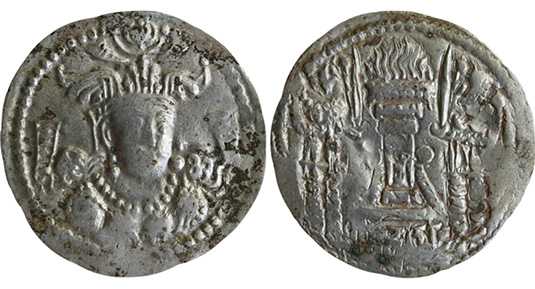
Figure 3. Kidarite silver drachm (3.65 g, 28 mm). Unidentified mint; obverse legend: absent; reverse legend (name of the ruler in Brāhmī): Buddhatala. American Numismatic Society 1996.75.1 (public domain).
Apart from the Rag-i Bibi stone relief, royal patronage for monumental endeavors in the eastern lands of the Sasanian Empire and in the Kushanshahs’ domains is not of incontrovertible evidence. The site of Bandiān in northern Khorasan (see KHORASAN xxiv. MONUMENTS OF KHORASAN) is a good example of a vast and richly adorned building complex, probably also of ritual nature, but the evidences brought forward by the fragmentary stuccos (see STUCCO DECORATION) are still not conclusive for a positive attribution to a specific royal patron, if any (Azarpay, 1997; Rahbar, 1998; idem, 2004; idem, 2007; Gignoux, 1998; 2008). The geographical location of the site, as well as the iconography of the figures represented on the stucco pieces, seem to point to an aristocratic background of local importance rather than to the Sasanian kings of kings themselves (Callieri, pp. 118-25; Cereti, 2019). The paintings and painted stucco reliefs of the ritual complex of Kuh-e Ḵvāja (q.v.) may suggest, instead, Sasanian patronage, considering the importance of the religious sanction to the rule of the kings, albeit explicit representation of historical sovereigns is debated (Kawami; Canepa, 2013, pp. 70-77; Ghanimati; Callieri, pp. 81-86). The paintings found in a cave at the site of Ghulbiyan, in Fāryāb (q.v.) province, northern Afghanistan, can also be linked to royal sponsorship. In fact, even if the figure of the main donor giving offers to a seated deity is not well preserved, it still shows traces of a Sasanian or Kushano-Sasanian crown with a korymbos (a cloth element enclosing the hair) and of rich clothing (Lee and Grenet; see SASANIAN WALL PAINTING).
The strategies of power legitimization adopted by the Kushanshahs and the Sasanian emperors in the eastern lands of the Iranian plateau, therefore, show great affinities with those employed by the political entities that they supplanted. Monetary productions, monumental inscriptions, and patronage of buildings are all active and productive systems employed to highlight and confirm royal control and dynastic continuity in this period.
Later interpretations of rulership among Chionites, Kidarites, Hephthalites, and Western Turks (4th-7th centuries CE). The end of the direct rule of the Kushanshahs resulted from both the arrival of new nomadic peoples from the north in the mid-4th century and the response adopted by the Sasanian kings to this new threat (Golden, 2006, pp. 18-25; Payne, pp. 7-10; Rezakhani, 2017a, p. 87). These new political actors, such as the Chionites, Kidarites, Hephthalites, and Western Turks, had already developed their own strategies devoted to the legitimization of nomadic rulership (Payne, pp. 10-11), but, in time, they also developed deep ties with the systems employed by their predecessors (for the impact and continuing importance of the definition of “Iranian Huns,” see Göbl, 1967). In this respect, a title such as ιαβγο ‘yabghu’ found in Bactrian documents referring to Hephthalite rulers of the 5th century can be traced back at least to Kushan times (see above, and Alemany, p. 15, for references). The adoption of Bactrian language and script, even for otherwise non-Iranian titles as ταρχανο ‘noble’ and χαγανο ‘king, supreme ruler’ (Alemany, p. 19 and pp. 21-22; see KHAGAN), may be considered a sign of the intended connection with the previous political structures in the area. The relationship of all these peoples to the Huns (q.v.) is still debated (Xiang; Brosseder), and this collective umbrella-name has been taken to reference, at different points in time, both Iranian and non-Iranian populations (see Cereti, 2010, for Avestan and Middle Persian attestations to Chionites; Rezakhani, 2017b, pp. 205-6; 2017c, for Roman sources). Given the mixed cultural composition, the strategies employed in these societies, once settled and stabilized, to display kingship and royal power were very eclectic in nature.
Coinage is generally in continuity with previous productions, especially Kushan and Sasanian ones. Chionite coins found at Čāč (q.v.) adopted Sogdian language (q.v.) for their legends, but the ruler’s title seems to be still a variant of yabghu, generally written γwβw (Fedorov). On the obverse of the exemplars stands the portrait of the king (frontal or profile), while on the reverse there is an emblem (tamgha) with the Sogdian legend, probably derived from the fire altar of late Sasanian coinage; later, in the 6th century, also appeared imitations of the Chinese square-holed type (Cribb, 2007, pp. 371-72). Kidarite coins show similar patterns of displaying royalty (Cribb, 2007, pp. 369-71; Alram, 2014, pp. 270-73; Rezakhani, 2017a, pp. 93-103), with the bust of the king on one side and the fire altar on the other (Figure 3; Cribb, 2010, particularly pp. 98-100; Alram, 2018, p. 8). Titles such as kušānšāh and baγ ‘lord’ in Bactrian script are attested on a seal recovered in Sogdiana (Rezakhani, 2017a, p. 100, with bibliography), testifying to the multilingualism of Kidarite high-ranking elites. Continuity of previous aspects in monetary issues, sometimes combined with different iconographical approaches, is evident also in later times. The Alkhon Huns employed titles such as mahāṣāhi ‘great king’ and devarāja ‘god-king’ in inscriptions, but their early coinage usually does not bear the name of the ruler, simply referred to as Alchonno in Bactrian script (Vondrovec, 2008; Falk, pp. 80-81; Rezakhani, 2017a, pp. 104-24; 2017b, pp. 207-8). In the 5th century, however, starting with king Khiṅgila (r. 430/440-ca. 470), the new issues exhibited the sovereign’s name; Khiṅgila also kept the title mahāṣāhi in a Brāhmī inscription (Alram, 2014, pp. 273-78). The Hephthalite coins started in Bactria with imitations of the silver drachms (see DIRHAM) paid as a ransom by the Sasanian king Firuz after his capture in 474 (Rezakhani, 2017a, pp. 126-28; 2017b, pp. 208-10; on the date, see Potts, pp. 292-96; Payne, 2015, p. 285). On this coinage, as well as in seals, the name of the ruler was not engraved and was substituted for by the Bactrian abbreviation ēbo of the title ēbodalo ‘Hephthal’, possibly the endonym for the Hephthalites (Alram, 2014, pp. 278-80; Rezakhani, 2017a, pp. 134-35). Later coins present tamgha marks, mint signs, and an iconography of rulers derived from the Sasanian issues of Kawād I (q.v.; r. 488-96, 498-531), such as the combination of star and crescent (Rezakhani, 2017a, pp. 137-40). The Nēzak (q.v.) dynasty in Kāpiśa (see BEGRĀM) started minting coins during the Hephthalite period, but continued also after the demise of Hephthalite rule at the hands of the combined forces of Ḵosrow I (q.v.; r. 531-79) and the Western Turks around 560. This local production eventually went on for about another century (Vondrovec, 2010, pp. 169-74; Alram, 2014, pp. 280-81; Rezakhani, 2017b, pp. 210-11). As a self-identifying title, Nēzak coins adopted the Middle-Persian aramaeogram (see HUZWĀREŠ), MLKA, šāh, “king” along with the name of the dynasty, written phonetically nycky (Rezakhani, 2017a, pp. 158-60). The iconographic elements to address the ruler are derived from Sasanian prototypes dating back to the silver drachms of Firuz, but with notable innovations such as a bull/buffalo head over the crown of the king instead of astral symbols (Vondrovec, 2010, pp. 174-78). Later coins adopted, instead, a combination of elements already employed in Alkhon coinage, such as legends in Bactrian or Brāhmī script and specific tamghas (Vondrovec, 2010, pp. 178-80; Alram, 2014, pp. 282-83; Rezakhani, 2017a, pp. 160-64). The monetary production of the so-called Western Turks presents legends in all the scripts used by the previous and contemporary political actors of the area, Bactrian, Sogdian, Middle-Persian, and Brāhmī. These coins show a great differentiation of titles, such as yabghu, σηροτορκο (Sēr of the Turks), šāh ‘king’, śri ‘lord’, while a highly unusual φορομο κησαρο (phoromo kēsaro, Caesar of Rome) seems instead to be understood as a personal name rather than a royal qualification (Vondrovec, 2010, pp. 181-87; Rezakhani, 2017a, pp. 164-75; 2017b, pp. 211-13; Alram, 2018, pp. 12-21).
Kingly and noble figures in pictorial complexes, such as those at Delbarjin (q.v.) and Balalyk Tepe in Bactria, and Panjikant and Afrāsiāb in Sogdiana (qq.v.), are important visual representations of royal displays of power in this period (see SOGDIANA iv. SOGDIAN ART). Kidarite and Hephthalite rule in the 5th and 6th centuries seems to have been beneficial for most of the cities in Sogdiana, and archeological findings show evidence of a rich and multicultural society, while Bactria may have had a more difficult time during the Western Turks period (Rezakhani, 2017a, pp. 176-84). Given the somewhat mixed political situation, royal legitimization in these two regions followed distinct, albeit similar, patterns. The site of Delbarjin had a long existence with different phases, starting from the Greco-Bactrian period and ending during the 6th century (Kruglikova). The wall paintings at Delbarjin, dated to the 5th or 6th century (Belenitskii and Marshak, p. 50), preserve the image of a male figure “crowned with a beaded crown” (Kruglikova, p. 418, fig. 10) reminiscent of Sasanian coin portraits (Cribb, 2010, p. 107). At Balalyk Tepe, the wall paintings, dated to late 5th or 6th century, portray only banquet scenes, but the mural cycle can be considered the result of an official court program of decorations, indirectly stressing the importance of royal commission (Belenitskii and Marshak, p. 47; Azarpay, 1981, pp. 87-89; for comparisons with other sites, see Kurbanov, pp. 321-24). In the 7th century, Panjikant developed into a major urban center and an independent political entity under local rulers with their specific coin production (Rezakhani, 2017a, pp. 147-56). Major painting cycles found here portray scenes with various subjects, such as religious worship or heroic battles (Belenitskii and Marshak, pp. 35-46, 63-73; Compareti, 2018). Among the epic compositions, there are the so-called Rustam Cycle (Iranian background: Marshak, pp. 25-108), the Mahabharata Cycle (Indian influence: Marshak, p. 142), the Romulus and Remus Cycle (Roman reminiscences: Marshak, pp. 142-45), and the so-called Rings and Dragons Cycle (local Sogdian epic). In this last pictorial complex, two kings are represented while fighting against each other and each other’s troops, on horseback and on foot, clad in armors and with bow and arrows; both receive the protection of the xwarrah, symbolized by a flying creature with ribbons or a winged bull (Marshak, pp. 145-50). Although there is no direct connection to a named ruler of the city, it is nonetheless probable that the local magnates desired to be portrayed in some way in the paintings; therefore, the figures of heroes and kings might be taken as a symbol of royal representation of power and dynastic legitimacy (Azarpay, 1981, pp. 95-125). The 7th-century (Belenitskii and Marshak, pp. 47-50) wall paintings at Afrāsiāb can be taken as having a similar purpose to those at Panjikant, if not an even more political nature, given the subjects of the so-called Hall of the Ambassadors (Compareti, 2006-2007; 2007). Although the building does not seem to have had a royal function, the envoys represented on the western wall were all directed toward a central figure, now lost, who might have been the patron of this work of art, if not the ruler in person mentioned in the accompanying mural inscriptions (Compareti, 2013). Other interpretations, though, are also possible, such as a ritual scene or a tribute procession (see AFRĀSIĀB ii. WALL PAINTINGS; Belenitskii and Marshak, pp. 61-63). Smaller sites around Samarkand preserve evidence of the Chionite and Kidarite periods, which point to similar strategies of legitimization of power. At the Sangyr Tepe cemetery (see SAMARQAND i. HISTORY AND ARCHAEOLOGY) were recovered painted ceramics with portraits stylistically similar to those at Panjikant (Grenet, 2010, pp. 268-70). The aristocratic mansion of Kindikli and the (possibly) Zoroastrian temple of Dzhar-Tepe (Uzbekistan), with their painting cycles, testify to the presence of noble possessions with artistic endeavors akin to the ones in Panjikant and Afrāsiāb (Grenet, 2010, pp. 270-71). The site of Kafir Kala (Afghanistan), however, may be connected to a royal possession thanks to sealings on bullae, comparable to others found in the Swāt valley (for the artistic background of the area see GANDHĀRAN ART) which bear the title of əfšyān, common among the rulers of Samarkand (Grenet, 2010, pp. 271-73).
Cross-cultural competitive appropriation of symbols of legitimacy, therefore, seems to be a common strategy among Hunnic and Turkic elites in this period, spanning from the Iranian world in the west to the Chinese cultural area in the east (Stark; Payne, pp. 11-31).
Strategies by which eastern Iranian powers sought to legitimize themselves during these periods show marked features of eclecticism and continuity, rather than abrupt interruptions and utter innovations. The same ruler could use different means to convey a similar message to different audiences, to all the subjects, or just to nobles and apical figures, thus employing statuary, wall paintings, coin effigies, and inscriptions to reassert the preeminence of the royal prerogatives. The elites, in turn, may adopt the same strategy of the ruler to express social and political importance, but with variable degrees of independence in their actions. If works of art do not necessarily imply ambitions of rulership from a noble circle, the case is different when currency is involved. Coin striking, in fact, means that the entire process, from gathering the metals to their impression with a determined imagery, resides under the direct control of the authority. The construction of monumental buildings, in a similar approach, may be taken as an example of continuity in aristocratic or royal patronage directed toward the strengthening of political and dynastic power.
Bibliography
- K. Abdullaev, “Nomad Migration in Central Asia,” in J. Cribb and G. Herrmann, eds., After Alexander: Central Asia before Islam, Oxford, 2007, pp. 73-98.
- A. Alemany, “Hunnic and Turkic Titles in the Bactrian Documents,” in H. Klinkott, A. Luther, and J. Wiesehöfer, eds., Beiträge zur Geschichte und Kultur des alten Iran und benachbarter Gebiete: Festschrift für Rüdiger Schmitt, Stuttgart, 2021, pp. 13-28.
- M. Alram, “From the Sasanians to the Huns: New Numismatic Evidence from the Hindu Kush,” The Numismatic Chronicle 174, 2014, pp. 261-91.
- Idem, “The Numismatic Legacy of the Sasanians in the East,” in T. Daryaee, ed., Sasanian Iran in the Context of Late Antiquity: The Bahari Lecture Series at the University of Oxford, Irvine, Calif., 2018, pp. 5-37.
- G. Azarpay, “The Pictorial Epic in Oriental Art,” in G. Azarpay, ed., Sogdian Painting: The Pictorial Epic in Oriental Art, Berkeley, 1981, pp. 81-184.
- Idem, “The Sasanian Complex at Bandian: Palace or Dynastic Shrine,” Bulletin of the Asia Institute 11, 1997, pp. 193-96.
- W. Ball, “The Sasanian Empire and the East: A Summary of the Evidence and its Implications for Rome,” in E.W. Sauer, ed., Sasanian Persia: Between Rome and the Steppes of Eurasia, Edinburgh, 2017, pp. 151-78.
- Idem, “Arachosia, Drangiana, and Areia,” in R. Mairs, ed., The Graeco-Bactrian and Indo-Greek World, London and New York, 2021, pp. 357-85.
- A. M. Belenitskii and B. I. Marshak, “The Paintings of Sogdiana,” in G. Azarpay, ed., Sogdian Painting: The Pictorial Epic in Oriental Art, Berkeley, 1981, pp. 13-77.
- C. Benjamin, Empires of Ancient Eurasia: The First Silk Roads Era, 100 BCE-250 CE, Cambridge and New York, 2018.
- J. Boardman, “Central Asia: West and East,” in J. Cribb and G. Herrmann, eds., After Alexander: Central Asia before Islam, Oxford, 2007, pp. 9-25.
- U. B. Brosseder, “Xiongnu and Huns: Archaeological Perspectives on a Centuries-Old Debate About Identity and Migration,” in N. Di Cosmo and M. Maas, eds., Empires and Exchanges in Eurasian Late Antiquity: Rome, China, Iran, and the Steppe, ca. 250-750, Cambridge, 2018, pp. 176-88.
- P. Callieri, Architecture et représentations dans l’Iran sassanide, Paris, 2014.
- M. P. Canepa, “Building a New Vision of the Past in the Sasanian Empire: The Sanctuaries of Kayānsīh and the Great Fires of Iran,” Journal of Persianate Studies 6, 1-2, 2013, pp. 64-90.
- Idem, “Sasanian Iran and the Projection of Power in Late Antique Eurasia: Competing Cosmologies and Topographies of Power,” in N. Di Cosmo and M. Maas, eds., Empires and Exchanges in Eurasian Late Antiquity: Rome, China, Iran, and the Steppe, ca. 250-750, Cambridge, 2018, pp. 54-69.
- C. G. Cereti, “X́iiaona- and Xyōn in Zoroastrian Texts,” in M. Alram, D. Klimburg-Salter, M. Inaba, and M. Pfisterer, eds., Coins, Art, and Chronology II: The First Millennium C.E. in the Indo-Iranian Borderlands, Vienna, 2010, pp. 59-72.
- Idem, “Once More on the Bandiān Inscriptions,” in Y. Moradi, S. Cantan, E. J. Keall, and R. Boroujeni, eds., Āfarin-nāma: maqālahā-ye bāstānšenāsi dar nikudāšt-e ostād Mehdi Rahbar/Afarin Nameh: Essays on the Archaeology of Iran in Honour of Mehdi Rahbar, Tehran, 2019, pp. 149-56.
- L. Colliva, “Sanctuaries and ‘Dynastic Cults’ in the Indo-Iranian World: Arsacid, Indo-Parthian and Kushan Evidence,” Parthica 20, 2018, pp. 89-110.
- O. Coloru, “I Am Your Father! Dynasties and Dynastic Legitimacy on Pre-Islamic Coinage between Iran and Northwest India,” Electrum 22, 2015, pp. 173-99.
- M. Compareti, “Further Evidence for the Interpretation of the ‘Indian Scene’ in the Pre-Islamic Paintings at Afrasiab (Samarkand),” The Silk Road 4/2, 2006-2007, pp. 32-42.
- Idem, “The Paintings Concerning Chinese Themes at Afrāsyāb,” in M. Compareti and S. Cristoforetti, New Elements on the Chinese Scene in the “Hall of the Ambassadors” at Afrāsyāb along with a Reconsideration of “Zoroastrian Calendar,” Venice, 2007, pp. 9-32.
- Idem, “Coronation and Nawruz: A Note on the Reconstruction of the Missing King at Afrāsyāb,” in I. V. Krotevič and Ju. R. Red’kina, eds., Sogdians, Their Precursors, Contemporaries and Heirs: Based on the Proceedings of the Conference “Sogdians at Home and Abroad” Held in Memory of Boris Il’ich Marshak (1933–2006), St. Petersburg, 2013, pp. 174-89.
- Idem, “Heroes Fighting Snake Demons: Problems of Identification in Panjikent Paintings,” The Silk Road 16, 2018, pp. 91-99.
- J. Cribb, “Numismatic Evidence for Kushano-Sasanian Chronology,” Studia Iranica 19/2, 1990, pp. 151-93.
- Idem, “The ‘Heraus’ Coins: Their Attribution to the Kushan King Kujula Kadphises, c. AD 30-80,” in M. Price, A. Burnett, and R. Bland, eds., Essays in Honour of Robert Carson and Kenneth Jenkins, London, 1993, pp. 107-34.
- Idem, “Money as a Marker of Cultural Continuity and Change in Central Asia,” in J. Cribb and G. Herrmann, eds., After Alexander: Central Asia before Islam, Oxford, 2007, pp. 333-75.
- Idem, “The Kushan Pantheon,” in Ch. Luczanits, ed., Gandhara: The Buddhist Heritage of Pakistan. Legends, Monasteries, and Paradise, Mainz and Bonn, 2008, pp. 122-25.
- Idem, “The Kidarites: The Numismatic Evidence, with an Analytical Appendix by A. Oddy,” in M. Alram, D. Klimburg-Salter, M. Inaba, and M. Pfisterer, eds., Coins, Art and Chronology II: The First Millennium C.E. in the Indo-Iranian Borderlands, Vienna, 2010, pp. 91-146.
- Idem, “Numismatic Evidence and the Date of Kaniṣka I,” in W. Rienjang and P. Stewart, eds., Problems of Chronology in Gandhāran Art: Proceedings of the First International Workshop of the Gandhāra Connections Project, University of Oxford, 23rd-24th March, 2017, Oxford, 2018a, pp. 7-34.
- Idem, “Kujula Kadphises and His Title Kushan Yavuga,” Sino-Platonic Papers 280, 2018b, pp. 1-20.
- Idem, “Greekness after the End of the Bactrian and Indo-Greek Kingdoms,” in R. Mairs, ed., The Graeco-Bactrian and Indo-Greek World, London and New York, 2021, pp. 653-81.
- H. Falk, “Names and Titles from Kuṣāṇa Times to the Hūṇas: The Indian Material,” in M. Alram, D. Klimburg-Salter, M. Inaba, and M. Pfisterer, eds., Coins, Art and Chronology II: The First Millennium C.E. in the Indo-Iranian Borderlands, Vienna, 2010, pp. 73-89.
- M. Fedorov, “Chionite Rulers of Chach in the Middle of the Fourth to the Beginning of the Seventh Century (According to the Data of Numismatics),” Iran 48/1, 2010, pp. 59-67.
- H.-P. Francfort, “Tillya Tépa (Afghanistan): La sépulture d’un roi anonyme de la Bactriane du Ier siècle P.C.,” Topoi 17/1, 2011, pp. 277-347.
- G. Fussman, “The Māṭ devakula: A New Approach to Its Understanding,” in D. M. Srinivasan, ed., Mathurā: The Cultural Heritage, New Delhi, 1989, pp. 193-99.
- G. Fussman and O. Guillaume, Surkh Kotal en Bactriane II: Les monnaies, les petits objets, Paris, 1990.
- S. Ghanimati, “Kuh-e Khwaja and the Religious Architecture of Sasanian Iran,” in D. T. Potts, ed., The Oxford Handbook of Ancient Iran, Oxford, 2013, pp. 878-908.
- S. Ghosh, “Revisiting Kushana Dynastic Sanctuaries,” Proceedings of the Indian History Congress 72/1, 2011, pp. 212-19.
- Idem, “Representation of Greek Gods/Goddesses in Graeco-Bactrian and Indo-Greek Visual Culture,” R. Mairs, ed., The Graeco-Bactrian and Indo-Greek World, London and New York, 2021, pp. 570-79.
- Ph. Gignoux, “Les inscriptions en moyen-perse de Bandiān,” Studia Iranica 27/2, 1998, pp. 251-58.
- Idem, “Le site de Bandiān revisité,” Studia Iranica 37/2, 2008, pp. 163-74.
- G. Gnoli, “Some Notes upon the Religious Significance of the Rabatak Inscription,” in W. Sundermann, A. Hintze, and F. de Blois, eds., Exegisti Monumenta: Festschrift in Honour of Nicholas Sims-Williams, Wiesbaden, 2009, pp. 141-59.
- R. Göbl, Dokumente zur Geschichte der iranischen Hunnen in Baktrien und Indien, 4 vols., Wiesbaden, 1967.
- Idem, System und Chronologie der Münzprägung des Kušānreiches, Vienna, 1984.
- Idem, Donum Burns: die Kušānmünzen im Münzkabinett Bern und die Chronologie, Vienna, 1993.
- P. B. Golden, An Introduction to the History of the Turkic Peoples: Ethnogenesis and State-Formation in Medieval and Early-Modern Eurasia and the Middle East, Wiesbaden, 1992.
- Idem, “Turks and Iranians: An Historical Sketch,” in L. Johanson and C. Burlut, eds., Turkic-Iranian Contact Areas: Historical and Linguistic Aspects, Wiesbaden, 2006, pp. 17-38.
- F. Grenet, “Découverte d’un relief sassanide dans le nord de l’Afghanistan,” Compte rendus des séances de l’Académie des Inscriptions et Belles-Lettres 149/1, 2005, pp. 115-34.
- Idem, “Iranian Gods in Hindu Garb: The Zoroastrian Pantheon of the Bactrians and Sogdians, Second-Eighth Centuries,” Bulletin of the Asia Institute 20, 2006, pp. 87-99.
- Idem, “A View from Samarkand: The Chionite and Kidarite Periods in the Archaeology of Sogdiana (Fourth to Fifth Centuries A.D.),” in M. Alram, D. Klimburg-Salter, M. Inaba, and M. Pfisterer, eds., Coins, Art and Chronology II: The First Millennium C.E. in the Indo-Iranian Borderlands, Vienna, 2010, pp. 267-81.
- Idem, “The Nomadic Element in the Kushan Empire (1st-3rd Century AD),” Journal of Central Eurasian Studies 3, 2012, pp. 1-22.
- Idem, “Zoroastrianism among the Kushans,” in Harry Falk, ed., Kushan Histories: Literary Sources and Selected Papers from a Symposium at Berlin, December 5 to 7, 2013, Bremen, 2015, pp. 203-39.
- F. Grenet, J. Lee, Ph. Martinez, and F. Ory, “The Sasanian Relief at Rag-i Bibi (Northern Afghanistan),” in J. Cribb and G. Herrmann, eds., After Alexander: Central Asia before Islam, Oxford, 2007, pp. 243-67.
- A. Hintze, Zamyād Yašt: Introduction, Avestan Text, Translation, Glossary, Wiesbaden, 1994.
- H. Humbach and P. R. Ichaporia, Zamyād Yašt: Yasht 19 of the Younger Avesta. Text, Translation, Commentary, Wiesbaden 1998.
- H. Humbach and P. O. Skjærvø, The Sassanian Inscription of Paikuli, Part 1: Supplement to Herzfeld’s Paikuli; Part 2: Synoptic Tables; Part 3.1: Restored Text and Translation; Part 3.2: Commentary, 3 vols. in 4, Wiesbaden and Tehran, 1978-83.
- P. Huyse, Die dreisprachige Inschrift Šābuhrs I. an der Kaʿba-i Zardušt (ŠKZ) Corpus Inscriptionum Iranicarum III/I: Texts 1, 2 vols., London, 1999.
- Idem, “Die sasanidische Königstitulatur: Eine Gegenüberstellung der Quellen,” in J. Wiesehöfer and Ph. Huyse, eds., Ērān ud Anērān: Studien zu den Beziehungen zwischen dem Sasanidenreich und der Mittelmeerwelt. Beiträge des Internationalen Colloquiums in Eutin, 8.-9. Juni 2000, Stuttgart, 2006, pp. 181-201.
- D. Jongeward, J. Cribb, and P. Donovan, Kushan, Kushano-Sasanian, and Kidarite Coins: A Catalogue of Coins from the American Numismatic Society, New York, 2015.
- T. S. Kawami, “Kuh-e Khwaja, Iran, and Its Wall Paintings: The Records of Ernst Herzfeld,” Metropolitan Museum Journal 22, 1987, pp. 13-52.
- S. Konow, ed., Kharoshṭhī Inscriptions, with the Exception of Those of Aśoka, Corpus Inscriptionum Indicarum II/1, Calcutta, 1929.
- P. J. Kosmin, Time and Its Adversaries in the Seleucid Empire, Cambridge, Mass., and London, 2018.
- I. Kruglikova, “Les fouilles de la mission archéologique soviéto-afghane sur le site gréco-kushan de Dilberdjin en Bactriane (Afghanistan),” Comptes rendus des séances de l’Académie des Inscriptions et Belles-Lettres 12/2, 1977, pp. 407-27.
- A. Kurbanov, “The Hephthalites: Iconographical Materials,” Tyragetia NS 8/1, 2014, pp. 317-34.
- J. L. Lee and F. Grenet, “New Light on the Sasanid Painting at Ghulbiyan, Faryab Province, Afghanistan,” South Asian Studies 14/1, 1998, pp. 75-85.
- E. I. Levine and D. Plekhov, “Reconsidering Rag-i Bibi: Authority and Audience in the Sasanian East,” Afghanistan 2/2, 2019, pp. 233-60.
- G. Lindström, “Southern Tajikistan,” in R. Mairs, ed., The Graeco-Bactrian and Indo-Greek World, London and New York, 2021, pp. 286-312.
- B. Lyonnet, “Sogdiana,” in R. Mairs, ed., The Graeco-Bactrian and Indo-Greek World, London and New York, 2021, pp. 313-34.
- B. I. Marshak, Legends, Tales, and Fables in the Art of Sogdiana, New York, 2002.
- L. Martinez-Sève, “Afghan Bactria,” in Rachel Mairs, ed., The Graeco-Bactrian and Indo-Greek World, London and New York, 2021, pp. 217-48.
- M. Mode, “Heroic Fights and Dying Heroes. The Orlat Battle Plaque and the Roots of Sogdian Art,” in M. Compareti, P. Raffetta, and G. Scarcia, eds., Ērān ud Anērān: Studies Presented to Boris Il’ič Maršak on the Occasion of His 70th Birthday, Venice, 2006, pp. 419-54.
- L. Morris, “Roman Objects in the Begram Hoard and the Memory of Greek Rule in Kushan Central Asia,” in R. Mairs, ed., The Graeco-Bactrian and Indo-Greek World, London and New York, 2021, pp. 580-92.
- M. J. Olbrycht, “Archaeological Discoveries at Tillya-Tepe and Parthia’s Relations with Bactria,” Parthica 18, 2016, pp. 9-29.
- L. M. Olivieri, “Gandhāra and North-Western India,” in R. Mairs, ed., The Graeco-Bactrian and Indo-Greek World, London and New York, 2021, pp. 386-415.
- A. Panaino, “Women and Kingship: Some Remarks about the Enthronisation of Queen Bōrān and Her Sister *Āzarmīgdux̣t,” in J. Wiesehöfer and Ph. Huyse, eds., Ērān ud Anērān: Studien zu den Beziehungen zwischen dem Sasanidenreich und der Mittelmeerwelt. Beiträge des Internationalen Colloquiums in Eutin, 8.-9. Juni 2000, Stuttgart, 2006, pp. 221-40.
- Idem, “The Bactrian Royal Title βαγ[η]-ζνογο / βαγο-ιηζνογο and the Kušān Dynastic Cult,” in W. Sundermann, A. Hintze, and F. de Blois, eds., Exegisti Monumenta: Festschrift in Honour of Nicholas Sims-Williams, Wiesbaden, 2009, pp. 331-46.
- R. Payne, “The Reinvention of Iran: The Sasanian Empire and the Huns,” in M. Maas, ed., The Cambridge Companion to the Age of Attila, Cambridge, 2015.
- Idem, “The Making of Turan: The Fall and Transformation of the Iranian East in Late Antiquity,” Journal of Late Antiquity 9/1, 2016, pp. 4-41.
- D. T. Potts, “Sasanian Iran and Its Northeastern Frontier: Offense, Defense, and Diplomatic Entente,” in N. Di Cosmo and M. Maas, eds., Empires and Exchanges in Eurasian Late Antiquity: Rome, China, Iran, and the Steppe, ca. 250-750, Cambridge, 2018.
- G. Puschnigg, “Merv and Margiana,” in Rachel Mairs, ed., The Graeco-Bactrian and Indo-Greek World, London and New York, 2021, pp. 335-56.
- M. Rahbar, “Découverte d’un monument d’époque sassanide à Bandian, Dargaz (Nord Khorassan). Fouilles 1994 et 1995,” Studia Iranica 27/2, 1998, pp. 213-50.
- Idem, “Le monument sassanide de Bandiān, Dargaz: un temple du feu d’après les dernières découvertes 1996-98,” Studia Iranica 33/1, 2004, pp. 7-30.
- Idem, “A Tower of Silence of the Sasanian Period at Bandiyan: Some Observations about Dakhmas in Zoroastrian Religion,” in J. Cribb and G. Herrmann, eds., After Alexander: Central Asia before Islam, Oxford, 2007, pp. 455-73.
- C. Rapin, “Nomads and the Shaping of Central Asia: From the Early Iron Age to the Kushan Period,” in J. Cribb and G. Herrmann, eds., After Alexander: Central Asia before Islam, Oxford, 2007, pp. 29-72.
- K. Rezakhani, ReOrienting the Sasanians: East Iran in Late Antiquity, Edinburgh, 2017a.
- Idem, “From the Kushans to the Western Turks,” in T. Daryaee, ed., King of the Seven Climes: A History of the Ancient Iranian World (3000 BCE – 651 CE), Irvine, Calif., 2017b, pp. 199-225.
- Idem, “Saansaan Pirosen: Ammianus Marcellinus and the Kidarites,” Dabir 1/3, 2017c, pp. 44-50.
- Idem, “The Kushan Empire,” in M. Gehler and R. Rollinger, eds., Empires to be Remembered: Ancient Worlds through Modern Times, Wiesbaden, 2022, pp. 299-331.
- J. M. Rosenfield, The Dynastic Arts of the Kushans, Berkeley, 1967.
- S. I. Rudenko, Frozen Tombs of Siberia: The Pazyryk Burials of Iron-Age Horsemen, Berkeley, 1970.
- V. I. Sarianidi, “Afghanistan: la colline d’or: les tombeaux d’une dynastie mystérieuse,” Le Courrier de l’UNESCO: une fenêtre ouverte sur le monde, 32/12, 1979, pp. 29-32.
- Idem, L’or de la Bactriane: fouilles de la nécropole de Tillia-Tépé en Afghanistan septentrional, Leningrad, 1985.
- V. Sarkhosh Curtis, “Religious Iconography on Ancient Iranian Coins,” in J. Cribb and G. Herrmann, eds., After Alexander: Central Asia before Islam, Oxford, 2007, pp. 413-34.
- N. Schindel, “Ardashir II Kushanshah and Huvishka the Kushan: Numismatic Evidence for the Date of the Kushan King, Kanishka I,” Journal of the Oriental Numismatic Society 198, 2009, pp. 12-14.
- Idem, “The Beginning of Kushano-Sasanian Coinage,” in M. Alram and R. Gyselen, eds., Sylloge Nummorum Sasanidarum: Paris-Berlin-Wien, II: Ohrmazd I.-Ohrmazd II., Vienna, 2012, pp. 65-73.
- Idem, “Ardashir I Kushanshah and Vasudeva the Kushan: Numismatic Evidence for the Date of the Kushan King, Kanishka I,” Journal of the Oriental Numismatic Society 220, 2014, pp. 27-30.
- Idem, “Sakastan in the Fourth and Fifth Century AD: Some Historical Remarks Based on the Numismatic Evidence,” Electrum 22, 2015a, pp. 227-48.
- Idem, “Sasaniden, Kushan, Kushano-Sasaniden: Münzprägung, Propaganda und Identitäten zwischen Westiran und Ostiran,” Haller Münzblätter 8, 2015b, pp. 137-67.
- D. Schlumberger, M. Le Berre, and G. Fussman, Surkh Kotal en Bactriane. 1. Les temples: architecture, sculpture, inscriptions, Paris, 1983.
- N. Sims-Williams, “The Bactrian Inscription of Rabatak: A New Reading,” Bulletin of the Asia Institute 18, 2004, pp. 53-68.
- Idem, “Bactrian Historical Inscriptions of the Kushan Period,” The Silk Road 10, 2012, pp. 76-80.
- F. Sinisi, “The Deities on the Kushano-Sasanian Coins,” Electrum 22, 2015, pp. 201-25.
- Idem, “Royal Imagery on Kushan Coins: Local Tradition and Arsacid Influences,” Journal of the Economic and Social History of the Orient 60/6, 2017, pp. 818-927.
- Idem, “Exchanges in Royal Imagery across the Iranian World, 3rd Century BC–3rd Century AD: Chorasmia between Arsacid Parthia and Kushan Bactria,” Ancient Civilizations from Scythia to Siberia 24/1-2, 2018, pp. 155-96.
- Idem, “On the Iconography and Identity of Kushan Manaobago,” in C. Wessels-Mevissen and G. J. R. Mevissen, eds., Indology’s Pulse: Arts in Context. Essays Presented to Doris Meth Srinivasan in Admiration of Her Scholarly Research, New Delhi, 2019, 131-44.
- Idem, “Iconography of the Elite in Post-Greek Bactria and North-West India and Its Transmission from the Saka to the Yuezhi,” East and West NS 1/2, 2020, pp. 365-92.
- D. M. Srinivasan, ed., Mathurā: The Cultural Heritage, New Delhi, 1989. L. Stančo, “Southern Uzbekistan,” in R. Mairs, ed., The Graeco-Bactrian and Indo-Greek World, London and New York, 2021, pp. 249-85.
- S. Stark, “Aspects of Elite Representation among the Sixth- and Seventh-Century Türks,” in N. Di Cosmo and M. Maas, eds., Empires and Exchanges in Eurasian Late Antiquity: Rome, China, Iran, and the Steppe, ca. 250–750, Cambridge, 2018, pp. 333-56.
- P. Tandon, “The Location and Kings of Pāradān,” Studia Iranica 41/1, 2012, pp. 25-56.
- K. Vondrovec, “Numismatic Evidence of the Alchon Huns Reconsidered,” in Historisches Museum der Pfalz Speyer, Hunnen zwischen Asien und Europa: Aktuelle Forschungen zur Archäologie und Kultur der Hunnen, Beiträge zur Ur- und Frühgeschichte Mitteleuropas 50, Langenweissbach, 2008, pp. 25-56.
- Idem, “Coinage of the Nezak,” in M. Alram, D. Klimburg-Salter, M. Inaba, and M. Pfisterer, eds., Coins, Art and Chronology. II, The First Millennium C.E. in the Indo-Iranian Borderlands, Vienna, 2010, pp. 169-90.
- J. Wiesehöfer, “Images of the Good Ruler in Sasanian Iran: An Emic View,” in P. M. Forness, A. Hasse-Ungeheuer, and H. Leppin, eds., The Good Christian Ruler in the First Millennium: Views from the Wider Mediterranean World in Conversation, Berlin and Boston, 2021, pp. 171-80.
- W. Xiang, “A Study on the Kidarites: Reexamination of Documentary Sources,” Archivum Eurasiae Medii Aevi 19, 2012, pp. 243-301.