



Achaemenid kingship has been described on the basis of material such as classical writers and the Avesta (q.v.; analyzed by Garrison, 2011, pp. 19-25). As the former reflects the views of outsiders and the latter is based on much later evidence, their use, despite their potential value, raises a range of methodological problems. More reliable in providing a picture of how the Persian rulers visualized their office and power is the evidence of contemporary inscriptions and the closely associated iconography, embedded in the fabric of royal palaces or carved on rock faces. These give valuable insights into the ideals of the institution, which should not be confused with the realities. They are the focus here (Kuhrt, 2010).
The Persian kingdom dates back to the mid-7th century BCE, with (according to the Cyrus Cylinder [see CYRUS iv.], Kuhrt, 2007, p. 71, ll. 20-21) Teispes, Great King of Anshan (q.v.), an old Elamite royal title, its first ruler. The significance of the Elamite precedents in aspects of Persian iconography, dress, cult, bureaucracy, language and script, though still not fully definable, has become much clearer recently (see particularly Miroschedji; Henkelman, 2003; Potts; Waters; Álvarez-Mon, 2004, 2010; Álvarez-Mon and Garrison, 2011; Garrison, 2011; Tavernier). Achaemenes (q.v.) does not appear as the founder of the royal line before Darius I (q.v.; r. 522-486 BCE), who was certainly not in the direct line of succession (Briant, 2002, pp. 107-38); hence it is now usual to distinguish an earlier Teispid from the later Achaemenid line (Henkelman, 2011).
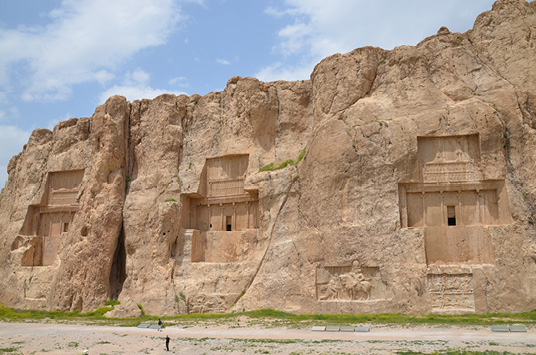
PLATE I. The cruciform tombs of Achaemenid kings at Naqš-e Rostam. Photograph by Carole Raddato, licensed under CC-by-SA 2.0.
The first expressions of Persian royalty in monumental form are found in Cyrus II’s (q.v.; r. 559-530 BCE) new foundation of Pasargadae (q.v.), and there the imagery, styles, and expertise of subject territories, such as the columned halls familiar from the earlier Zagros princedoms, masonry techniques in use in western Anatolia, and iconography familiar from the Assyrian palaces, figure alongside Elamite elements (Nylander; Stronach, 1978; Root, pp. 46-58, 301-4; Boucharlat and Benech), but contemporary verbal statements are absent (Stronach, 2000, pp. 685-92). The royal voice only becomes audible with the accession of Darius I when a new script, Old Persian, was devised for the language. This script was therefore able to stand beside Babylonian and Elamite cuneiform whose shape it imitated while diverging from it (DB §70, Huyse; Stolper, p. 19, with the important corrective by Stolper and Tavernier, 2007). It is with Darius I that what became the standard royal ideology was defined: first, by placing inscriptions in major royal construction projects, as well as in the landscape (see Kent; Lecoq; Schmitt, 1991, 2000, 2009, for the texts). Alongside this, royal iconography was given a definitive and enduring shape. Elements of Persia’s imperial predecessors—Assyro-Babylonia, Egypt—were selected, reshaped and deployed in order to express the new, Persian character of the empire (Root). It has survived best in Darius’ new royal center of Persepolis (q.v.), attached to an older Elamite city, where palaces were set on a high terrace. The royal burials were relocated close to Persepolis and differ markedly from that of Cyrus at Pasargadae (PLATE I). Their rock-cut, cruciform shape set the norm for Darius’ successors down to the end of the empire (Schmidt, 1953, 1957, 1970). Pasargadae continued to play an important role, both ceremonial (Henkelman, 2008a, pp. 385-452) and administrative (Hallock, s.v. batrakataš [q.v.]), but the government center in Fārs (q.v.) shifted to Persepolis. At the same time, Darius also refashioned the old Elamite center of Susa (q.v.) in a totally Persian style (Perrot). Another major center was Ecbatana (q.v.), but its continuous occupation makes excavation difficult, so that its appearance in Achaemenid times remains unclear (Sarraf; but see now Boucharlat, 2018). Other smaller royal centers were developed in Iran (Boucharlat; Henkelman and Kleber; Henkelman, 2008b; Tolini; Mohammadkhani); but, with few exceptions (Gasche; Davesne and Laroche-Traunecker, pp. 293-306), the appearance of provincial residences is poorly documented. These structures along with rock inscriptions and stelae (such as those set up along the canal in Egypt; Lloyd, pp. 99-107) manifested the king’s power, while he himself moved through his realm reaffirming links with local communities (Briant, 1988).
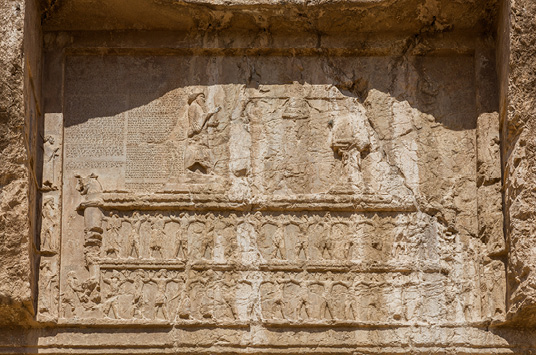
PLATE II. The tomb of Darius I at Naqš-e Rostam, top register. Photograph by Diego Delso, delso.photo, licensed under CC-BY-SA.
Crucial motifs that define the Persian concept of kingship emerge from this material, verbally and pictorially (the two must be considered together), as well as repeatedly in various combinations. One is the centrality of Persia (DPh/DH), the special place occupied in the universe by its people (DPe; DPd), and the identity of the king as a Persian and Iranian, who has fought battles far from home to establish Persian rule (DNa). This is mirrored in, for example, the way Persians are depicted at Persepolis as opposed to other peoples: they are the royal bodyguards, courtiers, officials, ushers, soldiers, servants; never are they depicted in the guise of tribute bearers, which shows that their relationship to the king differs fundamentally from that of the imperial subjects. An emphasis throughout is on the variety of peoples bound together in the empire (DNa; DPg), who unitedly support the king, graphically shown over and over again carved in doorways and in the reliefs on the royal tombs, where they form the struts of a kind of throne (OPers. gāθu-) on which the king stands on a stepped podium facing an “altar” from which flames emerge (PLATE II). This may echo a public royal ceremony as suggested by two very similar structures located in the so-called “sacred enclosure” at Pasargadae (Stronach, 1978, pp. 138-45). Despite the stressed diversity of the subjects, they are presented as brought together harmoniously in the service of the king—most strikingly in the evocation of each contributing a specific expertise or resource to build the great palace of Susa by Darius I (DSf), so that the royal setting forms a microcosm of the empire.
The extraordinary size of the king’s realm is driven home by the formal recitation of the subjects he rules, which appears in a majority of inscriptions and never acknowledges the existence of a world beyond its borders. But here the king never claims personal responsibility for control of this vast space, instead it has been bestowed upon him by Ahuramazdā (see AHURA MAZDĀ), “the greatest of the gods,” and many inscriptions end with a prayer for protection by him. Ahuramazdā’s role is presented particularly clearly in the introit of some texts, e.g.: “A great god (is) Ahuramazdā, who created this earth, who created yonder heaven, who created man, who created happiness (OPers. šiyāti-) for man, who made Darius king, one king of many, one lord of many” (DSf §1).
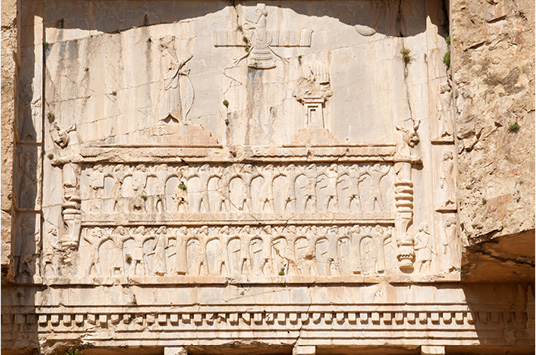
PLATE III. King saluting the winged disk; thought to be the tomb of Xerxes I (r. 485-465 BCE) at Naqš-e Rostam, top register. Photograph by A. Davey, licensed under CC-by-2.0 Generic.
This presents the institution of kingship as part of Ahuramazdā’s beneficent creation, which creates the possibility of ‘happiness’ for mankind. The term šiyāti- evokes notions of prosperity and serenity in this life, and it thus follows that, to participate in it, all owe obedience to the king’s word, his “law” (OPers. dāta), expressed concretely by rendering him “tribute” (OPers. bāji) (DNa §3). The message is that king and god complement each other in the universe working for the same ends. It is possible that this is symbolized by the image of the king on his tomb, where he raises his hand in salutation to a figure emerging from a winged disc, which hovers above the whole scene and returns the gesture, while presenting a ring with his other hand (PLATE III; further on this Garrison, 2017; Jacobs). Many take this to be a representation of Ahuramazdā (Sancisi-Weerdenburg, 1993, pp. 149), with the image encapsulating the close relationship between king and god, although others identify the figure in the disc differently (the royal farnah- [FARR(AH)]: Calmeyer; Shahbazi, 1974, 1980; Elamite kitin: Garrison, 2009). However it is understood, what is clear is that Ahuramazdā was essentially the king’s god, as the administrative texts from Persepolis show that the god by far most frequently honored and lavishly supplied over Ahuramazdā in Fārs was the old Elamite god Humban (Henkelman, 2008a, pp. 353-84; 2017; ELAM vi. ELAMITE RELIGION). One thing that is clear is that the king’s closeness to his god does not mean that he was regarded as divine, although his office gave him a privileged relationship to the gods, a situation true of many other royal institutions (see further Garrison, 2011; Rollinger, 2011). Note also that although Ahuramazdā is the most prominent in the royal inscriptions, the presence of “other gods” is always acknowledged, while Anahita (ANĀHĪD) and Mithra (q.v.) are actually named alongside Ahuramazdā in inscriptions of Artaxerxes II (A2 Ha, A2Hb, A2Sa) and III (qq.v.; A3Pa).
An evil that the king prays Persia should be spared is “the lie,” (OPers. drauga-; DRUJ-); that is what the rebels who challenged Darius’ seizure of the throne were guilty of (DB §52). This introduced social and political disorder, undermining the empire’s stability (the implied opposite, “truth” = OPers. *arta, does not appear in the Achaemenid inscriptions). To threaten it by one’s actions, private or public, is to risk bringing the divinely created universe down. Hence the king presents revolt as an offence against Ahuramazdā himself, as in DB §§ 72; 75: “By them (sc. the rebels) Ahuramazdā was not worshipped.” The implication is that in order for mankind to partake of blessings on this earth and, after death, in heaven, humanity must be loyal to the king, which is elided with reverence for the king’s god, Ahuramazdā. The message was elaborated by Xerxes in a set of foundation document from Persepolis (XPh §§ 4-5; Sancisi-Weerdenburg, 1980, pp. 1-47; Briant, 2002, pp. 550-53).
This moral-political stance, which makes the king into the guardian of Ahuramazdā’s creation, determined the way in which the king presented his own exercise of power. Two texts, promulgated in the name of two different rulers, set out these ideals of royal virtue (DNb; XPl). The identity of wording makes it clear that the document is a statement of what it means to be a Persian king, the duties it imposes, the qualities that he is expected to embody (Sancisi-Weerdenburg, 2002). These are that the king is firmly on the side of what is right, which he can distinguish clearly from that which is wrong, hence he upholds justice, which serves to maintain the proper social order. His ability to do so derives from the fact that he reflects carefully and controls his temper, so the rewards and punishments he metes out are fair and appropriate because they are only decided after he has weighed up the rights and wrongs of each case. While the king is prepared to pursue wrongdoers remorselessly, he is also well aware of the services his subjects strive to perform in order to maintain the imperial framework. He does not expect the impossible—each should only do what he can to the best of his ability; this pleases the king and he rewards such patent loyalty lavishly. Right at the end, the king adds that he is not only morally fitted to rule, but also physically equipped to fight the wars essential to hold the empire together and keep chaos at bay—an aspect of Persian kingship repeatedly represented on seals (Garrison and Root) as well as carved in relief in the doorways of the palaces where the Persian hero triumphs over this eternal threat depicted in the form of lions and monsters.
This information comes largely from the center of the empire but was not confined there. While the evidence is not huge, it is sufficient to indicate that both royal imagery and pronouncements circulated through the empire and, indeed, beyond (Rollinger, 2016). The famous audience scene from Persepolis, for example, is found adapted on seals, stelae and paintings in western Turkey (Kaptan, DS 4, pls. 47-48), Egypt (Mathieson et al.), Babylonia (Briant, 1996) and the Levant (Von Graeve; see generally on this image, Allen). Versions of Darius I’s account of his irregular accession to the throne have been found in Babylon (Seidl, 1999a; 1999b with a version of the Bisotun [q.v.] relief) and Elephantine (q.v.; Greenfield and Porten; Porten and Yardeni, C.2), as well as part of one of the inscriptions on Darius I’s tomb (Sims-Williams), while echoes of the stated royal ideals appear in many stories told by classical writers (see particularly Xenophon, Anabasis, 1.9).
Bibliography
- For the sigla of Old Persian [OPers.] inscriptions, see Kent, 1953 and Lecoq, 1997.
- Lindsay Allen, “Le Roi Imaginaire: An Audience with the Achaemenid King,” in Olivier Hekster and Richard Fowler, eds., Imaginary Kings: Royal Images in the Ancient Near East, Greece and Rome, Oriens et Occidens 11, Stuttgart, 2005, pp. 39-62.
- Javier Álvarez-Mon, “Imago Mundi: Cosmological and Ideological Aspects of the Arjān Bowl,” Iranica Antiqua 39, 2004, pp. 203-32.
- Idem, The Arjān Tomb: At the Crossroads Between the Elamite and the Persian Empires, Acta Iranica 49, Leuven, 2010.
- J. Álvarez-Mon and Mark B. Garrison, eds., Elam and Persia, Winona Lake, Ind., 2011. Rémy Boucharlat, “Iran,” in Pierre Briant and R. Boucharlat, eds., L’Archéologie de l’Empire Achéménide: nouvelles recherches, Persika 6, Paris, 2005, pp. 221-92.
- Idem, “Les traces archéologiques des palais achéménides de Hamadan,” ARTA, 2018.002 (www.achemenet.com/pdf/arta/ARTA_2018.002_Boucharlat.pdf).
- R. Boucharlat and Christophe Benech, “Organisation et aménagement de l’espace à Pasargades: reconnaissances archéologiques de surface,” ARTA, 2012.003 (www.achemenet.com/document/2012.003-Benech_Boucharlat_Gondet.pdf).
- Pierre Briant, “Le nomadisme du Grand Roi,” Iranica Antiqua 23, 1988, pp. 253-73.
- Idem, “Images Perses de Babylonie et d’Égypte,” La Lettre de Pallas 4, 1996, pp. 20-21.
- Idem, Histoire de l’Empire Perse de Cyrus à Alexandre, Paris, 1996; Eng. tr. as From Cyrus to Alexander: A History of the Persian Empire, Winona Lake, Ind., 2002.
- Peter Calmeyer, “Fortuna-Tyche-Khvarnah,” Jahrbuch des Deutschen Archäologischen Instituts 94, 1979, pp. 347-65.
- Alain Davesne and Françoise Laroche-Traunecker, Le site de Meydancikkale: recherches entreprises sous la direction d’Emmanuel Laroche (1971-1982), Gülnar 1, Paris, 1998.
- Mark B. Garrison, “By the Favor of Auramazdā: Kingship and the Divine in the Early Achaemenid Period,” in Panagiotis P. Iossif, Andrzej S. Chankowski, and Catharine C. Lorber, eds., More than Men, Less than Gods: Studies on Royal Cult and Imperial Worship. Proceedings of the International Colloquium organized by the Belgian School at Athens, November 1-2, 2007, Studia Hellenistica 51, Leuven, 2011, pp. 15-104.
- Idem, The Ritual Landscape at Persepolis: Glyptic Imagery from the Persepolis Fortification and Treasury Archives, Studies in Ancient Oriental Civilization 72, Chicago, 2017.
- Idem, “Visual Representation of the Divine and the Numinous in Early Achaemenid Iran: Old Problems, New Directions,” electronic pre-publication text available at “Iconography of Deities and Demons in the Ancient Near East” website, www.religionswissenschaft.uzh.ch/idd/prepublications/e_idd_iran.pdf, last revised 3 March 2009 (illustrations at www.religionswissenschaft.uzh.ch/idd/prepublications/e_idd_illustrations_iran.pdf).
- M. B. Garrison and Margaret C. Root, Seals on the Persepolis Fortification Tablets I: Images of Heroic Encounter, 2 vols., Chicago, 2001.
- Hermann Gasche, “Les Palais Perses Achéménides de Babylone,” in Jean Perrot, ed., Le Palais de Darius à Suse: Une résidence royale sur la route de Persépolis à Babylone, Paris, 2010, pp. 446-65.
- Jonas C. Greenfield and Bezalel Porten, The Bisitun Inscription of Darius the Great: Aramaic Version, Corpus Inscriptionum Iranicarum I/V.1, London, 1982.
- Richard T. Hallock, Persepolis Fortification Tablets, Oriental Institute Publications 92, Chicago, 1969.
- Wouter F. M. Henkelman, “Persians, Medes and Elamites: Acculturation in the Neo-Elamite Period,” in Giovanni B. Lanfranchi, Michael Roaf, and Robert Rollinger, eds., Continuity of Empire (?): Assyria, Media, Persia, History of the Ancient Near East Monographs 5, Padova, 2003, pp. 181-231.
- Idem, The Other Gods Who Are: Studies in Elamite-Iranian Acculturation Based on the Persepolis Fortification Texts, Achaemenid History 14, Leiden, 2008a.
- Idem, “From Gabae to Taoce: The Geography of the Central Administrative Province,” in P. Briant, W. Henkelman, and Matthew Stolper, eds., L’Archive des Fortifications de Persépolis: État des questions et perspectives de recherches, Persika 12, Paris, 2008b, pp. 303-16.
- Idem, “Cyrus the Persian and Darius the Elamite: A Case of Mistaken Identity,” in Robert Rollinger, Brigitte Truschnegg, and Reinhold Bichler, eds., Herodot und das Persische Weltreich, Classica et Orientalia 3, Wiesbaden, 2011, pp. 577-634.
- Idem, “Humban and Auramazdā: Royal Gods in a Persian Landscape,” in W. F. M. Henkelman and Céline Redard, eds., Persian Religion in the Achaemenid Period/La religion perse à l’époque achéménide, Classica et Orientalia 16, Wiesbaden, 2017, pp. 273-346.
- W. F. M. Henkelman and Kristin Kleber, “Babylonian Workers in the Persian Heartland: Palace Building at Matannan during the Reign of Cambyses,” in Christopher Tuplin, ed., Persian Responses: Political and Cultural Interaction with(in) the Achaemenid Empire, Swansea, Wales, 2007, pp. 163-76.
- Philip Huyse, “Some Further Thoughts on the Bisitun Monument and the Genesis of the Old Persian Cuneiform Script,” Bulletin of the Asia Institute 13, 1999, pp. 45-66.
- Bruno Jacobs, “Die ikonographische Angleichung von Gott und König in der achämenidischen Kunst,” in W. F. M. Henkelman and Céline Redard, eds., Persian Religion in the Achaemenid Period/La religion perse à l’époque achéménide, Classica et Orientalia 16, Wiesbaden, 2017, pp. 247-72.
- Deniz S. Kaptan, The Daskyleion Bullae: Seal Images from the Western Achaemenid Empire, 2 vols., Achaemenid History 12, Leiden, 2002.
- Roland G. Kent, Old Persian: Grammar, Texts, Lexicon, 2nd ed., New Haven, Conn., 1953.
- Amélie Kuhrt, The Persian Empire: A Corpus of Sources from the Achaemenid Period, 2 vols., London, 2007.
- Idem, “Achaemenid Images of Royalty and Empire,” in Giovanni B. Lanfranchi and R. Rollinger, eds., Concepts of Kingship in Antiquity: Proceedings of the European Science Foundation Exploratory Workshop held in Padova, November 28th – December 1st, 2007, History of the Ancient Near East Monographs 11, Padova, 2010, pp. 87-105.
- Pierre Lecoq, Les inscriptions de la Perse achéménide, Paris, 1997.
- Alan B. Lloyd, “Darius I in Egypt: Suez and Hibis,” in Christopher Tuplin, ed., Persian Responses: Political and Cultural Interaction with(in) the Achaemenid Empire, Swansea, Wales, 2007, pp. 99-115.
- Ian Mathieson, Elizabeth Bettles, Sue Davies, and H. S. Smith, “A Stela of the Persian Period,” The Journal of Egyptian Archaeology 81, 1995, pp. 23-41.
- Pierre de Miroschedji, “La fin du royaume d’Anshan et de Suse et la naissance de l’empire perse,” Zeitschrift für Assyriologie und verwandte Gebiete 75, 1985, pp. 265-306.
- Kourosh Mohammadkhani, “Une nouvelle construction monumentale achéménide à Dahaneh-e Gholaman, Sistan-Iran,” ARTA 2012/1 (http://www.achemenet.com/document/2012.001-Mohammadkhani.pdf).
- Carl Nylander, Ionians at Pasargadae: Studies in Old Persian Architecture, Boreas: Uppsala Studies in Ancient Mediterranean and Near Eastern Civilizations 1, Uppsala, 1970.
- Jean Perrot, ed., Le Palais de Darius à Suse: Une résidence royale sur la route de Persépolis à Babylone, Paris, 2010 (Eng. tr., London, 2013).
- Bezalel Porten and Ada Yardeni, Textbook of Aramaic Documents from Ancient Egypt III: Literature, Accounts, Lists, Jerusalem, 1993.
- Daniel T. Potts, “Cyrus the Great and the Kingdom of Anshan,” in Vesta Sarkhosh Curtis and Sarah Stewart, eds., The Idea of Iran I: Birth of the Persian Empire, London, 2005, pp. 7-28.
- Robert Rollinger, “Herrscherkult bei Teispiden und Achaimeniden. Realität oder Fiktion?,” in Linda-Marie Günther and Sonja Plischke, eds., Studien zum vorhellenistischen und hellenistischen Herrscherkult, Oikumene: Studien zur antiken Weltgeschichte 9, Berlin, 2011, pp. 11-54.
- Idem, “Royal Strategies of Representation and the Language(s) of Power: Some Considerations on the Audience and the Dissemination of the Achaemenid Royal Inscriptions,” in S. Procházka, L. Reinfandt, S. Tost, and K. Wagensonner, eds., Official Epistolography and the Language(s) of Power, Vienna, 2016, pp. 117-30.
- Margaret C. Root, The King and Kingship in Achaemenid Art: Essays on the Creation of an Iconography of Empire, Acta Iranica 19, Leiden, 1979.
- Heleen Sancisi-Weerdenburg, “Yaunā en Persai: Grieken en Perzen in een ander perspectief,” Ph.D. diss., University of Leiden, 1980.
- Idem, “Political Concepts in Old-Persian Royal Inscriptions,” in Kurt Raaflaub, ed., Anfänge politischen Denkens in der Antike: Die nahöstlichen Kulturen und die Griechen, Schriften des Historischen Kollegs Kolloquien 24, Oldenbourg, 1993, pp. 145-63.
- Idem, “The Personality of Xerxes, King of Kings,” in Egbert J. Bakker, Irene J. F. de Jong, and Hans van Wees, eds., Brill’s Companion to Herodotus, Leiden, 2002, pp. 579-90 (repr. from L. de Meyer and E. Haerinck, eds., Archaeologia Iranica et Orientalis: Miscellanea in Honorem Louis Vanden Berghe, Ghent, 1989, pp. 549-61).
- Mohammad Rahim Sarraf, “Archaeological Excavations in Tepe Ekbatana (Hamadan) by the Iranian Archaeological Mission between 1983 and 1999,” in Giovanni B. Lanfranchi, Michael Roaf, and Robert Rollinger, eds., Continuity of Empire(?): Assyria, Media, Persia, History of the Ancient Near East Monographs 5, Padova, 2003, pp. 269-79.
- Erich F. Schmidt, Persepolis I: Structures, Reliefs, Inscriptions, Oriental Institute Publications 68, Chicago, 1953.
- Idem, Persepolis II: Contents of the Treasury and Other Discoveries, Oriental Institute Publications 69, Chicago, 1957.
- Idem, Persepolis III: The Royal Tombs and Other Monuments, Oriental Institute Publications 70, Chicago, 1970.
- Rüdiger Schmitt, The Bisitun Inscription of Darius the Great: Old Persian Text, Corpus Inscriptionum Iranicarum I/1.1, London, 1991.
- Idem, The Old Persian Inscriptions of Naqsh-i Rustam and Persepolis, Corpus Inscriptionum Iranicarum I/1.2, London, 2000.
- Idem, Die altpersischen Inschriften der Achaimeniden: Editio minor mit deutscher Übersetzung, Wiesbaden, 2009.
- Ursula Seidl, “Ein Monument Dareios’ I. aus Babylon,” Zeitschrift für Assyriologie und verwandte Gebiete 89, 1999a, pp. 101-14.
- Idem, “Eine Triumphstele Darius’ I. aus Babylon,” in J. Renger, ed., Babylon: Focus mesopotamischer Geschichte, Wiege früher Gelehrsamkeit, Mythos in der Moderne, Saarbrücken, 1999b, pp. 297-306.
- Shapur A. Shahbazi, “An Achaemenid Symbol: I. A Farewell to ‘Fravahr’ and ‘Ahuramazda’,” AMI 7, 1974, pp. 135-44.
- Idem, “An Achaemenid Symbol: II. Farnah (God Given) Fortune ‘Symbolised’,” AMI 13, 1980, pp. 119-47.
- Nicholas Sims-Williams, “The Final Paragraph of the Tomb-Inscription of Darius I (DNb, 50-60): The Old Persian Text in the Light of an Aramaic Version,” BSOAS 44, 1981, pp. 1-7.
- Matthew W. Stolper, “Achaemenid Languages and Inscriptions,” in John Curtis and Nigel Tallis, eds., Forgotten Empire: The World of Ancient Persia, Berkeley and Los Angeles, 2005, pp. 18-24.
- M. W. Stolper and Jan Tavernier, “From the Persepolis Fortification Archive Project, 1: An Old Persian Administrative Tablet from the Persepolis Fortification,” ARTA, 2007.001 (www.achemenet.com/document/2007.001-Stolper‑Tavernier.pdf).
- David Stronach, Pasargadae: A Report on the Excavations Conducted by the British Institute of Persian Studies from 1961 to 1963, Oxford, 1978.
- Idem, “Of Cyrus, Darius and Alexander,” in R. Dittmann, B. Hrouda, U. Löwe, P. Matthiae, R. Mayer-Opificius, and S. Thuerwächter, eds., Variatio Delectat: Iran und der Westen: Gedenkschrift für Peter Calmeyer, Alter Orient und Altes Testament 272, Münster, 2000, pp. 681-702.
- Jan Tavernier, Iranica in the Achaemenid Period (ca. 550-330 B.C.): Lexicon of Old Iranian Proper Names and Loanwords, Attested in Non-Iranian Texts, Orientalia Lovaniensia Analecta 158, Leuven, 2007.
- Gauthier Tolini, “Les travailleurs babyloniens et le palais de Taokè,” ARTA, 2008.002 (www.achemenet.com/document/2008.002-Tolini.pdf).
- Volkmar von Graeve, Der Alexandersarkophag und seine Werkstatt, Berlin, 1970. Matthew W. Waters, A Survey of Neo-Elamite History, State Archives of Assyria Studies 12, Helsinki, 2000.