



Most of the Turks in Iran are descendants of the Oghuz (see ḠOZZ). The Oghuz migrated to the south under the Saljuqs (q.v.) in the 10th century CE, and, in the 11th century, they established an empire that expanded from the middle course of the Syr Daryā. From there, they moved first into Khorasan; subsequently, one group moved on to Anatolia, while another group remained in Khorasan. Meanwhile, the Oghuz who had stayed in the old Turkmen region to the east of the Caspian Sea later conquered the eastern part of what is today Turkmenistan. Thus, the modern Turkmens, speaking an East Oghuz language, are the descendants of those Oghuz who did not participate in the westward Saljuq migration. The groups speaking Azeri Turkish (see AZERBAIJAN viii. AZERI TURKISH) are the descendants of the Oghuz who had moved further west and either established themselves in Azarbaijan or returned to Iran from Anatolia; of those, some, called the “Southern Oghuz” by Gerhard Doerfer, migrated to western Iran and others to the east (e.g., to Galugāh, southeast of the Caspian, or Darragaz, northern Khorasan). The Khorasani Turks are descended from the Oghuz who had participated in the conquest of Khorasan under the Saljuqs, joined later by immigrants from other regions.
The concept of a distinct Khorasani Turkic identity and language has been slow to develop. Aleksander Chodźko (q.v.; 1804-91) had included folk songs from Khorasan Turkic in 1842 in his Specimens of the Popular Poetry of Persia (pp. 379-414), but unfortunately he only gave translations of them and called them “Turkman songs” (Doerfer and Hesche, 2002, p. 328). Vladimir Ivanow (q.v.; 1886-1970) grasped the nature of Khorasan Turkic as early as 1926 in his article “Notes on the Ethnology of Khorasan.” Ivanow discussed the Khorasani Turks and their language and cultural features (Ivanow, p. 154), pointing out that the Turks living in Khorasan are not Turkmens, but, unfortunately, he did not give an example of their language in his article. The information he provided did not receive the attention it deserved for some time. His article was important in two ways. First, it demonstrated the importance of the Turkic element across Iran. Second, he noticed before anyone else the existence of a distinct Khorasan Turkic, which appeared to be a missing link between the Azeri and Turkmen languages.
Beginning in 1927, A. P. Potseluevskiĭ (1894-1948) organized a series of research trips to Turkmenistan to study the dialects of the Turkmens in the Soviet Union. In his Dialekty Turkmenskogo yazyka, Potseluevskiĭ divided the Turkmen dialects into two major groups without going into much detail: Turkmen as we know it today, and the dialects as found in Iran and Uzbekistan. This latter should have been called “Khorasan Turkic” (Doerfer and Hesche 1993; Doerfer and Hesche, 2002, pp. 327-28), but Potseluevskiĭ had no knowledge of the existence of Khorasan Turkic dialects. His rather simplistic classification of Turkmen paved the way for the discovery of the characteristics of Khorasan Turkic, but at the same time it delayed investigation of the subject. Consequently, the view emerged that the northeast of Iran, i.e., the whole area north of the 36th latitude to the borders of Turkmenistan, was dominated by Turkmens, even though Khorasani Turks can readily be distinguished from Turkmens by their culture and traditions. This incorrect opinion was even reflected in the Philologiae Turcicae Fundamenta (Deny et al.; see Doerfer and Hesche, 1993, pp. 13-15).
The research of Gerhard Doerfer and his colleagues and students, beginning with an expedition to Khorasan in 1973, led to the recognition of the Khorasani Turks as a distinct subgroup of the Oghuz Turks, speaking a branch of Oghuz Turkic different from the Anatolian, Azeri, and Turkmen branches (Tulu, 2009, pp. 7-8, citing Doerfer, 2002). In actuality, there are four varieties of Oghuz languages spoken in the northeast of Iran: (1) Turkmen, in the west, e.g., around Gonbad-e Qābus (q.v.); (2) Azeri Turkic, in the north central area and in Darragaz (q.v.) and Loṭfābād; (3) Marvi, a dialect similar to Uzbek-Oghuz, in Langar, southeastern Khorasan; and (4) Khorasani Turkic, also called Eastern Oghuz, one of the five dialects of the Oghuz language. The latter dialect was actually identified by some with the dialects of Turkmenistan, which Potseluevskiĭ called “Turkmeni near the border of Iran.” However, Khorasani Turks call their language not torkmāni (türkmençe), but torki (türkçe), and they are culturally distinct from the Turkmens (Fázsy, p. 10; Tulu, 2009, pp. 7-8). The focus of this article is on the language of this particular ethnic group (for other Turkic languages and dialects, see IRAN vii. NON-IRANIAN LANGUAGES [7] TURKIC LANGUAGES; TURKIC LANGUAGES OF PERSIA: AN OVERVIEW).
OVERVIEW OF KHORASAN TURKIC DIALECTS
Due to historical circumstances, Khorasan Turkic developed in the area of interaction between Oghuz (Turkmen) and Eastern Turkic (Karakhanid, Khᵛārazm Turkic, Chagatay, and Uzbek) since the 11th century (Figure 1). While Western Oghuz developed its own linguistic features independently and as a relatively homogeneous entity, Khorasan Turkic (like Turkmen) remained isolated from the other Oghuz languages and was influenced by Eastern Turkic. Thus, Khorasan Turkic has features specific to Eastern Turkic as well as archaic features. These features increase even more as the geographical position of the speakers shifts towards the east. Indeed, Khorasan Turkic can be described as a mixed language consisting of Oghuz and Eastern Turkic elements; Doerfer compares its situation to that of English, which is a mixture of Germanic and Romance languages. On the other hand, Oghuz-Uzbek (correctly North Khorasani, according to Doerfer) is essentially an Oghuz dialect, but with characteristics of Eastern Turkic such as the dative case, -GA ‘to’.
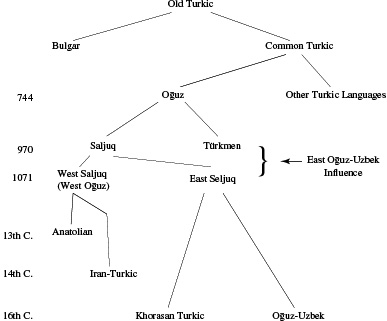
Figure 1. Diachronic development of Khorasan Turkic (after Doerfer, 1977, p. 193).
Khorasan Turkic is very different from all other Oghuz dialects in terms of literary development, i.e, with Western Oghuz as the language of the Ottoman state, Middle Oghuz (in a close connection with Western Oghuz) as a language of the Safavid state, and Turkmen as the language of a group that developed its own literature in the 17th century, though isolated and limited to a narrow area on the east coast of the Caspian Sea. In contrast, Khorasan Turkic developed in a scattered, fragmented, and unique way, without becoming a literary language. Under the overwhelming pressure and domination of the surrounding environment, it was almost completely submerged. Only recently has Khorasan Turkic begun to develop in terms of a literary language. Khorasan Turkic still does not have an official written language; for this reason, it often employs the orthography developed by the journal Vārliq for Azeri Turkic.
Despite the lack of a written literary heritage, there are traces of the language that might be detected in earlier historical periods. Doerfer pointed to the case, among others, of Jalāl-al-Din Rumi (1207-73), who moved to Anatolia from the city of Balkh, where Khorasan Turkic was spoken at that time, for examples of Old (mixed) Khorasan Turkic. According to Doerfer, although Rumi wrote predominantly in Persian, under the strong influence of Persian literature at that time, there are vestiges of Turkic language in some of his poems that fit perfectly with the eastern dialects of Khorasan Turkic (Doerfer, 1977, pp. 130-35; see also Mansuroğlu on Rumi’s “Turkish verses”). These do not contain true Eastern Turkic elements. In addition to Common Oghuz Turkic words such as dağ, dağ.dan ‘from the mountain’ (with ablative) or oda ‘room’, oda.ya ‘to the room’ (with dative suffix), there are also forms such as män yarġu.ya barurmän ‘I will go to judgment’. This is neither Eastern Turkic nor Western Oghuz, but it completely fits the Eastern dialects of Khorasan Turkic: Here, the dative suffix after the vowel is -ya, as seen in many Oghuz dialects, but the first person (particularly as a prefix) begins with m- (although the archaic form of b is preserved in words such as bindän and binüm), and it still displays archaic forms of the personal pronouns and certain suffixes; bol:ġay ‘will be’ or b- ~ v (as with barur instead of varur) are also seen in modern Khorasan Turkic, even in northeast dialects. Khorasan Turkic may also have an important role in solving the mystery of the “olga-bolga language” (so-called for the mixing of Western Oğuz ol- with Common Turkic bol- ‘to be’), which is reflected in some Anatolian Turkish texts from the 13th and 14th centuries. According to Doerfer, these texts actually represent the northern and northeastern variants of the Eastern Oghuz language, that is, Khorasan Turkic (for a summary of Doerfer’s interpretation and contrary views, see Erdal, pp. 139-40; for other criticism of Doerfer’s categorization of “historical Khorasan Turkic,” see Anetshofer).
At the present time, there are over one and a half million speakers of Khorasan Turkic in northeastern Iran and the border regions adjacent to Turkmenistan and also a little further east of the Āmu Daryā (q.v.), with Sarık and Ersarı Turkmens between both areas. The areas surveyed by Doerfer where local dialects of Khorasan Turkic may be found are indicated in Figure 2.
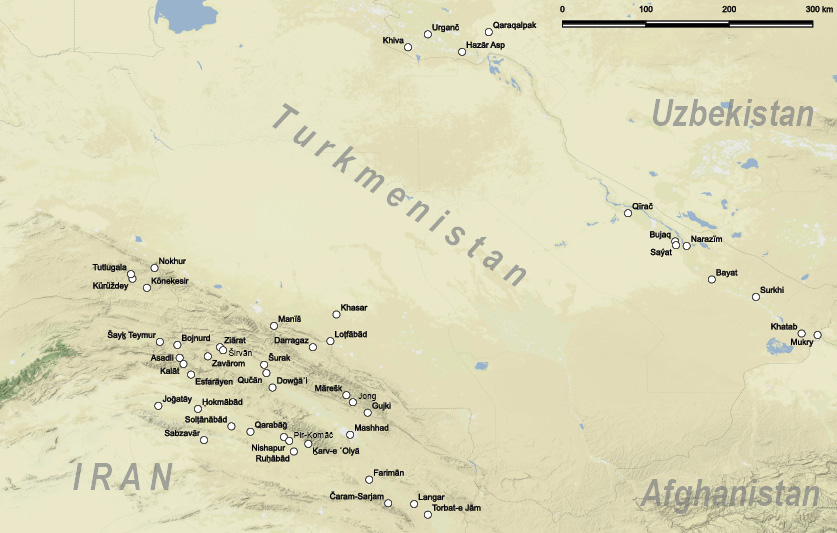
Figure 2. Turkic-speaking areas (surveyed in Doerfer, 1977, pp. 203-4). Map background © Stamen Design, under CC BY 3.0.
Khorasan Turkic differs significantly in the northern and southern regions of Khorasan. Features of Uzbek and Turkmen can be seen in the dialects of both regions. Sometimes, people speaking different languages live in the same area; in many cases, people in the region are bilingual, with Khorasan Turkic as the mother tongue and Persian as the second language. Because of this, Khorasan Turkic has been under the influence of Iranian languages in many ways. This is reflected in the phonology, morphology, and even the syntax of the language.
The influence of Khorasan Turkic is still seen in certain Turkmen dialects of the Republic of Turkmenistan. Although these generally follow the common Turkmen model (for example, in the 1st and 2nd person singular verb conjugation), they differ from standard Turkmen forms at many points and tend to reflect the Khorasan Turkic language (for example, the preservation of h- in Čovdur, Olam, Saqar, Emreli, Ärsarı, Arabačı, Sarıq, Garadašlı) and the influence of Uzbek (the use of -gA, -GA in Uzbek-Oghuz, Ersarı, Yomut, and Čovdur as well as Čaram-Sarjam, a dialect of Khorasan Turkic). Such similarities may have misled Potseluevski into not clearly distinguishing Khorasan Turkic from true Turkmen dialects (such as Teke and Göklen).
DIALECTOLOGY AND LINGUISTIC FEATURES
The classification of dialects spoken in Khorasan is difficult for four reasons: (1) variations from one speaker to another, (2) the slight differences between dialects, (3) the phenomenon of using dual language (forms occuring in spontaneous speech often differ from those in questionnaires, word lists, and short grammars) and (4) problems encountered in the analysis of the morphology (Doerfer and Hesche, 1998, p. 32). Khorasan Turkic reflects on the one hand intense pressure from a foreign language (Persian) and, on the other hand, a strong archaism and autonomy. Changes and differences are peculiar to dialects that have not yet been standardized, that could not form an independent written language, and that are affected by the dominant language.
Doerfer (1998c, p. 275, Table 16.2) distinguished six dialects of Khorasan Turkic, based on the present, predicate, and imperative forms used:
A. Present tense suffixes: (a) –IyA, (b) –Ir, (c) –A
B. Personal suffixes: (a) -(A)m, -(A)ŋ as in Qašqāʾi; (b) like category (a), but first and second person plural suffixes -IK, -IGIs; (c) –mAn, -sAn, as in Oghuz Uzbek (1st person plural suffix -mIz); (d) –mAn, -sAn, but 1st person plural –bIz. (These are quite different from Turkmen personal suffixes: -In, -sIŋ, -Is, -IK, – (s)IŋIz.)
C. First person voluntative forms: (a) –Im, -Ak (as Az.T.); (b) –Am, -Ak (with the same vowel in singular and plural); (c) –Im, -IK (with the same vowel in singularity and plurality), (d) –Im, -Äyli or similar special forms.
According to this schema, the dialects, the areas where they are spoken, and the distribution of the variants are as follows (for locations of the local dialects, see Figure 2):
1) Northwest = Šayḵ Teymur, Bojnurd, Asadli, Kalāt (Aa, Bb, Cc).
2) North = Ziārat, Širvān, Zavārom, Qučān, Šūrak, Lotfābād, Darragaz, Dowḡā’ī (Ac, Bc, Ca).
3) Northeast = Mārešk, Jong, Gujkī (Ac, Bc, Ca).
4) South = Joḡatay, Ḥokmābād, Solṭānābād, Qarabāḡ, Pir-Komāč, Safiābād (Ab, Ba, Cb).
5) Southeast = Ḵarv-e ʿOlyā, Ruḥābād, Čaram-Sarjam (Ab, Bb, Cc).
6) Langar (Ac, Bd, Ca).
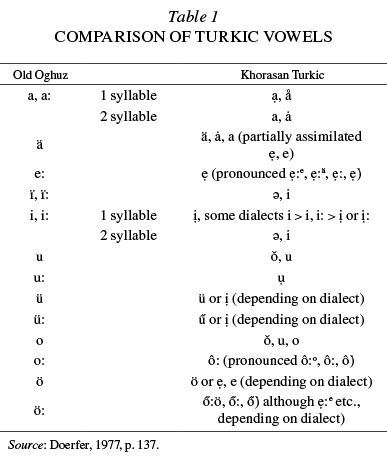
The vowel system, consonants and consonantal change, morphology (nouns, pronouns, verb forms), and lexicology of the various Khorasan Turkic dialects have been described at length by Doerfer (1977, pp. 135-83) and need not be discussed here. Of particular interest, however, is the way characteristic features of Khorasan Turkic have been affected by the strong influence of Iranian languages. According to the scheme proposed by Doerfer (1977, pp. 135-37), for example, the vowel system of Khorasan Turkic consists of a mixture of two systems, Turkic and Iranian: Turkic had originally used four front (ä, i, ü, ö) and four back (a, ï, u, o) vowels. Old Oghuz added shortened forms of the vowels (designated here by :), resulting in a, ä, a:, e:, ï, i, ï:, i:, u, ü, u:, ü:, o, ö, o:, ö:. The vowel system of the Khorasan Iranian dialect that affected Khorasan Turkic dialects was as follows: å (labialized a), ȧ (between a and ä), ị (close vowel), ə (between an open i and a close é); ụ (close vowel); and ǒ (between open u and close o). The resulting transition from Old Oghuz to Khorasan Turkic, with some of its own peculiarities, was summarized by Doerfer (1977, p. 137) as in Table 1.
Similarly, Khorasan Turkic dialects have been under the strong influence of Persian or “Khorasan-Iranian” in terms of vocabulary and other elements (Doerfer, 1977, pp. 179-83). For example, in some local dialects čöräk ‘bread’ may be nān (Persian) or na:n (“Khorasan-Iranian”), dämir ‘iron’ may be åhän or ähän (< Pers. āhan); most dialects use dizi ‘bowl’ (< Pers. dizi), käfš or kövüš ‘shoe’ (< Pers. kafš), bärk ‘sheet of paper’ (< Pers. barg), rutxana ‘river’ (< Pers. rudḵāna), etc. In word lists (Doerfer and Hesche, 1993, p. 23), it can be seen that the source speaker frequently adds a Turkic (-di, -dir, -dey, etc.) or Persian suffix (-ä, -äs, -ya, -ye, -y) to the word asked. However, the Persian -ä suffix is not only used as an affix (< ast), but also as a diminutive suffix (< ak), indicative case suffix (< rā) and determinative (Doerfer and Hesche, 1998, p. 23)
THE CONTEMPORARY SITUATION OF KHORASAN TURKIC
In Doerfer’s view (1999, pp. 307-8), Turkic languages such as Azeri, Qašqaʾi, and Turkmen were likely to persist in Iran, but Khorasan Turkic, like Ḵalaj (q.v.), without an accompanying literature, was “doomed to disappear”; only Turkic languages with a strong unifying power (ʿaṣabiya) could “survive against the ideology of the Persian state.” Doerfer noted that in Khorasan Turkic, unlike Azeri and Turkmen, Persian words were already beginning to replace common Turkic words, such as abru for kaş ‘eyebrow’, and even numbers such as Persian haštād ‘eighty’ and navad ‘ninety’ instead of the Turkic equivalents (Doerfer, 1999, p. 309). Persian, as the only official language of Iran, brings Persianization as the result of increasing education and communication. Economic pressure also causes people to migrate from rural areas to big cities and thus to be assimilated culturally and linguistically. As a result of mixed marriages, childhood speakers tend to disappear over time. The fact that Persian is a “prestige language” has also put Khorasan Turkic, which is an “ethnic language” or “local language,” under pressure; so too has the influence of other ethnic communities narrowed the use of Khorasan Turkic. In Stephen Wurm’s classification for the level of danger, Khorasan Turkic would be at the first level, i.e., among the “potentially endangered languages.” In the 2010 UNESCO atlas of endangered languages, Khorasan Turkic is classified as “vulnerable,” a stage where languages are socially and economically disadvantaged and experience heavy pressure from a dominant language and begin to lose their child speakers, as they no longer speak their parental language as a first language or restrict it to specific environments such as at home (Moseley, pp. 11-12, 18, Map 12).
Nonetheless, as Doerfer anticipated, there has been something of a counter-movement since the 1980s with the potential to produce a Khorasan Turkic literary language and avoid the predicted linguistic “apocalypse.” Doerfer pointed in particular to the journal Qalam Uju, edited and largely written by Moḥammad Tawḥidi in 1981, using his local dialect, which he claimed could be understood by all Khorasani Turks and could provide the basis for a common written Khorasan Turkic language (Doerfer, 1999, p. 308). Radio broadcasts from Mashhad also began to be made in Khorasan Turkic. This dynamism and ethnic awareness continues to be active and visible on the internet, where there are many blogs and webpages created by Khorasan Turks (see Table 2). In these, it is possible to find examples of Khorasan Turkic as well as information on the history and folklore of Turkic Khorasan.
| Table 2 Websites Related to Khorasan Turkic Language and Culture |
| www.xorasan.blogspot.com |
| www.xorasan.blogspot.com.tr/2010_12_01_archive.html |
| sites.google.com/site/wwwinsanchiliq/home |
| www.salariyan.blogfa.com/ |
| www.bojnourdan.blogfa.com/ |
| sozumuz.blogspot.com.tr/ |
| www.sosansosan.blogfa.com/ |
| shindokht-poetry.blogspot.com.tr/ |
| www.aa-seraj.blogfa.com/ |
| www.ali13851385.blogfa.com/ |
| www.sepehrblog.blogfa.com/ |
| www.bamvabamiha.blogfa.com/ |
| www.arabkhedri.blogfa.com/ |
| www.esmaeelkazemi.blogfa.com/ |
| Date Accessed: 09/07/2014. |
Bibliography
- F. A. Abdullaev, Xorezmskie govory uzbekskogo yazyka, Tashkent, 1961. Idem, Fonetika xorezmskix govorov, Tashkent, 1967.
- Helga Anetshofer, Temporale Satzverbindungen in altosmanischen Prosatexten: mit einer Teiledition aus Behcetü’l-Ḥadāʾiq (1303 und 1429), Muqaddime-i Quṭbeddīn (1433 und Ferec ba’de’ş-šidde (1451), Wiesbaden, 2005.
- Fāṭema ʿAzizi, Farhang-e loḡat-e torki-ye Bojnurdi: torki be-fārsi, fārsi be-torki, Bojnurd, 2015.
- F. Sema Barutçu Özönder, ‘‘İran ve Türkler,’’ Güney Azerbaycan Edebiyatında İstiklal Sempozyumu, 30 Mayıs 1998, Ankara, 1998.
- R. Berdiev, Türkmen diliniŋ dialektleriniŋ oçerki, Ashkabad, 1970.
- Sonel Bosnalı, İran Azerbaycan Türkçesi: Toplum dilbilimsel Bir İnceleme, Istanbul, 2007.
- Saadet Çağatay, Türk Lehçeleri Örnekleri: Yaşayan Ağız ve Lehçeler, 2 vols., Ankara, 1972.
- Alexander Chodźko, Specimens of the Popular Poetry of Persia as Found in the Adventures and Improvisations of Kurroglou, the Bandit-Minstrel of Northern Persia and in the Songs of the People Inhabiting the Shores of the Caspian Sea, London, 1842.
- Jean Deny et al., eds., Philologiae Turcicae Fundamenta, 3 vols., Berlin, 1959.
- Eva Dobos, “An Oghuz Dialect of Uzbek Spoken in Urgench,” Acta Orientalia Hungarica 28 (1974), pp. 75-97.
- Gerhard Doerfer, “Horasan Türkçesi,” in S. Çağatay, ed., Türk lehçeleri örnekleri II: yaşayan ağız ve lehçeler, Ankara, 1972, pp. 261-64.
- Idem, “Bericht über eine linguistische Forschungsreise in Iran,” Türk Dili Araştırmaları Yıllığı Belleten 21-22 (1973-74), pp. 199-202.
- Idem, ‘‘Das Chorasantürkische,’’ Türk Dili Araştırmaları Yıllığı Belleten 25, 1977, pp. 127-205.
- Idem, “Chorasantürkische aus dem ‘Türkenkessel’,” Central Asiatic Journal 36, 1992, pp. 44-71.
- Idem, “Die Sprache Gadāʾīs,” in Árpád Berta et al., eds., Symbolae Turcologicae: Studies in Honour of Lars Johanson on His Sixtieth Birthday, 8 March 1996, Stockholm, 1996a, pp. 71-76.
- Idem, “Ein çängä in Nordchorasan,” in J. P. Laut and M. Ölmez, eds. Bahşı Ögdisi: Klaus Röhrborn Armağanı, Freiburg and İstanbul, 1998a, pp. 67-72.
- Idem, “The Suffix of the Third Person Plural of the Verb in Khorasan Turkic,” Studia Turcologica Cracoviensia 5, 1998b, pp. 111-17.
- Idem, “Turkic Languages of Iran,” in Lars Johanson and Éva Á. Csató, eds., The Turkic Languages, London and New York, 1998c, pp. 273-82.
- Idem, “İran’daki Türk Dil ve Lehçeleri ile Bunların Hayatta Kalma Şansı,” in 3. Uluslararası Türk Dili Kurultayı, Ankara, 1999, pp. 303-10.
- Idem, “Irano-Turkic,” in Lars Johanson and Christiane Bulut, eds., Turkic-Iranian Contact Areas: Historical and Linguistic Aspects, Wiesbaden, 2006, pp. 93-113.
- Idem, “Die Volksliteratur der Türken Chorasans: Eine Übersicht,” Yaprak 19, 2002.
- Gerhard Doerfer and Wolfram Hesche, Chorasantürkisch: Wörterlisten, Kurzgrammatiken, Indices, Turcologica 16, Wiesbaden, 1993.
- Idem, Türkische Folklore-Texte aus Chorasan, Turcologica 38, Wiesbaden, 1998.
- Gerhard Doerfer, Wolfram Hesche, and J. Ravanjar, Oghusica aus Iran, Wiesbaden, 1990.
- Marcel Erdal, “Explaining the Olga-Bolga Dili,” in Bill Hickman, Gary Leiser, and Robert Dankoff, eds., Turkish Language, Literature, and History: Travelers’ Tales, Sultans, and Scholars Since the Eighth Century, London, 2016, pp. 135-46.
- Szabolcs Fázsy, “Das Bodschnurdi: ein türkischer Diyalekt in Chorasan, Ostpersien” Ph.D. diss., Zürich, 1977.
- Wolfram Hesche, “Persisch-türkische Interferenz in Nordostiran,” Materialia Turcica 21, 2000, pp. 1-54.
- Javad Hayʾat (C. Hey’et), Sayri dar tāriḵ-e zabān va lahja-hā-ye torki, Tehran, 1987, pp. 323-30.
- Idem, “Torki-ye Ḵorāsān / Horasan Türkçesi,” Vārliq 71/5, 1989, pp. 18-40.
- Idem, “Horasan Türkçesi,” Anayurttan Atayurda Türk Dünyası 22, 1994, pp. 21-30.
- V. Ivanow, “Notes on the Ethnology of Khorasan,” Geographical Journal 27, 1926, pp. 143–58.
- Lars Johanson,“Rūmī and the Birth of Turkish Poetry,” Journal of Turkology 1, 1993, pp. 23-37.
- Qalam Uju (see Moḥammad Tawḥidi).
- Jalāl Qolizada Mazarji, Āšnāyi bā zabān-i torki-e Ḵorāsāni, Mashhad, 2011.
- Mecdut Mansuroğlu, “Celāleddin Rumi’s türkische Verse,” Ural-Altaische Jahrbücher 24, 1952, pp. 106-15.
- Karl H. Menges, “Research in the Turkic Dialects of Iran (Preliminary Report on a Trip to Persia,” Oriens 4, 1951, pp. 273-79.
- ʿAli Mirniā, Īlāt wa tawāyef-e Darragaz, 2 vols., Mashhad, 1982-83.
- Christopher Moseley, ed., Atlas of the World’s Languages in Danger, Paris, 2010.
- A. P. Potseluevskiĭ, Dialekty turkmenskogo yazyka, Ashkhabad, 1936.
- Idem, Izbrannye trudy, Ashkhabad, 1975.
- Mousa Rahimi, “Dil Hayâtiyeti Bağlamında Horasan Türklerinin Bugünkü Durumu,” Türk Dünyası İncelemeleri Dergisi 2/13, 2013, pp. 131-41.
- Esmāʿil Sālāriān, Negāhi ba farhang‑e Torkān-e Ḵorāsān, Bojnurd, 2019.
- Ali Reza Sarrafi, “İran Türklerinin Dili ve Folkloru,” Vārliq 113-14, 1999, pp. 60-71.
- Amir Šālči, Farhang-e guyeši-ye Ḵorāsān-e Bozorg, Tehran, 1991.
- Ş. Ş. Şoabdurrahmanov, Uzbek xalq şevalari Luγati, Tashkent, 1971.
- Moḥammad Tawḥidi, comp. and ed., Qalam Uju, nos. 1-2, Tehran, 1981.
- Sultan Tulu, Chorasantürkische Materialien aus Kalat bei Esfarayen, Berlin, 1989.
- Idem, “Horasan Türkçesinden İki Hikâye,” Türk Dilleri Araştırmaları, 1992, pp. 131-53.
- Idem, “İranda Horasan Türkçesi Bir Dergi: ‘Galam Ucu’,” Uluslararası Türk Dili Kongresi 1988, Ankara, 1996, pp. 181-86.
- Idem, review of Doerfer and Hesche, Türkische Folklore-Texte aus Chorasan, in Çankaya Üniversitesi Fen-Edebiyat Fakültesi Journal of Arts and Sciences 5, 2006, pp. 117-22.
- Idem, Horasan Türklerinden Folklor Derlemeleri: Bocnurd Ağzı, Konya, 2009.
- Idem, “Die Stellung der Mundart Langar im Chorasantürkischen,” Dil Araştırmaları 15, 2014, pp. 61-69.
- Stephen Wurm, ed., Atlas of the World’s Languages in Danger, 1st ed. Paris, 1996.