



HISTORICAL BACKGROUND
The pre-Safavid period. There are only a few indications of a Kurdish presence in Khorasan in early Islamic times. The geographer Abu Esḥāq Ebrāhim Eṣtaḵri (q.v.; d. 951 or 957), in the section devoted to Khorasan in his Ketāb al-masālek wa’l-mamālek, refers to Kurds (al-Akrād) in three localities, noting that they were herdsmen. In the section on Quhestān, following a preliminary introduction, he writes, “The other towns in Quhestān that we mentioned are in the cold zone [see GARMSIR AND SARDSIR]. The towns and villages in this province are far removed from each other with desolate plains [Ar. mafāwez, see DESERT] in between. Unlike other regions in Khorasan, their inhabited areas are not clustered together. In the intervening plains between the towns live Kurds and herdsmen with their camels and sheep” (Eṣṭaḵri, p. 274). Also, in describing the region of Jowzjān (q.v.), he writes, “Anḵoḏ [Andḵuy; q.v.] is a small town situated in the desert with seven villages housing Kurds who keep sheep and camels” (Eṣṭaḵri, p. 271). And in a passage on roads and travelling stages in Khorasan, he writes, “from Nišābur to the outer borders of Khorasan in the direction of Qumes and the village of the Kurds situated near Asadābād, there are seven stages and from the village of the Kurds to Dāmḡān [q.v.] five stages…” (Eṣṭaḵri, p. 282). The geographer and traveler Ebn Ḥawqal (q.v.; 4th/10th century) merely repeats the same information in his Ṣurat al-arż. It should be borne in mind that in the medieval period many authors and travelers referred to many non-Arab migratory people as Kurds; and in some primary sources, the term kord was employed to refer to a tent-dweller or a migrating tribe (Amān-Allāhi Bahārvand, p. 1). Thus, it is possible that the references in Eṣtaḵri and Ebn Ḥawqal might have been intended to apply to tent-dwellers in general rather than specifically to Kurds.
The mention of Kurdish troops in military campaigns in eastern regions also suggests the presence of Kurds in Khorasan, at least temporarily. For example, Abul’l-Fażl Bayhaqi (q.v.) in his Tāriḵ refers to a number of Kurds in Sultan Mas‘ud’s army, including a reference to them as part of his troops in Pušang, near Herat (Bayhaqi, p. 802, tr. II, p. 293).
Ruy González de Clavijo (q.v.; d. 1412), envoy of King Henry III of Castile and Leon to the court of Timur, noted in his travelogue for 26 July 1404, “About a league before coming into Nishapúr the road crossed a district where there were many orchards well irrigated by numerous streams of water, and in this plain we saw a great camp of some four hundred tents. These we found were not of the common sort, but long and low and made of black felt. In the occupation of the same were folk known as the Alavari [who are nomadic Kurds]; they own no other habitations than their tents, for they never take up their abode in any city or village, but live in the open country-side, both summer and winter, pasturing their flocks” (Clavijo, tr. Le Strange, p. 96). The translator’s gloss of “Alavari” (Alabares in the original text) as “Kurds” is questionable, given the fact that alvar is the plural of lor and that, moreover, in the region of present-day Nishapur there are villages whose inhabitants have ancestral roots in Lorestān. This raises the possibility that perhaps what Clavijo described were Lors rather than Kurds (of course, at certain periods the two were not distinguished from each other). In any case, even if there were small communities of Kurds in northern Khorasan before the advent of the Safavids, it was only after the establishment of the Safavid dynasty that there was certainly a large and active presence of Kurds in Khorasan.
The Kurdish presence in Khorasan in the early Safavid era. The continuing and significant series of invasions of regions in Khorasan by tribes from Central Asia, particularly the Uzbeks, coupled with disturbances in the west on the Ottoman frontier with Iran, induced the Safavid shahs to pursue a policy of transplanting tribes from west to east, a policy that continued for well over a century. These transplantations brought in their wake radical changes in the demographic, political, economic, and social fabric of the province of Khorasan. They led to changes in the environment, with towns and villages destroyed or rebuilt and new ones created. Given the Kurdish nomadic presence and its increasing impact, rural and urban life retreated in the face of tribal migrations. In the course of over a century and a half, the irrigation system was to some extent abandoned, and more intricate forms of agriculture for silk or rice cultivation gave way to the production of pastoral products. The increasing power of the Kurdish tribal leaders (il-ḵāns) engendered resistance and rebellion against the central government. Security was at times imperiled, and the ways and norms of taxation, maintaining order, and securing justice began to differ in essential ways from how they had been conducted in earlier times.
The Kurdish intrusion and the expansion of their territory in the region took place in different stages. The first migration of the Kurds from the west of the country to northern Khorasan was initiated by Shah Esmā‘il I (q.v.; 1487-1524), who sent four thousand households of Kurds to a region between Kalāt-e Nāderi (q.v.) and Darragaz (q.v.). These Kurds were called Ṣufiānlu in recognition of the strong support given by their leaders to Shah Esmāʿil, whom they revered as the great Sufi (Afšār Sistāni, II, p. 995, no. 19). Even in the 20th century, there were Ṣufiānlu Kurds, who traced their origin back to the displaced Kurds of the era of Shah Esmāʿil, residing in the villages of Moḥammad-Taqi Beyk and Dust-Moḥammad Beyk of the districts of Nowḵandān of Darragaz and Kalāt-e Nāderi and particularly in the villages of Yekka-baḡ, Karimābād, Lāyen-now, Lāyen-kohna, Kohlāb, and Robāṭ (Mirniā, p. 134, no. 147). Their elders in the region, such as Ḥāji Allāhverdi Arjmand, Ḥosayn Ganj-baḵš, Ḥāji Maḥmud Qāʾemi, and Ḥāj ʿAsgar Dānā were still fully conversant with the history and process of the transference of their forefathers to Khorasan by Shah Esmāʿil. Local people refer to their tribe as se ṣad māl Ṣufi (or si ṣad mala Ṣufi). They believe that Shah Esmāʿil moved three hundred malas to this border region. The term māl is used as a synonym for the tribal mala, and if we define māl as a conglomeration of several tents sharing a flock, we can estimate that three hundred māls would constitute four thousand households, since even now each māl has on average 13 to 14 households. The Ṣufiānlu confederation comprised the tribes of Šādlu (or Šādellu/Šādillu), Zaydānlu, Šayḵvānlu, Šayḵkānlu, Bājkānlu, Gāvšānlu, and Kāvānlu (or Keyvānlu); these tribes are still present today, either sedentarized or partly sedentarized (Ritter, pp. 392-400; Kermāni, p. 204; Papoli Yazdi, 1991, pp. 27-28).
Historical sources record an active presence by the Kurds in northern Khorasan in the early years of the Safavid dynasty. Some sources, according to Kalim-Allāh Tavaḥḥodi (Awḡāzi), mention the support of the Zaʿfarānlu Kurds for Shah Esmāʿil and the audience given to the Kurdish chiefs of Ḵabušān (later called Qučān) by the Safavid shah. They also refer to the migration of the Kurds of Kamešgazak (Čamešgazak or Čāmešgazak) to Kabkān of Darragaz ordered by Shah Esmāʿil (Tavaḥḥodi, I, p. 56). Čamešgazak was thus not the name of a tribe but that of a Kurdish area in northern Turkey in the Ḵārput (Harput) region (Asadifar, p. 97; Madih, p. 15). During the reign of Shah Ṭahmasp I (q.v.; d. 1576), the Kurds enjoyed particular influence in northern Khorasan, and Shah Moḥammad Ḵodābanda (r. 1578-87) appointed the Kurdish tribal ruler Budāq Khan Čegani (see ČEGINI) as governor of Ḵabušān (Eskandar Beg Monši, I, pp. 139-41; tr. I, p. 339).
The Reign of Shah ‘Abbās I (1588-1629). The reign of Shah ʿAbbās (q.v.) was the main era of tribal displacement. Many tribes in Iran were moved from place to place, including several thousand Kurdish households from Kurdistan to northern Khorasan. Scholars disagree on the exact number. What is significant is that at the end of the reign of Shah ʿAbbās, the Kurdish population in northern Khorasan was of sufficient size to bring about a fundamental demographic upheaval, with the Kurds becoming the major power in the region, thanks to their tribal structure, military force, and superiority in numbers. So momentous was the impact of Shah ʿAbbās’ displacement policy that many people were led to believe that before his reign there had been no Kurds in Khorasan. For example, in his travelogue Henry-René d’Allemagne wrote that the presence of Kurds in northern Khorasan was a relatively recent phenomenon. He went on to point out that toward the end of the 16th century, Shah ʿAbbās transplanted forty thousand Kurdish households from the western frontiers to this region. By his action, this mighty monarch killed two birds with one stone: First, he quelled some Kurdish revolts in western Iran; and second, he strengthened his own position vis-à-vis “les Tartares” (d’Allemagne, III, p. 55; tr. Farahvaši, p. 585). The scholar Qodrat-Allāh Rowšani, himself from the Zaʿfarānlu tribe, explains further, “The tribes that now dwell in Khorasan under the name of Zaʿfarānlu, Šādlu, and Keyvānlu were ordered by Shah ʿAbbās to migrate to Khorasan to counter the raids by the Uzbeks into Khorasan. To this end, Shah ʿAbbās gathered together forty thousand Kurdish households from different tribes who resided in western regions of Iran and were known as the Čamešgazak (or Čāmešgazak) and assembled them all in Varāmin; and after a year, he dispatched them to different regions of Khorasan tasked with preventing the Uzbek raids” (Rowšani, commentary within the index, pp. 244-45).
The precise number of the transplanted households remains controversial. Some writers are of the opinion that despite his considerable might and authority, the Safavid did not have the ability to transplant such a large number of households from Varāmin to Khorasan, and that, altogether, the number of those whom he had managed to dispatch could not have exceeded 15,000. This accords with the observations by James Baillie Fraser (q.v.; 1783-1856) that “With a view to check these [i.e. Uzbek] depredations … the king determined to transplant from the Turkish frontier 40,000 families of Koords, and to settle them upon this northern frontier of Khorasān: 15,000 of these were actually removed, but some of the chiefs becoming aware of the intention of Abbas to weaken their power, resisted, and that monarch either could not, or did not choose to compel their obedience” (Fraser, Appendix B, p. 42). Some other sources, in contrast, have given even higher figures than 40,000 for the number of transplanted Kurds. For example, in the entry under “Pāzuki” in Dā’erat al-maʿāref-e bozorg-e eslāmi (XIII, p. 510), the figure cited is 45,000, which seems somewhat unlikely. Others agree with Fraser’s view that the monarch was not able to or did not wish to transfer more than 15,000 households to northern Khorasan (Minorsky, p. 457b; Youssefizadeh, p. 69).
Moreover, the location of Kurds in more recent times, including 1,200 households in Varāmin in 1935 according to the statistics given by Masʿud Keyhān (II, p. 111) as well as those found dispersed in other regions such as Qom (Sercey, p. 216) and Baluchistan, confirm the hypothesis that some of the Kurds stayed in the area around today’s Tehran or were sent to other regions of Iran, unless of course it can be proven that the Kurds in these regions belong to a different phase of transplantation. According to one researcher, Sirus Sahāmi (1975), some of the Kurds in Varāmin were moved to the Lādiz valley in the Ḵāš district of Baluchistan in the foothills of mount Taftān. These Kurds gradually forgot their Kurdish but still believe in their Kurdish origins and regard themselves as belonging to the Čašemgazak tribe. By contrast, according to Shirin Akiner, “In Turkmenia,” north of the borders of Khorasan, “ the Kurds are rapidly being assimilated by the Turkmen, to the extent that some now identify themselves as Turkmen” (Akiner, p. 209).
Over all, it can be concluded that not all the Kurds who had been transplanted to Varāmin were later moved to Khorasan. Nevertheless, by the sheer number that arrived in Khorasan in the reign of Shah ʿAbbās, they strengthened their hold on power in this region. For three centuries, from approximately 1600 to 1900, Kurdish tribal leaders dominated the region. This meant that for long periods, from the last years of the Safavid dynasty to the Nāderi, Zand, and Qajar eras, and particularly from the time of Fatḥ-‘Ali Shah (q.v.; r. 1797-1834) to the advent of the Constitutional Revolution of 1905-11 (q.v.), many writers referred to the northern regions of present-day Khorasan (Qučān, Širvān, Darragaz, and Bojnurd) as Kurdistan or as northeastern Kurdistan (Taheri, p. 149).
The reign of Nāder Shah (1736-47). From the early days of Nāder Shah’s rule, the northern territories in Khorasan were referred to as Kurdistan. For example, in his account of the marriage of Nāder to the sister of Moḥammad-Ḥosayn Khan Zaʿfarānlu and the events leading up to it, the contemporaneous chronicler Moḥammad Kāẓem Marvi refers to the Kurdish tribal leaders as ḵavānin-e Kordestān ‘the tribal chiefs of Kurdistan’ (Marvi, p. 77). During Nāder’s reign, some Kurds were moved into Khorasan while others were transplanted from northern Khorasan to different areas. The Polish scholar, poet, and diplomat Aleksander Chodźko (q.v.; 1804-91) refers to these movements in his article on Gilān: “Les Kurdes du Ghilan datent du temps de Nadir-chah, et ils appartiennent tous à la famille kurde de Richvend [Rišvand], dont le khan héréditaire, décoré du titre d’Ilkhani, réside à Koutchan [Qučān], dans les montagnes du Khoraçân” (Chodzko, 1850, p. 207). According to other sources, Nāder Shah transplanted two thousand households from the ʿAmmārlu (q.v.) tribe to Gilān (Keyhān, II, pp. 112, 273; Bāmdād, V, p. 20). The ʿAmmārlu, initially from Qučān, settled mostly in the Rudbār subprovince in Gilān, as indicated by the name ʿAmmārlu for the name of this district of the subprovince. Nāder Shah also sent a number of Kurds from Qučān to Kalāt-e Nāderi (Khanykov, p. 7; Sahāmi, 1975, pp. 46, 73). The Kurdish villages in the Kalāt valley have their origins in these transportations.
The Zand era (1751-94). In order to counter Moḥammad-Ḥasan Khan Qajar’s bid for independence (Perry, 1979, pp. 62-78), Karim Khan Zand (q.v.) dispatched an army to Māzandarān and Gorgān under Šayḵ-ʿAli Khan Zand. In response, Moḥammad-Ḥasan Khan sought help from the tribes in Bojnurd, and subsequently Tavalli Khan Šādlu and Najaf Khan came to his aid with ten thousand of their tribesmen, and they jointly managed at first to defeat the Zand troops in the vicinity of Ašraf (today’s Behšahr, q.v.). However, relations between the Kurdish and Qajar leaders soured over the distribution of booty and matters of military strategy, and the Kurds began withdrawing back to their own region and generally refrained from taking part in further warfare. Moḥammad-Ḥasan Khan was defeated in a subsequent engagement in the same area and died at the hands of one of the renegade Kurds after his horse had stumbled in marshy grounds while he was attempting to retreat toward Gorgān (Perry, 1979, p. 77). There were few attempts in the period of Karim Khan to relocate the Kurdish tribes in Khorasan. This may have been due to the fact that Karim Khan had left Nāder Shah’s progeny in charge of the province and did not directly engage with affairs there.
The Qajar era (1789-1925). After the death of Tavalli Khan II, his son Ebrāhim Khan succeeded him as the chief of the Šādlu tribe and governed Esfarāyen (q.v.) and Bojnurd. His rule there coincided with the emergence of Āḡā Moḥammad Khan Qajar (q.v.; r. 1789-97) on the political arena. Having defeated Loṭf-‘Ali Khan Zand, Āḡā Moḥammad Khan turned his attention to the conquest of Khorasan and the capture of the treasures amassed by Nāder Shah. On his journey to Mashhad in the year 1210/1795-96, he entered Esfarāyen and was ceremoniously greeted by Ebrāhim Khan, who pledged his obedience. However, as he was about to enter Mashhad, Āḡā Moḥammad Khan was informed that, whether by design or not, Ebrāhim Khan had failed to provide adequate fodder and other necessities for the royal troops. Ebrāhim Khan, his family, and his entourage were therefore exiled to Tehran. After the assassination of Āḡā Moḥammad Khan, Ebrāhim Khan Šādlu returned to Bojnurd and resumed his rule there and over Esfarāyen (Tavaḥḥodi, 1996, p. 130; Bāmdād, I, pp. 15-16). The Kurdish khans of the Šādlu in Bojnurd, with Ebrāhim Khan as their chief, did not participate in the disturbances that took place in Khorasan after the murder of Āḡā Moḥammad Khan. In 1217/1802, when his successor Fatḥ-ʿAli Shah personally led an army to Khorasan, Ebrāhim Khan attended an audience in the plains of Rādkān and expressed his fealty. After his death, Fatḥ-ʿAli Shah bestowed the title of ilḵāni on his son, Najaf-ʿAli Khan, as his successor (Noelle-Karimi, p. 212).
Beginning in the reign of Fatḥ-ʿAli Shah, the rivalry between Britain and Russia in northern Khorasan and Central Asia intensified. A great number of Russian and British travelers, diplomats, and officers visited and often wrote descriptions of the region (e.g., Yate; Napier, 1876; Moser; Curzon; Kinnier; Lessar, 1884; MacGregor; O’Donovan), and almost all of them refer to northern Khorasan as the Kurdistan of the northeast. For example, Captain Pierre Daussy Truilhier, a sapper who had been a member of the Gardane Mission (q.v.; 1807-9), writes in his diary of travels in eastern parts of Iran, “Two or three roads lead from Sébzévâr [Sabzavār] to different regions of Kurdistan. Kurdistan itself is made up of several valleys which lie more or less to the north of Sébzévâr and stretch eastwards to near Hérat. Their length is equivalent to ten to twelve days journey, with a width of roughly two to three days journey. This region is inhabited mainly by Kurdish nomads … Kurdistan is abundant in livestock” (Truilhier, p. 47). Fraser also described “the valley of Mushed” as containing “a considerable portion of the district known by the appellation of Koordistan, because it is inhabited by Koordish colonies” (pp. 249-50).
It is also possible that some Kurds had decided on their own accord to come into the region. In this context, it seems that some Kurds from Syria who are currently referred to under the names of Šāmi, Šāmlu, and Šāmāli and form part of the Bičarānlu tribe had come to Khorasan during the time of Moḥammad Shah Qajar (q.v.; r. 1834-48), accompanied by their chief tribal leader (Mirniā, p. 132, no. 139).
Throughout the Qajar era, the Kurds of northern Khorasan and in particular the Zaʿfarānlu Kurds in Qučān maintained their tribal structure and ilḵāni leadership (Šākeri, pp. 51-53). On several occasions, they came to the aid of the central government to quell local revolts, a notable example being the critical support given by Sām Khan, the son of Reżāqoli Khan Zaʿfarānlu, to the central government to quell the revolt of Moḥammad-Ḥasan Khan Sālār, the son of Allāh-Yār Khan Āṣaf-al-Dawla Davvalu, that had begun in 1260/1844 (Ādamiyyat, p. 229; Rowšani, pp. 227-28; Noelle-Karimi, p. 229). The Zaʿfarānlu Kurds also took an active part in support of the troops sent by Nāṣer-al-Din Shah (r. 1848-96) to Herat (see HERAT vi), where again Sām Khan made a conspicuous contribution (Rowšani, p. 228; Noelle-Karimi, pp. 231-34). Another case of support for the central government is mentioned in Henri Moser’s travelogue. He noted that the khan of Bojnurd, Yār Moḥammad Khan Sahām-al-Dawla, was away from the town, engaged in putting down a Turkmen rebellion (Moser, p. 374).
There were, however, also times when some Kurds rebelled against the central government. Alexander Burnes (q.v.) mentions the victory celebrations in Mashhad in 1832 for the defeat inflicted by the crown prince ʿAbbās Mirzā (q.v.; 1789-1833) on Reżāqoli Khan Zaʿfarānlu in Qučān. “For no monarch since the days of Nadir Shah,” he writes, “had ever subdued the chiefs of Khorasan” (Burnes, III, p. 72); the fortress at Qučān was razed and Reżāqoli Khan Zaʿfarānlu sent into exile (Yate, p. 182; Noelle-Karimi, p. 224). The resistance put up by the Kurds when they faced at least 13,000 men supported by powerful artillery provided by British officers is indicative of the extent of power wielded by the Kurdish khans. In this particular battle in Qučān, 8,000 men fought under the leadership of Reżāqoli Khan Zaʿfarānlu against the crown prince’s army. The historian Reżāqoli Khan Hedāyat (q.v.; 1800-71) gives 19,000 for the number of ʿAbbās Mirzā’s army and 13,000 for the opposing Kurdish troops (Rowżat al-ṣafā-ye nāṣeri, X, pp. 14-15).
In his account of travel to Khorasan in 1862, the British diplomat Edward Backhouse Eastwick (q.v.; 1814-83) said that “the normal state of Khórásán is war” (Eastwick, II, p. 216) and noted among his examples the case of a potential confrontation with the Kurds that was narrowly avoided: “On the 10th [October 1862] there was a very serious disturbance in Meshed between a body of Kurds under Amir Husain Khán and the soldiers of the Khalaj regiment. The Kurds attacked the guard-house and wounded several soldiers, when the police of the city attacked them in turn and drove them off, taking several prisoners, who were bastinadoed and had their ears cut off. On this, the Kurdish chief assembled his men to plunder the city, and the garrison were kept under arms and on the alert, until the Prince-Governor [Ḥosām-al-Salṭana, 1818-83] prevailed on the Kurd to come to his camp” (Eastwick, II, p. 218). During the reign of Moḥammad Shah and the early years of Nāṣer-al-Din Shah, there was a revolt against the central government by Moḥammad-Ḥasan Khan Sālār, which lasted over five years with several attacks on the city of Mashhad itself (Ādamiyyat, pp. 227-43). Some Kurdish tribal leaders, including Jaʿfar-ʿAli Khan Šādlu, cooperated with Sālār (but, as noted above, he was opposed by Sām Khan Zaʿfarānlu).
The late Qajar to Pahlavi period. A radical change in the territorial distribution of the Kurds came in the last quarter of the 19th century with the Russian domination of Central Asia and the establishment of a fixed boundary between Russia and Iran.
The northern regions of the Hazār Masjed, i.e., beyond the borders of Iran, was unruly and unstable until the Russians managed to subdue the Turkmens in the 19th century. The mountains of Hazār Masjed and the villages therein were primary targets for Turkmen raids; thus, one of the main aims of the Persian shahs in transplanting the Kurds there was to prevent these raids. Later, in the last years of the 19th century, the Russians managed to subdue the Turkmens, but their subjugation also entailed Russian expansionist ambitions and their advance into Central Asia. This was followed by the signing of a border agreement between Russia and Iran in Tehran on 21 December 1881 (see BOUNDARIES ii. WITH RUSSIA; von Stein; “New Russo-Persian Frontier”; Bahār, pp. 220-25). The transfer in 1893 of the region of Firuza (situated to the west of Ashgabat [ʿEšqābād] in Turkmenistan) north of Širvān, completed these boundary treaties. As a result, all the winter pastures in the foothills of Hazār Masjed, including the region of Russian Saraḵs, Ashgabat, Qalʿa Bāqer, Firuza, and Darra Čandir were annexed from Iran (Tavaḥḥodi I, pp. 475-79).
Almost all Kurds were unwilling to live under Russian jurisdiction, and once the borders were fixed, most of those on the Russian side migrated to inside Iran (Chaliand, pp. 321-35). Thus, Percy Molesworth Sykes (q.v.), during his travels in the winter of 1893-94, arrived at Samalqān and present-day Āšḵāna via Bandar-e Gaz (q.v.) and Torkaman-Ṣaḥrā, following a trajectory that corresponded exactly with some of the winter quarters of the Kurds and regions harboring Kurdish villages. Nevertheless, it appears that he did not encounter any Kurds there and even pointed out that the region as far as Samalqān was a Turkmen region and belonged to them: “The next morning we reached a cultivated district and the main Astrabád-Bujnurd road at Semalgán—probably the Samangán of the Sháh Náma—one of the many villages belonging to the Kurds, and needless to say, I was delighted to have seen the last of the Turkoman…” (Sykes, p. 19).
At the beginning of the Bolshevik Revolution in Russia, and even at the time of the 1921 Iran-Soviet treaty, the Soviets initiated movements among the Kurds of northern Khorasan in an attempt to create a communist revolution there. For example, a person named Ḵodu Sardār (Ḵodāverdi Sardār), supported by Grigory Yevseyevich Zinoviev, launched an uprising in Širvān centered around Goliān during the governorship of Qawām-al-Salṭana. Ḵodu Sardār fled to Ashgabat due to an attack by government forces and the exhaustion of his ammunition supply; from there, he went to Moscow. The governor of Ashgabat explicitly asked Ḵodu Sardār: “Were you supposed to be working for us or to start a revolution? We have found out through our spies, who are more numerous in Khorasan than your people [your supporters], that you were claiming to be launching a revolution yourself.” He informed Ḵodu Sardār that Zinoviev was in Moscow, and if he wanted to see him, he had better go to Moscow too, so Ḵodu Sardār left for Moscow with six of his comrades. At that time, the authorities in Moscow did not help him. He returned to Iran, where he was arrested by Sardār Moʿazzaz Bojnurdi in Bojnurd and handed over to Colonel Moḥammad-Taqi Khan Pesyān (q.v.), commander of the gendarmerie in Mashhad. Ḵodu Sardār was executed by a firing squad on 28 June 1921 at the Kuhsangi park in Mashhad (on this movement, see Farhādi, 2013, pp. 158-67). By 1921, most of the khans, the most important of them being ʿAziz-Allah Khan Šādlu, nicknamed Sardār Moʿazzaz Bojnurdi, had joined the gendarmerie forces under the command of Pesyān.
After the Constitutional Revolution (q.v.), proponents and opponents of the constitution were very active in Khorasan. Pesyān was also the leader of a pro-constitutional force. Qawām-al-Salṭana, the governor of Khorasan and later the prime minister, opposed Pesyān and the constitutionalists (see KHORASAN xi. HISTORY IN THE QAJAR AND PAHLAVI PERIODS). Sardar Moʿazzaz Bojnurdi had no interest in constitutionalist ideals, and Qawām-al-Salṭana sent telegrams to pro-government forces in Khorasan, including Sardār Moʿazzaz Bojnurdi, inciting them against Pesyān. This led to a Kurdish revolt against the colonel (Cronin, pp. 736-37). On 18 Šaʿbān 1340/26 April 1921, a number of Kurds from Širvān, led by Faraj-Allāh Khan Bičarānlu, looted the Širvān gendarmerie and moved to Qučān with the knowledge of Sardār Moʿazzaz. Apparently, Sayyed Ḥasan Khan Mirfaḵrāʾi, commander of the Qučān gendarmerie did not confront the insurgent Kurds, and, as a result, 600 of the 1,000 Qučān gendarmerie were disarmed, thereby strengthening the power of the Kurdish insurgents. Several clashes took place between the insurgents and the gendarmerie forces, and finally, on 30 Moḥarram 1340/3 October 1921, the Kurds killed Pesyān in the vicinity of Jaʿfarābād near Qučān and then decapitated his corpse in Qučān. The Kurds also executed a number of gendarmerie forces, with between 12 and 100 people killed. After Pesyān was assassinated, the gendarmes were disarmed in all the Kurdish areas by Kurdish forces. This was the last widespread Kurdish uprising in Khorasan (Motavalli Ḥaqiqi, 2001, pp. 105-6, 127).
In the spring of 1925, the conflict between the Turkmens and the Kurds of Bojnurd intensified. Although a number of Kurds collaborated with the Turkmens against the central government, the Kurds of Bojnurd were apparently under the control of the central government. They were willing to carry out the orders of the prime minister and the commander of the Eastern Division, but they were unable to free the city of Bojnurd from the Turkmen siege. Therefore, for the first time, on the orders of Prime Minister Reżā Khan, several warplanes (of the Yonkers type, owned by Germany and leased by the Iranian government) were used to bombard Bojnurd on 18 May 1925. This was the first time that people in Bojnurd and the entire region had seen airplanes. The bombing of Bojnurd was very effective, shook the morale of the insurgents, and improved the morale of the army (Tavaḥḥodi, 1981-2006, VI, p. 381).
After the bombing of Bojnurd, the Kurds did not attempt to resist the central government but cooperated with it to calm the region until after the fall and exile of Reżā Shah in 1941. Other factors contributing to the lack of resistance included: (1) the greater authority of the central government; (2) the increasing power of the army’s Eastern Division, based at Mashhad in the center of Khorasan; (3) the end of the ilḵāni system and the suppression of the tribal chieftains; (4) the expansion of government institutions and organizations (post and telegraph, health, police, bureaucracy); (5) the reduction of influence and intervention by the Soviet Union and Britain in the region; (6) expanded education, newspapers, magazines; (7) an improved network of roads and increased trade; (8) better economic conditions, prosperity, and liberation from the yoke of the khans; (9) the establishment of public security and reduction of conflicts between ethnic groups (Kurds and Turkmens) and tribal groups (the khans of Qučān versus those of Bojnurd, etc.); and (10) transformation of personal identity from ethnic-tribal to geographical-national (see below), and the subordination of individuals to the central government or their tribes.
The last political efforts and struggle for power of the Kurds of Khorasan are related to the period after the deposition of Reżā Shah in September 1941. On 16 February 1942, Faraj-Allāh Khan Bičarānlu, who had returned from exile, captured Širvān with 400 men and then took control of the cities of Esfarāyen, Darragaz, Māna, Samalqān, Jājarm, Fāruj, and Qučān. Faraj-Allāh Khan planned to move on Tehran together with Moḥammad-Yusof Khan Ṣawlat-al-Salṭana Hezāra, a powerful local magnate in southern Khorasan, but they were defeated by the army. Faraj-Allāh Khan Bičarānlu was the last Kurdish ilḵān and served five years in prison and five years in exile. He died of a heart attack in 1952 (on Faraj-Allāh Khan, see Farhādi, 2014).
During and after World War II, the Tudeh party was very active in the Kurdish region of Khorasan, especially in the border areas. With the Coup d’État of 1332 Š./1953 (q.v.) and the arrest of Tudeh party members, Soviet and Tudeh party influence in the region diminished. The closure of the Iranian-Soviet border in the region and the cessation of trade and commerce also played an effective role in reducing Soviet influence in the region. Nonetheless, many people in northern Khorasan listened to Radio Moscow or watched Turkmenistan or Moscow television until the collapse of the Soviet Union. As late as 1977, the author of this article witnessed Kurds in the area of Lāyen-now, using electricity generated by tractors, watching broadcasts from Ashgabat and Moscow television. Even those who did not know Russian could at least see the pictures.
After the Islamic Revolution, with the culmination of the efforts of the Fedāʾiān-e Ḵalq guerrillas in Torkaman-Ṣaḥrā from 12 February 1979 to 8 February 1980, some Turkmens prevented Kurdish tribes from entering Torkaman-Ṣaḥrā. This was the last confrontation between the Kurds and the Turkmens in that area. With the intervention of elders on both sides, and the defeat of the Fedāʾiān-e Ḵalq in Torkaman-Ṣaḥrā, nomadic Kurds again entered the area for the winter of 1980. From 1980 to 2020, there were apparently no clashes between Turkmen and Kurds and government forces, and the central government was in charge of the situation there (Khomeini, p. 8, see Ḵᵛājanežad, 2020).
Thus, from about 1925 onwards, the Kurds have gradually come more and more under the authority of the central government, and it appears that tribal and ilḵāni power have collapsed. The Kurdish issue in the region is now primarily a cultural one. In the years after 1978, and especially after 1990, the Kurds of Khorasan have expressed their political will through the elections of members of parliament and town and village councils.
THE KURDISH TERRITORIES IN KHORASAN
As pointed out above, Shah Esmā‘il transplanted a number of Ṣufiānlu Kurds to the area between Kalāt and Darragaz. According to extant land deeds in the possession of local landholders, Shah Esmāʿil bestowed land in this area as fiefs to the Kurds who had migrated and settled there. Shah ʿAbbās also installed Kurdish tribes in the region of Āḵāl and in the northern foothills of the Hazār Masjed range (now in Turkmenistan).
Moḥammad-Ḥasan Khan Ṣaniʿ-al-Dawla Eʿtemād-al-Salṭana (q.v.; 1843-96) gave a detailed account of the Kurdish territories in his book, Maṭlaʿ al-šams: “The initial patriarch of the Zaʿfarānlu ilkhani who governed and are governing in Qučān was Šāhqoli-Solṭān. Having first extricated Herat, Marv, Mehna, Čačaha, Bāvard, Nesā, and other localities within the Āḵāl region from the clutches of the Uzbeks, Shah ʿAbbās bestowed the title of amir-al-omarā on Šāhqoli-Solṭān and assigned him the region of Āḵāl to act as a bulwark against the Uzbeks; and he transplanted 40,000 of the Čamešgazak Kurdish households who had been stationed for two or three years at Varāmin to the aforesaid region. In the reign of Shah Solṭān-Ḥosayn [r. 1694-1722] and the ensuing administrative anarchy, the Kurds of the Āḵāl turned from raids on Bokhara and Urgench [Gorgānj] to mountains and arduous terrains. At the time, the regions of Qučān, Širvān, Bojnurd, and Samalqān were inhabited by the Gerāyli [q.v.] Turkic tribes. The Kurds, in order to secure for themselves the right to pitch their yurts (tents and dwellings) there, picked a quarrel with the Gerāyli tribe and managed to drive them out shortly afterwards. Qarā Khan, the son of Mehrāb Beyk (the son of Šāhqoli-Solṭān) who was the head of the Čamešgazak Kurds and the ilḵāni of this tribe managed to gain control of all these regions and set up his yurt at Širvān. He settled the entire 40,000 Kurdish Čamešgazak households, which consisted of the Zaʿfarānlu, Šādlu, Kāvānlu (Keyvānlu), ʿAmmārlu, and Qarāčulu, in encampments in Qučān, Širvān, Bojnurd, and their environs. The Šādlu were settled from the upper Čenārān to the lower Čenārān as far as Samalqān. The Kāvānlu were assigned in the direction of Mashhad, meaning that the area from the village of Čulāy-ḵāna, which lies to the north of Mashhad, to the Yusof-Khan citadel, located four parsangs (farsaḵs) to the north of Qučān, would be assigned to for the yurts of the Jāni Qorbāni tribe. The mountain to the north of Čašma Gol-e asb (also known as Čašma-ye Gilās), which is named Kuh-e ʿEmārat, flanked on one side by Kalāt and Darragaz and on the other side the road from Qučān to Mashhad [i.e., the approach to the Kašaf river and the Atrak basin], became the home of the Kāvānlu” (Eʿtemād-al-Salṭana, I, pp. 157-58; Rowšani Zaʿfarānlu, p. 244).
Eʿtemād-al-Salṭana’s account does not refer to any sources, and several scholars, some of whom are themselves Kurds from Khorasan, regard it as incomplete and deficient. It should not be inferred that the Kurds actually moved to Qučān for the first time in the reign of Shah Solṭān-Ḥosayn. As mentioned earlier, the governor of Ḵabušān during the reign of Shah Moḥammad Ḵodābanda Ṣafavi was a Kurd; and, during the reign of Shah ʿAbbas, Yusof-Solṭān, the chief of the Čamešgazak tribe, was the governor of Ḵabušān (Eskandar Beg, Vol.1; Noelle-Karimi, p. 56). Moreover, we know that at the time of Nāder’s emergence on the scene, the Kurds were already firmly ensconced in Qučān and its surroundings, as Moḥammad-Kāẓem Marvi referred to the entire region of Qučān at that time as Kurdistan. The Kurds must have therefore arrived and settled in Qučān and today’s northern Khorasan well before the reign of Shah Solṭān-Ḥosayn, given the relatively short span of time between his reign and the beginnings of the Nāderi era, and the unlikelihood of such a vast area changing its name and becoming known as Kurdistan. It is, however, clear that during the reign of Shah Solṭān-Ḥosayn, owing to the weakness of the central government, a number of Kurds left Aḵāl for Qučān, and the Kurdish khans managed to overwhelm the Gerāyli Turks completely and put an end to their authority in the regions mentioned in Maṭlaʿ al-šams. But then they too were forced in turn to yield some of the territories that had recently changed hands to the Turkic Jāni Qorbānis. In other words, Eʿtemād-al-Salṭana’s account relates to the complete possession of the territories by the Kurds in the first instance, followed once again by a division and dispensation of it.
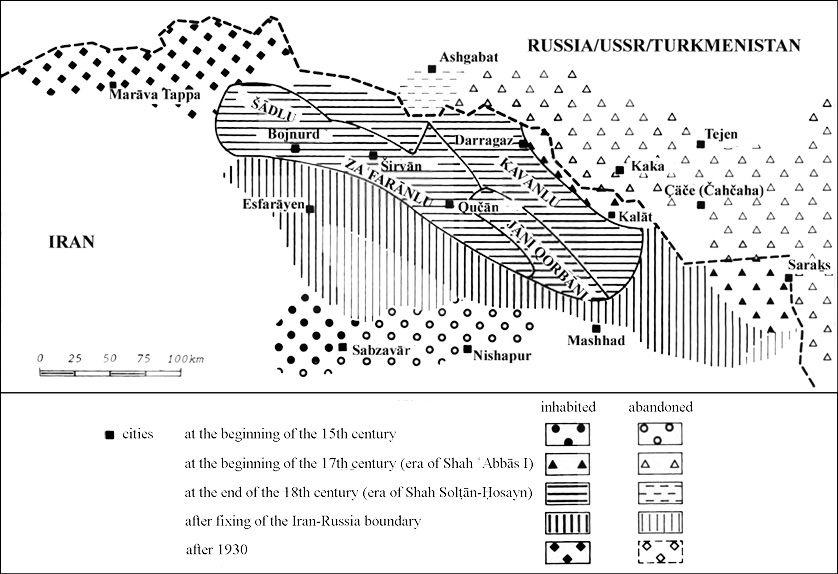
Figure 1. Territories in Khorasan occupied by Kurdish tribes and nomads (Papoli Yazdi, 1991, p. 31).
In general, the territorial confines of the Kurds in Khorasan can be divided into two parts (Figure 1): One part (a) consists of those enclaves where more than half the population are Kurds; where prior to to the registration of property deeds and particularly before the 1979 Revolution, a substantial portion of agricultural, urban, and village lands belonged to Kurdish families; and the absolute majority of grazing pastures (apart from the pastures in village preserves) in the region prior to the nationalization of pastures belonged to the Kurds. After nationalization, too, the Kurds had the largest number of permits for their use. These territories were under the management of Kurdish tribal leaders (ilḵānān) from the time of the Safavids to the first years of Reżā Shah’s reign. These Kurdish territories can be conceived of in two parts: a central nucleus and a surrounding enclosure. The central nucleus can be defined as the region that was ruled by the Kurds and in practice included the subprovinces of Čenārān and Darragaz and as far as the subprovinces of Māna and Samalqān with Āšḵāna as its center, and the subprovince of Esfarāyen (in northern Khorasan). However, it should be noted that from time to time Čenārān and Darragaz were under the direct rule of the governor of Khorasan.
Part (b) includes the regions on the periphery or where the Kurds still enjoyed some rights and privileges, but not a semi-independent rule. These peripheral regions include Saraḵs, Torkaman-Ṣaḥrā (Dašt-e Sabzavār and Nišābur), and parts of today’s province of Semnān (Šāh-Ḥosayni, pp. 37-64). In these regions, the Kurds enjoy certain privileges. For example, although the Turkmen are in the majority in Torkaman-Ṣaḥrā and Saraḵs, the Kurds used to, and still do, take their flocks to these regions for winter grazing, i.e., roughly from November to late March; and the Turkmen in these regions acknowledge the Kurds’ grazing rights.
The Kurds have several settlements in the region of Nišābur, Sabzavār, and eastern parts of Semnān province. In Torkaman-Ṣaḥrā and the plains of Saraḵs, only a small number of Kurds live in the villages. In these two regions, there are no villages in which the residents are exclusively Kurds; but in winter, the plains of Saraḵs and Torkaman-Ṣaḥrā, and parts of the plains of Nišābur and Sabzavār, are taken over by the Kurds. This means that through their seasonal migration, these Kurds widen the sphere of the Kurdish influence and extend it further than those villages and towns that for three centuries have been under their rule. Thus there is a central geographical nucleus of Kurdish settlements and a peripheral zone of influence. The peripheral zone include the common law rights of grazing pastures and dry farming. These rights are acknowledged by local people, such as those of Saraḵs in the east and those of Torkaman-Ṣaḥrā in the west and those of Nišābur and Sabzavār in the south, as well by the authorities from the central government. The Kurds are not, however, granted permits to build and create villages of their own in Saraḵs and Torkaman-Ṣaḥrā.
The Āstān-e Qods-e Raẓawi (q.v.) maintains that the entire region of Saraḵs, including pastures, woodlands, and the majority of agricultural, urban, and village lands, is its property. The Kurds therefore face a serious barrier to ownership in establishing villages, and the Āstān-e Qods only allows the Kurds use of the pastures. In Torkaman-Ṣaḥrā, too, as mentioned earlier and according to settled arrangements, the Kurds can only make use of the pastures in the winter season, and therefore have not embarked on establishing any settlements. In other regions (Nishapur, Sabzavār, and Semnān), however, the Kurds have set up villages or inhabit already existing ones and engage in agriculture and keeping livestock. As well as the above regions, in spring and summer the Kurds have control of the uplands of Khorasan (Šāh-Jahān, Binālud, and the valleys of the Kopet-dāḡ, Allāho Akbar, and Hazār Masjed ranges). In actual fact, the Kurds had and still have a presence in all regions of northern Khorasan, be it town or village, plains, or uplands.
Since the year 2000, Kurdish presence in Torkaman-Ṣaḥrā and the plain of Saraḵs has been on the wane. This is not, however, related to any political factors but has to do with changes in modes of living and the decrease in the number of seasonal migrations.
During the year 2020, the migrating Kurds in the region of Marāva Tappa engaged in seasonal migrations in order to make use of the pastures. However, according to data from the population census and local authorities in Marāva and on site observation, there are no Kurdish settlements in the region of Torkaman-Ṣaḥrā, and only very rarely do Kurdish households settle in Turkmen villages. Within the region of Saraḵs, too, there are no villages where the Kurds form the entirety or the majority of the inhabitants.
KURDISH POPULATION OF KHORASAN
Clavijo was perhaps the first to indicate the number of Kurds in Khorasan in noting that he had encountered a group of 400 Kurdish tents. As mentioned earlier, numerous sources claim that Shah ʿAbbās moved 40,000 Kurdish families from Čamešgazak to northern Khorasan. In more recent sources and books of the 19th century, the number of Kurds in Khorasan is also said to have been 40,000 families. Indeed, this same number of 40,000 families as in the Shah ʿAbbās period is found in many sources for the Safavid period and later. Of course, there are doubts about the transfer of these 40,000 families to Khorasan since it is unlikely that Khorasan during the period of Shah ʿAbbās had the capacity to absorb 40,000 families (about 200,000 to 250,000 people).
For the late Safavid to early Qajar period, some statistical information comes from a manuscript discovered by Moḥammad-Taqi Dānešpažuh in the library of the University of California at Los Angeles (MS 322). It was copied in 1215/1800, i.e., at the beginning of the reign of Fatḥ-ʿAli Shah Qajar, but based on a Toḥfa šāhi by Mirzā Moḥammad-Ḥosayn Mostawfi, written in Isfahan in 1128/1716, during the reign of Shah Solṭān-Ḥosayn. It recorded the number of Kurdish mounted troops (savār) from Khorasan in the service of Shah Solṭān-Ḥosayn as 12,000 (Dānešpažuh, p. 398). It also listed the four Kurdish tribal divisions there, their homelands, their commanders (in the early Qajar period), and an estimate of their total population ostensibly in late Safavid times (Table 1; Dānešpažuh, pp. 410-11; Ṣafinežād). However, the numbers are not particulary credible and are probably garbled.
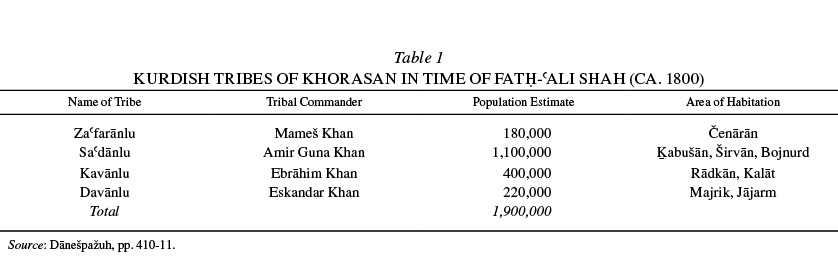
Toward the end of the 19th century, European sources estimated the Kurdish population of Khorasan as 250,000 out of a total of 1,160,000 (Nouveau dictionnaire, III, p. 115; the same figures are given in Curzon, I, p. 179, although he judged the actual number was half that after the great famine of 1872). Other sources indicated that Kurds made up the majority of the population in Bojnurd, Širvān, Qučān, and Esfarāyen and numbered about 300,000 in all of Khorasan (Elahi, p. 31).
The first census conducted after the Constitutional Revolution of 1906 included an enumeration of the Kurdish tribal families of Khorasan (Table 2).
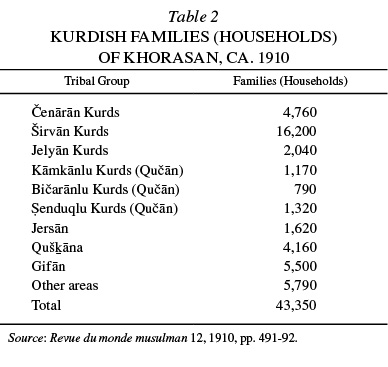
For many reasons, these statistics cannot be trusted. First, it is true that the word census has been used in historical sources, but it was not truly a “census.” The numbers were nothing more than an estimate, which was based primarily on the register of taxes from the khans and the number of soldiers.
In the official censuses from 1976 to 2016, there was no attempt to distinguish different ethnic groups in Khorasan, and as a result there is no way of knowing what percentage of the people of Khorasan were Kurds or Turks or Persians. Even numbers for the nomadic population cannot be trusted: According to the 1976 census, there were only 247,000 nomads in the whole of Iran. On this matter, Xavier de Planhol wrote (1968, p. 198), “If the true nomads in Turkey are no more than a few tens of thousands, in Iran there is no doubt they would number more than a million …” The roster of the High Tribal Council (Šurā-ye ʿāli-e ʿašāyir), established in 1946 and affiliated with the Ministry of Court, did not mention the names of the tribal and nomadic groups of Khorasan. Neither were the names of any of the tribes of Khorasan to be found in the list of tribes and nomads of Iran included in ʿAli-Aṣḡar Ḥekmat’s
Irānšahr
(q.v.), although some of them were indicated in a map appended to the book. Thus, neither in the Pahlavi period nor after the 1979 Revolution of were there reliable statistics on ethnicity or nomadism in Khorasan, whether Kurdish or non-Kurdish. In 2016, however, the Management and Planning Organization (Sāzmān-e modiriyat va barnāma-rizi) for the North Khorasan province published for the first time official statistics on the ethnic distribution of the population in the province (Table 3). An estimate of the Kurdish population in Razavi Khorasan is given in Table 4.
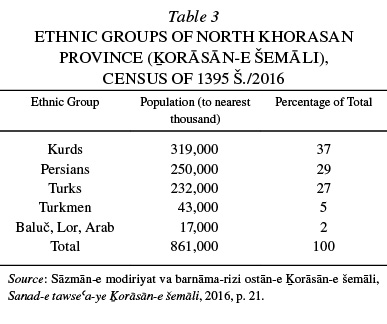
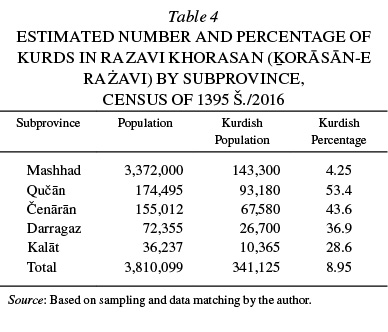
Based on these statistics and estimates, the Kurdish population in North Khorasan province is 319,000; the Kurdish population in Razavi Khorasan is 341,125; and the total Kurdish population for the two provinces is 660,125. Mashhad, with more than 143,000 Kurds, is the most important city in Khorasan that has a Kurdish population. But since Kurds represent only 4.25 percent of the population of Mashhad, it cannot be considered a Kurdish city. (Of course, some Kurdish writers would probably not accept these statistics.)
NOMADISM AND SEDENTARIZATION AMONG THE KURDS OF KHORASAN
Power relationships in Khorasan underwent radical changes with the coming of the Kurdish tribes. These changes in the balance of power were completed toward the end of the reign of Shah Solṭān-Ḥosayn, when the Kurds had managed to bring northern Khorasan completely under their control. The power distribution was in three main geographical areas: (1) the Šādlu (Šāmlu) assumed power in Bojnurd and Esfarāyen; (2) the Za‘farānlu in Qučān; and (3) the regions of Čenārān, Darragaz, and Kalāt were at times under the control of Qučān and at others under the authority of the governor of Khorasan in Mashhad.
These three centers of power, i.e., Mashhad with the governor as the representative of the central government, Qučān, and Bojnurd (sanctioned by the central government), were in a state of rivalry with each other for nearly a hundred years. The khans of Qučān and Bojnurd were, on some occasions, in alliance but at other times their rivalry would lead to conflict. The ilḵāns of Qučān would at times contemplate attacks against Mashhad and at other times would fight against rebels alongside the troops from the central government. In the long period after the Russian domination of Central Asia, from the fixing of the border between Russia and Iran to the October Revolution of 1917, through World War I, the establishment of a strong central government during the reign of Reżā Shah, the events of World War II, the Coup d’État of 1953, and, finally, the Revolution of 1978-79, the Kurds in Khorasan witnessed several radical developments. On the one hand, in their original settlement area, i.e. from Čenārān to Āšḵāna of Bojnurd, they became increasingly settled in towns and villages and adopted a modern living style. On the other hand, in peripheral areas where other groups were in the majority, they established their legal rights in the use of pastures and validated their existence as an acknowledged minority.
As Jean Aubin (q.v.; 1927-98) has pointed out, the Māzandarān plain (i.e., Torkaman-Ṣaḥrā) had served in the 14th and 15th centuries as a vast winter pasture for all the nomadic tribes of north Khorasan (Aubin, p. 117). Although some Kurds lived in the area in the Safavid period, the Kurds of Khorasan did not have regular access to the region between the Atrak and Gorgān rivers. According to Eskandar Beg, during the reign of Shah Ṭahmāsb, “[the Yaqqa Turkmens] lived between the Jorjān and Atrak rivers, where they molested the local inhabitants.” (Eskandar Beg Monši, I, p. 175, tr., I, p. 766-67). Throughout most of the Qajar era, the Kurds had no access to the region. Although after 1881, there were no more Turkmen raids from the new territories under Russian rule, the conflict between the Turkmens in Iran and the Kurds over the use of pastures in Torkaman-Ṣaḥrā continued until Reżā Shah consolidated the control of the central government throughout the country. In interviews carried out by the author in 1975 and later in 1979 and 1983 with 32 Kurdish khans and leaders in Kurdish regions, they expressed the opinion that for at least a century and half prior to 1929, the Kurds did not venture into Torkaman-Ṣaḥrā (Papoli Yazdi, 1991). After 1929, the Kurds and the Turkmen of Torkaman-Ṣaḥrā cooperated well with each other in their pastoral activities and mode of life until the time of the Revolution of 1979-80 (see above; Papoli Yazdi, 1991, pp. 158-59). But geographical conditions and ownership stipulations prevented the Kurds from establishing settlements in Turkmen-inhabited places such as Tanga-ye Torkman, the villages of Darra Čendir, and the valleys of Sumbār, Qāzān-qāya, etc. In those regions, the Turkmen owned the land, and the Kurds had only the right of access and grazing. In Turkmen regions, Kurdish villages were few and far between. The last surviving large Kurdish villages in the Atrak valley were Piš-qalʿa and ʿEšqābād.
Legislation in 1932 and 1934 gave official sanction to Reżā Shah’s policy of forced settlement of the tribes. But even before this, the process of subduing and settling the tribes of Torkaman-Ṣaḥrā and northern Khorasan had begun. The relocation of the tribes that began in these regions in 1929 brought a new wave of Kurdish permanent settlements. At the same time, while the Kurds were benefitting from the security and tranquility of Reżā Shah’s reign, they were expanding their winter quarters in Torkaman-Ṣaḥrā. Perhaps the only location in Iran during his reign where tribal migration and setting up tents was tolerated was at Torkaman-Ṣaḥrā by the Kurds. In 2016, according to the Iranian Center for Statistics, there were 22 villages in the provinces of Māzandarān and Golestān that still had the word Kurd in their toponym, such as Kord-kuh, Kord-maḥalla, Kord-āsiāb, etc. (Markaz-e āmār, 2016).
After the fixing of the border with Russia, the Russians acknowledged the Kurds’ grazing rights, and every year up to the October Revolution of 1917, a great number of Kurds would enter the territory of present-day Turkmenistan legally with permits. In exchange for the grazing of their flocks, for every ten sheep they would hand over one to the Russians before returning from Russian Turkmenistan. This went on in a random manner up to 1953. From that date on, all entry permits for Kurds to enter Soviet Turkmenistan were revoked, and the Kurds were left to make do with the foothills and valleys of the Hazār Masjed.
The fixing of the border enabled the Kurds to create a great number of settlements in the area near or at some distance from the frontier and expand their influence in northern Khorasan by erecting new villages over the following decades. Kurds began to settle in the plains and foothills around Sabzavār, Esfarāyen, and Nishapur. By comparing the taxation data for the settlements in the 1881 decade (i.e., after borders were fixed) with the inventory of the settlements in the Gazetteer of the British army in India (1910), it can be seen that within about three decades there was an increase of at least 87 settlements in the number of the border settlements in the Kurdish region of Khorasan. For the period 1881-1976, nearly 273 large or small settlements ( ābādi ; q.v.) populated mostly by the Kurds appeared in the Kurdish regions of Khorasan, and the percentage of Kurds compared to other groups also increased in the cities. From 1910 to 2016 (the date of the last population and housing census in Iran), 294 new settlements had been added (for a comprehensive list of Kurdish villages in Khorasan, see Madih, pp. 21-29). The majority of the population of these settlements, some of which have grown into towns, were Kurds. At the same time, in already existing villages, the percentage of Kurds compared to other groups also increased (for a detailed discussion of the process of sedentarization, see Papoli Yazdi, 1991, pp. 347-71). This trend toward sedentarization, movement from village to village, and from villages to towns continues to the present date (2020).
FROM ETHNIC AND TRIBAL IDENTITY TO GEOGRAPHICAL AND NATIONAL IDENTITY
Traditional identity. Until the time of Reżā Shah and centralized government, the Kurds living in the northern region of Khorasan defined their identity in hierarchical layers.
The first layer was clan identity. That is, people went by the name of their clan, such as Bičarānlu or Kāviānlu.
The second layer was tribal identity, such as Zaʿfarānlu or Šādlu. Along with tribe, geographical location was also indicated: Two hundred years of rivalry between the ilḵāns of Qučān and Bojnurd had gradually become part of individual identity by being associated with the ilḵān of Qučān or Bojnourd or the khans of Darragaz, Kalāt, etc.
The third layer was ethnicity (especially in terms Kurdish vs. Turkmen). The Kurds considered themselves superior to other ethnic groups. The Persians, Tāts, and Gerāyli Turks, though native to the region, were in a minority. Their position in power relations was lower than that of the Kurds. In the course of two hundred years from the Safavid period, Turks or Persians were appointed as governors of Qučān with the support of the central government for only a few short periods of time. The main rivals of the Kurds during those two centuries were the Turkmens. The Turkmens were different from the Kurds in terms of the geographical area inhabited, ethnicity, race, language, religion, and type of livelihood. Thus, every Kurd recognized as part of his or her identity the struggles their tribe had waged against the Turkmens. Stories about courage, or disaster, or the purchase and enslavement of girls, were told in mothers’ lullabies to their children. Participation in war and conflict, and tales of the struggles and the bravery of the Kurds against the Turkmens had become an essential part of Kurdish identity.
A fourth layer was religion. Kurds are Shiites. One of the reasons for moving the Kurds to northern Khorasan was that they were Shiʿites, and, as Shiʿites, they were in Khorasan to resist the Sunni invasions of the Uzbeks and Turkmens. The confrontation with the Uzbeks and the Turkmens was not only a confrontation with a people of a different ethnicity, but also a confrontation with the Sunnis.
Identity as Iranians represented a fifth layer of identity. It has always been important for Kurds to be Iranian. But the Kurds did not regard their identity as Iranians as implying subservience to the central government in Tehran. They considered themselves Iranians, but they were obedient to their khans. Thus, if a Kurdish khan had a good relationship with Russia, his followers would also increase their own relationship with Russia; and if the khan had a relationship with Britain, their relationship with the British would expand.
A sixth layer of identity was based on geography. Inhabiting a place such as the regions of Qučān, Bojnurd, Darragaz, or Esfarāyen did not create an independent identity by itself. But because the ilḵāns of these regions were different, there was also a geographical element in identity. To be a Qučāni meant being a subordinate of Amir Ḥosayn Khan Shojāʿ-al-Dawla, or to be a Bojnurdi meant being a subordinate of Sardār Moʿazzaz Bojnurdi. Geographical identity outside of tribal identity made little sense. Defending the land was practically the same as defending the tribe, the clan, and the ilḵān. It was the same with the taxation system.
The failed return of the khans to the tribes. After the Revolution of 1979, a number of khans across Iran sought to reassert authority over their tribes but failed (for example, Ḵosrow Khan of the Qašqāʾi, executed in 1982; or Ṣamad Khan Rasulḵāni of the Baluč, executed in 1981). Tribal people, as well as the revolutionary forces, were by no means ready to accept the leadership of the khans. At the same time, extensive Persian-language education, increasing urbanization, migration and travel, greater governmental power and enhanced security, the absence of inter-tribal conflict, and the sense of a shared national solidarity in the war with Iraq all tended to reduce ethnic chauvinism and prejudices. Technological developments with regard to radio, television, mobile communications, and the internet accelerated this process. In 1970, according to the Management and Planning Organization, 34.5 percent of people in the north Khorasan region did not understand Persian. In 2018, the number was less than one percent. As a result of these trends, tribal and nomadic peoples, including the Kurds, have tended to reassert their self-identity through culture, not through the restoration of tribalism and the authority of the ilḵāns.
Music as a means of ethnic revival. Traditional maqāmi music has always been important to the Kurds of Khorasan (see KHORASAN xxvi. MUSIC OF KHORASAN). But after 1978, significant efforts have been made to revive Khorasan maqāmi music as an element of Kurdish identity. Great teachers of music such as Ḥāj Qorbān Solaymāni (1920-2008) have emerged. Studies have been made about the dastgāhs, radifs, and musical instruments of the Kurds of Khorasan. The songs and lyrics used in the music have been refined and edited. The variations in the music of different regions, including the differences between the music of the plains and mountains (Hazār Masjed, Lāyen, etc.) have been studied and classified.
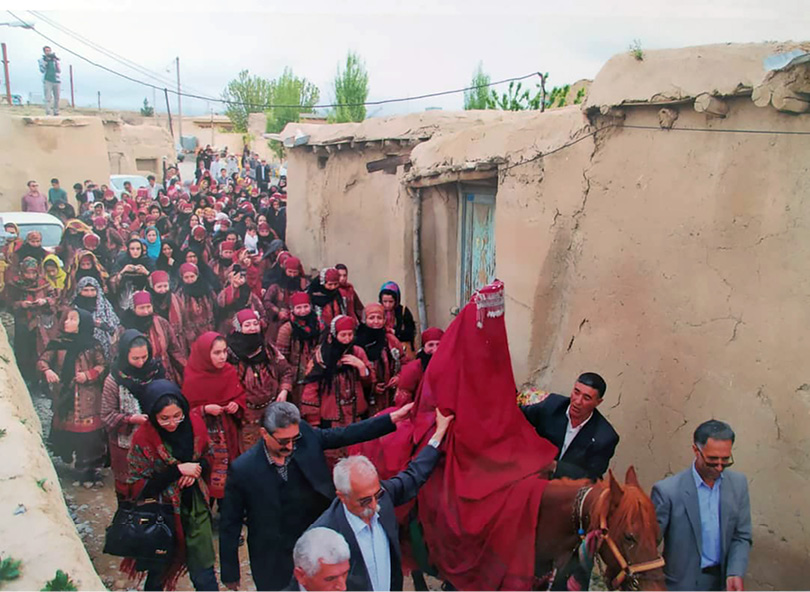
Plate I. Kurdish wedding procession in village of Lāyen-e Now, Razavi Khorasan (near Kalāt-e Nāderi), 2019. Photograph by ʿAli Ganjbaḵš, courtesy of M.-H. Papoli Yazdi.
For centuries, the Kurds participated in personal and communal dancing but did not play musical instruments. Playing musical instruments was reserved to groups known as baḵši and ʿāšeq. For others, playing an instrument, or even holding an instrument, was frowned on by the general public. Music education took place only in the homes of the baḵšis and ʿāšeqs from generation to generation. But after 1987, the stigma associated with studying music, including Kurdish music, gradually decreased throughout Iran. Teaching and learning music was no longer monopolized by a few families; music classes and music education became widespread. According to a statement by the General Directorate of Guidance for Razavi Khorasan and North Khorasan Provinces, at least 38 formal and informal music schools were operating in the Kurdish regions of Khorasan in 2020. In Mashhad, 16 schools also taught Kurdish music. In 1971, there was not a single specialized book or article on Kurdish musical culture in Khorasan. By 2020, 120 books and dozens of articles about Kurdish music and the culture of music and poetry of Kurmanji Khorasan had been published.
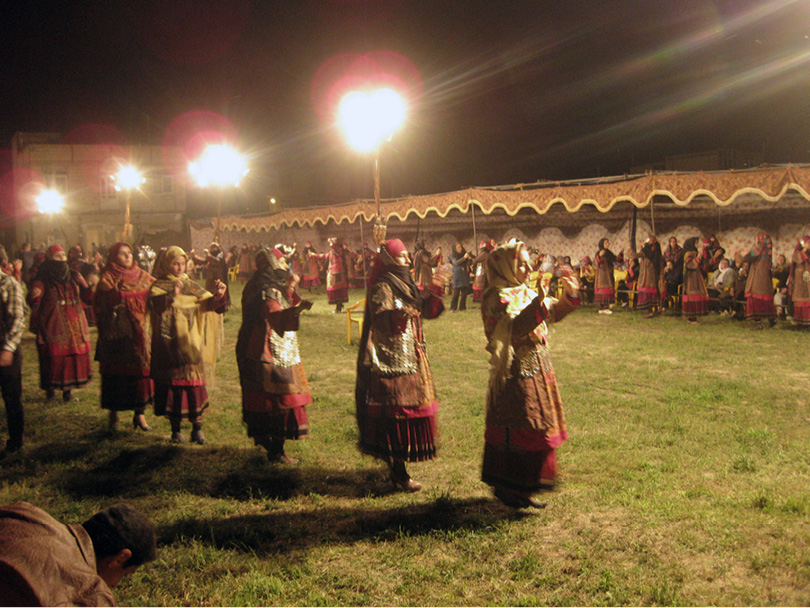
Plate II. Kurdish folk dance at a wedding celebration, Lāyen-e Now, Razavi Khorasan, 2019. Photograph by ʿAli Ganjbaḵš, courtesy of M.-H. Papoli Yazdi.
The Kurmanji program of Radio Khorasan. Radio Khorasan has been broadcasting from Mashhad since 1949 (1328), and it has played an important role in reconstructing the identity of the Kurds of Khorasan. The archive of programs from this radio station compiled over a period of 65 years is the most complete collection of its kind, especially in regards to culture, about the Kurds of Khorasan.
In the summer of 1956, a Kurdish song called “Ḵaja Lora” performed by Esmāʿil Sattārzāda was broadcast on the Radio Mashhad channel. Then, at the suggestion of some Kurds, followed up by Ḵānlar Qarāčurlu, Bojnurd’s representative in the Majles, Radio Mashhad agreed to have a program in the Kurmanji language. Hāšem Ṣādeqi, the announcer and producer of this program since 1964, writes: “In accordance with an interest I had, the programs were enriched in terms of content, and I got help from the experts of the Department of Agriculture, Horticulture and Animal Husbandry… .” (Ṣādeqi Bājgirān, p. 607) That is, in the beginning, the Kurmanji program of Radio Mashhad had a rural and nomadic approach, focusing more on works about development and prosperity. Recordings of music and cultural programming were rare. But as demands of the Kurdish audience increased, the programming diversified. Gradually, the Kurmanji musical archive for Radio Mashhad was improved, and Kurdish music and other aspects of Kurdish culture increased in the programming.
In 1969, Faraḥnāz Moḥammadi, the first female announcer, started working for the Radio Kormānji program. Kurmanji researchers and scholars on Radio Mashhad were the first group to try to collect and record the Kurdish musical culture of Khorasan and to organize it methodically. For example, the song “Qarsa” was special to the tribes of Qučān, and artists from Qučān worked on it and produced it in an authentic way. The song “Qālda qālda” was entrusted to people from Širvān, and the songs “Čapa rāsta” and “Samā-ye tā beškan beškan” were performed by Bojnurdi artists. Ḥosayn Yegāna Qučāni became the producer for mystical music composed by Jaʿfarqoli Zangali, a Kurdish poet from Khorasan. Thanks to the existence of numerous ethnic groups in the region, including Kurds, Turks, Tat, Turkmen, Baluchis, and Persians, and the influence of their music on each other, the maqāmi music of northern Khorasan became some of the richest music in Iran.
After 1978, the approach of the Kurmanji program of Radio Mashhad, in addition to rural and nomadic issues, turned to urban, national, and even international issues. As of 2020, the Kurmanji program was broadcast on Radio Razavi Khorasan from Saturday to Wednesday for one hour starting at 15:30, and it has had a relatively large audience. Radio North Khorasan, which has its station in Bojnurd, broadcasts for half an hour a day in Kurmanji. In general, the Kurmanji channel of Radio Mashhad became the main center for collecting and editing cultural works about the Kurds of Khorasan, but research and field work to collect and record Kurmanji music was also carried out by other experts.
Thus, music became one of the main elements of identity and unity for the Kurds of Khorasan, particularly as many of the young people, both boys and girls, turned to Kurdish music. In the first decades of the 21st century, music, much more than tribal chants, has become an identity marker for the Kurdish youth of Khorasan. Recreating ethnic identity through music has been far more effective for them in that regard than myth-making and exaggeration about historical figures.
Literature and the arts. Before 1978, very few books were written about the history, literature, art, etc. of the Kurds of Khorasan. In the 1980s, the publication of written works about the Kurds of Khorasan became popular. Initially, Kurdish writers relied on idealized and romanticized examples of heroism, bravado, and stout-heartedness as exemplified in their representation of the stories of the Kurdish khans, such as Amir Ḥosayn Khan Shojāʿ-al-Dawla, Sardār Moʿazzaz Bojnurdi, Farhād Khan Bičarānlu, and various insurgents and rebels in Khorasan such as Rašid Khan, Joju Khan, Ḵodāverdi, etc. They exaggerated the struggles with the central government and with the governors of Khorasan or the Turkmen. They portrayed their fighters and insurgents as epic heroes; others attempted to create a national heroic identity by depicting all the dynasties of Iran, even rulers such as Nāder Shah or Reżā Shah, as Kurds. They tried to connect the Kurds of Khorasan to those of western Iran and the Kurds of Iraqi Kurdistan. At the same time, a commendable effort was made to collect many truly historical documents, and Kalim-Allāh Tavaḥḥodi’s six-volume history of the migration of Kurds to Khorasan (Ḥarakat-e tāriḵi-e Kord ba Ḵorāsān dar defāʿ az esteqlāl-e Irān, n.p., 1981-2000) was a significant accomplishment. But the interpretations in these works were guided by ideology, i.e., the desire to create an epic narrative about Kurdish tribal leaders and their struggles. In that sense, they had an impact, but they have not been particularly successful in academic terms.
Since the mid-1990s, Kurdish intellectuals and the younger generation have increasingly turned to an artistic, literary, and scholarly approach to regaining their identity. Numerous books have been published on Kurdish music, poetry, handicrafts, architecture, and rural and urban issues. Books and articles about modern Kurdish scholars and scientists have been published and are being published. Some books and poems by Kurds in the west of the country and even Iraqi Kurds have been translated and republished.
Prior to the revolution, the Kurds of Khorasan had almost no contact with the Kurds of western Iran. Since the 1980s, the relationship between the Kurds of Khorasan, the Kurds of western Iran, and the Kurds of Iraqi Kurdistan has been increasing, both in the form of cultural works and in person and virtually. In the 1990s, very few books on the Kurds of western Iran and the Kurds of Iraq were found in the Kurdish region of Khorasan. On 28 November 2020, in just one bookstore in Širvān, there were more than 32 books in Kurdish and 285 books about the Kurds in general (communication from Mahdi Ḥātemi, Markaz-e baḵš-e ketābhā-ye Kordi). In the bookstores of Širvān, Qučān, Bojnurd, Esfarāyen, etc., dozens of books can be found in Kurmanji or in the Sorani Kurdish of Iraqi Kurdistan (see KURDISH LANGUAGE) or in translation (for example, the poems of Şêrko Bêkes or of books about the Kurds in foreign languages, such as those by Jordi Tejel or Martin van Bruinessen).
Kurdish books, literature, and poetry collections are thus becoming increasingly common, including historical and geographical books that are thoroughly researched and scholarly as well as books that aim to construct identity, written by Kurds in the region as well as by Kurds in the west of the country and Iraqi Kurdistan.
Since the first decade of the 21st century, there has thus been a fundamental change in the way the Kurds of Khorasan understand their identity. The new generation of intellectuals and young people are no longer looking for the adventurous history of tribal leaders, commanders, and heroes to regain their identity. According to interviews conducted by the author, 79 percent of young people between the ages of 17 and 35 do not want to recognize their identity by exaggeration, boasting, and the glorification of Kurdish khans, heroes, and insurgents. The new generation does not want to regain its identity by introducing Kurdish nationalism and portraying all dynasties of Iran as Kurds. The new generation wants to establish its identity through art, especially music and literature, and the enrichment of language and culture. The new generation of Khorasani Kurds does not want to raise the issue of recovering identity through armed and belligerent actions. This generation tends toward peace and peaceful co-existence through the spread of music, art, and poetry.
As Kurdish youth have put it, it is time to drop the gun and pick up the pen and the musical instrument. In a poll conducted by sampling with Cochran’s formula (384 samples) in Qučān, 86 percent of people between 18 and 45 years old were more proud of Ḥāj Qorbān Solaymāni (1920-2008) than of Amir Ḥosayn Šojāʿ-al-Dawla Ilḵāni. The same poll showed that 64 percent of Kurds between the ages of 18 and 40 in Širvān knew nothing about Farhād Khan Bičarānlu, the last khan of the region, and had not even heard his name. According to studies conducted in 1968, only 13.5 per cent of Kurdish people were married to non-Kurds. This percentage has reached 43 percent in 2018 (see Manṣuriān, 2021).
Conclusion. In sum, it can be said that Kurds are located in northern Khorasan in an area about 350 km long and with an average width of 100 km. They have a rich culture and history and a clear identity. The administration of the region was once under the control of their khans. In the contemporary era, they try to send their representatives to the Islamic Consultative Assembly and town and village councils by voting, and they are more proud of their musicians, writers, artists, scientists, and athletes than of their khans and the insurgents of previous decades and centuries. The younger generation of Khorasani Kurds looks more to the future than to the past.
Bibliography
- Iraj Afšār Sistāni, Moqaddama-i bar šenāḵt-e ilhā, čādornešinān wa tavāyef-e ʿašāyeri-e Irān, 2 vols., Tehran, 1989.
- Shirin Akiner, Islamic Peoples of the Soviet Union, London, 1986, tr. ʿAli Ḵazāʾifar, as Aqvām-e mosalmān-e Etteḥād-e Šurawi, Mashhad, 1987.
- Henry-René d’Allemagne, Du Khorassan au pays des Backhtiaris: trois mois de voyage en Perse, 4 vols., Paris, 1911; tr. Motarjem-e Homāyun Farahvaši, as Safar-nāma az Ḵorāsān tā Baḵtiāri, Tehran, 1956.
- Sekandar Amān-Allāhi Bahārvand, Kučnešini dar Irān: pežuheši darbāra-ye ʿašāyer wa ilāt, Tehran, 1981.
- Saʿid Asadifar, Sarzamin-e Kormānjhā: negāhi ba nežād, tāriḵ, joḡrāfiyā, masāken-e avvaliya va ādāb va rosum-e qawm-e irāni-e Kord az advār-e gozašta tā konun, Tehran, 2017.
- Jean Aubin, “Réseau pastoral et réseau caravanier: les grand routes du Khurassan a l’époque Mongole,” Le Monde Iranien et l’Islam 1, 1971, pp. 105-30 (offprint, Paris, 1971).
- M. Bahār, “Naẓari ba sarḥadāt-e Ḵorāsān va Āḵāl,” in K. Bayāt and Āḏari Šahreżāʾi, Āmāl-e Irāniān, Tehran, 2013, pp. 220-25 (reprint from newspaper Irān, 1918).
- Hāšem Ṣādeqi Bājgirān, Marzdārān e dāmena-ye Keysmār: Revāyati az Kordhā-ye šemāl-e Ḵorāsān, Mashhad, 2009.
- ʿAli Baḵtiār, På bagsiden af bogen (The city of white musicians), tr. Reżā Karim Mojāwer, as Šahr-e navāzandegān-e safid, Tehran, 2010.
- Mehdi Bāmdād, Šarḥ-e ḥāl-e rejāl-e Irān dar qarn 12, 13, 14 hejri, 5 vols., Tehran, 1968.
- Abu’l-Fażl Bayhaqi, Tārikh-e Bayhaqi, ed. ʿAli-Akbar Fayyāż, Mashhad, 1971; tr. C. E. Bosworth with revision by Mohsen Ashtiany, as The History of Beyhaqi, 3 vols., Boston, 2011.
- Ḥaydar Behtuyi, Kord va parākandagi-e u dar gostara-ye Irān-zamin, Tehran, 1998.
- Martin van Bruinessen, Agha, Shaikh, and State: The Social and Political Structures of Kurdistan, London, 1991, tr. Ebrāhim Yunesi, as Āḡā, šayḵ, wa dawlat: Jāmeʿa-šenāsi mardom-e Kord, Tehran, 1999.
- Alexander Burnes, Travels into Bokhara, 3 vols., London, 1834.
- Gérard Chaliand et al., Les Kurdes et le Kurdistan: la question nationale kurde au Proche-Orient, Paris, 1981.
- Alexsander Chodźko, “Le Ghilan ou les marais Caspiens,” Nouvelles Annales du Voyage, 1849, no. 4, pp. 257-71; 1850, no. 1, pp. 193-215, 285-306, no. 2, pp. 61-76, 200-209, no. 3, pp. 68-93; tr. S. Sahāmi as Sarzamin-e Gilān, Tehran, 1975.
- Ruy González de Clavijo, Embajada a Tamorlán, tr. Guy Le Strange, as Embassy to Tamerlane 1403-1406, London, 1928; tr. Masʿud Rajabniā, as Safar-nāma-ye Klāviḵu, Tehran, 1958.
- Stephanie Cronin, “An Experiment in Revolutionary Nationalism: The Rebellion of Colonel Muhammad Taqi Khan Pasyan in Mashhad, April-October 1921,” Middle Eastern Studies 33, 1997, pp. 693-750.
- George N. Curzon, Persia and the Persian Question, 2 vols. London, 1892; tr. Waḥid Māzandarāni, as Irān wa qażia-ye Irān, Tehran, 1983.
- Dāʾerat al-maʿāref-e bozorg-e eslāmi, ed. Kāẓem Musavi Bojnurdi, Tehran, 1988- .
- Esmatalmoluk Danech-Pojouh, “Le Xorasan á la fin du 18e siècle et au début du 19e siècle,” Thèse de 3e cycle, University of Paris, 1967.
- Moḥammad-Taqi Dānešpažuh, “Āmār-e māli va neẓāmi-e Irān dar 1128 yā tafṣil-e ʿasāker-e firuzi maʾāṯer-e Šāh Solṭān-Ḥosayn Ṣafavi az Mirzā Moḥammad-Ḥosayn Mostawfi,” Farhang-e Irān Zamin 20, 1974, pp. 396-421.
- Edward B. Eastwick, Journal of a Diplomate’s Three Years Residence in Persia, 2 vols., London, 1864.
- Ḥosayn Elāhi, Ruz-nāma wa ruz-nāma-negari dar Ḵorāsān, 2 vols., Mashhad, 2001.
- Abu Esḥāq Eṣṭaḵri, Ketāb masālek al-mamālek, ed. M. J. de Goeje, Leiden, 1870.
- Eskandar Beg Torkamān Monši, Tāriḵ-e ʿālamārā-ye ʿabbāsi, 2 vols., Tehran, 1971; tr. Roger Savory, as History of Shah ʿAbbas the Great, 3 vols., Boulder, Colo., 1979-86.
- āšem Farhādi, Farmānravā-ye jang wa musiqi Ḵodu Sardār: ẓohur-e Ḵodāverdi Sardār bar afaq-e t āriḵ-e Irān, Širvān, 2013.
- Idem, Faraj-Allāh Ḵān Bičarānlu, Širvān, 2014. Gazetteer of Persia, Simla, 1910.
- James Baillie Fraser, Narrative of a Journey into Khorasān in the Years 1821 and 1822, Including Some Account of the Countries to the North-East of Persia, London, 1825.
- Alfons Gabriel, Die Erforschung Persiens: Die Entwicklung der abendl ändischen Kenntnis der Geographie Persiens, Vienna, 1952, tr. Fatḥ-ʿAli Ḵᵛāja Nuri, as Taḥqiqāt-e joḡrāfiāʾi rājeʿ ba Irān, Tehran 1969.
- Reżāqoli Khan Hedāyat, Rawżat al-ṣafā-ye nāṣeri, vol. X, Qom, 1960.
- W. A. Ivanov, “Notes on the Ethnology of Khurasan,” Geographical Journal 67, 1926, pp. 143-58.
- Aḥmad Ḵᵛājanežad, Ḡobār e ṣaḥrā: Jang-e avval va dovvom-e Gonbād-e Kāvus dar sāl-e 1358, Tehran, 2020.
- Masʿud Keyhān, Joḡrāfiā ʾ- e mofaṣṣel-e Irān, 3 vols., Tehran, 1932-33.
- Nikolai V. Khanykov, Memoir sur la partie méridionale de l’Asie central, Paris, 1861.
- Ruḥ-Allāh Ḵomeyni [Ruhollah Khomeini], Ṣaḥifa-ye nur VII, Tehran, 1999. John Macdonald Kinneir, A Geographical Memoir of the Persian Empire, London, 1813. Ann Lambton, Landlord and Peasant in Iran, tr. Manučehr Amiri, as Mālek wa zāreʿ dar Irān, Tehran, 1960.
- P. M. Lessar, “Bemerkungen über Transkaspien und die benachbarten Landstriche,” in A. Petermann, Mittheilungen aus Justus Perthes’ Geographischer Anstalt 30, Gotha, 1884, pp. 281-96; tr. as “M.P.M. Lessar’s Second Journey in the Turkoman Country: Askabad to Ghurian near Herat,” Proceedings of the Royal Geographical Society and Monthly Record of Geography 5/1, January 1883, pp. 1-23.
- Charles Metcalfe MacGregor, Narrative of a Journey through the Province of Khorassan and on the N.W. Frontier of Afghanistan in 1875, 2 vols., London, 1879.
- Abbas-Ali Madih, “The Kurds of Khorasan,” Iran and the Caucasus 11, 2007, pp. 11-31.
- Markaz-e āmar-e Irān, Saršomāri-e nofus wa maskan ostān-e Māzandān wa ostān-e Golestān, 2016.
- Moḥammad Kāẓem Marvi, ʿĀlamārā-ye nāderi, ed. Moḥammad Amin Riāḥi, 3 vols., Tehran, 1990.
- Aḥmad Majd-al-Eslām Kermāni, Tāriḵ-e enqelāb-e mašruṭiyat-e Irān I: Safar-nāma-ye Kalāt, ed. and introd. Maḥmud Ḵalilpur, Tehran, 1968.
- V. Minorsky, “Kurds, Kurdistān,” in EI 2, V, p. 457.
- Sayyed ʿAli Mirniā, Ilhā wa ṭāyefahā-ye ʿašāyeri-e Ḵorāsān wa naqš-e siāsi-e roʾasā-ye ilhā-ye bozorg dar omur-e kešvar va ravābeṭ-e ānhā bā ḥokumathā wa esteʿmārgerān, Tehran, 1990.
- Said Mobini, “Agriculture et vie rurale en Iran au nord du Khorassan: Quchan-Shirvan-Dargaz,” Thèse de 3e cycle, University of Paris, 1977.
- Loṭf-Allāh Mofaḵḵam Pāyān, Farhang-e ābādihā-ye Irān: šāmel-e nāmhā wa mawqeʿiat-e joḡrāfiāʾi-e šahrhā wa dihhā-ye kešvar, Tehran, 1960.
- Esmāʿil Moqimi, Joḡrāfiāʾi-e tāriḵi-e Širvān, Mashhad, 1991.
- H. A. Moser, A travers l’Asie Centrale et la Perse: La steppe Kirghize – Le Turkestan Russe – Boukhara – Khiva – Le pays des Turcomans et la Perse, impression de voyage, Paris, 1885; tr. ʿAli Motarjem, as Safar-nāma-ye Torkestān wa Irān: goḏari dar Āsiā-ye markazi, ed. Moḥammad Golbon, Tehran, 1977.
- Yusof Motavalli Ḥaqiqi, Az Tabriz tā Mašhad: pežuheš-e pirāmun-e zendagi wa qiām-e Kolonel Moḥammad-Taqi Ḵān Pesyān, Mashhad, 2001.
- Idem, Ḵorāsān-e šemāli: pežuheš-e pirāmun-e tāriḵ-e taḥavvolāt-e siāsi-e šahrhā-ye Ḵorāsān-e šemāli az āḡāz tā enqelāb-e eslāmi, Mashhad, 2008.
- ʿAli-Reżā Manṣuriān, “Olgu-ye hamzisti dar fażāhā-ye čand qawmi-e nomuna mawredi: Ḵorāsān-e šemāli,” Ph.D. diss., Dānešgāh-e Tarbiat Modarres, 2021.
- Afsaneh Najmabadi, The Story of the Daughters of Quchan: Gender and National Memory in Iranian History, Syracuse, 2000 (Ḥekāyat-e doḵtarān-e Qučān: az yādraftahā-ye enqelāb-e mašruṭa, Tehran, 2002).
- G. C. Napier, Extracts from a Diary of a Tour in Khorassan and Notes on the Eastern Alburz Tract, London, 1876.
- Idem, Collection of Journals and Reports Received from Captain the Hon. G. C. Napier, Bengal Staff Corps, on Special Duty in Persia, 1874, London, 1876.
- “The New Russo Persian Frontier East of the Caspian Sea,” Proceedings of the Royal Geographical Society and Monthly Record of Geography 4, 1882, pp. 213-19.
- Sirus Nisāri, Kolliāt-e joḡrāfiā-ye Irān, Tehran, 1971.
- Christine Noelle-Karimi, The Pearl in Its Midst: Herat and the Mapping of Khurasan (15th-19th Centuries), Vienna, 2014. Nouveau Dictionnaire de Geographie Universelle, Paris, 1887.
- Edmund O’Donovan, The Merv Oasis: Travels and Adventures East of the Caspian during the Years 1879-80-81, including Five Months Residence among the Tekkés of Merv, 2 vols. London, 1883.
- Mohammad Hossein Papoli Yazdi [Moḥammad-Ḥosayn Pāpoli Yazdi], Le nomadisme dans le nord du Khorassan, Iran, Paris, 1991.
- Idem, Farhang ābādihā wa makānhā-ye maḏhabi-e kešvar, Mashhad, 2009.
- Mohammad Hossein Papoli Yazdi, Fatemeh Vossoughi, and Majid Labbaf Khaniki [Moḥammad-Ḥosayn Pāpoli Yazdi, Fātema Voṯuqi, and Majid Labbāf Ḵāniki], “Maskan-e Kordha-ye šemāl-e Ḵorāsān: takvin va taḥavvol-e maskan dar baṭn-e sāḵtārhā-ye ḏehni va farhangi,” Faṣl-nāma-ye taḥqiqāt-e joḡrāfiāʾi 62, 2001, pp. 5-29.
- John Perry, “Forced Migration in Iran during the Seventeenth and Eighteenth Centuries,” Iranian Studies 8/4, 1975, pp. 199-215.
- Idem, Karim Khan Zand: A History of Iran, 1747-1779, Chicago, 1979.
- Farhād Pirbāl, Ḥāšiyanešinhā-ye Orupā, tr. Marivān Ḥalabčaʾi, Tehran, 2019.
- Xavier de Planhol, Les fondements géographiques de l’histore de l’Islam, Paris, 1968.
- Idem, “Le déboisement de l’Iran,” Annales de géographie 430, 1969, pp. 625-35.
- H. L. Rabino, Les provinces caspiennes de la Perse: Le Guîlân, Paris, 1917; tr. Jaʿfar Ḵomāmizāda, as Vilāyat-e Dār al-marz-e Irān: Gilān, repr. Rasht, 2012.
- Idem, Mazanderan and Astarabad, London, 1928. ʿAli Raḥmati, Farhang-e qawmi va joḡrāfiā-ye šahrhā va ābādihā-ye Ḵorāsān-e šemāli, Bojnurd, 2015.
- Ḥosayn-ʿAli Razmārā, Farhang-e joḡrāfiā-ye Irān, 10 vols., Tehran, 1949-53.
- Élisée Reclus, Nouvelle geographie universelle IX: L’Asie antérieure, Paris, 1884.
- Carl Ritter, “Die Ilats Kurd-Zeban,” in Die Erdkunde von Asien Band VI/8 teil, Abt. 1. Buch 3: Westasien, Iranische Welt, Berlin, 1838, pp. 392-400.
- Qodrat-Allāh Rowšani Zaʿfarānlu, Seh safar-nāma: Herāt, Marv, Mašhad, Tehran, 1968.
- Moḥammad-Jamil Ružbeyāni, Čahār amirnešin-e Kord, tr. Moḥammad-Raʾuf Tawakkoli, Tehran, 2013.
- ʿAli-Reżā Šāh Ḥosayni, “Kordhā-ye ostān-e Semnān,” Majalla-ye Qumes 63-64, Summer 2020, pp. 47-58.
- Ramażān-ʿAli Šākeri, Joḡrāfiā-ye tāriḵi-e Qučān, Mashhad, 1967.
- Hāšem Ṣādeqi Bājgirān, Marzdārān-e dāmana-ye Kismār: revāyati az Kordhā-ye šemāl-e Ḵorāsān, Mashhad, 2009.
- Javād Ṣafinežād, “Jamʿiyat-e ʿašāyeri-e Irān az 1128 tā 1220 hejri qamari: ʿahd-e Šāh Solṭān-Ḥosayn wa Fatḥ-ʿAli Šāh,” in Moḥammad-Ḥosayn Pāpoli Yazdi, ed., Majmuʿa-ye maqālāt-e joḡrāfi, Mashhad, 1988.
- Sirus Sahāmi, “Darra Lādiz,” Anjoman-e joḡrāfiā’i Irān 1, 1975a, s.v.
- Idem, “Negāhi ba zandegi-e rustāʾi dar Darra-ye Kalāt,” in Maḥmud ʿAlavi, ed., Majmuʿa-ye soḵanrānihā-ye naḵostin seminār-e masāʾel joḡrāfiā-ye nāḥiya-ye Irān, Mashhad, 1975b, pp. 46-73.
- Moḥammad Ḥasan Khan Ṣaniʿ-al-Dawla (Eʿtemād-al-Salṭana), Matlaʿ al-šams, 2 vols., Tehran, 1884.
- Sayyed Mehdi Sayyedi, Tāriḵ-e šahr-e Mašhad az āḡāz tā mašruṭa, Mashhad, 1999.
- Sāzmān-e barnāma wa budja-ye Ḵorāsān, Gozāreš-e farhangi-e Ḵorāsān, Mashhad, 1970.
- Sāzmān-e joḡrāfiāʾi-e kešvar, Farhang-e ābādihā-ye Irān III: Ostān-e dovvom, Tehran, 1998.
- Sāzmān-e modiriyat va bar-nāmarizi-e ostān-e Ḵorāsān-e šemāli, Sanad-e tawseʿa-ye Ḵorāsān-e šemāli, Bojnurd, 2016.
- Na Lirzā Sepāhi Lāyin (Kāvāzidi), Mināmāl du mālkin kurdi, Sanandaj, 2020.
- Félix Édouard de Sercey, Une ambassade extraordinaire: La perse en 1839-1840, Paris, 1928.
- Širku Bikas (Şêrko Bêkes), Majmuʿa-ye šeʿr, tr. Reżā Karim Mojāwer, Tehran 2006.
- Idem, ʿĀšeqānahā: inak doḵtari-e meyhan-e man ast, tr. Reżā Karim Mojāwer, Tehran, 2019.
- F. von Stein, “Die neue russisch-persische Grenze im Osten des Kaspischen Meeres und die Merw-Oase,” Petermanns Mitteilungen, 1882, pp. 369-76.
- Percy M. Sykes, Ten Thousand Miles in Persia, London, 1902.
- Hossein Taghipour, (1979) “La géographie humaine de la région Daragaz,” Thèse de 3e cycle, University of Paris, 1979.
- Abu’l-Qāsem Ṭāheri, Joḡrāfiā-ye tāriḵi-e Ḵorāsān az naẓar-e jahāngardān, Tehran, 1969.
- Jordi Tejel, Syria’s Kurds: History, Politics and Society, tr. Emily Welle and Jane Welle, London and New York, 2009; tr. Ṣadaqat Ḥayati, as Kordhā-ye Suriya, Tehran, 2016.
- Kalim-Allāh Tavaḥḥodi Awḡāzi, Ḥarakat-e tariḵi-e Kord ba Ḵorāsān dar defāʿ az esteqlāl-e Irān, 6 vols., Mashhad and Tehran, 1981-2006.
- Idem, Esfarāyen: diruz, emruz, Mashhad, 1996.
- Pierre Daussy Truilhier, Mémoire descriptif de la route de Téhran à Meched et de Meched à Iezd, Paris, 1841 (Bulletin de la Société Géographie, ser. 2, 9-10, 1838, pp. 109-45, 249-82, 313-29).
- Šahāb-al-Din Yāqut, Moštarek ważʿan wa’l-moftareq ṣuqʿan, ed. F. Wüstenfeld, as Jacut’s Moschtarik, das ist, Lexicon geographischer Homonyme, Göttingen, 1846, tr. Parvin Gonābādi as Bargozida-ye Moštarek-e Yāqut Ḥamawi, Tehran, 1983.
- Charles E. Yate, Khurasan and Sistan, London, 1900, tr. Qodrat-Allāh Rowšani Zaʿfarānlu, as Safar-nāma-ye Ḵorāsān wa Sistān, Tehran, 1986.
- Mohammad Ali Youssefizadeh, “Esquisse d’une sociologie tribale de l’Iran: La structure sociale et économique des tribus Shah-Sevan,” Thèse de 3e cycle, Université René Descartes, Paris, 1974.