



KHIVA, a city in the south of the oasis of Khorezm (Ḵᵛārazm; see CHORASMIA), in the lower course of the Āmu Daryā (q.v.), in Central Asia; in Western literature, at least since the 17th century, its name was also used as the name of the country.
A settlement on the site of modern Khiva existed by the 4th-3rd centuries B.C.E.; as a city, it was first mentioned by the Arab geographers of the 10th century. The ancient form of the name was Khivaq (Kivaq), which continued to be used in literature and official records until the beginning of the 20th century. The city has been situated at the edge of cultivated lands, close to the Qaraqum desert, and received water from the Āmu Daryā river through one of the major canals of this region. Khiva did not have much political or economic importance until the early 17th century. Under the ʿArabshahid dynasty (see ʿARABŠĀHI), it was the center of one of the many princely appanages into which the country was divided, and initially not the most important one. With the decline of the urban centers in the northern part of Khorezm, and concomitant infrastructural investments in the southern part of the oasis, the political importance of Khiva increased, and, during the reign of ʿArab Moḥammad Khan I (1603-22), it became the capital of the country. Khiva augmented its political prominence at the beginning of the 18th century, i.e., after the establishment of a shrine complex dedicated to Pahlavān Maḥmud, a saint, poet, and professional wrestler (pahlavān) of the 14th century, who became the patron-saint of Khiva, much venerated also throughout Khorezm and Central Asia.
The economic role of Khiva did not entirely reflect its political role: it was the city of Urgench (Urganj or Urganč; originally, in the north of the oasis of Khorezm, until it was relocated to the southern part of Khorezm by Abu’l-Ḡāzi Khan I) that was the main center of commerce and handicrafts in Khorezm. But the city of Khiva, besides being the seat of the central administration of the khanate, also had the greatest concentration of religious institutions (mosques and madrasas); by 1920, Khiva had 81 mosques and 64 madrasas, most of which had been erected upon commission of Qonghrat (Qonḡrāt) dynasts, who had also established large endowments for their upkeep (Sartori, 2016a, pp. 98-134). The public buildings of Khiva that remain to this day (mosques, madrasas, caravansaries, and others) were constructed during a relatively short period and have many common features in their design and ornamentation, making the city a unique architectural ensemble. The population of the city of Khiva, as that of the other regions of the south of Khorezm, was mostly made up of Turkic-speaking Sarts (Bregel, 2008, pp. 196-206).
Outside of Khorezm, especially in Russia, the name Khiva was used interchangeably with the term Urgench (in Russian records, “Iurgench”) to denote the local state formation through the end of the 17th century. The same applies to Bukhara, where the inhabitants of Khorezm were referred to either as “Urganji” or “Ḵivaqi” through the 19th century. The most recurrent designation for the country and its ruling state was always “Khorezm” (velāyat-e Ḵᵛārazm). In Russian and Western scholarly literature, however, the expression “Khanate of Khiva” gained currency, most probably under the influence of Tsarist chancellery practices. The population of the khanate of Khiva initially consisted of sedentary Sarts and nomadic Uzbeks and Turkmens, with Uzbeks being the dominant group politically and militarily.
The ʿArabshahid dynasty ruled firmly over Khorezm until the end of the 17th century. It was later extinguished in the course of internecine wars and finally by Nāder Shah Afšār’s military campaign in 1740 (Wilde and Allaeva, pp. 77-100). As the prestige of Chinggisid genealogy declined, the dynasty of the Qonghrats, of Uzbek tribal origin, rose to power. The chieftains of the Qonghrats, who replaced the ʿArabshahids, had the title of in ā q (see on this title Bregel, 1982, pp. 419-20); Eltüzer Ināq was proclaimed khan, with the support of Uzbek tribal nobility, in 1219/1804. The transition from the rule of the ʿArabshahid dynasty to that of the Qonghrats lasted nearly a century in which, after the military campaign of Nāder Shah Afšār, local regents elected puppet khans, mostly among Qazaqs. This practice is known in local parlance as ḵ ān-bāz i or the “khans’ play” and led to several decades-long interregnum between rulers of Chinggisid lineage and Qonghrat dynasts (Abdurasulov, 2013, pp. 17-32). The new Uzbek rulers claimed continuity with the regency of the 13th-century dynasty of the Khwarazmshahs (q.v.), strengthened their connections with local Sufi lineages and shrines communities, and promoted the re-elaboration and circulation of earlier narratives of resistance to and Islamization of the Mongols (Sartori, 2019, pp. 1-40).
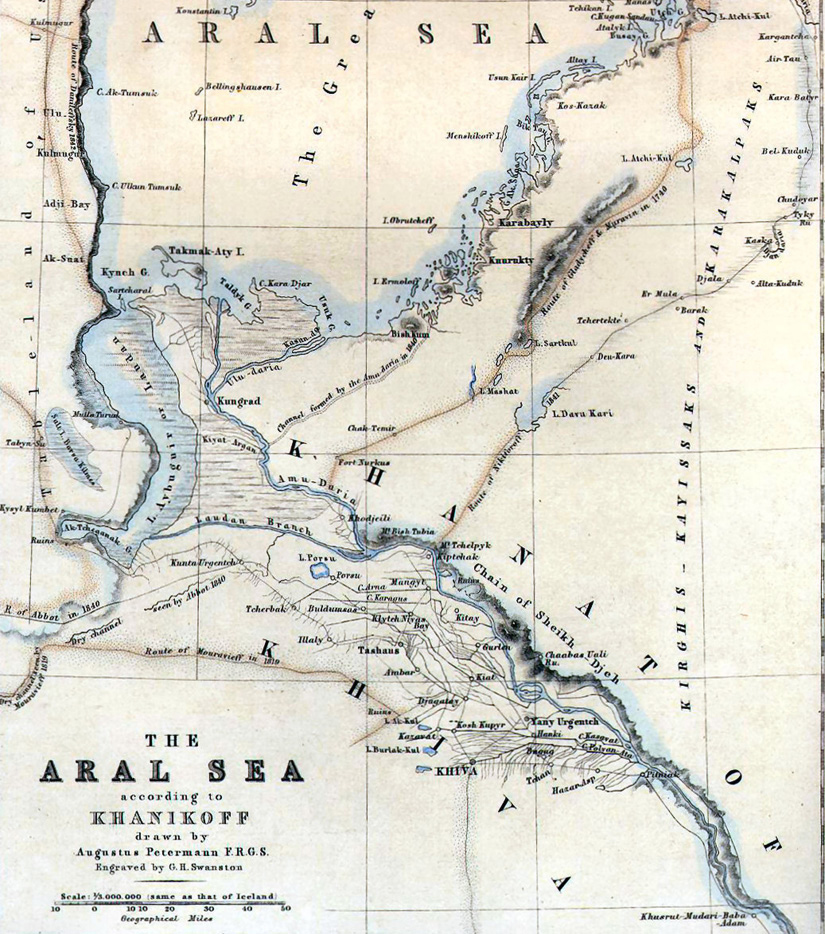
Figure 1. Map of the Khanate of Khiva; detail from map by Nikolai Khanykov (q.v.), drawn by Augustus Petermann, “Portions of the Russian Empire in Eastern and Western Asia: The Aral Sea According to Khanikoff,” London and Edinburgh, ca. 1860.
The administrative system of the khanate of Khiva under the Qonghrats assumed its final shape under Eltüzer and his brother and successor, Moḥammad Raḥim I. The khan ruled autocratically; there existed a khan’s council, whose members were called “great amirs” (omarā-ye ʿeẓām) or simply ā qs ā q ā ls, but it had a consultative function and did not have a prominent role in governing. The administration was mostly in the hands of two major officials, the mehtar and the qo š begi, who oversaw the civil administration (above all, finance) and were in charge of military affairs. The third high official, in charge of the collection of the zak ā t, was the div ā nbegi; the importance of this official increased in the 1840s and 1850s much beyond his initial functions. Representatives of the royal court also solved disputes through a system of appeal and extra-judicial conflict resolution, which was administered by the office of the yasāvol-bā ši; the ʿ olamā ʾ offered mostly notarial services (Sartori and Abdurasulov, 2017, pp. 20-60).
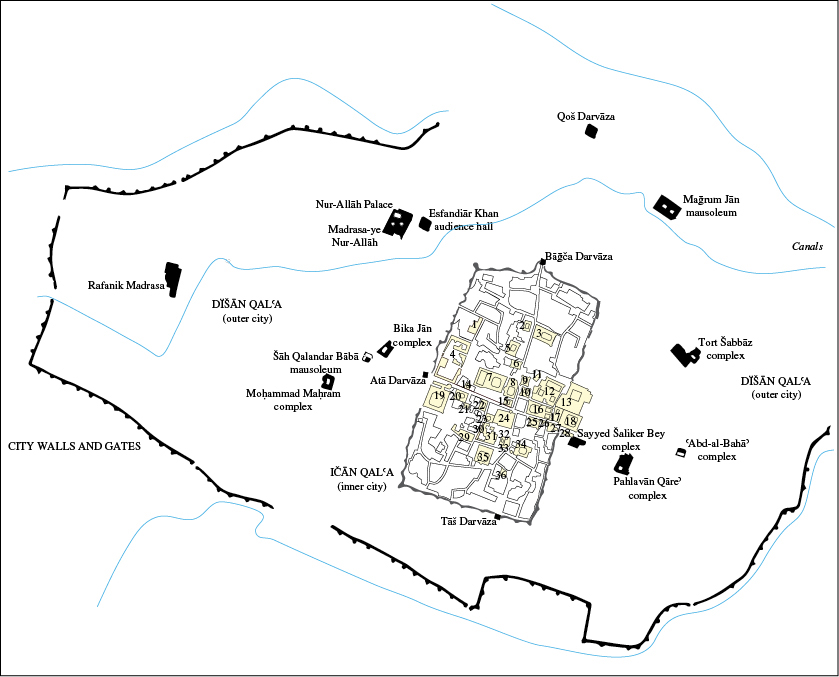
Figure 2. Sketch map of Khiva, 19th-20th centuries. Map data from openstreetmap.org; nomenclature after Yuri Bregel, An Historical Atlas of Central Asia, Leiden and Boston, 2003, pp. 98-99. Monuments of the Ičān Qalʿa: (1) Atā Morād Qošbegi mosque; (2) Ḥasan Morād Qošbegi mosque; (3) Amir Tora madrasa; (4) Kohna Ark, “Old Citadel”; (5) Musā Tora madrasa; (6)Yusof Yasāvol-bāši madrasa; (7) Moḥammad Raḥim Khan II madrasa; (8) ʿArab Moḥammad Khan I madrasa; (9) Dost Aʿlam madrasa; (10) Moḥammad Amin Ināq madrasa; (11) Uč Awliā mausoleum; (12) Tāš-ḥawli palace; (13) Allāh-qoli Khan caravanserai and storehouse; (14) Shaykh Moḵtār Atā mosque; (15) Moḥammad Panāh Bey madrasa; (16) Qotloḡ Morād Ināq madrasa; (17) Ḵojam-berdi madrasa; (18) Allāh-qoli Khan madrasa; (19) Moḥammad Amin Khan madrasa and minaret; (20) Moḥammad Niāz Divānbegi madrasa; (21) Sayyed ʿAlā-al-Din mausoleum; (22) Qażi Kalan madrasa; (23) Ḵojaš Maḥram madrasa; (24) Friday mosque; (25) ʿAbd-Allāh Khan madrasa; (26) Aq-masjed mosque; (27) Anuša Khan bath; (28) Pahlavān Darvāza; (29) ʿAbd-al-Rasul Bey madrasa; (30) Qāreʾ-ḵāna; (31) Pahlavān Maḥmud mausoleum; (32) Mazār-e Šarif madrasa; (33) Atājān Bey madrasa; (34) Eslām Ḵᵛāja madrasa and minaret; (35) Šir Ḡāzi Khan madrasa; (36) Bāḡbānli mosque.
Bureaucracy in Khiva was not centralized, even though there existed an institution called the chancellery (divān-ḵ āna). Record-keeping activities in the khanate of Khiva were mostly carried out in Central Asian Turkic (torki, otherwise known as Chaghatay) and led also to a complex system of archival practices. It is unclear whether records were arranged in a chamber in the royal citadel or if they were kept by officials and scribes. The “Archive of the Khans of Khiva” is the conventional name with which historians refer today to a large collection of texts (ca. 11,000) that the Russians found during the siege of the citadel of Khiva in 1873 and, together with the codices belonging to the royal library, brought to St. Petersburg in the wake of their military campaign in Khorezm. The archive contains mostly fiscal registers and records of precedential value regarding tenurial rights, fiscal exemptions, confiscation of property, and other, mostly legal, matters. It also contains a substantial number of records detailing raids and military campaigns; diplomatic correspondence with Kokand, Bukhara, and Iran; and intelligence reports, especially, from the Dašt-e Qepčāq (see QEPČĀQ) and areas inhabited by Turkmen groups. Together with officials and scribes, court historians and literati too had access to officials records (Sartori, 2016b, pp. 228-57).
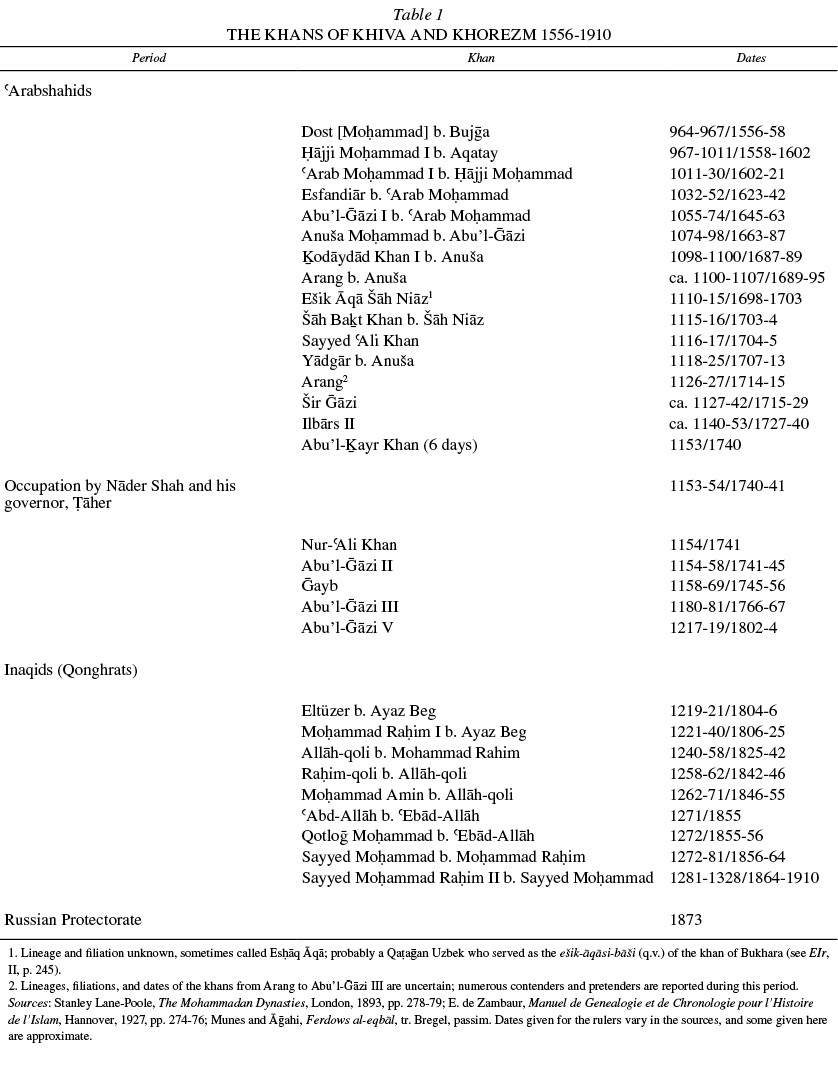
Table 1 THE KHANS OF KHIVA AND KHOREZM 1556-1910
The nomadic population (Turkmens, Karakalpaks [Qarāqalpāqs], and Qazaqs) were governed by their tribal chieftains, in accordance with their customs, and the Khivan authorities generally did not interfere in their internal affairs. In times of war, however, these nomadic groups (especially the Turkmens) supplied troops to the army of Khiva, which were subordinate to Uzbek military commanders. Besides their military commitments, both the latter groups were subjected to taxation and were required to provide a good deal of workers during the mass mobilization campaigns.
Of the two Uzbek states that were established in Central Asia after the Shibanid conquest in the early 16th century, the khanates of Bukhara and Khiva, that of Khiva was much smaller. However, this did not prevent the rulers of Khiva from pursuing a very active, and sometimes aggressive, policy in their relations with their neighbors, i.e., the khanate of Bukhara, Iran, Russia, the Turkmen tribes, and the Qazaqs. The limited state revenues made it difficult to maintain a strong military and to preserve the authority of the khans in their relations with both Uzbek tribal rivals and external enemies. To overcome this weakness, the rulers of Khiva, beginning with Abu’l-Ḡāzi I, paid much attention to the development of irrigation. New canals were built, and the newly irrigated lands were distributed among the Uzbek tribes. Some lands were taken over by the crown and were either leased out to individual farmers or cultivated by slaves. The first Qonghrat khans, who ruled the khanate of Khiva from 1804, introduced a new system of taxation. The land tax (salḡut) in monetary form was imposed on all landowners, who were divided into three categories according to the size of their lands: the highest (aʿl ā), the middle (awsaṭ) and the lowest (adn ā). There was a uniform tax rate for each of these categories, giving great advantage to the owners of large estates. The collection of the land tax was centralized: It was done by special officials sent from Khiva to all the provinces twice a year.
The measures of the first two Qonghrat khans aimed at strengthening their authority met with strong resistance from several Uzbek tribes, which was brutally suppressed. The Qonghrats made several groups of Turkmens, who lived west and south of Khorezm, migrate to Khorezm, giving them irrigated lands to settle and employing them in the Khivan army. The most numerous of these tribal groups were the Yomut, the Čowdur, and the Yemreli; in the middle of the 19th century Turkmens formed about one quarter of the entire population of the khanate. Another important ethnic group in Khorezm, besides the Sarts, the Uzbeks, and the Turkmens, was the Karakalpaks, who in the early 19th century were brought by force by the khan of Khiva from the eastern shore of the Aral Sea and settled in the Āmu Daryā delta (Abdurasulov, 2016, pp. 3-36). Some Qazaq groups, who belonged to the Junior Horde (Kishi Zhuz [Ki ši Juz]), nomadized near the Āmu Daryā delta. In the 18th century, they sometimes played a prominent political role in the khanate of Khiva, but their influence decreased with the final annexation of the Qazaq lands by the Russian Empire in the early 19th century. The Turkmens enjoyed a privileged position: For their military service, they were exempt from the land tax, as well as from the duty of repairing and cleaning their irrigation systems; this work was imposed on the Karakalpaks, who had to send their laborers to the Turkmen regions twice a year. Both the Turkmen and the Karakalpak tribes were self-governing, but they were not admitted into the central administration of the khanate.
Despite improvements in the early 19th century, the economy of the khanate of Khiva was still not strong enough to support the political ambitions of the Qonghrats. The state revenues were insufficient for the payment to the troops, and the military campaigns directed against the neighbors of Khorezm, i.e., the khanate of Bukhara, the Qazaqs in the north, and the Turkmens and Iran in the south, very often aimed not at territorial acquisitions, but at plunder. According to established custom, one third of the military booty belonged to the khan. The plunder was not the only purpose of the frequent (almost annual) wars with their neighbors: The Qonghrat khans tried to increase the number of taxpayers and soldiers by deporting to Khorezm (in addition to the Turkmens and the Karakalpaks), when the circumstances allowed, some population groups from neighboring regions, Transoxania and Khorasan, giving them irrigated land in Khorezm. Serious attempts were also made at establishing some permanent positions in the south, along the northern rim of Khorasan, and in the oasis of Marv. The Turkmen tribes in the south were compelled to pay tribute that had to be collected during military expeditions from Khiva. In the course of these expeditions, some tribes were also deported from northern Khorasan to Khorezm (Iš Morād).
Marv was especially important: The possession of this oasis allowed domination of the trade routes between Bukhara and Iran, as well as between Khorezm and Afghanistan. The city also served as a base for military raids further south, into Afghanistan. The fights for Marv, first with Bukhara and then with the independent Turkmen tribes, primarily the Sarïqs, which occupied this oasis (and were occasionally assisted by a small Qajar force from Khorasan), lasted until the mid-1850s. The last such war, in 1855, ended disastrously for Khiva: Moḥammad Amin Khan was killed in a battle with the Teke Turkmens (assisted by a Qajar detachment sent from Khorasan) at Saraḵs, and the army of Khiva was routed. This defeat was followed by an uprising of some major Turkmen tribes in Khorezm, in the course of which two successive khans of Khiva were killed. The Turkmens were joined by the Karakalpaks in the Āmu Daryā delta, and their uprising lasted until 1859. The uprisings were suppressed, with difficulties, but the protracted hostilities and some measures of the government of Khiva aimed at bringing the rebellious tribes to submission (such as blocking the access of water for irrigation to the Turkmen regions in the west of Khorezm) resulted in a decline of agricultural production in Khorezm. All this weakened the khanate at the time, just as it began to be threatened by the Russian expansion in Central Asia.
Trade and diplomatic relations between Khiva and Russia (in the 16th century, i.e., Muscovy) began in the mid-16th century. Khiva enjoyed great significance as a trading partner for Russia for the latter’s interest in opening a commercial route to India (Abdurasulov, 2016). Diplomatic relations between Russia and Khiva were complicated, however, by the presence of Russian captives in Khiva; these were mostly Russian peasants, and sometimes soldiers, captured by the Qazaqs along the southern Russian borders in Siberia, as well as Russian sailors and fishermen captured by the Turkmens along the Caspian shores. They were brought to Khiva and sold as slaves on the slave market. Similarly, Persians captured in the villages of Khorasan by Turkmen raiding parties, if not ransomed by relatives, were also sold on the same slave market (other than those who were kept by the Turkmens in the south for themselves). These slaves were employed either as domestic servants or as agricultural laborers, and their number was estimated at twenty to thirty thousand. Both Russia and Persia made some efforts at having the khans of Khiva release their respective countrymen, but these efforts did not have lasting effects (Eden, pp. 205-27). Nāder Shah found the most radical solution: When he captured Khiva after a brief military campaign in 1740, he ordered all slaves kept in Khiva set free (their number is given differently, one reliable source gives 7,000, but those were only the Persians; see Munes and Āḡahi, p. 578) and had a town built for them, near Abivard (q.v.), called Ḵiva-ābād. But during the following hundred years, the number of slaves, both Persian and Russian, was replenished, and they were liberated only after the Russian conquest of Khiva in 1873; the liberated Persian slaves (whose number at that time was estimated differently: as more than 5,000 in a Khorezmian historical work and as less than 2,000 according to a Russian source) reportedly, on their way to Persia, were attacked and plundered by the Khorezmian Turkmens (see Bregel’, 1961, p. 155).
After the debacle at Saraḵs and the beginning of the internal troubles in Khorezm, the khanate of Khiva was unable to pose any new threat to Iran and Bukhara, and its relations with Russia gradually deteriorated. The Russian government was alarmed by the attempts of Khiva to extend its influence into the Qazaq steppes, including its support of some Qazaq chieftains of the Junior Horde, who rebelled against the Russians. Especially irritating to the Russian government was the problem of Russian slaves in the khanate, which could not be solved by diplomatic means, and the plundering by the Khivans of Russian trade caravans travelling to Bukhara. In the winter of 1839/40, a Russian military expedition against Khiva set out from Orenburg led by the governor of Orenburg, Vasiliǐ Perovskiǐ, but it suffered from a severe winter and returned, having advanced only half the way (Morrison, pp. 443-85; see also EIr, XVI, p. 422 [s.v. KHANYKOV]).
The conquest of Khiva was undertaken later as a part of the overall Russian plan of expansion in Central Asia to the south of the steppes region, and it was preceded by the conquest of Tashkent in 1865 and the defeat of the khanate of Bukhara in 1868. In 1873, Russian troops under the Governor-General of Turkestan, K. P. von Kaufman, advanced against Khiva from three directions (Bukhara, Orenburg, and Manghyshlaq); it was mostly the Turkmen troops who tried to fight the invaders. On 29 May (here and below according to the Julian calendar), Kaufman entered Khiva.
The khan of Khiva, Moḥammad Raḥim II, at first fled to the Turkmens, but on 2 June he came to Kaufman’s camp near Khiva and offered his submission. The abolition of slavery was proclaimed by the khan on 12 June 1873, and all the slaves were released (cf. above). The Khorezmian Turkmens (primarily the tribe of the Yomuts), who were not in a hurry to release their slaves and to pay to the Russians the considerable fine imposed by Kaufman, were subjected to a brutal punitive expedition under General Golovachev, during which hundreds of Turkmens were killed, their livestock slaughtered, and their settlements devastated (Golovachev’s expedition was described by J. A. MacGahan, a correspondent of the New York Herald, who accompanied the Russian troops during the entire campaign of 1873; see his Campaigning on the Oxus). On 12 August 1873, Kaufman signed a peace treaty with the khan called the Treaty of Gandemian, in which the Qonghrat ruler declared himself an “obedient servant” of the Russian emperor; the territory of the khanate on the right bank of the Āmu Daryā was annexed to Russia, and the khanate had to pay a large war indemnity. Russia received exclusive control of navigation on the Āmu Daryā. The khan also gave up his right to exercise any kind of foreign policy without the authorization of higher Russian authorities, relinquished his claim to the entire right bank of the Āmu Daryā “with all the peoples settled or migrating there” (that is, to more than half of the territory he had previously held), and also recognized a range of other political and commercial concessions to the advantage of the Russian government.
In order to monitor affairs in Khiva and influence politics within the Khanate, the Āmu Daryā Department (Amudar’inskii otdel, ADO) was established on the territories annexed on the right bank of the Āmu Daryā, with its administrative center at Fort Petro-Aleksandrovsk (modern To’rtko’l, Karakalpakstan). The head of the ADO oversaw both civil and military authorities in a new administrative unit. Although the ADO was formally subordinated to the military governor of the Syr Daryā province (oblast’), its distance from the main centers of colonial administration and the weak state of communications’ infrastructure allowed the head of the department to enjoy significant authority when mediating between Khiva and other Russian imperial authorities.
The main feature of the Russian Empire’s relationship with this protectorate was a fundamental ambivalence. On the one hand, preserving the semi-independent Khanate with an uncertain status among other colonial possessions seemed to be a very politically risky and costly undertaking that conflicted with imperial interests in the region. On the other hand, however, the uncertainty of the Khanate’s position suited various interest groups, given that it provided broad access to Khiva’s internal resources without the need to build a costly system to administer Khorezm (Sartori and Abdurasulov, 2016/3, pp. 1-50).
After the signing of the peace treaty, the Russian troops left the territory of the khanate, but the authorities of the Governorate General had to interfere again repeatedly in the affairs of the khanate, especially because of the Turkmen rebellions caused mainly by the problems of irrigation in the Turkmen regions. On 25 January 1913, an agreement was signed between the Khivan government and the Turkmens, according to which the government promised to safeguard Turkmen rights on water, while the Turkmens promised to pay a large fine for their raids against the Uzbek regions. However, already on 22 March 1915 the Turkmens, under the Yomut chieftain Jonayd Khan, attacked Khiva, and in early April they captured several Khivan towns. On 30 June 1915, a peace agreement with the Turkmens was arranged with Russian help, but in February 1916 Jonayd Khan declared himself khan of Khiva, and on 13 February he seized Khiva and deposed Esfandiār Khan. Three ministers of Esfandiār were killed, and the city was plundered by the Turkmens for three days. The governor of the Syr Daryā oblast’, Lieutenant General Galkin, went to Khorezm with a punitive expedition and on 15 February expelled the Turkmens from Khiva. Jonayd fled to Persia and from there to Afghanistan, while Galkin attacked the regions inhabited by the Turkmens for two-and-a-half months and levied a substantial indemnity. On 29 January 1917, A. N. Kuropatkin, the governor-general of Turkestan, signed an agreement with Esfandiār Khan, according to which a military commissar had to be placed in Khiva as the representative of the central government in Petrograd.
However, after the February revolution in Russia and the fall of the monarchy on 27 February 1917, the situation in Turkestan, including both Russian protectorates, Bukhara and Khiva, changed drastically. The governor-general in Tashkent was replaced as the representative of the Provisional Government in Petrograd by the Turkestan Committee. Following the formation of soviets throughout the former Russian Empire, a soviet of soldiers’ deputies was formed in the Russian garrison at Khiva, and the party of Uzbek reformers called “Young Khivans” pressed Khan Esfandiār for reforms, which were promulgated in April 1917. These reforms largely remained on paper because of the resistance of the provincial governors and especially because of the inability of the Young Khivans (all of whom were Uzbeks) to find some accommodation with the Turkmens, whose old grievances about the unjust taxation and distribution of water for irrigation were still not addressed.
In August, the Turkestan Committee sent a regiment of Orenburg Cossacks under Colonel Zaitsev as an acting military commissar in Khiva with the task of pacifying the Turkmens. Shortly before that, Jonayd Khan returned from Afghanistan and allied with Zaitsev against two Turkmen rebel leaders, who were his old enemies. In spring and early summer 1918, Jonayd was a de facto ruler of Khiva, governing from his headquarters in Bederkend (northwest of Khiva) through Turkmen military commanders (atlı-bāši) appointed by him. On 30 September, Jonayd had his son assassinate the khan of Khiva, Esfandiār (he was succeeded by his brother ʿAbd-Allāh, who did not play any role in governing). At the end of November, Jonayd tried to occupy the right bank of the Āmu Daryā, but his troops were defeated and, in March 1919, were defeated again near Pitnak and in several more places on the left bank. On 9 April, a peace treaty was signed at Takhta, which reconfirmed the independence of Khiva and proclaimed the establishment of diplomatic relations with Russia.
In the summer of 1919, the Ural Cossacks stationed in the Āmu Daryā delta started a revolt, with the support of the Karakalpaks, and the delta region came under their control; Jonayd gave his support to the Cossacks. But by the fall of 1919, the entire military situation in Central Asia changed in favor of the Soviets. In Khorezm, the Young Khivans organized their militia and had an underground cell in Khiva. In November, two Turkmen tribal chieftains, old rivals of Jonayd, started a revolt against Jonayd in the northern part of Khorezm. On 25 December, the Bolshevik troops began their invasion of Khorezm. Insurgent Turkmen chieftains joined the red army troops; Jonayd’s “capital” Bederkend fell on 23 January 1920, and Jonayd fled into the Qaraqum desert. In the north, the Cossack revolt was suppressed, and in the south Khiva fell on 1 February. ʿAbd-Allāh Khan was forced to abdicate in favor of a revolutionary committee, composed of two Young Khivans, two Turkmen chiefs, and one cleric. During February, the local governors who had been appointed by the khan or Jonayd were replaced by local soviets. On 1 April, a political mission from Tashkent came to Khiva to organize elections to a congress of soviets. The elections were held under Tashkent supervision, and at the end of April the first All-Khorezmian congress of soviets met, abolished the khanate, and proclaimed an independent Khorezmian People’s Soviet Republic, adopted a constitution and sent a delegation to Moscow to conclude treaties of alliance and assistance. At the end of May, the Khorezmian Communist Party was established, which, however, was composed almost entirely of communists from Russia and Turkestan. On 10 July, the former khan ʿAbd-Allāh was arrested and taken to Moscow, where he soon died (almost certainly killed) in a prison hospital.
The Young Khivans suspected the Turkmens of collaboration with Jonayd Khan, who was with his supporters in the Qaraqum desert; in August 1920, two campaigns of the Red Army against Jonayd Khan ended in failure, and the Young Khivan government, with the support of Russian representatives in Khiva, put the blame on the Turkmen chieftains and pressed for the disarming or expulsion of Turkmen troops. In September, the government of Khiva invited a number of Turkmen chieftains, with their troops, to Khiva, ostensibly for the preparation of a campaign against Bukhara, but with the intention of disarming them. The Turkmens, under Qoš Moḥammad (Qoshmamed) Khan, came to the Tāzābāḡ garden, in the southern outskirts of Khiva. While his people remained in the garden, Qoš Moḥammad Khan himself came to the government meeting, where he was killed during an evening session, while his people in Tāzābāḡ were disarmed. Another Turkmen leader, Šāh Morād Baḵši, who had been arrested earlier in the north of Khorezm, was also executed in Khiva.
All these repressions resulted, by early November, in a mass flight of Turkmens to the center and north of Khorezm, where many of them joined Jonayd Khan. A special representative of Moscow, who came to Khorezm in early November to conduct an investigation, reported that the government now had to deal with a general Turkmen uprising. Only in early January 1921 was the Red Army able to occupy the entire north of Khorezm. After a mass meeting in Khiva (with the participation of Red Army troops) on 6 March, the Young Khivan government was overthrown and replaced with the Revolutionary Committee, and the Young Khivan members of the government fled to Jonayd Khan. In 15-23 May, the second qurultay (congress) of the soviets convened in Khiva and adopted the new constitution of Khorezm People’s Soviet Republic (as it began to be called). The fourth qurultay of Khorezmian soviets, convened in 17-20 October, adopted a new constitution, which renamed the country the Khorezm Soviet Socialist Republic. On the basis of the new constitution, new administrative divisions were introduced: Tashauz oblast’, with a predominantly Turkmen population, and Khojeyli oblast’, with a mainly Qazaq and Karakalpak population. These new divisions were the precursors of the “national delimitation” of Central Asia, which took place in 1924-25.
The main problem for the Soviet authorities in Khorezm at that time was not, however, the nationalities question, but the invigorated resistance movement (dubbed “Basmachi” by the Soviets). This Turkmen rebellion began in the south of Khorezm, with the centers in Pitnak and Hazārāsp. On 15 January 1924, these two towns were captured by the Turkmen rebels under Āḡaji Ishān, from the Turkmen tribe of Ata. On 23 January 1924, Khiva was surrounded and besieged by the troops of Jonayd Khan and Āḡaji Ishān, who had under their command altogether about 2000 men. The garrison of Khiva repelled several attempts at storming the city. The siege was somewhat relieved on 27 January, after the garrison of Tashauz, in the north of Khorezm, which had been besieged until then, abandoned that city and joined the defenders of Khiva; the Basmachi troops attempted a new storming of Khiva, but after its failure they only continued the blockade. As a result of the various measures by the Soviet authorities, aimed at attracting the rank-and-file members of the rebels to the government side, mass defections from the troops of Jonayd Khan and Āḡaji Ishān took place in February. On 23 March, Āḡaji Ishān and his group surrendered, which ended the Basmachi movement in Khorezm, while Jonayd Khan retreated with the remnants of his people to the Qaraqum, being pursued by the Red troops, and, on 8 April, he crossed the border to Iran near Qezel Arvāt (Kyzyl-Arvat).
In the spring and summer of 1924, heated debates took place in Khorezm concerning the projected “national delimitation” of Central Asia. At first, the Khorezmian communist party insisted on the preservation of the Khorezmian republic as a well-developed, separate economic region with its own irrigation system (an argument that was supported, among others, by some Russian scholars, such as Vasiliǐ Barthold; q.v.). But the new system of “national republics” was already decided in Moscow. The fifth Khorezmian Qurultay of the Soviets at the end of September proclaimed the liquidation of the Khorezmian Soviet Socialist Republic, and from February 1925 the new administrative division of Khorezm was in place.
The city of Khiva did not fare well at first after the national delimitation. It was the center of “the old regime,” with a great number of Muslim clerics and the former officials of the khanate, who could not serve as the social basis of the new regional administration, while its role in the newly developing economy was very limited. The more important role belonged to the city of Urgench, the main commercial and industrial center of the region, and it was made the center of the new administrative unit, Khorezmskaia oblast’, which also included the city of Khiva. The architectural monuments of Khiva under Soviet rule were neglected for a long time and even abused: Several mosques and madrasas were even used as warehouses for fuel storage (according to the first-hand observations of Yuri Bregel in the summer of 1958). But the economic importance of Khiva as a major attraction for international tourists was recognized by the Soviet authorities, albeit belatedly. In 1969, the inner city (Itchan Kala [Ičān Qalʿa]) was proclaimed as an architectural preserve, and in 1990 it was placed on the World Heritage list of UNESCO. The 28th General Conference of UNESCO in 1995 decided to have an international celebration of the 2,500th anniversary of the city of Khiva in 1997, simultaneously with a similar anniversary of the city of Bukhara; it should be noted that there was no factual basis for either of these anniversaries, but the international attention helped to improve the general condition of the city of Khiva and especially of its architectural monuments, which became also the subject of several fairly good art publications (see bibliography below).
Bibliography
(works on the general history of Khorezm and the Khanate of Khiva are included only selectively; for a detailed bibliography see Bibliography of Islamic Central Asia, compiled and edited by Yuri Bregel, Bloomington, Indiana, 1995, pt. i-iii):
U. Abdurasulov, “Ot Arabshakhidov k Kungradam: dinamika i politcheskii landshaft Khorezma v period pravleniya dvukh dinastii,” O’zbekiston tarixi 2, 2013, pp. 17-32.
Idem, “The Aral Region and Geopolitical Agenda of the Early Qongrats,” Eurasian Studies 14, 2016, pp. 3-36.
Seymour Becker, Russia’s Protectorates in Central Asia: Bukhara and Khiva, 1865-1924, Cambridge, Mass., 1968.
Yuri Bregel’ [Bregel], “Sochinenie Baiani ‘Shadzhara-ii khorezmshakhi’ kak istochnik po istorii turkmen,” Kratkie soobshcheniya Instituta narodov Azii 44, 1961, pp. 125-57.
Idem, “I̊naḳ,” EI 2, Suppl. 5-6, [1982], pp. 419-20.
Idem, “Recent Publications on the Sarts: A Review Article,” Journal of Asian History 42/2, 2008, pp. 196-206.
Ergun Çağatay, Bir zamanlar Orta Asya: Once upon a Time in Central Asia: Kogda-to Srednyaya Aziya, Istanbul, 1996 (includes numerous photographs reproduced from earlier publications).
Devin DeWeese, “Mapping Khwārazmian Connections in the History of Sufi Traditions: Local Embeddedness, Regional Networks, and Global Ties of the Sufi Communities of Khwārazm,” Eurasian Studies 14, 2016, pp. 37-97.
Jeff Eden, “A Persian Captive’s Guide to Khiva: Esmāʿil Mir-Panja’s Satirical Recollections,” Journal of Persianate Studies 9/2, 2016, pp. 205-27.
Ia. G. Guliamov, Pamiatniki goroda Khivy, Tashkent, 1941.
Iš Morād b. Ādina Moḥammad ʿAlavi, Jamshīdī ṭavāyifī fatḥī (The Subjugation of the Jamshīdīs), ed. Nuryoghdi Toshov, Vienna, 2018.
Pavel Petrovich Ivanov, Arkhiv khivinskikh khanov XIX v. Issledovanie i opisanie dokumentov s istoricheskim vvedeniem, Leningrad, 1940.
Januarius A. MacGahan, Campaigning on the Oxus and the Fall of Khiva, New York, 1874.
L. Man’kovskaya, Khiva: Zapovednik khorezmskogo zodchestva, Tashkent, 1982 (186 color plates).
Alexander Morrison, “Camels and Colonial Armies: The Logistics of Warfare in Central Asia in the Early 19th Century,” Journal of the Economic and Social History of the Orient 57, 2014, pp. 443-85.
Šir Moḥammad Mirāb Munes and Moḥammad Reżā Mirāb Āḡahi, Ferdows al-eqb ā l, tr. from Chaghatay and annotated by Yuri Bregel, as Firdaws al-Iqb āl : History of Khorezm, Leiden, 1999.
Vitalij V. Naumkin, Khiva, Reading, U.K., 1993 (includes 105 plates).
Gaib Nepesov, Iz istorii Khorezmsko ǐ revolyutsii, Tashkent, 1962.
Angelo Michele Piemontese, “La leggenda del santo-lottatore Pahlavān Maḥmud Xvārezmi «Puryā-ye Vali» (m. 722/1322),” Annali dell’ Istituto Universitario Orientale di Napoli 14, 1964, pp. 453-73.
Ivan V. Pogorel’skiǐ, Istoriya khivinsko ǐ revolyutsii i Khorezmsko ǐ Narodno ǐ Sovetsko ǐ Respubliki 1917-1924 gg., Leningrad, 1984.
Paolo Sartori, “On Madrasas, Legitimation and Islamic Revival in 19thCentury Khorezm: Some Preliminary Observations,” Eurasian Studies 16/1-2, 2016a, pp. 98-134.
Idem, “Seeing like a Khanate: On Archives, Cultures of Documentation, and 19th Century Khorezm,” Journal of Persianate Studies 8/2, 2016b, pp. 228-57.
Idem, “Of Saints, Shrines, and Tractors: Untangling the Meaning of Islam in Soviet Central Asia,” Journal of Islamic Studies 30/3, 2019, pp. 1-40.
P. Sartori and U. Abdurasulov, “The Politics of Ambiguity: What Does It Mean to Be a Russian Protectorate?” Ab Imperio 2016/3, pp. 1-50.
Idem, “Take Me to Khiva: Sharīʿa as Governance in the Oasis of Khorezm (19th-Early 20th Centuries),” Islamic Law and Society 24/1-2, 2017, pp. 20-60.
Nikolai [I.] Veselovskiǐ, Ocherk istoriko-geograficheskikh svedeni ǐ o Khivinskom khanstve ot drevne ǐ shikh vremen do nastoyashchego, St. Petersburg, 1877.
A. Wilde and N. Allaeva, “Lost in Khvārazm: On the Interdependence of Power and Conflict in the Example of Nādir Shāh’s Khīva Campaign(s),” Central Asiatic Journal 59/1-2, 2016, pp. 77-100.