



KAŠKUL , an illustrated satirical weekly published in Tehran and Isfahan (1907-8, 1909).
Kaškul (lit. alms gourd carried by mendicant dervishes, and also colloquially implying “hodgepodge”) was one of the leading satirical newspapers (see JOURNALISM i. Qajar Period) to appear in Persia following the promulgation of the country’s first constitution (see CONSTITUTIONAL REVOLUTION) in the summer of 1906 by Moẓaffar-al-Din Shah (r. 1896-1907). Initially published in Tehran as a four-page, 21 x 34 cm, lithographed weekly newspaper, 42 issues of Kaškul appeared between 15 Ṣafar 1325/30 March 1907 and 2 Jomādā I 1326/2 June 1908. Its proprietor, Shaikh Aḥmad Majd-al-Eslām Kermāni (q.v.; 1871-1923), was an advocate of the Constitutional Revolution and earlier had served for two years as the editor of the weekly newspaper Adab (q.v.), the first illustrated publication in Persia to feature cartoons, which had been published at various locations in the country between 1898 and 1906 and faced intermittent state censorship (q.v.) and closure (Kohan, I, p. 188). With the temporary easing of press censorship following the abolition of the Ministry of Publications (Wezārat-e enṭebāʿāt) in March 1907 (Nabavi, pp. 239-40), an unprecedented number of privately-owned newspapers and periodicals were founded across the country. In fact, Kaškul was the third of four newspapers published by Majd-al-Eslām during the first constitutional era (1906-8), the others being Nedā-ye waṭan, al-Jamāl, and Moḥākamat (Kamali, “Majd-al-Eslām Kermāni”).
Kaškul rapidly gained renown for its distinctive style of black and white cartoons (see GRAPHIC ARTS. i. IN THE QAJAR AND PAHLAVI PERIOD). The editorial in the first issue of the paper underscored the advantage of printing cartoons:
“After one thousand years of reflection and deliberation on how to bring about moral edification, and disseminate civilization and education across the country…, the sages of the world have finally reached the consensus that the best way is by means of portraying and displaying to the people their [own] ugly habits. That way, people will learn to adopt proper conduct and avoid undesirable behavior. There are two easy and simple ways [to accomplish this]: one is [by means of] theatrical plays [teʾātr; see DRAMA], and the other is through creating imaginary [illustrated] scenes, known as cartoons, and exposing the general public [ʿomum-e mardom] to these [cartoons] in [the pages of] newspapers.”
The editorial added that since plays (here meaning modern theatrical plays, as opposed to the tradition of taʿzia [q.v.], religious plays) were contrary to Islam, cartoons were therefore the best means of achieving this goal (Kaškul, 30 March 1907, p. 1; Ṣadr-Hāšemī, IV, pp. 135-36;). Similarly, Kaškul’s motto, appearing at the top of its front page in every issue, underscored the point that while the contents of the weekly were intended to be lighthearted and were “not [specifically] directed at any particular individual,” the paper’s ultimate objective was “to dispel ugly habits…and promote the standards of civilization and propriety [(tarbiyat)].” To this end, the paper not only devoted three of its four pages to cartoons in most issues, but it also invited the learned (dānešmandān) to submit their own humorous cartoons (ṣowar-e mohum-e ḵanda-āmiz) to the paper, accompanied by edifying descriptive messages that did not slander any specific individual (Ṣadr-Hāšemi, IV, p. 136; see Figure 1).
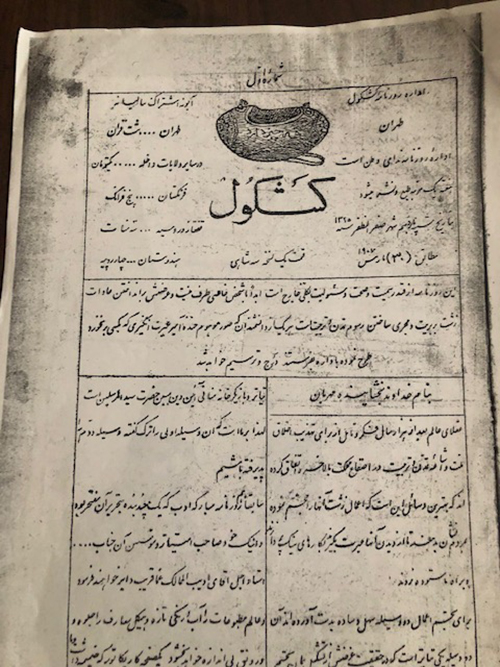
Unlike most other satirical newspapers published in Persia at the time, there is no evidence that Kaškul drew inspiration from Mollā Naṣr-al-Din (see MOLLA NASREDDIN ii. POLITICAL AND SOCIAL WEEKLY), the influential social-democratic Turkish-language satirical newspaper that had begun publication in Tblisi, Georgia, in 1906 (Parvin, p. 661). According to Majd-al-Eslām’s first editorial in Kaškul, the stylistic precedent for the paper’s cartoons was that of the one-page cartoons in Adab, which he had edited from 1904 to 1906. The editorial added that the inclusion of cartoons in Kaškul was in response to the great popularity of Adab’s cartoons “in different quarters of the country” (Kaškul, 30 March 1907, p. 1). Moreover, there was an unmistakable element of continuity in the styles of cartoons appearing in these two papers, and in at least the first two issues of Kaškul the cartoons were signed by Ḥoseyn-ʿAli, the former cartoonist of Adab (Parvin, p. 668). Other cartoonists whose names appeared in subsequent issues were Mirzā ʿAli Mozayyan, and Ḥasan (Parvin, p. 668). However, the cartoons in Kaškul addressed a broader range of political and social issues in comparison with the cartoons in Adab, not forgetting, though, the stringent state press censorship faced by the latter. Kaškul’s cartoons, rather than seeking to merely entertain the public through satire, aimed to visually highlight a range of subjects deemed paramount in promoting constitutional rights and laws, as well as in salvaging Persia’s territorial self-determination, promoting reforms, and countering some of the prevalent social mores considered deleterious to the welfare of the nation. The cartoons addressed such topics as Persia’s economic exploitation by European powers, the imperial encroachment of Russia and Britain in the country’s internal affairs, the importance of preserving the National Assembly (Majles) and promoting constitutional rights and laws (mašruṭa) for countering despotism (estebdād), and the necessity of establishing and fostering new institutions such as a National Bank as a means of bolstering Persia’s sovereignty (see BANKING). In addition, the cartoons also addressed a broad spectrum of social issues, such as the prevalence of poor hygiene habits (see HEALTH IN PERSIA iii. QAJAR PERIOD), widespread addiction to opiates (see AFYŪN), pervasiveness of superstition, and extensive corruption among officials and the entrenched practice of bribery (see Figures 2, 3 and 4).
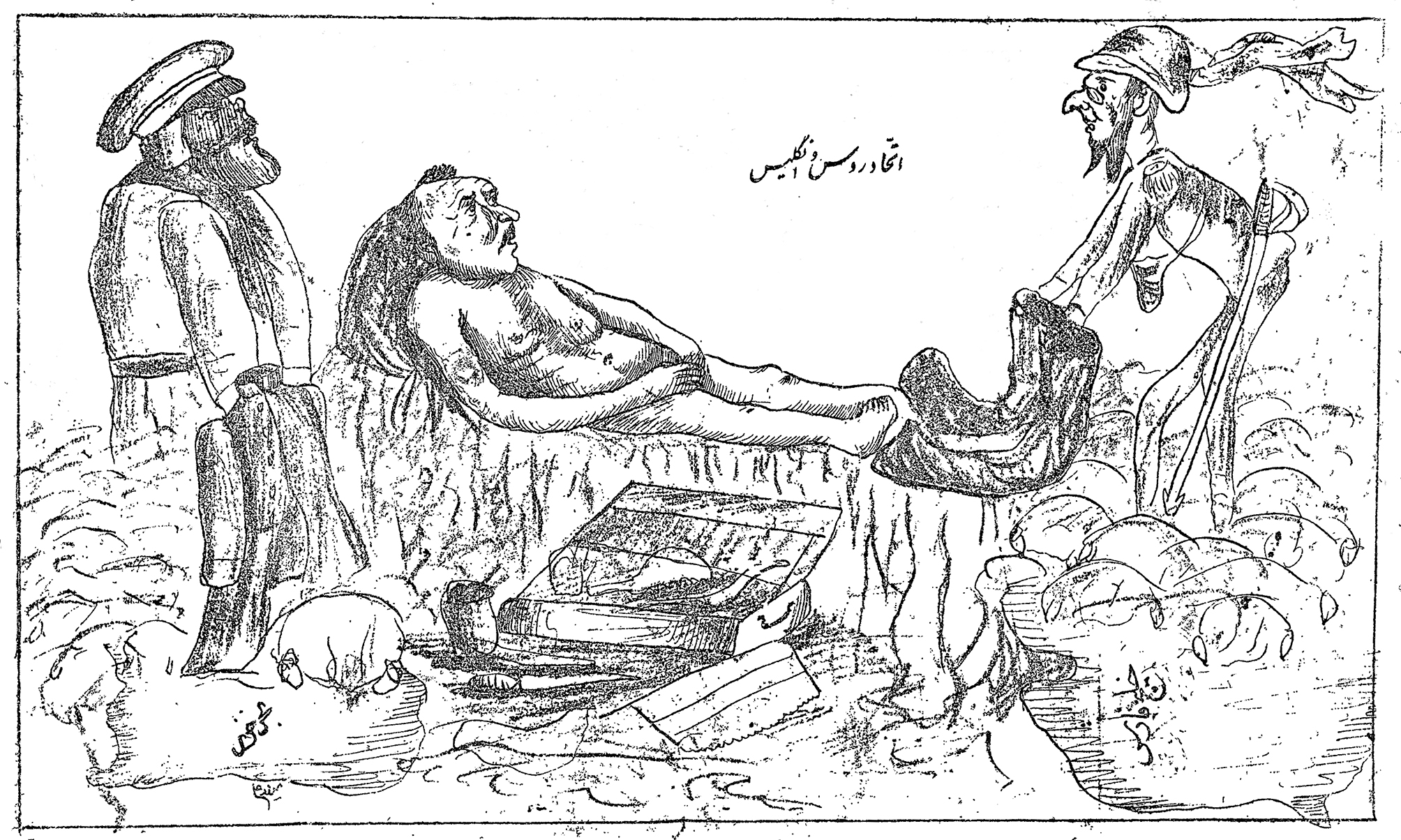
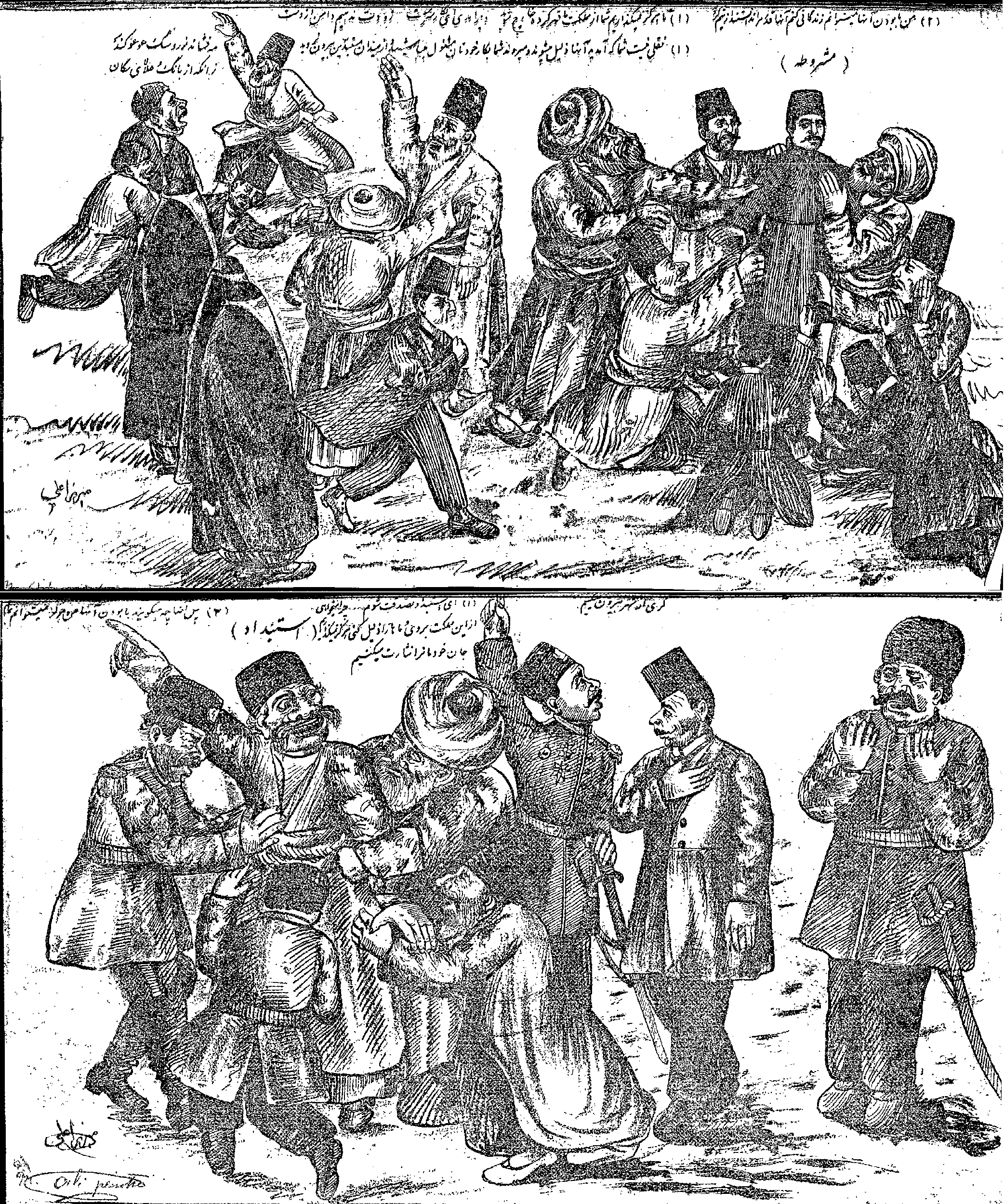
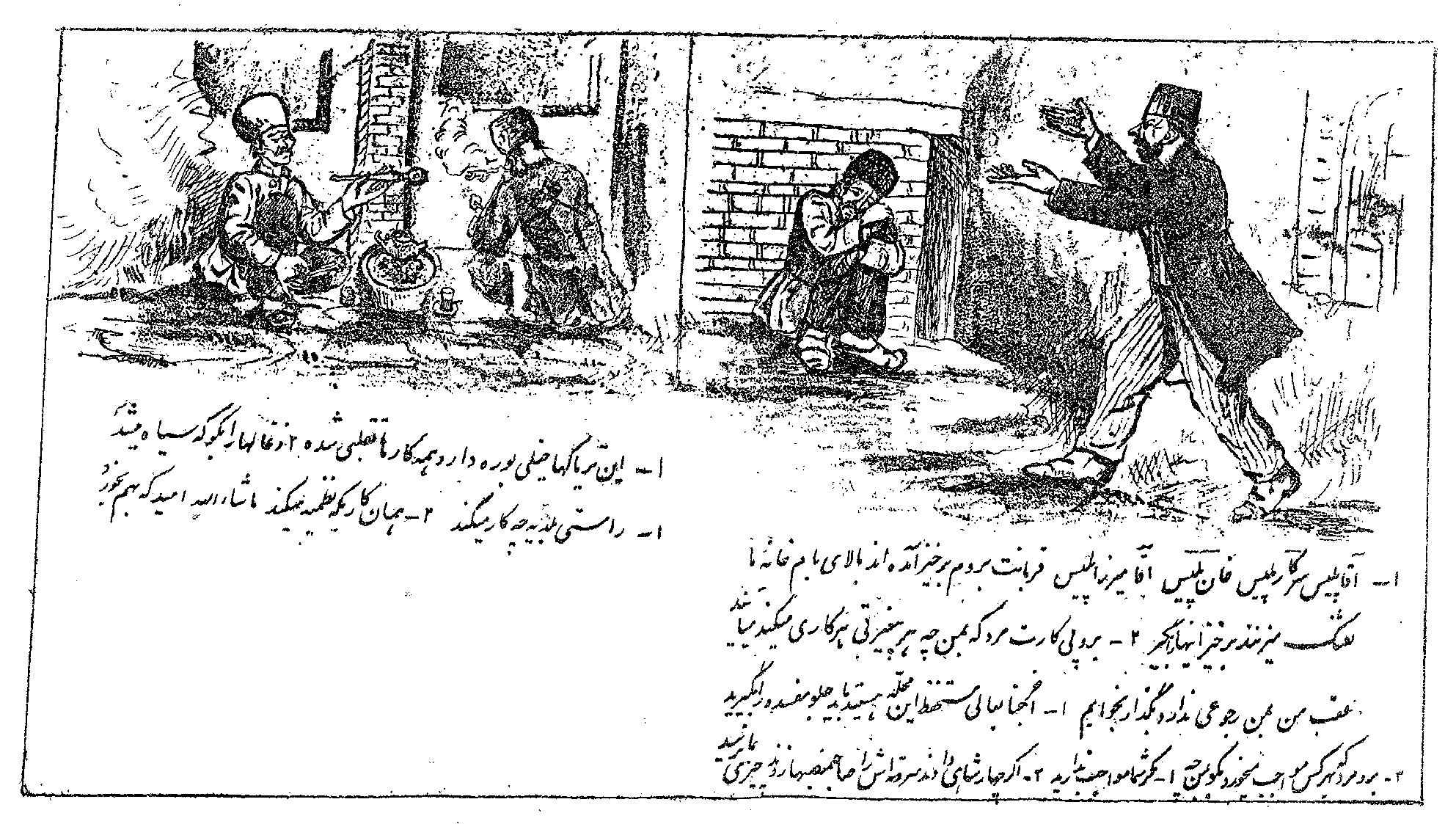
Cartoons had the advantage of reaching a larger audience, both literate and illiterate. The cartoons in Kaškul, while not always self-explanatory, were often accompanied by captions written in accessible everyday language, whether in the form of dialogues between the characters in the cartoons or as brief straightforward commentaries that would have been easy to comprehend when read out in public gatherings (Balaghi, pp. 168-69). Kaškul regarded what it termed as the “general public” to be its target audience, as stated in its first issue. To this end, the paper also noted its affordability, asserting that it was not pursuing profits, since the sale price and subscription rate for each issue of the paper reportedly equaled its cost of production (Kaškul, 30 March 1907, p. 2). The single issue price and the annual subscription rate for the paper were, in fact, slightly lower than those of other weeklies published at the time.
Following the coup d’état of 23 June 1908, carried out by supporters of Moḥammad-ʿAli Shah (r. 1907-9) with Russian backing, Kaškul, along with most other pro-constitution newspapers, was shut down—the only constitutionalist newspapers still printed after the coup were those that had managed either to transfer publication to parts of the country where armed resistance had broken out against the autocratic shah, or to move outside the country. Kaškul resumed publication nearly ten months after its closure, following the capture of Isfahan by constitutionalist forces. It now appeared twice a week and was published in Isfahan, lasting for some three months between 12 Rabiʿ I 1327/3 April 1909 and 26 Jomādā II 1327/15 July 1909 (Parvin, p. 558). However, in light of the changed circumstances, along with the revived paper’s first editorial statement that it was “grieving the martyrdom of fellow [journalists],” the new Kaškul lacked its previous humor and contained fewer cartoons, with its content instead assuming a more solemn tone and focusing on news of current events, particularly the armed preparations by the pro-constitutionalist Baḵtīārī tribes (q.v.) in Isfahan that were planning to advance on Tehran (Parvin, p. 558; Kamali, 2011, p. 139). Once the constitutionalist forces captured Tehran, Kaškul, too, ceased publication in Isfahan, hoping that it could start publishing in Tehran again. However, suspicion towards Majd al-Eslam and allegations that he had compromised with courtiers resulted in him being exiled to Kerman (Kamali, “Majd-al-Eslām Kermāni”).
Bibliography
Shiva Balaghi, “Print Culture in Late Qajar Iran: the Cartoons of ‘Kashkūl’,” Iranian Studies, 34/1-4, 2001, pp. 165-81.
Edward Granville Browne, The Press and Poetry of Modern Persia, reprint, Los Angeles, 1983 (partly based on the manuscript work of Mirzā Moḥammad-ʿAli Khan “Tarbiat” of Tabriz).
Maryam Kamali, “Majd-al-Eslām Kermāni,” Encyclopedia Iranica Online, http://dx.doi.org/10.1163/2330-4804_EIRO_COM_11433.
Maryam Kamāli and Ḥabib Ḥājiḥaydari, Aḥmad Majd-al-Eslām Kermāni rewāyatgar-e mašruṭa, Tehran, 2011.
Kaškul (Tehran and Isfahan).
Guʾel Kohan, Tāriḵ-e sānsur dar maṭbuʿāt-e Irān, 2 vols., Tehran, 1981-83.
Negin Nabavi, “Modernity and Its Discontents: Newspapers, Censorship, and the Press Law in Late Nineteenth and Early Twentieth Century Iran,” Iranian Studies 54/1-2, 2021, pp. 221-45.
Nāṣer-al-Din Parvin, Tāriḵ-e ruz-nāma-negāri-e Irāniān wa digar-e pārsi-nevisān, vol. II, Tehran, 2000.
Moḥammad Ṣadr-Hāšemi, Tāriḵ-e jarāyed va majallāt-e Irān, vol. IV, Isfahan, n.d.