



FARMAYAN, HAFEZ (Ḥāfeẓ Farmānfarmāʾiān; b. Tehran, 7 October 1927; d. Austin, Texas, 4 July 2015; Figure 1), prominent historian of the Middle East and, in particular, of the Qajar period. A pioneer in the scholarly study of Qajar Persia, Hafez Farmayan was among the first historians to point out the significant social and cultural changes taking place during the Qajar period.
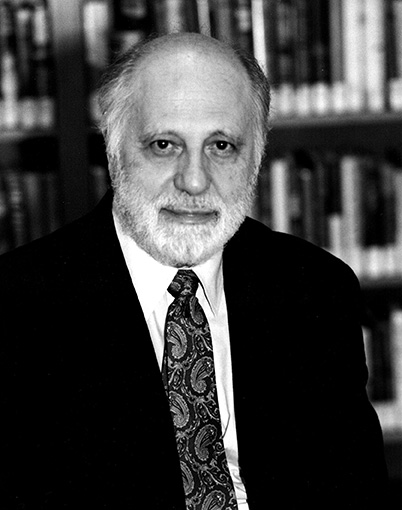
He was born to a distinguished family, one of the youngest sons of Prince ʿAbd-al-Ḥosayn Mirzā Farmānfarmā (q.v.; 1858-1939), the grandson of ʿAbbās Mirzā (son and crown prince of Fatḥ-ʿAli Shah Qajar [qq.v]). With the transition from the Qajar to the Pahlavi dynasty, his father, who had served in important administrative positions, including governorships, commander-in-chief of the armies, and the premiership, essentially withdrew from political life, devoting much of his time to the rearing and education of his thirty-two children. Similar to his siblings, Hafez had his basic education in Persia by private tutors and in public schools. For his elementary education, he attended Dabestān-e Tarbiyat, which was run by the Baha’i community (Gallagher, p. 82), and afterward an Islamic school in Tehran. He then attended a Zoroastrian high school in that city. Although ʿAbd-al-Ḥosayn Farmānfarmā died in 1940, he had made sure that his children would continue their education, in many cases abroad (Farman-Farmaian, pp. 12, 48); and Hafez was sent to the United States during World War II to continue his education. He traveled by land to Bombay, and then by an American troop ship to the United States, where he arrived in 1944. For his last year of high school, he attended Montezuma Mountain School in Los Gatos and then began his higher education at Stanford University, where he initially intended to study engineering, but soon decided on history and Western civilization. In 1949, he completed his B.A. and a year later, in 1950, his M.A., the same year in which he married his wife Jo Ann Hambrick, a graduate of the Chicago Art Institute and an accomplished artist (Daniel, p. viii).
A year later, Farmayan began his Ph.D. education at Georgetown University in Washington, D.C., where he worked with many distinguished historians, including his dissertation supervisor, Cyrille Toumanoff (1913-1997), a noted American-Russian historian, who specialized in Sasanian and Byzantine history. While working on his doctorate, at the request of the Library of Congress, he compiled one of the first bibliographies of scholarship on Iran, called Iran: A Selected and Annotated Bibliography. He wrote his dissertation on “The Fall of the Qajar Dynasty” and received his Ph.D. in 1953. In September of the same year, Farmayan went back to Tehran with the hope of getting a teaching position at the University of Tehran, which he was unable to do, since “the old guard did not want to hire American-educated young people” (Gallagher, p. 89). Eventually, however, through the Point Four project for introducing modern public administration to Iran, in a competitive program, Farmayan was chosen as a candidate to return to the United States to study for another Ph.D., in public administration, at the University of Southern California, a degree he completed in 1957. Upon his return to Iran in 1958, he was appointed assistant professor of public administration at the University of Tehran, where he also became the director of the new Library and Research Program of the Institute of Public Administration. In the meantime, on the initiative of Ehsan Yarshater, along with his lifelong friend, Iraj Afshar (1925-2011), Farmayan became involved in the founding of a book society which published Majalla-ye Anjoman‑e Ketāb-e Iran (journal of the Book Society of Iran; see ANJOMAN-E KETĀB).
In the following year, on the recommendation of Saʿid Nafisi (1895-1966), who had been impressed by Farmayan’s knowledge of modern historical methodology, he was appointed associate professor of history in the Department of History of the University of Tehran, where he taught European history and published Orupa dar ʿasr-e enqelāb (Europe in the age of revolution) in 1965 for his promotion to full professorship. It was during this time that, persuaded by Nafisi, Farmayan changed his scholarly focus to Iranian and Islamic history, a change that eventually led to his groundbreaking idea of looking at the Qajar period as the time in which modernization began in Iran. To this end, he undertook the uncovering, editing, and publishing of a number of important 19th century memoirs and travel diaries, including Safarnāma-ye Ḥājji Pirzāda (Travel diary of Ḥājji Pirzāda) and Ḵāterāt-e siyāsi-e Mirzā ʿAli Khan Amin-al-Dawla (Political memoirs of Amin-al-Dawla).
Even though by the early 1960s Farmayan had become a highly recognized scholar, teacher, and administrator, and a notable figure among the intellectual elite in Iran, he gradually came to the realization that the political and bureaucratic atmosphere of the University of Tehran was becoming unbearable to him and not suitable for his teaching and scholarship; in particular, when Jahānšāh Ṣāleh (1904-96) became the president of the university (1963-67), Farmayan decided to leave for the United States, where he had several employment offers from various universities. Before he was offered a permanent position at the University of Texas, Farmayan taught at Columbia University and the University of Utah. In addition to teaching at the Department of History at The University of Texas, Farmayan played a pivotal role in the Center for Middle Eastern Studies, in the establishment and development of which he had been instrumental. Similar to his efforts in Iran, Farmayan continued his scholarly endeavors toward a reassessment of Qajar history. His seminal articles, including “The Forces of Modernization in Nineteenth Century Iran: A Historical Survey” (1968); “Observations on Sources for the Study of Nineteenth- and Twentieth-Century Iranian History” (1974); and “Portrait of a Nineteenth Century Iranian Statesman” (1983), gave a new direction to the field of Qajar studies, not only in Iran and the United States, but internationally. A Shi’ite Pilgrimage to Mecca 1885-1886 (1990) was one of Farmayan’s last publications, which he co-translated and annotated with Elton L. Daniel. Until his retirement in 2003, Farmayan devoted his academic activities to teaching and to his students, supervising and training several dozens of doctoral students who now hold important positions in universities and elsewhere, on every continent.
Bibliography
Major works:
Iran: A Selected and Annotated Bibliography, Washington, D.C., 1951.
Raveš-e tadris-e tāriḵ dar dabestān-hā: az ma’āḵez va manābeʿ-e čāpi-ye tāriḵi morājeʿān-e dānešjuyān-e dānešgāh, Tehran, 1961.
Ḵāterāt-e siyāsi-e Mirzā ʿAli Khan Amin-al-Dawla, Tehran, 1962 (edited).
Safarnāma-ye Moẓaffar-al-Din šāh az Tabriz beh Ḵoy dar hengām-e valāyat-e ʿahd, Tehran, 1962 (edited).
Safarnāma-ye Ḥājji Pirzāda, 2 vols., Tehran, 1963 and 1965 (edited).
Safarnāma-ye Mirzā Ḥosayn Farāhāni be Qafqāziya, Oṯmāni, Makka 1303-1321, Tehran, 1964 (edited).
Orupā dar ʿaṣr-e enqelāb (Europe in the age of revolution), Tehran, 1965.
Ketābšenāsi-ye tāriḵ-e jadid va moʿāser, fehrest va montaḵabi az ma’āḵez va manābeʿ-e čāpi-ye tāriḵi barāye morājeʿa-ye dānešjuyan-e dānešgāh, Tehran, 1965.
Ketābšenāsi-ye tāriḵ-e mašrutiyat-e Iran: fehrest-e tawẓihi az ma’āḵez va kotob va maqālāt-e čāpi dar bāraye tāriḵ-e mašruṭiyat, Tehran, 1966.
“The Forces of Modernization in Nineteenth Century Iran: A Historical Survey,” in W. R. Polk and R. L. Chambers, eds., Beginnings of Modernization in the Middle East: The Nineteenth Century, Chicago, 1968, pp. 119-51.
The Beginnings of Modernization in Iran: The Policies and Reforms of Shah Abbas I (1587-1629), Salt Lake City, Utah, 1969.
“Politics During the Sixties: A Historical Analysis,” in E. Yarshater, ed., Iran Faces the Seventies, New York, 1971a, pp. 88-116.
The Foreign Policy of Iran: A Historical Analysis 559 B.C –A.D. 1971, Salt Lake City, Utah, 1971b.
“Observation on Sources for the Study of Nineteenth- and Twentieth-Century Iranian History,” IJMES 5/1, 1974, pp. 32-49.
“Turkoman Identity and Presence in Iran,” Journal of South Asian and Middle Eastern Studies 4/4, 1981, pp. 45-62.
“Portrait of a Nineteenth-Century Iranian Statesman: The Life and Times of Grand Vizier Amin ud-Dawlah, 1844-1904,” IJMES 15/3, 1983, pp. 337-51.
A Shi’ite Pilgrimage to Mecca (1885-1886): The Safarnâmeh of Mirzâ Moḥammad Ḥosayn Farâhânî, ed. and tr. H. Farmayan and E. Daniel, Austin, 1990.
Other works cited.
E. Daniel, “Preface: Hafez Farmayan and Qajar Studies,” in Elton L. Daniel, ed., Society and Culture in Qajar Iran: Studies in Honor of Hafez Farmayan, Costa Mesa, Calif., 2002.
Sattareh Farman-Farmaian, Daughter of Persia, New York, 1992.
N. Gallagher, “The Evolution of an Iranian Historian: The Life Story of Hafez Farmayan,” Critique:
Critical Middle Eastern Studies 4/6, 1995, pp. 81-99.
M. Ghanoonparvar, “Hafez Farmayan: In Memoriam,” Iran Nameh 30/4, 2016, pp. cxlvi-cxlix.