


i. GEOGRAPHY
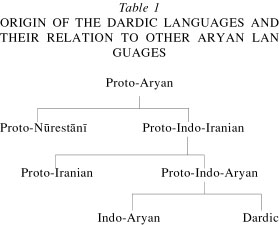
The term Dardestān once described the extreme northwestern region of the Indian subcontinent, extending from Kashmir to Kabul (Emeneau). It is in this region that the Indic languages begin to merge with Southwestern Iranian Darī or Northeastern Iranian Pashto. The alleged eponym of the word Dard is Daradae (Pliny, Naturalis Historia 5.9; Ptolemy, Geography 4.6.6; see ii, below). The terms Dardic or Dardestān are not, however, in common use in the region; rather, they were adopted by Western scholars after G. W. Leitner used them in his books in the late 19th century (1877, 1887, 1893, 1894, 1895). It has been suggested that dard may be a local word for “cave,” although other origins have also been given (Dani, pp. 112-15; see ii, below). Another common toponym for the region is Kōhestān, referring to the mountains along the upper Indus in the vale of Kashmir, Indus and Swat Kōhestān, Nūrestān, and Kabul Kōhestān (Jettmar, 1982; idem, 1983).
The geography of the Dardic languages has been described in great detail, with extensive bibliography, by Gérard Fussmann (I), though his treatment of Pashai (Pašaī), the most widely distributed Dardic language, is incomplete for the western reaches. The southern limit of its distribution is the Kabul river, and the extreme western outposts are hamlets in Estālef and villages in Qarābāḡ, on the western slopes of the Kōh-dāman valley adjacent to Kabul (Allan, 1974; idem, 1978).
In the time of the Mughal emperor Bābor (932-37/1526-30) Dardic languages were more widespread, but they have retreated as Iranian languages have intruded, Pashto (see AFGHANISTAN vi) from the south, especially in the Pakistan sector of the region, and Afghan Persian (Darī) in the west. Pashto speakers, largely concentrated in the foothills, represent a powerful political force, and Darī is the predominant bāzār language around Kabul. There are scattered remnants of other languages, like Southeastern Iranian Parachi, found in Kabul Kōhestān, and Burushaski (Berger, 1985), found in Hunza and Nagar districts in northern Gilgit (Mueller-Stellrecht). Wakhi (Wāḵī), a mountain (Pamir) Tajik language, is found on the northern margins of Chitral and Gilgit districts (for others, see CHITRAL ii). In southern Indus Kōhestān, Hindki is a buffer between Punjabi/Pashto and the Dardic languages (Gankovskiĭ).
As use of Dardic languages has declined, ethnonyms have shifted. In the west the residents of Kabul Kōhestān became Islamicized in the early 19th century, and Pashto speakers now call them Tajiks, after the Persian speakers across the Hindu Kush mountains in Central Asia, Kōhestānīs or Fārsīwāns (see AFGHANISTAN iv). Many former Pashai speakers have adopted the ethnonym Safi (Allan, 1978; Keiser) and often refer to themselves by the mountain valleys in which they live, for example, Panjšēr, Nejrāw, Tagāw, Laḡmān, Darra-ye Nūr, and Peč (Grierson), whereas in Swat and Indus Kōhestān many former Dardic speakers now claim to be Pashtuns, though they speak Urdu. Karl Jettmar (1967) attributed a Central Asian origin to speakers of Dardic languages on the basis of their funerary rites and practices.
The toponym Dardestān is a social and political construct. Its currency toward the end of the 19th century in many ways reflected an attempt by supporters of imperial India to link the Indian northwestern frontier tracts to Kashmir, with which the British had treaties. Once Prime Minister Benjamin Disraeli had been defeated by William Gladstone in 1880, the British abandoned the “forward policy” of maintaining a British presence in the Kabul area. As a consequence the British created the modern entity of Afghanistan. In 1893 adoption of the Durand Line (see BOUNDARIES iii) fixed the limit of Kabul’s influence, and the homogeneous linguistic region implicit in the term Dardestān became obsolete.
See also AFGHANISTAN v.
Bibliography
N. J. R. Allan, “The Modernization of Rural Afghanistan. A Case Study,” in L. B. Dupree and L. Albert, Afghanistan in the 1970’s, New York, 1974, pp. 113-25.
Idem, “Men and Crops in the Central Hindukush,” Ph.D. diss., Syracuse University, Syracuse, N.Y., 1978.
H. Berger, “A Survey of Burushaski Studies,” Journal of Central Asia 8/1, 1985, pp. 33-37.
A. H. Dani, History of the Northern Areas of Pakistan, Islamabad, 1989.
M. Emeneau, “Dialects of Old Indo-Aryan,” in H. Birnbaum and J. Puhvel, Ancient Indo-European Dialects, Berkeley, Calif., 1966, pp. 123-38.
G. Fussman, Atlas linguistique des parlers dardes et kafirs, 2 vols., Paris, 1972.
Yu. V. Gankovskiĭ, Istoriya Pakistana, tr. I. Gavrilov as The Peoples of Pakistan. An Ethnic History, Lahore, 1971.
G. Grierson, “On Pashai, Laghmani, or Dehgani,” in ZDMG 54, 1900, pp. 563-98.
K. Jettmar, “The Middle Asiatic Heritage of Dardistan (Islamic Collective Tombs in Punyal and Their Background),” East and West 17, 1967, pp. 59-82.
Idem, “Kafiran, Nuristani, Darden. Zur Klärung des Begriffsystems,” Anthropos 77, 1982, pp. 254-63.
Idem, “Indus Kohistan. Entwurf einer historischen Ethnographie,” Anthropos 78, 1983, pp. 501-18.
R. Keiser, “Social Structure in the Southeastern Hindukush. Some Implications for Pashai Ethno-History,” Anthropos 69, 1974, pp. 445-56.
G. W. Leitner, Races and Languages of Dardistan, Lahore, 1877.
Idem, The Results of a Tour in Dardistan, Lahore, 1887.
Idem, “Dardistan,” Imperial and Asiatic Quarterly Review, n.s. 6, 1893, pp. 422-25.
Idem, Dardistan in 1866, 1886, and 1893, Woking, Kent, 1894. Idem, Dardistan in 1895 I. The Future of Chitral and Neighbouring Countries, Woking, Kent, England, 1895.
I. Mueller-Stellrecht, Materialien zur Ethnographie Dardistans (Pakistan) II-III, Bergvölker im Hindukusch und Karakorum 3, Graz, 1980.
R. Strand, “Notes on the Nuristani and Dardic Languages,” JAOS 93, 1973, pp. 297-305.