




Single dancers or groups of dancers represented on pottery from prehistoric Iranian sites (e.g., Tepe Siyalk [Sīalk]: Ghirshman, 1954, pp. 37, 40 fig. 13; Tepe Mūsīān: Contenau, p. 177 fig. 27) attest the antiquity of this art in Iran (see Figure 38).

According to Duris of Samos (apud Athenaeus, Deipnosophistae 10.434d), the Achaemenid Persians learned to dance, just as they learned to ride horseback, and considered the practice suitable exercise “to develop bodily strength.” At a banquet held by Oxyartes, satrap of Sogdiana, for Alexander the Great “thirty high-born maidens,” including the satrap’s daughter Roxanē, attended (Curtius Rufus, 8.4.22-23) and “participated in a dance” (Plutarch, Alexander 47.7). The most joyous style of dance was “the Persian” (Gk. Persikón; Xenophon, Cyropaedia 8.4.12), a military dance in which the performer carried two shields, which he clashed together, “crouching down and then rising up again, all the time keeping to the music of the flute” (Xenophon, Anabasis 6.1.10).
Once a year, at the feast of Mithra (OIr. *Miθrakāna- > NPers. Mehragān), when the great king was allowed to get drunk, he danced “the Persian” while everyone else abstained from the dance on that day (Ctesias and Duris of Samos apud Athenaeus, Deipnosophistae 10.434e; contrast Boyce, Zoroastrianism II, p. 35). According to Curt Sachs (p. 30), the Greeks took this manner of “Cossack dance” from the Persians.
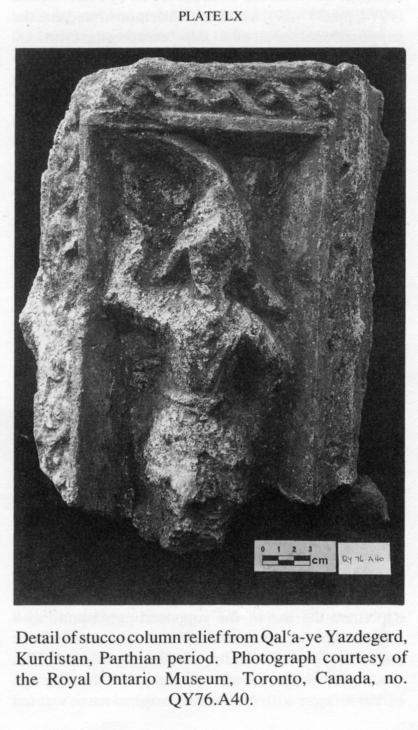
During the Hellenistic period Greek theater and dance were adapted to Iranian taste and traditions, especially by the Parthians (cf. Plutarch, Crassus 33.1-2; Ghirshman, 1962, pp. 274-78). The Parthians were fond of feasting and dancing (Philostratus, The Life of Apollonius of Tyana 1.21). When Artabanus V (Artabanus IV in the “new chronology”; see EIr. II, p. 647) was preparing a feast to receive the emperor Caracalla, who had asked for his daughter’s hand, the Parthians, garlanded and richly dressed, “leapt about in rhythm to the sound of flutes and pipes and to the beat of drums. This is their favorite form of dancing on occasions when they have taken quite a lot of drink” (Herodian, 4.11.3). During the Hellenistic and Parthian periods the dance also found ample expression in art, for example, the terracotta figurine of a girl dancer from Dura Europus (Rostovtzeff, fig. 18); bronze figurines of female acrobats in Parthian costume from Olbia (Ghirshman, 1962, p. 268 fig. 348); painted murals of dancing couples or groups from the sites of Hatra in Mesopotamia, Toprak-Kala (Topraq Qaḷʿa) in Choresmia, and Kūh-e Ḵᵛāja in Afghanistan (Colledge, pp. 118-19, 133); and the stucco relief of a male dancer in tunic and tall “Scythian” cap from Qaḷʿa-ye Yazdegerd in Kurdistan (Plate LX; Keal, pl. 10).
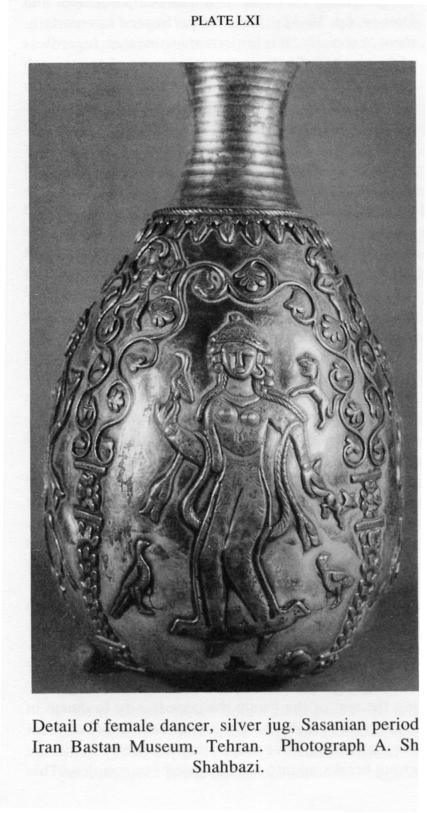
The Sasanians esteemed music and its accompaniments highly (Christensen, Iran. Sass., pp. 402-04, 482-86; Boyce, pp. 20-30). The pleasure-loving Sasanian Bahrām Gōr (420-38), who was known for his keen interest in music, acquired singing and dancing girls ([Pseudo] Jāḥeẓ, p.159) and was entertained by a dehqān’s three daughters, “one a dancer (pāykūb), another a harpist, the third a singer” (Šāh-nāma, Moscow, VII, p. 343). Female dancers were among mosaic portraits decorating the palace of Šāpūr I (240-70) at Bīšāpūr (Ghirshman, 1962, p. 141). Four dancing girls holding auspicious attributes (probably figurines shaped as birds, flowers, and animals) are shown on a 6th-century silver jug from Kālār-dašt, Māzandarān (Plate LXI), now in the Iran Bastan Museum (Ghirshman, 1962, fig. 256). On a silver ewer of the 6th-7th centuries in The Metropolitan Museum of Art, New York, similar “bacchantes” are represented; they are “dressed in long-sleeved, tight-fitting costumes of diaphaonous material,” and an additional “piece of drapery encircles the body below the thighs” (M. Carter, in Harper, 1978, p. 61; see EIr. V, p. 740 pl. LXIX). Each wears a bejeweled diadem, necklace, anklets, and earrings. Slightly later in date is a boat-shaped bowl in the Walters Art Gallery, Baltimore, ornamented with an enthronement scene and, on the narrower sides, two nude dancing girls throwing their veils in the air (Ghirshman, 1962, p. 214, figs. 242, 258; Harper, 1981, pp. 119-20, pl. 36). Sixth-century murals from Panjīkant provide evidence of the ceremonial aspect of the dance in eastern Iran (Azarpay, pp. 189, 196, 197).
Bibliography
G. Azarpay, Sogdian Painting. The Pictorial Epic in Oriental Art, Berkeley, Calif., 1981.
M. Boyce, “The Parthian Gōsān and Iranian Minstrel Tradition,” JRAS, 1957, pp. 10-45.
M. A. R. Colledge, Parthian Art, London, 1977.
G. Contenau, “Early Ceramic Art,” in Survey of Persian Art I, pp. 171-94.
R. Ghirshman, Iran from the Earliest Times to the Islamic Conquest, Suffolk, U.K., 1954.
Idem, Persian Art. The Parthian and Sassanian Dynasties, 249 B.C.-A.D. 651, New York, 1962.
P. Harper, The Royal Hunter. Art of the Sasanian Empire, New York, 1978, pp. 60-61, 77-78.
Idem, Silver Vessels of the Sasanian Period I. Royal Imagery, New York, 1981.
E. Herzfeld, Die Malereien from Samarra, Berlin, 1927.
(Pseudo) Jāḥeẓ, Ketāb al-tāj fī aḵlāq al-molūk, ed. A. Zakī Bāšā, Cairo, 1914.
E. Keal, “The Art of the Parthians,” in R. W. Ferrier ed., The Arts of Persia, New Haven, Conn., 1989, pp. 49-60.
M. Rostovtzeff, “Dura and the Problem of Parthian Art,” Yale Classical Studies 5, 1935, pp. 157-304.
C. Sachs, World History of the Dance, tr. B. Schönberg, New York, 1937.
(A. Shapur Shahbazi)