


ii. Languages
The former principality of Chitral, especially the southern quarter of the country, is one of the most polyglot regions of the Hindu Kush. Eleven distinct languages are spoken there, some of them in multiple dialects. With the influx of refugees from many different linguistic areas of Afghanistan since 1359 Š./1980 the situation has become even more complex. Only four languages have been in use in Chitral for more than a few generations, however: Khowar, Kalasha, Phalūṛa, and Gawar-Bati, all members of the northwestern Indo-Aryan (Dardic) group (see dardestān ii. languages). Present knowledge of the linguistic map is based mainly on field research conducted early in this century by Georg Morgenstierne (1932).
Khowar. The most important of the Dardic languages spoken in Chitral is Khowar, often called Chitrali by outsiders (other names found in older sources include Amiya and Qāšqārī); it is spoken without very pronounced dialect variation by more than 100,000 people (more than 90 percent of the population), including the former ruling family. Nevertheless, very little was known of this most archaic of all Dardic languages before Morgenstierne began his work in 1924 (Endresen and Kristiansen; Fussman, I, p. 23); most of the texts collected by him and D. L. R. Lorimer are still unpublished. On Kivi, a variety of Khowar spoken in Soviet Wakhan, see Buddruss (forthcoming). The earliest dictionary (O’Brien) suffers from having been printed in a script that is insufficiently differentiated phonemically, a problem that also characterizes a more recent effort (Sloan); both are thus of limited linguistic value. Since 1917 various attempts have been made to write and print Khowar in Arabic script with specially devised diacritics (Buddruss).
Kalasha. Kalasha (Kal’aṣa), which is historically closely connected with Khowar, is spoken by 3-4,000 people in the western tributary valleys (Rumbur, Bumburet, Birir, Jinjiret, Urtsun) along the lower Chitral river, with some differences between the dialects in the north and south. During field work conducted in 1929 Morgenstierne collected texts related to the pagan religion of the Kalasha speakers, which dates from pre-Islamic times; he published them, together with a few fragmentary earlier notes and all other available information about the language, in 1973. New materials, especially on syntax, have recently been assembled by Elena Bashir. Kalasha contains numerous loanwords from Khowar, which it also resembles in many points of syntax and general structure.
Phalūṛa. Phalūṛa (Palūla, Palola, Ḍangarikō bāt) is spoken by only 800-1,000 people in a few eastern tributary valleys of the lower Chitral river. Morgenstierne, who considered it an archaic offshoot of Shina (a language current in the Gilgit and upper Indus valleys), has provided (1941) the only description, based on work with informants from the villages of Ashret, Purigal, and Biōr′i. Data collected by Richard Strand in 1985 are still unpublished.
Gawar-Bati. Gawar-Bati (Narisāti, Narsāti) is spoken around Arandu (Haranu, Arnawai) in southern Chitral and in several villages on the Afghan side of the frontier; related dialects are also spoken in parts of the Peč valley in Afghanistan. The available information on this language is almost all to be found in a monograph by Morgenstierne (1950), in which a few earlier fragmentary accounts are included.
Dameli. Dameli (Dāma-bāṣa) is spoken by perhaps seventy families in the isolated Damel (Dāmen) valley on the left bank of the Chitral (or Konar) river (Morgenstierne, 1942). Its linguistic position is still doubtful. The vocabulary seems to contain a considerable number of words of a Kafiri (Nūrestāni) type mixed with Dardic features.
Kati. Kati (Bashgali), a genuine Kafiri (Nūrestāni) language, has been spoken in the Kalash valleys of Chitral for only a few generations.
Iranian languages. Four Iranian languages have also been introduced into the Chitral only in comparatively recent times: Wakhi (spoken in upper Yarkhun), Pashto, Madaglashti Persian (spoken in the Shishivalley; Lorimer, 1922), and Yidgha (spoken by about 300 families in several villages in upper Lutkuh). Yidgha is undoubtedly a dialect of Munji (Monjāni), which is spoken in Afghanistan, but the date when this group immigrated from Monjān is uncertain (Gryunberg, 1972); the dialect includes a large number of loanwords from Khowar, however. The best description, with a report on the scanty earlier research, was published by Morgenstierne (1938).
Gujari. Indian Gujari is spoken in pockets throughout much of the Dardic area, but next to nothing is known about the dialect affiliations of the Gujar shepherds of Chitral.
Official languages. In the former principality of Chitral Persian was the official and administrative language, and local historical works were written in it as well; Persian has now been replaced by Urdu as the official language.
Bibliography
E. Bashir, Topics in Kalasha Syntax. An Areal and Typological Perspective, Ph.D. diss., The University of Michigan, Ann Arbor, 1988.
G. Buddruss, Khowar-Texte in arabischer Schrift, Wiesbaden, 1982.
Idem, “Kommentar zu einem Kivi-Vokabular aus dem sowjetischen Pamir,” Studia Iranica (forthcoming).
R. T. Endresen and K. Kristiansen, “Khowar Studies,” in Monumentum Georg Morgenstierne I, Acta Iranica 21, Leiden, 1981.
G. Fussman, Atlas linguistique des parlers dardes et kafirs, 2 vols., Paris, 1972.
A. L. Gryunberg, Mundzhanskiĭ yazyk. Teksty, slovar’, grammaticheskiĭ ocherk, Leningrad, 1972.
D. L. R. Lorimer, The Phonology of the Bakhtiari, Badakhshani, and Madaglashti Dialects of Modern Persian, with Vocabularies, London, 1922.
G. Morgenstierne, Report on a Linguistic Mission to North-Western India, Oslo, 1932.
Idem, “Yidgha-Munji,” in Indo-Iranian Frontier Languages II: Iranian Pamir-Languages, Oslo, 1938, pp. 3-282; repr. Oslo, 1973.
Idem, Notes on Phalūṛa, an Unknown Dardic Language of Chitral, Oslo, 1941.
Idem, “Notes on Dameli, a Kafir-Dardic Language of Chitral,” NTS 12, 1942, pp. 115-98.
Idem, Notes on Gawar-Bati, Oslo, 1950.
Idem, Indo-Iranian Frontier Languages IV. The Kalasha Language. Texts and Translations, Vocabulary and Grammar, Oslo, 1973.
Idem, “Languages of Nuristan and Surrounding Region,” in K. Jettmar and L. Edelberg, eds., Cultures of the Hindukusch, Wiesbaden, 1974, pp. 1-10.
D. J. T. O’Brien, ed., Grammar and Vocabulary of the Khowar Dialect, 2nd ed., Lahore, 1896.
M. I. Sloan, Khowar-English Dictionary, Peshawar, 1981.
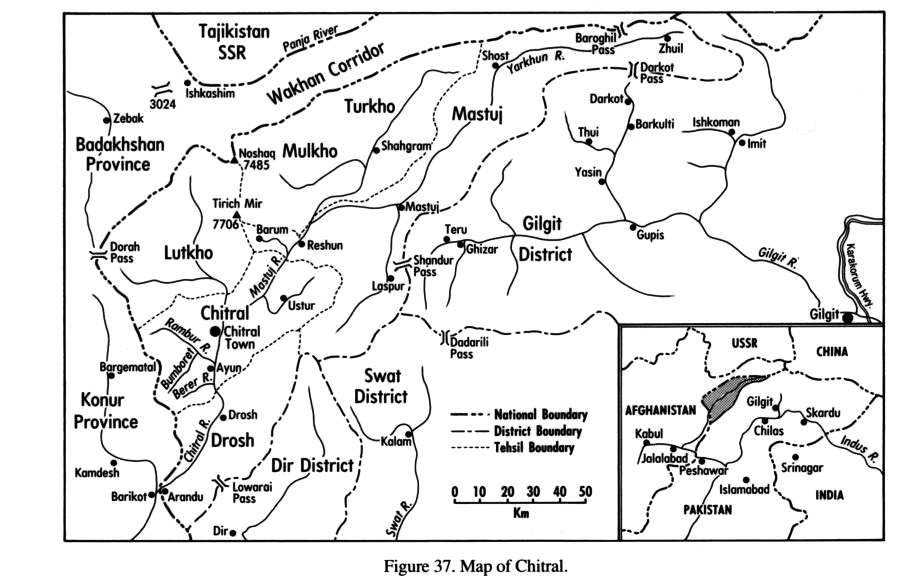
Figure 37. Map of Chitral.
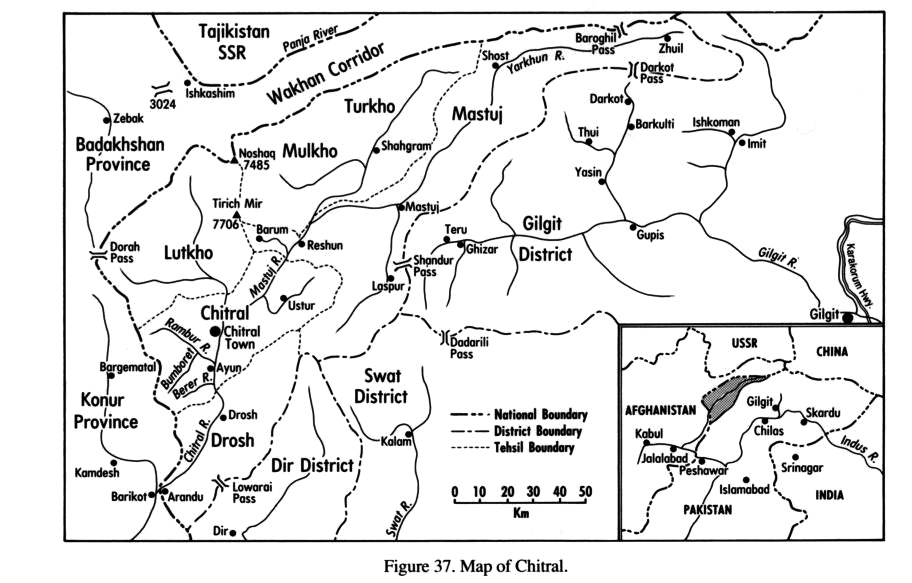
Table 40. Population of Chitral District

Sources: Population Census of Pakistan 1961. Census Report of Tribal Areas, Karachi, 1964; A. Latif, 1972 District Census Report. Chitral, Karachi, 1976; A. H. Khan, 1981 District Census Report of Chitral, Islamabad, 1983.