




Čahārṭāq, literally “four arches,” is a modern term for an equilateral architectural unit consisting of four arches or short barrel vaults between four corner piers, with a dome on squinches over the central square; this square and the lateral bays under the arches or barrel vaults together constitute a room of cruciform ground plan. Because of its structural and aesthetic properties this unit became the most prominent element in traditional Iranian architecture after the ayvān. The term čahārṭāq probably originally became current because it seems descriptive of many ruins that can be observed in Iran. Most of these ruins are, however, only the surviving cores of more complex buildings from which surrounding walls, ambulatories, and subsidiary rooms have disappeared. As the domed unit with four axial arches has been in continuous use in both religious and secular contexts over a period of more than 1,500 years, the term cannot be considered to define a single functional building type; it must be used only in its literal sense, to identify a specific architectural form.
The origins of the čahārṭāq are still a matter of debate. It has been suggested that the dome on squinches originated in the mud-brick architecture of eastern Iran, where it may have been developed from the simple pitched-brick dome or squinch vault (Reuther, pp. 501-04; Herzfeld, 1942, pp. 17-18). The earliest definite archeological evidence of pitched-brick vaulting, however, comes from Mesopotamia in the late 3rd or early 2nd millennium b.c. (Oates, 1970, pp. 11ff.; 1973, pp. 183ff.). Although certain types of corbelled vaultings, for instance those found above some tombs at Ur (Besenval, 1984, I, pp. 81ff.), which are dated to the 1st half of the 3rd millennium b.c., may be regarded as forerunners. In Iran there is no evidence of the čahārṭāq proper earlier than the beginning of the Sasanian period. The cruciform ground plan appears in rudimentary form in Parthian buildings like Qaḷʿeh Zohak (Qaḷʿa-ye Żaḥḥāk) in Azarbaijan, which were influenced by Roman architectural forms (Kleiss, 1973, pp. 171-76; Colledge, 1977, p. 54); it was fully developed in structures roofed with pendentive domes circumscribing the square, which were popular in 2nd- and early 3rd-century Roman Syria, for example, the western baths at Jerash (Gerasa) and the so-called Qasr Nuwayjis at Amman (Creswell, 1969, pp. 150; Huff, 1989).
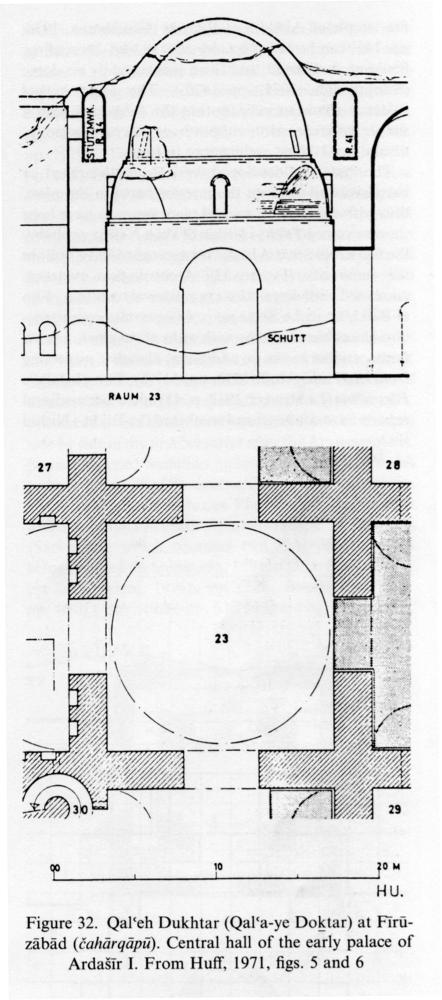
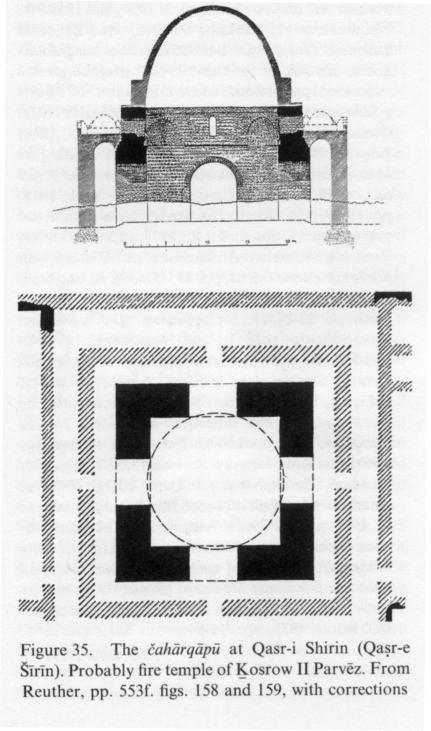
It may be assumed that in Iran the first step in the development of the čahārṭāq was taken at Fīrūzābād (Ardašīr-Ḵorra) about the 2nd decade of a.d. the 3rd century, in buildings erected by Ardašīr before he became king in 224 (See ardašīr i pābagān; cf. Ṭabarī cited in Widengren, pp. 737, 761, 765). Both the earlier clifftop fortress of Qaḷʿeh Dukhtar (Qaḷʿa-ye Doḵtar) and the later nearby Great Palace contain domed cubes, each with four axial doors (Figure 32; Huff, 1971, pp. 136ff.; Huff and Gignoux, pp. 128f., 136ff.). This type, which is essentially a square room with plain walls, may correctly be called čahārqāpū, literally “four doors,” a term that is sometimes applied to čahārṭāq structures, as well. Although the čahārṭāq may have developed from the čahārqāpū, in the strict sense the terms are not interchangeable. But neither are they entirely antithetical, as they describe different aspects of the building: the term čahārqāpū characterizes the connective possibilities of the layout, whereas čahārṭāq primarily denotes the system of construction. Under the first aspect čahārṭāq may be called a čahārqāpū if, as is often the case, there are doors in the back walls of the four bays or in the enclosure walls. Otherwise the term čahārqāpū should be applied only to those buildings where there are comparatively small openings that justify the designation door or gate. This condition is fulfilled in the so-called čahārqāpū at Qasr-i Shirin (Figure 35), which has to be dated to the time of Ḵosrow II Parvēz (590-628; Reuther, pp. 552ff.; Schippmann, 1971, pp. 282ff.; see also architecture iii. sasanian, p. 331), although an early Islamic date has also been suggested (Bier, 1986, pp. 70f.). The so-called fire temple of Anāhitā at Bīšāpūr (Ghirshman, 1938, pp. 14f.) can be called a čahārqāpū as well. Its roofing, however, is debated, and there was certainly no dome (Schippmann, 1971, pp. 142ff.). The archeological evidence seems to indicate that the čahārqāpū with a simple square interior without bays was rare in monumental pre-Islamic architecture in Iran.
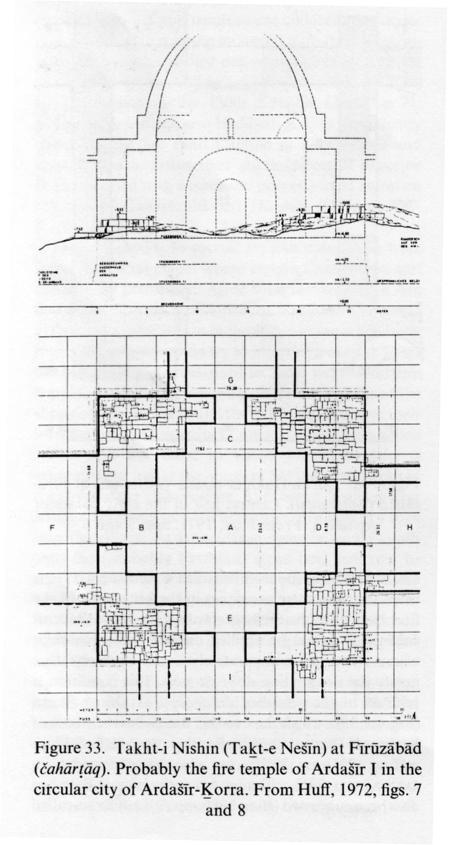
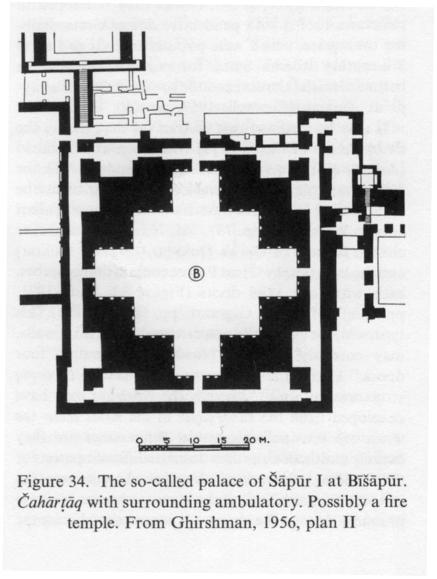
The first fully developed čahārṭāq, with arched or barrel-vaulted bays on the interior between the piers, thus with a cruciform ground plan, seems to have been the now ruined Takht-i Nishin (Taḵt-e Nešīn), probably the fire temple that Ardašīr is reported to have built in the same city (Figure 33). Archeological evidence, combined with descriptions in medieval texts (e.g., Ebn al-Balḵī, tr. in Le Strange, p. 45), permits reconstruction of a cubical building with walls of cut stone, a brick dome, and an ayvān or additional chamber projecting from each side (Huff, 1972, pp. 517ff.). Ebn al-Balḵī’s Fārs-nāma (Le Strange, 1912, p. 45) and other medieval reports have confused and combined the Takht-i Nishin and the nearby tower-like minar, called Tirbal in ancient times. Herzfeld (1935, p. 90), assuming that this name belonged to the Takht-i Nishin, suggested that it was a derivation of the Greek word tetrapylon, the equivalent of Persian čahārqāpū. This unjustified hypothesis led to the erroneous reconstruction of the ruin as an open canopy, reflecting a Roman quadruple gate like the lanus Quadrifrons (Godard, 1938, pp. 19ff.; Erdmann, 1941, pp. 46ff.). Probably the largest Sasanian čahārṭāq ever built was the hall of the so-called “palace of Šāpūr I” (r. 241-72), Ardašīr’s son and successor, in Bīšāpūr (Figure 34), the dome of which spanned 22.75 m. It seems to have been the first čahārṭāq to be surrounded by an ambulatory, which separated the central cruciform unit from the other rooms of the complex, the function of which is still debated (Ghirshman, 1938, pp. 15ff.; 1956, pp. 11f.; Huff, 1972, pp. 530ff.; Sarfaraz, 1987, pp. 25ff.). From the later Sasanian period examples of the simple cruciform čahārṭāq, and the čahārṭāq surrounded by an ambulatory are all known in various permutations: for example, those excavated at Kuh-i Khwaja (Kūh-e Ḵᵛāja; Herzfeld, 1935, pp. 58ff.; 1941, pp. 301ff.; Gullini, 1964, pp. 34ff.), Takht-i Suleiman (Taḵt-e Solaymān; Naumann et al., 1965, pp. 622ff.; 1977, pp. 46ff.; Huff, 1983-84, pp. 293ff.), Qaḷʿeh-i Yazdigird (Qaḷʿa-ye Yazdegerd; Keall, 1981, pp. 33f.; 1982, p. 59)—all with ambulatories and additional rooms, and the one at Tureng (Tūrang) Tepe (Boucharlat, 1987, pp. 51ff.)—a simple closed cube, possibly with an entrance room or shelter. Countless others have been reported from surveys (cf. Schippmann, 1971; Vanden Berghe, 1984, with further literature; Reut, 1973; de Miroschedji, 1980; Huff, 1982; Bier, 1986), but the majority are only superficially documented, and traces of enclosure walls, surrounding corridors, or adjacent rooms have frequently been overlooked. Furthermore, as attribution to the Sasanian period has not been confirmed by excavation or other archeological evidence and as Sasanian building techniques did not change fundamentally in Iran with the Arab conquest, dating such buildings to one period or the other is often problematic (Schippmann, 1971, p. 505; Huff, 1975a, pp. 247f.; 1975b, pp. 158ff.).
André Godard (1938, pp. 7ff.) and Kurt Erdmann (1941, pp. 35ff.), who misunderstood the remaining cores of ruined čahārṭāqs, suggested that the main element of the Sasanian fire sanctuary was a “canopy čahārṭāq,” a free-standing, domed baldachin with arches open to the outside (see Figure 35). They assumed that the sacred flame was brought from a hypothetical repository, the ātašgāh (or ātašdān), to such a canopy structure for worship during public ceremonies; the term čahārṭāq thus became nearly synonymous with “fire temple” in the architectural and art-historical literature. There is, however, no archeological evidence that a canopy čahārṭāq existed in the Sasanian period. Furthermore, the transfer of fire does not accord with fundamental Zoroastrian ritual (Boyce, 1968; 1975, pp. 463f.). More recent research has substantiated the view of Ernst Herzfeld (1935, pp. 88ff.; 1941, pp. 301f.) and others (e.g., Monneret de Villard; Reuther, pp. 550ff.) that fire temples were always closed buildings, more complex than a simple open canopy (Huff, 1972, pp. 528ff.; 1975a, pp. 243ff.; 1975b, pp. 156ff.; 1982, pp. 197ff.; Deshayes, 1973, pp. 31ff.; Keall, 1973, pp. 16f.; Boucharlat, 1995, pp. 466ff.). Within these structures the čahārṭāq, with or without ambulatory but always surrounded by walls or adjoining rooms, served as the sanctuary where the fire altar was kept and worship took place. As the same architectural unit also appeared in various other, nonreligious contexts, however, the term cannot be used as a synonym for a Sasanian sanctuary (see ARCHITECTURE iii. Sasanian, fig. 11).
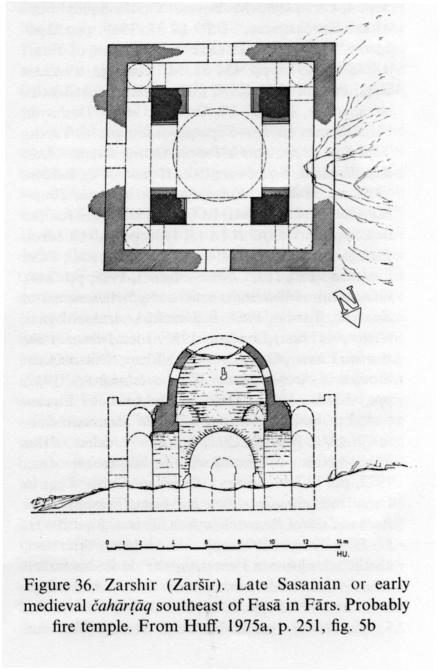
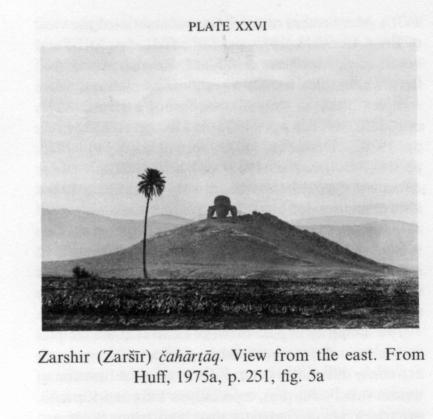
The similarity in plan between excavated fire temples and Islamic shrines (emāmzāda, gonbad) often makes it extremely difficult to determine the original function of unexcavated čahārṭāqs, especially in Fārs and Kermān, provinces where Zoroastrianism and Islam flourished side by side in the first centuries after the Arab conquest. Some presumed Sasanian buildings may thus turn out to have been either Zoroastrian or Islamic sanctuaries of the early Islamic centuries. For example, the function and date of the so-called “Sasanian palace” at Sarvistan (Sarvestān), which contains two čahārṭāqs, are still being debated (Schippmann, 1971, p. 505; Huff, 1975a, pp. 244ff.; idem, 1975b, pp. 158f.; Boucharlat, 1985, pp. 464ff.; Bier, 1986, pp. 63ff.; Figure 36; Plate xxvi).
Bibliography
R. Besenval, Technologie de la voûte dans l’Orient ancien, 2 vols., Paris, 1984.
L. Bier, Sarvistan. A Study in Early Iranian Architecture, University Park, Pa., 1986.
R. Boucharlat, “Chahar taq et temple du feu sasanide. Quelques remarques” in J.-L. Huot, M. Yon, and Y. Calvet, eds., De l’Indus aux Balkans. Receuil à la mémoire de Jean Deshayes, Paris, 1985, pp. 461-72.
Idem, Fouilles de Tureng Tepe I, Paris, 1987.
M. Boyce, “On the Sacred Fires of the Zoroastrians,” BSOAS 31, 1968, pp. 52-68.
Idem, “On the Zoroastrian Temple Cult of Fire,” JAOS 95, 1975, pp. 454-63.
M. Colledge, Parthian Art, London, 1977.
K. A. C. Creswell, Early Muslim Architecture, 2nd ed., I/2, Oxford, 1969.
J. Deshayes, “Un temple du feu d’époque islamique à Tureng Tépé,” in Le feu dans le Proche-Orient antique. Actes du colloque de Strasbourg (9 et 10juin 1972), Leiden, 1973, pp. 31-40.
K. Erdmann, Das iranische Feuerheiligtum, Leipzig, 1941.
R. Ghirshman, “Les fouilles de Châpour (Iran),” RAA 12, 1938, pp. 12-19.
Idem, Bichâpour II, Paris, 1956. A. Godard et al., “Les monuments du feu,” Āthār-é Īrān 3, 1938, pp. 7-80.
G. Gullini, Architettura iranica dagli Achemenidi ai Sasanidi, Torino, 1964. E. Herzfeld, Archaeological History of Iran, London, 1935.
Idem, Iran in the Ancient East, Oxford, 1941.
Idem, “Damascus. Studies in Architecture—I,” Ars Islamica 9, 1942, pp. 1-53.
D. Huff, “Qaḷʿa-ye Dukhtar bei Firuzabad. Ein Beitrag zur sasanidischen Palastarchitektur,” AMI, N.S. 4, 1971, pp. 127-71.
Idem, “Der Takht-i Nishin in Firuzabad,” Archäologischer Anz., 1972, pp. 517-40.
Idem, “”Sasanian” Čahār Tāqs in Fārs,” in Proceedings of the 3rd Annual Symposium on Archaeological Research in Iran, Tehran 23rd 10.-1st 11, 1974, Tehran, 1975a, pp. 243-54.
Idem, “Grabung westlich des grossen Feuertempels,” in R. Naumann et al., “Takht-i Suleiman 1965-1973,” Archäologischer Anz. 1975b, pp. 137ff.
Idem, “Das Imamzadeh Sayyid Husein und E. Herzfelds Theorie über den sasanidischen Feuertempel,” Stud. Ir. 11, 1982, pp. 197-212.
Idem, “Takht-i Suleiman,” Archiv für Orientforschung 29-30, 1983-84, pp. 293-95.
Idem, “The Gunbad in Islamic (Iranian) Architecture,” in Y. Kiani, Iranian Architecture in the Islamic Period, Tehran, 1987, pp. 397ff.
Idem, “Das Qasr Nuweijis bei Amman,” Istanbuler Mitteilungen 39, 1989, forthcoming.
Idem and Ph. Gignoux, “Ausgrabungen auf Qaḷʿa-ye Dukhtar bei Firuzabad 1976,” AMI 11, 1978, pp. 117-50.
E. J. Keall, “Archaeology and the Fire Temple,” in C. J. Adams, ed., Iranian Civilization, Montreal, 1973, pp. 15-22.
Idem, “Qaḷʿeh-i Yazdigird. An Overview of the Monumental Architecture,” Iran 20, 1982, pp. 51-72.
Idem and M. J. Keall, “The Qaḷʿeh-i Yazdigird Pottery. A Statistical Approach,” Iran 19, 1981, pp. 33-80.
W. Kleiss, “Qaḷʿeh Zohak in Azerbaidjan,” AMI, N.S. 6, 1973, pp. 163-88.
G. Le Strange, “Description of the Province of Fars, in Persia, at the Beginning of the Twelfth century A.D., Translated from the MS. of Ibn-al-Balkhí in the British Museum,” JRAS, 1912, pp. 1-30, 311-39, 865-89 (printed separately as Asiatic Society Monographs 14).
P. de Miroschedji, “Un chahār ṭāq dans la plaine de Darab,” Iran 18, 1980, pp. 157-60.
U. Monneret de Villard, “The Fire Temples,” Bulletin of the American Institute for Persian Art and Archaeology 5, 1936, pp. 175ff.
R. Naumann et al., “Takht-i Suleiman und Zendan-i Suleiman. Vorläufiger Bericht über die Ausgrabungen in den Jahren 1963 und 1964,” Archäologischer Anz., 1965, pp. 619-802.
Idem, Die Ruinen von Tacht-e Suleiman und Zendan-e Suleiman, Berlin, 1977.
D. Oates, “The Excavations at Tell al-Rimah,” 1968, Iraq 32, 1970, pp. 1-26.
Idem, “Early Vaulting in Mesopotamia,” in Archaeological Theory and Practice, ed. D. E. Strong, London and New York, 1973, pp. 183-91.
M. Reut, “Āteškade, un nouveau site préislamique,” Stud Ir. 2, 1973, pp. 119-25.
O. Reuther, “Sāsānian Architecture. A. History,” in Survey of Persian Art I, pp. 493-578.
A. A. Sarfaraz, “Bishapur,” in M. Y. Kiani, Iranian Cities, Tehran, 1987, pp. 22-74.
K. Schippmann, Die iranischen Feuerheiligtümer, Berlin and New York, 1971.
L. Vanden Berghe, “Récentes découvertes de monuments sassanides dans le Fārs,” Iranica Antiqua 1, 1961, pp. 163-98.
Idem, “Nouvelles découvertes de monuments du feu d’époque sassanide,” Iranica Antiqua 5, 1965, pp. 128-47.
Idem, “Les chahar taqs du Pusht-i Kuh,” Iranica Antiqua 12, 1977, pp. 175-77.
Idem, “Le chahār ṭāq de Qanāṭ-i Bāgh (Fārs) et l’inventaire des chahār ṭāqs en Irān,” Iranica Antiqua 29, 1984, pp. 201-20.
G. Widengren, “The Establishment of the Sassanian Dynasty in the Light of New Evidence,” in Atti del convegno internazionale sul tema: La Persia nel Medioevo (Roma, 31 marzo—5 aprile 1970), Accademia Nazionale dei Lincei, no. 160, Rome, 1971, pp. 711-84.
Figure 32. Qaḷʿeh Dukhtar (Qaḷʿa-ye Doḵtar) at Fīrūzābād (čahārqāpū). Central hall of the early palace of Ardašīr I. From Huff, 1971, figs. 5 and 6
Figure 33. Takht-i Nishin (Taḵt-e Nešīn) at Fīrūzābād (čahārṭāq). Probably the fire temple of Ardašīr I in the circular city of Ardašīr-Ḵorra. From Huff, 1972, figs. 7 and 8
Figure 34. The so-called palace of Šāpūr I at Bīšāpūr. Čahārṭāq with surrounding ambulatory. Possibly a fire temple. From Ghirshman, 1956, plan II
Figure 35. The čahārqāpū at Qasr-i Shirin (Qaṣr-e Šīrīn). Probably fire temple of Ḵosrow II Parvēz. From Reuther, pp. 553f. figs. 158 and 159, with corrections
Figure 36. Zarshir (Zaršīr). Late Sasanian or early medieval čahārṭāq southeast of Fasā in Fārs. Probably fire temple. From Huff, 1975a, p. 251, fig. 5b
Plate xxvi. Zarshir (Zaršīr) čahārṭāq. View from the east. From Huff, 1975a, p. 251, fig. 5a