




vi. Monuments of Balḵ
The successive city-walls. The mud ramparts of Balḵ which still survive, superimposed one upon the other, at an impressive length and height, more than 20 m at the citadel (Bālā-Ḥeṣār) and on the southern side, are the most substantial remains of the ancient periods of the “Mother of Cities.” Archeological examination of these ramparts has provided the key to the successive stages of the topographical development of the town (see Le Berre and Schlumberger). The initial limit is represented by the Bālā-Ḥeṣār (“Balḵ I”); its circular plan is probably inherited from the Achaemenian period, while its present Timurid circuit-wall largely reuses the massive Greek rampart which, in 208-06 b.c., withstood the attack of the Seleucid Antiochus III. From the Greek period also dates a gigantic wall built against the nomadic incursions along the northern edge of the oasis, where its remains have been traced for a length of 60 km (Kruglikova; Pugachenkova, 1976); it is mentioned as still in use by Yaʿqūbī (fl. 276/889), and it sheltered other important towns, mainly Delbarjīn (Greek-Kushan period) and Zādīān-Dawlatābād (Saljuq period) (see Figure 15).
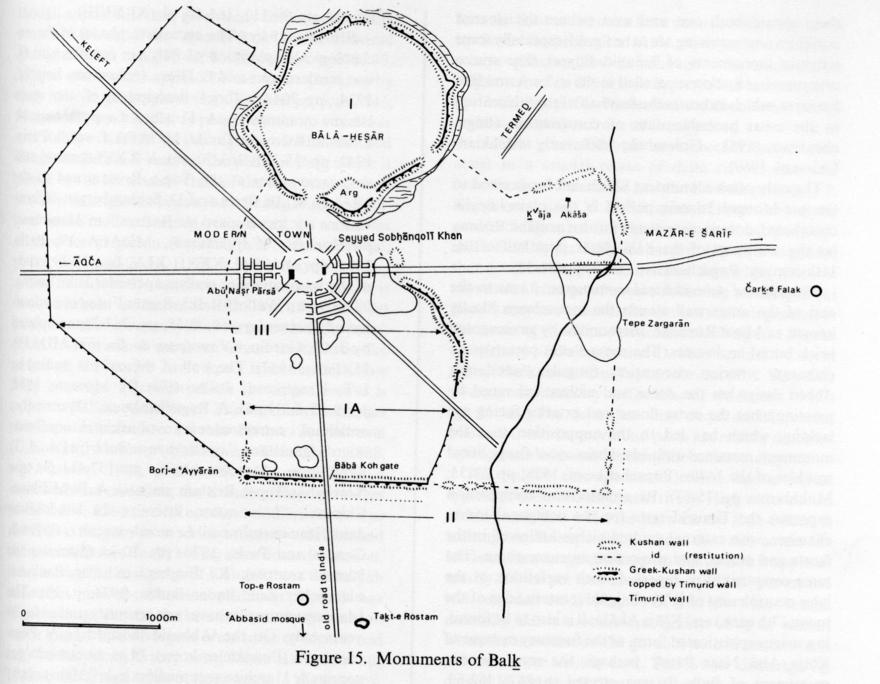
The development of a southern suburb of Balḵ along the caravan-road to India led to a first extension of the walled city (“Balḵ IA”: late Greek or Kushan period). At some time between the Kushans and the Islamic conquest it was further enlarged to the east (“Balḵ II”). These walls with square towers remained in use until Balḵ was thoroughly destroyed in 617/1220 by the Mongols of Jengiz Khan.
In 765/1363 the Bālā-Ḥeṣār was reoccupied by Amir Ḥosayn, after which Tīmūr and his successors completely refortified the whole city while slightly moving it to the west, probably because the eastern part had become marshy after the destruction of the irrigation system. This last rampart (Balḵ III), made of heterogeneous materials extracted from the ruins left by the Mongols, had semi-circular towers, and was adorned at its southern side by the monumental Bābā-Kōh gate (or Nowbahār gate; now destroyed) and by the Borj-e ʿAyyārān, an eight-arched belvedere (Foucher, p. 164, pl. VI; Mukhtarov, pp. 21-42).
The Buddhist remains. Apart from the ramparts, the only monuments which have survived from pre-Islamic Balḵ are Buddhist stūpas, which owed their preservation to the massivity of their mud-brick masonry. Four, all standing along the roads on the outskirts of the city, were identified by A. Foucher in 1924-25; the Top-e Rostam, in the south, was the only one he excavated. Although greatly ruined and stripped of all its decoration, it can be reconstructed as the most monumental stūpa witnessed north of the Hindu Kush (dimensions: square platform 54 x 54 m, cylindrical dome 47 m in diameter, total height probably ca. 60 m). Its location and size correspond to those of the “New Monastery” described in the 7th century by the Chinese pilgrim Hsüan-tsang (Th. Watton, On Yuan Chwang’s Travels in India I, London, 1904, pp. 108-09); otherwise known as the Nowbahār (from Sanskrit nava-vihāra), it is renowned in the Islamic sources because the Buddhist ancestors of the Barmakids had been its administrators. But the neighboring Taḵt-e Rostam, a steep mound sometimes considered the remains of the convent itself, looks rather like the mud platform of an early medieval manor (kōšk). Two other stūpas, the Čarḵ-e Falak and the Āsīā-ye Kohnak, have mosques grafted onto their remains, a clear indication of the continuity of cult-places (Foucher, pp. 83-98, 168-69, pls. XIX-XXII; Mélikian-Chirvani, 1974).
Pre-Mongol Islamic monuments. A building of outstanding interest is an ʿAbbasid suburban mosque known locally as Noh Gombad or Ḥājī Pīād, which was discovered in 1966, at a short distance south of the Top-e Rostam. Built of baked bricks, it consists of four round pillars standing in the center of a square (20 x 20 m) formed by three curtain walls and an open façade which is articulated on two more pillars; the pillars were linked to each other and to coupled columns attached to the walls by perpendicular arcades, the inner space being thereby divided into nine equal squares, each of which originally supported a dome. A deeply carved stucco ornamentation still covers the capitals, imposts, and bases of the pillars, as well as the spandrels and soffits of the arches; the motifs include grape leaves, freely moving vine-scrolls, fir-cones, palmettes, rosettes, set in interlacing straps and thickly packed so as to fill up the panels almost entirely. Neither the architectural composition nor the decoration have their direct origin in the Central-Asian tradition (which, for example, ignored the open arcatures); they rather represent the direct transposition of a model which took shape in the heart of the ʿAbbasid empire and from there spread both east and west (where the clearest examples now surviving are to be found, especially some religious monuments of Tulunid Egypt). The stucco ornament has its closest parallels in the styles A and B of Samarra, which indicates the first half of the 9th century as the most probable date of construction (Pugachenkova, 1968; Golombek; differently Mélikian-Chirvani, 1969).
The only other monument which can be ascribed to the pre-Mongol Islamic period is the plain, single-chambered, domed mausoleum known as Bābā Rōšnay (at the southwest of the Bālā-Ḥeṣār; first half of the 11th century; Pugachenkova, 1978, pp. 31-32).
Timurid and Ashtarkhanid monuments. 3 kms to the east of the outer wall stands the mausoleum locally known as Mīr-e Rūzadār, surrounded by ornamented brick burial enclosures. The mausoleum preserves an elaborate interior decoration (angular interlacing ribbed design on the dome and niches, enhanced by painting); but the outer dome and exterior facing are lacking, which has led to the supposition that the monument remained unfinished because of the political troubles of the 1440s (Pugachenkova, 1978, pp. 33-35; Mukhtarov, pp. 75-83). Its architectural composition expresses the Timurid taste for the octagonal tomb-chamber, with external vaulted niches hollowed in the facets and angles, and projection entrance-room. The same composition is repeated, with variations, at the later mausoleums of Ḵᵛāja Bajgāhī (eastern edge of the town; 17th cent.) and Ḵᵛāja Akāša; it is also to be found, in a more sophisticated form, at the funerary mosque of Ḵᵛāja Abū Naṣr Pārsā, perhaps the most famous monument of Balḵ. It was erected in 867/1462-63, shortly after the death of the theologian, who is buried in the platform which lies in front. The usual entrance-room is replaced here by a tall pēštāq flanked by two minarets, each of which is preceded by slender corkscrew pillars. The whole of the façade and the fluted outer dome were veneered in kāšī whose predominant tint is a cold silvery blue; their manufacture was of the best quality, but due to an inadequate mode of fixation large surfaces have collapsed. The interior, lighted by sixteen lattice openings at the basis of the drum, is richly ornamented by a well-preserved angular interlace of stucco, completed by painted floral motives (Pugachenkova, 1970). Together with the contemporary mosque at Anau (Turkmenistan), this monument represents one of the finest examples of late Timurid memorial architecture.
Balḵ had a late flourish under the Ashtarkhanid dynasty, when it formed the apanage of the heirs to the throne of Bukhara (1007-1164/1599-1751). From this time dates the madrasa built by the Sayyed Sobḥānqolī Khan in the last years of the 11th/17th century; only the tiled entrance ayvān remains, facing the mosque of Abū Naṣr Pārsā in the garden which is now the center of the town. The ruins of the governor’s palace, including a small mosque, which were excavated by Foucher in the Arg of the Bālā-Ḥeṣār, cannot be precisely dated but obviously belong to the late Islamic period also (Foucher, pp. 98-112, 165-66, pls. XI-XVIII).
Bibliography
The successive phases of the archeological exploration of Balḵ are described in: O. von Niedermayer and E. Diez, Afghanistan, Leipzig, 1924, pp. 204-05 (brief description of the main Islamic monuments); A. Foucher, La vieille route de l’Inde de Bactres à Taxila, MDAFA 1, vol. 1, Paris, 1942, pp. 55-121, 163-70, pls. V-XXVI (general survey; excavations at the Top-e Rostam and at the citadel); M. Le Berre and D. Schlumberger, “Observations sur les remparts de Bactres,” in Monuments préislamiques d’Afghanistan, MDAFA 19, Paris, 1964, pp. 61-105 pl. XXXII-XLV, figs, 10-19 (study of the successive city-walls; supersedes R. S. Young, “The South Wall of Balkh-Bactra,” American Journal of Archaeology 59, 1955, pp. 267-76; completed by J. Cl. Gardin, Céramiques de Bactres, MDAFA 15, Paris, 1957).
The wall of the oasis is studied by I. T. Kruglikova, Dil’berdzhin [I], Moscow, 1974, pp. 9-15, and by G. A. Pugachenkova, “K poznaniyu antichnoĭ i rannesrednevekovoĭ arkhitektury Severnogo Afganistana,” in Drevnyaya Baktriya I, ed. I. T. Kruglikova, Moscow, 1976, pp. 137-41.
On the Nowbahār/Top-e Rostam see also A. S. Mélikian-Chirvani, “L’évocation littéraire du bouddhisme dans l’Iran musulman,” Le monde iranien et l’Islam 2, Geneva and Paris, 1974, pp. 10-23 (discusses the Islamic sources); K. Fischer, Indische Baukunst islamischer Zeit, Baden-Baden, 1976, p. 131.
The Islamic monuments have been seriously studied for 20 years only. On the ʿAbbasid mosque: G. A. Pugachenkova (Pougatchenkova), “Les monuments peu connus de l’architecture médiévale de l’Afghanistan,” Afghanistan 21/1, 1968, pp. 17-27; A. S. Mélikian-Chirvani, “La plus ancienne mosquée de Balkh,” Arts Asiatiques 20, 1969, pp. 3-19; L. Golombek, “Abbasid Mosque at Balkh,” Oriental Art 25, 1969, pp. 173-89.
On the mosque of Abū Naṣr Pārsā: G. A. Pugachenkova, “A l’étude des monuments timourides d’Afghanistan,” Afghanistan 23/3, 1970, pp. 33-37; idem, Zodchestvo Tsentral’noĭ Azii: XV vek, Tashkent, 1976, pp. 30 and 61.
On other monuments recently discovered: Idem, “Little Known Monuments of the Balkh Area,” Art and Archaeology Research Papers, London, June, 1978, pp. 31-40.
A. Mukhtarov, Pozdnesrednevekovyĭ Balkh, Dushanbe, 1980.