




The Avestan script is known from manuscripts written in Iran (at Yazd and Kerman) and in India (in Gujarat, e.g., Cambay, Broach, Ankleshwar, Surat, and Navsari). The earliest manuscript dates from A.D. 1288. The script consists of 14 (or 16) letters for vowels and 37 letters for consonants, see Table 2. In printed texts the letters ȧ, ġ, ŋᵛ, ń, m̨, and ẏ are not used. The transliteration given in Table 2 differs in some points from that almost universally used until recently. Thus, it has been usual to use ḣ for x́ ; č and ǰ for c and j; w for β; n for both n and ṇ; š for š, š′, and ṧ; y for both y (ẏ) and ii; v for both v and uu. The signs for ą̇, ġ, ŋᵛ, ṅ, ṇ, m̨, š, and ṧ were not used at all until recently.
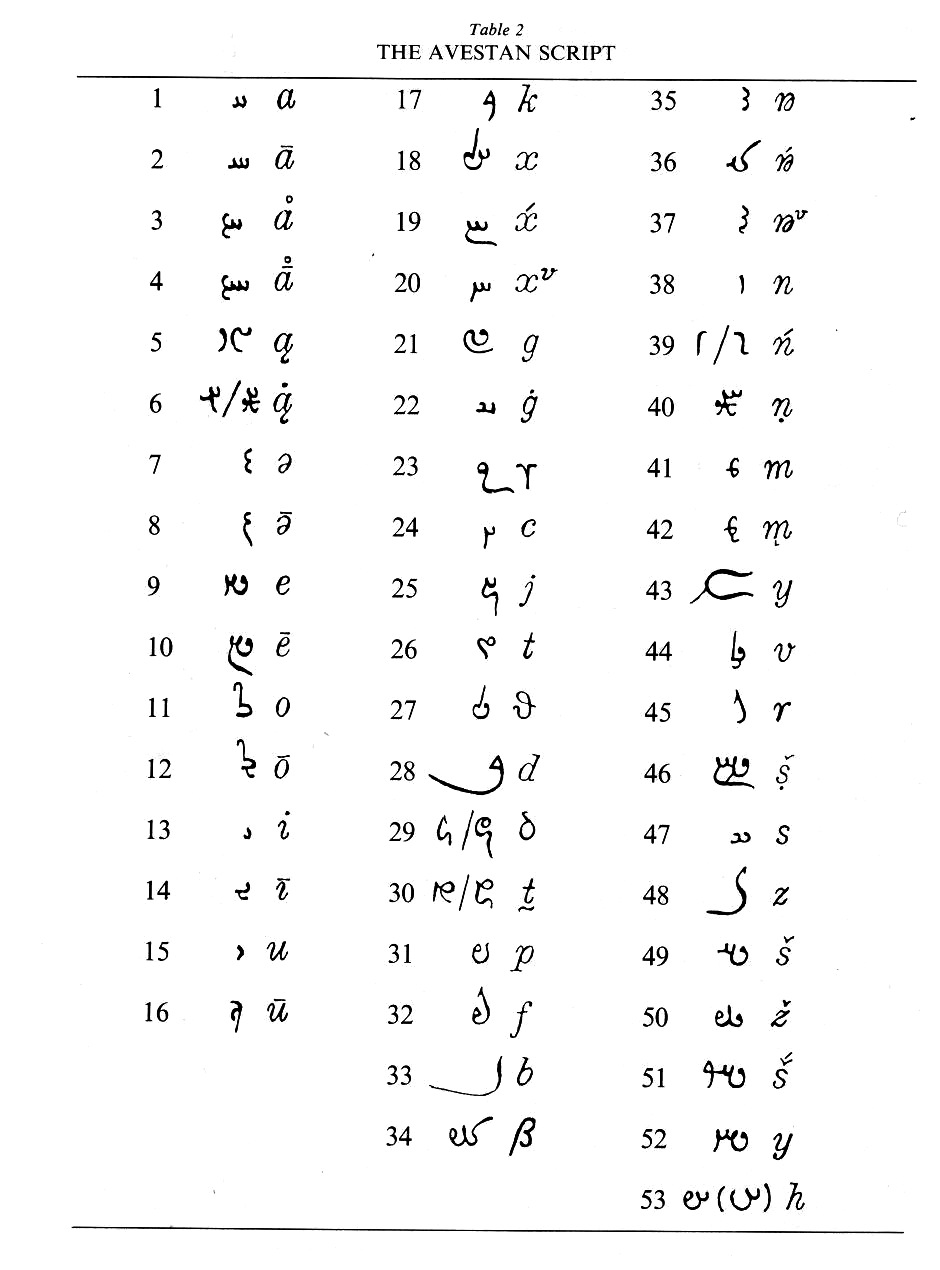
The letters are written from right to left and are not connected. Ligatures (e.g., šk, šc, št, ša) are rare and clearly of secondary origin. A point (dot) is used to indicate the end of a word or the end of the first member of a compound, no distinction being made between the two. The letters have almost the same shapes in all manuscripts. Only some Indian manuscripts show peculiarities: H2 (A.D. 1415), S1 and J9 (14/15th century A.D.).
The large number of letters used suggests that their invention resulted from an attempt to record an orally recited text with all its phonetic nuances. For that reason the Avestan script must have been the deliberate invention or creation of a scholar or of a group of scholars (see, e.g., Morgenstierne, “Orthography and Sound-system,” pp. 31-33; Henning, “Disintegration,” p. 44).
The Avestan script is based on the Pahlavi (q.v.) script in its cursive form as used by theologians of the Zoroastrian church when writing their books. The earliest Pahlavi manuscripts date from the fourteenth century A.D., but the Pahlavi cursive script must have developed from the Aramaic script already in the first centuries A.D. This is proved for example by the fact that an early inscription on the lid of a sarcophagus found in Istanbul that for archeological reasons can not be dated later than A.D. 430 already shows the characteristic written forms of the Pahlavi cursive script with two insignificant exceptions (k and s). (See the bibliography in Ph. Gignoux, Glossaire des inscriptions pehlevies et parthes, Corp. Inscr. Iran., Suppl. Ser. I, London, 1972, p. 14.) In the Pahlavi cursive script almost all the letters represent several different sounds. This ambiguity is due in part to inadequacies of the Aramaic alphabet from which it developed, in part to the phonological development of the Middle Persian language (“historical spelling”), and in part to the graphic coalescence of signs. In addition, many individual letters of a word are joined to one another, with the result that extremely ambiguous ligatures occur.
Apart from the Pahlavi cursive script as used in the Zoroastrian church there was a still older kind of script that was to some extent less ambiguous. This script, called here the “Psalter script,” is known to us from a manuscript from the seventh or eighth century A.D. containing a “Christian” Pahlavi translation of the Psalms. (See D. N. MacKenzie, A Concise Pahlavi Dictionary, London, 1971, pp. xi, xiii, for tables of the Pahlavi and Psalter scripts; and Aramaic, i.)
The creator of the Avestan script took over from the Pahlavi cursive script the letters a, i, k, t, p, b, m, n, r, s, z, š, and xᵛ to represent the same sounds as in Pahlavi. The sign (28) for d derives likewise from the unambiguous Psalter script. In Pahlavi the sign for k (17) represented both the sounds k and γ, because k had developed to γ in word-interior position. In the Psalter script the sign for k differed from that of the Pahlavi cursive in that the Psalter sign ended in a flourish towards the right. The creator of the Avestan script made use of this variation in the shape of the letters by assigning to the Pahlavi form (17) the fixed value k and to the Psalter form (23) the fixed value γ. In this way the flourish could be reinterpreted as a diacritical mark, which the creator of the script put to further use. The Pahlavi Psalter sign (25) for c/j/z/ž had a similar flourish and was accordingly adopted to represent the voiced sound j. By removing the flourish the creator of the script obtained the sign (24) for c, which has a different shape in the Pahlavi cursive script. Pahlavi p represented the sounds p/(f)/β. It was retained unchanged in Avestan for p (31) while an initial flourish converted it into the sign for β (34). The addition of a flourish to Pahlavi t (26) either initially or finally was not used, as might be expected, to represent δ but to represent a word-final t̰ (30) that was probably implosive. The Pahlavi alef was adopted as a (1) in the Avestan alphabet.
In Pahlavi, alef had coalesced graphically with h, from which it was still distinguished in the Psalter script. Thus, Pahlavi had only one sign to represent alef, h, and x. In order to represent the sound xᵛ in Avestan, use was made of an ambiguous Pahlavi ligature (20) of ʾ/h + w/n/r, which among many others had the value xw. The shape of the ligature hw adopted for Avestan xᵛ not only is characteristic of the Pahlavi books but is found already in the inscription on the sarcophagus lid from Istanbul, whereas the ligature has a different shape in the Psalter script. In the Avestan script a flourish was added to distinguish x́ (19) from xᵛ (20). An unusual diacritic in the form of a loop at the end of a curved flourish was used to distinguish h (53) from a (1). The loop may have been a secondary addition providing graphical resemblance to p (31), since a variant form of h (53 in brackets) without the loop is found in such manuscripts as H2 and J9. By extending the curve further upwards than in the unlooped variety of h it was possible to distinguish x (18) from both a (1) and h (53). The curved upwards flourish was further used to create Avestan f (32) out of Pahlavi p (31) and is seen in the voiceless fricative θ (27). The basic shape to which the curved upwards flourish was added in the case of θ is to be seen in the form taken by final s in Pahlavi words such as gʾs for Avestan gāθā, in which s represents Avestan θ (MacKenzie, Pahlavi Dictionary, p. xiii, the second s, to the right).
The Avestan letter ā (2) is also derived from the Pahlavi script, where this sign was used for ʾy at the end of a word (already in the Istanbul sarcophagus inscription). However, as early as in Middle Persian inscriptions from the third century A.D., ʾy was used to represent the final -ā of foreign names as in swlyʾy for (Greek) Sūríā, and the Pahlavi Psalter confirms that this convention continued to be adopted as the Psalter itself has the spelling ʾpltʾy for Syriac ʾprtʾ, that is (Greek) Ephrathá (Bethlehem).
The Avestan letter o (11) corresponds in graphic shape to a special form of Pahlavi l that is found only in Aramaic heterograms. The commonest of those heterograms is the preposition ʿL “to, at,” which was read in Middle Persian as ō (MacKenzie, Pahlavi Dictionary, p. 187, left column, 3rd line from the top). It looks as though the creator of the Avestan script used this special form of l without the initial ʿayn to represent the sound o. The letter e (9) seems to have a similar origin. Pahlavi ēw “one” was probably pronounced simply as ē already at an early date. This pronunciation is actually attested in the later Pahlavi literature. Avestan e differs from the Pahlavi ligature ēw only by the absence of a small initial hook which was indispensable for Pahlavi but unnecessary for Avestan. (Words with initial ēw-/ēn- in MacKenzie, Pahlavi Dictionary, pp. 232f.)
The original (Aramaic) letters n, w, r, and ʿ (ʿayn) coalesced in a single short vertical stroke in Pahlavi. This sign was taken over unchanged for n in the Avestan alphabet (38). A slight bend in the stroke was made to distinguish Avestan u (15) from n since Pahlavi w was used in internal position also to designate the sound u.
The Pahlavi script had very inadequate means to designate the vowel sounds. By contrast the creator of the Avestan script quite clearly invented a special sign for every vowel distinguished in the oral tradition. No doubt the Greek script had provided a model; the Greek script was well known in Iran as is shown by the fact that already under Šāpūr I (241-72 A.D.) Greek translations accompanied the royal inscriptions. Thus Avestan ə (7) could have been adopted from Greek minuscules, which had a comparable form already in the fourth century. The sign for ā (2) probably came directly from Pahlavi but the letters for the remaining long vowels were evidently formed by adding diacritics to letters for the corresponding short vowels. ə̄ (8) was accordingly formed by adding to ə (7) a flourish to the left, while ē (10) was formed by adding to e (9) a flourish to the right. The letters for ō (12), ī (14), and ū (16) were distinguished from the letters for the corresponding short vowels by the addition of a short vertical stroke at the bottom. It is likely that the creator of the script based the sign for ō (12) on the Pahlavi heterogram ʿL, which was pronounced ō, by placing the ʿayn, the vertical stroke on the right, under the L. The sign for the short vowel was then formed by treating the vertical stroke as a diacritic denoting length. The same stroke may subsequently have been used by analogy in order to differentiate between ī and i and between ū and u.
As yet few plausible statements can be made concerning the origin of the remaining letters of the Avestan alphabet, but it must be accepted that the creator of a script is free to invent letters or diacritics arbitrarily.
ā̊ (4), which looks like a ligature of ā + ə, was differentiated from ā. Short ȧ (3) has been found in one manuscript only (Pd, where it is used instead of ą before ŋh; see Salemann, “Parsenhandschrift,” p. 510). ą (5) seems to be a free invention. In some manuscripts (e.g., Mf4, ed. in facsimile by K. M. JamaspAsa) ą̇ (6) is found instead of ą (5). There is some slight evidence that ą and ą̇ were not just graphic variants but two different letters. ą may have been a nasalized long ą̄, and ą̇ a nasalized short ə. The original form of ą̇ may have been the left variant of no. 6 in the table.
The Avestan script originally possessed also the letter ġ (22). All the known Avestan alphabets, most of which are very corrupt, begin with the letters g, ġ, γ (21-23). ġ is seldom found in the manuscripts but relatively often in final -ə̄ṇġ, especially in the manuscripts S1 and J3. This suggests that ġ was implosive, like t̰, the only other final stop in Avestan.
Avestan g (21) may be a modification of the corresponding Pahlavi letter. Neither of the forms of δ (29) appears to be based on Pahlavi letters.
Among the nasal signs ŋ (35), the labialized nasal ŋᵛ (37), and the uvular nasal ṇ (40) appear to be free inventions. Both forms of palatalized ń (39)—that on the right in the table is found only in MS K7—are modifications of n (38). The voiceless m̨ (42) is simply m (41) plus a diacritic.
The sign for initial ẏ (43) and v (44) are free inventions.
The left part of ž (50) resembles the Pahlavi ligature ʾc (written like 53). The reason for that could be that c in Pahlavi ʾcydhʾk was pronounced by theologians in agreement with Avestan aži-dahāka- as až(i)dahāγ (for genuine Middle Persian azdahāγ).
šˊ (51) is simply š (49) plus a diacritic. In Indian manuscripts initial ẏ (43) is replaced by initial y (52), which looks like š (49) with a slightly different diacritic. If the sign originally had the phonetic value palatal ž, that may in fact have been its origin. Even ṧ (46) could be a modification of š (49) if the sound it represents was already some kind of š sound at the time the script was invented (see on phonology below).
It is generally considered that the Avestan script dates to the Sasanian period (224-651 A.D.). The evidence of the Istanbul sarcophagus inscription (before A.D. 430) suggests that it may have been invented already by the fourth century A.D., perhaps even under Šāpūr II (310-379 A.D.). Note, however, that none of the letters of the alphabet used in the monumental Mid. Pers. inscriptions seem to have been borrowed for the Avestan alphabet (table in MacKenzie, Pahlavi Dictionary, p. xi).
It may be assumed that the Avestan texts were written down shortly after the invention of the script, which was designed to provide a special sign for each sound used in the traditional pronunciation of Avestan. In this first notation of the Avestan texts, the so-called “Sasanian archetype,” the aim of the inventor of the script must have been put into practice.
In the post-Sasanian period there took place a serious deterioration in what had become a manuscript tradition. There must have been numerous errors even in the manuscripts written in the ninth or tenth century, from which ultimately the extant manuscripts descend. Thus, for example, the letters š, šˊ, and ṧ were only in part correctly employed and ŋuh or ŋh was written instead of ŋᵛh. The manuscripts themselves constantly betray a marked deterioration in the pronunciation of the vulgate.
Bibliography
C. F. Andreas, “Die Entstehung des Awesta-Alphabetes und sein ursprünglicher Lautwert,” Verhandlungen des XIII. internationalen Orientalisten-Kongresses, Hamburg, September 1902, Leiden, 1904, pp. 99-106.
W. B. Henning, “The Disintegration of the Avestic Studies,” TPS, 1942, pp. 40-56 (Selected Papers II, Acta Iranica 15, pp. 151-67).
Idem, “Mitteliranisch,” p. 52.
K. Hoffmann, “Zum Zeicheninventar der Avesta-Schrift,” in Festgabe deutscher Iranisten zur 2500 Jahrfeier Irans, Stuttgart, 1971, pp. 64-73 (Aufsätze zur Indoiranistik I, Wiesbaden, 1975, pp. 316-25).
A. V. W. Jackson, The Avestan Alphabet and its Transcription, Stuttgart, 1890.
K. M. JamaspAsa, Manuscript D90: Yasnā with its Pahlavi Translation I-II, Shiraz, 1976 (facsimile of Geldner’s ms. Mf4).
G. Morgenstierne, “Orthography and Sound-system of the Avesta,” NTS 12, 1942, pp. 30-82 (Irano-Dardica, Wiesbaden, 1973, pp. 31-79).
C. Salemann, “Ueber eine Parsenhandschrift der Kaiserlichen Oeffentlichen Bibliothek zu St. Petersburg,” Travaux de la troisième session du Congrès international des Orientalistes 1876 II, St. Petersburg and Leiden, 1879, pp. 508-19.
G. Windfuhr, “Diacritic and Distinctive Features in Avestan,” JAOS 91, 1971, pp. 104-24 (somewhat speculative).
See also J. Duchesne-Guillemin, Kratylos 7, 1962, pp. 4-9.