



i. IMAGE OF PERSIANS IN
In the Sasanian period Armenians developed a self-awareness as Christians against the background of their earlier Iranian social and religious culture (see ARMENIA AND IRAN i-v). Although written texts, beginning in the fifth century CE, only give a partial view of Armenian ideas about themselves and their place in the larger world, the long-term impact of the early major texts was formative for later ideology down to modern times. The native script was developed in the Iranian sector of the country during the reign of Yazdegerd I (for background see Winkler), and the literary genres that shaped Armenian literature were primarily those of Christian Syria and the world of Greco-Roman antiquity (see East of Byzantium
).The first Armenian historians naturally rejected Persian traditions overtly, though they were still influenced by them, as is particularly obvious in the Buzandaran (see Garsoïan’s Introduction to The Epic Histories). Persian mythology, when deliberately cited, was treatedwith scorn, as in the work of Eznik (see EZNIK OF KOŁB). And the historian Movsēs Xorenac’i contrasts “senseless” Iranian myths with Greek fables which have hidden in themselves an “allegorical” meaning (Moses Khorenatsʿi, History, “From the Fables of the Persians,” at the end of Book I, tr. Thomson, pp. 126-28). Unlike the Christian Georgians (the Iberians of K’art’li), Armenians were never tempted to integrate into their own pre-history the heroes of Iranian legend.
Several writers, however, did attempt to work out the practical aspects of their relationship with the Sasanian regime. In his History Łazar of P’arp accentuates the positive, setting out a clear picture of the responsibilities of ruler and subject. He accepts the position of Armenia as a province within the greater Sasanian Empire, but one with its own Christian traditions which the Persian Great King should not attempt to subvert. Yet he makes no attempt to envisage a larger Christendom of which the Armenian Church might be a part, and his idea that Christianity was an ancient and ancestral Armenian tradition is disingenuous. For Łazar the empire consists of many peoples with differing customs (religion included), but united in military and political loyalty to a common sovereign.
Ełišē’s History accepts the same general principle, but his message is more directed towards the Armenians themselves. Iranian attempts to impose Zoroastrian conformity on Armenia must be met with armed resistance. Ełišē is much indebted to the Armenian version of the Martyrs of the East, accounts of the fourth-century Syrian martyrs in Iran (see ACTS OF THE PERSIAN MARTYRS; for the influence of this on Armenian writers see Ter-Petrosyan). But his own ideology emphasizes collective, not individual action; secession from the covenant of church and people is equivalent to betrayal of both. The imagery that Łazar and Ełišē employed struck a receptive chord in later Armenian historiography. The parallels they drew between the Maccabees and the Armenian faithful remnant – for many Armenians were more prepared to stress their allegiance to the Persian Great King than to hold out for religious freedom – have often been noted and were applied by later historians todifferent circumstances (see Thomson “Maccabees,” and the Introduction to Thomas Artsruni). Nonetheless, it remains difficult to consider Armenia a homogenous entity within the empire; the local rivalries of major families continued to dictate the course of politics.
After the Persians had suppressed the rebellion of 450-451 an uneasy symbiosis was worked out. Armenian sources do not suggest that Persian law was imposed on the country – as opposed, of course, to tax. Indeed the author responsible for the homilies known as Yačaxapatum states that unlike the Greeks, the Persians had no law (p. 90). This reflects the state of legal administration in Armenia, where local traditions were applied in areas governed by the various noble families. Attempts to produce a general Armenian code of secular law were not made for many centuries; even in the 12th century Mxit’ar Goš did not consider his work as a code for all Armenians (see his own Introduction to the Girk’ Datastani, pp. 1-25). Canon-law, on the other hand, did cut across the social and political divisions of the country. Greek canons were augmented by Armenian legislation from the fourth century, first written down in the fifth; but only in the early eighth century was the first formal collection compiled (the Kanonagirk’).
When Armenians described their position vis-à-vis Persia in specifically geographical terms vagueness pertains. Although the majority of Armenians lived within the boundaries of the Sasanian Empire, their writers give no clear idea whether they thought Armenia was part of Eran or of Aneran (< Mid. Pers. Ērān and Anērān, “Iran and non-Iran”; see ANĒRĀN, ĒRĀN, ĒRĀNŠAHR). The famous early seventh-century Geography, the Ašxarhac’oyc’, includes detailed descriptions of Armenia and the Caucasus, and a section on Iran. But the book is a disparate compilation, and the unknown compiler has not attempted to bring his material into a coherent whole (see Hewsen’s introduction to Geography).
Influenced by biblical genealogies, as expounded and integrated with Greek traditions, the Armenians classified the various peoples of the world as descended from one of Noah’s three sons, and integrated their own legendary ancestors into that schema as the line of Japheth. This echoes the earlier classification found in the original Greek Chronicle of Hippolytus (sec. 68) and the expanded Armenian version known as the Anonymous Chronicle (forArmenian versions of Hippolytus see Mahé, 1987). The Persians are descended from Sem (Sam) via Abraham; again, the view of Hippolytus.
The bible also provided a schema for the classification of the world’s kingdoms. Beginning with Sebeos in the seventh century, Armenian historians used imagery from the Book of Daniel to contrast the Greeks, Persians, Medes, Parthians, and Arabs. After Sebeos such comparisons were combined with themes from apocalypses like that of Pseudo-Methodius. Recourse to such imagery occurred whenever an established order had been overthrown. Later writers thus updated such categories to cover the Saljuqs, the Crusaders, and then the Mongols, by which time the picture of Sasanian Iran had faded away (see Thomson, “Crusaders,” Garsoïan, “Reality and Myth”).
Although the Armenian Anonymous Chronicle indicates which peoples used writing, including the Persians, the languages themselves are not classified. Early Armenian texts have remarkably few references to Persian as a language or to Armenian knowledge of it. But it seems to be taken for granted that Armenian nobles and Persians could converse without difficulty. The close family links between them, especially the tradition of sending a son to be brought up by a foreign tutor (the relationship of san to dayeak; see Garsoïan, Epic Histories, p. 521), are often mentioned (see also HORMOZD III).
Some characteristics of Persian as a language are mentioned in the Armenian commentary literature. The early eighth century scholar Step’annos of Siwnik’, for example, notes the prevalence of compound nouns in Persian. This is an elaboration on the discussion of compounds in Dionysius Thrax, whose Greek grammar was translated and served as a basis for numerous Armenian commentaries (see Adontz, Denys de Thrace).
The Armenian model of their place in the world, owing political allegiance to the Great King but preserving their traditional customs, was shaken by the overthrow of the Sasanian Empire. The Muslims were outsiders, a different people, ayl azgi, and for centuries little or no attempt was made to understand Islam as a religion or a society (see Thomson, “Muhammad and the Origin of Islam,” “Mxit’ar and the Muslims”). Following the Muslim conquest, the term “Persia” was restricted more and more to the Eastern Caucasus, to Ran (Arrān) and Atrpatakan (Azarbaijan). The adjective “Persian” could now be used in the sense of “Muslim,” regardless of the ethnic origin involved, Turkish, for example, The old word for the Arabs of Northern Mesopotamia, tačik (cf. Mid. Pers. Tāčik, Pers. Tāzi), also gained wide acceptance in the new sense of Muslim, especially after the Seljuk invasions, and it later came to mean simply “Turk.”
The shift of power from the Sasanians in Ctesiphon to the Umayyads in Damascus and the establishment of military garrisons in the Muslim province of Arminiyya (Armenia) did not stifle the continuing process of Armenian self-assertion. A definite process of codification of faith and practice was now put into effect, the leading figure in this process of framing Armenian liturgical practice, theological orthodoxy, and canon-law being Yovhannes III Awjnec’i, Catholicos 717-28 CE (see Mahé in Des Parthes au Califat, pp. 59-105).
Another important aspect of Armenian self identity was the use of anational calendar. Back-dated to 552 AD, this was worked out in the mid-seventh century (see Grumel, pp. 140-45), but did not come into general use until the end of the eighth. The standard means of dating for Armenian historians during the Sasanian era was by regnal year of the Persian Great King. The historian Łewond (after 790) adapted this system, using caliphs instead of Great Kings. He gives only one reference to an Armenian era: Hamazasp Arcruni’s martyrdom in 784 is said to be in the year 233. The earliest attested surviving inscription with an Armenian date is that of 783 from T’alin, while the earliest dated manuscript is the Queen Mtike Gospel of 862 (see Stone et al. ,pp. 115, 120). The Muslim hejra is hardly ever used for dating by Armenian authors. Memory of Persian Great Kings lingered on. Even in 1181 CE an Armenian scribe in Cilicia dated his manuscript to the year 630 from “Xosrov of the Persians” [i.e., Ḵosrow I] (see Conybeare, p. 5). This was more a parade of learning than an accepted method of reckoning, for he simply meant “of the Armenian era,” which had indeed been retrospectively dated to the reign of Ḵosrow I Anōširvān.
Armenian awareness of Sasanian Persian traditions gradually faded. The majority of medieval Armenian historians regarded the conversion of King Trdat to Christianity as the beginning of Armenian history. Hence, naturally, it is not the Sasanian background but the fact that Trdat was an Arsacid that is stressed. Furthermore, the supposed alliance of Trdat with the emperor Constantine, first found in Agat’angelos (Agathangelos) and greatly elaborated over the centuries (see Thomson, 1997), takes on a new life once the Armenians came into direct contact with the West. The Crusaders, interpreted as Romans, were introduced into the apocalyptic schemes that became popular from the twelfth century onwards. Armenians found solace in foreseeing a new Trdat emerge in alliance with a new Constantine, with a direct successor of Saint Gregory at the head of the church. Romans and Armenians together would trample on the infidels before the coming of Anti-Christ and the Last Things (see Sanjian, pp. 227-39). The formative process of Christianization in Armenia did indeed begin with an Arsacid on the throne; but the development of Armenian literary traditions only started in the fifth century, and the most enduring images of the early Armenian Church and state were the products of later times under Sasanian influence.
Bibliography
- N. Adontz, Denys de Thrace et les commentateurs armeniens, Louvain, 1970.
- F. C. Conybeare, A Catalogue of Armenian Manuscripts in the British Museum, London, 1913.
- Des Parthes au Califat, ed., N. G. Garsoian and J.-P. Mahe (Travaux et Memoires) Monographies 10, Paris, 1997.
- East of Byzantium: Syria and Armenia in the Formative Period, ed. N. G. Garsolan, T. F. Mathews, R. W. Thomson, Washington, DC, 1982.
- Ełišē, Vasn Vardanay ew Hayoc’ Paterazmin, ed. E. Ter-Minasyan, Erevan, 1957; tr. R. W. Thomson, Ełishe. History of Vardan and the Armenian War, Cambridge, MA, 1982.
- Eznik of Kołb, De Deo, ed. L. Manes and C. Mercier, Patrologia Orientalis 28: 3, 4, Paris, 1959.
- N. G. Garsoian, The Epic Histories attributed to P’awstos Buzand (Buzandaran Patmut’iwnk’), Cambridge, MA, 1989.
- N. G. Garsolan, “Reality and Myth in Armenian History,” The East and the Meaning of History (International Conference 23-27 November, 1992) (University di Roma “La Sapienza,” Studi Chrientali, 13), Rome 1994, pp. 117-45.
- V. Grumel, La chronologie (Traite d’etudes byzantines, 1), Paris 1958.
- R. H. Hewsen, The Geography of Anania of Sirak (Asxarhac’oyc’), Wiesbaden, 1992.
- Kanonagirk’ Hayoc (Book of Armenian Canon-law), ed. V.1Jlakobyan, 2 vols., Erevan 1964, 1971.
- Łazar of P’arp, Patmut’iwn Hayoc’, ed. G. Ter-Mkrtč’ean and S. Malxasean, Tiflis 1904 (repr. Delmar, NY, 1985); tr. R. W. Thomson, The History of Łazar P’arpec’i, Atlanta, GA, 1991.
- J.-P. Mahé, “Quadrivium et cursus d’études au VIIe siècle en Arménie et dans le monde byzantin d’apres le K’nnikon d’Anania Širakac’i,” Travaux et Memoires 10, 1987, pp. 159-206.
- Movsēs Xorenac’i, Patmut’iwn Hayoc’, ed. M. Abełean and S. Yarut’iwnean, Tiflis 1913 (repr. Delmar, NY, 1981, Erevan 1991); tr. R. W. Thomson, Moses Khorenatsʿi, History of the Armenians, Cambridge, MA, 1978, and A. and J.-P.Mahē, Histoire de l’Armēnie par Moïse de Khorène, Paris, 1993.
- Mxitar Goš, Girk’ Datastani, ed. H. T’orosyan, Erevan 1975; tr. R. W. Thomson, The Lawcode of Mxit’ar Goš, Amsterdam and Atlanta, GA, 2000.
- A. K. Sanjian, “Two contemporary Armenian Elegies on the Fall of Constantinople, 1453), Viator 1, 1970, pp. 223-61.
- M. E. Stone, D. Kouymjian and H. Lehmann, Album of Armenian Palaeography, Aarhus, 2002.
- L. H. Ter-Petrosyan, Abraham Xostovanołi Vkayk’ Arewelic’ (The Martyrs of the East by Abraham the Confessor), Erevan, 1976.
- R. W. Thomson, “Constantine and Trdat in Armenian Tradition,” Acta Orientalia [Academiae Scientiarum Hungaricae] 50, 1997, pp. 277-89.
- Idem, “The Crusaders through Armenian Eyes,” in The Crusades from the Perspective of Byzantium and the Muslim World, ed. A. E. Laiou and R. P. Mottahedeh, Washington, DC, 2001, pp. 71-82.
- Idem, “The Maccabees in early Armenian Historiography,” Journal of Theological Studies 26, 1975, pp. 329-41 (reprinted in his Studies).
- Idem,”Muhammad and the Origin of Islam in Armenian Literary Tradition,” in Armenian Studies in Memoriam Haïg Berbérian, ed. D. Kouymjian, Lisbon, 1986, pp. 829-58 (reprinted in his Studies).
- Idem, “Mxit’ar and the Muslims,” in Mxit’ar Goš, The Lawcode, pp. 47-57.
- Idem, Studies in Armenian Literature and Christianity (Variorum, CS 451), Aldershot, 1994.
- Thomas Artsruni, History of the House of the Artsrunik’, tr. R. W. Thomson, Detroit, 1985.
- G. Winkler, Koriwns Biographic des Mesrop Maštocδ (Orientalia Christiana Analecta, 245), Rome, 1994.
- Yačaxapatum Čařk’ (Homilies), Venice, 1954.
ii. ARMENIAN WOMEN IN THE LATE 19TH- AND EARLY 20TH-CENTURY PERSIA
Armenian women in general, and Armenian women in Persia more specifically, have received very little scholarly attention for a variety of reasons, from a lack of available sources to a lack of scholarly interest. Yet their contribution to the life of the Armenian community of Persia in the middle and late 19th and early 20th centuries, especially in terms of education and charitable work, is noteworthy and certainly deserves a greater scholarly examination.
Armenian women were part of a large minority dispersed throughout the Ottoman and Persian empires and concentrated in Anatolia, Azarbaijan, in/near the city of Isfahan, and, after World War I, in Arab lands. Throughout the 19th century and during the early part of the 20th century, the majority of Armenian women, like their male counterparts, belonged to the rural lower classes, with notable exceptions in larger urban areas. However, very little is known about the everyday life of the majority of Armenian women in Iran. The sources that have come down to us focus predominantly on women’s activities and roles in the propagation of the Armenian nation, whether through the education of Armenian children, charitable organizations, or participation in the nascent nationalist and reformist movements that originated from the Ottoman Empire and Russia-ruled Caucasus. Nationalist writers have often singled out such activities, perceiving the progress of Armenian women in the Ottoman, Russian, and Persian empires, and praised them for their contributions to Armenian national development.
In the 19th and early 20th centuries, Iranian Armenians were concentrated in Azarbaijan and Isfahan, and their population was estimated to be between 63,000 and more than 70,000 at the turn of the 20th century. When demographic studies included the numbers of women, these were noticeably smaller than those for men, most likely because male heads of families were less apt to report about female family members. Well into the 20th century, the majority of the Armenian population in Iran were peasants. Generally, men and boys—from as young as six or seven—worked in the fields, while women and girls took care of the household and the livestock. Women spent their evenings doing needlework; older women spun wool and prepared threads to weave rugs in the winter (Mamian, p. 186). They were the chief carpet weavers in Čahār Maḥāl (see ČAHAR MAḤĀL wa BAḴTIĀRI; Yedgarian, p. 46). In urban areas, most Armenians were involved in trade, with a great number of artisans working as goldsmiths, blacksmiths, gunsmiths, carpenters, and a significant number being wine-makers and wine-sellers. Armenian commercial firms in Azarbaijan and Isfahan, as well as in other towns, played an important role in the trade between Iran, Europe, and Russia (Goroyiants, pp. 130-34; Frangian, pp. 185-89; Ter Hovhaniants, p. 288). The significance of Armenian merchants in this period pales in comparison to the important role they played in the 17th- and early 18th-century Safavid Iran (see Aslanian). Interestingly, the wine trade was in the hands of women, as alcohol could not be sold openly and was, therefore, sold out of the home, the seat of female authority (Frangian, p. 56; Raffi, p. 549). Some nationalist writers raised objections to the predominance of women in the wine trade, which they considered detrimental because of the connection of women’s honor with national well-being (Frangian, p. 56; Raffi, p. 536; for a more detailed discussion on the Iranian Armenian community see Berberian, 2001, pp. 34-66).
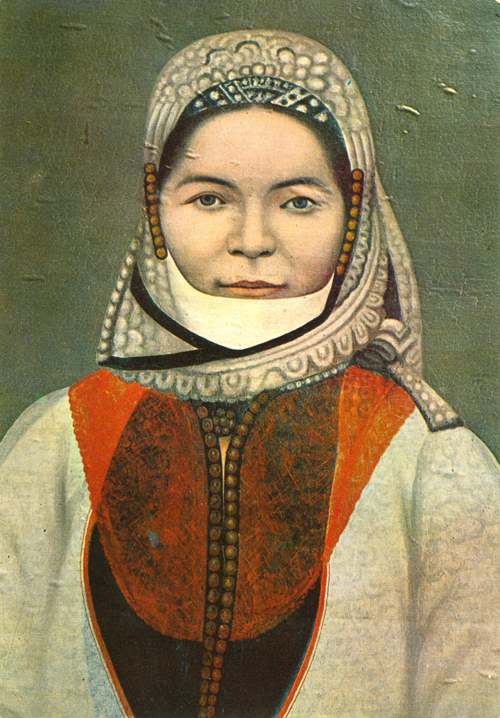
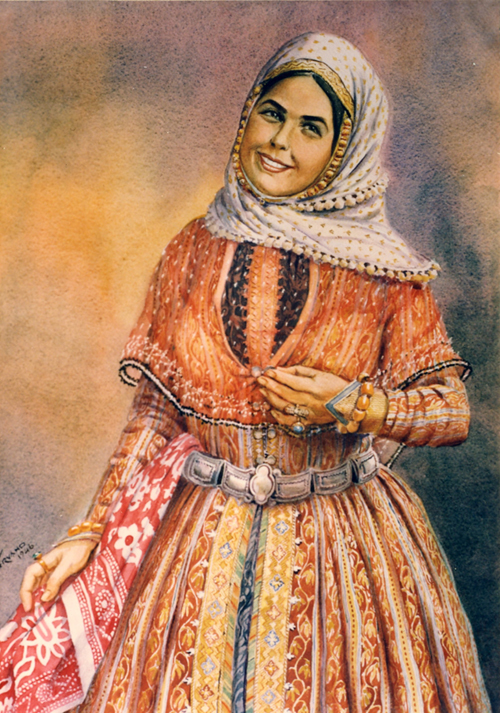
Culture. Iranian Armenian women, as members of a religious and ethnic minority, preserved their cultural distinctiveness far more than Iranian Armenian men, who were much more likely to come into contact with Muslims. For instance, women retained their distinctive dress and head-cover well into the 1930s, while men by that time had adopted the Iranian hat, tunic/cloak (qabā), and loose pants(šalvār; see Minasian, p. 376; Yedgarian, pp. 158-62; Yeremian, pp. 122-23). Women’s dress generally consisted of several layers of undergarment, shirts, long skirts, aprons, ornamental belts, riāl coins in place of buttons, necklaces and other ornaments of beads and silver coins, head-covers decorated with rial coins and hanging down from the forehead, and mouth-covers, usually white (Minasian, pp. 376-78; Yedgarian, pp. 162-67; Yeremian, pp. 123-26; Lima, figs. 12, 14, 15, 16). Not surprisingly, the dress and other social customs were often not distinguishable from those of Muslim women (Berberian, 2000, p. 74).
There were several categories of women’s dress depending on age and marital status. For example, younger girls wore a distinct head-cover; unmarried older girls did not have a nose- or mouth-cover, while new brides covered both with a white cloth. Middle-aged women dressed simpler, in darker colors, sometimes mixed with white, and wore no ornaments, while elderly women dressed even simpler and wore a white head-cover and often did not cover their noses or mouths (Minasian, pp. 378-79). Girls often married at the age of fifteen or sixteen; the bride and the groom did not see each other until the wedding ceremony. The new bride, whose mouth was covered, could not speak or eat in the presence of her husband’s family. She could only speak through younger boys and girls, who would relay messages for her. If, however, no children were present, the bride would speak with her hands or facing a wall. Women’s dress and behavior, including segregation during mealtime and church services, remained basically unchanged in the rural Iranian Armenian communities until the mid-20th century (Minasian, pp. 383-84; Yeremian, pp. 98-99). Women, therefore, did not merely physically reproduce their children, but—as mothers who were the major influence in the lives of their children—they were also the socializers of children, reproducing the culture through dress, behavior, and use of language, as well as culinary and other customs (FIGURE 1, FIGURE 2; Berberian, 2000, p. 75).
Armenian Women Fig 1
Armenian Women Fig 2
In contrast to the above, women began to make appearances on the theater stage in Iranian cities from the late 19th century (Berberian, 2000, p. 86). Starting in the 1880s, women also began to establish their own theatrical groups, traveling and performing in Istanbul and parts of Iran and Egypt (Navasargian, p. 43).
Education. Until the advent of missionary schools and, later, Armenian girls’ schools, only a small minority of Armenian girls from wealthy families received an education, albeit a limited one. The first access to Western-style education by Armenian girls outside the home came with the opening of the missionary girls’ school in Urmia (Orumia) in 1838 (Arasteh, p. 128). In Tabriz, an Armenian girls’ school opened about four decades later, in 1879, after much opposition and debate. New Julfa (see JULFA) had a girls’ school from 1858-60.
Religious and lay community leaders opened Armenian boys’ and girls’ schools for two reasons: to counteract the influence of missionary schools and to prevent further acculturation. For example, Armenians of Urmia communicated only in Turkish or Kurdish rather than in Armenian, and there were cases of conversion to Islam in Khoy (Berberian, 2000, pp. 78-79; Raffi, pp. 501, 533, 535; Frangian, pp. 25, 52, 93,117; Pahlevanyan, pp. 192-93, 203). Proponents of education argued for girls’ education by placing it within the context of national progress, emphasizing its connection to transforming the Iranian Armenian community and society by means of educating women and preparing them for their primary roles as wives, mothers, and the first teachers of future generations of the community (Berberian, 2000, pp. 82-83).
In 1879, the first girls’ school, named “Annayian,” opened in Tabriz. Its curriculum included Armenian and Persian languages, religion, mathematics, Armenian history, geography, natural sciences, and needlework, with the addition of French and Russian when it became coeducational. More girls’ schools opened in the late 19th and early 20th centuries in both urban and rural Iranian Armenian communities, some of which later became coeducational, primarily for financial reasons (Berberian, 2000, pp. 80-83; Hakovbiants, p. 98; Pahlevanyan, pp. 200-1; Mamian, pp. 361-62; Goroyiants, pp. 124-25; Abrahamian, II, p. 241). Iranian Armenian women, who organized into charitable organizations, helped to establish new schools, especially girls’ schools, and often provided students with tuition, clothing, and school supplies (Berberian, 2000, pp. 83-85). Women’s charitable groups in Tabriz, New Julfa, and Tehran comprised mostly of members of the wealthy strata of the Iranian Armenian community, who often saw to the community’s expenses and even paid house calls in order to convince families to send their girls to the newly opened Armenian girls’ schools rather than to the Protestant missionary schools. Their efforts in helping hundreds of girls attend school cannot be underestimated. They also saw to the opening of the first kindergarten in Iran (in the street of Leylavā in Tabriz) in 1896, as well as vocational schools and workshops for sewing and carpet weaving (Berberian, 2000, pp. 83-85; Hakobian, I, pp. 8, 83; Grigorian, pp. 85-94; Frangian, pp. 127, 129, 130, 137, 141; Tadeosian, p. 88; Goroyiants, p. 126; Yeremian, pp. 60-62; Pahlevanyan, p. 139; Amurian, p. 127). They also provided support to Armenian refugees fleeing from the massacres perpetrated under the rule of Ottoman Sultan ʿAbd-al-Ḥamid II (r. 1876-1909). Starting in 1896, the women’s organizations collected money, clothing, and wheat and at times personally saw to the distribution of the latter two items (Grigorian, pp. 93, 95-97).
Politics. Starting in the mid-19th century, Iranian Armenian communities throughout Azarbaijan and Isfahan went through a major transition in terms of education and politicization. A greater number of Armenians began to be educated by newly arriving teachers from the Caucasus and members of political parties, particularly the nationalist-socialist Dashnaktsutiun (see DASNAK) and internationalist-socialist Hnchakian parties, which began to operate in Iran in the 1890s and subsequently took part in the Iranian Constitutional Revolution (1905-11, q.v.). In northwestern Iran, the Dashnaktsutiun Party organized small military groups to be sent across the Iranian-Ottoman border and disseminated party ideology, with the purpose of liberating Ottoman Armenians to one degree or another. The Dashnaktsutiun boasted of having more than 2,000 members, organized into 242 groups under its auspices in all of Iran. These groups included women, who formed on average about 24 percent of the total membership of each branch, with a few exceptions (Berberian, 2001, p. 51; Report of Azarbaijan’s Activities, 1904-1906; Report of Azarbaijan Regional Congress; Report of Minaret [Salmas] Region, 1904-1905; Report of Avarayr [Khoy] Region; Report of Shahsevan [Ardabil] and Andar [Astara] Region). There is no evidence that the Dashnakist women members took part in actual fighting; some were, however, involved in propaganda and the transfer of arms (Berberian, 2001, pp. 51-52; Hanguyts, pp. 86, 130-44; Tadeosian, pp. 80-103; Kitur, I, p. 209; Malkhas, pp. 340-42; Amurian, pp. 25, 30-31; Gulkhandanian, pp. 56-57; Lazian, pp. 19-20; Zeytlian, pp. 35-41).
During the Constitutional Revolution (1905-11), through the formation of women’s groups, Iranian Armenian women began to be involved in the women’s movement in Iran, especially in the attempt to heighten attention and raise consciousness about women’s issues among Iranian Armenian women and Iranian women in general. They worked to educate women in politics, party issues, and Ottoman and Qajar constitutionalism, as well as in inheritance rights, hygiene, and other women’s issues. Despite considerable hostility by conservative segments of society, they also formed the Persian Women’s Benevolent Society, whose immediate goals were charitable in nature, although their future plans were much larger and encapsulated feminist ideals (Report of Vrezh [Azarbaijan] Central Committee; Minutes of Gilan Committee, Third Regional Congress). According to its own records, in April 1910 the group organized a successful gathering of 500 Iranian women (Muslim, Jewish, and Armenian, as well as European) in a Tehran park, where women gave lectures and recited poems. Janet Afary and Badr-al-Molk Bāmdād mention such a gathering sponsored by the Society of Ladies of the Homeland in the Atābak Park in Tehran in 1910 (Report of Shah City [Tehran] Committee; Report of Persian Women’s Benevolent Society; Afary, pp. 186, 196; Bāmdād, p. 34). According to the report of the Persian Women’s Benevolent Society, the group also received permission from the Iranian government to publish a journal on women’s issues entitled Šekufa (’Blossom’). This may have been the same Šekufa whose publication began in Tehran in 1913 (Report of Shah City [Tehran] Committee; Report of Persian Women’s Benevolent Society). The paucity of information on the Society leaves room for a great deal of conjecture, but at present the relationship between these two societies remains obscure. It may have been that these organizations were one and the same. Yephram (Yeprem) Khan’s wife, Anahit Davitian, was also involved in women’s circles and was a member of the Society of Ladies of the Homeland (Berberian, 2000, pp. 91-92; Bamdad, p. 34; Singh, pp. 173-81).
A large number of Iranian Armenian women began to be educated and politicized in the late 19th and early 20th centuries, although the majority shared similar status, roles, and customs as their Muslim counterparts and remained traditional in interpersonal relations, social structure, and worldview. Socio-economic class and exposure to Westernization, especially through missionaries and Armenian immigrants from the Caucasus in the case of Iran, determined women’s lives more than religion.
Iranian Armenian women’s activities at the turn of the 20th century in the areas of education, charity, and, to a lesser extent, politics (as part of the Armenian nationalist movement) have been notable. In the early 20th century, they also contributed to a wider Persian nationalist movement and Persian women’s movement during the Constitutional Revolution. Perhaps because of their minority status or for the reasons yet to be explained, Iranian Armenian women did not carry out an autonomous struggle for equal rights that would focus on Iranian Armenian women; instead, they took part in a larger Iranian women’s movement that began to take shape during the Constitutional Revolution.
Bibliography
- A. G. Abrahamian, Hamarot urvagits Hay gaghtavaireri patmutian (Brief Outline of the History of Armenian Colonies), 2 vols., Yerevan, 1964-67.
- M. L. Adanalyan, “Azganver Hayuhyats Enkerutiune” (Patriotic Armenian Women’s Society), Patma-banasirakan Handes 4/87, 1979, pp. 255-59.
- Janet Afary, The Iranian Constitutional Revolution, 1906-1911: Grassroots Democracy, Social Democracy, and the Origins of Feminism, New York, 1996.
- Andre Amurian, H.H. Dashnaktsutiune Parskastanum, 1890-1918 (The Armenian Revolutionary Federation in Iran, 1890-1918), Tehran, 1950.
- Reza A. Arasteh, Education and Social Awakening in Iran, 1850-1968, Leiden, 1969.
- Sebouh Aslanian, “From the Indian Ocean to the Mediterranean: Circulation and the Global Trade Networks of Armenian Merchants from New Julfa/Isfahan, 1605-1747,”Ph.D. diss., Columbia University, 2007.
- Badr-al-Molk Bāmdād, From Darkness into Light: Women’s Emancipation in Iran, trans. and ed. F. R. C. Bagley, Smithtown, NY, 1977.
- Houri Berberian, “Armenian Women in Turn-of-the-Century Iran: Education and Activity,” in Iran and Beyond: Essays in Middle Eastern History in Honor of Nikki R. Keddie, ed. R. Matthee and B. Baron, Costa Mesa, Calif., 2000, pp. 70-98.
- Idem, “Armenian Women and Women in Armenian Religion,” in Encyclopedia of Women and Islamic Cultures, vol. II, ed. S. Joseph and A. Najmabadi, Leiden, 2004, pp. 10-14.
- Idem, “The Dashnaktsutiun and the Iranian Constitutional Revolution, 1905-1911,” Iranian Studies 29/1-2, 1996, pp. 1-28.
- Hratch Dasnabedian [Tasnapetian], ed., Niuter H. H. Dashnaktsutian patmutian hamar (Materials for the History of the Armenian Revolutionary Federation), 4 vols., 2nd ed., Beirut, 1984. Vardan Demirchian, ed., Divan Atrpatakani Hayots Patmutian (Archives of the History of the Azarbaijan Armenians), 4 vols. Tabriz, 1966-78.
- Folk Arts, Culture, and Identity, ed. L. Abrahamian and N. Sweezy, Bloomington, Ind., 2001.
- E. Frangian, Atrpatakan (Azarbaijan), Tbilisi, 1905.
- Nazar H. Goroyiants, Parskastani Hayere: patmakan, teghagrakan yev vijakagrakan hamarot teghekutiunner Parskastani Hayeri masin amenahin zhamanaknere minjev 1898 t. (Persia’s Armenians: Brief Historical, Topographical, and Statistical Information about Persia’s Armenians from the Most Ancient Times to the Year 1898), Tehran, 1968.
- Khachatur Grigorian, ed., “Kaghvadzk ’Davrezhu Baregortsakan Enkerutian yev Atrapatakani Hayuhiats Baregortsak[an] Enkerutian’ Arkhivits, 1891 tvits minjev 1907 t.” (Excerpts from the Archives of the Tabriz Benevolent Society and the Benevolent Society of Azarbaijan’s Armenian Women, from 1891 to 1907),” in Demirchian, I, 1966, pp. 85-98.
- Abraham Gulkhandanian, Heghapokhakan Hayhuyiner (Revolutionary Armenian Women), Paris, 1939.
- Emile Hakobian, “Tavrizi Hayots Kanants Miutiunnere” (Armenian Women Associations of Tabriz), in Demirchian, I, 1966, pp. 81-84.
- N. Hanguyts (Nikol Aghbalian), “Samsoni hushere” (Samson’s Memoirs), in Hairenik amsagir 1/10, August 1923, pp. 78-97.
- Arsen Kitur, Patmutiun S.D. Hnchakian kusaktsutian (History of the Social-Democrat Hnchakian Party), 2 vols., Beirut, 1962-63.
- Gabriel Lazian, Hayhuyin yev hay heghapokhutiune (Armenian Woman and the Armenian Revolution), Cairo, 1959.
- Gregory Lima, Hayuhin yev ir taraznere (Armenian Woman and Her Costumes), Tehran, n.d.
- Malkhas (Artashes Hovsepian), Aprumner (Life Experiences), Boston, 1931.
- Norayr Mamian, “Atrpatakani Hayots teme” (Armenian Diocese of Azarbaijan), in Raffi taregirk (Raffi Yearbook), ed. T. Poghosian, Tehran, 1969, pp. 345-416.
- Levon G. Minasian, Patmutiun Periayi Hayeri (1606-1956) (History of Armenians of Persia, 1606-1956), Antilias, Lebanon, 1971.
- “Minutes of Gilan Committee, Third Regional Congress, 29 September 1909 to 7 October 1909, Session 5, 2 October 1909,” Dashnaktsutiun Archives (Watertown, Mass.), File 584, Document 39.
- Alice Navasargian, Armenian Women of the Stage, Glendale, Calif., 1999.
- H. L. Pahlevanyan, Iranahay hamaynke (1941-1979) (Iranian Armenian Community, 1941-1979), Yerevan, 1989.
- Raffi, Parskakan Partkerner (Persian Images), Vienna, 1913.
- “Report of Avarayr (Khoy) Region,” in Dasnabedian, IV, 1982, pp. 270-75.
- “Report of Azarbaijan Regional Congress,” in Dasnabedian, IV, 1982, pp. 240-58.
- “Report of Azarbaijan’s Activities, 1904-1906,” in Dasnabedian, IV, 1982, pp. 228-37.
- “Report of Minaret (Salmas) Region, 1904-1905,” in Dasnabedian, IV, 1982, pp. 266-70.
- “Report of Persian Women’s Benevolent Society,” Dashnaktsutiun Archives (Watertown, Mass.), File 586, Document 78.
- “Report of Shah City (Tehran) Committee,” Dashnaktsutiun Archives (Watertown, Mass.), File 587, Document 30.
- “Report of Shahsevan (Ardabil) and Andar (Astara) Region,” in Dasnabedian, IV, 1982, pp. 295-98.
- “Report of Vrezh (Azarbaijan) Central Committee, 14 March 1910,” Dashnaktsutiun Archives (Watertown, Mass.), File 477, Document 17.
- Jasamin Rostam-Kolayi, “From Evangelizing to Modernizing Iranians: The American Presbyterian Mission and its Iranian Students,” Iranian Studies 41/2, 2008, pp. 213-40.
- Saint Nihal Singh, “The Persian Woman at the Parting of the Ways,” The Englishwoman, February 1911, pp. 173-81.
- Samson Tadeosian, “Atrpatakani Hay kanants gortsuneutiune” (Activity of Armenian Women of Azarbaijan), in Hairenik amsagir 18/1, November 1939, pp. 80-103.
- Harutiun Ter Hovhaniants, Patmutiun Nor Jughayu vor Haspahan (History of New Julfa and Isfahan), 2 vols., New Julfa, 1880.
- A[verdis] V. Kah[ana] Yedgarian, Irani Chharmahal gavare (Iranian Province of Chaharmahal), Tehran, 1963.
- Aram Yeremian, Spahani Peria gavare (Persian Province of Isfahan), New Julfa, 1919.
- Sona Zeytlian, Hay knoj dere Hay heghapokhakan sharzhman mej (The Role of Armenian Woman in the Armenian Revolutionary Movement), Antitlias, Lebanon, 1968.
Bibliography
N. Adontz, Denys de Thrace et les commentateurs armeniens, Louvain, 1970.
F. C. Conybeare, A Catalogue of Armenian Manuscripts in the British Museum, London, 1913.
Des Parthes au Califat, ed., N. G. Garsoian and J.-P. Mahe (Travaux et Memoires) Monographies 10, Paris, 1997.
East of Byzantium: Syria and Armenia in the Formative Period, ed. N. G. Garsolan, T. F. Mathews, R. W. Thomson, Washington, DC, 1982.
Ełišē, Vasn Vardanay ew Hayoc’ Paterazmin, ed. E. Ter-Minasyan, Erevan, 1957; tr. R. W. Thomson, Ełishe. History of Vardan and the Armenian War, Cambridge, MA, 1982.
Eznik of Kołb, De Deo, ed. L. Manes and C. Mercier, Patrologia Orientalis 28: 3, 4, Paris, 1959.
N. G. Garsoian, The Epic Histories attributed to P’awstos Buzand (Buzandaran Patmut’iwnk’), Cambridge, MA, 1989.
N. G. Garsolan, “Reality and Myth in Armenian History,” The East and the Meaning of History (International Conference 23-27 November, 1992) (University di Roma “La Sapienza,” Studi Chrientali, 13), Rome 1994, pp. 117-45.
V. Grumel, La chronologie (Traite d’etudes byzantines, 1), Paris 1958.
R. H. Hewsen, The Geography of Anania of Sirak (Asxarhac’oyc’), Wiesbaden, 1992.
Kanonagirk’ Hayoc (Book of Armenian Canon-law), ed. V.1Jlakobyan, 2 vols., Erevan 1964, 1971.
Łazar of P’arp, Patmut’iwn Hayoc’, ed. G. Ter-Mkrtč’ean and S. Malxasean, Tiflis 1904 (repr. Delmar, NY, 1985); tr. R. W. Thomson, The History of Łazar P’arpec’i, Atlanta, GA, 1991.
J.-P. Mahé, “Quadrivium et cursus d’études au VIIe siècle en Arménie et dans le monde byzantin d’apres le K’nnikon d’Anania Širakac’i,” Travaux et Memoires 10, 1987, pp. 159-206.
Movsēs Xorenac’i, Patmut’iwn Hayoc’, ed. M. Abełean and S. Yarut’iwnean, Tiflis 1913 (repr. Delmar, NY, 1981, Erevan 1991); tr. R. W. Thomson, Moses Khorenatsʿi, History of the Armenians, Cambridge, MA, 1978, and A. and J.-P.Mahē, Histoire de l’Armēnie par Moïse de Khorène, Paris, 1993.
Mxitar Goš, Girk’ Datastani, ed. H. T’orosyan, Erevan 1975; tr. R. W. Thomson, The Lawcode of Mxit’ar Goš, Amsterdam and Atlanta, GA, 2000.
A. K. Sanjian, “Two contemporary Armenian Elegies on the Fall of Constantinople, 1453), Viator 1, 1970, pp. 223-61.
M. E. Stone, D. Kouymjian and H. Lehmann, Album of Armenian Palaeography, Aarhus, 2002.
L. H. Ter-Petrosyan, Abraham Xostovanołi Vkayk’ Arewelic’ (The Martyrs of the East by Abraham the Confessor), Erevan, 1976.
R. W. Thomson, “Constantine and Trdat in Armenian Tradition,” Acta Orientalia [Academiae Scientiarum Hungaricae] 50, 1997, pp. 277-89.
Idem, “The Crusaders through Armenian Eyes,” in The Crusades from the Perspective of Byzantium and the Muslim World, ed. A. E. Laiou and R. P. Mottahedeh, Washington, DC, 2001, pp. 71-82.
Idem, “The Maccabees in early Armenian Historiography,” Journal of Theological Studies 26, 1975, pp. 329-41 (reprinted in his Studies).
Idem,”Muhammad and the Origin of Islam in Armenian Literary Tradition,” in Armenian Studies in Memoriam Haïg Berbérian, ed. D. Kouymjian, Lisbon, 1986, pp. 829-58 (reprinted in his Studies).
Idem, “Mxit’ar and the Muslims,” in Mxit’ar Goš, The Lawcode, pp. 47-57.
Idem, Studies in Armenian Literature and Christianity (Variorum, CS 451), Aldershot, 1994.
Thomas Artsruni, History of the House of the Artsrunik’, tr. R. W. Thomson, Detroit, 1985.
G. Winkler, Koriwns Biographic des Mesrop Maštocδ (Orientalia Christiana Analecta, 245), Rome, 1994.
Yačaxapatum Čařk’ (Homilies), Venice, 1954.
A. G. Abrahamian, Hamarot urvagits Hay gaghtavaireri patmutian (Brief Outline of the History of Armenian Colonies), 2 vols., Yerevan, 1964-67.
M. L. Adanalyan, “Azganver Hayuhyats Enkerutiune” (Patriotic Armenian Women’s Society), Patma-banasirakan Handes 4/87, 1979, pp. 255-59.
Janet Afary, The Iranian Constitutional Revolution, 1906-1911: Grassroots Democracy, Social Democracy, and the Origins of Feminism, New York, 1996.
Andre Amurian, H.H. Dashnaktsutiune Parskastanum, 1890-1918 (The Armenian Revolutionary Federation in Iran, 1890-1918), Tehran, 1950.
Reza A. Arasteh, Education and Social Awakening in Iran, 1850-1968, Leiden, 1969.
Sebouh Aslanian, “From the Indian Ocean to the Mediterranean: Circulation and the Global Trade Networks of Armenian Merchants from New Julfa/Isfahan, 1605-1747,”Ph.D. diss., Columbia University, 2007.
Badr-al-Molk Bāmdād, From Darkness into Light: Women’s Emancipation in Iran, trans. and ed. F. R. C. Bagley, Smithtown, NY, 1977.
Houri Berberian, “Armenian Women in Turn-of-the-Century Iran: Education and Activity,” in Iran and Beyond: Essays in Middle Eastern History
in Honor of Nikki R. Keddie, ed. R. Matthee and B. Baron, Costa Mesa, Calif., 2000, pp. 70-98.
Idem, “Armenian Women and Women in Armenian Religion,” in Encyclopedia of Women and Islamic Cultures, vol. II, ed. S. Joseph and A. Najmabadi, Leiden, 2004, pp. 10-14.
Idem, “The Dashnaktsutiun and the Iranian Constitutional Revolution, 1905-1911,” Iranian Studies 29/1-2, 1996, pp. 1-28.
Hratch Dasnabedian [Tasnapetian], ed., Niuter H. H. Dashnaktsutian patmutian hamar (Materials for the History of the Armenian Revolutionary Federation), 4 vols., 2nd ed., Beirut, 1984. Vardan Demirchian, ed., Divan Atrpatakani Hayots Patmutian (Archives of the History of the Azarbaijan Armenians), 4 vols. Tabriz, 1966-78.
Folk Arts, Culture, and Identity, ed. L. Abrahamian and N. Sweezy, Bloomington, Ind., 2001.
E. Frangian, Atrpatakan (Azarbaijan), Tbilisi, 1905.
Nazar H. Goroyiants, Parskastani Hayere: patmakan, teghagrakan yev vijakagrakan hamarot teghekutiunner Parskastani Hayeri masin amenahin zhamanaknere minjev 1898 t. (Persia’s Armenians: Brief Historical, Topographical, and Statistical Information about Persia’s Armenians from the Most Ancient Times to the Year 1898), Tehran, 1968.
Khachatur Grigorian, ed., “Kaghvadzk ’Davrezhu Baregortsakan Enkerutian yev Atrapatakani Hayuhiats Baregortsak[an] Enkerutian’ Arkhivits, 1891 tvits minjev 1907 t.” (Excerpts from the Archives of the Tabriz Benevolent Society and the Benevolent Society of Azarbaijan’s Armenian Women, from 1891 to 1907),” in Demirchian, I, 1966, pp. 85-98.
Abraham Gulkhandanian, Heghapokhakan Hayhuyiner (Revolutionary Armenian Women), Paris, 1939.
Emile Hakobian, “Tavrizi Hayots Kanants Miutiunnere” (Armenian Women Associations of Tabriz), in Demirchian, I, 1966, pp. 81-84.
N. Hanguyts (Nikol Aghbalian), “Samsoni hushere” (Samson’s Memoirs), in Hairenik amsagir 1/10, August 1923, pp. 78-97.
Arsen Kitur, Patmutiun S.D. Hnchakian kusaktsutian (History of the Social-Democrat Hnchakian Party), 2 vols., Beirut, 1962-63.
Gabriel Lazian, Hayhuyin yev hay heghapokhutiune (Armenian Woman and the Armenian Revolution), Cairo, 1959.
Gregory Lima, Hayuhin yev ir taraznere (Armenian Woman and Her Costumes), Tehran, n.d.
Malkhas (Artashes Hovsepian), Aprumner (Life Experiences), Boston, 1931.
Norayr Mamian, “Atrpatakani Hayots teme” (Armenian Diocese of Azarbaijan), in Raffi taregirk (Raffi Yearbook), ed. T. Poghosian, Tehran, 1969, pp. 345-416.
Levon G. Minasian, Patmutiun Periayi Hayeri (1606-1956) (History of Armenians of Persia, 1606-1956), Antilias, Lebanon, 1971.
“Minutes of Gilan Committee, Third Regional Congress, 29 September 1909 to 7 October 1909, Session 5, 2 October 1909,” Dashnaktsutiun Archives (Watertown, Mass.), File 584, Document 39.
Alice Navasargian, Armenian Women of the Stage, Glendale, Calif., 1999.
H. L. Pahlevanyan, Iranahay hamaynke (1941-1979) (Iranian Armenian Community, 1941-1979), Yerevan, 1989.
Raffi, Parskakan Partkerner (Persian Images), Vienna, 1913.
“Report of Avarayr (Khoy) Region,” in Dasnabedian, IV, 1982, pp. 270-75.
“Report of Azarbaijan Regional Congress,” in Dasnabedian, IV, 1982, pp. 240-58.
“Report of Azarbaijan’s Activities, 1904-1906,” in Dasnabedian, IV, 1982, pp. 228-37.
“Report of Minaret (Salmas) Region, 1904-1905,” in Dasnabedian, IV, 1982, pp. 266-70.
“Report of Persian Women’s Benevolent Society,” Dashnaktsutiun Archives (Watertown, Mass.), File 586, Document 78.
“Report of Shah City (Tehran) Committee,” Dashnaktsutiun Archives (Watertown, Mass.), File 587, Document 30.
“Report of Shahsevan (Ardabil) and Andar (Astara) Region,” in Dasnabedian, IV, 1982, pp. 295-98.
“Report of Vrezh (Azarbaijan) Central Committee, 14 March 1910,” Dashnaktsutiun Archives (Watertown, Mass.), File 477, Document 17.
Jasamin Rostam-Kolayi, “From Evangelizing to Modernizing Iranians: The American Presbyterian Mission and its Iranian Students,” Iranian Studies 41/2, 2008, pp. 213-40.
Saint Nihal Singh, “The Persian Woman at the Parting of the Ways,” The Englishwoman, February 1911, pp. 173-81.
Samson Tadeosian, “Atrpatakani Hay kanants gortsuneutiune” (Activity of Armenian Women of Azarbaijan), in Hairenik amsagir 18/1, November 1939, pp. 80-103.
Harutiun Ter Hovhaniants, Patmutiun Nor Jughayu vor Haspahan (History of New Julfa and Isfahan), 2 vols., New Julfa, 1880.
A[verdis] V. Kah[ana] Yedgarian, Irani Chharmahal gavare (Iranian Province of Chaharmahal), Tehran, 1963.
Aram Yeremian, Spahani Peria gavare (Persian Province of Isfahan), New Julfa, 1919.
Sona Zeytlian, Hay knoj dere Hay heghapokhakan sharzhman mej (The Role of Armenian Woman in the Armenian Revolutionary Movement), Antitlias, Lebanon, 1968.