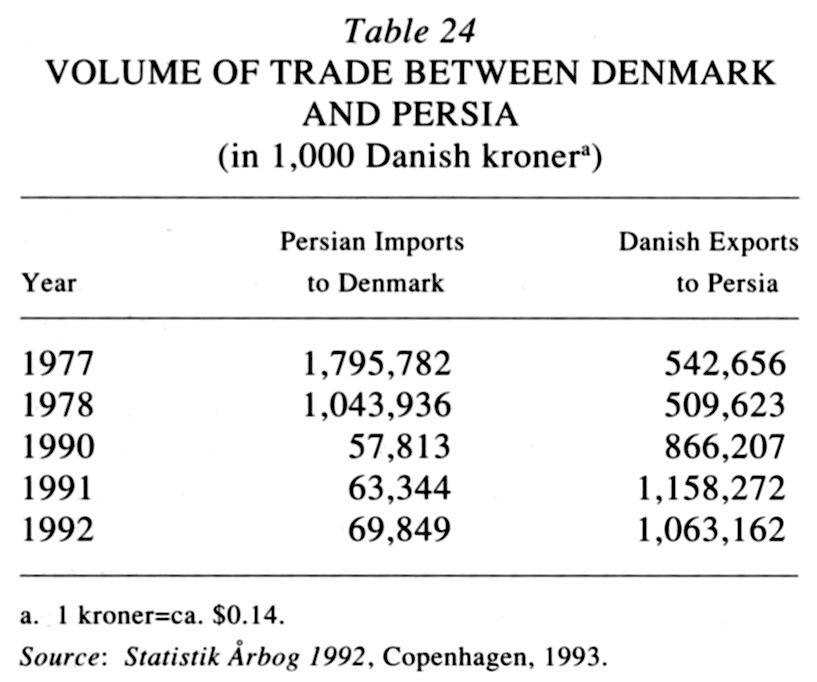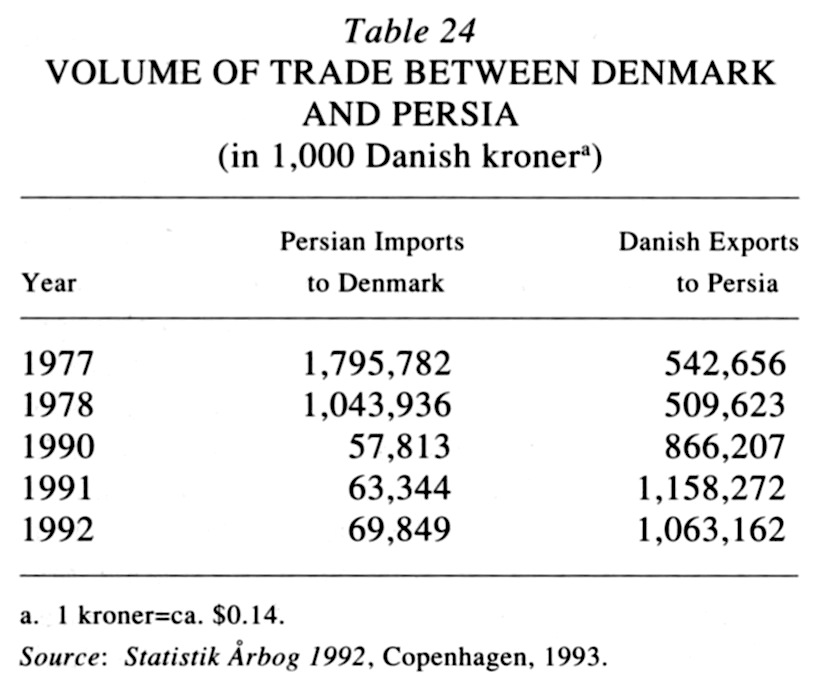



The Danish Iranian Society (Dansk Iransk Selskab, Anjoman-e Īrān o Dānmārk) was founded in Copenhagen on 14 October 1976 to further ties between Denmark and Persia in cultural, social, and economic matters and to further personal contacts between Danes and Persians through meetings, exhibitions, publications, exchange of scholars and artists, and similar activities. The leading figures in launching the society were Mehrangīz Dawlatšāhī, at that time Persian ambassor to Denmark, and Birte Saxild, whose husband, Jθrgen, was director of the Kampsax firm, which had built the Trans-Persian Railway (see i, above). A few weeks after its establishment the society already had about 200 members, and the number increased in subsequent years. Birte Saxild served as president until 1984 and was succeeded by Jes P. Asmussen. After the Revolution of 1357 Š./1978 in Persia, however, the membership declined sharply; although in 1994 it seemed to be stable, the possibility that the society will come to an end in the next few years cannot be excluded.
Among the society’s most important activities is sponsoring lectures on the culture, defined as broadly as possible, of ancient and modern Persia and on cultural relations between Persia and Denmark, the latter including reports of diplomats since the time of Shah ʿAbbās I (996-1038/1588-1629), of Danish archeological expeditions to Persia, and of language studies. Danish, Persian, and other foreign lecturers have addressed the society on such topics as “Persian Poetry and Mysticism,” “Šāh-nāma, the National Epic of the Iranians,” “Rūmī and Sufism,” “Treasures from Ancient Iran in the National Museum of Denmark” (in connection with an exhibition of the collection), “The Architecture of Isfahan,” and “Ṣādeq Hedāyat and Modern Persian Literature.” They have included Annemarie Schimmel, Bozorg Alavī, Arild Hvidtfeldt, Hans Munk Hansen, and Fereydun Vahman.
The society is not sponsored by the Danish government but itself sponsors performances of traditional Persian music and exhibitions of modern Persian art and Persian minatures, bookbindings, lacquer penboxes, and carpets. Whenever possible these arrangements are made in collaboration with the Danish Royal Library, the David Samling (containing Persian miniatures, ceramics, and other decorative arts; von Falsach), the Danish National Museum, and the museum of Rosenborg Castle (where a collection of rare Safavid carpets, including the famous “Coronation carpet,” is housed; see carpets ix, Plate CXI; cf. Martin).
Bibliography
K. von Falsach, Islamisk Kunst, Copenhagen, 1990.
F. R. Martin, Die persischen Prachstoffe im Schloss Rosenborg in Kopenhagen, Stockholm, 1901.
Vedtœgter for Dansk Iransk Selskab/Asās-nāma-ye Anjoman-e Īrān o Dānmārk, Copenhagen, n.d.