




Kamāl-al-Molk’s art was the culmination of a trend towards the adaptation of a European naturalistic style in Persian art, which led to the emergence of a Euro-Persian style in Iran. This hybrid approach began to take shape during the latter half of the 17th century (see art ix. SAFAVID TO QAJAR). This period marked the advent of numerous Iranian contacts with European commercial and diplomatic missions, the presence of a large Armenian community in New Julfa with a variety of European-influenced murals decorating the churches, the arrival of European artists and craftsmen at the royal court in Isfahan, and the influence of new, Western-oriented Indian art on Persian art (see isfahan xxi. school of painting; india xi. indian influence on persian art).
Iranian painters who adapted European perspectives and themes in their hybrid style on paper and papier-maché in this period included such painters as Sheikh ʿAbbāsi, who produced paintings from 1650 to 1684, under the influence of new Indian painting with certain European elements (see ʿabbāsi, šayḵ); Moḥammad Zamān (1649-1704), who was apparently sent to Rome to study the Western classical style (Zoka, 1994; Moḥammad Zaman’s trip to Italy, however, has been questioned by scholars since Zoka; see Layla Diba, “Selseleh: Artistic Dynasties In Persian Painting,” forthcoming). ʿAliqoli Jobbadār (1657-1716) was another pioneer of Euro-Persian style. He was a European (termed Farangi) convert to Islam who became a court official and painter, and his son, Moḥammad-ʿAlī Beg, rose to the position of Naqqāšbāši under Nāder Shah Afshar (r. 1736-47; see ʿali-qoli jobba-dār).
The Euro-Persian style is also in evidence during the Afsharid, Zand, and Qajar periods. In the Qajar period it was practiced by such artists as Abu’l-Ḥasan Ḡaffāri Saniʿ-al-Molk (1814-67) and Mirzā ʿAli-Akbar Khan Mozayyen-al-Dawla, who preceded Kamāl-al-Molk as court painters. But Kamāl-al-Molk’s strong tendency towards naturalism appears to have toned down the Persian elements in his paintings. While Kamāl-al-Molk’s shift from a hybrid Euro-Persian to a purely European style was praised by his students and admirers as revolutionizing Persian painting, it has been criticized by modernist critics for draining Persian painting of the valuable, anti-naturalistic elements which are close to the essence of modern art (see below).
LEARNING AND PRACTICING ACADEMIC PAINTING
Learning academic painting. Kamāl-al-Molk’s early training as an artist likely included an apprenticeship with his uncle, the court painter Ṣaniʿ-al-Molk, who had been sent to Europe by Moḥammad Shah and received training there in classical painting and in the use of the lithographic press. He was appointed chief court painter (naqqāšbāši) and provided with an official studio (Naqqāšḵāna-ye Dawlati) to work in and train students. He taught lithography and painting, partly based on European academic principles, at the Dār al-fonun, Iran’s first modern school of higher learning, where he was director of the state press and editor of the court newspaper until his death in 1867 (see abu’l-ḥasan ḡaffāri; see also Moṣṭafavi, pp. 30-44).
Kamāl-al-Molk continued his studies at Dār al-fonun during the 1870s, where he studied painting with Mozayyen-al-Dawla, Ṣaniʿ-al-Molk’s successor. Mozayyen-al-Dawla was himself a graduate of the Académie des Beaux-Arts in Paris. He faithfully applied the methods of the French Academy and probably maintained aspects of the curriculum instituted by Kamāl-al-Molk’s uncle. Mozayyen-al-Dawla was also a prolific author of textbooks, including several treatise on painting (Ekhtiar, p. 175). Although he relates that his teacher, “Mozayyen al-Dawla was a trained artist in academic art,” Kamal-al-Molk maintained that “I learned the art of painting from no one but myself” (Kamal-al-Molk, p. 35).”
The court painter. Kamāl-al-Molk’s skill soon caught the attention of the shah, who appointed him court painter in circa 1880 at the age of “approximately 20” and generously rewarded him with salaries and court sinecures and offered premises in the Golestān Palace for his studios (Kamāl-al-Molk, p. 28). During the next ten years, Kamāl-al-Molk primarily executed portraits of the ruler and notables of the court, and palace and landscape views that surpassed his contemporaries in their almost photographic naturalism, attention to detail, and color sense. His renderings of the Hall of Mirrors, the Takya-ye Dawlat (Figure 4 and Figure 5), and the Ḥawż Ḵāna are considered among his masterpieces and were universally admired in his day. Yet he also showed an interest in genre scenes, producing a painting of a geomancer (Figure 8) and two women during this period (for details, see iii, below; see also Kamāl-al-Molk, pp. 29-35).
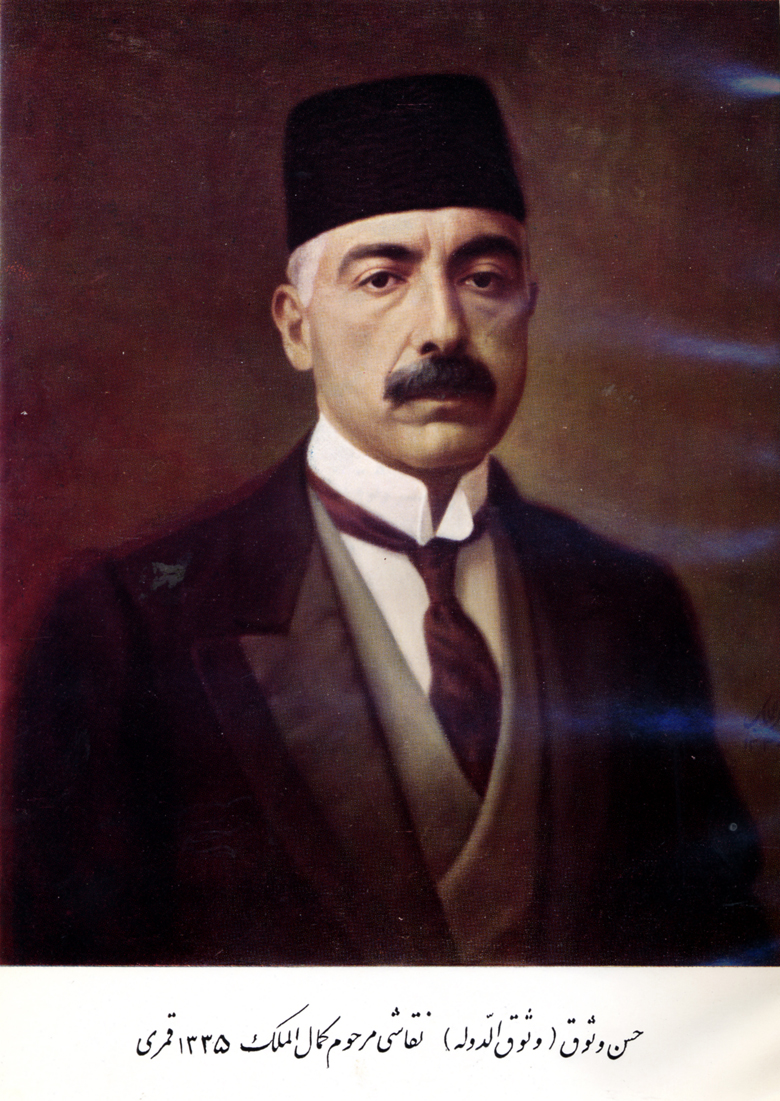
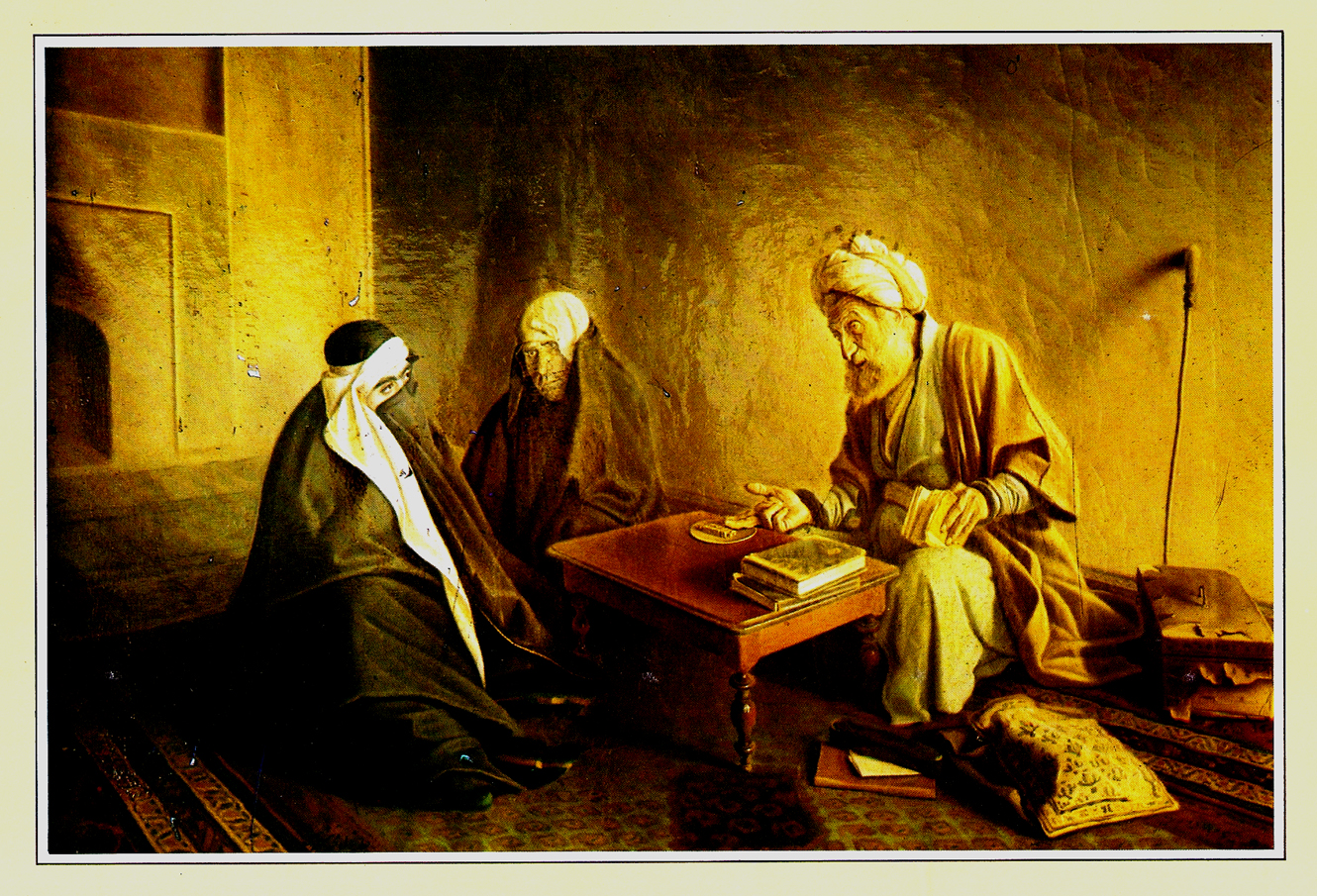
Kamāl-al-Molk often accompanied the ruler on his trips throughout the provinces, and he executed landscape and encampment scenes paintings en plein air, not back at the studio (according to inscriptions on the paintings). Photography played a role in his practice, particularly in portraiture and memorial portraits, but it was his extraordinary skill as a painter even before his trip to Europe, where he would study the old masters directly, which is revealed in the works he produced in the decade when he was working for the court (Kamāl-al-Molk, pp. 29-30).
Learning and practicing in Europe. After the shah’s assassination in 1896, Kamāl-al-Molk briefly worked for his successor Moẓaffar-al-Din Shah, who commissioned him to paint a group portrait with his father at the center and images of Moẓaffar-al-Din Shah at various ages. Many of the portraits were based on photographs in the royal collection taken by Jules Richard (1816-91), one of the early court photographers, who had lived in Persia since 1844 and had converted to Islam, assuming the name Mirzā Reżā Khan (see dār al-fonun; see also Adle and Zoka, pp. 249-80). At this time the ruler accepted Kamāl-al-Molk’s request to go to Europe to study painting for about three years (Kamāl-al-Molk, p. 31; Moʿayyer-al-Mamālek, p. 276). He worked in ateliers in Florence and in Paris, and while there he made copies of the old masters, such as Rembrandt’s Saint Matthew and the Angel and Titian’s Entombment of Christ (Louvre Museum). He also executed portraits of his fellow artists, such as Henri Fantin-Latour, the French realist painter (1836-1904). His main achievement in Europe was to advance his knowledge of perspective, which he had learned by his own practice before (for his works, see iii, below; see also Kamāl-al-Molk, pp. 35).
Although Kamāl-al-Molk worked as court painter for a year on his return, he did not like Moẓaffar-al-Din Shah or his questionable taste in art. Kamāl-al-Molk retired himself to Baghdad and Karbalā for over two years. It is from this period that a shift in subject matter occurs, with greater attention paid to urban scenes and images of the everyday lives of ordinary people (see Table 6, below). This represented a major evolution in the imagery of Persian painting and would have a lasting effect on its subsequent development (Kamāl-al-Molk, pp. 32-33). With the death of Moẓaffar-al-Din Shah in 1907, the system of court patronage of official art, which had endured since the Safavid period, collapsed.
Academy of Fine Arts. In 1911 Kamāl-al-Molk was given permission to establish the Academy of Fine Arts (Madrasa-ye ṣanāyeʿ-e mostaẓrafa), under the aegis of the ministry of education (Ḥakim-al-Molk, pp. 804-5). He was to remain its director through the turbulent times of the Constitutional period and Iran’s political turmoil during the post-Constitutional period and World War I, through to the early 1920s (Foruḡi, pp. 797-805; for useful information concerning the school’s directors, instructors, students, and alumni in 1918, see Ḡani, X, pp. 698-702, 736-39). The school’s alumni formed the nucleus of the school of painters who were the followers of Kamāl-al-Molk’s naturalistic style of painting, known as Maktab-e Kamāl-al-Molk (Āštiāni, pp. 17-18; for samples of the works of Kamāl-al-Molk and a number of his students, see bibliography under Maktab-e Kamāl-al-Molk).
The Academy’s primary mission was to teach academic-style easel painting. The school continued the tradition, initiated at the Dār al-Fonun, of an annual exhibition of artists’ works, which were for sale. Also taught were such applied arts as carpet weaving and lithography. This mixed curriculum reflected the policies and needs of the time. Many schools were founded at this time to supplement the teaching of the Dār al-Fonun, which had significantly declined. Local arts and crafts were also in decline due to foreign imports, and the need for better standards and controls in the carpet weaving industry undoubtedly lay behind this curriculum. The lithographic press had evolved into a tool for the dissemination of constitutional ideals and propaganda, contributing to its predominance at the school.
Kamāl-al-Molk trained the next generation of Persian painters and was greatly respected by Iranians for his character, dedication, and leadership. His students, such as Ḥasan-ʿAli Khan Vaziri and Esmāʿil Āštiāni, continued to direct the school and championed the cause of the classical academic painting which dominated the art scene for the next generation of Iranian painters, for better or worse. Another prominent alumnus of the school was ʿAli-Moḥammad Ḥaydariān, who was considered by some observers to be even superior to his master in portraiture (Vaziri Moqaddam, p. 35). Other students and alumni of the school included Abu’l-Ḥasan Khan Ṣadiqi (Ṣadiq-al-Dawla’s son); Ḥasan Neʿmat-Allāh, a poor boy whom he brought up; Moḥsen Khan Moqaddam (Eḥtesāb-al-Molk’s son); and Ṣaniʿ-al-Solṭān, a talented painter who produced relatively few works (Kamāl-al-Molk, p. 35; for a sample of the works of leading artists of this school, see bibliography under Maktab-e Kamāl-al-Molk).
KAMĀL-AL-MOLK’S ART STYLE
Kamāl-al-Molk was a student of European academic painting, first at Dār al-Fonun and the royal court, and later in Europe. When he was working in Europe, the academic painting that adhered to Neoclassicism and Romanticism was still dominant institution in visual arts—not only in Europe but also in the periphery of the West. The challenges of such modern currents as Impressionism and, more specifically, Expressionism and Cubism, to academic painting only began to gather force during the late 19th and early 20th centuries. Thus it would stand to reason that Kamāl-al-Molk remained untouched by the modernist movements.
But another current of the time that appears to have further buttressed Kamāl-al-Molk’s belief in the Renaissance masters is Naturalism, which has largely been neglected by those who have criticized his European experience (see below, art critique). Naturalism is a broad movement intended to apply to the humanities specific scientific laws that govern the natural sciences. Thereby, the target of the Naturalistic artists is to portray the real world as exactly as possible by using the precise methodology of the natural and physical sciences. In the history of art, Naturalism is a current that appeared during the late 19th century when Kamāl-al-Molk visited European academies and museums. As observed by his disciple, Esmāʿil Āštiāni, “Kamāl-al-Molk chose nature as his model, science as his guide” (Āštiāni, p. 18).
Although undoubtedly influenced by Rembrandt, Kamāl-al-Molk appears to have also been an admirer of Raphael’s style of painting, while, like Edouard Manet (1832-83) and other painters of the latter half of the 19th century, he chose subjects from the events and circumstances of his own time. He observed: “I am inherently inclined to Naturalism. In early life I was enamored by Raphael. Later, when I became more cultivated, I became more attracted to Rembrandt. In painting my ideal was Rembrandt, although I admit that out of a hundred students only two may come equal to Raphael, and ten turn out as Rembrandt, because there are minute points about Raphael that are indescribable. However, I am a great admirer of Rembrandt, and have copied his St. Matthew, which is a great work. To sum up, I believe that Raphael was greater than Rembrandt, but I am attracted and charmed by Rembrandt. I may add that, in terms of color, school of painting, and style I have tried to model myself on Italian masters, the likes of Raphael, emulating Rembrandt to a much lesser extent” (Kamāl-al-Molk, p. 35).
ART CRITIQUE
Discussion on Kamāl-al-Molk’s life and works began in the mid-1940s (a few years after his death) by a number of artists and scholars who in various ways praised him as a great master of Persian art (see, e.g., Vaziri; Qarābegiān; Navāʾi; and Ḡani). The same category of favorable criticism was continued by his students and admirers in the 1950s-60s (see Ḡani; Jamālzādeh; Ḥejāzi; Āštiāni). Although the challenge to Kamāl-al-Molk’s school of painting came in the late 1940s and early 1950s from modernist painters of different political and artistic orientations, it did not lead to a more methodical criticism of Kamāl-al-Molk and his school until the period of the 1970s-80s (for the advent of post-Kamāl-al-Molk modernist painting in Iran during the late 1940s and 1950s, see Yarshater, pp. 363-77). In the period of the 1970s-80s, in addition to admiring reviews (see, e.g., Šayḵ; Eskandari; Yusofi), a number of more relevant critiques from both supporters of European academic art and modernist artists and art critics were published.
Kamāl-al-Molk’s work has been critiqued from different perspectives in the 1970s-80s: loyal students and admirers who believe that he revolutionized Persian art through his meticulous photographic sense of reflecting the object in its natural form and color; modernists who bitterly criticized Kamāl-al-Molk for his preoccupation with emulating nature and thereby discouraging innovative art; and finally those who saw in the rise of his school a deterrent to the revival of such authentic, yet innovative, Persian traditional painting as the works of Reżā ʿAbbāsi or such innovative, popular art as coffeehouse painting (naqqāši-e qahvaḵānaʾi).
Students’ praise. Ḥosayn Šayḵ, in an interview entitled “Painting means the emulation of nature” (“Naqqāši yaʿni taqlid-e ṭabiʿat”), praises Kamāl-al-Molk for founding the Persian school of painting by presenting the beauties of nature (Šayḵ, pp. 32-33; see also Vaziri, pp. 13-99; both were Kamāl-al-Molk’s loyal students).
Esmāʿil Āštiāni, a former student and associate, believes that “in accuracy of design, richness of color, and painstaking attention to detail, Kamāl-al-Molk was greater than all contemporary artists.” Āštiāni says that, if we were to compare painting with photography, we could say that Kamāl-al-Molk’s eyes resembled a camera. The teacher frequently said: “I am able to draw a painting of an object so accurately that it would show no difference from its photograph.” Āštiāni also admires Kamāl-al-Molk for his ability to discover the basic rules of perspective on his own, which he later perfected in Europe. But he observed two weaknesses in his painting. First, he believes that Kamāl-al-Molk was so preoccupied with accuracy of design and mellowness of color that “he little cared about composition and its various modes.” Second, “he paid little attention to the poetical aspect of painting.” Despite these shortcomings, Āštiāni believes that Kamāl-al-Molk “revolutionized Persian painting” during a relatively short period at the Academy, turning the previous styles into decorative arts. Consequently, “the two so-called ‘traditional arts’ or ‘national arts,’ on the one hand, and ‘modern arts,’ on the other, became separate” (Āštiāni, pp. 16-18).
Modernist critiques. The modernist critics of Kamāl-al-Molk’s style focus their assessments on precisely what his supporters highlighted as the achievements of his school. Aidin Aghdashlou (Āydin Āḡdāšlu), a modernist artist and art critic, maintains that Kamāl-al-Molk was able to gain a good command of Western painting, understand the rules and norms of naturalistic art, and assimilate all the achievements of post-Renaissance Italy. However, this was not a very significant triumph, because Western art at the turn of the 20th century was discarding these achievements and their foundations, and moving toward a subjective, flat, pure, and abstract kind of art; that is to say, it was heading in the same direction from which Kamāl-al-Molk had come (Aghdashlou, p. 232).
Dissuasive effect on Persian art. Moḥsen Vaziri-Moqaddam, another modernist critic, focuses his criticism on the obstacles that Kamāl-al-Molk and, more specifically, his mediocre students, created to the revival of authentic, yet innovative, Persian art. He believes that Reżā ʿAbbāsi created pictures “that promised a new stage in the art of painting and portraying.” For the first time, Vaziri-Moqaddam says, pictures of nature and human beings were combined with Iranian architecture. Reżā ʿAbbāsi’s innovations, including new proportions, dimensions, and color schemes, were transformed in Zand and Qajar painting; that is, “geometrical lines and eslimi decorations gradually gave way to natural elements,” while they continued to show traces of the old Iranian miniatures (Vaziri-Moqaddam, pp. 34-35). In Vaziri-Moqaddam’s negative assessment, instead of receiving inspiration from Reżā ʿAbbāsi’s style and combining it with an innovative understanding of European classical art, and instead of giving a fresh spirit to Qajar mural drawings and paintings, “Kamāl-al-Molk set about photographing Nature, painting things exactly as all people see them” (Vaziri-Moqaddam, p. 35).
In praise of naturalism. Ruiʾin Pākbāz, who was enchanted by Kamāl-al-Molk’s naturalistic outlook, believes that he made a breakthrough in Persian art. He maintains that the canvas “The Hall of Mirrors” (Tālār-e āʾina; Figure 2) was a starting point in modern Persian art. It shook the pillars of the “Qajar School,” which according to Pākbāz focused on Persian miniature traditions, increasingly receding into mere imitation and unoriginality. Pākbāz believes that Kamāl-al-Molk pursued, to the end of his life, a continuation of the “The Hall of Mirrors.” In this way, Kamāl-al-Molk represented the ending of a tradition and the serious beginning of another current, which was inspired by Western art. Though the process of receiving influence from Western art had started at a much earlier time, the effects of such art, before Kamāl-al-Molk, were somehow absorbed into the works of traditional Persian painters, while in Kamāl-al-Molk’s works, the traditional standards of Iranian painting were gradually pushed aside and replaced with the norms of European art. Pākbāz believes that traditional Iranian painting had always moved in an anti-naturalistic atmosphere, essentially due to its mystical motifs. Nonetheless, following the efforts made by his predecessors toward Naturalism, Kamāl-al-Molk completely set aside the symbolic view of nature and gradually advanced to a mature form of Naturalism (Pākbāz, pp. 241-42).
Bibliography
Chahryar Adle and Yahya Zoka, “Notes et documents sur la photographie iranienne et son histoire,” Studia Iranica 12, 1983, pp. 249-80.
Āydin Āḡdāšlu, “Ḵāstgāh-e Kamāl-al-Molk,” in Yād-nāma, pp. 223-38.
Bozorg Alavi, Čašmhāyaš, Tehran, 1952; tr., J. O’Kane as Her Eyes, New York, 1989.
Esmāʿil Āštiāni, “Šarḥ-e ḥāl va tāriḵ-e ḥayāt-e Kamāl-al-Molk,” in Honar o mardom 1/7, 1963, pp. 8-19; repr. in Yād-nāma, pp. 177-98.
Ṣaniʿ ʿAṭāʾi, “Šarḥ-e ḥāl-e Kamal-al-Molk,” a letter to Dr. Qāsem Ḡani (31 August 1940), in Ḡani, IX, pp. 810-16.
Mehdi Bāmdād, Tāriḵ-e rejāl-e Irān dar qorun-e 12, 13, 14 Ḥejri, 6 vols., Tehran, 1968-72.
ʿAbd-al-ʿAli Dastḡayb, Naqd-e āṯār-e Bozorg-e ʿAlavi, Tehran, 1999.
ʿAli Dehbāši, ed., Nāmahā-ye Kamāl-al-Molk, Tehran, 1989.
Maryam Ekhtiar, “The Dār al-Funun: Educational Reform and Cultural Development in Qajar Iran,” Ph.D. diss., New York University, 1994.
Karim Emāmi, “Art xi. Post-Qajar (Painting),” in EIr. II, 1987, pp. 640-46.
Iraj Eskandari, “Kamāl-al-Molk va taḥavvolāt-e naqqāši-e moʿāṣer-e Irān,” in Qāmus 3, 1985; repr. in Yād-nāma, pp. 319-26.
Moḥammad-Ḥasan Khan Eʿtemād-al-Salṭana, al-Maʾāṯer wa’l-āṯār, Tehran, 1888.
Idem, Ruz-nāma-ye ḵāṭerāt-e Eʿtemād-al-Salṭana, ed. I. Afshar, Tehran, 1970.
Willem Floor, “Art (Naqqāshi) and Artists (Naqqāshān) in Qajar Persia,” Muqarnas 16, 1999, pp. 125-54.
M.-ʿA. Foruḡi, “Ḥālāt-e Kamāl-al-Molk,” in Ḡani, IX, pp. 783-802.
Ḡolām-Ḥosayn Ḡaffāri Ṣāḥeb Eḵtiār, “Nāma-ye Ṣāḥeb Eḵtiār be Doctor Ḡani,” in Ḡani, IX, pp. 807-9.
Qāsem Ḡani, Yāddāšthā-ye Doktor Qāsem-e Ḡani, 12 vols., London, 1980-84.
Idem, “Ḵāṭerāti az Kamāl-al-Molk,” in Ḡani V, 1981, pp. 10-25.
Idem, “Nāmahā-ye Kamāl-al-Molk,” in Ḡani, V. Nāmahā-ye Kamāl-al-Molk va Moḥammad Qazvini, London, 1981, pp. 26-162.
Idem, “Dar bāb-e Mirzā Moḥammad Khan Ḡaffāri Kamāl-al-Molk,” in Ḡani, X, London, 1983, pp. 677-85.
Moḥammad Golbon, “Sālšemār-e zendagi-e Kamāl-al-Molk,” in Āyanda 9/12, 1983; repr. in Yād-nāma, pp. 331-36.
Hušang Golširi, Bāḡ dar bāḡ (A garden within the garden), Tehran, 1999.
Ebrāhim Ḥakimi Ḥakim-al-Molk, “Ānčeh Ḥakim-al-Molk rājeʿ be Kamāl-al-Molk negāšteh ast,” in Ḡani, IX, pp. 803-6.
Moḥammad Ḥejāzi, “Kamāl-al-Molk,” in E. Ḵājenuri, Mardān-e ḵowd sāḵteh, Tehran, 1956, pp. 103-18; repr. in Yād-nāma, pp. 155-64.
Michael C. Hillmann, ed., “Major Voices in Contemporary Persian Literature,” Literature East and West 20, l976, pp. 85-98.
Sayyed Moḥammad-ʿAli Jamālzādeh, “Kamāl-al-Molk,” in Honar o mardom 3/35, 1965, pp. 6-19; repr. in Yād-nāma, pp. 81-92; and “Yād-e Kamāl-al-Molk,” in Yād-nāma, pp. 93-96. Kamāl-e honar: see Sohayli Ḵvānsāri.
Kamāl-al-Molk, “Šarḥ-e ḥāl-e Kamāl-al-Molk az zabān-e ḵodaš,” in Ḡani, V, pp. 26-37 (this autobiography is based on an interview of Kamāl-al-Molk by Dr. Ḡani in Nišabur); repr. in Yād-nāma, pp. 11-20.
M.-ʿA. Karimzādeh Tabrizi, Aḥvāl va āṯār-e naqqāšān-e qadim-e Iran va barḵi az mašāhir-e negārgar-e Hend va ʿOṯmāni, London, 1985, III, entry no. 1117, pp. 1031-59.
ʿAli Maḥmudi, two letters to Dr. Ḡani (Maḥmudi, a student and relative of Kamāl-al-Molk, wrote two letters to Dr. Qāsem Ḡani in 1940 and 1941, collecting his memories of Kamāl-al-Molk), in Ḡani X, pp. 707-31.
“Majmuʿa-ye asnād-e montašer našoda dar bāre-ye aʿżā-ye Lož-e Bidāri-e Irān,” Irān 1/48, 4 April, 1995, pp. 6-7.
Ḥassan Mirʿābedini, Sad sāl dāstān nevisi dar Iran (One hundred years of fiction writing in Iran) I, Tehran, 1999.
Maktab-e Kamāl-al-Molk: Majmuʿa-ye āṯār-e Kamāl-al-Molk, Āštiāni, Awliāʾ, Ḥaydariān, Šayḵ, Yāsami, va Šehābi, Tehran, 1986.
Ḥosayn-ʿAli Moʾayyad Pardāzi, “Čeguna bā Kamāl-al-Molk āšnā šodam,” in Ḡani, X, pp. 733-48.
Dust-ʿAli Khan Moʿayyer-al-Mamālek, “Mirzā Moḥammad Khan Ǧaffāri Kamāl-al-Molk,” in idem, Rejāl-e ʿaṣr-e Nāṣeri, Tehran, 1982, pp. 276-77.
M.-T. Moṣṭafavi, “Čand nasl-e honarmand dar yek ḵāndān-e čand ṣad sāla-ye Kāšān,” Naqš o negār 1/7, 1950, pp. 30-44; repr. in Yād-nāma, pp. 21-38.
Ḥ. Narāqī and F. Ḡaffāri, Ḵānadān-e Ḡaffāri-e Kāšān, Tehran, 1974.
ʿAbd-al-Ḥosayn Navāʾi, “Kamāl-al-Molk, āfarinande-ye zibāʾi,” in Eṭṭelāʿāt-e māhāna, 4 July 1949; repr. in Yād-nāma, pp. 97-138.
Ruʾin Pākbāz, “Kamāl-al-Molk: Sonnat-šekan-e bozorg,” in Tamāšā 4/186, 1974; repr. in Yād-nāma, pp. 239-46.
Idem, “Kamāl-al-Molk: Sonnat-šekan va sonnat-gozār,” Honar o mardom 13/150, 1975, pp. 63-67; 151, pp. 63-68; 152, pp. 62-67; 155, pp. 47-51; repr. in Yād-nāma, pp. 247-77.
Mārkār Qarābegiān, “Moḥammad Ḡaffāri Kamāl-al-Molk, honarmand va naqqāš-e bozorg,” Payām-e now 2/9-10, 1946, pp. 81-92; repr. in Yād-nāma, pp. 199-206.
B. W. Robinson, “Art in Iran x. Qajar 2. (Painting)” in EIr. II, 1987, pp. 637-40.
Šarāfat 60, Tehran, 1902; reprint, 1976. Ḥosayn Šayḵ, “Naqqāši yaʿni taqlid-e ṭabiʿat” (an interview by Kāveh Rastegār), Rudaki 4/37-38, 1974, pp. 32-33; repr. in Yād-nāma, pp. 213-16.
A. Sohayli-Ḵᵛānsāri, ed., Kamāl-e honar: Aḥvāl va āṯār-e Moḥammad Ḡaffāri Kamāl-al-Molk (Perfection of the art: life and works of Mohammad Ghaffari Kamal-al-Molk), Tehran, 1989.
Tābeš “Kamāl-al-Molk mardi az Kāšān” (attributed to Kamāl-al-Molk’s cousin, a certain Tābeš, by Ḡani’s son, Cyrus), in Ḡani, V, pp. 38-46.
Ḥasan-ʿAli Vaziri, Kamāl-al-Molk, Tehran, 1946; selection repr. in Yād-nāma, pp. 165-76.
Moḥsen Vaziri-Moqaddam, “Kamāl-al-Molk va peyrovan-e ou,” Rudaki 4/37-38, 1974, pp. 33-36; repr. in Yād-nāma, pp. 279-88.
Wezārat-e maʿāref va awqāf va ṣanāyeʿ-e mostaẓrafa, Sāl-nāma, 1918, “Qesmat-e šešom, Ṣanāyʿ-e mostaẓrefa,” pp. 41-43; repr. Ḡani, X, pp. 698-702.
[Yād-nāma] Yād-nāma-ye Kamāl-al-Molk, ed. D. B. Šabāhang and ʿAli Dehbāši, Tehran, 1985.
Ehsan Yarshater, “Contemporary Persian Painting,” in R. Ettinghausen and E. Yarshater eds., Highlights of Persian Art, Boulder, 1979, pp. 363-77.
ʿAli Yādgār Yusofi, “Kamāl-al-Molk gozašta-gerā-ye sonnat šekan,” in Rastāḵiz 702, 1977; repr. in Yād-nāma, pp. 303-10.
Yahya Zoka, “Mohammd Zaman, The First Iranian Painter to Visit Europe,” in Stuart Welsh and Y. Zoka, Persian and Mughal Miniatures. The Life and Times of Muhammad-Zaman, Tehran, 1994, pp. 18-22.
Idem, Tāriḵča-ye arg-e salṭanati va rāhnemā-ye kāḵ-e golestān, Tehran, 1970.
Idem, Tāriḵ-e ʿakkāsi va ʿakkāsān-e pišgām dar Iran (The history of photography and pioneer photographers in Iran), Tehran, 1997. (The author would like to acknowledge Dr. Layla Diba’s contribution in preparing the part on “Learning and practicing academic painting,” in section ii, above.)