




Soon after the inception of Islam Muslim leaders found it necessary to establish a basis for determining the proper dates for recurring religious observances. As the community grew, this simple calendar had to be altered and supplemented to meet the need for more sophisticated recording of events and transactions. Finally, after the conquest, it became clear that effective administration of a vast territorial empire would require a consistent calendar suitable especially for the collection of taxes and tribute. Gradually evolving awareness of these increasingly complex demands was reflected in anomalies like the concurrent use of different calendars for different purposes. Several of the calendars introduced in the Islamic period were adaptations of ancient Iranian systems, and in Iran itself foreign influences continued to be assimilated to indigenous practices and requirements.
The lunar Hejrī calendar (Q. = Qamarī, A.H. = anno hegirae). For several years after the hejra (the Prophet’s flight from Mecca to Medina), which took place in the Arab month of Rabīʿ I, that event was taken as the starting point of the Islamic calendar, and dates were reckoned by counting the months from Rabīʿ I. Wāqedī (130-207/747-823), who was a major source for most later historians, reckoned dates in this way until the expedition against Dūmat al-Jandal in the forty-ninth month after the hejra (5/626; I, p. 402). After that, though he sometimes dated an event or expedition by this system, he more often specified the year, following the old Arabian system in which the years began with the month of Moḥarram. It thus seems clear that he did not calculate the dates himself but simply copied them as he found them in his sources. Ebn Saʿd (168-230/784-845), author of Ketāb al-ṭabaqāt at-kobrā, and the historians Yaʿqūbī (d. 284/897), Ṭabarī (d. 311/923), and Masʿūdī (d. ca. 345/956) also included both kinds of dates in the same apparently random way, no doubt reflecting their sources.
Early Islamic historians and later scholars have been virtually unanimous in reporting that the so-called lunar Hejrī calendar was introduced by the second caliph, ʿOmar b. Ḵaṭṭāb (r. 13-23/634-44), in A.H. 16, 17, or 18 (637-39). This statement has apparently never been seriously questioned, yet the sources contain other evidence that this calendar was already in use before his succession. Ṭabarī, who gives a lengthy account of the introduction of the lunar calendar by ʿOmar (I, pp. 1250-56, 2480), also quotes the full texts of letters from Ḵāled b. Walīd (d. 21/642) to the governors of certain towns (I, pp. 2044-45, 2051); they are dated in different months of the twelfth year after the hejra, before ʿOmar’s accession to the caliphate. Balāḏorī (pp. 80-81) quotes a message from the Prophet himself, dated in the ninth year of the hejra</em>; another letter from the Prophet, of the same year, is quoted by Abū Noʿaym (I, pp. 52-53) and Ḥamd-Allāh Mostawfī (pp. 229-31; for other documents, see Abdollahy, 1987, pp. 15-25).
The practice of counting months from Rabīʿ I but years beginning with Moḥarram soon led to difficulties, however, and it was to resolve the resulting confusion that ʿOmar decided to convene a council, reports of which are included in several sources (Masʿūdī, Tanbīh, pp. 266-67; Yaʿqūbī, II, p. 29; Ṭabarī, I, pp. 1250-56, 2480). These accounts suggest that two matters were discussed at the meeting of this council. The first was official definition of the lunar Hejrī era. The second was formulation of an appropriate calendar for collecting tribute and taxes (see below). In order to regularize public business, either 1 Rabīʿ I or 1 Moḥarram of the year in which Moḥammad made the hejra had to be chosen as the official beginning of the Muslim epoch. According to Ṭabarī (I, p. 1253), ʿOmar summoned the leading men and asked, “from which day should we write [dates]?” ʿAlī b. Abī Ṭāleb answered, “from the day on which God’s Apostle emigrated [from Mecca],” that is, the first day of Rabīʿ I. ʿOmar, however, preferred 1 Moḥarram (15 July 622; Ṭabarī, I, pp. 1254-55). As the Prophet’s departure from Mecca had taken place on the eve of a Monday (i.e., on a Sunday night), that Monday was established as the first day of the month of Rabīʿ I of the first year in the Hejrī calendar (12 September 622).
The lunar Hejrī calendar was based on the synodic month, reckoned from one sighting of the new moon to the next. The root meanings of the month names, many of which refer to climatic conditions (see Table 34), indicate that in pre-Islamic Arabia lunar months had customarily been brought into line with the seasons through recurrent insertion of an intercalary month and thus that a sort of lunisolar calendar was in use. There is, however, a great deal of evidence to suggest that no such intercalation took place in the territory under the Prophet’s rule during the first decade after the hejra (Nallino, pp. 108ff.; Beeston, pp. 15-25; Nilsson, pp. 251-55; see also Abdollahy, 1987, pp. 29-30). The lunar Hejrī calendar used by Muslims today for the timing of religious observances still follows the same pattern as in those first Hejrī years; it consists of lunar years and months with no intercalations.
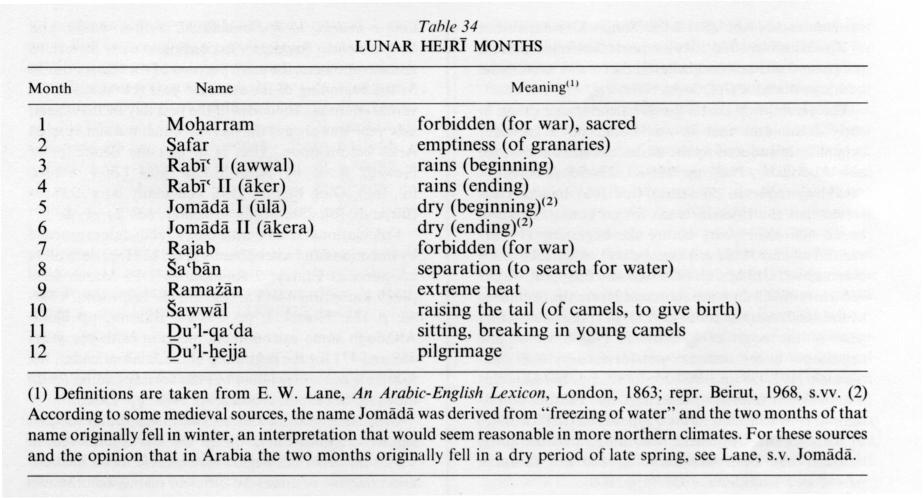
For the purpose of establishing consistent intervals between the beginning of the epoch and given dates, however, astronomers adopted an “artificial” standard calendar. As a result, two separate lunar Hejrī calendars have arisen: an unofficial version used for determining religious observances and an official one computed mathematically, in which dates are more predictable. It often happens that the calculated first days of lunar months given in almanacs differ by one or two days from the dates of religious celebrations determined by sightings.
Astronomers base their computations for almanacs and perpetual lunar calendars on a mean value for the length of a synodic month: 29; 31, 50 days, expressed sexagesimally (i.e., 29 days plus 31 sixtieths of a day plus 50 sixtieths of a sixtieth of a day); the length of the year is 354; 22, or 354 11/30 days. The lengths of the months are normally set alternately at thirty and twenty-nine days; Ḏu’l-ḥejja, the last month, contains twenty-nine days in an ordinary year and thirty in a leap year. In the computed lunar Hejrī calendar leap years are distributed over thirty-year cycles. Each cycle consists of 354 11/30 x 30, or 10,631 days, which are divided among nineteen ordinary years of 354 days each (a total of 6,726 days) and eleven leap years (a total of 3,905 days). Within each cycle the second, fifth, seventh, tenth, thirteenth, sixteenth, eighteenth, twenty-first, twenty-fourth, twenty-sixth, and twenty-ninth years are designated as leap years. This is the system of Ḵᵛārazmī and of Yaḥyā b. Abī Manṣūr (see Pingree, p. 110). Others intercalate on the third, sixth, eighth, eleventh, thirteenth, sixteenth, nineteenth, twenty-first, twenty-fourth, twenty-seventh, and thirtieth years, but generally all astronomers follow Yaḥyā (see Ginzel, I, p. 255).
The ḵarāji calendar. Early Muslim leaders dispensed with the old Zoroastrian method of intercalation, based on a solar year of 365 1/4 days. In this cycle a normal year contained 365 days, and after 120 years an extra month of thirty (120 x 1/4) days was added. Under the newly adopted Hejrī calendar, however, the period during which ḵarāj, or land tax (paid in cash or kind), was to be collected fell earlier in each annual agricultural cycle; as a result there were long intervals in which the tax came due before harvest time. This problem must have been recognized very early. The captive Iranian general Hormozān is said to have attended ʿOmar b. Ḵaṭṭāb’s advisory council (see above) to explain the solar calendar by which taxes had been collected in the Sasanian empire (Bīrūnī, Āṯār, pp. 29-30; Ḥabīb al-sīar I, pp. 484-85). Some modern researchers have exaggerated the importance of Hormozān’s role, even claiming that ʿOmar’s formulation of the lunar Hejrī calendar was made on his advice (Homāʾī, pp. 399-402), but it is clear that Hormozān could not have had either the competence or the status to participate in such a decision. Although early historians do not mention whether or not ʿOmar decided to adopt a version of the Iranian calendar for tax purposes, Moḥammad b. Abī ʿAbd-Allāh Sanjar Kamālī, author of Zīj-e ašrafī (ca. 710/1310), reports that in his time the people and astronomers believed that it was ʿOmar who had introduced it (fol. 3a-b).
The assumption that a ḵarājī calendar was in use in early Islam and that it was based on a calendar originally introduced by the Sasanians (see i above; see also Abdollahy, 1988, pp. 225-34, 279-95) is corroborated by a report in Zīj-e ašrafī (fol. 10b), in which it is stated that the calendar used for collecting the ḵarāj began 468 solar years before the beginning (1 Farvardīn) of the Jalālī era (see below), which fell on 9 Ramażān 471/15 March 1079 (see also Fārsī, fol. 7b). If 468 years of 365 days are subtracted from the beginning of the Jalālī era, the result is a.d. 611, the twenty-first year of the reign of Ḵosrow II (591-628); despite arguments to the contrary put forward by S. H. Taqizadeh (1937-39, pp. 909-10; 1967, pp. 164-66), this date was not related to the Hejrī era. Further confirmation is to be found in the Ẓafar-nāma (828/1424-25) of Šaraf-al-Dīn ʿAlī Yazdī, who noted that the ḵarājī calendar had been introduced in the late Sasanian period (see Taqizadeh, 1937-39, p. 909).
Early Islamic Persian writers rarely cited ḵarājī dates, but the few instances in which they did give them with their Hejrī equivalents throw some light on the nature of the early ḵarājī calendar. For example, according to Zīj-e ašrafī (fol. 10b), the months used in Fārs coincided exactly with those of the Yazdegerdī calendar, though they were eleven full years apart. This calendar of Fārs must have been the original ḵarājī calendar adopted soon after the coming of Islam. The ḵarājī dates given by Moḥammad b. Ebrāhīm (see Abdollahy, 1988, pp. 289, 290, 365; 1977, pp. 140-41, 194) are of the same nature. On the other hand, those given by Waṣṣāf (663-735/1265-1334; Abdollahy, loc. cit.) indicate that he followed a system in which the months coincided with the months of the Jalālī calendar (see below; cf. Fārsī, fol. 5b).
Whether or not it was ʿOmar b. Ḵaṭṭāb who adapted the Sasanian ḵarājī calendar for tax purposes in Islam, it was already in use by the time of the caliph Hešām (r. 105-25/724-43); Bīrūnī reports that landlords petitioned one of his officials to restore the intercalary month and thus to postpone the beginning of tax collection (eftetāḥ ḵarāj</em>; Āṯār, p. 32). Although taxpayers’ complaints persisted through the early ʿAbbasid period, it was not until the reign of al-Moʿtażed (279-89/892-902) that an intercalation of two months was introduced into the Zoroastrian year (Bīrūnī, Āṯār, p. 33; Qomī, pp. 145-46; Masʿūdī, Morūj, ed. Pellat, V, pp. 172-73; tr. Pāyanda, II, p. 664); through the addition of sixty days to the year 264 Yazdegerdī (282/895), Nowrūz was relocated from Saturday, 1 Farvardīn (12 Ṣafar/12 April), to Wednesday, 1 Ḵordād (13 Rabīʿ 1/12 May; see Abdollahy, 1988, pp. 280, 283).
The Jalālī calendar. A true solar calendar was introduced during the reign of the Saljuq sultan Jalāl-al-Dawla Moʿezz-al-Dīn Abu’l-Fatḥ Malekšāh (465-85/1072-92) and variously designated tārīḵ-ejalālī, tārīḵ-emalekī, tārīḵ-emalekšāhī, tārīḵ-esolṭānī, and tārīḵ-emoḥdaṯ (modern). According to early historians and astronomers, the main purpose of the reform was to fix the beginning of the calendar year (Nowrūz) at the vernal equinox. Thenceforth the first day of the official new year was always the day on which the sun entered Aries before noon. That is in fact the definition of Nowrūz given by Naṣīr-al-Dīn Ṭūsī (Zīj-e īl-ḵānī, fol. 15b), Oloḡ Beg (p. 310), and many later authors (Bīrjandī, fol. 23b; Mollā Moẓaffar, bāb 2, sec. 4).
Calculations based on the many Jalālī dates recorded by historians and astronomers give the Hejrī date of its adoption as Friday, 9 Ramażān 471/15 March 1079 (= 19 Farvardīn 448 Yazdegerdī; cf. Taqizadeh, 1940-42, p. 112; Ginzel, I, pp. 303-04; Bulsara, pp. 66ff.). Although some astronomers mention both the years 468 and 471 for the beginning of the Jalālī calendar, the former is not a Hejrī date but the corresponding ḵarājī date (see above; cf. Abdollahy, 1988, pp. 298ff.).
Most astronomers and historians agree that the first eighteen days of Farvardīn of the Yazdegerdī year in which the Jalālī era began were treated as an intercalation (kabīsa-ye jalālī). In order to distinguish the two calendars, in which the same Zoroastrian month names were used, the Yazdegerdī months were qualified as qadīmī (old) or fārsī and those of the Jalālī calendar as either jalālī or malekī. Similarly, Nowrūz in the Jalālī calendar was designated Nowrūz-e malekī, Nowrūz-e solṭānī, and Nowrūz-e Ḥamal. Naṣīr-al-Dīn Ṭūsī describes the Jalālī calendar in Zīj-e īl-ḵānī</em>; elsewhere, however, he remarks that certain earlier astronomers had recorded the introduction of new names for the months and days in the Jalālī calendar (1330/1912, faṣl b). These names also appear, with some differences, in Zīj-e ašrafī (Sanjar Kamālī, fol. 4a). See Table 35, Table 36.

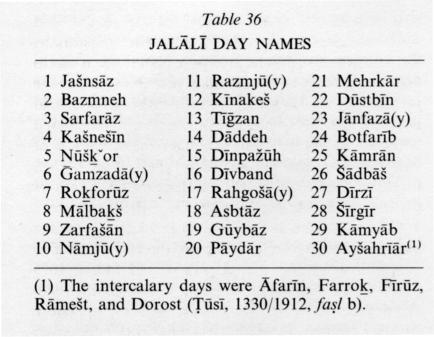
Medieval astronomers mention that, because the Jalālī year was a true solar year, some people assumed, that the length of its months was that of a true solar month; they therefore also assumed incorrectly that the beginning of each month was the day on which the sun entered the associated sign of the zodiac. In fact, the months were not true solar months but consisted of thirty days each. The seasons in this calendar were astronomically true, however, as the beginning of each was marked by the apparent passage of the sun through the equinox or solstice.
The astronomers responsible for devising the Jalālī calendar worked out rules for the sequence of ordinary and leap years. ʿAbd-al-Raḥmān Ḵāzenī (fl. 6th/12th century), who is said to have been one of the eight astronomers in charge of the reform, explains in his al-Zīj al-moʿtabar al-sanjarī the method of intercalation in a cycle of 220 years (Moḥīṭ Ṭabāṭabāʾī; Taqizadeh, 1939-42, pp. 111, 114-16; Abdollahy, 1977, p. 151; 1988, pp. 306-08). It seems, however, that his formula was abandoned in later centuries. The establishment of the observatory at Marāḡa in the second half of the 7th/13th century resulted in significant advances in astronomy, and the length of the true solar year was found to differ from the length of the year in the Jalālī calendar; modification of the intercalation system therefore became necessary.
In Zīj-e īl-ḵānī Naṣīr-al-Dīn Ṭūsī gives a table in which the quadrennia and quinquennia of the first 295 Jalālī years are shown (fol. 16a). That is, an extra day was added every four years, and after seven such quadrennia the extra day was added to a period of five years. The quinquennial leap years are the Jalālī years 31, 64, 97, 130, 163, 192, 225, 258, and 291 (Abdollahy, 1977, pp. 154-56; 1988, pp. 309-16). In 295 years therefore a quarter-day was intercalated 295-9 = 286 times, for a total of 295 x 365 + 286 x 1/4 days. The length of a solar year thus closely approximated Ptolemy’s 365 1/4-1/300 days (expressed sexagesimally, 6, 5; 14, 48 days; the length of the Jalālī year would be 6, 5; 14, 45 days by this reckoning).
In order to discover whether a particular year in the Jalālī calendar is an ordinary or a leap year, it is necessary first to add 3 to the year in question (correcting for the beginning of the epoch), then to multiply the total by 39 (the number of leap years in each major cycle), and finally to divide the product by 161; if the remainder is less than 39, the year was a leap year. The fraction 39/161 is a crude approximation of the excess of a solar year over 365 days: 39/161 ~ 0; 14, 33, instead of Ptolemy’s 0; 14, 48. (For the more accurate 128-year cycle see discussion of the solar Hejrī calendar below).
The duodecennial animal cycle. As Ṭūsī supervised construction of the observatory at Marāḡa at the request of the Mongol ruler Hūlāgū (Hülegü) Khan, it is not surprising that the greater part of his Zīj-e īl-ḵānī, which he wrote there, is devoted to the calendar used by the Mongols, the duodecennial animal cycle (see also i above), in which the years are named after each of twelve animals in turn. There can be no doubt, however, that the original Chinese-Uighur form of this calendar was never used by Iranians, either during the Mongol period or later. The only references to it are several dates in the early Mongol period mentioned by Rašīd-al-Dīn (p. 18; Boyle, 1971, pp. x, 346). The form of this calendar used by Iranians combined features of the Chinese-Uighur original with those of the lunar Hejrī and Jalālī calendars. Furthermore, during the period of seven centuries in which this calendar was in use, from the Mongol invasion until 1304 Š./1925, certain additional modifications were made. (Cf. Tables 33, 42.)
The point from which the years are reckoned is the same as for the Hejrī era (Thursday, 15 July 622). A new starting point was adopted in the reign of Ḡāzān Khan (r. 694-703/1295-1304), but it did not remain in use for long; contemporary historians do not agree on the corresponding lunar Hejrī date (see Abdollahy, 1977, pp. 164-65; 1988, p. 330). Dating by the Tārīḵ-eḡāzānī, or Tārīḵ-eḵānī, continued in official Il-khanid circles during the reign of Ḡāzān’s successors Ūljāytū (Öljeitü, 703-17/1304-17) and Abū Saʿīd (717-36/1317-35) but was not in general use (see Sayılı, pp. 229-31).
Even after the duodecennial animal cycle became widely accepted, use of the lunar months determined by direct observation was not given up. Consequently, two features of the lunar Hejrī calendar were incorporated into it: the starting point, which was directly connected with the Prophet of Islam, and the lunar months, which, according to Koranic teaching, could not be changed. The religious year was considered to begin on the first day of the lunar Hejrī calendar, but in administrative affairs the solar Nowrūz-e jalālī was used, and the year ended on the day before the next Nowrūz. In order to keep the reckonings of these lunar and solar years in harmony any lunar year that happened to fall completely within a solar year was dropped from the animal cycle (Poole, pp. xviii-xx; see also Abdollahy, 1988, pp. 334-36).
In 1329/1911 the Persian parliament adopted as the official calendar of Iran the Jalālī solar calendar with months bearing the names of the twelve constellations of the zodiac and the years named for the animals of the duodecennial cycle; it remained in use until 1344/1925. The naming of years for animals is still customary in certain Persian almanacs. In order to determine the animal to which a given Hejrī year is allotted, 6 must first be added to the year in question and the sum divided by 12; the remainder can be matched to an animal in the cycle: 1 = mouse, 2 = ox, 3 = tiger, and so on up to 12 = pig, the last animal in the cycle.
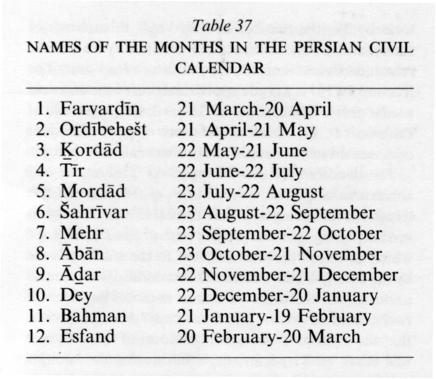
The solar Hejrī (Š. = Šamsī) and Šāhanšāhī calendars. The combination of the solar year with the Hejrī era, called Taqwīm-e hejrī-e šamsī, is a comparatively recent development. The law by which it became the official Persian calendar was enacted by the Majles on 11 Farvardīn 1304 Š./31 March 1925; it has remained in force since, except for a short break (Table 37).
On 24 Esfand 1354 Š./14 March 1975 the Majles approved a new era based on the supposed year of accession of the first Achaemenid king, Cyrus the Great (559 b.c.); thus, 21 March 1976 became the first day (Nowrūz) of the year 2535 in the Šāhanšāhī era. The month names of the Persian solar Hejrī calendar were retained without change. Official documents and publications were dated according to the new calendar. This caused much confusion and created widespread discontent, particularly among the clergy. Eventually, on 5 Šahrīvar 1357 Š./27 August 1978, the government, in the face of the coming revolution, reverted to the solar Hejrī calendar. This calendar is reckoned from 1 Farvardīn, 119 days before 1 Moḥarram of the Arabian lunar year in which the hejra took place. The Julian date corresponding to the first day of the solar Hejrī era is 19 March 622. Taqizadeh gives 17 March 622 (1937-39, p. 916), which was apparently the date arrived at by the Persian commission for calendar reform in 1304 Š./1925.
The months of the solar Hejrī and Šāhanšāhī calendars are named for the ancient Iranian months, first attested in the Arsacid period (see i above; cf. Abdollahy, 1977, p. 78; 1988, p. 166) and used in various Iranian calendars up to the present day. Although the sequence and number of months are identical in all Iranian calendars, the lengths of the months were changed by the reform of 1304 Š./1925. In the solar Hejrī calendar the year begins on Nowrūz-e jalālī</em>; the first six months have thirty-one days each, the next five thirty days each, and the last one twenty-nine days in ordinary years and thirty in leap years. The length of each year is thus absolutely solar.
The timing of ordinary and leap years in this calendar follows the Jalālī rule of intercalation over a 128-year cycle. To determine whether a particular year in the solar calendar is an ordinary or a leap year, 38 must be added to the year in question (correcting the epoch), the sum multiplied by 31, and the product divided by 128. If the remainder is greater than 30, the year is an ordinary year; if not, it is a leap year. The fraction 31/128 means that each year contains 6, 5; 14, 32 days, close to the previous 6, 5; 14, 33 days.
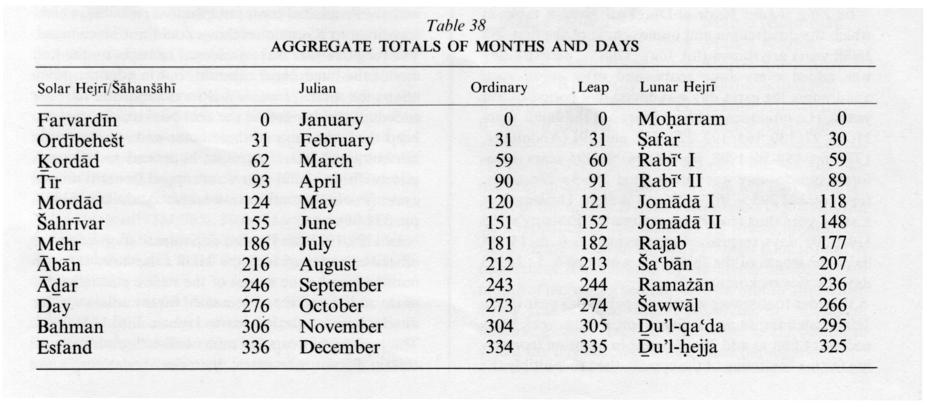
Conversion of dates. The method of converting dates traditionally given in astronomical handbooks is to reckon the number of days between the date in question and the beginning of the calendar in which it appears and then to translate this figure into the comparable interval in the second calendar (Abdollahy, 1987, pp. 67-95). For example, to convert a lunar Hejrī date to the corresponding date in the Julian calendar (in use before the Gregorian reform on 16 Ramażān 990 = 22 Mehr 961 Š./4 October 1582), the elapsed complete lunar Hejrī years are multiplied by 354 11/30 (the average number of days in a lunar year) and the elapsed days of the date year (see Table 38) are added; the resulting total of elapsed days is added to the number of days between the beginnings of the two calendars. The result represents the number of days between the beginning of the Christian era and the date in question. This number is then divided by 365 1/4; the quotient is the number of elapsed years and the remainder the number of additional elapsed days. As Christian dates are given in current years, the elapsed years must be increased by one. (For Gregorian equivalents up to a.d. 1699, ten days must be added to the Julian date, for 1700-99 inclusive eleven days, for 1800-99 inclusive twelve days, and for 1900-2099 inclusive thirteen days.) When the highest possible number in the columns of elapsed days in the Julian year is subtracted from the remainder (i.e., the number of days in the current year), the residue is the day of the month corresponding to that highest possible number. (See Bīrašk for methods of conversion from Hejrī lunar to Hejrī solar and Christian dates and vice versa, as well as lists of conversion from 621 to 2621 a.d.)
Bibliography
Primary sources: Abū Noʿaym, ed. S. Dedering, Geschichte Isbahans, 2 vols., Leiden, 1931-34.
Balāḏorī, Fotūḥ, ed. ʿA. Anīs al-Ṭabā, Beirut, 1957.
Abū Solaymān Dāwūd Banākatī, Rawżat ūli’l-albāb fī maʿrefat al-tawārīḵ known as Tārīḵ-eBanākatī, ed. J. Šeʿār, Tehran, 1348 Š./1969.
Mollā ʿAbd-al-ʿAlī Bīrjandī, Šarḥ-e zīj-e jadīd-e solṭānī, India Office Library and Records, ms. Ethé 2237.
Bīrūnī, Ketāb al-tafhīm le awāʾel ṣenāʿat al-tanjīm, tr. R. Wright, London, 1934.
Idem, al-Qānūn al-masʿūdī, 3 vols., Hyderabad, 1373/1953-54.
Ebn Esḥāq, Sīrat Rasūl Allāh, tr. Qāżī Abarqūh, ed. A. Mahdawī, 2 vols., Tehran, 1360 Š./1981.
Abu’l-Ḵayr Moḥammad Fārsī, Ḥall at-taqwīm, India Office Library and Records, London, ms. 2244.
Moḥammad b. Abī Bakr Fārsī, Zīj-e momtaḥan, University Library, Cambridge, ms. Gg. 3.27.
Ḥamza Eṣfahānī, Tārīḵ senī molūk al-arż wa’l-anbīāʾ, ed. J. Īrānī Tabrīzī, Berlin, 1340/1921-22.
Ḡīāṯ-al-Dīn Jamšīd b. Masʿūd Kāšī, Zīj-e ḵāqānī, India Office Library and Records, ms. Ethé 2232.
Masʿūdī, Morūj, tr. A. Pāyanda, 2 vols., Tehran, 1344-46 Š./1965-67.
Idem, Tanbīh, tr. A. Pāyanda, Tehran, 1349 Š./1970.
Moḥammad b. Ebrāhīm, Tārīḵ-esaljūqīān-e Kermān, ed. M. T. Houtsma, Leiden, 1886.
Mollā Moẓaffar, Šarḥ-e bīst bāb, Tehran, 1267/1851.
Ḥamd-Allāh Mostawfī, Tārīḵ-egozīda, ed. A.-Ḥ. Navāʾī, Tehran, 1339 Š./1960.
Nowrūz-nāma, ed. M. Mīnovī, Tehran, 1312 Š./1933.
Ḥasan b. Moḥammad b. Ḥasan Qomī, Ketāb-e tārīḵ-e Qom, ed. J. Ṭehrānī, Tehran, 1313 Š./1934.
Rašīd-al-Dīn Fażl-Allāh, Tangsūq-nāma, Tehran, 1350/1971.
Moḥammad b. Abī ʿAbd-Allāh Sanjar Kamālī, Zīj-e ašrafī, Bibliothèque Nationale, ms. Suppl. 1488.
Ḥasan b. Ḥosayn b. Ḥasan Šāhanšāh Semnānī, Tawżīḥ-e zīj-e īl-ḵānī, British Museum, ms. Add. 11, 636.
Abū Jaʿfar Moḥammad b. Ḥāseb Ṭabarī, Zīj-e mofrad, Cambridge, ms. Browne 0.1(10). Tārīḵ-eWaṣṣāf, ed. M. M. Esfahānī, Tehran, 1338 Š./1959.
Naṣīr-al-Dīn Ṭūsī, Sī faṣl, Tehran, 1330/1912.
Idem, Zīj-e īl-ḵānī, Cambridge, ms. Browne 0.2.(7). Moḥammad b. ʿOmar b. Wāqedī, Ketāb al-maḡāzī, ed. M. Jones, 3 vols., London, 1966.
Yaʿqūbī, Taʾrīḵ, tr. M. Āyatī, 2 vols., Tehran, 1344-45 Š./1965-66. Zīj-e Oloḡ Beg, ed. A. Sédillot, Paris, 1847.
Studies: R. Abdollahy (ʿAbd-Allāhī), A History of Chronology and Calendars in Iran from Ancient to modern Times with Principles of Date Conversion, Ph.D. thesis, Durham University, 1977. Idem, Taḥqīq-ī dar zamīna-ye gāh-šomārī-e hejrī wa masīḥī, Tehran, 1365 Š./1987. Idem, Tārīḵ-etārīḵdar Īrān, Tehran, 1366 Š./1988. L. Bazin, Les calendriers turcs anciens et mediévaux, thesis, Paris University, 1972; publ. Lille University, 1974. A. F. L. Beeston, Epigraphic South Arabian Calendar and Dating, London, 1956. Ḏ. Behrūz, Taqwīm-e nowrūzī-e šahrīārī (šamsī-e qamarī-e fārsī), Īrān Kūda 18, Tehran, 1347 Š./1968. A. Bīrašk, Gāhnāma-ye taṭbīqī-e se-hazār-sāla, n.p., 1367 Š./1988. J. A. Boyle, “The Longer Introduction to the Zīj-e Ilḵānī of Naṣīr al-Dīn Ṭūsī,” Journal of Semitic Studies 8/2, 1963, pp. 244-54. Idem, tr., The Successors of Genghis Khan, New York, 1971. S. T. Bulsara, “The Old Iranian Calendar,” in M. P. Kharegat Memorial Volume I, Bombay, 1953, pp. 177-97. G. S. P. Freeman-Grenville, The Muslim and Christian Calendars, London, 1963.
F. K. Ginzel, Handbuch der mathematischen und technischen Chronologie, 3 vols., Leipzig, 1906-14.
J. Homāʾī, Tārīḵ-eadabīyāt-e Īrān az qadīmtarīn ʿaṣr-e tārīḵī tā aṣr-e ḥāżer, Tehran, 1340 Š./1961.
L. Ideler, Handbuch der mathematischen und technischen Chronologie II, Berlin, 1826.
N. Majd, Taqwīm-e taṭbīqī-e šaṣt-o-šeš sāla.1304-1369 šamsī, 1925-1991 mīlādī, London, 1987.
S. M. Moḥīṭ Ṭabāṭabāʾī, “Eḥqāq-e ḥaqq-e Ḵāzenī-e maẓlūm,” Gowhar 1, 1352 Š./1973, pp. 683-92.
C. A. Nallino, ʿElm al-falak. Taʾrīḵoh ʿend al-ʿArab fi’l-qorūn al-wost¡ā, Rome, 1911.
M. P. Nilsson, Primitive Time-Reckoning. A Study in the Origins and First Development of the Art of Counting Time among the Primitive and Early Culture Peoples, Lund, 1920.
D. Pingree, “The Fragments of the Works of al-Fazarī,” JNES 29/4, 1970, pp. 103-23.
R. S. Poole, The Coins of the Shahs of Persia. Safavids, Afghans, Efsharis, Zands and Kajars, London, 1887.
T. Rīāḥī, Šarḥ-e taqwīmhā-ye moḵtalef wa masʾala-ye kabīsahā-ye Jalālī, Tehran, 1335 Š./1956.
A. Sayılı, The Observatory in Islam and Its Place in the General History of the Observatory, Ankara, 1960.
S. H. Taqizadeh, “Various Eras and Calendars Used in Countries of Islam,” BSO(A)S 9, 1937-39, pp. 903-22; 10, 1939-42, pp. 107-32.
Idem, Gāh-šomārī dar Īrān-e qadīm, Tehran, 1317 Š./1938.
Idem, Bīst maqāla, tr. A. Ārām, Tehran, 1346 Š./1967.
V. V. Tsybulsky, Calendars of Middle East Countries. Conversion Tables and Explanatory Notes, Moscow, 1970.