
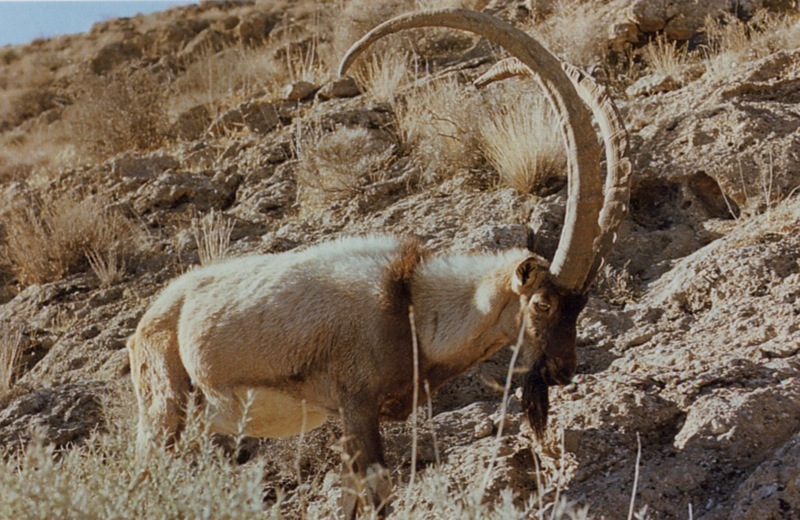



The ibex was hunted in Iran from the Middle Paleolithic period onwards. Ibex first appear in Iran in Middle Paleolithic contexts at Warwasi (Uerpmann, Table 25a) and Yāfte Cave (ca. 38,000-29,000 B.C.E.) in Luristan, where it was the dominant species represented (Smith, p. 27); and it is likely that the ibex continued to be hunted in the Zagros mountains during the millennia that followed. Unfortunately, most Epipaleolithic sites of the late Pleistocene era are known only from surface finds of stone tools. In places where we have excavated assemblages, such as the cave of ʿAli Tappe (near Behšahr on the southern coast of the Caspian Sea), occupied ca. 10,400-8800 B.C.E., it is notoriously difficult to distinguish the post-cranial skeletal remains of wild goat from wild sheep (McBurney, pp. 396-97; Hole, Flannery, and Neely, p. 267). Studies of horn cores from the early Neolithic sites of Tappe ʿAli Koš and Tappe Sabz (Ḵuze-stān), however, certainly indicate that ibex were being hunted in the late 8th and 7th millennia B.C.E., if not on the Dehlorān plain itself then in the nearby foothills of the Zagros mountains (Hole, Flannery, and Neely, pp. 266-67). Early Neolithic sites in Azarbaijan (Ḥāji Firuz) and Luristan (Sarāb, Āsiāb, Ganj Darre, and Tepe Gorān) contain abundant evidence of ibex consumption, as do Chalcolithic sites in the region, such as Siāhbed and Dehsavar in Kurdistan, which date to the 5th millennium B.C.E. (Bökönyi, pp. 16-22; Uerpmann, Table 25a; Hesse, pp. 403-14). Later Chalcolithic and Bronze Age sites of 4th-2nd millennium B.C.E. date on the central Iranian Plateau, such as Tappe Zāḡe, Tappe Qabrestān, and Tappe Sagzābād, also Tall-e Malyān on the Marv-dašt plain of Fārs, attest to the continued hunting of ibex through time (Mashkour, Fontugne, and Hatte, p. 70; Mashkour, 2002, Table 2). Farther east, the ibex is attested at the predominantly 3rd-millennium B.C.E. site of Šahr-e Soḵta in Iranian Sistān (Caloi, Compagnoni, and Tosi, p. 87; cf. Bökönyi and Bartosiewicz, 2000, p. 121). Ibex continue to occur in Azarbaijan in Iron Age contexts at Bastām (see BESṬĀM), Zendān-e Solaymān, and Nuš-e Jān and also in the Sasanian period at Taḵt-e Solaymān (Uerpmann, Table 25a).
The incorporation of the ibex into decorative friezes on painted pottery was widespread in pre-Islamic Iran. The ibex appears as a decorative motif on Chalcolithic pottery in Luristan at Čeḡā Sabz (Schmidt, van Loon, and Curvers, Pl. 69g-i), Se Gābi (Young and Levine, Figs. 11.25 and 29), and Tappe Giān (McCown, Fig. 7); in Ḵuzestān at numerous unexcavated sites among survey collections (Alizadeh, Figs. 8, 27D, 30I, 44D, 48G, 62K), and at Čoḡā Miš (in ancient Susiana; Delougaz and Kantor, Pls. 57-58). Several of the tall, Susa I (formerly Susa A) beakers from ca. 4000 B.C.E. show elegantly stylized ibex with long, curving horns and characteristic beard (Harper, Aruz, and Tallon, no. 1; cf. contemporary material from Tappe Jaʿfarābād; Dollfus, Fig. 19.6); and rows of ibex decorate contemporary pottery at sites in the Dehlorān plain, such as Tappe Sabz and Tappe Mu-siān (Neely and Wright, Fig. III.2d, g). The ibex is equally common on the painted pottery of Tall-e Bakun A in Fārs (Langsdorff and McCown, Pls. 69-73). Farther north, it appears on the Chalcolithic pottery of Ḥesār IB-C (Schmidt, Figs. 35A and 37; Pls. V, VII and X-XIII). At Šahr-e Soḵta in the mid-3rd millennium B.C.E., stylized ibex appear, framed between pairs of vertical and horizontal lines, on pear-shaped beakers (Biscione and Bulgarelli, p. 224 and Fig. 55). The ibex is even more common on the pottery at Bampur (late 3rd/early 2nd millennium B.C.E.) in Iranian Baluchistan (Stein, Pl. VII; de Cardi, Figs. 16, 28, 30, 32, 35, 37, 39, 43), although it must be admitted that it is not always clear whether the animal depicted with long, curving horns is an ibex or a wild sheep (cf. Valdez, Nadler, and Bunch, Fig. 2). Both species seem to be depicted on the carved soft-stone of late 3rd millennium B.C.E. date from the Jiroft basin in southeastern Iran (Majidzadeh, pp. 18-20, 24-31, 34-35, 49-50, 134).
Long-horned caprids, many of whom may be ibex, appear on pre-Islamic stamp and cylinder seals all over Iran. An ibex-headed figure—possibly a human wearing the horns of an ibex—appears in the guise of the “master of animals” on stamp seal impressions from Susa dating to ca. 4000 B.C.E. (Harper, Aruz, and Tallon, no. 18; Rashad, Abb. 15.811 and 17.1061). Late prehistoric stamp seals bearing ibex images are also known from Tappe Sialk (Amiet, 1985, Fig. 13.2), Tappe Giān (Rashad, Abb. 5.179, 6.189, 196, 227), and Tappe Jaʿfarābād (Rashad, Abb. 14.584). Cylinder seals from numerous sites, most notably Susa, depict ibex (distinguishable from mountain sheep by their beards), often flanking a tree of life (e.g., Harper, Aruz, and Tallon, nos. 39, 43, and 45)
Middle Elamite, Neo-Assyrian, provincial Neo-Assyrian, and Neo-Elamite cylinder seals from Čeḡā Sabz and Sorḵ Dom-e Lori in Luristan illustrate hunters with bow and arrow shooting leaping caprids, many of which appear more like ibex than wild sheep (Schmidt, van Loon, and Curvers, Pls. 233, 237, 242-243), and this interpretation is consistent with the faunal evidence (mentioned above) demonstrating the continued hunting of ibex in the Iron Age.
Vessels made of bitumen mastic from Susa (early 2nd millennium B.C.E.) employ ibex protomes as parts of the legs and feet (e.g., Connan and Deschesne, pp. 225, 242, 250, 254, 57). The ibex was frequently depicted in the metalwork of late Bronze Age and Iron Age Luristan (Schmidt, van Loon, and Curvers, Pls. 172g, 174i, 179e, 180d, 186-88, 212c-e, 260d, 262d; Seipel, no. 34). Some of the caprid representations on Sasanian stamp seals previously classified as antelopes may in fact represent ibex (e.g., Frye, D.288). The ibex is clearly represented on at least one Sasanian textile fragment (Harper, no. 55).
The symbolic and/or religious significance of the ibex in pre-Islamic Iran is unclear, although in Yasht 14 of the Avesta the god of victory, Vərəthragna, appears to Zarathushtra in various animal forms, including that of a male ibex (Yt. 14.25; von Gall, p. 445).
Bibliography
A. Alizadeh, Prehistoric Settlement Patterns and Cultures in Susiana, Southwestern Iran: The Analysis of the F.G.L. Gremliza Survey Collection, Ann Arbor, 1992.
P. Amiet, “La période IV de Tépé Sialk reconsidérée,” in De l’Indus aux Balkans, Recueil Jean Deshayes, Paris, 1985, pp. 293-312.
R. Biscione and M. C. Bulgarelli, “Painted Geometrical Decoration on the Shahr-i Sokta Buff Ware: Approach to a Systematic Classification,” in Prehistoric Sistan I, Rome, 1983, pp. 211-58.
S. Bökönyi, Animal Remains from the Kermanshah Valley, Iran, Oxford, 1977.
S. Bökönyi and L. Bartosiewicz, “A Review of Animal Remains from Shahr-i Sokhta (Eastern Iran),” in Archaeozoology of the Near East, Vol. IV B, Groningen, 2000, pp. 116-52.
L. Caloi, B. Compagnoni, and M. Tosi, “Preliminary Remarks on the Faunal Remains from Shahr-i Sokhta,” in Approaches to Faunal Analysis in the Middle East, Cambridge, 1978, pp. 87-90.
B. de Cardi, Excavations at Bampur, a Third Millennium Settlement in Persian Baluchistan, 1966, New York, 1970.
J. Connan and O. Deschesne, Le bitume à Suse, Paris, 1996.
P. Delougaz and H. J. Kantor, Chogha Mish I. The First Five Seasons of Excavations, 1961-1972, 2 vols., Chicago, 1996.
G. Dollfus, “Djaffarabad, Djowi, Bendebal: Contribution à l’étude de la Susiane au Ve millénaire et au début du IVe millénaire,” Paléorient 4, 1978, pp. 141-67.
R. N. Frye, ed., Sasanian Remains from Qasr-i Abu Nasr, Cambridge, Mass. 1973, pp. 66-87.
H. von Gall, “Tiere,” Wörterbuch der Mythologie. Altiranische und zoroastrische Mythologie, Stuttgart, 1986, pp. 444-46.
P. O. Harper, J. Aruz, and F. Tallon, The Royal City of Susa, New York, 1992.
P. O. Harper, The Royal Hunter: Art of the Sasanian Empire, New York, 1978.
B. Hesse, “Slaughter Patterns and Domestication: The Beginnings of Pastoralism in Western Iran,” Man, N.S. 17, 1982, pp. 403-17.
F. Hole, K. Flannery, and J. Neely, Prehistory and Human Ecology of the Deh Luran Plain: An Early Village Sequence from Khuzistan, Iran, Ann Arbor, 1969.
A. Langsdorff and D. E. McCown, Tall-i-Bakun A, Season of 1932, Chicago, 1942.
Y. Majidzadeh, Jiroft: The Earliest Oriental Civilization, Tehran, 2003.
M. Mashkour, M. Fontugne, and C. Hatte, “Investigations on the Evolution of Subsistence Economy in the Qazvin Plain (Iran) from the Neolithic to the Iron Age,” Antiquity 73, 1999, pp. 65-76.
M. Mashkour, “Chasse et élevage au nord du Plateau central iranien entre le Néolithique et l’âge du Fer,” Paléorient 28, 2002, pp. 27-42.
C. B. M. McBurney, “The Cave of Ali Tappeh and the Epi-Palaeolithic in N.E. Iran,” Proceedings of the Prehistoric Society 34, 1968, pp. 385-413.
D. E. McCown, The Comparative Stratigraphy of Early Iran, Chicago, 1942.
J. A. Neely and H. T. Wright, Early Settlement and Irrigation on the Deh Luran Plain: Village and Early State Societies in Southwestern Iran, Ann Arbor, 1994.
M. Rashad, Die Entwicklung der vor- und frühgeschichtlichen Stempelsiegel in Iran, Berlin, 1990.
G. Santini, “A Preliminary Note on Animal Figurines from Shahr-i Sokhta,” in South Asian Archaeology 1987, Part 1, Rome, 1990, pp. 427-51.
E. F. Schmidt, Excavations at Tepe Hissar, Damghan, Philadelphia, 1937.
E. F. Schmidt, M. N. van Loon, and H. H. Curvers, The Holmes Expedition to Luristan, Chicago, 1989.
W. Seipel, ed., 7000 Jahre persische Kunst, Vienna, 2001.
P. E. L. Smith, Palaeolithic Archaeology in Iran, Philadelphia, 1986.
M. A. Stein, Archaeological Reconnaissances in North-Western India and South-Eastern Iran, London, 1937.
H.-P. Uerpmann, The Ancient Distribution of Ungulate Mammals in the Middle East, Wiesbaden, 1987.
R. Valdez, C. F. Nadler, and T. D. Bunch, “Evolution of Wild Sheep in Iran,” Evolution 32, 1978, pp. 56-72.
T. C. Young, Jr. and L. D. Levine, Excavations of the Godin Project: Second Progress Report, Toronto, 1974.
M. A. Zeder, Feeding Cities: Specialized Animal Economy in the Ancient Near East, Washington, D.C., and London, 1991.