



Introduction. The Sasanian Empire (ca. 224-651 CE) was the last great oriental power of antiquity, which at its height ruled over most of Central Asia, the Near East, and Egypt. It is known to posterity not only as Rome’s most formidable opponent, a crossroads for wandering merchants, itinerant monks, and religious ideas, but also as the locus of an eastern paideia and courtly esthetics that would hold sway over mentalities and inform artistic perceptions in West Asia and the eastern Mediterranean long after the polity that gave rise to them had vanished. It is certainly the merit of the Sasanian civilization to have engendered a conception of Persian (and Iranicate) culture that would eventually unseat and supersede the vestiges of Hellenism in West- and Central Asia, thereby lastingly impacting Islamic traditions that were to follow.
THE FOUR AGES OF SASANIAN KINGSHIP
Sasanian kingship is not an immutable entity whose structure may be captured in a panoramic view. In the four centuries of Sasanian rule in the ancient world, it underwent extensive changes and caesurae, whose articulations only a careful periodization and recourse to source material, more immediate to the periods and structures under examination, may reveal (Wiesehöfer, 2021). The key to understanding and the criterion for delimitating these periods are changes within the royal titulature that are reflected on Sasanian coinage (q.v.), but also, for the early period, in the epigraphic material (EPIGRAPHY i. OLD PERSIAN AND MIDDLE IRANIAN EPIGRAPHY), and occasionally on gems (Huyse, 2006, pp. 182-93; Shayegan, 2013). Indeed, the numismatic evidence exhibits only four radical departures in the royal titulature—(1) šāhān šāh “king of kings”; (2) kay; (3) abzōn “increase”; and (4) xwarrah abzūd “increased is the (royal/epic) glory”—each being indicative of vicissitudes within ideological and political conceptions of Sasanian kingship and possibly announcing the emergence of new historical paradigms. These departures in the conception of kingship, are perforce reflected in the multitude of events and structures (social, economic, and mental) that define Sasanian history and the ages that bestow unity and coherence upon them. These four ages have been expediently called: (1) the Šāhān Šāh period; (2) the Kayanid period; (3) the Abzōnate; and (4) the Abzūd period.
From the establishment of the empire by Ardašīr I (q.v.) up to the reign of Yazdegerd II (q.v.), ca. 224-439, the title of the Sasanian sovereigns, despite minor alterations, remained: mazdēsn bay [name of the sovereign] šāhān šāh Ērān (ud An-ērān) kē čihr az yazdān, “His Mazdean Majesty [name of the sovereign] king of kings of Iran(ians) (and non-Iran[ians]) whose seed is from the gods.” The title of “king of kings of Iran,” which was established by Ardašīr, augmented by the important element ud An-ērān “and non-Iran(ians)” under Šāpur I (q.v.), with ephemeral omission of the selfsame under Narseh (q.v.; Huyse, 2006, pp. 183-84), thus represented mutatis mutandis the core of the Sasanian titulature during this period. Under Yazdegerd II and up to and including Kawād I (q.v.), the titulature changed considerably. The main constant of the titulary being šāhān šāh Ērān disappeared entirely and was replaced by the title kay, which referred to a mythical and heroic sovereign (Huyse, 2006, p.186; Daryaee, 2006a, pp. 500-501). The titulature—except for Walāxš (BALĀŠ) and Zāmasp (JĀMĀSP)—included the title kay after the king’s name: mazdēsn bay (rāmšahr) kay [name of the sovereign], and later only [name of the sovereign] kay. It was during the reign of Kawād I that the next change in the titulature took place. Under Ḵosrow I (q.v.), the king was neither called šāhān šāh, nor kay. Only the king’s name occurred, and beginning with his sixth year, it was followed by the term abzōn “increase”: [name of the sovereign] abzōn. The next change in Sasanian titulature occurred under Ḵosrow II (q.v.), when the name of the sovereign was followed by the expression xwarrah abzūd: [name of the sovereign] xwarrah abzūd “increased is the (royal/epic) glory of/by [name of the sovereign].” However, Ḵosrow II also occasionally used the term abzōn, as well as for the first time after the early period, the element šāhān šāh (Husraw šāhān šāh xwarrah abzūd), which was undoubtedly a consequence of his Byzantine policy and may have reflected a conscious reference to the political program of his victorious predecessors, notably Šāpur II (q.v.).
The “šāhān šāh” period. The first age is marked by the empire’s tenuous confrontation with Rome and the formulation of a universalist ideology in the political realm, as expressed in the title of “king of kings of the Iranians (and non-Iranians),” as well as the attempt to come to terms with the impact of two universalist religions, Christianity and Manicheism (qq.v.). Although opinions differ as to the rationale behind the offensives of the first Sasanian rulers, it is not likely that they were from the beginning motivated by the desire to revive Achaemenid traditions, and Roman accounts to that effect ought to be taken with skepticism (Shayegan, 2004 [2008]; idem, 2011, pp. 1-38). However, at the latest, beginning with Šāpur I, the neo-Persian empire seems to have made its universalist claim to (co-)regency known, if we are to interpret the addition of the element ud Anērān “and non-Iran(ians)” to the royal title as the manifestation of such encompassing projection of power. It may thus be assumed that the idea of šahr ī Ērān ud Anērān “Empire of Iran(ians) and non-Iran(ians)” was meant to be an ideological riposte to Rome’s notion of imperium sine fine (Börm, 2008, pp. 426-27). Universalist ambitions of the kind that we see actualized through the unity of the Christian faith and romanitas, following the Constantinian shift in Rome—that is, a powerful ideological mix that could be projected onto other cultural spheres—were unattainable for the Sasanian polity, whose ethnic, ancestral faith, Zoroastrianism (q.v.; also called Mazdaism on account of the name of the supreme divinity in the Iranian pantheon, Ohrmazd < Ahura Mazdā/Ahuramazdā [q.v.]) was intrinsically incapable of projecting universalism. To compensate for this lacuna, and unable to impose doctrinal uniformity, the Sasanian empire would later, under the rule of Šāpur II’s grandson, namely, Yazdegerd I (q.v.) reinvent the concept of universality not through the forcible leveling of the religious landscape and its subjugation to the precepts of one dominating faith, but by embracing the diversity of faiths within the realm, as if they were alternate religious manifestations of the empire itself. Prior to Yazdegerd I, the early Sasanians under Šāpur I seem to have diced with Manicheism as an alternative to, or possibly a suppletive form of, Mazdaism to project universality in the religious realm as well. The global aspirations of the Manichean religion, which Mani (q.v.) ought to have deliberately stressed, in order to conform with the perceived ambitions of the Persian king—as well as the similarities his teachings exhibited with the Mazdean cosmogony (see COSMOGONY AND COSMOLOGY) and divinities, which again were intentionally calibrated to conform to Iranian religious perceptions—must have rendered Manicheism’s ability to contribute, unlike any other religion before it, to the imperial project of its royal patron, by synthesizing religious diversity (BeDuhn, p. 266), attractive to Šāpur I. However, as the later disgrace and execution of Mani at the incitation of the chief-magus (mowbed ud ēhrbed) Kartīr (q.v.), clearly indicates, the empire’s first (and promising) attempt at transcending the limitations imposed by an ethnic religious system were nullified.
The Kayanid age. The second age represents the empire’s dramatic shift toward its eastern expanse and the danger of Hunnic invasions (see HUNS). This was also a time of profound receptivity to Iranian mytho-epic conceptions. This shift, which had already begun under the reigns of Yazdegerd I and Bahrām V Gōr (q.v.), only to reach its climax under Yazdegerd II and his successor Pērōz (FĪRŪZ), may have been caused by the arrival of belligerent Hunnic tribes on the empire’s eastern borders. The mobilization of the empire’s resources in the East may have given rise to a more accelerated and sustained reception of eastern mytho-epic (oral) traditions, as reflected, among others, in the Younger Avesta and the Zand (qq.v.), that is, the old Mazdean scriptures and their Middle Persian exegesis. Indeed, Sasanian warfare against Hunnic tribes may have eventually evoked the antagonism prevailing between the mythical Kayanian (kauuaiia-) rulers of Iran (see KAYĀNIĀN) and their eastern Turanian (tūiriia-) foes; what is more, this opposition, in time possibly prompted the adoption of the title kay, which derived from the selfsame Young Avestan title (kauui-) the mythical kings of Iran bore in the fight against the eastern Turanians. Consequently, under the sway of the Kayanid reception, the Sasanians in the age of Yazdegerd II, considering themselves heirs to the archetypal Iranian king-hero Frēdōn (FERĒDŪN)—who ruled over three climes: the Roman West = Hrōm/Rūm; the heartland = Iran; and the eastern expanse = Tūrān—could have regarded not only Roman possessions in the West, but also Turanian lands disputed by the Hephthalites (q.v.) in the East, as belonging to Frēdōn’s empire, and may have sought through the adoption of the Kayanid title kay symbolically to lay claim to them (Daryaee, 2006b, pp. 389-93; Wiesehöfer, 2005a, pp. 144-45; 2005b, pp.114-16). The erection of the massive defensive brick wall(s) of Gorgān (and Tamiša; GORGĀN iv. ARCHAEOLOGY; TAMIŠA WALL) that stretched from the Caspian Sea (q.v.) in the west over two hundred kilometers to the east (Sauer et al., 2013, p. 614; Howard-Johnston, 2012, p. 106), as well as the “Caspian Gates” (q.v.), the defensive fortifications of the Dariali Gorge to control the trans-Caucasian traffic—possibly erected already in late 4th century CE (Sauer et al., 2019, pp. 871-72)—represent major imperial investments to ward off the Hephthalite threat. They were most likely initiated by Yazdegerd II and brought to fruition by Pērōz (Sauer et al., 2013, p. 614; Howard-Johnston, 2012, p.106). The Gorgān wall constituted one of the longest defensive barriers of Antiquity, and appears to have necessitated substantial resources to build, maintain, and man. An estimated thirty fortifications along the wall, as well as a handful of sizable base camps procured an estimated thirty thousand standing troops to guard the wall and the northeastern frontiers of the empire against the Hephthalites (Sauer et al., 2013, pp. 234, 613-16).
The significance of introducing the title kay may be measured in religious matters as well. Under Yazdegerd I, the empire underwent a dramatic shift in its religious policy and sought to maintain political cohesion among its disparate religious communities by domesticizing their structures of governance and partially acculturating their constituents to the Iranian element (Bakhos and Shayegan, pp. xiv–xv). Thus, not only the Jewish institution of the Exilarchate (q.v.), which may well have been a Sasanian creation (Herman, pp. 117-33), but also the institutionalization of the Persian Church, may be deemed as an attempt at integrating these different religious forces into the confines of the Sasanian state, which in spite of the Mazdean character of its dominant ethno-class, had found no remedy other than to promote confessional co-existence as a means of pacification (Bakhos and Shayegan, pp. xiv–xv); thence possibly the title of Yazdegerd I as rāmšahr “(who) pacifies the empire” (Huyse, 2006, p.185). Under Yazdegerd II, however, we may observe a reaction to the concept of a nascent “multi-confessional” empire, and the very sources of this legitimacy may be found in the Avestan-inspired mytho-epic reception of the Iranian past. The adoption of the title kay simultaneously announced its transcendental/cosmic nature, whence Sasanian kingship perceived itself to derive, and its indubitably Mazdean quality. The new kay’s attempt at reintroducing Mazdaism in Armenia (see ARMENIA AND IRAN ii. THE PRE-ISLAMIC PERIOD), or re-subjecting the Christians of Iran to persecution are testimony to the religious quality inherent in the title.
The next change in titulature, announced already under the reign of Kawād I, was completed under Ḵosrow I, when the titles šāhān šāh and kay disappeared and only the king’s bare name followed by the term abzōn “increase” became the norm. The meaning of the term abzōn is not to be grasped intuitively; it could, as the next transformation of the royal title, namely, xwarrah abzūd “increased is the (royal) glory” might imply, be a reference to the strengthening of the royal glory, or along a comparable line of thought, merely signal the empire’s recovery, in the wake of Pērōz’s disastrous demise. It is this latter construal that we shall retain, hence, regarding the third age as one of deep turmoil and recovery.
The Abzōnate. This age, which would be dominated by the reigns of Kawād and his son Ḵosrow I, is also intimately associated with the “Mazdakite” movement, the emergence and containment of which shaped the royal ideology at the dawn of the later empire (Gnoli, pp. 439-56; Wiesehöfer, 2009; Börm, 2007, pp. 230-33). This movement, which profoundly shook the foundations of the Sasanian state, was attributed by later sources to a certain Mazdak, reportedly a former/heretic Mazdean priest, who sought to establish a new social regime, wherein class distinctions would be attenuated by dint of wealth distribution and communal access to (aristocratic?) women. It is possible to presume that in the aftermath of the economic hardship caused by Pērōz’s death, and oppressive ransoms levied by the Hephthalites, a socio-religious movement, associated with a charismatic leader, might have arisen. It has been most recently argued that Mazdakites, far from being revolutionaries seeking the redistribution of wealth, were actually professing a more ascetic way of life (de Blois, 2012, pp. 20-24) and intent on altering—within the broader confines of the Zoroastrian belief system—the norms requiring Mazdean priests to officiate at ritual practices, as well as those regulating the allocation of animal offerings. The consequences of these changes were to lessen the presence of Mazdean priests and their clientele in the appropriation of economic benefits resulting from sacrifices and to favor the deprived and needy as the recipients of offerings, rather than the “righteous men” advocated by the clergy (Macuch, pp. 159-64). The Mazdakite aim to favor the needy and “hungry” hence could have been consistent with the dire economic circumstances the Sasanian empire faced in the period following the Hephthalite sway over Iran. It is equally conceivable that Kawād may have, as the result of a political calcul, assented to the movement’s rise, using its nascent thrust to restrain disenchanted social strata most affected by the effects of war and retribution efforts. In this, the relation between the king and the Mazdakite front provides some analogy with the political will manifested by Šāpur I vis-à-vis Manicheism, which ephemerally served as an experiment in the Sasanian quest for a universalist religion. In both cases, the institution of kingship, on account of its political exigency, could have used, guided, and emboldened these movements, before eventually thwarting their thrust, and eliminating their leaders and adherents. However, since contemporaneous sources, such as Procopius (q.v.) and Joshua the Stylite (Chronicle, 20; Luther, pp. 44-45, 137-44) do not mention Mazdak—only Muslim chronicles, such as Ṭabari’s history, and late 9th-century Middle Persian compilations (the Bundahišn, Dēnkard, Pahlavi Widēwdād, and the Zand ī Wahman Yašt) know of Mazdak—and make Kawād solely responsible for enabling, or consenting to, the communal possession of women, the historicity of Mazdak and the economic dimension (that is, the allocation of offerings/wealth redistribution?) of the movement is open to question.
The accusation of forced communal access to women by the “Mazdakite” movement is reflected in most sources—zan ud frazand ud xwāstag pad hamīh ud hambāyīh abāyēd dāštan framūd “He [Mazdak] ordered that wives (zan), children, and belongings should be held [by men] in common (pad hamīh) and in co-partnership (hambāyīh)” (Bundahišn, 33.24; Pakzad, pp. 367-68; Agostini and Thrope, p. 174)—and must hence be taken seriously. Recently, it has again been argued that the notion of communal access to women ought to be differently interpreted (Macuch, pp. 165-69). Mazdakites, it appears, rejected the strict Zoroastrian laws on succession, which exclusively sanctioned patrimonial lineages, and instead recognized matrilineal descent: ud zahagīh gōwēnd kū paywand pad mādarān gōwēnd … čiyōn ān ī gurg zahag pas mādar awēšān-iz paywand pad mādarān kunēnd “and they [the Mazdakites] would advertise the principle of matrimonial descent (zahagīh), that is, lineage through mothers (pad mādarān) … [and] in the same way as the wolf’s offspring belongs thereafter to the mother, they also established lineage through mothers” (Dēnkard 7.7.24). Since one of the main functions of women in élite, aristocratic circles (either as wives or daughters) consisted in assuring the continuity of their houses by providing a successor to the paterfamilias (sālār), any revision to the principle of patrimonial succession ought to have been deemed as socially revolutionary. The picture that emerges from the late Sasanian law book Mādayān ī Hazār Dādestān (q.v.) “Book of a Thousand Decisions” (whose norms ought to have been applicable to the social realities of the fifth century CE as well) is that of a Sasanian élite obsessively preoccupied with the issue of patrimonial succession but in all appearance diminished in its reproductive abilities, most likely on account of incessant endogamous alliances (see MARRIAGE ii. NEXT OF KIN MARRIAGE IN ZOROASTRIANISM).
What the Mazdakite movement—in the aftermath of the Hephthalite defeat, which undoubtedly diminished the ranks of the nobility—may have advocated was precisely the ability for Sasanian élite women to procreate outside the confines of kin relations, thereby sensibly bolstering the probability of reproduction, even though in manifest defiance of Mazdean precepts. This might have been a proposition King Kawād could have tacitly tolerated, in order to evade a demographic crisis within the ranks of his nobility (Elman, pp. 273-76). One of the consequences of Kawād’s policy of laisser-aller vis-à-vis the Mazdakites, if substantiated, may be gauged by the reforms with which Ḵosrow I is generally credited (see ḴOSROW I ii. REFORMS). Indeed, he is believed to have laid the foundation for a knighthood, whose ranks were constituted partially from among the selfsame offspring the Mazdakite movement and its permissive stance toward matrimonial succession had generated, and which Ḵosrow I had collectively adopted as his wards (Nöldeke, p. 164). The initial embrace of Mazdakite precepts by Kawād, as well as the reforms initiated by Ḵosrow I, all point to the inescapable realization that the two opposing forces, which from the outset had been shaping the empire’s grand ambitions—that is, on the one hand, the push for political universality as a means to negotiate the imperial other (Rome) and the nascent Central Asian polities, as well as to contain the religious diversity within the borders, and on the other hand, the limitations imposed on the selfsame ambitions by a religious system rooted in the Iranian ethnogenesis—had also important reverberations on the empire’s social fabric.
Cosanguineous marriages and endogamous alliances were merely other realizations of the same spirit that had time and again thwarted the universalist ouvertures of Sasanian sovereigns. In this context, the toleration of Mazdakite mores by Kawād, which apparently did break away from endogamous practices, might be deemed in essence akin to the universalist designs of Šāpur I and Yazdegerd I in its ambition to meet the exigencies of a global empire, this time by opening up the ranks of a stratified and endangered aristocracy.
The Abzūd period. The last period is marked from the outset by the steady decline of Sasanian royal authority, which was heralded by the uprising of the commander Bahrām VI Čōbīn (q.v.) against his rightful sovereign Hormozd IV (q.v.; r. 579-91 CE). The legitimacy of the Sasanian royal house was grounded upon the conception that the nimbus of kingship, the xwarrah (see FARR[AH]), was bestowed upon the house of Ardašīr and his progeny following the latter’s triumph over the Arsacids (q.v.) and the establishment of a new Iranian empire (see below Succession). The seizure of power by Bahrām VI Čōbīn was the first attempt by an imperial grandee to challenge the authority of the Sasanian house and to contest openly the inherited right of its members to rulership.
Several factors had contributed to the frictions between the crown and the nobility. Ḵosrow I’s social and economic reforms had led the way for Ḵosrow II’s policy of expansion, but may have also sown the seeds of dissention between the king and his subjects. In the wake of the Mazdakite “revolution,” the royal house appears to have subjected the nobility to greater scrutiny and state control by levying regularly imposts and taxes, not only on royal demesnes, but on the totality of the empire’s cultivated surface (Wiesehöfer, 2010, pp. 138, 141; Gariboldi). Moreover, the establishment by the crown of a potent military nobility, whose members were not only equipped, but also endowed with fiefs in return for military service, created a formidable, uniform force accountable to the sovereign. The dramatic increase of the state incomes, further enhanced by poll tax and Byzantine indemnities under Ḵosrow I, had created an economically powerful state that would have possessed the means as well as the military capacity to sustain a large-scale campaign aimed at overpowering Byzantium, when the ideological underpinning for such an enterprise was put into place under Ḵosrow II (Greatrex, 2007, p. 123). These reforms, albeit salutary for the fortunes of the state, may have also led to the deterioration of the traditional bonds between the nobiliary houses and the king under Hormozd IV and Ḵosrow II, to the extent that members of the high nobility (wuzurg “grandee”)—such as the commanders Bahrām VI Čōbīn of the Mehrān family, and later Farrōḵān Šahrwarāz of the Warāz family—dared to reach for the throne, and thus challenge the legitimacy of the Sasanian dynasty. The promotion of the lower nobility (āzād “freeman”) and the enfeoffment of the knighthood (dehqān [q.v.]) undertaken with the intent of establishing a military class that, being economically secured, would provide a counterweight to the potency of the high nobility, did not yield the intended result. Increased affluence may have prompted the rapprochement of the military class with the high aristocracy—from among whose ranks such military leaders as Bahrām VI Čōbīn and Farrōḵān Šahrwarāz had arisen—with whom, beyond economic interests, it shared a common ethos. Thus, the military class, originally created as a possible bulwark against the aspirations of the high nobility, may have eventually contributed to the erosion of royal power due to its increasing affinity with the selfsame nobility. In order to prevent the accession of Bahrām VI Čōbīn, whose victorious campaigns had elevated him to an exalted position, whence he could defy royal legitimacy, Ḵosrow II may have agreed (in concert with his maternal uncles) to overthrow his father Hormozd IV, the principal object of Bahrām’s enmity, and possibly acquiesce to his assassination (Howard-Johnston, 2010). However, his regicide falling short of preventing Bahrām VI Čōbīn from seeking the throne, Ḵosrow II was eventually constrained to take refuge in Byzantium, whence he set out to retake his empire with Byzantine troops in return for territorial concessions (Howard-Johnston, 2010; Rubin, pp. 643-44; Whitby, 1988, pp. 250-304).
The rebellion of Bahrām having already diminished the prestige of the Sasanian house, Ḵosrow II’s act of regicide (or acquiescence thereto), as well as Byzantine intervention in Persia’s internal affairs at Ḵosrow’s instigation, followed by territorial concessions, decisively shattered the nimbus of Sasanian rule. The war of conquest waged against Byzantium by Ḵosrow II, could have aimed at increasing the Sasanian dynastic fortune, and by the same token, resuscitating the Achaemenid empire, historical knowledge of which (through Roman intermediary), interwoven with epic elaboration seem to have been commonplace in Sasanian Iran since Šāpur II. One should not underestimate the symbolic importance of Byzantium suspending the payment of subsidies to Persia toward the defense of their common borders against foreign intruders, or of Justin II’s negotiating with the newly emerging Turkic power to form an alliance against the Sasanian state, which gave rise to a new chapter in the Roman and Persian relations (Whitby, 2001, pp. 91-94). With the discontinuation of subsidies, both empires adopted a confrontational attitude, which first led to Justin II’s thwarted campaign against the Sasanian empire in 572-73, eventually to the first Roman intervention in Persia’s internal affairs by the emperor Maurice, and finally to the ill-inspired attempt of Ḵosrow II to overpower Byzantium (Whitby, 2001, pp. 102-4; Howard-Johnston, 2006, pp. 93-113; Shahîd).
Thus, the elimination of subsidies, which up to Justin II had ideologically warranted the interdependence between Rome and Persia, may have ultimately given rise to a confrontational stance. Ḵosrow II, by conquering, albeit ephemerally, all of Byzantium’s eastern possessions seems to have implemented this logic to the letter. Indeed, Ḵosrow II’s territorial expansion to an extent never experienced since the Achaemenids may be regarded as the instauration of a new empire that, surpassing in glory even Ardašīr’s founding act, invested the Sasanian house with new legitimacy. The legend on Ḵosrow II’s coinage Husraw xwarrah abzūd “Ḵosrow whose xwarrah is increased; Ḵosrow, by whom the xwarrah is increased,” seems to indicate the king’s political agenda of a Sasanian renewal subsequent to his seizure of power in Persia, inasmuch as the subsequent reintroduction of the old Sasanian title šāhān šāh “king of kings”, this time with possible allusions to the Persians of old, was indicative of an Achaemenid revival—a fact further substantiated by preparatory measures to emplace monumental reliefs at the sites of Bisotun and Naqš-e Rostam (qq.v.), on a scale dwarfing all prior Sasanian undertakings. Eventually, Ḵosrow’s hubris, that is, his desire to rule as a kosmokrator, rather than the co-ruler of the world, led to the fall of the empire, just a few decades after it had reached its greatest geographical expansion, holding sway over an expanse seen only under the Achaemenids.
REPRESENTATION OF THE KING AND THE ESSENCE OF KINGSHIP
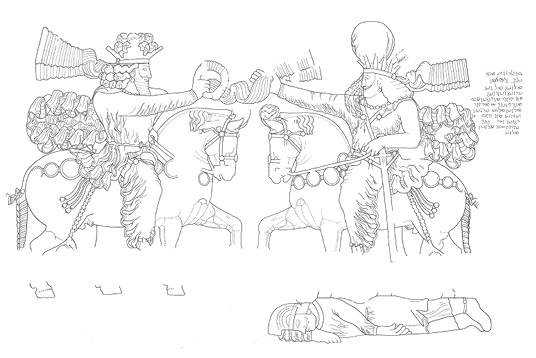
Figure 1. Investiture and triumph of Narseh over Wahnām, son of Tadrōs (Bīšāpūr 5). Originally relief of Bahrām I, whose inscription was emendated to reflect Narseh’s ownership, and with the possible addition of Wahnām. From Herrmann and Howell, 1981, fig. 2. © Deutsches Archäologisches Institut, Fotoarchiv Teheran, all rights reserved.
The decidedly Mazdean character of Sasanian kingship is well captured in early Sasanian rock reliefs (q.v.), which, in spite of their relative thematic variety, often exhibit scenes of divine investiture (Canepa, pp. 861, 863). Therein, the king is shown as the recipient of the royal glory (xwarrah), symbolized by a diadem being extended by the god Ohrmazd (illustrated as an anthropomorphic figure), which not only alluded to the divine sanction of Sasanian kingship (also articulated in the formula: kē čihr az yazdān “whose seed is from the gods”), but also to its intrinsically Mazdean character (evinced in the expression mazdēsn bay “[His] Mazdean majesty”) (Alram, Blet-Lemarquand, and Skjærvø, pp. 30-33). The cosmic dimension of Sasanian kingship, as Ohrmazd’s instrument against the evil forces of Ahriman (q.v.), may be furthermore observed in a number of equestrian investiture (INVESTITURE iii. SASANIAN PERIOD) and triumph reliefs, through the parallel portrayal of the king and god Ohrmazd trampling with their horses on foes, abjectly thrown under the mounts’ hooves, and who may be identified with historical enemies (such as, Ardawān IV [see ARTABANUS IV] or Gordian III) on the one side, and Ahriman on the other (Ardašīr I at Naqš-e Rostam 1; and Šāpur I at Bišāpūr 1) (Canepa, p. 863, fig. 45.1; Vanden Berghe, pp. 66-67, pl. 18; and 72-73; Herrmann, pp. 69-71, 76-78; Herrmann, MacKenzie, and Howell, pp. 7-10, fig. 1). Thus, the parity created between opposite cosmic forces Ohrmazd/Ahriman, as well as the king and his enemies, is yet another indication of the perception of kingship as intrinsically interwoven into the fabric of the Mazdean cosmic struggle in early Sasanian Iran (Canepa, pp. 865-66).
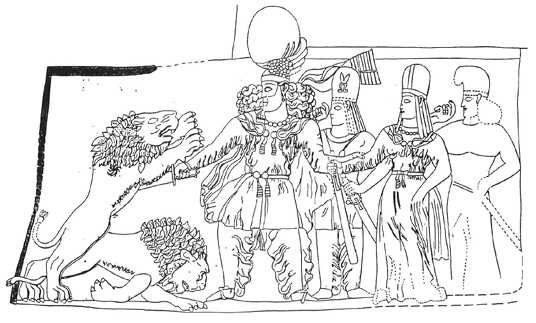
Figure 2. Relief of Bahrām II at Sar-e Mašhad, depicting the king confronting two lions and holding hands with a female figure (likely the queen). Two dignitaries stand behind the king: the high priest (mowbed) Kartīr with a pair of scissors on his tall hat as heraldic emblem (nišān); and an unknown personage. Trümpelmann, 1975, plate 7, with the addition of the ornament added on the shoulder of the attacking lion by Tanabe, 1990, p. 30, Fig. 2b. © Deutsches Archäologisches Institut, Fotoarchiv Teheran, all rights reserved.
This equivalency is further manifest in the Sasanian inscriptions, in particular, in that of King Narseh at Paikuli (late 3rd century CE), who accuses his nephew Bahrām III (q.v.) to have been unjustly helped upon the throne, through the deception (drōžanīf/dōzanīh) of a certain Wahnām, son of Tadrōs (Tatrus), described as a villain (wadgar “evil-doer”; Humbach and Skjærvø, 3.1, NPi, B1,04), in league with “Ahriman and the demons” (Wahnām ī Tadrōsān [pad] xwēbēh drōžanīf (Parth.) ud [pušt] ī Ahreman ud dēwān [pad Sagān šāh sar] dēhēm bandēd, “Wahnām, son of Tadrōs, [through] his own falsehood and with [the help] of Ahriman and the devils attached the Diadem [to the head of the king of Sakas]”; Humbach and Skjærvø, 3.1, NPi, A7,02–A15,02; Weber, 2010a, pp. 353-94; Shayegan, 2012, pp. 109-38). Once more, we see Ahriman’s agent (here Wahnām, son of Tadrōs) prostrate and trodden down by the king’s horse on Narseh’s equestrian investiture relief at Bīšāpūr (q.v.; Figure 1); (Herrmann and Howell, pp.18-19, fig. 2; Gyselen, 2005 [2009], pp. 29-36). In Bahrām II’s (q.v.) relief at Sar Mašhad (Figure 2), the king is portrayed confronting two lions, one already slain and lying on the ground and the other being thrust with the king’s sword, while he is protecting his queen, held by the hand, and imperial dignitaries, among them the chief magus (mobed) Kartīr, standing in the foreground (Trümpelmann, plate 7; Tanabe, p. 30, Fig. 2b). It is likely that the depiction of the two lions in this context was symbolically referring to the Sasanian king as the champion of the weh dēn “good religion” (see BEHDĪN) confronting (the creations of) darkness and evil, which on a less allegorical register referred to the enemies of the empire under Bahrām II, themselves manifestations of darkness/evil: his rebel brother, Hormozd Kušānšāh (q.v.); and the Roman emperor Carus (Shayegan, 2020-21, pp. 6-9).
The king’s qualities and ethics. Nowhere may the idealized personal virtues and ethics of the king in contemporaneous sources be better assessed than in the inscription of King Narseh at Paikuli, where the shortcomings and vices of the evildoer(s) are systematically opposed to the perceived virtues the king must possess, in order to rule. In contrast to Wahnām, the agent of Evil, who is supported by Ahriman and the devils, the king is assisted by the gods: ud Wahnām kū wēnēd [kū pad pušt ī] (yazdān) xwarrah ud šahr-xwadāyīh ō amā dād ud dānēd kū, “and Wahnām when he saw [that with the help of] gods, glory and rulership had been given to Us, then he knew that …” (Humbach and Skjærvø, 3.1, NPi, E4,03–d15,05); [p]as amā pad puš[t] ud [n]ām ī yazdān ud xwēš [… pad gāh ī] pidar ud niyāgān ēstēm, “then We with the support and in the name of the gods and our own […] ascended [the throne of?] (our) father and ancestors” (Humbach and Skjærvø, 3.2, p. 119; and 3.1, NPi, 43H9,02–H14,02). Whereas the distinctive vices of Wahnām are qualified as drōzanīh “deceit; falsehood” and ǰādūgīh “sorcery,” Narseh is praised for his farroxīh “fortune” and frazānagīh “wisdom”: anī-tān kēž hamγōnag nē būd [kē …] yazdān *pargasād ahād [ud pad farr]oxīh (MPers.) ud frazānagīf ud xwēbeh m[ardīf? čē Aryān]šahr istambag … “(because ever since then) nobody else has been similar to You [whom …] the gods have favored? [and (who) by Your fortune? and wisdom and Own m[anliness? have kept?] oppression [away from Ērān-]šahr …” (Humbach and Skjærvø, 3.1, NPi, f14,06–g7-8,01). Whereas Wahnām is accused of being against the gods and the whole realm, Narseh is described as most dutiful in the service of gods and best suited to warrant the security of the realm. The king’s suitability reposes, as we learn, aside from the aforesaid personal qualities of the prince, upon the candidate’s piety toward the gods, as well as his ability to safeguard Ērānšahr (q.v.): ag šahrδār [zānānd kū … keš ast kē] až amāh pad yazadān rāštistar ud abardar ud kerdagānistar ahēndē *āgām Aryānšahr až amāh *padrāmistar ud [wišidāxw ādūg ahēndē dirdan ud Pārsān kār framādan …], “if the Landholders [know that in Ērānšahr there is someone who] would be more righteous and better and more pious with respect to the gods, or [would be more able] than Ourselves [to keep] Ērānšahr in peace [and confident and to govern the Persian army/people …]” (Humbach and Skjærvø, 3.1, NPi, f4-5,03–f3,04). As the Paikuli inscription further reveals, the sum of virtues expected in a king, as well as the procedure for electing the most suitable candidate for rulership, had been in place since the rule of the first Sasanian kings, Ardašīr I and Šāpur I: bē kē (dānēd) kū [andar Ērānšahr] kas ast kē az Šābuhr šāh rāštistar (Parth.) ud pad yazdān kerdagārdar ayāb wehdar ud pas ēn Ērānšahr *pā[ddom ud drusttar?] ādūg dāštan ud (framādan) kū (Šābuhr šāh) ōy ēw gōwēd, “but, whoever may know [that in Ērānšahr?] there is someone who may be more righteous than king Šāpur and more officious in the service of the gods, or better, and (who) hereafter (may be) able to keep this Ērānšahr [better] (guarded) [and healthier?] and to govern (it better) than king? Šāpur, let him say (so)!” (Humbach and Skjærvø, 3.1, NPi, F6,04—F18,04–1,05).
Thus, schematically, since the foundation of the empire, as typified in the personae of the early Sasanian kings, notably Šāpur I, a suitable king must be bestowed with farroxīh “fortune” and frazānagīh “wisdom,” which are derived from the gods and make the king more officious in the services of gods and the safeguard of the empire, hence, rendering him rāsttar “more righteous,” wēhdar “better,” and kerdagāndom “most pious” (Table 1).
SUCCESSION
The succession of a candidate to royal dignity, in addition to the personal virtues he exhibited, also reposed on a number of other factors: one being the lineage, that is, descent from the house of Sāsān (tōm ī Sāsānagān “house [of the descendants] of Sāsān”), the eponymous founder; yet another factor, at least in the early empire, was the approbation of the candidate by (a) nobiliary council(s) representing the leading great houses of the empire.
The king’s pedigree. In the inscription of Narseh at Paikuli, the king’s pedigree is clearly mentioned as the foremost quality: ōy [andar tōm ī] Sāsān(agān?) ud hamāg šahr mard[ān Ar]mi[nā]n šā[h mahist ud pāhl]om ‘And he [among the family] (of) Sāsān and the men? of the whole realm, the king of Armenia? [= Narseh] is the greatest and best’ (Humbach and Skjærvø, 3.1, NPi, A12,05–A17,05).
Councils. The inscription of Narseh reports that the Persian and Parthian dignitaries on two occasions held a council to debate the subject of succession: once to invite the prince to seize the crown (which was constitutive), and once more to confirm his suitability (Shayegan, 2012, pp. 127-32). In the first council, the Persian and Parthian nobility (assembled in Asōristān [q.v.]) decided to support Narseh in assuming rulership: ud Pārs ud (Pahlaw) [ud any kē?] Asōrestān pad pāhrag *ānānd ān hanzaman kūnēnd [ud] (gowēnd) [kū]: [..] Sagān šāh [… agar? ādūg] hād Pārsān kār framādan ud (šahr) [dāštan …], “And then the Persians and Parthians and others who were in Asōristān at the watch-post, those made a council [and s]aid [that]: […] (Narseh) the king of Sakas […] [if he w]ere [able] to govern the Per[sian people] in arms [then …]”; (Humbach and Skjærvø, 3.1, NPi, A12,04—A5–6,05). In the second council, the candidate’s suitability was reconfirmed: anī-tān kēž hamγōnag nē būd [kē …] yazadān *pargasād ahād [ud pad] farroxīh (MPers.) ud frazānagīf ud xwēbeh m[ardīf? čē Aryān]šahr istambag …, “(because ever since then) nobody else has been similar to You [whom …] the gods have favored? [and (who) by Your? Fortune? and wisdom and Own [courage? have kept?] oppression [away from Ērān-]šahr …” (Humbach and Skjærvø, 3.1, NPi, f14,06—g7–8,01); [ēg pad x]wēš gāh ud padix[šar ī] pidar ud [niyā]gān ēstēd kū [… Ērān-]šahr tis gām rā[st …] (ud) askādar (Parth.) [hād], “[therefore (do now)] ascend Your throne and (receive) the honor(s) [of] (your) father and ancestors, so that [henceforth … in Ērān?]šahr things … [will be more?] righteous? […] and higher” (Humbach and Skjærvø, 3.1, NPi, G6,06—G13,06).
Past procedures for a king’s election. We are also aware, again through Narseh’s inscription, of existing procedures for establishing the suitability of a royal candidate, dating back to the time of the empire’s foundation, namely, the rules of Ardašīr I and Šāpur I. Narseh is reported to have convoked a council on his own, which presumably assisted him in the interpretation of past procedure(s), by evoking the judgment of past dignitaries who had made Šāpur I the protector of the realm: […] agar ēw bār Šābuhr šāhān šah pāsdārīg kerd u-šān pāsdārīgān padixšar dād ēg-iz-išān […] ī Ěrān-šahr […] rāy hamwašt u-šān wizār ēd-ōwōn kerd [kū], “and if once, they made Šāpur, the king of kings the Guardian, and since they gave honor to the guardians, then also […] on account of the Empire of the Iranians they gathered and made the following determination/interpretation that: […]” (Humbach and Skjærvø, 3.1, NPi, F15,03—F3–4,04; Cereti and Terribili, p. 376). It seems that the procedure required the king to be confirmed in his rule only after having been publicly challenged by other possible contestant(s). Indeed, were the dignitaries to know of another/other candidate(s), who would be more virtuous, more pious toward the gods, or more able to safeguard Ērānšahr, then, so the procedure seems to indicate, they might have contested the aptitude of the (selected?) king. Were the king to remain unchallenged, that is, deemed to be the most suited for the job, he would be confirmed in his rulership. Having thus set the framework for the election/confirmation procedure by dint of past judgments, Narseh proceeded by defying the dignitaries to find a better candidate than he himself, which they do not: ag šahrδār [zānānd kū … keš ast kē] až amāh pad yazadān rāštistar ud abardar ud kerdagānistar ahēndē *āgām Aryān-šahr až amāh *padrāmistar ud [wišidāxw ādūg ahēndē dirdan ud Pārsān kār framādan …] ud dušmenīn passox (dādan) hō awās hēb wāžēd kū šahr ud paδgōs [xwadāw hō bawād kē] (ādūg) hāδ šahr dirdan ud framādan “if the Landholders [know that (in Ērānšahr) there is someone who?] would be more righteous and better and more pious with respect to the gods, or [would be more able] than Ourselves [to keep] Ērānšahr in peace [and confident and to govern the Persian people in arms …. and] to answer … enemies, let him say so now, so that [he may be lord of?] the realm and (its various) districts [who] is able to keep and govern the realm” (Humbach and Skjærvø, 3.1, NPi, f4–5,03—G7–11,03).
Summary. Altogether, it appears that the designation of the royal successor had to be approved through an acclamation by Persian and Parthian grandees, in order to be effective. The inscription suggests that the right to contest an undesired candidate by the nobiliary council was based on procedural precedence from the time of Šāpur I and encompassed the possibility of contestation by a rival candidate. The non-observance of this procedure could invalidate the king’s accession (Huyse, 2009, pp. 154-55; Weber and Wiesehöfer, p.104). Whether the six modalities (three being necessary and three optional) deemed to be pertinent to the choice of the royal successor, as reported by Procopius (q.v.) in the 6th century CE (Börm, 2008, pp. 433-35) may be substantiated for the early empire, remains unclear. The factors, which seem to matter throughout the Sasanian empire, were certainly (1) the king’s belonging to the royal house of Sāsān; (2) his being the elected choice of the leading faction(s) of the nobility; (3) his being of (ethical and religious) rectitude (protector of the Mazdean faith); and (4) possessing the ability to protect the empire of the Iranians, Ērānšahr, which we may ascribe to the king’s military prowess. Bodily soundness and the concept of primogeniture might have been at work circumstantially.
ROYAL COMMUNICATIVE STRATEGIES
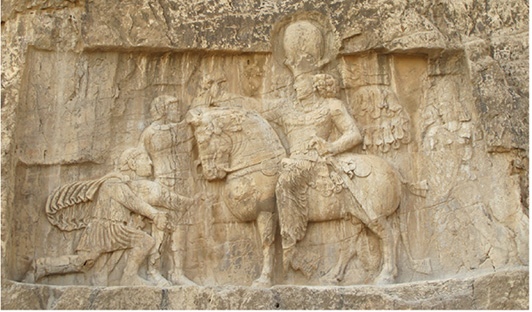
PLATE I. Relief of Šāpur I at Naqš-e Rostam. Photograph by Ali Mousavi.
The king’s discourse (as reflected in royal proclamations and the royal ideology) was disseminated through a network of discrete transmissions, which, whilst complementary to each other, were addressing diverging recipients, whose intellectual predispositions they espoused. In the early empire, the inscriptions of Šāpur I on the Kaʿba-ye Zardošt (q.v.) at Naqš-e Rostam and Narseh at Paikuli had radically divergent recipients as their primary, silent “interlocutors”: the Roman world in the first instance, and the Persian and Parthian ethno-class/“Persian people in arms” (pārs ud pahlaw/pārsān kār), in the second (Shayegan, 2020).
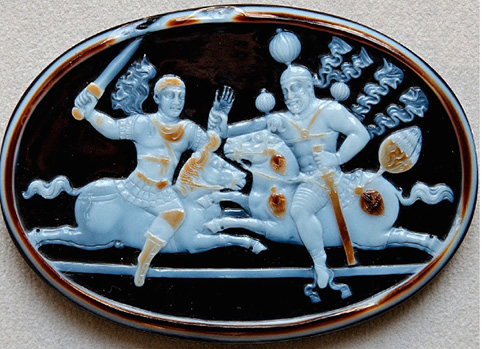
PLATE II. Cameo depicting Šāpur’s triumph over the Roman Caesar Valerian. 6.8 x 10.3 x 0.9 cm. © Paris, Bibliothèque Nationale de France, département des Monnaies, médailles et antiques, inv. no. Camée 360.
The narrative of Šāpur I’s inscription provided a mere backbone of historical context for the three victorious campaigns of the king against the defeated Roman Caesars Gordianus, Philip the Arab, and Valerian, with the latter having to suffer the humiliating fate of being made captive by the Sasanians. Although the themes of Šāpur I’s victories were thrust upon the population of the Iranian heartland through a profusion of reliefs, mainly in Persis (southwestern Iran), that were a vivid reminder of the king’s nimbus of invincibility (PLATE I), an array of “mobile documents,” such as Šāpur’s Cameo (PLATE II) and Medallion (Figure 3) were bound to disseminate further the content of the royal narrative(s) within the empire, or the enemy’s realm (Shayegan, 2020, pp. 144-49). By adopting Roman aesthetics and motifs (such as the Roman clementia) in the iconographical compositions of the Šāpur Cameo and Medallion, the Persian king permitted a Roman audience more intuitively and immediately to grasp Šāpur’s message of triumph (for the gesture of clementia on Šāpur’s Medallion: Luschey, p. 34; von Gall, p. 104; Schneider, 1986, pp. 22-26; 29-50; Alram, Blet-Lemarquand, and Skjærvø, p. 16).
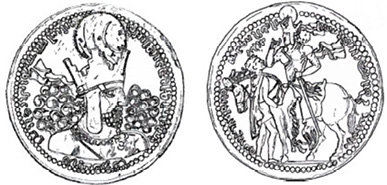
Figure 3. Medallion of Šāpur I receiving homage from Philip the Arab executing a genuflexion. Alram, Blet-Lemarquand, and Skjærvø, 2007, 19, no. 19.
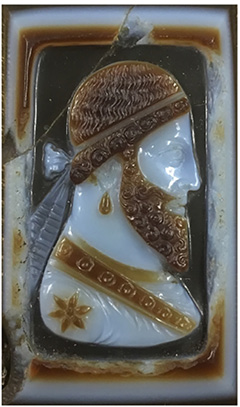
PLATE III. The “Collot Cameo” depicting an early Sasanian king, perhaps King Narseh? Private collection.
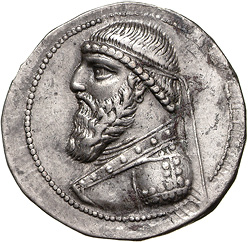
PLATE IV. The obverse of Mithradates II’s silver tetradrachm. Type: S(ellwood) 24.2/SNP (Sylloge Nummorum Parthicorum) 2, 58 – Type Ib/1b.δ Staatliche Museen zu Berlin, Münzkabinett nr. 18203098. Photograph by Dirk Sonnenwald, licensed under CC BY-NC-SA 4.0.
In the case of the Šāpur Medallion, the Sasanians, while maintaining the overall conceptual frame of the Roman clementia motif, had merely inversed the usual roles of lord and supplicant by casting the Roman Caesar as the recipient and Šāpur as the bestower of clementia (Schneider, 2006, p. 243; Alram, Blet-Lemarquand, and Skjærvø, p. 16). The appropriation of this theme, which complemented the more pronouncedly Persian motif of Šāpur’s Cameo, bespoke the Sasanian desire to individualize their ideological messages to befit the perceived intellectual dispositions of their target audiences. At the antipodes of Šāpur’s res gestae stands the inscription of Narseh at Paikuli, whose narrative is the tale of a coup-d’état, that is, the seizure of power by a younger son of King Šāpur I, namely, Narseh, king of Armenia (Arminān šāh) supported by a faction of the Iranian aristocracy. Narseh’s audience was the domestic constituency, to which Narseh time and again refers as pārs ud pahlaw kē-n xānag bandag … *ā̆nānd, “Persians and Parthians, who were … subjects in our household,” and which reflected the exalted status of Sasanian Parthian houses, who were placed, above all other ethnicities, on an equal footing with the dominant Persian ethno-class. The king’s narrative at Paikuli was complemented by the iconography of the newly re-discovered “Collot Cameo” (PLATE III), wherein one may possibly discern Narseh’s portrait with features that evoke similarities with the effigy of the Arsacid king Mithradates II on coinage (PLATE IV), and the Hyacinth of (the Duke of) Gotha (PLATE V) that also emulates Arsacid models, but assuredly belongs to the Sasanian era (Alram and Gyselen, p. 287; Seyrig and Curiel, pp. 55-59; Gignoux, p. 30, no. 3.32; and pl. vii, no. 3.32; Gyselen, 1993, pp. 45, 56, 104, 20.J.1 and pl. 16, 20.J.1; Gyselen, 2007, p. 74). These archaizing, “Parthianizing” tendencies in the depiction of Narseh on the “Collot Cameo” were an artifice to dialogue with the Parthian element among the imperial aristocracy, to whom Narseh owed his throne; once more, we observe the tailoring of the iconographic motifs in royal mobile objects to befit the cultural specificity of the intended audience.
Another cameo, long fallen into desuetude, the “Cameo of Bahrām II” (PLATE VI) much like the Šāpur Cameo and the “Collot Cameo,” was intended for a specific audience, likely the Kušāns (KUSHAN DYNASTY) in the East (Shayegan, 2020-21). The iconographic composition of the “Cameo of Bahrām II,” depicts a Sasanian king accompanying the sacred bull Nandī (whose tail, rear, and rump we still can clearly discern), a motif known to us from Kušān and Kušāno-Sasanian coinage (Jongeward, Cribb, and Donovan, pp. 210-11, no. 2211; and pl. 57, no. 2211). The adoption of the Nandī Bull by Bahrām II on his cameo was of symbolic significance, aiming to convey the (re)imposition of Sasanian royal authority in the East that had been seriously shaken by the rebellion of his brother, Hormozd Kušānšāh (q.v.), on whose coinage the Nandī Bull was also well attested (PLATE VII). Bahrām II’s deployment of the cameo for propagandistic purposes was geared toward the Kušān and cosmopolitan élites of the borderlands, by co-opting the iconography of the Nandī Bull and, as such, it represented a pendant to the Šāpur Cameo, not only on account of the technical properties that links them—which may suggest a shared provenance, possibly the selfsame royal ateliers—but also in the purpose they fulfilled as portable objects destined to impress the royal message upon cosmopolitan enemies, or Iranicate élites on the borderland. In sum, in Sasanian Iran, the king’s relation with its virtual “audiences” was highly individualized and sought to negotiate the recipients’ frame of mind, in an effort to ensure the receptivity of the royal discourse.
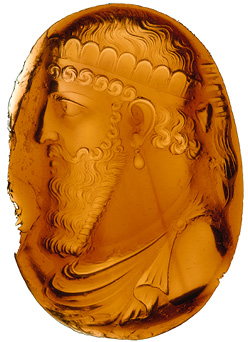
PLATE V. The Hyacinth of (the Duke of) Gotha depicting possibly King Narseh. © Paris, Bibliothèque Nationale de France, département des Monnaies, médailles et antiques, ACQ 1970.392.

PLATE VI. Extant fragment of the cameo representing Bahrām II and the Nandī Bull. 4.4 x 3 cm. Originally attributed to Ardašir I, son of Pābag. © Paris, Bibliothèque Nationale de France, département des Monnaies, médailles et antiques, inv. no. Camée 359.
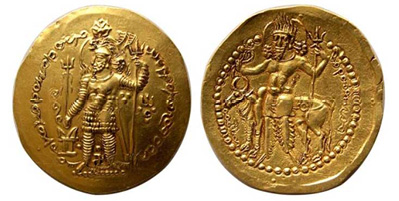
PLATE VII. Gold coin of the wazurg Kušān šāh ‘great king of Kūšān’ Ōhrmazd 1. The obverse represents Oηþο in the company of the Nandī Bull. Image licensed under CC BY-3.0 Unported; https://commons.wikimedia.org/wiki/ (File:Hormizd_I_Kushanshah_circa_AD_285-300.jpg; original image CNG Coins).
Bibliography
- D. Agostini and S. Thrope, The Bundahišn: The Zoroastrian Book of Creation, New York, 2020.
- M. Alram and R. Gyselen, Sylloge Nummorum Sasanidarum: Paris – Berlin – Wien II: Ohrmazd I. – Ohrmazd II, Denkschriften der Wiener Akademie der Wissenschaften, philosophisch-historische Klasse 422 / Veröffentlichungen der numismatischen Kommission 53, Vienna, 2012.
- M. Alram, M. Blet-Lemarquand, and P. O. Skjærvø, “Shapur, King of Kings of Iranians and Non-Iranians,” in R. Gyselen, ed., Des Indo-Grecs aux Sassanides: Données pour l’histoire et la géographie historique, Res Orientales 17, Bures-sur-Yvette, 2007, pp. 11-40.
- C. Bakhos and M. R. Shayegan, eds., The Talmud in Its Iranian Context, Texte und Studien zum antiken Judentum 135, Tübingen, 2010.
- J. BeDuhn, “Mani and the Crystallization of the Concept of ‘Religion’ in Third Century Iran,” in I. Gardner, J. BeDuhn, and P. Dilley, eds., Mani at the Court of the Persian Kings: Studies on the Chester Beatty Kephalaia Codex, Nag Hammadi and Manichaean Studies 87, Leiden, 2015, pp. 247-75.
- R. C. Blockley, “The Romano-Persian Peace Treaties of A.D. 299 and 363,” Florilegium 6, 1984, pp. 28-49.
- Idem, East Roman Foreign Policy: Formation and Conduct from Diocletian to Anastasius, ARCA: Classical and Medieval Texts, Papers, and Monographs 30, Leeds, 1992.
- F. de Blois, “A New Look at Mazdak,” in T. Bernheimer and A. Silverstein, eds., Late Antiquity: Eastern Perspectives, Cambridge, U.K., 2012, pp. 13-24.
- Idem, “Mazdak the Ancient and Mazdak the Last: Further Remarks on the History and Religious Typology of Mazdakism,” in C. Jullien, ed., Husraw Ier: Reconstructions d’un règne: Sources et documents, Studia Iranica Cahier 53, Paris, 2015, pp. 141-53.
- H. Börm, Prokop und die Perser: Untersuchungen zu den römisch-sasanidischen Kontakten in der ausgehenden Spätantike, Oriens et occidens 16, Stuttgart, 2007.
- Idem, “Das Königtum der Sasaniden – Strukturen und Probleme: Bemerkungen aus althistorischer sicht,” Klio 90/2, 2008, pp. 423-43.
- M. Canepa, “Sasanian Rock Reliefs,” in D. T. Potts, ed., The Oxford Handbook of Ancient Iran, Oxford, 2013, pp. 856-77.
- C. G. Cereti and G. Terribili, “The Middle Persian and Parthian Inscriptions on the Paikuli Tower: New Blocks and Preliminary Studies,” Iranica Antiqua 49, 2014, pp. 347-412.
- P. Crone, “Kavād’s Heresy and Mazdak’s Revolt,” Iran: Journal of the British Institute of Persian Studies 29/1, 1991, pp. 21-42.
- V. Sarkhosh Curtis, A. Magub, E. J. Pendleton, and E. C. D. Hopkins. Sylloge Nummorum Parthicorum II: Mithradates II, Österreichische Akademie der Wissenschaften, phil-hist. Klasse, Denkschriften, Band 520–Veröffentlichungen zur Numismatik, Band 63, Vienna, 2020.
- T. Daryaee, “The Construction of the Past in Late Antique Persia,” Historia: Zeitschrift für Alte Geschichte 55/4, 2006a, pp. 493-503.
- Idem, “Sasanians and Their Ancestors,” in A. Panaino and A. and A. Piras, eds., Proceedings of the 5th Conference of the Societas Iranologica Europæa Held in Ravenna, 6-11 October 2003 I: Ancient and Middle Iranian Studies, Milan, 2006b, pp. 387-93.
- Idem, “The Sasanian Empire (224–651 CE),” in T. Daryaee, ed., The Oxford Handbook of Iranian History, Oxford, 2012, pp. 187-207.
- P. Dilley, “Hell Exists, and We Have Seen the Place Where It Is: Rapture and Religious Competition in Sasanian Iran,” in I. Gardner, J. BeDuhn, and P. Dilley, eds., Mani at the Court of the Persian Kings: Studies on the Chester Beatty Kephalaia Codex, Nag Hammadi and Manichaean Studies, 87, Leiden, 2015, pp. 211-46.
- Y. Elman, “Marriage and Marital Property in Rabbinic and Sasanian Law,” in C. Hezser, ed., Rabbinic Law in Its Roman and Near Eastern Context, Texte und Studien zum antiken Judentum 97, Tübingen, 2003, pp. 227-76.
- D. Frendo, “Dangerous Ideas: Julian’s Persian Campaign, Its Historical Background, Motivation, and Objectives,” Bulletin of the Asia Institute NS 21, 2007 [2012], pp. 79-96.
- H. von Gall, Das Reiterkampfbild in der iranischen und iranisch beeinflußten Kunst parthischer und sasanidischer Zeit, Teheraner Forschungen Band 6, Berlin, 1990.
- A. Gariboldi, Il regno di Xusraw dall’anima immortale: Riforme econimiche e rivolte sociali nell’Iran sasanide del VI secolo, Milan, 2006.
- H. Gaube, “Mazdak: Historical Reality or Invention,” Studia Iranica 11, 1982, pp. 111-22.
- Ph. Gignoux, Catalogue des sceaux, camées et bulles sasanides de la Bilbliothèque Nationale et du Musée du Louvre II: Les sceaux et bulles inscrits, Paris, 1978.
- G. Gnoli, “Nuovi studi sul Mazdakismo,” in G. Gnoli and A. Panaino, eds., Convegno internazionale La Persia e Bisanzio (Roma, 14-18 ottobre 2002), Atti dei Convegni Lincei 201, Rome, 2004, pp. 439-56.
- G. Greatrex, “Two Fifth-Century Wars Between Rome and Persia,” Florilegium 12/1, 1993, pp. 1-14.
- Idem, “Roman Frontiers and Roman Foreign Policy in the East,” in R. Alston and S.N.C. Lieu, eds., Aspects of the Roman East: Papers in Honour of Professor Fergus Millar, Turnhout, 2007, pp. 103-73.
- R. Gyselen, Catalogue des sceaux, camées et bulles sassanides de la Bibliothèque Nationale et du Musée du Louvre I: Collection générale, Paris, 1993.
- Idem, “Vahrām III (293) and the Rock Relief of Naqsh-i Rustam II: A Contribution to the Iconography of Sasanian Crown Princes in the Third Century,” in C. Altman Bromberg, N. Sims-Williams, and U. Sims-Williams, eds., Iranian and Zoroastrian Studies in Honor of Prods Oktor Skjærvø, Bulletin of the Asia Institute NS 19, 2005 [2009], pp. 29-36.
- Idem, “Shapur, fils d’Ohrmazd, petit-fils de Narseh,” in R. Gyselen, ed., Des Indo-Grecs aux Sassanides: Données pour l’histoire et la géographie historique, Res Orientales 17, Bures-sur-Yvette, 2007, pp. 73-80.
- G. Herman, A Prince without a Kingdom: The Exilarch in the Sasanian Era, Tübingen, 2012. G. Herrmann, “The Dārābgird Relief—Ardashīr or Shāhpūr?” Iran 7/1, 1969, pp. 63-88.
- G. Herrmann and R. Howell, The Sasanian Rock Reliefs at Bishapur II: Bishapur IV, Bahram II Receiving a Delegation. Bishapur V, Investiture of Bahram I. Bishapur VI, The Enthroned King, Iranische Denkmäler, Reihe II: Iranische Felsreliefs, Lieferung 10, F., Berlin, 1981.
- G. Herrmann, D. N. MacKenzie, and R. Howell, The Sasanian Rock Reliefs at Bishapur III: Bishapur I, The Investiture/Triumph of Shapur I. Bishapur II, Triumph of Shapur I and Sarab-i Bahram, Bahram II Enthroned. Rock Relief at Tang-i Qandil, Iranische Denkmäler, Reihe II: Iranische Felsreliefs, Lieferung 11, G., Berlin, 1983.
- J. D. Howard-Johnston, East Rome, Sasanian Persia and the End of Antiquity: Historiographical and Historical Studies, Aldershot, Hampshire, U.K. and Burlington, Vt., 2006.
- Idem, Witnesses to a World Crisis: Historians and Histories of the Middle East in the Seventh Century, Oxford, 2010.
- Idem, “The Late Sasanian Army,” in T. Bernheimer and A. Silverstein, eds., Late Antiquity: Eastern Perspectives, Cambridge, U.K., 2012, pp. 87-127.
- Idem, “Heraclius’ Persian Campaigns and the Revival of the East Roman Empire, 622–630,” in A. Cameron, ed., Late Antiquity on the Eve of Islam, The Formation of the Classical Islamic World 1, Burlington, 2013, pp. 341-84.
- Idem, Last Great War of Antiquity, Oxford, 2021. H. Humbach and P. O. Skjærvø, The Sassanian Inscription of Paikuli, Part 1: Supplement to Herzfeld’s Paikuli; Part 2: Synoptic Tables; Part 3.1: Restored Text and Translation: Part 3.2: Commentary, 3 vols. in 4, Wiesbaden and Tehran, 1978-83.
- Ph. Huyse, “Die sasanidische Königstitulatur: Eine Gegenüberstellung der Quellen,” in J. Wiesehöfer and Ph. Huyse, eds., Ērān ud Anērān: Studien zu den Beziehungen zwischen dem Sasanidenreich und der Mittelmeerwelt: Beiträge des Internationalen Colloquiums in Eutin, 8.-9. Juni 2000, Stuttgart, 2006, pp. 181-201.
- Idem, “Die königliche Erbfolge bei den Sasaniden,” in Ph. Gignoux, C. Jullien, and F. Jullien, eds., Trésors d’Orient: Mélanges offerts à Rika Gyselen, Studia Iranica Cahier 42, Paris, 2009, pp.145-57.
- D. Jongeward, J. Cribb, and P. Donovan, Kushan, Kushano-Sasanian, and Kidarite Coins: A Catalogue of Coins from the American Numismatic Society, New York, 2015.
- C. Jullien and F. Jullien, Apôtres des confins: Processus missionnaires chrétiens dans l’Empire Iranien, Res Orientales 15, Bures-sur-Yvette, 2002.
- H. Luschey, “Iran und der Westen von Kyros bis Khosrow,” Archäologische Mitteilungen aus Iran 1, 1968, pp. 15-37.
- A. Luther, Die syrische Chronik des Joshua Stylites, Untersuchungen zur antiken Literatur und Geschichte 49, Berlin and New York, 1997.
- M. Macuch, “Legal Implications of Mazdakite Teaching According to the Dēnkard,” in C. Jullien, ed., Husraw Ier: Reconstructions d’un règne: Sources et documents, Studia Iranica Cahier 53, Paris, 2015, pp. 155-74.
- K. Mosig-Walburg, Römer und Perser: Vom 3. Jahrhundert bis zum Jahr 363 n. Chr., Gutenberg, 2009.
- T. Nöldeke, Geschichte der Perser und Araber zur Zeit der Sasaniden: Aus der arabischen Chronik des Tabari übersetzt und mit ausführlichen Erläuterungen und Ergänzungen versehn, Leiden, 1879.
- F. Pakzad, Bundahišn: Zoroastrische Kosmogonie und Kosmologie I: Kritische Edition, Ancient Iranian Studies Series 2, Tehran, 2005.
- Z. Rubin, “The Sasanid Monrachy,” in A. Cameron, B. Ward-Perkins, and M. Whitby, eds., The Cambridge Ancient History XIV, Cambridge, 2001, pp. 638-61.
- E. W. Sauer et al., Persia’s Imperial Power in Late Antiquity: The Great Wall of Gorgan and the Frontier Landscapes of Sasanian Iran, The British Institute of Persian Studies Archaeological Monographs 2, Oxford, U.K. and Oakville, Conn., 2013.
- E. W. Sauer et al., Dariali: The ‘Caspian Gates’ in the Caucasus from Antiquity to the Age of the Huns and the Middle Ages: The Joint Georgian-British Dariali Gorge Excavations and Surveys, 2013-2016, The British Institute of Persian Studies Archaeological Monographs 5, Oxford, 2019.
- R. M. Schneider, Bunte Barbaren: Orientalstatuen aus farbigem Marmor in der römischen Repräsentationskunst, Worms, 1986.
- Idem, “Orientalism in Late Antiquity? The Oriental in Imperial and Christian Imagery,” in J. Wiesehöfer and Ph. Huyse, eds., Ērān ud Anērān: Studien zu den Beziehungen zwischen dem Sasanidenreich und der Mittelmeerwelt: Beiträge des Internationalen Colloquiums in Eutin, 8.-9. Juni 2000, Stuttgart, 2006, pp. 241-78.
- S. Secunda, The Iranian Talmud: Reading the Bavli in Its Sasanian Context, Philadelphia, 2013.
- H. Seyrig and R. Curiel, “Une intaille iranienne,” in D. K. Kouymjian, ed., Near Eastern Numismatics, Iconography, Epigraphy and History: Studies in Honor of Georges C. Miles, Beirut, 1974, pp. 55-59.
- I. Shahîd, “The Last Sasanid-Byzantine Conflict in the Seventh Century: The Causes of its Outbreak,” in G. Gnoli and A. Panaino, eds., Convegno internazionale La Persia e Bisanzio (Roma, 14-18 ottobre 2002), Atti dei Convegni Lincei 201, Rome, 2004, pp. 223-44.
- M. R. Shayegan, “Approaches to the Study of Sasanian History,” in S. Adhami, ed., Paitimāna: Essays in Iranian, Indo-European, and Indian Studies in Honor of Hanns-Peter Schmidt, 2 vols., Costa Mesa, Calif., 2003, pp. 363-84.
- Idem, “On the Rationale behind the Roman Wars of Šābuhr II the Great,” Bulletin of the Asia Institute NS 18, 2004 [2008], pp. 111-33.
- Idem, “Bardiya and Gaumāta: An Achaemenid Enigma Reconsidered,” Bulletin of the Asia Institute NS 20, 2006 [2010], pp. 65-76.
- Idem, Arsacids and Sasanians: Political Ideology in Post-Hellenistic and Late Antique Persia, Cambridge, 2011.
- Idem, Aspects of History and Epic in Ancient Iran: From Gaumāta to Wahnām, Washington, D.C., 2012.
- Idem, “Sasanian Political Ideology,” in D. T. Potts, ed., The Oxford Handbook of Ancient Iran, Oxford, 2013, pp. 805-13.
- Idem, “Le Roi et son interlocuteur: Remarques sur les stratégies discursives des inscriptions royales Achéménides et Sassanides,” in R. Gyselen, ed., Persia (552 BCE-758 CE): Primary Sources, Old and New, Res Orientales 28, Bures-sur-Yvette, 2020, pp. 137-67.
- Idem, “The Cameo of Warahrān II and the Kušano-Sasanians,” Bulletin of the Asia Institute NS 30, 2020-21, pp. 1-20.
- N. Sims-Williams, Bactrian Documents from Northern Afghanistan I: Legal and Economic Documents, Studies in the Khalili Collection 3 / Corpus Inscriptionum Iranicarum Part II: Inscriptions of the Seleucid and Parthian Periods and of Eastern Iran and Central Asia 6/1, London and New York, 2000.
- Idem, Bactrian Documents from Northern Afghanistan II: Letters and Buddhist Texts, Studies in the Khalili Collection 3 / Corpus Inscriptionum Iranicarum Part II: Inscriptions of the Seleucid and Parthian Periods and of Eastern Iran and Central Asia 6/2, London and New York, 2007.
- Idem, “The Bactrian Inscription of Rabatak: A New Reading,” Bulletin of the Asia Institute NS 18, 2004 [2008], pp. 53-68. N. Sims-Williams and J. Cribb, “A New Bactrian Inscription of Kanishka the Great,” Silk Road Art and Archaeology 4, 1995-96, pp. 77-142.
- W. Sundermann, “Kē čihr az yazdān: Zur Titulaatur der Sasanidenkönige,” Archív Orientální 56, 1988, pp. 338-40.
- K. Tanabe, “The Lions at Sar Mašhad and the Lion-Hunt of Bahram II: An Additional Note to Leo Trümpelmann’s Monograph,” Al-Rāfidān 11, 1990, pp. 29-43.
- L. Trümpelmann, Das Sasanidische Felsrelief von Sar Mašhad, Iranische Denkmäler, Reihe II: Iranische Felsreliefs, Lieferung 5, A., Berlin, 1975.
- L. Vanden Berghe, Reliefs rupestres de l’Iran Ancien: Bruxelles, Musées royaux d’art et d’histoire, 26 octobre 1983-29 janvier 1984, Brussels, 1983.
- K. Vondrovec, Coinage of the Iranian Huns and Their Successors from Bactria to Gandhara (4th to 8th century CE), Denkschriften der Wiener Akademie der Wissenschaften, philosophisch-historische Klasse 471 / Veröffentlichungen der Numismatischen Kommission 59/1-2, 2 vols.,Vienna, 2014.
- U. Weber, “Wahrām III., König der Könige von Ērān und Anērān,” Iranica Antiqua 45, 2010a, pp. 353-94.
- Idem, “Zu den Feldbildernissen des Königs Narseh,” in R. Gyselen, ed., Sources for the History of Sasanian and Post-Sasanian Iran, Res Orientales 19, Bures-sur-Yvette, 2010b, pp. 305-19.
- U. Weber and J. Wiesehöfer, “König Narsehs Herrschaftsverständnis,” in H. Börm and J. Wiesehöfer, eds., Commutatio et Contentio: Studies in the Late Roman, Sasanian, and Early Islamic Near East in Memory of Zeev Rubin, Düsseldorf, 2010, p. 89-132.
- M. Whitby, The Emperor Maurice and His Historian: Theophylact Simocatta on Persian and Balkan Warfare, Oxford Historical Monographs, Oxford, 1988.
- Idem, “The Successors of Justinian,” in A. Cameron, B. Ward-Perkins, and M. Whitby, eds., The Cambridge Ancient History XIV, Cambridge, 2001, pp. 86-111.
- J. Wiesehöfer, Iraniens, Grecs et Romains, Paris, 2005a.
- Idem, “Rūm as Enemy of Iran,” in E. S. Gruen, ed., Cultural Borrowings and Ethnic Appropriations in Antiquity, Oriens et Occidens 8, Stuttgart, 2005b, pp. 105-20.
- Idem, “Kawad, Khusro I and the Mazdakites: A New Proposal,” in Ph. Gignoux, C. Jullien, and F. Jullien, eds., Trésors d’Orient: Mélanges offerts à Rika Gyselen, Studia Iranica Cahier 42, Paris, 2009, pp. 391-409.
- Idem, “King and Kingship in the Sasanian Empire,” in G. B. Lanfranchi and R. Rollinger, eds., Concepts of Kingship in Antiquity: Proceedings of the European Science Foundation Exploratory Workshop Held in Padova, November 28th–December 1st, 2007, History of the Ancient Near East Monographs 11, Padova, 2010, pp. 135-52.
- Idem, “Images of the Good Ruler in Sasanian Iran: An Emic View,” in Ph. M. Forness, A. Hasse-Ungeheuer, and H. Leppin, eds., The Good Christian Ruler in the First Millennium: Views from the Wider Mediterranean World in Conversation, Berlin and Boston, 2021, pp. 171-80.